Market Watch: U.S. Consumer Brands Find Faster Growth Overseas as Americans Pull Back on Spending
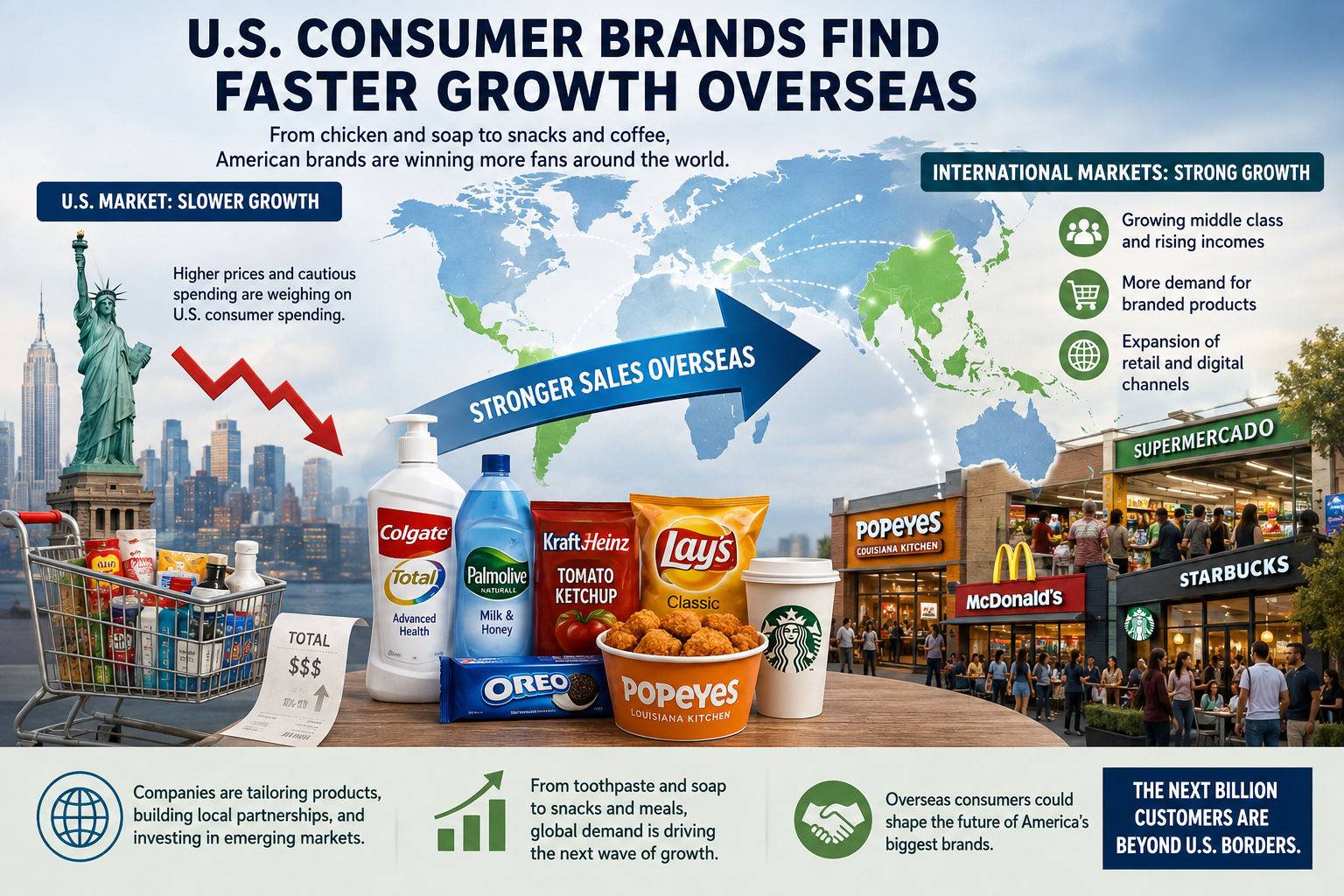
Monday August 10, 2026 – American consumer brands are increasingly looking beyond the United States for growth as shoppers at home become more selective about where they spend their money.
Recent corporate earnings and industry data point to a widening gap between some U.S. consumer markets and faster-growing international economies. Products ranging from soap and toothpaste to packaged foods, chicken and restaurant meals are finding enthusiastic customers abroad, giving multinational companies another source of growth when their domestic businesses slow.
The shift is particularly noticeable in emerging markets, including parts of Latin America and Asia, where expanding middle-class populations, improving distribution networks and growing demand for branded consumer products are creating opportunities for American companies.
International Markets Become a Bigger Growth Engine
The contrast is particularly striking at Colgate-Palmolive.
The consumer-products company reported that second-quarter 2026 net sales increased 4.9% globally and organic sales rose 2.4%. But the geographic breakdown showed dramatically different conditions.
Colgate's North American net sales declined 3%, with organic volume falling 3.9%. Latin America moved in the opposite direction: net sales jumped 13.7%, while organic sales increased 5.3% and organic volume rose 2.6%.
Latin America now accounts for roughly 26% of Colgate's company sales, making the region an increasingly important part of the company's global business.
The numbers illustrate why multinational consumer companies continue investing in emerging economies. Mature U.S. markets already have high household penetration for products such as toothpaste, detergent and personal-care products. In developing economies, companies can still expand distribution, introduce premium products and reach millions of consumers entering higher income brackets.
American Consumers Are Becoming More Value Conscious
The overseas momentum comes as U.S. households remain careful about spending.
Years of higher prices have changed purchasing behavior. Consumers are comparing prices more closely, looking for promotions and, in some categories, switching to cheaper alternatives or private-label products.
For companies that spent several years raising prices to offset inflation, generating additional domestic growth has consequently become more difficult.
The Wall Street Journal reported that several major American consumer companies are experiencing stronger momentum internationally while facing slower conditions at home. Kraft Heinz, for example, has seen notable growth in emerging markets even as its North American operations have faced pressure.
That does not mean American consumers have stopped spending. Instead, the market has become more competitive. Brands increasingly need to demonstrate value, introduce new products or offer promotions to convince shoppers to pay premium prices.
Restaurants See Opportunities Beyond the U.S.
The trend extends beyond packaged consumer goods.
McDonald's second-quarter 2026 results showed international operations slightly outperforming its domestic business. U.S. comparable sales increased 0.8%, compared with growth of 1.5% in International Operated Markets and 1.9% in International Developmental Licensed Markets.
Worldwide systemwide sales increased 5%, or 4% in constant currencies, to approximately $37 billion during the quarter.
For major restaurant chains, international expansion provides something increasingly difficult to obtain in the mature U.S. restaurant market: large numbers of potential new locations.
Companies can open restaurants in rapidly urbanizing cities, expand delivery operations and use digital loyalty programs to reach younger consumers.
Starbucks has similarly emphasized international expansion. In its second fiscal quarter of 2026, international comparable-store sales increased 2.6%, driven primarily by a 2.1% increase in comparable transactions. International segment revenue climbed 10% to approximately $2.1 billion.
International markets therefore represent more than an additional revenue stream. For restaurant companies approaching saturation in parts of the United States, they can provide years of potential store expansion.
Emerging Markets Offer Scale
Demographics help explain the enthusiasm.
Many emerging economies have large, relatively young populations. Rising incomes can quickly translate into higher spending on packaged foods, personal-care products, restaurants and other branded goods.
A consumer moving from a lower income level into the middle class does not simply purchase more products. That consumer may also shift from local or unbranded alternatives toward internationally recognized brands.
Companies are adapting their strategies accordingly.
Rather than simply exporting American products, multinational brands increasingly tailor package sizes, flavors, pricing and marketing to individual countries. Digital commerce is also making it easier to reach consumers without relying exclusively on traditional retail distribution.
Colgate, for instance, said its focus on omnichannel demand generation helped produce double-digit e-commerce growth in toothpaste during 2026.
Global Growth Doesn't Eliminate the Risks
International expansion nevertheless creates its own challenges.
Currency fluctuations can significantly affect reported revenue and profits. Political instability, tariffs, regulatory changes and supply-chain disruptions can also complicate operations.
Consumer preferences vary widely between countries, meaning a product successful in the United States may require significant modification before succeeding elsewhere.
Competition can also be intense. U.S. brands are not entering empty markets; they often face powerful domestic companies as well as European, Asian and other multinational competitors.
At the same time, emerging-market consumers can be particularly sensitive to inflation and currency depreciation. Economic shocks can rapidly reduce purchasing power.
Companies therefore need to balance the opportunity for faster growth against greater economic and geopolitical volatility.
U.S. Consumer Companies Are Becoming More Globally Dependent
The broader development could reshape how investors evaluate America's biggest consumer companies.
For decades, international operations were often viewed as supplementary growth businesses supporting strong U.S. franchises. Increasingly, that relationship may be reversing.
The United States remains one of the world's largest and wealthiest consumer markets, but slower population growth, intense competition and high product penetration limit expansion opportunities in many categories.
International markets provide a different equation: lower average spending per consumer in many countries, but substantially greater room to grow.
Recent corporate results underline that distinction. Colgate's Latin American business is expanding much faster than its North American operation, while McDonald's international comparable sales recently outpaced the U.S. Starbucks has also reported rising international traffic and revenue.
Even Procter & Gamble's latest results highlight the difficult environment confronting the broader consumer-products industry. P&G reported fiscal 2026 net sales growth of 3%, but organic sales increased only 1%, while volume and mix were unchanged for the year.
Overseas Consumers Could Shape the Next Era of American Brands
The emerging pattern does not signal the end of the American consumer's importance. The U.S. remains enormously profitable for many global brands and will continue to command substantial investment.
But the geographic balance of growth is shifting.
As American households scrutinize prices and mature consumer categories become harder to expand, multinational companies are increasingly depending on consumers in Mexico, Brazil, India, China and other international markets to deliver incremental growth.
That could influence everything from new product development and advertising budgets to factory investment and restaurant expansion.
For America's biggest consumer brands, the next billion customers are increasingly likely to be found outside the United States.
The strongest fresh supporting data I found include Colgate's July 31 results showing North American sales down 3% versus Latin America up 13.7%, (Colgate-Palmolive Company) McDonald's August 4 results showing U.S. comparable sales growth of 0.8% versus 1.5% and 1.9% across its two international divisions, (McDonald’s Corporation) and Starbucks' recent international results, where Q2 international revenue rose 10%. (Starbucks Investor Relations) P&G also reported fiscal-2026 organic growth of just 1%, illustrating the relatively subdued environment facing major consumer-products companies. (Procter & Gamble)
The original Wall Street Journal report provides the central reporting behind the trend.
Keywords: U.S. consumer brands, international sales growth, emerging markets, consumer spending, consumer staples, Colgate-Palmolive, McDonald’s, Starbucks, Kraft Heinz, global consumer market, overseas sales
###