Microbial Degradation in Flavor Products
Introduction
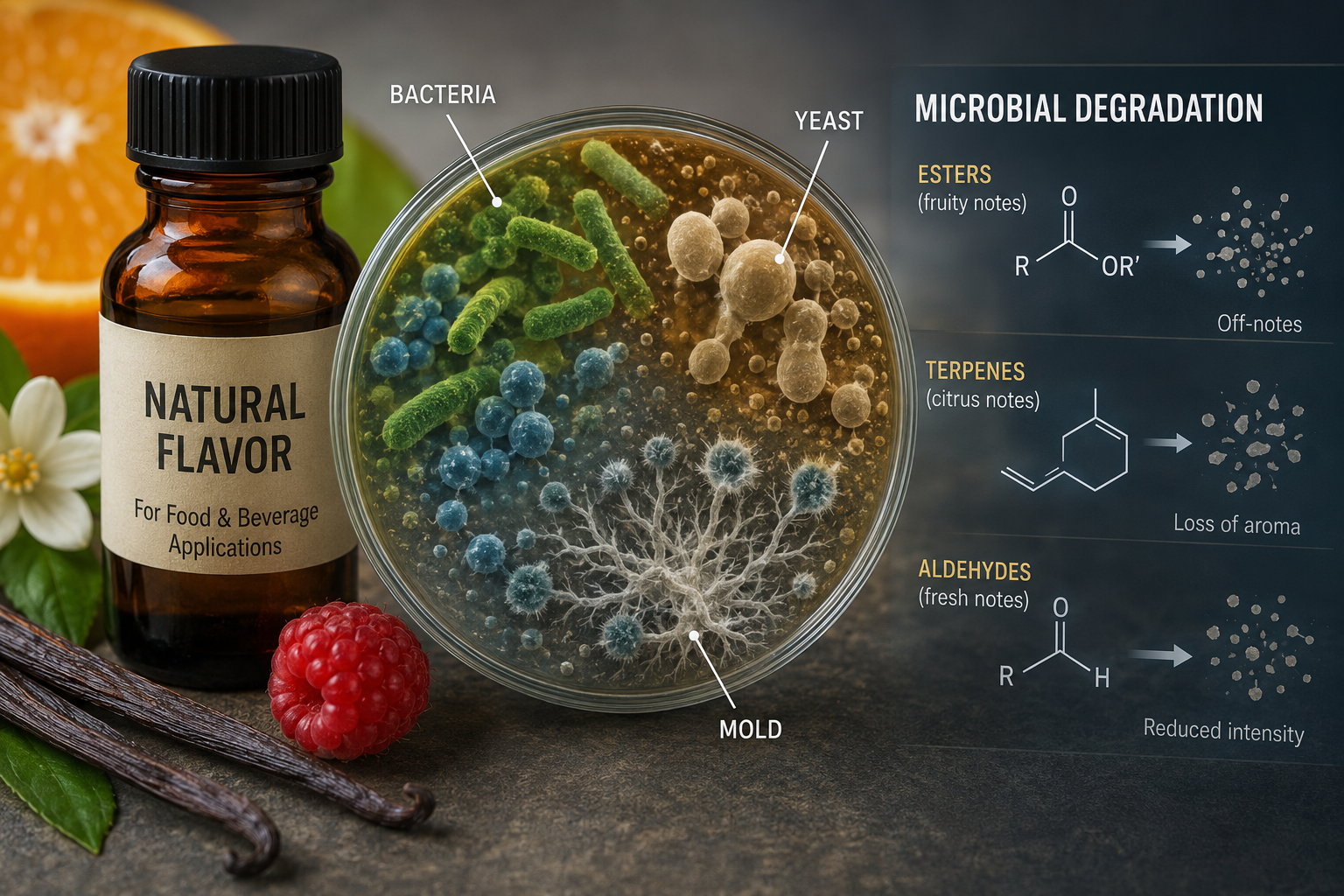
Microbial degradation is the breakdown of flavor compounds by bacteria, yeasts, and molds through enzymatic activity. Unlike oxidation or thermal degradation, it is a biological process that can occur at room temperature in closed containers, even in systems that appear chemically stable. For a flavorist, this makes it a uniquely unpredictable aging pathway — and one that demands attention at the formulation stage, not after a shelf life failure.
The three organism classes of concern are bacteria (fastest-growing; broadest enzymatic arsenal), yeasts (ferment sugars; thrive in acidic, high-sugar systems), and molds (tolerant of low water activity; produce musty off-notes via geosmin and 2-methylisoborneol).
Chemical Groups Susceptible to Microbial Attack
Microorganisms target specific functional groups in flavor molecules as carbon or energy sources. The most vulnerable classes are:
Esters are among the most widely used fruity and floral aroma compounds and among the most microbially vulnerable. Extracellular esterases and lipases secreted by Pseudomonas, Bacillus, and Aspergillus species hydrolyze the ester bond, releasing the constituent acid and alcohol. Ethyl butyrate (pineapple) yields ethanol and butyric acid (rancid). Isoamyl acetate (banana) yields isoamyl alcohol and acetic acid. The hydrolysis products are typically malodorous at very low thresholds and may themselves become further microbial substrates, causing cascading degradation.
Aldehydes are metabolically attractive to microorganisms. Aldehyde dehydrogenases oxidize them to carboxylic acids; oxidoreductases reduce them to primary alcohols. Benzaldehyde (cherry/almond) converts to benzoic acid or benzyl alcohol. Citral (lemon) degrades to terpenoid fragments. Vanillin oxidizes to vanillic acid, losing vanilla character. Diacetyl (buttery) is reduced by Lactobacillus and Leuconostoc to acetoin and then the virtually odorless 2,3-butanediol — a critical concern in dairy flavors.
Terpenes and terpenoids in citrus, herbal, and spice flavors undergo microbial hydroxylation and epoxidation. Pseudomonas putida converts limonene to limonene-1,2-epoxide and ultimately to p-cymene (turpentine-like off-note). Linalool and geraniol undergo stepwise degradation to less desirable terpenoid fragments. Deterpenation — the physical removal of hydrocarbon terpenes — is a common strategy to reduce both substrate availability and the harsh off-note risk.
Sulfur compounds are the most acutely damaging class because their odor thresholds are in the ppb or ppt range. Furfuryl mercaptan (roasted coffee) is oxidatively coupled to a disulfide by Arthrobacter species, entirely losing its coffee character. Methanethiol is converted to dimethyl disulfide or dimethyl sulfide. Even microscopic microbial conversion produces intense, undesirable aromas (putrid, fecal, rubbery).
Alcohols and carboxylic acids are also vulnerable. Ethanol — the most common flavor carrier — is oxidized to acetaldehyde and then acetic acid by Acetobacter and Gluconobacter; below ~15% v/v it supports rather than prevents growth. Medium-chain fatty acids in dairy and coconut flavors undergo beta-oxidation (two-carbon chain shortening), progressively altering the fatty note profile.
Phenolic compounds (eugenol, vanillin, guaiacol) can be degraded through the beta-ketoadipate ring-fission pathway by Pseudomonas and Rhodococcus. Notably, organisms that are resistant to thymol and carvacrol (natural antimicrobials) may ultimately metabolize them, reducing the protective effect of spice-based extracts over time.
Conditions Required for Microbial Degradation
Four parameters define whether microbial degradation can occur:
Water activity (Aw) is the master variable. Most spoilage bacteria require Aw ≥ 0.90; most molds ≥ 0.70–0.80; osmophilic yeasts (Zygosaccharomyces rouxii) can grow down to Aw 0.62. A 100% propylene glycol flavor has Aw ~0.65–0.70 and is effectively self-preserving. A water-based flavor has Aw ~1.0 and requires aggressive intervention.
pH determines which organisms are active. Most spoilage bacteria are neutrophilic (optimal pH 6.5–7.5). Acidifying to pH 3.5–4.0 suppresses bacteria, but acid-tolerant yeasts and molds remain active. Citrus and berry flavors benefit from natural acidity; dairy, savory, and herbal-type flavors at neutral pH carry the highest risk.
Temperature governs growth rate. Most spoilage organisms are mesophilic (20–40°C), meaning ambient warehouse storage presents maximum risk. Psychrotrophic organisms (Pseudomonas, Listeria) can grow at refrigeration temperatures, so cold storage alone is not a complete solution. From the flavorist's perspective, products must be designed to withstand worst-case supply chain temperatures, not laboratory conditions.
Oxygen and nutrients determine which degradation pathways dominate. Aerobic organisms concentrate at air-liquid interfaces; nitrogen flushing suppresses these. The nutritional richness of the formula matters enormously: a simple synthetic aroma in anhydrous PG offers virtually no nutrients; a natural yeast extract or hydrolyzed protein base is a growth medium.
Factors Accelerating or Inhibiting Degradation, and Formulation Considerations
Accelerating factors include high Aw (aqueous systems), neutral pH, warm storage, high oxygen headspace, ethanol below the antimicrobial threshold (<15% v/v), natural ingredient content (which introduces both nutrients and resident field microflora), high sugar levels (fermentation substrate), and protein/amino acid content (nitrogen sources for proteolytic bacteria).
Inhibiting factors and the levers available to flavorists:
Water activity reduction via propylene glycol (≥50% significantly reduces Aw), glycerol, spray drying, or encapsulation is the single most impactful control. This is why PG is the benchmark low-risk carrier.
pH reduction to below 4.0 with citric, malic, or acetic acid suppresses most bacteria. Note that sodium benzoate loses efficacy above pH 4.5, and potassium sorbate loses efficacy above pH 6.0 — common formulation errors arise when preservatives are added at pH levels where they cannot function.
Preservatives should be matched to the pH and target organism. Potassium sorbate (primarily antifungal) and sodium benzoate (primarily antibacterial) are synergistic in combination, allowing reduced individual concentrations while broadening spectrum. For neutral-pH applications (dairy, savory), parabens or ε-polylysine are more effective. For clean-label natural flavors, nisin (effective against Clostridium and Listeria) and rosemary extract (antioxidant and limited antimicrobial) are viable options.
Heat treatment — pasteurization (72°C/15 sec) eliminates vegetative cells in aqueous flavors. For spore-forming concern (dairy, savory), retort conditions are required.
Packaging choices matter: oxygen-impermeable containers, nitrogen headspace flushing, hermetic seals, and moisture-barrier packaging (critical for spray-dried powders) all contribute meaningfully to microbial stability.
The hurdle technology concept is the governing principle: no single parameter provides sufficient protection for high-risk products. Combining moderate levels of Aw reduction + pH + preservative + heat treatment + good packaging creates overlapping barriers that together prevent microbial proliferation without requiring extreme interventions. Effective hurdle strategies affect different microbial targets simultaneously — water stress (Aw) combined with membrane disruption (ethanol) and metabolic inhibition (sorbate, pH) is more potent than stacking multiple agents with the same mechanism.
A critical formulation note: natural does not mean microbiologically safe. Ground spices routinely carry total aerobic plate counts of 10⁴–10⁶ CFU/g. Natural extracts provide a rich nutrient base. Every natural raw material must carry validated microbial specifications as part of the supplier quality agreement.
Examples of Microbial Degradation in Practice
Citrus flavor: A lemon flavor in 10% ethanol/water develops a rancid, soapy off-note within 3 months. Pseudomonas fluorescens, growing in the sub-antimicrobial ethanol phase, secretes esterases that hydrolyze ethyl butyrate to butyric acid (threshold ~1 ppm). Simultaneously, limonene is oxygenated to p-cymene. Corrective action: increase ethanol to 25%, add potassium sorbate, reduce pH to 3.5, improve packaging barrier.
Dairy/butter flavor: A butter flavor at pH 6.5 and Aw 0.96 shifts from fresh butter to sour/rancid within 8 weeks. Pseudomonas hydrolyzes delta-decalactone; Lactococcus reduces diacetyl to the odorless 2,3-butanediol; Clostridium ferments butyric acid, generating CO₂ and causing container swelling. Corrective action: acidify to pH 4.0–4.5, combine sorbate + benzoate, add nisin, pasteurize before filling.
High-sugar fruit preparation: A 60° Brix strawberry syrup at pH 3.6 bulges in packaging after 6 weeks at 28°C. Zygosaccharomyces rouxii, an osmophilic yeast capable of growth at Aw as low as 0.62, ferments fructose to ethanol and CO₂, adding yeasty/acetate off-notes. Corrective action: potassium sorbate at 0.15%, cold storage below 15°C.
Spray-dried orange powder: Mold colonization (Penicillium expansum) on a spray-dried powder (Aw 0.35) occurs after moisture ingress through damaged bag seams raises local Aw above 0.70. The result is a persistent musty off-note from geosmin (threshold: 0.004 ppb in water) contaminating the entire batch. Corrective action: aluminum foil laminate barrier bags, silica gel desiccant, climate-controlled storage, Aw monitoring at production.
Impact on Flavor Aging and Shelf Life
Microbial degradation follows microbial growth kinetics. During the lag phase, no perceptible change occurs. As organisms enter exponential growth, subtle top-note loss and early off-note emergence become detectable by trained panel. The active degradation phase produces clear consumer-detectable failure: rancid, sour, musty, or yeasty off-character alongside measurable loss of key aroma compounds. Advanced spoilage may include gas production, container swelling, turbidity, and irreversible profile destruction.
Unlike oxidative or thermal degradation, microbial aging can be detected analytically before sensory failure — making routine monitoring valuable. Key markers include: pH drop (>0.5 units), increase in free short-chain fatty acids (GC-FID), loss of ester concentration (GC-MS), diacetyl-to-acetoin conversion (dairy flavors), increase in turbidity (NTU), and rising total plate counts (TPC) or yeast and mold counts. A structured shelf life program tracks these at T=0, 1, 3, 6, and 12 months alongside sensory evaluation, with pre-agreed failure criteria defined before testing begins.
Accelerated shelf life testing (elevated temperature) has important limitations for microbial stability: microbial growth kinetics do not follow Arrhenius behavior. At 40–45°C, many spoilage organisms are inhibited rather than accelerated, meaning ASLT cannot reliably substitute for real-time microbial stability data. Real-time and accelerated studies must always run in parallel.
Summary: Principles for the Working Flavorist
- Know your Aw before you finalize any formulation. It is the single most powerful control parameter.
- Apply hurdle technology — stack Aw reduction, pH, preservative, heat treatment, and packaging as complementary controls.
- Match preservatives to pH — sorbate and benzoate are inactive above their effective pH ranges; choose accordingly.
- Treat natural ingredients as high-risk materials — specify and test incoming bioburden on every natural raw material.
- Recognize your highest-risk flavor types: dairy, savory/HVP-based, fruit preparations in aqueous systems, and natural botanical extracts in water.
- Communicate storage and use conditions to customers — dilution, open-container time, and storage temperature at the customer site all affect the microbial stability of the finished flavor system.
- Build shelf life testing into development timelines, not as an afterthought, and include both microbiological and chemical markers alongside sensory evaluation.
###