North America Food & Flavor Industry: Law & Regulatory News June 7–17, 2026 — Manufacturer Guidelines & Advisory Summary
FDA Food Traceability Rule, Food Traceability List (FTL), Phthalates, Food Contact Materials, Food Additives, Color Additives, Synthetic Dye Phase-Out, Natural Colorants, GRAS Reform, Front-of-Package Labeling.
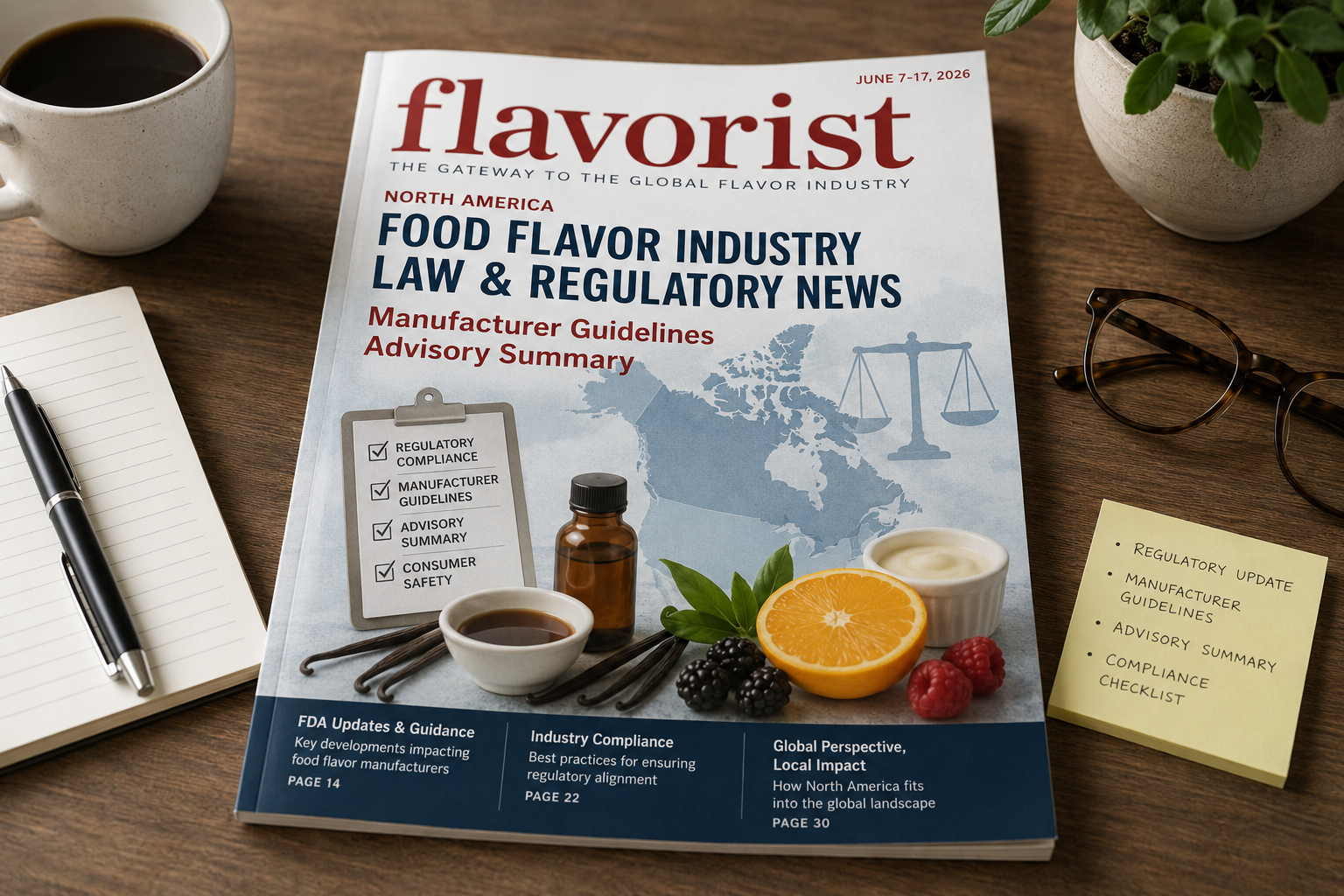
Summary Table of Action Items for Food & Flavor Manufacturers
| # | Topic | Action Needed | Deadline |
|---|---|---|---|
| 1 | Food Traceability Rule – Lot Level Flexibilities | Submit comments to FDA Docket FDA-2014-N-0053 | July 15, 2026 |
| 2 | Phthalates in Food Contact Materials | Submit data/comments to FDA Docket FDA-2026-N-5776 | June 26, 2026 |
| 3 | Food Additive Solvent Removal Petition | Submit comments on practical impact to FDA-2023-F-5684 | June 29, 2026 |
| 4 | Color Additive Solvent Removal Petition | Submit comments on practical impact to FDA-2023-C-5679 | June 29, 2026 |
| 5 | BHT / ADA Post-Market Reassessment | Submit safety/use data to FDA | July 13, 2026 |
| 6 | Synthetic Dye Phase-Out | Begin reformulation; identify natural alternatives | End of 2027 |
| 7 | "No Artificial Colors" Labeling | Update label claims if using natural colorants only | Immediate |
| 8 | GRAS Reform Proposed Rule | Audit self-affirmed GRAS ingredients; prepare dossiers | Forthcoming |
| 9 | Canada FOP Labeling | Confirm compliance for all Canadian products | NOW (enforced) |
| 10 | Canada Jagua Blue Color | Monitor proposal for new natural blue option | Pending |
1. FDA Food Traceability Rule: Public Meeting & Discussion Paper on Lot-Level Tracking Flexibilities
Date: June 15, 2026 | Type: Advisory / Stakeholder Engagement Applicability: All food manufacturers, processors, packers, and holders of foods on the FDA's Food Traceability List (FTL)
FDA held a virtual public meeting titled "Challenges and Solutions in Lot-Level Food Traceability" on June 15, 2026. The meeting was part of a Congressionally mandated series of quarterly engagements with regulated entities. It addressed continued implementation of the Food Traceability Rule (FSMA Section 204), focusing specifically on lot-level tracking challenges and potential compliance flexibilities. The compliance deadline has been extended to July 20, 2028.
In advance of the meeting, FDA released a Discussion Paper titled "Identifying Additional Flexibilities for Satisfying the Food Traceability Rule's Lot-Level Tracking Requirement." The paper outlines potential flexibilities FDA is willing to consider for satisfying lot-level tracking requirements and invites stakeholder feedback.
Manufacturers and other regulated entities subject to the Food Traceability Rule may submit formal comments on the discussion paper to Docket No. FDA-2014-N-0053 by July 15, 2026.
Why it matters: Any manufacturer, processor, packer, or holder of FTL-covered foods (leafy greens, fresh-cut produce, shell eggs, nut butters, etc.) must track Key Data Elements (KDEs) at Critical Tracking Events (CTEs). This discussion paper directly guides how companies can satisfy those requirements in a practical manner.
🔗 FDA FSMA Food Traceability Rule Page 🔗 FDA Public Meeting Page – June 15, 2026 🔗 Federal Register Notice 🔗 Discussion Paper PDF
2. FDA Advances Post-Market Review of Phthalates in Food Contact Materials — Comment Deadline June 26, 2026
Date: May 27, 2026 (active comment window through June 26) | Type: Regulatory Advisory / Request for Stakeholder Input Applicability: Food manufacturers, packaging manufacturers, food contact material suppliers
The FDA released a scientific evaluation of eight ortho-(o)-phthalates currently authorized as plasticizers for food contact use to determine if they should be grouped for the purpose of a cumulative risk assessment. This work informs the agency's upcoming post-market safety assessment of the food contact uses of phthalates. The public comment deadline is June 26, 2026, through docket FDA-2026-N-5776.
FDA's findings support grouping DEHP, DCHP, DIOP, and DINP as chemically or pharmacologically related substances for a future cumulative risk assessment. The agency will consider stakeholder input on this grouping before proceeding.
FDA noted that selection for review is not itself a safety determination; however, review activity may prompt customer inquiries, retailer pressure, state-level activity, reformulation requests, or litigation interest even before FDA reaches a final conclusion.
Why it matters: Food manufacturers using flexible packaging or plastic-lined equipment or containers should track this closely. Manufacturers with phthalate-bearing food contact systems should submit data to the open docket to influence FDA's upcoming cumulative risk assessment.
🔗 FDA HFP Constituent Update on Phthalates 🔗 Morrison Foerster Legal Advisory 🔗 Docket FDA-2026-N-5776 on Regulations.gov
3. FDA Reopens Comment Period on Food Additive Petition: Removal of Solvents (Benzene, Ethylene Dichloride, Methylene Chloride, Trichloroethylene) — Comment Deadline June 29, 2026
Date: May 28, 2026 (active comment window through June 29) | Type: Regulatory Petition / Manufacturer Advisory Applicability: Flavor manufacturers, botanical extract producers, hop extract users, beverage ingredient companies, processing-aid users
FDA reopened the comment period on a food additive petition originally filed January 11, 2024, proposing to amend food additive regulations to remove four solvents: benzene, ethylene dichloride, methylene chloride, and trichloroethylene. These solvents are currently authorized in 21 CFR 172.560 (modified hop extract), 21 CFR 173.230, 173.255, 173.290, and 173.315. FDA is explicitly seeking comment on what practical considerations food manufacturers would have in phasing out impacted uses if the petition is granted in part or in full. Comments are due June 29, 2026 to Docket FDA-2023-F-5684.
Even when a solvent is not present at meaningful levels in the final food, regulatory removal can affect processing methods, supplier qualifications, validation records, and customer documentation. Flavor houses, botanical extract suppliers, beverage ingredient firms, and hop extract users should review whether any supplier specifications, residual-solvent statements, or regulatory compliance letters could be affected.
Why it matters: This is a direct call for input from manufacturers. Flavor houses using extraction processes or suppliers relying on these solvents for annatto extract, paprika oleoresin, turmeric oleoresin, modified hop extract, or washing agents for fruits and vegetables must act before June 29.
🔗 Federal Register – Food Additive Petition Solvents
4. FDA Reopens Comment Period on Color Additive Petition: Removal of Solvents from Annatto, Paprika Oleoresin, Turmeric Oleoresin — Comment Deadline June 29, 2026
Date: May 28, 2026 (active comment window through June 29) | Type: Regulatory Petition / Advisory for Color Manufacturers Applicability: Color additive manufacturers, natural color users (annatto, turmeric, paprika), flavor companies using natural colorants
FDA reopened the comment period on a color additive petition proposing to remove three specified solvents — ethylene dichloride, methylene chloride, and trichloroethylene — from 21 CFR 73.1, 73.30 (annatto extract), 73.345 (paprika oleoresin), and 73.615 (turmeric oleoresin). FDA is seeking updated data and any practical considerations food manufacturers would have in phasing out impacted uses. Comments must be submitted by June 29, 2026 to Docket FDA-2023-C-5679.
Why it matters: Directly relevant to manufacturers of or users of annatto, paprika oleoresin, and turmeric oleoresin — all widely used as natural colorants and flavor ingredients in the food and flavor industry. This petition directly threatens to remove authorized manufacturing pathways for these natural colorants if solvent use is confirmed abandoned.
🔗 Federal Register – Color Additive Petition Solvents
5. FDA Post-Market Reassessment of BHT and ADA — Active Advisory for Food Manufacturers (Comment Deadline July 13, 2026)
Date: May 12, 2026 (active comment window through July 13) | Type: Regulatory Advisory / Request for Information Applicability: All food manufacturers using BHT as a preservative or ADA as a dough conditioner/bleaching agent
FDA finalized a new food chemical safety post-market assessment program and launched reassessments of butylated hydroxytoluene (BHT) and azodicarbonamide (ADA). BHT is found in breakfast cereals, frozen pizza, frozen meals, baking mixes, cookies, chewing gum, and meat products. ADA is used as a whitening agent in cereal flour and as a dough conditioner in breadmaking and in food contact materials. The public comment period for the BHT and ADA Requests for Information will close on July 13, 2026. FDA explicitly encourages food manufacturers, researchers, and consumers to submit relevant data and information.
FDA's first finalized document, "The Enhanced Systematic Process for FDA's Post-Market Assessment of Chemicals in Food," describes how FDA will monitor and triage signals related to food chemicals, then prioritize for assessment, evaluate, and manage these chemicals in the food supply.
Why it matters: Food manufacturers relying on BHT as a preservative for fats/oils in packaged foods, or using ADA in baked goods or flour products, should submit data and prepare for possible reformulation. The framework document itself serves as a roadmap for how FDA will review all chemical additives going forward.
🔗 FDA Press Release on BHT/ADA Reassessment 🔗 FDA Post-Market Safety of Chemicals Webpage 🔗 Bergeson & Campbell Advisory
6. FDA Food Traceability Rule: Industry Training Now Available (Online)
Date: May 21, 2026 (remains active) | Type: Compliance Guidance / Training Resource Applicability: All entities subject to FSMA 204 Food Traceability Rule
FDA announced availability of industry training on the Food Traceability Rule in May 2026. This training is intended to assist regulated entities — manufacturers, processors, packers, and holders — in understanding and implementing the Rule's requirements.
Why it matters: Manufacturers covered by the Food Traceability List can use this official FDA training to structure internal compliance programs, particularly around lot-level recordkeeping and Critical Tracking Events documentation.
7. FDA Industry Pledge Tracker: Removing Petroleum-Based Synthetic Dyes — Ongoing Compliance Tool
Date: Active through 2026–2027 | Type: Compliance Advisory / Industry Tracker Applicability: All food manufacturers using FD&C certified petroleum-based synthetic dyes
FDA maintains a public "Industry Pledge Tracker" listing organizations removing petroleum-based food dyes from their products. This tracker is actively updated as companies commit to removing FD&C-certified dyes.
The regulatory action context: Red 3 was formally banned as of January 2025 (enforcement by January 2027). Red 40, Yellow 5, Yellow 6, Blue 1, Blue 2, and Green 3 must be removed by October 2027 per voluntary industry commitments made in coordination with FDA. FDA has also fast-tracked reviews of natural alternatives including calcium phosphate, Galdieria extract blue, gardenia blue, and butterfly pea flower extract.
Why it matters: Food and flavor manufacturers must audit formulations for these dyes, identify natural alternatives, and update labeling. The tracker functions as a reference for gauging competitive industry compliance timelines and what alternatives are being adopted.
🔗 FDA Industry Pledge Tracker 🔗 FDA Color Additives Consumer Page
8. FDA New Enforcement Policy on "No Artificial Colors" Labeling (Effective February 5, 2026 — Now Operative)
Date: February 5, 2026 (operative during this period) | Type: Labeling Policy / Manufacturer Guidance Applicability: All food manufacturers using natural colorants who wish to make "no artificial colors" label claims
FDA announced a significant policy shift regarding voluntary food labeling claims related to artificial colors, stating it will exercise enforcement discretion under Section 403(a)(1) of the FD&C Act. Under this new policy, FDA does not intend to take enforcement action against food companies that use "no artificial colors" claims, as long as the products do not contain any FD&C-certified (petroleum-based) color additives. This represents a departure from prior practice, which only permitted these claims where a product contained no added color of any kind.
This enforcement discretion does not change the underlying law, and does not preempt more stringent state laws. California and West Virginia have laws banning certain synthetic color additives effective 2027 and 2028 respectively.
Why it matters: Flavor and food manufacturers reformulating with natural colors (beet red, spirulina, annatto, turmeric, etc.) can now commercially and legally claim "no artificial colors" on labels, which is a significant marketing advantage and compliance clarification.
🔗 Buchanan Ingersoll Legal Analysis 🔗 FDA Color Additives Consumer Information
9. FDA Listeria Outbreak Investigation — Soft Cheese / Requeson (Active Advisory)
Date: Active as of June 2026 | Type: Food Safety Advisory / Manufacturer Alert Applicability: Soft cheese manufacturers, dairy processors, distributors, retailers
FDA and CDC are investigating a multi-state outbreak of Listeria monocytogenes infections linked to requeson (a soft cheese similar to ricotta). As of June 2026, 8 people have been infected across 3 states. FDA confirmed through whole genome sequencing that a Listeria strain found in requeson cheese matched the outbreak strain. The recall covers 1-lb containers of requeson cheese repackaged from a Listeria-positive batch.
FDA's advisory for manufacturers and retailers: Do not sell or serve recalled cheese; clean and sanitize any surfaces or containers that contacted it. Listeria can survive at refrigerated temperatures and can easily spread to other foods and surfaces.
Why it matters: This active outbreak investigation serves as a direct advisory to dairy flavor ingredient and soft-cheese manufacturers about cross-contamination risks from retailer repacking and distributor chain traceability failures — a key operational risk signal.
🔗 FDA Listeria Outbreak Investigation Page
10. FMI Statement on Food Traceability Rule — Industry Association Advisory
Date: June 16, 2026 | Type: Industry Advisory / Policy Signal Applicability: All food manufacturers and distributors subject to FSMA 204
Following FDA's public meeting on June 15, FMI – The Food Industry Association reiterated the industry's support for the Trump administration's extended timeline and flexibility for compliance with the Food Traceability Rule. FMI emphasized its support for an approach to traceability that supports public health while minimizing unnecessary costs and operational burdens throughout the food supply chain.
Why it matters: This signals the current prevailing industry-regulatory dynamic around the Traceability Rule — manufacturers can expect FDA to be receptive to reasonable flexibility requests submitted through the ongoing quarterly engagement process.
🔗 The Shelby Report – FMI Statement
11. GRAS Reform Proposed Rule — Anticipated Publication (Active Compliance Planning Signal)
Date: Under OMB review as of June 2026 | Type: Forthcoming Mandatory Rule / Advance Advisory Applicability: All food manufacturers using GRAS self-affirmed or voluntarily notified ingredients
FDA intends to publish a proposed rule requiring submission of GRAS notices for all substances claimed to be GRAS — effectively replacing the longstanding voluntary notification pathway. The proposal is currently under OMB review during this period.
The proposed GRAS Reform law (legislative version) would require the FDA to issue regulations establishing procedures for creating and maintaining a public list of GRAS substances. Any current food substance sold through interstate commerce must file a GRAS notice with the FDA within two years of enactment. New substances or new uses of existing substances would be subject to a 120-day filing deadline.
Why it matters: Every food and flavor manufacturer using GRAS self-affirmed ingredients — including the majority of flavor ingredients operating under FEMA GRAS — must prepare documentation and begin auditing ingredient dossiers now in anticipation of mandatory notification requirements.
🔗 Davis Wright Tremaine 2026 Ingredients Regulatory Update 🔗 FlavorSum 2026 Regulatory News
12. FDA's FRESH Act and Congressional Food Safety Legislation — Advisory for Industry (Active Legislative Watch)
Date: Under congressional consideration through June 2026 | Type: Legislative Advisory Applicability: All food and flavor manufacturers selling in multiple states
The proposed FDA Review and Evaluation for Safe, Healthy and Affordable Foods Act (FRESH Act) of 2026 contains controversial provisions including a "National Uniformity and Preemption Standard" that would make federal requirements for food additives, infant food, and contaminants supersede any state requirements. It also proposes allowing FDA only 90 days to review GRAS notifications, after which substances would be automatically approved, and recognizes accredited scientific panels (such as the FEMA Expert Panel) as authorized reviewers.
Why it matters: Flavor manufacturers benefit from FEMA GRAS recognition. If enacted, the FRESH Act would codify that recognition pathway and potentially streamline ingredient commercialization. Manufacturers in states with additive bans (California, West Virginia, New York) must monitor preemption outcomes.
🔗 Food Safety News – GRAS, Additives, Chemicals Analysis
13. Health Canada Proposal — Jagua (Genipin-Glycine) Blue as a Permitted Food Color (Comment Window Active)
Date: May 14, 2026 (active comment period) | Type: Regulatory Proposal / Manufacturer Advisory Applicability: Canadian food and flavor manufacturers; U.S. companies exporting to Canada
On May 14, 2026, Health Canada announced a proposal to modify the List of Permitted Food Colors, authorizing the use of jagua (genipin-glycine) blue as a new food colour. The proposal covers various food products such as jam, milk, and confectionery. All permitted food additives and their conditions of use are listed in Canada's Lists of Permitted Food Additives, which contains 15 classes.
Why it matters: Manufacturers seeking a new natural blue colorant for Canadian market products should review this proposal. Jagua blue would expand the palette of approved natural colors in Canada, directly relevant to reformulation efforts to replace synthetic FD&C Blue No. 1 and Blue No. 2.
🔗 ChemLinked Canada Food Additive Updates 2026
14. Canada Front-of-Package (FOP) Nutrition Labeling — Now Enforceable (Operative Directive)
Date: January 1, 2026 (now in full enforcement during this period) | Type: Mandatory Regulatory Requirement Applicability: All food manufacturers selling prepackaged foods in Canada
Canada's front-of-package nutrition labeling regulations are now fully enforceable. Products made or imported on or after January 1, 2026, that are high in saturated fat, sugars, and/or sodium must display a standardized "magnifying glass" front-of-package nutrition symbol. Products that do not comply are subject to regulatory action by the CFIA.
Why it matters: Any North American food manufacturer exporting to or selling in Canada must already have this label on qualifying products. This is a firm compliance requirement — not a proposal. Flavor formulations that affect sodium, sugar, or saturated fat levels in finished products will determine whether this symbol is required.
🔗 Trace One Canada Regulatory Updates
15. eCFR Title 21 Updated Through June 15, 2026 — Living Regulatory Reference for Manufacturers
Date: June 15, 2026 | Type: Active Regulatory Reference Applicability: All U.S. food and flavor manufacturers
The Electronic Code of Federal Regulations (eCFR) Title 21 (Food and Drugs) was last amended on June 15, 2026, with changes made in the preceding two weeks. This is the operative U.S. food regulatory code that governs all food additives (21 CFR Part 172), color additives (21 CFR Parts 73–74), flavoring agents, and labeling (21 CFR Part 101).
Why it matters: Any manufacturer formulating products for the U.S. market should reference the current eCFR Title 21 to ensure ingredient authorizations are current and compliant. The eCFR is the legally authoritative source for permitted uses, maximum levels, and labeling requirements.
🔗 eCFR Title 21 (current through June 15, 2026) 🔗 eCFR 21 CFR Part 172 — Food Additives
Summary Table of Action Items for Food & Flavor Manufacturers
| # | Topic | Action Needed | Deadline |
|---|---|---|---|
| 1 | Food Traceability Rule – Lot Level Flexibilities | Submit comments to FDA Docket FDA-2014-N-0053 | July 15, 2026 |
| 2 | Phthalates in Food Contact Materials | Submit data/comments to FDA Docket FDA-2026-N-5776 | June 26, 2026 |
| 3 | Food Additive Solvent Removal Petition | Submit comments on practical impact to FDA-2023-F-5684 | June 29, 2026 |
| 4 | Color Additive Solvent Removal Petition | Submit comments on practical impact to FDA-2023-C-5679 | June 29, 2026 |
| 5 | BHT / ADA Post-Market Reassessment | Submit safety/use data to FDA | July 13, 2026 |
| 6 | Synthetic Dye Phase-Out | Begin reformulation; identify natural alternatives | End of 2027 |
| 7 | "No Artificial Colors" Labeling | Update label claims if using natural colorants only | Immediate |
| 8 | GRAS Reform Proposed Rule | Audit self-affirmed GRAS ingredients; prepare dossiers | Forthcoming |
| 9 | Canada FOP Labeling | Confirm compliance for all Canadian products | NOW (enforced) |
| 10 | Canada Jagua Blue Color | Monitor proposal for new natural blue option | Pending |
###