North America Food & Flavor Regulatory Update: Key Legal and Regulatory Developments, August 31–September 15, 2026
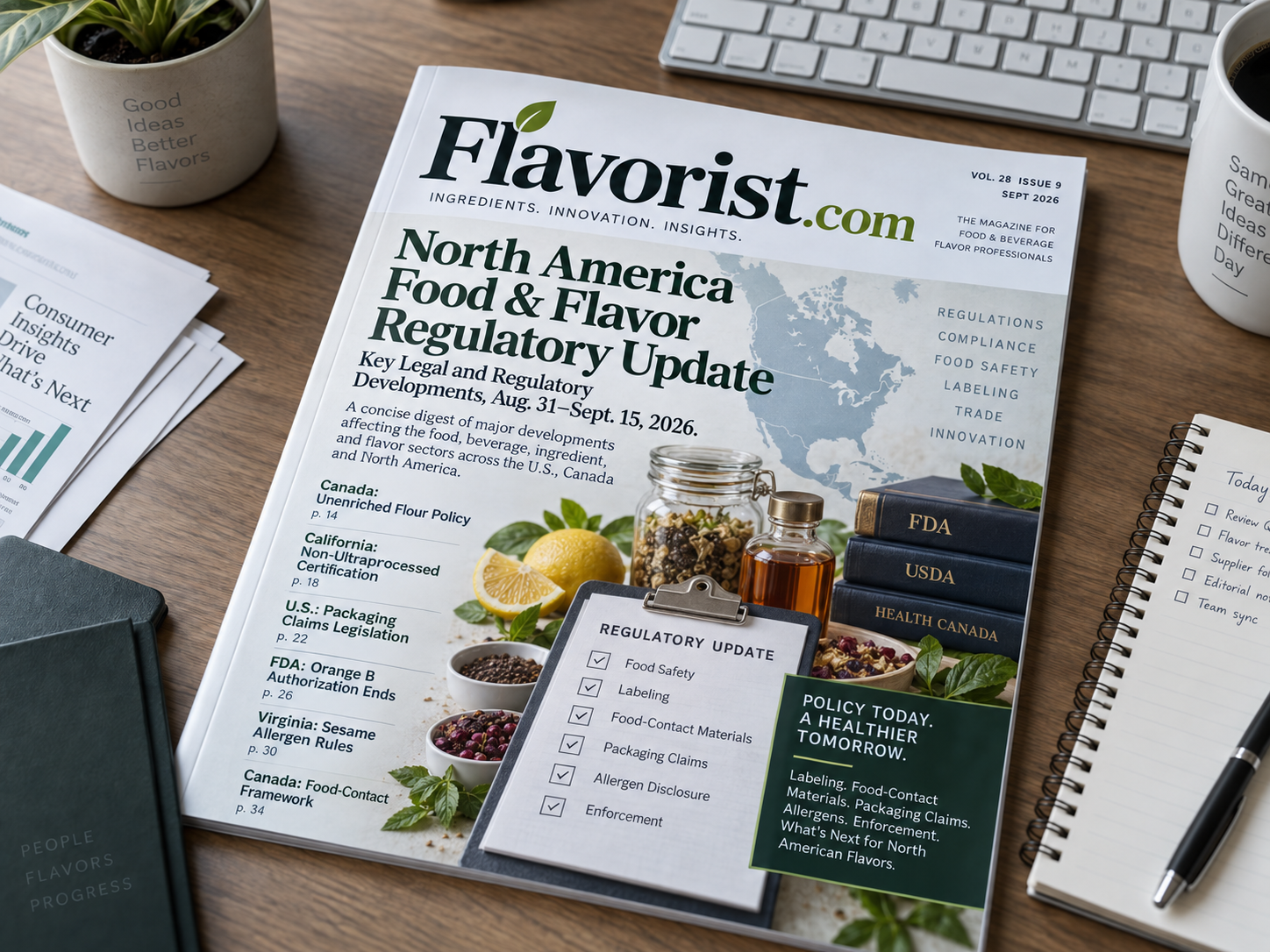
This regulatory news update comes from official U.S./Canadian/Mexican regulatory sources plus food-law and industry regulatory coverage for August 31–September 15, 2026, focusing on developments relevant to food manufacturers, flavor houses, ingredient suppliers, packaging suppliers, restaurants/foodservice, and CPG companies. Ordinary product recalls are not included unless they reflected a broader regulatory or enforcement issue.
During the specified period, 12 material developments is worthy of attention. The largest themes were ingredient labeling, UPF policy, packaging regulation, allergen disclosure, procurement rules, pesticide use, and food-safety enforcement.
1. Canada allows limited use of unenriched white flour — August 31
Health Canada issued an interim enforcement policy allowing unenriched white flour to be imported and sold directly to manufacturers or distributors for use in specified foods where flour contributes negligibly to nutrient intake. Covered categories include confectionery, frozen desserts, processed meats, sauces, soups, flavored grain mixtures, and preparations where flour acts as a carrier for flavorings, food additives, spice mixtures, or vitamin premixes. Packages must identify the flour as unenriched and state “for manufacturing use only.” The policy is particularly relevant to flavor and ingredient suppliers and is intended as an interim measure pending future amendments to the Food and Drug Regulations. Canada
Health Canada — Interim policy on unenriched white flour
2. California advances a government-backed “Non-Ultraprocessed Certified” standard — September 1–8
California’s legislature approved AB 2244, creating a proposed voluntary state certification program for foods meeting a “non-ultraprocessed” standard. The enrolled bill was presented to the governor on September 8. The definition is particularly relevant to flavor formulators because ingredients that can contribute to UPF classification include certain flavoring agents and adjuvants, flavor enhancers, colors, emulsifiers, stabilizers, thickeners and non-nutritive sweeteners. If enacted, the state would establish accredited certifiers, a standardized seal and a public directory. The proposal could influence formulation decisions well outside California if manufacturers pursue a single national product specification. LegiScan
California AB 2244 enrolled text
3. Allulose “zero sugar” and “sugar free” claims face expanding litigation — September 3
Food manufacturers using allulose faced growing labeling risk after multiple proposed class actions followed the Seventh Circuit’s decision in Franco v. Chobani. The court held that allulose falls within the federal regulatory definition of “total sugars,” even though FDA currently exercises enforcement discretion allowing it to be excluded from the Nutrition Facts “Total Sugars” declaration. That distinction means products may comply with FDA’s enforcement policy yet still encounter state consumer-protection litigation over “zero sugar” or “sugar free” front-of-pack claims. New suits reportedly targeted several major food and beverage brands, making claim substantiation and label review increasingly important for sweetener suppliers and formulators. Justia Law
Seventh Circuit decision — Franco v. Chobani
4. U.S. House panel advances federal packaging-claims legislation — September 4
Two bipartisan bills, the Packaging and Claims Knowledge Act (PACK Act, H.R. 6832) and Recycled Materials Attribution Act (H.R. 7502), advanced through a House subcommittee. The proposals would establish national standards governing claims such as “recyclable,” “compostable,” “reusable” and recycled content. The legislation could preempt conflicting state requirements and, under the recycled-content proposal, permit forms of mass-balance accounting. For food and beverage companies, the issue extends beyond packaging suppliers: sustainability statements printed on finished consumer packages increasingly carry legal exposure under state labeling, extended-producer-responsibility and consumer-protection regimes. The bills still require further congressional action before becoming law. BakeryAndSnacks.com
FoodNavigator coverage of PACK Act and RMAA
5. FDA’s Orange B authorization formally disappears — effective September 8
FDA’s previously issued final order revoking authorization for Orange B became effective September 8, 2026. Orange B had been authorized for coloring casings or surfaces of frankfurters and sausages, but FDA concluded that the authorized use had effectively been abandoned by industry. The regulation at 21 CFR 74.25 was therefore removed. Although Orange B has seen little modern commercial use, the action is relevant to color and flavor companies because it forms part of FDA’s broader reassessment and removal of outdated petroleum-derived color authorizations. Companies maintaining legacy specifications or regulatory databases should ensure Orange B is no longer represented as an authorized U.S. food color. FDA HFP App
FDA — Orange B final order record
6. Canada food-contact-material notification proposal draws renewed industry attention — September 8–10
Health Canada’s ongoing consultation on a proposed mandatory food-contact-material notification framework became a major regulatory issue in early September. Canada currently relies largely on voluntary premarket submissions for many food-contact materials. The proposed system could require notification of FCMs used with foods sold in Canada, potentially create a public knowledgebase, introduce risk-based reviews and evolve toward a positive-list approach. Foodservice articles such as containers, straws and utensils may also be covered. A roughly five-year implementation period has been discussed, and first-round comments are due October 9, 2026. The proposal could materially affect packaging, ingredient and finished-food supply chains. REACH24H
Steptoe analysis — Canada food-contact framework
7. USDA simplifies local-food purchasing rules for child nutrition programs — September 9
USDA issued a direct final rule simplifying language governing the geographic preference option used by school and child-nutrition programs when purchasing locally grown, caught or raised unprocessed agricultural products. The amendment affects the National School Lunch, School Breakfast, Special Milk, Child and Adult Care Food, and Summer Food Service programs. USDA says the changes clarify existing purchasing flexibility rather than materially alter program meaning. Unless adverse comments trigger withdrawal, the rule becomes effective November 9, 2026. For food companies and processors selling into institutional channels, clearer local-procurement rules may affect sourcing strategies, supplier relationships and opportunities for minimally processed or locally sourced products. Farm Service Agency
USDA — Simplified Geographic Preference Procurement final rule
8. Canada proposes broader pesticide use in vertical farms — September 9
Health Canada’s Pest Management Regulatory Agency opened consultation on PRO2026-03, proposing to allow certain non-conventional and microbial pesticides already registered for greenhouse crop/site/pest combinations to be used in corresponding vertical-farm settings under specified conditions. The proposal is intended to reduce regulatory duplication when comparable controlled-environment conditions exist. Comments are open through October 24, 2026. Although primarily an agricultural input rule, the proposal matters downstream to produce processors, flavor companies using botanical raw materials and ingredient manufacturers because it could expand pest-management options for vertically farmed herbs, vegetables and specialty crops while affecting supplier pesticide specifications and residue-compliance programs. Canada
Health Canada — Regulatory Proposal PRO2026-03
9. Virginia’s revised food regulations add sesame and strengthen allergen disclosures — September 10
Updated Virginia Food Regulations took effect September 10 and align portions of state law with the newer FDA Food Code. Sesame is now explicitly included among the major food allergens, and food establishments must disclose major allergens in both packaged and unpackaged foods. The regulations affect restaurants, foodservice operators and potentially suppliers providing ingredient or allergen information to those businesses. For flavor companies, compound flavors, seasoning systems and other multi-component ingredients require especially reliable allergen documentation because operators depend on supplier specifications to meet disclosure obligations. Virginia notes that additional regulatory changes arising from the state’s 2026 legislative session will follow separately. Virginia Department of Health
Virginia Department of Health — 2026 Food Regulations Update
10. FDA closes hydrolyzed-lignin animal-feed additive petition — September 10
FDA announced withdrawal, without prejudice to future refiling, of a food-additive petition submitted by Green Innovation GmbH seeking authorization for hydrolyzed lignin as a source of neutral-detergent-soluble fiber in feed for multiple animal species. Proposed uses included poultry, swine, dairy and beef cattle, sheep, goats, salmonids and adult dogs, generally at no more than 1% of feed. Because the petition was withdrawn rather than denied on safety grounds, a future submission remains possible. The action is chiefly relevant to animal-feed ingredient suppliers, but it also illustrates FDA’s petition pathway for ingredients that fall outside GRAS or other established authorization mechanisms. Justia Regulations
Federal Register summary via Justia — hydrolyzed lignin petition withdrawal
11. FDA issues industry compliance reminder following massive Cyclospora outbreaks — September 11
FDA sent an industry letter to growers, harvesters, packers, processors, distributors, importers and retailers following recurring Cyclospora outbreaks associated with fresh produce. FDA emphasized that regulated companies must rigorously implement agricultural-water controls, employee health and hygiene practices, sanitation measures and, where applicable, supplier-program requirements under the FSMA Produce Safety Rule and Preventive Controls for Human Food Rule. The agency’s communication converts lessons from the 2026 outbreaks into an explicit compliance reminder for the supply chain. Ingredient and flavor manufacturers sourcing fresh herbs, botanicals, fruit or vegetable materials should review supplier verification and sanitation programs where relevant. U.S. Food and Drug Administration
FDA — Letter to industry on Cyclospora prevention
12. CFIA publicizes Safe Food for Canadians licence suspension — September 11
The Canadian Food Inspection Agency announced that it had suspended the Safe Food for Canadians licence of Ramelli Truffles Ltd. because the company had not completed corrective actions addressing regulatory deficiencies. CFIA cited failures involving hazard identification, labeling, traceability, recall preparedness and licensing permissions. Although the suspension itself occurred August 18, the enforcement announcement was released September 11, placing it within the requested news period. The case is a useful enforcement signal for Canadian ingredient, specialty-food and flavor businesses: CFIA can suspend authorization to conduct licensed activities when corrective measures are not completed, even across multiple compliance areas rather than a single food-safety violation. Canadian Food Inspection Agency
CFIA — Ramelli Truffles licence suspension
Geographic check
For Mexico, a search of COFEPRIS, Gobierno de México and Diario Oficial material for September 1–15 was conducted, but no significant relevant news or update was identified on a substantive federal food/flavor regulation, additive rule, labeling measure or flavor-related legal release published during this period. COFEPRIS posted several documents during the period, but the surfaced items principally concerned drugs, medical devices, clinical research or general risk alerts rather than food/flavor regulation. Gobierno de México
A practical priority list for flavor and ingredient companies from this period would therefore be: Canada’s unenriched-flour policy, California AB 2244 and its treatment of flavoring agents, allulose claim litigation, Canada’s food-contact framework, Virginia allergen disclosure requirements, and the Orange B revocation. Those six have the clearest direct implications for formulation, specifications, labeling or regulatory dossiers.
###