Patent Summary: Flavouring Agent and Methods for Preparing and Using Same: GB 2363965A
Basic Information
| Field | Details |
|---|---|
| Patent Number | GB 2 363 965 A |
| Application Number | 0011211.0 |
| Date of Filing | 09.05.2000 |
| Date of Publication | 16.01.2002 |
| Applicant | Bush Boake Allen Inc. (Incorporated in USA – Virginia), 7 Mercedes Drive, Montvale, New Jersey 07654, United States of America |
| Inventors | Ronald Louis Belanger; Benjamin Owen Issac; Anne-Dominique Fortineau |
| Agent | Frank B Dehn & Co, 179 Queen Victoria Street, LONDON, EC4V 4EL, United Kingdom |
| International Classification (INT CL⁷) | A23L 1/226; C07D 307/38 |
| UK Classification (Edition T) | A2B BSF3; C2C CAA |
| Documents Cited | JP 110001397 A |
| Field of Search | INT CL⁷: A23L 1/226; Online: EPODOC, WPI, JAPIO, CAS-ONLINE |
| Abstract Title | Flavouring agent |
| Examiner | Peter Trickey |
| Date of Search | 25 October 2001 |
Summary
Overview
This patent application, titled FLAVORING AGENT AND METHODS FOR PREPARING AND USING SAME, discloses furfuryl propyl disulfide (chemical formula: 2-Furan-CH₂SSCH₂CH₂CH₃) as a novel flavoring agent for ingestible compositions. The compound is provided in purified form, unaccompanied by the substances of natural origin normally present in cooked beef and onions.
Background
The invention arises from the Generessence® flavor research program conducted by Bush Boake Allen, which analyzes volatile organic components in natural products to develop improved flavors. A key challenge in developing cooked beef and onion flavors is that natural flavoring agents contain complex mixtures of volatile components, making identification of characteristic flavor compounds difficult. While several prior patents (e.g., US 3,803,172; US 3,917,869; US 3,982,038; US 3,985,907; US 3,985,908; US 3,993,792; US 4,000,328; US 4,007,287; US 4,105,661; US 4,514,429) disclose various furan, thiophene, and pyrazine flavor compounds, none provide satisfactory cooked beef and onion flavoring agents.
Key Discovery
Through analysis of cooked beef and onions, 231 components were identified. Furfuryl propyl disulfide was identified, synthesized, and confirmed as authentic by NMR and IR spectroscopy. The compound was found to possess unexpected organoleptic properties, conferring a unique note described as:
- Roasted, sulfide, alliaceous, coffee, meaty, chicken, metallic, burnt, onion-leek like, coffee-like, pungent, rubbery, sulfurous, cooked, sharp, and garlic flavor.
Notably, this compound had not been previously reported in nature; its identification in cooked beef and onions warrants a change in status to nature identical.
Methods of Preparation
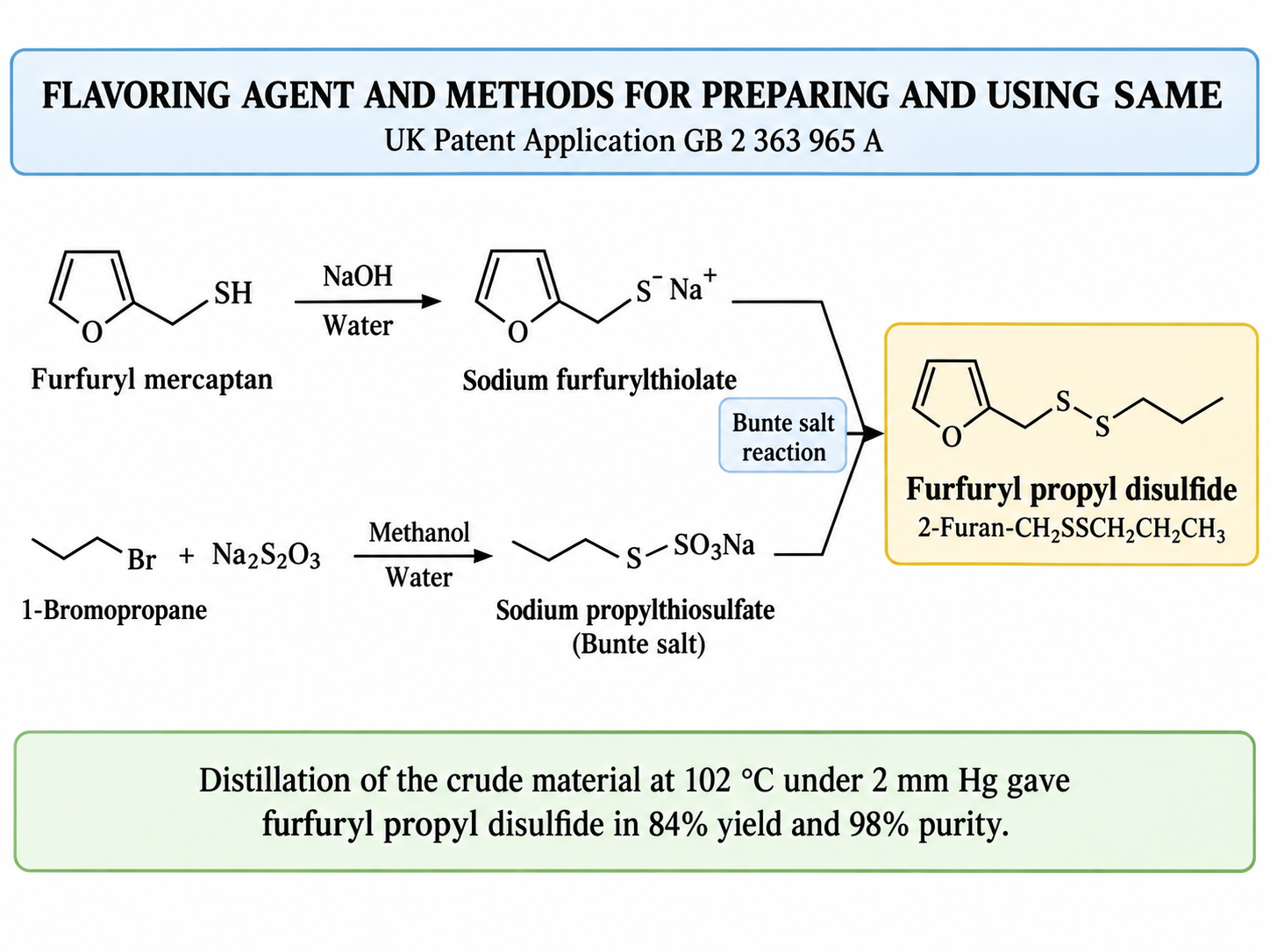
Furfuryl propyl disulfide is prepared via a Bunte salt reaction:
- Sodium furfurylthiolate is prepared by reacting furfuryl mercaptan with sodium hydroxide in water.
- Sodium propylthiosulfate (Bunte salt) is prepared by reacting bromopropane with sodium thiosulfate in a methanol/water mixture.
- The two salts react in water to yield furfuryl propyl disulfide.
Distillation of the crude material at 102°C under 2 mm Hg gives the product in 84% yield and 98% purity.
Uses and Applications
The flavoring agent may be used in a wide variety of ingestible vehicles, including:
- Meat products (preferred)
- Dairy products
- Beverage products
- Liquid foods, fruit and vegetable juices, milk, coffee, tea, cocoa, chocolate
- Solid foods such as cereals, flours, confections, vegetables, and meats
It is particularly useful for augmenting or enhancing the aroma or taste of:
- Roasted nut, roasted meat, beef broth, black pepper, onion, fine herbs, omelet, and cooked onion omelet flavored foodstuffs.
The flavoring agent may be used in free or encapsulated form and may include an organoleptically acceptable solvent (e.g., propylene glycol, ethanol, triacetin, glycerol, vegetable oils).
Dosage
The organoleptically effective amount typically ranges from:
- About 0.001 ppm to about 1000 ppm by weight
- Preferably 0.01 ppm to about 500 ppm
- More preferably 0.01 ppm to about 100 ppm
Flavor Evaluation
In a beef bouillon soup (vegetable base) with 0.10% w/w added beef flavoring:
| Sample | Added Furfuryl Propyl Disulfide | Flavorist Panel Opinion |
|---|---|---|
| A (Control) | 0 ppm | Fatty, meaty |
| 1 | 0.2 ppm | Fatty, onion-like, more meaty impact |
| 2 | 0.5 ppm | Fatty, onion-like, juicy meaty, authentic |
Sample 2 (0.5 ppm) was most preferred, determined to be more characteristic than the other samples.
Claims
- A method for preparing a flavored ingestible composition by admixing an ingestible vehicle with an organoleptically effective amount of furfuryl propyl disulfide in purified form.
- The method of claim 1, wherein furfuryl propyl disulfide is present in an amount from about 0.001 ppm to about 1000 ppm.
- The method of claim 2, wherein the amount is from about 0.01 ppm to about 500 ppm.
- The method of any one of claims 1–3, wherein the ingestible vehicle is selected from meat products, dairy products, and beverage products.
- The method of claim 4, wherein the ingestible vehicle is a meat product.
- An ingestible composition comprising an ingestible vehicle and an organoleptically effective amount of furfuryl propyl disulfide in purified form.
7–10. Further embodiments of the ingestible composition with specified concentration ranges and vehicles. - Furfuryl propyl disulfide in purified form, unaccompanied by substances of natural origin present in cooked beef and onions.
- A method for preparing furfuryl propyl disulfide by reacting sodium furfurylthiolate with sodium propylthiosulfate.
Search Report
The search report cites JP 110001397 A (Ogawa) as relevant to the claims, with the WPI abstract accession number 1989-160473 [35]. The document is categorized as A (technological background and/or state of the art).
Detailed summary: which compounds are tied to which flavors
The document is a flavor patent centered overwhelmingly on one newly characterized flavor chemical: furfuryl propyl disulfide. Although it mentions a very large number of other flavor chemicals, the patent generally does not say which individual flavor note each of those other compounds produces. That distinction matters: the specific sensory claims and tasting data are for furfuryl propyl disulfide, while most of the other named compounds are merely suggested as optional ingredients that could be blended with it.
The main compound: furfuryl propyl disulfide
The compound is furfuryl propyl disulfide, represented in the patent as 2-Furan-CH₂SSCH₂CH₂CH₃. It was discovered during analysis of the volatiles from cooked beef and onions. The investigators report identifying roughly 231 components in that cooked-beef/onion system, but furfuryl propyl disulfide stood out because its sensory properties were unusually useful. They describe it as having better organoleptic properties than many of the other actual components of cooked beef and onion flavor.
The patent gives the following sensory profile for furfuryl propyl disulfide itself:
| Compound / level | Flavor or aroma contribution described by the patent |
|---|---|
| Furfuryl propyl disulfide | Roasted, sulfidic, alliaceous (onion/garlic-family), coffee, meaty, chicken, metallic, burnt, onion-leek-like, pungent, rubbery, sulfurous, cooked, sharp, and garlic-like notes |
| 0.2 ppm furfuryl propyl disulfide in beef-flavored bouillon | Fatty, onion-like, with more meaty impact than the control |
| 0.5 ppm furfuryl propyl disulfide in beef-flavored bouillon | Fatty, onion-like, juicy-meaty, authentic; judged more characteristic of beef than the other samples |
| Control without the compound | Simply described as fatty, meaty |
The broad descriptor set appears explicitly in the detailed description: the compound is said to confer roasted, sulfidic, alliaceous, coffee, meaty, chicken, metallic, burnt, onion-leek-like, pungent, rubbery, sulfurous, cooked, sharp, and garlic characteristics. The same sensory description is repeated when the patent discusses practical flavor formulations.
What it actually does in a beef flavor
The most informative part of the patent is the controlled tasting experiment on page 18.
The researchers prepared a vegetable-base bouillon containing 0.10% added beef flavoring. That served as the base/control. They then added furfuryl propyl disulfide at 0.2 ppm and 0.5 ppm, and flavorists evaluated the samples blind.
The untreated control was described as “fatty, meaty.” At 0.2 ppm, the flavor became “fatty, onion-like, more meaty impact.” At 0.5 ppm, it became “fatty, onion-like, juicy meaty, authentic.” The 0.5 ppm sample was the preferred sample and was judged to have a more characteristic beef profile.
That experiment is important because it clarifies the functional role of the compound better than the long descriptor list does. In an actual beef flavor, it appears to contribute mainly to the onion/sulfur dimension of cooked meat while simultaneously strengthening meatiness, juiciness, and perceived authenticity. The inventors conclude that its odor and taste characteristics improve the overall profile of beef flavorings.
So, for someone formulating flavors, the practical reading of the patent is:
furfuryl propyl disulfide is principally a cooked-meat + onion/garlic sulfur note, with roasted and slightly burnt/coffee dimensions, that can make a beef flavor seem more juicy and authentically cooked at very low concentration.
How the various descriptors fit together
The descriptor list can be understood as several overlapping sensory families rather than unrelated flavors.
The alliaceous/sulfur family includes sulfidic, sulfurous, onion-leek, garlic, pungent, and sharp. This appears to be a major part of the molecule's character and explains why it fits naturally into a cooked beef-and-onion flavor.
The cooked/thermal family includes roasted, burnt, cooked, and coffee-like. These are the kinds of notes that help move a flavor away from “raw meat” or generic meatiness and toward something perceived as browned or cooked.
The meat family includes meaty and chicken. In the actual tasting test, this became “more meaty impact” at 0.2 ppm and “juicy meaty, authentic” at 0.5 ppm.
The remaining metallic and rubbery descriptors show that it is a powerful sulfur compound rather than a simple pleasant “beef” flavor on its own. The patent's results imply that these aspects can be useful when the compound is dosed at trace levels inside a larger flavor composition rather than consumed as a neat flavor.
Foods and flavors it is intended to enhance
The patent says the compound is especially useful for cooked beef and onion flavor, but its proposed applications are much broader. It specifically says it can augment or enhance the aroma or taste of roasted nuts, roasted meat, beef broth, black pepper, onion, fine herbs, and omelet-type foods. It also proposes use in seasonings, snack foods, baked goods, cheese, egg products, gravies, soups, poultry, fish, pork, coffee, tea, cocoa, chocolate, vegetables, and other foods.
These should not be interpreted as saying furfuryl propyl disulfide “tastes like black pepper” or “tastes like chocolate.” The patent is saying that its roasted/sulfur/meaty characteristics can augment those flavor systems.
Concentration is critical
The patent gives an extremely broad formulation range of about 0.001–1,000 ppm, with a preferred range of approximately 0.01–500 ppm and a more-preferred range of about 0.01–100 ppm.
But the experimentally demonstrated beef effect occurred at only 0.2–0.5 ppm. That is a much more useful indication of its potency. It behaves like a trace-impact flavor ingredient: very small quantities noticeably change the character of the overall flavor.
The difference between the two tested amounts is particularly instructive. At 0.2 ppm, the emphasis was “onion-like” plus increased meat impact. Raising it to 0.5 ppm produced the additional perceptions of juiciness and authenticity. The patent does not test higher levels in this experiment, so it does not establish whether still higher concentrations would improve the effect or instead become excessively sulfury, rubbery, metallic, or pungent.
What about all the other compounds listed in the patent?
Pages 12–13 contain a very long catalogue of possible “other flavorants and flavor intensifiers.” This includes organic acids, aldehydes, ketones, alcohols, esters, terpenes, pyrazines, essential oils, sulfur compounds, and miscellaneous flavor chemicals. Examples include acetic acid, diacetyl, benzaldehyde, furfural, linalool, eugenol, ethyl butyrate, isoamyl acetate, numerous dimethylpyrazines, black pepper oil, coriander oil, diallyl disulfide, diallyl trisulfide, dipropyl disulfide, dipropyl trisulfide, and bis(2-methyl-3-furyl) disulfide.
The patent does not provide a compound-by-compound sensory assignment for these ingredients. In other words, even though many of those substances have well-known flavor descriptions elsewhere in flavor chemistry, this particular document does not say, for example, “compound X supplies nutty flavor” or “compound Y supplies buttery flavor.” They are presented only as possible adjuncts that a flavorist could blend with furfuryl propyl disulfide. The patent explicitly says their selection depends on the organoleptic character desired in the finished product.
Therefore, attributing detailed flavor notes to those compounds from outside knowledge would go beyond what this document itself establishes.
How they established that furfuryl propyl disulfide occurs in cooked beef/onion flavor
The inventors did more than synthesize the compound and taste it. They prepared a model cooked food by browning 750 g of cubed beef, mixing it with lightly sautéed onions and water, and simmering it covered for roughly three hours. They collected headspace volatiles on Tenax and also performed simultaneous distillation/extraction.
The extracts were analyzed by gas chromatography on two different stationary phases and by GC–mass spectrometry. They also compared the natural component with synthesized furfuryl propyl disulfide using GC, IR, NMR and mass spectral data. The reported retention index was about 1004 on the BPX-5 phase and approximately 1300 on BP21.
That analytical work is the basis for the patent's claim that the compound is genuinely associated with the volatile profile of cooked beef and onions rather than merely being an invented synthetic beef flavor.
Synthesis
The patent prepares furfuryl propyl disulfide using a Bunte-salt reaction. Furfuryl mercaptan is reacted with sodium hydroxide to form sodium furfurylthiolate. Separately, bromopropane reacts with sodium thiosulfate to produce sodium propylthiosulfate. Reaction of those two salts gives furfuryl propyl disulfide. The product was distilled at about 102°C under 2 mm Hg, giving an 84% yield and 98% purity.
Bottom line for a flavor reader
The patent's useful flavor map is essentially this:
Furfuryl propyl disulfide → cooked beef/onion realism. Its intrinsic character combines onion, leek and garlic sulfur notes with roasted/browned, coffee/burnt and cooked notes, plus a direct meaty/chicken dimension. At trace levels in beef flavor, approximately 0.2 ppm strengthens onion-like meatiness, while 0.5 ppm produces a more juicy, authentic and characteristic beef impression.
The dozens of other chemicals named in the patent are potential supporting flavor ingredients, but this document does not establish which particular sensory notes each of them supplies.
Its substantive sensory discovery is specifically the role of furfuryl propyl disulfide in building a convincing cooked, roasted, sulfurous, onion-garlic, meaty beef character.
Furfuryl propyl disulfide is a recognized FEMA flavoring ingredient.
It is listed as FEMA No. 3979, CAS 252736-36-0, and appears in FEMA GRAS Publication 20. FEMA’s own Flavor Ingredient Library lists it by name, and the FDA’s current Substances Added to Food database identifies it as a “flavoring agent or adjuvant.” (FEMA)
It also has JECFA No. 1079. JECFA evaluated it in 2002 and concluded there was “no safety concern at current levels of intake when used as a flavouring agent.” (FAOHome)
One important regulatory nuance: FEMA GRAS does not mean that FDA individually “approved” the compound as a food additive. FEMA’s Expert Panel independently determined it to be Generally Recognized as Safe for its intended flavor uses. FDA's database records that FEMA GRAS status and lists its technical use as a flavoring agent/adjuvant. (FDA HFP App)
So for a U.S. flavor formulation, the practical answer is yes—it can be used as a flavor ingredient under its FEMA GRAS conditions of use, assuming appropriate purity/specifications and use consistent with good manufacturing practice.
The FEMA GRAS 20 publication specifically identifies FEMA 3979 = furfuryl propyl disulfide and provides the food-category use levels on which the Expert Panel based its GRAS judgment.
FDA entry for Furfuryl Propyl Disulfide
FEMA Flavor Ingredient Library
Log in to continue reading and learning how flavorists may use this patented compound and others to formulate a beef flavor.