South America Food & Flavor Industry: Laws, Regulations and Food Safety News: October 16–31, 2026
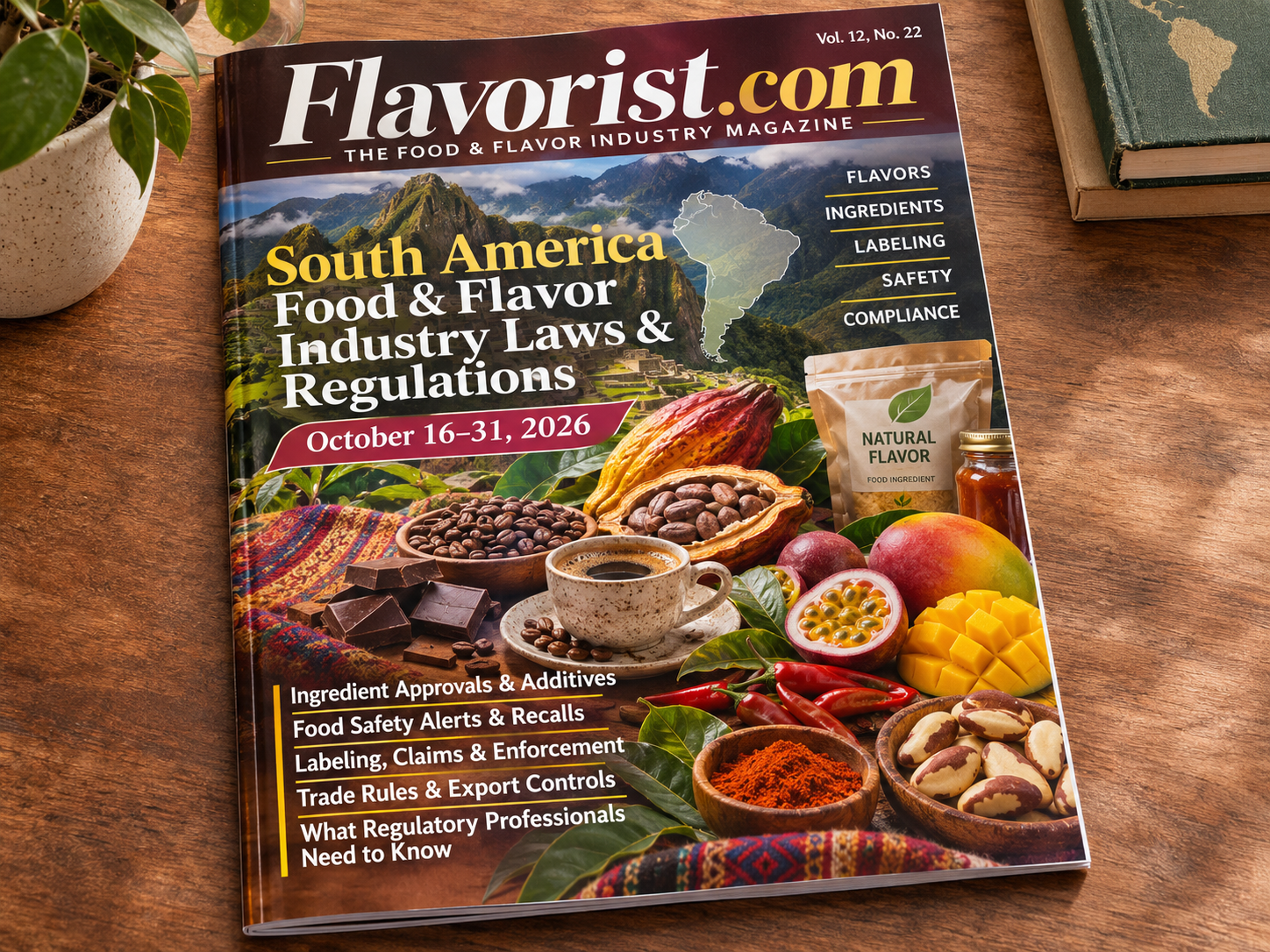
South America Food & Flavor Industry: Laws, Regulations and Food Safety News
October 16–31, 2026
ANVISA's October 29 approval of updates to Brazil's rules on food additives, processing aids, and vegetable oils is the development most likely to affect flavor and formulation teams this period.
This report covers 23 regulatory and food-safety developments published during October 16–31, 2026 that matter to food manufacturers, flavor houses, ingredient suppliers, beverage producers, importers, exporters, and natural-food businesses. Coverage draws primarily on official government publications and food-safety authorities.
Not every item is a new law. The report includes adopted rules, proposals, sanitary market-access decisions, compliance advisories, and enforcement actions, and each entry states its regulatory status.
Key developments for flavor and formulation teams
- Additives and vegetable oils: ANVISA approved updates to IN 211/2023 and IN 87/2021 (items 1 and 2).
- Ingredient specifications: Brazil is consulting on a new framework for ingredient identity, purity, and composition (item 3).
- Unauthorized ingredients: ANVISA acted against unauthorized ingredients in a functional ice pop and a protein supplement, and restated that ashwagandha is not permitted in dietary supplements (items 4–6).
- Medical nutrition: ANVISA published preparatory work on future rules for foods for special medical purposes (item 9).
- HACCP in Peru: New certificates now carry a two-year validity period, while earlier certificates fall under a separate interim regime (item 13).
Table of contents
Brazil: Ingredient approvals, formulation requirements and food safety
- 1. ANVISA approves updates to permitted food additives and processing aids
- 2. ANVISA approves changes to vegetable oil and fat specifications
- 3. ANVISA advances proposals to overhaul specifications for authorized food ingredients
- 4. ANVISA orders recall of functional ice pop containing unauthorized ingredients
- 5. ANVISA prohibits cocoa-flavored protein supplement containing unassessed hydrolyzed protein
- 6. ANVISA reiterates that ashwagandha is not authorized in dietary supplements
- 7. ANVISA orders removal of misleading blood-sugar claims from supplement advertising
- 8. ANVISA suspends smoked pork sausage after Listeria detection
- 9. ANVISA publishes regulatory analysis on foods for special medical purposes
- 10. Brazil declares animal-health emergency following Newcastle disease outbreak in poultry
- 11. Brazil updates rules for purchasing food from family farmers for school meals
- 12. Brazil adopts emergency food-purchasing rules for crisis-affected regions
Peru: Food safety certification and HACCP requirements
Argentina: Food transport and sanitary enforcement
Colombia: Labeling compliance and counterfeit food products
- 15. INVIMA warns of fraudulent Oreo ingredient products in the Colombian market
- 16. INVIMA reinforces sanitary registration and allergen-labeling obligations for confectionery
Ecuador: Food manufacturing enforcement
Regional trade, export permissions and phytosanitary controls
- 18. Brazil and Colombia approve new sanitary access for Brazilian pet-food products
- 19. Peru and Argentina authorize imports of additional Brazilian agricultural products
- 20. Brazil establishes export quota procedures under the Mercosur–EFTA trade agreement
- 21. Brazil's agricultural inspectors intercept quarantine pest in imported chestnuts
- 22. Mexico recognizes regionalized Newcastle disease controls and restores Brazilian poultry imports
Brazil: Ingredient approvals, formulation requirements and food safety
1. ANVISA approves updates to permitted food additives and processing aids
October 29, 2026 | Brazil | Food additives and processing aids | Approved regulatory amendment
Brazil's National Health Surveillance Agency (ANVISA) approved changes to Normative Instruction IN 211/2023 at its 20th public board meeting of 2026. The instruction governs authorized food additives and processing aids, including their technological functions, maximum permitted levels, and conditions of use.
The proposal was developed under the agency's program for periodically updating authorized additives and processing aids. ANVISA released a draft on October 9 and updated it on October 23 before the board's decision.
Authorization conditions determine which substances can legally be used in particular food categories, so the change directly affects food manufacturers, flavor houses, and ingredient suppliers. Manufacturers should compare the final published amendment with their existing formulations, especially products containing multiple additives or processing aids.
Regulatory status: Approved October 29. Check the final published text and effective date before making formulation changes.
Sources: ANVISA: October 29 board decisions | ANVISA: Regulatory draft and amendment details
2. ANVISA approves changes to vegetable oil and fat specifications
October 29, 2026 | Brazil | Vegetable oils and food ingredients | Approved regulatory amendment
At the same meeting, ANVISA approved updates to Normative Instruction IN 87/2021, which sets requirements for vegetable oils and fats. The instruction covers authorized botanical species, ingredient designations, fatty-acid composition, and maximum acidity and peroxide values.
Vegetable oils are widely used in bakery, confectionery, snacks, sauces, dressings, margarines, and other processed foods. Identity and composition specifications help determine whether a product can be marketed under a particular vegetable-oil designation and whether the raw material meets quality standards.
Oil refiners, ingredient distributors, and food manufacturers should review product specifications, supplier certificates of analysis, and quality-control procedures. ANVISA's announcement confirms the approval but does not say which individual limits changed.
Regulatory status: Approved October 29. Consult the final amendment for exact technical requirements and commencement provisions.
Source: ANVISA: Approval of updates to IN 87/2021
3. ANVISA advances proposals to overhaul specifications for authorized food ingredients
October 20, 2026 | Brazil | Ingredient identity, purity and composition | Proposed rules
ANVISA released materials from a regulatory dialogue on proposed changes to the identity, purity, and composition specifications for ingredients permitted in foods. The proposals stem from Public Consultations 1,324/2025 and 1,325/2025, which drew more than 600 stakeholders.
One proposed instruction would organize specifications into three categories: those published by ANVISA, those based on recognized references, and proprietary specifications. It would also set criteria for assessing equivalence between specifications and update ingredient lists.
A related proposal would harmonize existing food-category rules, including ingredient identification and the documentation required for product notifications.
The changes could affect how flavoring substances, processing aids, and other food ingredients are documented and assessed. Manufacturers should examine the proposed specifications and supporting documentation requirements.
Regulatory status: Consultation-stage proposals, not final binding rules.
Source: ANVISA: Regulatory dialogue and proposed ingredient specifications
4. ANVISA orders recall of functional ice pop containing unauthorized ingredients
October 26, 2026 | Brazil | Novel ingredients and functional foods | Enforcement
ANVISA ordered the recall of Bentô Gelatos Magnésio + Inositol Relief 3.0 ice pops manufactured by ABB Gelateria Ltda. The action followed concerns about melatonin and inositol, which had not undergone the safety assessment required for use in that food category.
According to ANVISA, melatonin and inositol are authorized for specific supplement applications, and inositol is also permitted in a specified ready-to-drink liquid category. Those permissions do not automatically extend to frozen desserts.
The agency suspended manufacturing, sales, distribution, advertising, and consumption of the product.
The case matters for formulators of functional ice cream, confectionery, snacks, and beverages: authorization in supplements does not necessarily permit use in conventional foods. Manufacturers should verify ingredient permissions for the exact food category, use level, and conditions before commercialization.
Regulatory status: Binding product-specific enforcement action.
Source: ANVISA: Recall of ice pop containing unauthorized ingredients
5. ANVISA prohibits cocoa-flavored protein supplement containing unassessed hydrolyzed protein
October 26, 2026 | Brazil | Protein ingredients and supplements | Enforcement
In a separate action announced alongside the ice-pop recall, ANVISA ordered the recall of Equaliv Body Strong Protein, cocoa flavor, manufactured by Althaia S.A. Indústria Farmacêutica.
The supplement contained Peptistrong, a hydrolyzed fava-bean protein ingredient that ANVISA said had not undergone the necessary safety assessment for use in foods. The agency suspended its manufacture, sale, distribution, advertising, and use.
Novel protein ingredients are increasingly promoted for sports nutrition, healthy aging, muscle support, and functional foods, but their commercial use remains subject to safety assessment and authorization requirements. Ingredient developers and supplement manufacturers should confirm whether a protein hydrolysate requires novel-food assessment in Brazil and whether the supplier holds the necessary regulatory documentation.
Regulatory status: Binding product-specific enforcement action. An earlier Peptistrong recall dated October 9 falls outside this reporting period.
Source: ANVISA: Equaliv Body Strong Protein recall and enforcement decision
6. ANVISA reiterates that ashwagandha is not authorized in dietary supplements
October 21, 2026 | Brazil | Botanical ingredients and supplements | Compliance warning
ANVISA issued a public warning on ashwagandha, a botanical increasingly promoted internationally for stress management and general wellness. The agency stated that ashwagandha is not on Brazil's list of ingredients authorized for dietary supplements, and that its manufacture, commercialization, distribution, and use as a supplement ingredient are prohibited.
The warning followed international attention to a reported serious adverse health incident associated with an ashwagandha supplement.
Botanical extracts authorized in one country may not be permitted in another. Brazilian manufacturers developing botanical beverages, supplement powders, or other functional formulations should verify the authorization status of each ingredient.
Regulatory status: Official clarification of existing restrictions, not a newly adopted prohibition.
Source: ANVISA: October 21 warning on ashwagandha
7. ANVISA orders removal of misleading blood-sugar claims from supplement advertising
October 27, 2026 | Brazil | Supplement advertising and health claims | Enforcement
ANVISA ordered the suspension of advertising for Glifit and Glicofit, two dietary supplements in drop form manufactured by Vita Nutriom Saúde & Bem Estar Ltda. The action was established through Resolution RE 4,224/2026.
The agency identified online claims that the products could regulate blood glucose, improve insulin sensitivity, and prevent glucose spikes. ANVISA determined that these statements included unauthorized or misleading functional, health, and therapeutic claims.
Even when an ingredient is permitted, marketing claims must stay within the scope of applicable authorizations. Supplement, natural-food, and functional-beverage companies should review their websites, packaging, social-media promotions, and distributor materials to confirm that claims are supported and permitted.
Regulatory status: Binding advertising-enforcement action.
Source: ANVISA: Suspension of misleading supplement advertising
8. ANVISA suspends smoked pork sausage after Listeria detection
October 28, 2026 | Brazil | Meat products and microbiological safety | Enforcement
ANVISA suspended sales of KF Embutidos smoked pork sausage after laboratory testing detected Listeria monocytogenes in lot 21/08/2026. The manufacturer, Fábrica de Embutidos Zanetti Ltda., told authorities it had started a voluntary recall.
The agency also suspended manufacture, distribution, advertising, and consumption of the affected product through Resolution RE 4,227/2026. ANVISA noted that under RDC 655/2022, companies must communicate relevant food recalls to the agency within the applicable 48-hour requirement.
Listeria monocytogenes can pose serious health risks, particularly for vulnerable consumers. Meat processors and suppliers of flavorings, marinades, and seasoning systems should maintain validated hygiene procedures, environmental monitoring, traceability, and product-release controls.
Regulatory status: Binding enforcement action involving a specific product lot.
Source: ANVISA: KF Embutidos smoked sausage suspension
9. ANVISA publishes regulatory analysis on foods for special medical purposes
October 22, 2026 | Brazil | Medical nutrition and specialized foods | Regulatory development
ANVISA released a report summarizing industry consultations on the future regulation of foods for special medical purposes, part of Topic 3.6 of its 2026–2027 Regulatory Agenda. The report supports regulatory impact analysis and future policy development.
It identifies possible improvements involving labeling, product communication, new formulations, product presentation, and authorization procedures. A central objective is to clarify the distinctions between foods for medical purposes, other special-purpose foods, and medicines. Participants also discussed scientific evidence requirements, compliance costs, and how regulatory changes might affect product availability.
The initiative could influence future registration and formulation strategies for clinical nutrition, specialized protein products, enteral nutrition, and related ingredients. Flavor suppliers should follow the process because medical nutrition products often require specialized sensory development and ingredient compatibility.
Regulatory status: Preparatory regulatory work. The announcement adopts no new binding standard.
Source: ANVISA: Report on regulation of foods for medical purposes
10. Brazil declares animal-health emergency following Newcastle disease outbreak in poultry
October 19–22, 2026 | Santa Catarina, Brazil | Poultry safety and export controls | Emergency measure
Brazil's Ministry of Agriculture (MAPA) confirmed Newcastle disease at a commercial turkey facility in Nova Itaberaba, Santa Catarina, following laboratory analysis of samples collected during an epidemiological investigation.
The ministry then announced Portaria MAPA No. 962/2026, declaring a 60-day animal-health emergency covering Nova Itaberaba, Águas Frias, Coronel Freitas, and Nova Erechim. Measures include movement restrictions, sanitary depopulation of the affected facility, disease surveillance, and additional controls on poultry movements.
Brazil notified international trading partners and the World Organisation for Animal Health. The ministry said officially inspected poultry products remain safe for human consumption.
Disease-related restrictions can affect the movement and export eligibility of poultry products. Food manufacturers sourcing poultry ingredients should verify current origin restrictions and veterinary certification requirements before arranging shipments. Item 22 covers Mexico's response.
Regulatory status: Binding emergency animal-health and movement-control measures.
Sources: MAPA: Confirmation of Newcastle disease outbreak | MAPA: Emergency measures and Portaria 962/2026
11. Brazil updates rules for purchasing food from family farmers for school meals
Reported October 28, 2026 | Brazil | Food procurement and regional agriculture | Adopted regulation
Brazil's federal government published Resolution CD/FNDE No. 17, dated October 22, 2026, updating procedures for acquiring food from family farmers through the National School Feeding Program (PNAE).
The resolution modifies supplier selection rules, documentation requirements, and procedures for setting purchase prices. It prioritizes local agricultural producers and adds clearer provisions for participation by women, young people, and traditional communities.
Pricing research must be based on three local family-farming suppliers. The rules also restrict reliance on quotations from intermediaries whose logistics do not reflect short agricultural supply chains.
The changes could affect suppliers of fresh produce, dairy, grains, and other foods used in public-school meals. Regional food companies should pay close attention to eligibility, documentation, pricing, and supplier-selection procedures.
Regulatory status: Adopted federal procurement regulation.
Source: Brazilian Ministry of Agrarian Development: Updated school-meal procurement rules
12. Brazil adopts emergency food-purchasing rules for crisis-affected regions
October 29, 2026 | Brazil | Public food procurement and agricultural supply chains | Adopted regulation
Brazil's National Supply Company (Conab) announced Resolution No. 40/2026, published October 28, which sets special procedures for the Food Acquisition Program (PAA) in territories affected by emergencies.
The resolution changes how suppliers are identified, registered, and documented, and establishes procedures for purchasing food and monitoring deliveries. Its objective is to accelerate procurement during emergencies while expanding participation by family farmers, Indigenous communities, and traditional agricultural producers.
Food producers and regional distributors gain an additional framework for public-sector purchasing during natural disasters and other qualifying emergencies. Suppliers should check the eligibility and documentation requirements instead of assuming conventional purchasing procedures apply. The initiative may also affect logistics and distribution for products destined for emergency food programs.
Regulatory status: Adopted regulation, effective upon publication.
Source: Conab: Resolution 40/2026 on emergency food procurement
Peru: Food safety certification and HACCP requirements
13. Peru clarifies two-year validity rules for new HACCP technical-validation certificates
October 30, 2026 | Peru | HACCP and food manufacturing | Official regulatory clarification
Peru's General Directorate of Environmental Health and Food Safety (DIGESA) issued Communiqué No. 11-2026-DIGESA/MINSA, clarifying the validity of official technical-validation certificates for Hazard Analysis and Critical Control Points (HACCP) plans. The clarification follows a judicial interim measure suspending the effects of an earlier administrative decision on certification validity.
HACCP validations that remained valid on June 11, 2026 retain indefinite validity while the judicial proceeding continues. This includes certificates whose original two-year validity periods expired after that date.
New certificates granted from October 19, 2026, including those arising from pending applications, carry a two-year validity period.
HACCP validation supports documented food-safety controls and can be essential to commercial operations. Food and beverage processors should review their certificates' issuance dates, maintain supporting records, and confirm the applicable validity regime with DIGESA when arranging renewals or new applications.
Regulatory status: Official clarification of an interim legal and administrative regime. The underlying litigation remains unresolved.
Sources: DIGESA: October 30 HACCP communiqué (PDF) | DIGESA: October 26 consultation with the food and beverage industry
Argentina: Food transport and sanitary enforcement
14. Argentina seizes 400 kilograms of fish transported without required sanitary controls
October 26, 2026 | Entre Ríos, Argentina | Seafood and cold chain | Enforcement
Argentina's National Service for Agrifood Health and Quality (SENASA) confiscated 400 kilograms of freshwater fish being transported in violation of sanitary requirements.
Inspectors stopped a pickup truck traveling from Concordia, Entre Ríos, toward Paso de los Libres, Corrientes. The shipment contained several freshwater species, including dorado, sábalo, catfish, and boga. According to SENASA, it lacked required sanitary transport documentation, appropriate labeling, and adequate refrigeration to maintain the cold chain.
Food-safety obligations apply throughout transportation, not only at the manufacturing facility. Fish processors, wholesalers, restaurants, and refrigerated-food distributors moving seafood between provinces should confirm that shipment documentation, product identification, and refrigeration systems meet sanitary requirements.
Regulatory status: Enforcement of existing sanitary transport requirements. No new general regulation was announced.
Source: SENASA: Seizure of 400 kg of improperly transported fish
Colombia: Labeling compliance and counterfeit food products
15. INVIMA warns of fraudulent Oreo ingredient products in the Colombian market
October 30, 2026 | Colombia | Packaged-food ingredients and labeling | Enforcement
Colombia's National Institute for Food and Drug Surveillance (INVIMA) issued a warning about fraudulent products marketed under the Oreo name.
Mondēlez Colombia reported suspicious products identified as medium cookie pieces, small cookie pieces, and another Oreo-branded presentation, none of which the company recognized as authentic. INVIMA identified discrepancies in ingredient declarations, nutritional information, warning symbols, lot coding, and general label design.
The agency stated that the products should not be commercialized and asked regional health authorities to actively identify affected goods.
The notice is particularly relevant to manufacturers that buy branded cookie inclusions and other processed ingredients for ice cream, bakery products, dairy desserts, and confectionery. Supplier verification, ingredient traceability, and packaging authentication are especially important when buying through third-party distributors.
Regulatory status: Official product-fraud and enforcement alert under existing Colombian food-safety and labeling requirements.
Source: INVIMA: Warning about fraudulent Oreo products
16. INVIMA reinforces sanitary registration and allergen-labeling obligations for confectionery
October 23, 2026 | Colombia | Confectionery and food labeling | Compliance advisory
INVIMA issued a consumer-safety and compliance advisory ahead of Halloween, covering requirements for confectionery and alcoholic beverages sold in Colombia.
The agency reminded businesses that candies, sweets, and other applicable food products must carry the appropriate sanitary registration, permit, or notification. It also highlighted mandatory information on manufacturers, ingredients, allergens, lot identification, expiration dates, and importers where applicable. For alcoholic beverages, INVIMA emphasized the required sanitary registration and consumer verification of product authenticity.
Although the announcement was seasonal, the underlying obligations apply more broadly to packaged-food manufacturing and distribution. Manufacturers introducing seasonal products, limited-edition sweets, or imported confectionery should ensure that labels reflect the actual formulation and meet Colombian requirements.
Regulatory status: Official reminder of existing rules, not a newly adopted regulation.
Source: INVIMA: October 23 confectionery and beverage compliance advisory
Ecuador: Food manufacturing enforcement
17. Ecuador shuts down corn-snack manufacturing plant following major hygiene violations
October 21, 2026 | Huaquillas, Ecuador | Snack manufacturing and sanitation | Enforcement
Ecuador's National Agency for Sanitary Regulation, Control and Surveillance (ARCSA) closed a corn-snack manufacturing facility in Huaquillas after an inspection found serious hygiene violations.
Inspectors found accumulated waste, extreme dirt, and inadequate cleaning and disinfection in production, storage, and finished-product areas. Authorities immobilized 366 sacks of corn snacks, each weighing about 11.5 kilograms, for a total of about 4.2 metric tons. ARCSA said an administrative proceeding would follow.
Many small and medium-sized processors operate in this growing category. Manufacturers should maintain documented cleaning, pest prevention, sanitation verification, and separation of production and storage areas. Ingredient and flavor suppliers should also consider their customers' manufacturing controls, particularly for products destined for broad retail distribution.
Regulatory status: Facility closure and product immobilization under existing food-safety requirements.
Source: ARCSA: Closure of corn-snack manufacturing plant in Huaquillas
Regional trade, export permissions and phytosanitary controls
18. Brazil and Colombia approve new sanitary access for Brazilian pet-food products
October 29, 2026 | Brazil and Colombia | Pet food and international trade | Market authorization
Brazil's Ministry of Agriculture announced the completion of sanitary negotiations allowing Brazilian producers to export specified pet-food products to Colombia. The authorization covers dehydrated chew products of bovine and porcine origin intended for companion animals.
The decision expands access for Brazilian makers of animal-derived pet treats and related products, a category that relies on specialized processing and sanitary controls. Colombia imported more than US$873 million in Brazilian agricultural products in 2025, according to the ministry.
Companies seeking to enter Colombia should confirm the exact product scope, veterinary certification requirements, and eligibility of their facilities before shipping.
Regulatory status: New sanitary market access for specified product categories, not a blanket authorization for all pet foods.
Source: MAPA: Brazil–Colombia agreement on pet-food exports
19. Peru and Argentina authorize imports of additional Brazilian agricultural products
October 23, 2026 | Brazil, Peru and Argentina | Agricultural sourcing and trade authorizations
Brazil's Ministry of Agriculture announced new export authorizations from several trading partners. Argentina authorized imports of Brazilian crotalaria seeds, while Peru approved specified products including mung bean seeds, coriander seeds, and equine leather.
Coriander and mung bean supply chains are of particular interest to food and flavor professionals. However, these permissions cover specific products and uses, and should not be read as permission to import related finished-food ingredients or processed products.
Importers should verify whether their goods match the approved sanitary categories and confirm documentation and certification requirements with national authorities.
Regulatory status: Product-specific market-access authorizations.
Source: MAPA: New agricultural market access in Peru, Argentina and other countries
20. Brazil establishes export quota procedures under the Mercosur–EFTA trade agreement
October 19–23, 2026 | Brazil and Mercosur | Beef, poultry and trade documentation | Adopted procedure
Brazil published Portaria SECEX No. 548, dated October 16 and published October 19, setting criteria for allocating export quotas granted by Norway under the Mercosur–EFTA free-trade agreement.
The procedures cover tariff-quota products including beef and chicken meat, and establish how eligible exporters must request allocations. An October 23 Siscomex notice said the corresponding license, permit, certificate, and other-document models would become available through Brazil's trade portal from November 1, 2026.
Tariff-quota administration can materially affect competitiveness, shipment planning, and documentary compliance. Meat processors and exporters must verify product classification under the Mercosur Common Nomenclature, quota eligibility, available balances, and the required electronic documentation.
Regulatory status: Adopted export-quota allocation procedure, with specified electronic documentation arrangements.
Sources: SECEX: Portaria No. 548/2026 | MAPA: Guidance on tariff-quota administration
21. Brazil's agricultural inspectors intercept quarantine pest in imported chestnuts
October 20, 2026 | Brazil | Imported food ingredients and plant quarantine | Enforcement
Brazil's international agricultural inspection service, Vigiagro, intercepted a quarantine pest in a 900-kilogram shipment of European chestnuts imported from Italy through São Paulo's Guarulhos International Airport.
Laboratory analysis identified Cydia splendana, an insect associated with chestnut damage and subject to Brazilian quarantine controls. The shipment arrived on October 7, and the ministry published the finding on October 20 after inspection and identification. Authorities subjected the shipment to phytosanitary treatment.
Agricultural imports may require phytosanitary documentation and inspections in addition to ordinary food-safety testing. Importers of nuts, seeds, fruits, and other plant-based ingredients should factor quarantine risks and treatment requirements into supplier selection and import logistics.
Regulatory status: Import inspection and quarantine enforcement under existing phytosanitary requirements.
Source: MAPA: Quarantine pest detected in imported chestnut shipment
22. Mexico recognizes regionalized Newcastle disease controls and restores Brazilian poultry imports
October 30, 2026 | Brazil and Mexico | Poultry exports and sanitary restrictions | Trade measure
Brazil's Ministry of Agriculture announced that Mexico had accepted the regionalization of sanitary restrictions linked to the Newcastle disease outbreak in Santa Catarina (item 10). Mexican restrictions on Brazilian poultry imports will be limited to that state, so exports from other Brazilian states meeting sanitary requirements can continue.
Mexico is outside South America, but the decision matters for Brazilian poultry exporters and the regional protein supply chain. Regionalization lets trading partners apply disease-related restrictions according to where outbreaks occur, preserving trade from unaffected regions.
Exporters should verify the current eligibility of their producing state and establishment before shipping.
Regulatory status: Revised international sanitary trade restriction.
Source: MAPA: Mexico restores poultry imports from eligible Brazilian regions
Small business administration
23. Brazil introduces simplified tax documentation for microbusinesses, including small food producers
October 21–23, 2026 | Brazil | Small food businesses and tax administration | Adopted legislation
Brazil's government announced measures to simplify tax documentation for individual microentrepreneurs and very small independent businesses.
Decree No. 13,140, published October 21, allows qualifying microentrepreneurs to use their annual simplified declaration for certain sales and services to individual consumers, subject to tax-system rules. The government also announced Complementary Law No. 238/2026, raising the annual turnover ceiling for registered individual microentrepreneurs from R$81,000 to R$110,000 in 2027 and R$140,000 in 2028.
The measures are relevant to small bakeries, artisanal food producers, specialty-food sellers, and independent beverage businesses. They do not remove food-safety licensing, manufacturing hygiene, labeling, or other requirements for food products.
Regulatory status: Adopted business and tax measures with different implementation provisions.
Source: Brazilian Ministry of Entrepreneurship: October 23 tax and microbusiness changes
What to monitor
| Regulatory area | Country | What food and flavor professionals should monitor | Items |
|---|---|---|---|
| Additives and processing aids | Brazil | Final amendment text, maximum levels, conditions of use, and effective date | 1 |
| Vegetable oils and fats | Brazil | Revised specifications, supplier certificates, and commencement provisions | 2 |
| Ingredient identity and purity | Brazil | Proposed ingredient specifications and equivalence documentation | 3 |
| Functional-food ingredient authorization | Brazil | Whether ingredients approved for supplements are permitted in conventional foods | 4, 5 |
| Botanicals and health claims | Brazil | Authorization status of botanical ingredients and the scope of permitted marketing claims | 6, 7 |
| Food safety and recalls | Brazil, Argentina, Ecuador | Microbiological controls, sanitation, cold-chain management, and product traceability | 8, 14, 17 |
| Medical nutrition | Brazil | Potential changes to labeling, product classification, and registration requirements | 9 |
| Poultry sanitary controls | Brazil, Mexico | Disease-related movement restrictions and eligibility for export | 10, 22 |
| Public food procurement | Brazil | Supplier eligibility, pricing, documentation, and local sourcing requirements | 11, 12 |
| HACCP certification | Peru | Different validity periods for existing and newly issued certificates | 13 |
| Product authenticity and labeling | Colombia | Counterfeit ingredients, accurate declarations, sanitary registration, and allergen information | 15, 16 |
| Food trade certification | Brazil, Colombia, Peru, Argentina | Product-specific export permissions, quotas, and import requirements | 18–21 |
Coverage notes
This edition includes qualifying announcements from Brazil, Argentina, Colombia, Peru, and Ecuador, plus one Mexican trade decision affecting Brazil.
No sufficiently substantiated, significant food-industry announcement clearly dated October 16–31 was found for Chile, Uruguay, Paraguay, Bolivia, Venezuela, Guyana, or Suriname. That does not establish that none were issued, since smaller administrative actions may appear only in national gazettes or specialized regulatory databases.
Several relevant items were published before the reporting period and are excluded: Peru's October 9 food-labeling advisory, Ecuador's October 15 announcement of electronic phytosanitary certification for exports to the European Union, and Argentina's earlier transfer of food regulatory responsibilities from ANMAT to SENASA.
This roundup is a curated editorial summary, not a comprehensive legal register. Companies should consult the underlying official instruments and obtain jurisdiction-specific advice before making compliance decisions.
This roundup is a curated editorial summary, not a comprehensive legal register. Companies should consult the underlying official instruments and obtain jurisdiction-specific advice before making compliance decisions.