Society of Flavor Chemists · Study guide: Other Considerations in Flavor Formulations
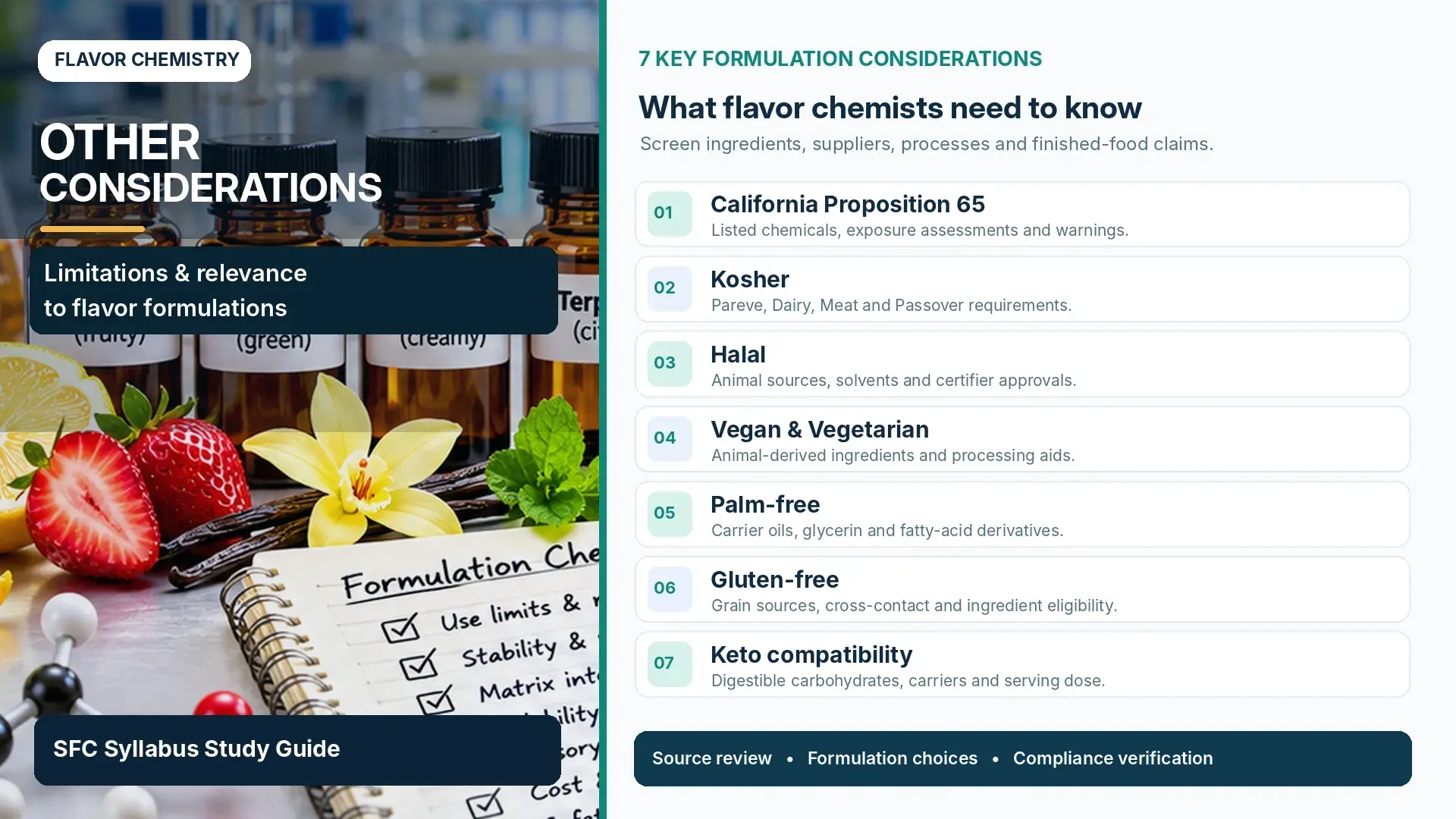
This study guide provides information on the following topics that the Society of Flavor Chemists requires flavorist candidates to understand:
Other Considerations – understanding of the limitations and its relevance to flavor formulations
Proposition 65
Kosher Certification – Pareve, Dairy, Meat, Passover
Halal
Vegan, Vegetarian
Palm free
Gluten free
Keto
Other Considerations in Flavor Formulations
Limitations, ingredients, reformulation approaches, calculations and practice questions for seven SFC syllabus topics.
Scope: California Proposition 65; Kosher; Halal; Vegan and Vegetarian; Palm-free; Gluten-free; Keto.
Syllabus reference: Society of Flavor Chemists (SFC), January 2026 syllabus, Section III, “Other Considerations — understanding of the limitations and its relevance to flavor formulations.”
Study note: The SFC syllabus identifies the topics. The explanations, tables, scenarios and practice questions in this guide are educational material and are not official SFC model answers. Regulatory requirements and certification policies change, so current requirements should be verified for each product, market and certifying body.
1. Overview#
A flavor can be organoleptically successful yet unsuitable for a customer's religious, dietary, regulatory or supply-chain requirements. A legally permitted food flavoring may also be incompatible with a specific certification. A plant-derived flavor is not necessarily Halal, Kosher or palm-free, and the status of a concentrated flavor does not by itself establish the compliance of the finished food.
The flavor chemist must understand which raw materials and processes are limited and why, how those limitations affect performance, sourcing, manufacturing and labeling, and how to reformulate while retaining the required sensory profile.
2. Comparison of the seven SFC considerations#
| Consideration | Principal limitation | Flavor-formulation relevance |
|---|---|---|
| Proposition 65 | Exposure to listed carcinogens or reproductive toxicants | Chemical selection, contaminants, exposure calculations and warning decisions |
| Kosher | Ingredient origin, religious classification, equipment and processing | Dairy, meat, animal derivatives, grape products, Passover requirements |
| Halal | Prohibited animal sources, certain alcohol uses and manufacturing controls | Solvents, gelatin, glycerin, enzymes and meat extracts |
| Vegan / Vegetarian | Animal-derived ingredients and, depending on the standard, processing materials | Dairy, honey, animal-based reaction precursors and carriers |
| Palm-free | Palm-derived feedstocks and downstream derivatives | MCT, glycerin, emulsifiers and fatty-acid derivatives |
| Gluten-free | Gluten-containing grains, prohibited derivatives and cross-contact | Malt extracts, cereal flavors, carriers and hydrolyzed proteins |
| Keto | Digestible carbohydrate contribution and finished-food dietary suitability | Sugars, maltodextrin, carriers and sweetness modulation |
These requirements are independent: compliance with one does not establish compliance with another.
3. California Proposition 65#
A. Definition and purpose#
California Proposition 65, the Safe Drinking Water and Toxic Enforcement Act of 1986, generally requires covered businesses to provide clear and reasonable warnings before knowingly and intentionally exposing people to certain state-listed chemicals unless an applicable exception or exemption applies. It is an exposure-based warning law rather than a list of banned food ingredients.
B. Technical vocabulary#
| Term | Meaning |
|---|---|
| OEHHA | California Office of Environmental Health Hazard Assessment |
| NSRL | No Significant Risk Level, generally used for cancer-risk safe-harbor analysis |
| MADL | Maximum Allowable Dose Level, generally used for reproductive-toxicity analysis |
| Safe-harbor level | Exposure level generally not requiring a Proposition 65 warning for the relevant endpoint |
| Exposure | Amount of a chemical a person is expected to encounter under relevant use and consumption conditions |
| Naturally occurring exemption | A narrow, conditional rule for some listed chemicals naturally present in foods; not a blanket exemption for natural flavors |
Concentration and exposure are different measures. The percentage of an ingredient in a flavor concentrate does not by itself determine whether a warning is required; finished-food dosage, typical consumption, chemical origin and the relevant legal exposure rules must also be considered.
C. Substances and contaminants to investigate#
| Example | Why a flavor chemist may encounter it |
|---|---|
| Myrcene | Constituent of some citrus and other essential oils |
| Pulegone | Constituent of certain mint-related oils |
| Methyleugenol | Can occur in various botanical essential oils |
| Estragole | Can occur in tarragon, basil and anise-related botanical materials |
| Safrole | Can occur in certain botanical extracts and oils |
| Lead | Potential environmental contaminant of spices and botanicals |
| Cadmium | Potential environmental contaminant of agricultural raw materials |
| Acrylamide | May form in certain high-temperature food processes |
| Furan | May form during thermal processing of some foods |
These examples indicate what to investigate; they do not mean that every use, concentration or source requires a warning. Current listing status, exposure route, potential exemptions and safe-harbor levels must be confirmed for each case.
D. Formulation limitations#
- Essential oils are chemically complex and may contain variable amounts of listed substances.
- “Natural” status does not by itself establish an exemption.
- Thermal processes may create additional contaminants or reaction products.
- Botanical composition can change with cultivar, origin, harvest and processing.
- Supplier composition data, analytical methods and representative exposure estimates may be needed.
- A customer may impose ingredient exclusions stricter than the minimum legal requirements.
E. Worked scenario: mint flavor#
Objective: Build a mint flavor using botanical oils. Issue: Some mint-related oils may contain pulegone. Formulation workflow: (1) obtain constituent and specification data; (2) identify potentially listed chemicals; (3) calculate ingredient contribution to the finished food; (4) estimate exposure under relevant consumption assumptions; (5) consult regulatory specialists on whether a warning, substitution or further testing is appropriate; and (6) adjust the botanical blend or use suitable alternative aroma materials when required.
F. Review questions#
- Does Proposition 65 ban all listed chemicals in flavors? No; its principal business obligation generally concerns warnings about qualifying exposures.
- Are natural flavors automatically exempt? No; a valid exemption must apply.
- What is the key quantitative distinction? Chemical concentration in the flavor versus actual consumer exposure to that chemical.
4. Kosher certification#
A. Definition#
Kosher describes foods, ingredients and manufacturing practices that comply with Jewish dietary law (kashrut). Ingredient identity, source, plant, equipment, processing and certifier approval may all matter.
B. Kosher categories#
| Category | Meaning | Flavor example |
|---|---|---|
| Pareve / Parve | Neither meat nor dairy under the certifier's rules; eggs and kosher fish may be permitted | Certified Pareve fruit or butter-style flavor |
| Dairy | Contains dairy ingredients or has dairy status under relevant equipment rules | Butter flavor with approved butter oil |
| Meat | Uses approved kosher meat ingredients or has meat status through processing | Certified kosher beef flavor |
| Passover | Subject to additional requirements involving chametz, relevant kitniyot customs, and manufacturing | Specifically approved Passover vanilla flavor |
C. Ingredients needing special review#
| Material | Concern | Possible response |
|---|---|---|
| Butter oil | Dairy classification | Use an approved Pareve butter-note system |
| Whey | Dairy classification | Choose suitable non-dairy carriers |
| Cheese extract | Dairy source, enzymes and manufacturing | Obtain ingredient- and process-specific certification |
| Beef extract | Kosher animal origin and slaughter | Use certified extracts or a Pareve savory formulation |
| Gelatin | Species, source and processing | Approved alternative encapsulation materials |
| Glycerin | Possible animal-derived origin | Certified appropriate vegetable grade |
| Grape or wine-based derivatives | Special Kosher treatment | Certifier-specific approval |
| Multi-ingredient flavor bases | Hidden ingredients and equipment considerations | Confirm every component and production location |
D. Creating a Pareve buttery or creamy flavor#
Dairy-like aroma can sometimes be achieved without dairy by using suitably approved buttery and creamy ingredients, such as acetoin, diacetyl, selected fatty-acid materials and lactones. A chemical's name alone does not establish its Kosher status; sourcing, manufacture and certifier acceptance still matter. A Kosher Pareve flavor is not necessarily vegan, because Pareve can allow some animal-origin ingredients such as eggs or fish.
E. Passover limitations#
Chametz restrictions involve specified grains and leavening-related dietary rules; kitniyot customs may impose further restrictions on corn, rice, soy and related materials for some communities. Check ethanol, glucose syrups, maltodextrin, dextrins, fermentation media, enzymes, vinegars and carriers. A gluten-free ingredient is not necessarily Kosher for Passover; even an ingredient with negligible measured gluten may be inappropriate because of its source or manufacturing history.
F. Manufacturing limitations#
Shared equipment, cleaning/Kosherization, heat, product changeovers, supplier substitutions, location-specific approval and certificate validity can alter Kosher status. The certifier makes the final determination.
G. Worked scenario: Pareve creamy vanilla#
Challenge: A rich cream extract makes a vanilla profile dairy. Solution: Replace the extract; use certified Pareve vanilla/vanillin and suitably sourced acetoin, lactone and fatty notes; verify solvents/carriers and manufacturing; and obtain certifier approval. Rebalance creaminess and release in the finished beverage.
H. Review questions#
- Can a butter-like flavor be Pareve? Yes, if composition and manufacture qualify.
- Does Kosher status establish Halal status? No.
- Why can identical chemicals differ in Kosher status? Source, processing, equipment and certification can differ.
5. Halal certification#
A. Definition#
Halal means permissible under Islamic dietary requirements; haram means prohibited. Flavor evaluation can involve animal source, method of slaughter, solvents, fermentation, processing aids, equipment and cross-contact. Certification requirements vary across certifiers and markets.
B. Critical ingredients#
| Material | Halal question |
|---|---|
| Pork-derived materials | Prohibited |
| Gelatin | Species, source, process and certification |
| Animal fats | Species and applicable slaughter standards |
| Meat extracts | Animal origin, slaughter and processing |
| Enzymes | Source organism or animal and processing inputs |
| Glycerin | Animal, vegetable or synthetic origin |
| Mono-/diglycerides | Origin of fatty acids and glycerol |
| Ethanol | Source, intended use, amount and certifier requirements |
| Fermented flavor materials | Media, aids and alcohol development |
| Flavor carriers | Potential prohibited feedstocks |
C. Alcohol in flavor systems#
Ethanol is commonly used to dissolve botanical extracts and aroma compounds, influence volatility and support dispersion. Different scenarios require separate review: ethanol intentionally added as a solvent; ethanol naturally present in an extract; ethanol produced by fermentation; manufacturing residuals; and concentrated flavor versus finished food. No single ethanol percentage guarantees Halal acceptance, and a specific dilution does not by itself make a flavor Halal.
D. Alternative solvent and carrier systems#
| Alternative | Advantage | Technical limitation |
|---|---|---|
| Water | Broad utility | Poor solvent for many hydrophobic aromas |
| Propylene glycol | Useful co-solvent | Not suitable for every essential-oil fraction |
| Glycerin | Humectant and co-solvent | Viscous; may have limited solubility for some materials |
| Triacetin | Solvent for certain oil-soluble materials | Not ideal for every beverage or product |
| Appropriate vegetable MCT | Oil-soluble carrier | Requires emulsion or dispersion in water-based beverages |
| Emulsion system | Disperses hydrophobic ingredients | Requires physical-stability and emulsifier evaluation |
Every alternative must be checked against the intended product application and relevant certification rules.
E. Halal savory flavor development#
Halal-compatible chicken- or beef-style flavors can sometimes be built without meat ingredients using approved yeast extracts, vegetable protein materials, amino acids, reducing sugars, reaction flavors and selected sulfur, fatty and roasted aroma materials. All ingredients, including reaction precursors and processing aids, require review.
F. Review questions#
- Is vegetable glycerin always Halal? Not necessarily; its source and certification status must be verified.
- Can a meatless chicken-style flavor be Halal? Potentially, if all materials and processes qualify.
- What is a major formulation challenge? Replacing non-approved alcohol, animal materials or carriers while retaining solubility, stability and flavor character.
6. Vegan and Vegetarian#
A. Definitions#
Vegetarian generally excludes meat, fish and slaughter-derived ingredients; some vegetarian diets allow dairy and eggs. Vegan excludes animal-derived materials including dairy, eggs and honey, and certification programs may also consider processing aids, testing and cross-contact.
B. Ingredient reference#
| Ingredient | Typical vegetarian status | Typical vegan status |
|---|---|---|
| Plant-derived essential oils | Generally suitable | Generally suitable |
| Appropriate microbial fermentation flavors | Potentially suitable | Potentially suitable |
| Butter oil / whey | Often permitted | Not suitable |
| Honey | Often permitted | Not suitable |
| Egg-derived ingredients | Often permitted | Not suitable |
| Fish oil / meat extract | Not suitable | Not suitable |
| Animal-derived gelatin | Not suitable | Not suitable |
| Plant-derived glycerin | Generally suitable | Generally suitable |
Specific certification standards, source and production methods take precedence over these general classifications.
C. Hidden animal-derived inputs#
Investigate glycerin, fatty acids, emulsifiers, lactones, enzyme preparations, fermentation nutrients, reaction precursors, encapsulants and processing aids. Purification alone does not necessarily establish vegan suitability if the production feedstock or process violates the chosen standard.
D. Vegan dairy-style flavors#
| Desired sensation | Possible formulation approach |
|---|---|
| Buttery | Suitable acetoin, diacetyl and related buttery notes |
| Creamy | Selected lactones and creamy components |
| Milky | Balance of fatty, lactonic and delicate creamy notes |
| Yogurt-style | Lactic, cultured and acetoin-like notes |
| Cheese-style | Fatty acids, sulfur nuances and approved fermentation inputs |
| Caramelized milk | Caramel, brown and approved Maillard-style notes |
Material origin and process must support the vegan claim even when the molecules also occur in animal-derived foods.
E. Vegan savory flavors#
Plant-based roasted-beef-style flavors may combine approved yeast extract, amino acids and reducing sugars, sulfur compounds, fatty aldehydes, ketones and botanicals. A practical difficulty is recreating cooked-meat depth and lingering fat character without animal-derived precursors.
F. Claim distinction#
“Plant-based” and “vegan” are not necessarily identical under every marketing or certification scheme. Obtain the customer's exact definition before formulating.
G. Review questions#
- Can lactones be vegan? Yes, depending on source, manufacturing and the applicable standard.
- Can a flavor be vegetarian but not vegan? Yes; a cheese flavor containing dairy is an example.
- Why check processing aids? Some standards consider animal-derived inputs even when not declared in the finished ingredient list.
7. Palm-free formulation#
A. Definition#
Palm-free generally excludes palm oil, palm kernel oil and derivatives within the scope of the customer or certification requirement. Palm oil comes from fruit flesh; palm kernel oil from the kernel. Oleochemicals made downstream from either source may be difficult to identify by their chemical name alone.
B. Ingredients of possible palm origin#
| Ingredient | Potential concern | Flavor use |
|---|---|---|
| MCT oil | Can be made from palm kernel-derived fractions | Oil-soluble carrier |
| Glycerin | Can originate from palm-based oils | Solvent / humectant |
| Mono- and diglycerides | Fatty acids may be palm-derived | Emulsification |
| Polyglycerol esters | Fatty acids and/or glycerol may be palm-derived | Emulsification |
| Sorbitan esters | Fatty acids may be palm-derived | Stabilization |
| Sucrose esters | Fatty acids may be palm-derived | Emulsification |
| Fatty-acid esters | Lipid feedstock may be palm-derived | Processing / carrier role |
| Certain anti-foam or release aids | Could use palm-derived components | Manufacturing |
Not every grade of these materials comes from palm.
C. Palm-free and sustainable palm#
Palm-free concerns exclusion of specified palm-derived ingredients. Sustainable palm, including certain RSPO supply-chain claims, may still involve palm-derived ingredients. RSPO certification by itself does not demonstrate palm-free status.
D. Formulation effects#
Substitutions can change solubility, emulsion droplet size, creaming, ringing, oxidative stability, viscosity, clouding, flavor release, cost and shelf life. Supplier origin and lot traceability are therefore as important as functional equivalence.
E. Worked scenario: orange emulsion#
A beverage emulsion contains palm-kernel-derived MCT. Verify the source and find a suitable non-palm carrier; check the fatty-acid source of every emulsifier; reformulate; test droplet size, creaming, ringing, flavor release and oxidation; and retain written supplier traceability records. Coconut-derived MCT can sometimes be considered but cannot be assumed equivalent without testing.
F. Review questions#
- Is vegetable glycerin always palm-free? No.
- Does RSPO mean palm-free? No.
- What supplier information is essential? Feedstock, derivative origin, chain of supply and written confirmation against the customer's definition.
8. Gluten-free formulation#
A. FDA context#
For FDA-regulated foods in the United States, 21 CFR 101.91 sets conditions for a “gluten-free” claim. Generally, unavoidable gluten must be below 20 ppm, and the food must also satisfy additional ingredient-based restrictions. A result below 20 ppm is not sufficient on its own.
B. Major gluten-containing grains#
Wheat (including spelt and related varieties), barley, rye and crossbreeds such as triticale are the main concern. Oats do not inherently contain the same gluten proteins but require cross-contact and supply-chain verification.
C. Flavor materials requiring review#
| Material | Potential issue |
|---|---|
| Barley malt extract | Gluten-containing grain ingredient |
| Malt flavoring | Potential barley-derived components |
| Wheat hydrolyzed protein | Source and hydrolysis-related complications |
| Cereal flavor blends | Unclear grain source |
| Wheat-flour-containing seasonings | Direct prohibited source |
| Maltodextrin | Verify source and processing when relevant |
| Starch-based carriers | Origin and manufacturing records |
| Fermentation-derived components | Starting material and regulatory documentation |
| Powdered flavors | Shared-equipment cross-contact |
Maltodextrin is not inherently forbidden in gluten-free applications. Its source, purification and applicable ingredient conditions matter; appropriately processed wheat-derived maltodextrin may also qualify.
D. Hydrolyzed and fermented ingredients#
Hydrolysis and fermentation can fragment gluten proteins, complicating some detection methods. FDA regulations for relevant ingredients and foods require suitable records and controls; a low or negative test result alone may not establish regulatory eligibility.
E. Worked scenario: roasted malt style#
To replace a noncompliant barley malt ingredient, rebuild roasted grain notes using appropriately sourced toasted, caramel and Maillard-type materials or qualifying gluten-free grain ingredients; verify powdered carriers, manufacturing cross-contact and the finished-food claim.
F. Gluten contribution calculation#
If a flavor contains 100 ppm gluten and is used at 0.5% in a finished food, and there is no other contribution:
100 ppm × 0.005 = 0.5 ppm gluten contributed to the finished food.
This figure is the flavor's contribution only and is not a legal determination. The original ingredient and finished product must still meet all applicable gluten-free rules.
G. Review questions#
- Can barley malt be added because final gluten is under 20 ppm? Not on that basis alone; FDA ingredient restrictions also apply.
- Is wheat-derived maltodextrin always unacceptable? No; eligibility depends on processing and requirements.
- Why is hydrolyzed protein difficult to assess? The process may fragment gluten beyond reliable detection by some conventional assays.
9. Keto (ketogenic diet compatibility)#
A. Definition and regulatory context#
Ketogenic diets typically restrict carbohydrates and emphasize higher fat intake, with protein depending on the intended dietary pattern. The formulation question is usually the digestible carbohydrate contribution and overall suitability of the finished food. The U.S. FDA does not provide a single generally applicable numerical legal definition for a food simply labeled “keto.” Marketing claims must still be truthful and not misleading.
B. Ingredients to consider#
| Ingredient | Formulation consideration |
|---|---|
| Sucrose / dextrose / fructose | Digestible sugars |
| Maltodextrin / corn syrup solids | Typically digestible carbohydrate carriers |
| Erythritol | Often used as a lower-calorie sweetener |
| Stevia and monk-fruit sweeteners | High-intensity sweetness with small use-level contribution |
| Allulose | Has distinct metabolism and U.S. labeling treatment |
| Glycerin | Requires nutritional and use-level review |
| MCT oil | Primarily fat; oil-soluble carrier |
Commercial grades may contain additional carriers or bulking ingredients; evaluate the actual supplied material.
C. Effect of carriers#
A powdered vanilla or berry flavor may contain substantial maltodextrin or starch. An active aroma blend can have negligible sugar while its delivery system materially increases carbohydrate per serving. A more concentrated flavor or a non-carbohydrate delivery system can help, but solubility, dosing and stability must still be confirmed.
D. Carbohydrate calculation#
For a 40 g serving and a flavor used at 1% that contains 70% digestible carbohydrate:
40 g × 0.01 × 0.70 = 0.28 g digestible carbohydrate contributed per serving.
The remaining finished-food ingredients must also be counted.
E. Net carbohydrates#
A common commercial concept is net carbs = total carbohydrate − fiber − selected excluded carbohydrates, but there is no single universally adopted U.S. regulatory definition of net carbohydrates. Treatment of sugar alcohols, allulose and certain fibers varies by method. The nutrition calculation should be documented and agreed with regulatory and nutrition specialists.
F. Worked flavor scenarios#
Keto-style caramel: Reduce a maltodextrin-rich delivery system, use a more concentrated caramel profile and rebuild brown sweetness and mouthfeel. Keto-style chocolate: Balance cocoa/roasted character, bitterness and sweetness with permitted low-carbohydrate ingredients and appropriate fats or emulsions. In either case, a keto-positioned flavor does not establish that the finished food is keto-compatible.
G. Review questions#
- Why can a powdered flavor be more difficult to use than a liquid flavor in keto applications? Powdered carriers may add digestible carbohydrates.
- Is sugar-free synonymous with keto? No.
- Is maltodextrin legally banned from all keto foods? No universal keto ban exists; its carbohydrate load may make it undesirable.
10. Combined restrictions#
Example customer brief: “Create a natural strawberry-cream flavor that is Kosher Pareve, Halal, vegan, palm-free, gluten-free and suitable for a keto-positioned beverage, while addressing Proposition 65 obligations.”
| Ingredient or material | Screening question |
|---|---|
| Vanillin | Origin, processing and certifier approval? |
| Ethyl maltol | Supplier and dietary certifications? |
| Gamma-decalactone | Vegan origin and production? |
| Acetoin | Source and process? |
| Dairy cream extract | Incompatible with vegan and Pareve requirements? |
| Glycerin | Palm origin, Kosher, Halal and vegan status? |
| Ethanol | Halal conditions and Passover requirements if applicable? |
| Maltodextrin | Digestible carbohydrates and gluten-source eligibility? |
| MCT oil | Palm-free source and carrier suitability? |
| Strawberry botanical extract | Relevant listed constituents or contaminants? |
| Modified starch | Carbohydrate contribution and source/certification? |
| Emulsifier | Animal or palm-derived source? |
This table is a checklist for investigation and does not give a pass or fail result.
11. Seven-step workflow for restricted formulations#
- Define the exact brief. Establish target countries, product matrix, usage rate, label claims, certifiers and sensory expectations.
- Screen every raw material. Include actives, essential oils, extracts, solvents, carriers, emulsifiers, antioxidants, processing aids and relevant impurities.
- Shortlist qualifying materials. Identify approved substitutions and source documentation before intensive flavor matching.
- Create and balance the flavor. Optimize top notes, body, base notes, mouthfeel, solubility, release and cost.
- Validate in the finished product. Test at the intended dose, through processing, storage and shelf life.
- Complete regulatory/certification review. Confirm documentation, exposure assessments, nutritional contributions and manufacturing controls.
- Maintain change control. Reassess upon changes to formula, supplier, feedstock, equipment, site, process or customer requirement.
12. Calculations#
| Question | Simplified equation | Application |
|---|---|---|
| How much constituent reaches finished food? | C_finished = C_flavor × flavor_use_fraction |
Substance contributions |
| How much is consumed? | mass = finished_concentration × amount_consumed |
Exposure estimates |
| What is approximate daily intake? | daily_exposure = finished_concentration × daily_food_consumption |
Proposition 65 screening |
| How many grams of digestible carbohydrate are added? | carbs = serving_mass × flavor_use_fraction × carbohydrate_fraction |
Keto suitability |
| How much ingredient is required? | ingredient_mass = batch_mass × ingredient_mass_fraction |
Compounding / scale-up |
Use consistent units and mass fractions. A regulatory exposure analysis may require additional information and methods.
Carbohydrate contribution calculator#
Adjust flavor dose, carbohydrate fraction and serving size in the calculator below. Results show the flavor's contribution only and do not determine keto compliance.
Formula: carbs = serving_mass × flavor_use_fraction × carbohydrate_fraction. The interactive calculator is available in the HTML version; the table below gives example results.
| Flavor usage in finished food | Digestible carbohydrate in flavor | Finished-food serving size | Digestible carbohydrate contributed per serving |
|---|---|---|---|
| 0.50% | 70% | 40 g | 0.140 g |
| 1.00% | 70% | 40 g | 0.280 g |
| 2.00% | 70% | 40 g | 0.560 g |
| 0.50% | 100% | 40 g | 0.200 g |
| 1.00% | 70% | 100 g | 0.700 g |
| 5.00% | 100% | 200 g | 10.000 g |
13. Documentation that flavor chemists should recognize#
| Document | Why it matters |
|---|---|
| Raw-material specification | Ingredient identity, composition and quality requirements |
| Supplier origin statement | Animal/plant/microbial origin and feedstocks |
| Certificate of Analysis (COA) | Lot-specific analytical information where relevant |
| Kosher certificate | Approved product, facility and classification |
| Halal certificate | Acceptance under a named certification body |
| Vegan / vegetarian declaration | Defined dietary standard and ingredient/process eligibility |
| Palm-free statement | Feedstock origin and traceability |
| Gluten-free declaration | Ingredient eligibility and cross-contact controls |
| Nutritional composition | Carbohydrate and other nutrient calculations |
| Proposition 65 assessment | Listed constituents, exposure basis and warning evaluation |
| Change-control records | Continued validity of prior approvals |
| Production and cleaning records | Manufacturing and cross-contact controls |
One supplier's declaration is not always enough for a finished-product claim; the applicable law, customer specification and certification body determine what evidence is required.
14. SFC-style oral examination practice#
These are original practice questions and are not SFC-issued examination items. Select a question to show its answer. All answers expand when the guide is printed.
15. What a prepared SFC candidate should demonstrate#
A well-prepared flavorist should be able to:
- Define each consideration and distinguish law, private certification and customer policy.
- Identify hidden restricted materials and process-related limitations.
- Explain why chemically identical ingredients may have different certification status.
- Replace problem ingredients with practical alternatives, describing trade-offs in aroma, solubility, stability, cost and shelf life.
- Calculate ingredient or carbohydrate contributions and explain the limits of what those numbers show.
- Evaluate equipment, manufacturing changes and supplier documentation.
- Work with several restrictions at once without assuming that one claim establishes another.
- Know when specialist legal, nutrition, analytical or certifier review is essential.
Suggested structure for an oral answer: state the restriction, the problematic ingredient, the reason it is a problem, the alternative, the sensory or technical consequence, and the verification or documentation required.
16. References#
- Society of Flavor Chemists, January 2026 Syllabus (PDF). Section III.
- California OEHHA, Proposition 65. Exposure warning framework and safe-harbor guidance.
- Orthodox Union, Kosher Certification. Kosher categories, equipment and certification requirements.
- IFANCA. Halal ingredient and certification guidance.
- The Vegan Society, Vegan Trademark Standards. Vegan certification standards.
- U.S. FDA, Gluten-Free Labeling. U.S. gluten-free claim framework.
- Roundtable on Sustainable Palm Oil (RSPO). Sustainable palm supply-chain standards (not a palm-free certification).