Canadian Flavour Regulations: Comprehensive Study Guide for Flavor Chemists
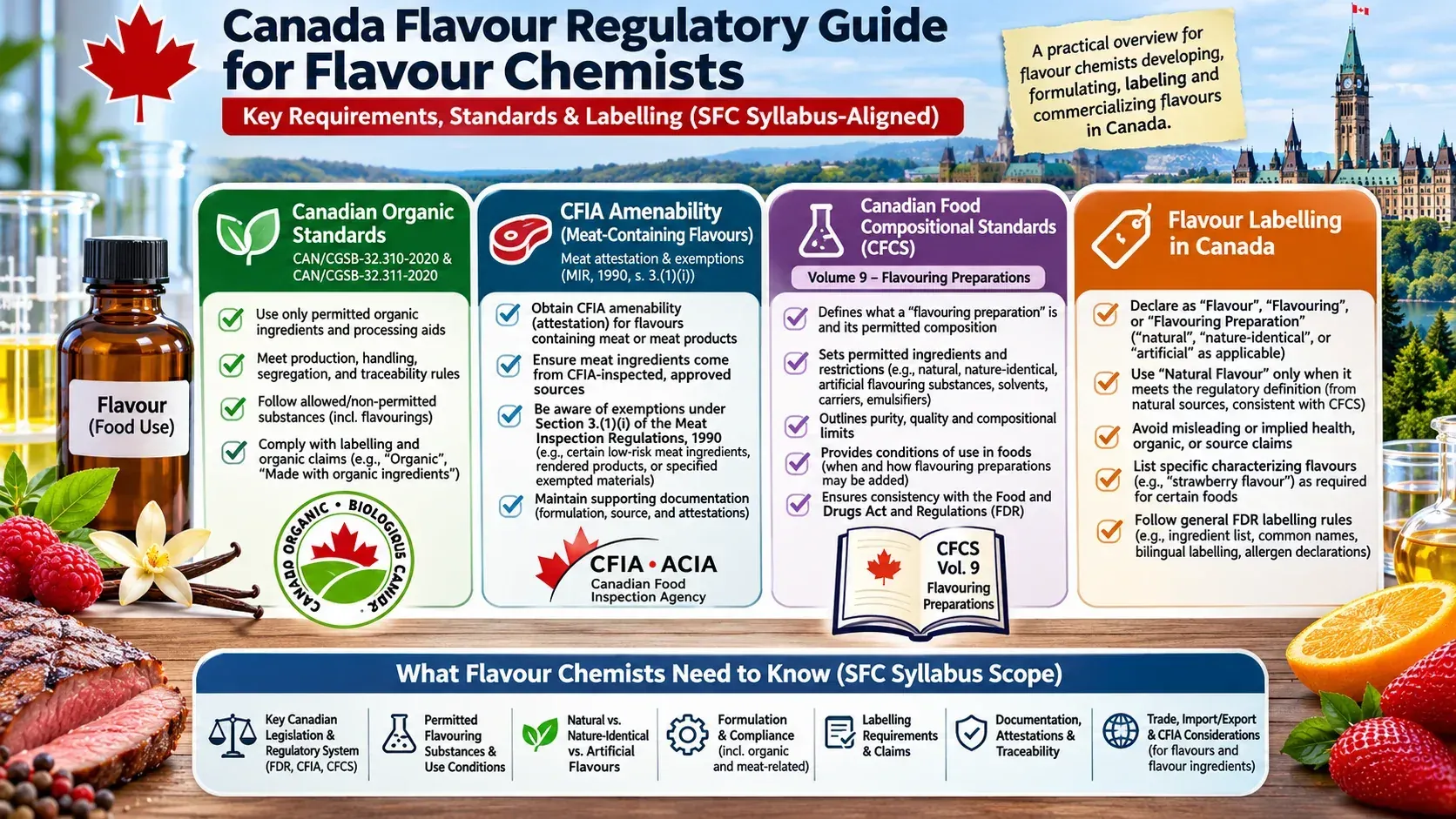
Society of Flavor Chemists (SFC) syllabus • January 2026 edition • Canadian regulatory requirements reviewed November 2026
This study guide covers the four Canadian regulatory topics identified in Section III, Flavor Regulations – International Considerations, of the Society of Flavor Chemists syllabus (January 2026).
It addresses the regulations and their effect on flavour formulation, raw-material selection, manufacturing, imports, documentation, and finished-food labeling.
1. Regulatory overview
Canada's primary regulatory authorities are:
- Health Canada: Establishes food safety requirements, food additive permissions, and standards relevant to food composition and labeling.
- Canadian Food Inspection Agency (CFIA): Administers and enforces many federal food requirements, including import controls, organic certification oversight, food inspection, and labeling compliance.
- Canadian General Standards Board (CGSB): Developed the Canadian Organic Standards referenced in the SFC syllabus.
The principal legal frameworks are the Food and Drugs Act, Food and Drug Regulations (FDR), Safe Food for Canadians Act, and Safe Food for Canadians Regulations (SFCR).
Important updates to the SFC syllabus
| SFC syllabus reference | Current regulatory context |
|---|---|
| CAN/CGSB-32.310-2020 | Superseded by CAN/CGSB-32.310-2026 |
| CAN/CGSB-32.311-2020 | Superseded by CAN/CGSB-32.311-2026 |
| Meat Inspection Regulations, 1990, Section 3(1)(i) | Historical reference; current analysis principally uses the SFCR, including Sections 25 and 1 |
| CFCS Volume 9 | Current incorporated food compositional standards for flavouring preparations |
| Flavour labeling | Governed principally by the FDR and SFCR, with CFIA interpretation and guidance |
The 2026 organic standards were published in March 2026. The Canadian organic industry has been provided a one-year transition period to adapt to the revised standards. The SFC syllabus still cites the 2020 versions, so an exam candidate should recognize both editions.
2. Canadian Organic Standards: CAN/CGSB-32.310 and 32.311
2.1 Purpose of the two standards
| Standard | Main purpose | Relevance to flavour chemists |
|---|---|---|
| CAN/CGSB-32.310 | Organic production, processing, handling, and management | Determines how an organic flavour or a flavour for organic food may be formulated and manufactured |
| CAN/CGSB-32.311 | Lists of permitted substances, with conditions of use | Determines which processing inputs, additives, aids, and other substances may be used in organic production |
These two documents must be read together. A flavour ingredient can be safe and legal for conventional food but not acceptable for organic food production.
Official documents: CAN/CGSB-32.310-2020, CAN/CGSB-32.310-2026, and CAN/CGSB-32.311-2026.
2.2 Organic formulation principles
A flavour chemist must understand the following requirements and evaluate them during raw-material selection:
Origin of flavour components
An organic-compatible formula requires review of whether flavouring materials are organic agricultural ingredients, permitted non-organic ingredients, or prohibited materials.
For example, organic-certified peppermint oil, conventional peppermint oil, and synthetic menthol have different organic compliance implications, even when they produce similar sensory effects.
Processing and extraction
Assess whether the method used to produce a flavour component is acceptable under the organic standard. Relevant processes include:
- Steam distillation and physical extraction
- Expression of citrus oils
- Solvent extraction and concentration
- Fermentation and enzymatic processing
- Fractionation, isolation, and purification
The acceptability of a process depends on the applicable standard, the materials used, and any listed restrictions. It cannot be determined solely by whether a process is considered natural.
Solvents and carriers
Evaluate all solvents and non-flavour ingredients, including ethanol, glycerol, propylene glycol, vegetable oil, maltodextrin, gum arabic, emulsifiers, and preservatives.
A compound that is permitted in conventional flavours is not automatically permitted in organic flavour formulations.
Prohibited practices
Under the 2020 standard, important prohibitions include genetic engineering, irradiation except where specifically permitted, and intentional nanotechnology with specified exceptions. The 2026 standard must be consulted for the current wording and any revisions.
2.3 Organic labeling thresholds in Canada
Organic content and permitted Canadian claims
95–100% organic
Organic claim and logo permitted
70% to less than 95%
Percentage claim only
Less than 70%
Ingredient-list identification only
Certification and the other applicable requirements remain necessary. The percentage thresholds alone do not establish organic eligibility.
For products containing 95% or more organic content, the organic claim and Canada Organic logo may be used if the certification requirements are met. Products with 70% to less than 95% may declare their organic ingredient percentage but may not use the organic logo. Products below 70% generally may identify organic ingredients only in the ingredient list.
Canada also restricts certain expressions, including standalone "100% organic" and ambiguous "made with organic ingredients" claims.
2.4 Formulation example: organic vanilla flavour
Suppose a flavour chemist is designing vanilla flavour for certified organic ice cream.
| Ingredient | What must be verified |
|---|---|
| Organic vanilla extract | Certificate, source, extraction method, processing inputs |
| Ethanol | Origin and acceptability for the intended organic use |
| Glycerol | Source, manufacturing method, and organic acceptability |
| Maltodextrin | Agricultural origin, processing method, and permitted status |
| Vanillin | Source, production method, and whether permitted for the organic application |
| Preservatives | Specific permission and restrictions under the applicable standard |
A natural source or a natural flavour designation does not, by itself, establish organic acceptability.
2.5 Documents a flavour supplier should maintain
An organic documentation package includes the quantitative formulation, raw-material specifications, organic certificates, supplier declarations, production methods, solvent and carrier information, genetic-engineering status, processing-aid information, traceability records, and evidence of compliance with the applicable standard.
SFC examination point: Be prepared to explain why a flavour compliant with ordinary Canadian food regulations might still be rejected by an organic certification body.
3. CFIA amenability: Meat-containing flavours
3.1 What amenability means
In the flavour industry, amenability refers to whether a product falls within the regulatory controls applicable to meat products.
For example, a beef-style flavour created entirely from non-meat ingredients has a different regulatory status from a flavour containing actual beef extract, beef broth, or beef-derived fat.
Canadian meat-product classification affects import eligibility, inspection, certification, manufacturing, licensing, and documentation.
3.2 Historical versus current regulations
The SFC syllabus explicitly refers to Section 3(1)(i) of the Meat Inspection Regulations, 1990. Those regulations were repealed effective January 15, 2019. The current framework is the Safe Food for Canadians Regulations and related legislation.
For examination purposes, understand the historical exemption concept, but do not use the repealed regulation as the operative legal authority for a current shipment.
3.3 Insignificant quantities of meat
Canadian rules recognize certain foods containing insignificant quantities of meat that are not treated as meat products for the relevant SFCR definition.
Important examples include:
| Food or preparation | Relevant exception |
|---|---|
| Foods containing small quantities of meat product | Generally 2% or less, calculated using cooked meat-product weight, subject to the definition |
| Flavouring and seasoning preparations | Specifically recognized in CFIA's insignificant-quantity guidance |
| Cheese containing meat | Specific conditions and a maximum of 3% added meat product |
| Certain potato-based foods | Up to 3% meat products, subject to the specified conditions |
| Certain traditional bakery products | Specific recognized categories |
These are distinct, category-specific exceptions. The 2% threshold is not a universal safe harbour for every meat-based flavour or broth.
3.4 Section 25: Broth, animal fat, meat flavour, and meat extract
Section 25 of the SFCR provides certain exceptions to meat-product-specific requirements for qualifying mixtures and products such as broth, rendered animal fat, meat flavour, or meat extract.
However, those exceptions do not mean that a meat-derived flavour is exempt from every requirement.
CFIA guidance explains that qualifying imported products must meet conditions concerning the exporting country, meat establishment, source material, and official documentation. Canadian production may also require a Safe Food for Canadians licence and preventive control plan.
3.5 Import documentation and attestations
The SFC syllabus's phrase meat-containing attestation should be understood in its historical and modern context.
Previously, importers could use CFIA letters of exemption or model importer attestations for certain products. These were replaced by official documentation processes, with the historical transition ending October 31, 2020.
For applicable United States-origin beef, pork, or poultry broths, flavours, or extracts, CFIA guidance recognizes:
- An FDA-CFSAN Certificate to a Foreign Government (CFG) for qualifying FDA-manufactured products.
- A USDA-FSIS Official Meat Inspection Certificate (OMIC) for qualifying FSIS products.
Other countries may require an OMIC or a CFIA-approved negotiated certificate. Some expressly defined low-risk product categories require no certificate. The exact requirements must be confirmed for the product and country of origin.
Important distinction: Meat-product import exceptions under the SFCR do not automatically remove animal-health import requirements. CFIA states that the Health of Animals Regulations apply to meat ingredients regardless of the insignificant-quantity threshold.
3.6 Case studies
Case A: Beef-style flavour with no beef
A formula contains plant-derived ingredients and aroma chemicals producing cooked beef notes. It does not contain meat or meat products.
Interpretation: Actual meat-content rules are not triggered merely because the flavour tastes like beef. Its ingredients, label claims, and food safety compliance must still be reviewed.
Case B: Chicken flavour containing chicken broth
The formula contains actual chicken-derived material.
Interpretation: Determine meat-product classification, animal-health restrictions, source-establishment eligibility, heat-treatment requirements, and appropriate import certification. A low inclusion rate does not by itself remove those requirements.
Case C: Instant noodles with meat seasoning
A prepackaged, shelf-stable, heat-treated meat seasoning is included in the same package as the noodles.
Interpretation: CFIA identifies a specific low-risk import-documentation exception for this type of product. The exception does not eliminate other applicable food and animal-health rules.
3.7 Required checks for animal-derived ingredients
Before incorporating beef extract, chicken broth, pork fat, animal digest, or another animal-derived component, verify its species, country of origin, source establishment, processing method, heat treatment, percentage of use, intended application, and import eligibility.
A separate check is needed for ingredients such as fish and seafood, which may be governed by different commodity-specific rules. Do not automatically apply beef, pork, and poultry requirements to them.
4. Canadian Food Compositional Standards (CFCS): Volume 9 – Flavouring Preparations
4.1 Role of Volume 9
Volume 9 of the Canadian Food Compositional Standards establishes standards of identity for specified flavouring preparations.
These standards are incorporated by reference into the Food and Drug Regulations. They are relevant when a manufacturer wants to identify a preparation using a standardized name such as Vanilla Extract, Lemon Extract, or Peppermint Flavour.
Key principle: A formula must meet the applicable identity, ingredient, and strength requirements before the corresponding standardized name can be used.
This is different from assessing whether the individual ingredients are safe for use in food.
Source: CFIA — Canadian Food Compositional Standards, Volume 9.
4.2 Core definitions: Sections 9.1.1–9.1.5
| Section | Preparation | Regulatory concept |
|---|---|---|
| 9.1.1 | Named Extract or Essence | Aromatic principles from the named plant, dissolved in permitted specified solvents |
| 9.1.2 | Artificial or Imitation Extract or Essence | Flavouring principles wholly or partly from sources other than the named aromatic plant |
| 9.1.3 | Named Flavour | A specified type of preparation derived from the named aromatic plant, other than an extract or essence defined in 9.1.1 |
| 9.1.4 | Artificial or Imitation Flavour | Flavouring principles wholly or partly from sources other than the named aromatic plant |
| 9.1.5 | Naturally Fortified Fruit Extract, Essence, or Flavour | Named-fruit preparation enhanced by other natural extractives, with at least 51% of flavouring strength from the named fruit |
For Sections 9.1.1 and 9.1.2, the solvents identified are ethyl alcohol, glycerol, and propylene glycol, individually or in combination. Section 9.1.1 also permits water and a sweetening agent.
Section 9.1.3 permits a sweetening agent, water, and edible vegetable oil in the standardized named flavour preparation.
Examination distinction: Extract, essence, flavour, naturally fortified flavour, and artificial or imitation flavour are not necessarily interchangeable names in Canada. Their meanings and the applicable standards must be checked.
4.3 Commodity-specific strength and composition standards
These standards affect how much essential oil, extractive matter, or marker component a preparation must contain.
| Flavour | Volume 9 section | Selected compositional requirement |
|---|---|---|
| Almond | 9.1.6 | At least 1% by volume of specified hydrocyanic-acid-free volatile oil |
| Anise | 9.1.7 | Flavouring strength equivalent to at least 3% by volume anise oil in alcoholic solution |
| Celery seed | 9.1.8 | Strength equivalent to at least 0.3% volatile celery seed oil |
| Cassia cinnamon | 9.1.9 | Strength equivalent to at least 2% cassia oil, from the specified source |
| Ceylon cinnamon | 9.1.10 | At least 2% Ceylon cinnamon oil, with specified cinnamic aldehyde and eugenol limits |
| Clove | 9.1.11 | At least 2% by volume clove oil |
| Ginger | 9.1.12 | Alcohol-soluble matter corresponding to at least 20 g ginger per 100 mL |
| Lemon | 9.1.13 | At least 0.2% citral derived from lemon oil |
| Nutmeg | 9.1.14 | Strength equivalent to at least 2% nutmeg oil |
| Orange | 9.1.15 | Strength equivalent to 5% specified sweet orange oil, with identity requirements |
| Peppermint | 9.1.16 | Strength equivalent to at least 3% peppermint oil, with at least 50% free and combined menthol in the oil |
| Rose | 9.1.17 | At least 0.4% by volume attar of rose |
| Savory | 9.1.18 | At least 0.35% by volume oil of savory |
| Spearmint | 9.1.19 | At least 3% by volume spearmint oil |
| Sweet basil | 9.1.20 | At least 0.1% by volume sweet basil oil |
| Marjoram | 9.1.21 | At least 1% by volume marjoram oil |
| Thyme | 9.1.22 | At least 0.2% by volume thyme oil |
| Vanilla | 9.1.23 | Specified vanilla-bean soluble extractives equivalent to the prescribed bean quantities |
| Wintergreen | 9.1.24 | At least 3% by volume wintergreen oil |
The table is a study summary, not the complete statutory specification. Some standards also prescribe botanical species, analytical characteristics, source materials, and how strength equivalence must be determined. All must be satisfied.
4.4 Key standards
Vanilla — Section 9.1.23
Canadian standardized vanilla extract, essence, and flavour must be prepared from specified vanilla beans and contain the required soluble substances in their natural proportions.
The standard refers to extractable solids corresponding to:
- At least 10 g of vanilla beans per 100 mL when bean moisture is 25% or less.
- At least 7.5 g of vanilla beans on a moisture-free basis per 100 mL when bean moisture exceeds 25%.
A vanillin solution that smells like vanilla does not automatically qualify as standardized vanilla extract.
Lemon — Section 9.1.13
A standardized lemon extract, essence, or flavour must derive from the specified lemon materials and meet the minimum citral requirement.
A formula containing synthetic citral and limonene is not automatically a standardized lemon extract even if its sensory profile resembles lemon.
Orange — Section 9.1.15
The standard covers source, flavouring strength, and specific analytical characteristics of the orange oil.
The identity and technical specification of an essential oil can therefore be as important as the flavour's sensory quality.
4.5 Questions likely to arise in an SFC interview
A candidate should be able to explain why adding vanillin does not turn a preparation into standardized vanilla extract; why a natural extract may fail a minimum strength requirement; why a source plant matters; why artificial and imitation have specific naming implications; and how a compound's compositional compliance should be documented.
5. Flavour labeling in Canada
Flavour labeling determines what the flavour manufacturer should communicate to its customers and how the finished food may be labeled.
5.1 Natural, artificial, and imitation flavour
Canadian flavour declarations should not be copied from United States labels. They must be checked under Canadian requirements.
| Declaration | Practical meaning or concern |
|---|---|
| Flavour / Flavouring | General ingredient declaration, where appropriate under applicable rules |
| Natural flavour | Must accurately describe the nature and source of the flavouring material |
| Artificial flavour | Requires appropriate artificial or imitation identification under the applicable provisions |
| Imitation flavour | Identifies an applicable artificial or imitation preparation |
| Naturally fortified fruit flavour | A specific standardized concept under CFCS 9.1.5 |
| Named natural flavour, e.g. natural cherry flavour | Must not falsely imply that the flavouring material comes from cherry when it does not |
One important Canadian rule is FDR B.10.008: where an artificial flavour is added, whether alone or combined with natural flavouring agents, the artificial or imitation description must appear as an integral part of the flavouring preparation name and in the same type size and style.
This does not mean that every finished food must display a separately worded artificial-flavour claim on its front panel. Front-panel requirements depend on other factors, including pictorial representations.
5.2 Ingredient lists and compound ingredients
Under the Canadian FDR, the ingredients of a prepackaged multi-ingredient food generally must be listed in descending order by weight, subject to applicable exceptions.
Flavouring preparations and artificial flavouring preparations are among the preparations whose components generally do not have to be individually declared when incorporated into another food, under B.01.009(2).
However, that exemption does not override mandatory declarations for relevant allergens, gluten sources, added sulphites, or other components that are specifically required to be identified.
This applies in particular to flavour formulas involving milk-derived flavours, wheat-based fermentation substrates, soy lecithin, mustard extract, or allergenic carriers.
5.3 Priority food allergens in Canada
A flavor chemist must recognize Canada's priority allergens, including categories that differ from those emphasized under United States requirements.
Canadian priority allergen and gluten-source review
Milk
Eggs
Fish
Crustaceans and molluscs
Peanuts
Tree nuts
Soy
Wheat and triticale
Sesame
Mustard
Sulphites
Other regulated gluten sources
Added sulphites have specific declaration requirements, including the relevant 10 ppm threshold. Gluten sources are addressed separately in the Canadian regulations.
When reviewing a flavour, investigate intentionally added flavour chemicals as well as carriers, extraction materials, fermentation media, processing aids, and supplier-derived subingredients.
For example, a butter flavour may contain a milk-derived component, even if the finished beverage or snack is not marketed as containing dairy.
5.4 Pictures of fruit and artificial flavour disclosures
Canadian labeling rules require special care when artwork implies the presence of a natural flavour source.
Consider a beverage that contains artificial strawberry flavour and displays strawberries on its front label.
Under SFCR Section 224, when a pictorial representation shows a natural substance and an artificial flavour simulating that substance is present, an artificial, imitation, or simulated flavour statement is required in the prescribed manner.
The statement must comply with location, language, and type-height requirements.
Conversely, CFIA gives an example of natural almond flavour being used to simulate cherry flavour. A natural almond flavour declaration may be appropriate, but calling it natural cherry flavour would misrepresent its source.
These distinctions can affect the entire product package as well as the ingredient statement.
5.5 Bilingual labeling
Canadian consumer food labels generally require specified mandatory information in both English and French, subject to exceptions.
Relevant translations include:
| English | French |
|---|---|
| Flavour | Arôme |
| Natural flavour | Arôme naturel |
| Artificial flavour | Arôme artificiel |
| Vanilla extract | Extrait de vanille |
| Ingredients | Ingrédients |
| Contains | Contient |
For an actual commercial label, the required words, presentation, placement, and any Quebec-specific obligations should be reviewed with regulatory personnel.
5.6 Food additives versus flavouring preparations
Canadian food legislation distinguishes flavouring preparations from food additives for definitional purposes.
The fact that a substance is included in a flavour does not automatically make every technological function or use level permissible.
A chemist needs to distinguish:
- A substance providing the flavour itself.
- A solvent or carrier supporting the flavour system.
- A food additive functioning in the flavour preparation.
- A food additive functioning in the final food.
- A processing aid used during manufacture.
Health Canada maintains 15 functional lists of permitted food additives, including solvents, preservatives, sweeteners, colours, and emulsifying or stabilizing agents.
Applicable permissions and maximum use levels must be evaluated in relation to the final food and the substance's intended function.
5.7 Flavoring preparation labeling versus finished-food labeling
A flavour supplier's concentrated product and the consumer's finished food may require different regulatory disclosures.
For example, a flavour manufacturer may provide an internal formulation listing every chemical component, solvent, and carrier. The ingredient declaration used by the finished-food manufacturer may instead use a permitted collective flavouring designation, while still disclosing required allergens and other components.
The flavour chemist therefore needs enough ingredient and use-level data to support both regulatory assessments.
6. Integrated regulatory decision process
The four Canadian syllabus topics can be applied by evaluating each new flavour using the following process.
1. Identify the flavour and its ingredients
Source, composition, function, manufacturing process
2. Determine applicable food standards
CFCS Volume 9, identity, strength, named flavour
3. Review special regulatory conditions
Organic, meat origin, additives, import controls
4. Verify labeling and documentation
Natural/artificial designation, allergens, bilingual statements, certificates
5. Regulatory approval before commercial use
7. SFC examination preparation: Practice questions
These questions are based on the knowledge areas of the January 2026 syllabus and the Canadian regulatory framework. They are original practice questions, not official SFC examination questions.
01. What is the difference between CAN/CGSB-32.310 and CAN/CGSB-32.311?
02. Can a flavour made entirely from natural ingredients automatically be used in certified organic food?
03. What organic-content percentage is generally needed to use the Canada Organic logo?
04. Does a product containing 1% beef extract automatically avoid Canadian meat-import controls?
05. Which current Canadian regulation replaces the syllabus's historical Meat Inspection Regulations, 1990 reference?
06. What is the difference between standardized vanilla extract and a vanillin-based artificial vanilla flavour?
07. What does the naturally fortified fruit flavour standard require?
08. What must be declared when an artificial flavour simulating pictured fruit is added to a consumer packaged food?
09. Can a flavour supplier omit allergens because the flavour's components are exempt from full declaration?
10. Why must food additives be assessed at the finished-food level?
8. Essential reference documents
The following are the principal references to study in conjunction with the SFC syllabus.
| Reference | Main study purpose |
|---|---|
| SFC Syllabus 2026 | Scope and expected knowledge |
| CFIA Organic Standards | Current organic framework |
| CAN/CGSB-32.310-2020 | Historical syllabus edition |
| CAN/CGSB-32.310-2026 | Current organic management standards |
| CAN/CGSB-32.311-2026 | Current permitted substances |
| CFIA Section 25 exemptions | Meat-product amenability |
| CFIA Meat Flavour Imports | Certificates and import rules |
| CFCS Volume 9 | Standards of identity and flavour strength |
| CFIA Ingredients and Allergens | Flavour declarations and allergens |
| CFIA Pictures and Artificial Flavours | Fruit artwork and artificial flavour labeling |
9. Final competency checklist
Canadian regulatory preparation
Explain the purpose of both organic standards and identify the 2026 updates
Identify major organic-processing restrictions and assess carriers and solvents
Explain Canadian organic percentage and logo rules
Differentiate meat-free flavours from meat-derived flavours
Explain the historical meat exemption and current SFCR Section 25
Identify meat-import documentation and animal-health considerations
Distinguish extracts, essences, flavours, and imitation preparations
Recall the major Volume 9 flavour strength standards
Explain Canadian artificial flavour declarations
Recognize when artwork triggers artificial-flavour statements
Identify Canadian priority allergens and gluten-source rules
Understand flavour-component declaration exemptions
Evaluate food additive functions and use levels
Prepare a regulatory documentation package for a flavour
Key distinctions
For the SFC interview, the four most important distinctions are:
- Natural is not the same as organic. Organic suitability depends on standards, permitted substances, processing, and certification.
- Low meat content does not automatically eliminate CFIA controls. Meat classification, import exemptions, and animal-health restrictions must be evaluated separately.
- A matching flavour profile does not establish a standardized identity. Source and compositional requirements in Volume 9 matter.
- A flavour's declaration is not necessarily the finished food's complete labeling obligation. Allergens, artificial flavours, artwork, additives, and mandatory bilingual information must also be considered.
This guide covers the core syllabus knowledge and its principal applications. For a specific commercial flavour, compliance still requires checking the full current regulatory text, the precise formula, the intended finished food, and the applicable organic transition arrangements.