South America Food & Flavor Industry Business News Report: October 16–31, 2026
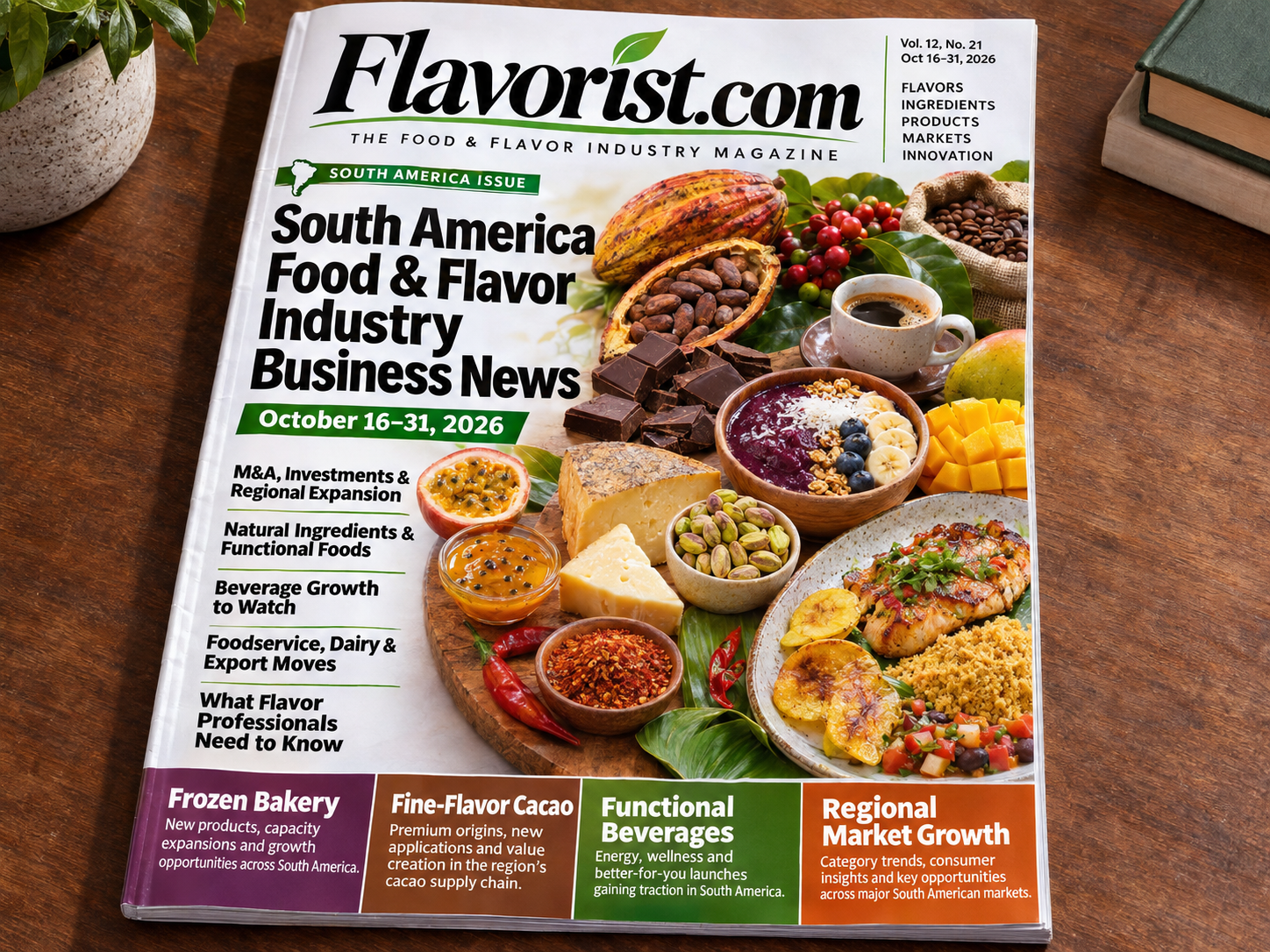
South America Food & Flavor Industry Business News Report
October 16–31, 2026 | South America
Geographic coverage: Brazil, Argentina, Chile, Colombia, Peru, Ecuador, Uruguay, Paraguay, Bolivia, and neighboring South American markets.
This report covers significant food and flavor industry business news published between October 16 and October 31, 2026, inclusive. It focuses on mergers and acquisitions, manufacturing investments, ingredient innovation, natural and specialty foods, beverages, foodservice, exports, and regional market trends.
Sources include Portuguese-, Spanish-, and English-language publications such as AgFeed, InvestNews, Mercado&Consumo, Diario Financiero, FoodNewsLatam, and industry-specific outlets.
The report is written for flavorists, ingredient suppliers, food manufacturers, product developers, distributors, foodservice operators, and regional and natural-food businesses. It is a selection of significant stories, not a complete record of every announcement in the region.
1. Major acquisitions, investments and corporate expansion
1. M. Dias Branco acquires 80% of Grespan, entering Brazil’s frozen-bakery industry
October 16, 2026 | Brazil | Mergers & acquisitions / Frozen bakery
Brazilian food manufacturer M. Dias Branco announced an agreement to acquire 80% of Grespan Pães Congelados, marking its entry into the frozen-bread segment. Based in Marília, São Paulo, Grespan manufactures more than 60 frozen bakery products and serves over 1,100 customers, including supermarkets, wholesalers, and bakeries. The company reported approximately R$139 million in 2025 revenue.
The acquisition supports M. Dias Branco’s strategy of diversifying beyond its established pasta and biscuit businesses into higher-growth food categories. Management sees frozen bakery as a fragmented industry offering opportunities for further consolidation, additional manufacturing capacity, and commercial expansion.
For bakery and flavor professionals, the transaction could create demand for specialty flour blends, enzymes, dough conditioners, fillings, savory flavors, and frozen-baking technologies. It also points to the growing importance of convenience-oriented bakery products in Brazil’s retail and foodservice markets.
The agreement has been announced, but completion has not been confirmed.
Sources: AgFeed: M. Dias Branco acquires Grespan | Dealroom: Acquisition analysis
2. Aurora Coop acquires seafood-processing complex to expand into fish production
October 29–30, 2026 | Mato Grosso do Sul, Brazil | M&A / Seafood processing
Aurora Coop announced the acquisition of assets belonging to the Mar & Terra seafood production and processing complex in Itaporã, Mato Grosso do Sul. The transaction, involving assets purchased from Bello Alimentos, gives the major Brazilian food cooperative an industrial platform for expanding its fish-processing operations.
Aurora had previously outlined plans to develop a larger aquaculture business as part of an investment cycle exceeding R$1.1 billion. Its cooperative network encompasses more than 87,000 associated farming families through 14 affiliated cooperatives. The acquisition is designed to strengthen supply integration and create additional income opportunities for participating producers.
Aurora is extending its established animal-protein expertise beyond poultry and pork into aquaculture. For food manufacturers and ingredient suppliers, the expansion may generate opportunities involving seafood processing, marinades, seasonings, frozen products, packaging, and cold-chain logistics.
It also shows the growing role of diversified protein production within Brazil’s cooperative food industry.
Sources: AgFeed: Aurora expands into fish processing | Mercado&Consumo: Aurora Coop acquires Mar & Terra assets
3. Cepêra signs agreement to acquire Karambi Alimentos and Colonial tomato brand
October 21, 2026 | Minas Gerais, Brazil | M&A / Sauces and condiments
Brazilian sauces and condiments producer Cepêra signed an agreement to acquire control of Karambi Alimentos, owner of the Colonial brand. The transaction includes the Colonial trademark, a manufacturing facility in Itacarambi in northern Minas Gerais, and associated commercial operations. Colonial products are distributed through more than 5,000 retail outlets.
The acquisition strengthens Cepêra’s position in tomato paste, sauces, and condiments while expanding its manufacturing footprint and distribution reach. Financial terms were not disclosed, and completion was expected in October or November 2026.
The deal matters to flavor professionals because tomato-based products require expertise in acidity, sweetness, spice balance, savory character, and thermal processing. A larger condiment portfolio may support new product development and increased purchasing of flavor ingredients and seasoning systems.
The transaction also shows continuing consolidation among Brazilian manufacturers of everyday grocery products, where distribution scale and recognizable regional brands remain important competitive advantages.
Source: InvestNews: Cepêra acquires Colonial brand owner
4. Chile’s Savory ice-cream shops gain new operator with ambitious expansion plans
October 28, 2026 | Chile | Foodservice / Franchise expansion
Chilean restaurant operator Fagase, which operates the Dunkin’ franchise in Chile, reached an agreement with Nestlé to become the new operator of Savory-branded ice-cream shops. Fagase already manages more than 160 Dunkin’ locations and has expanded into other international restaurant concepts.
The Savory agreement gives Fagase control of a familiar ice-cream retail format. At the time of reporting, seven Savory shops were operating under the new arrangement, with plans to exceed 20 locations by the end of 2026.
The development follows difficulties experienced by Savory’s previous franchise operator and forms part of a wider restructuring of ice-cream retail operations in Chile.
For dairy, frozen-dessert, and flavor professionals, the new franchise structure could support renewed investment in ice-cream formats, seasonal products, toppings, and premium dessert experiences. It also shows how established food brands can pursue growth through experienced local operators instead of directly managing every retail outlet.
Source: Diario Financiero: New operator for Savory ice-cream shops
5. Kraft Heinz seeks to double Brazilian business through mayonnaise expansion
October 16, 2026 | Brazil | Corporate strategy / Condiments
Kraft Heinz outlined a strategy to expand its Brazilian business by competing more aggressively in mayonnaise, a category in which established rivals such as Hellmann’s hold strong positions. The strategy builds on the company’s existing strength in ketchup while seeking additional sales opportunities in sauces, condiments, and related products.
The company is also emphasizing agricultural sourcing and the operational capabilities supporting its tomato-based portfolio. Its ability to expand into neighboring categories will depend on brand positioning, product differentiation, distribution, and consumer acceptance.
For the food and flavor industry, mayonnaise and other condiments provide substantial opportunities for sensory innovation. Manufacturers can differentiate through acidity, creaminess, herbs, spices, smoke notes, regional flavors, and premium formulations.
The initiative also shows the strategic importance of Brazil to multinational packaged-food companies. Rather than relying exclusively on established products, Kraft Heinz is seeking growth through additional consumption occasions and greater participation in everyday meals.
Source: InvestNews: Kraft Heinz targets Brazilian mayonnaise market
6. ICB Food Service enters direct retail with seven stores in Chile
October 16, 2026 | Chile | Food distribution / Retail expansion
ICB Food Service, a major Chilean supplier to hotels, restaurants, and institutional kitchens, announced an expansion into direct retail through seven stores. Traditionally focused on professional foodservice customers, the company is adapting its business model to reach consumers seeking competitive prices and convenient access to food products.
ICB Food Service operates a portfolio exceeding 2,200 products and maintains nine distribution centers serving a large portion of Chile, from Arica in the north to Puerto Montt and Chiloé in the south.
The retail initiative comes as price-sensitive consumers increasingly consider alternative shopping channels, including discount stores and wholesale-style outlets.
For food manufacturers and ingredient distributors, the move blurs the boundaries between foodservice and retail distribution. Suppliers may gain access to additional consumer channels through established business-to-business networks. The strategy may also create opportunities for larger pack sizes, specialty ingredients, prepared foods, and products traditionally sold primarily to restaurants.
Source: Diario Financiero: ICB Food Service launches direct retail stores
7. J. Macêdo plans new investment cycle exceeding R$800 million to expand value-added foods
October 28–29, 2026 | Brazil | Food manufacturing / Capital investment
Brazilian food manufacturer J. Macêdo, owner of Dona Benta flour and Petybon pasta, is preparing a new five-year investment program focused on higher-value and more convenient food products. Chief executive Irineu José Pedrollo indicated that the company intends to invest more than the R$800 million allocated during its previous investment cycle, although the new budget has not been finalized.
The earlier program included factory modernization and new production facilities in Londrina, Paraná, and Horizonte, Ceará. J. Macêdo generated R$3.76 billion in gross revenue in 2025 but faces higher wheat costs and logistical pressures in 2026.
For food and flavor professionals, the proposed investment could create opportunities in bakery mixes, pasta products, functional ingredients, flour-based convenience foods, and product reformulation. The strategic emphasis on value-added products also shows how Brazilian staple-food manufacturers are seeking differentiation rather than relying exclusively on commodity processing.
Sources: AgFeed: October 28 report | FoodNewsLatam: October 29 coverage
2. Flavor, ingredient and natural-food innovation
8. Chile’s CREAS seeks Latin American markets for sustainable food ingredients
October 16, 2026 | Chile / Regional Latin America | Functional ingredients / Commercialization
Chile’s Regional Center for Studies in Healthy Foods (CREAS) announced initiatives to commercialize sustainable ingredients developed through the TT Green Foods program, supported by the country’s economic development agency Corfo.
Representatives participated in Expoalimentaria in Peru and Food Tech Summit & Expo in Mexico, meeting ingredient manufacturers, distributors, and potential commercial partners. The development program focuses on functional dietary fibers, natural food colorants, and ingredients for animal nutrition.
Research-based ingredient innovations often face difficulties moving from laboratory development to industrial production and commercial distribution. By establishing regional relationships, CREAS hopes to create broader markets for technologies developed in Chile.
For food and flavor professionals, natural colors and dietary fibers offer opportunities in reformulated beverages, bakery products, snacks, and nutritional foods. The program also shows South America’s potential to become a source of specialized food ingredients rather than remaining primarily an exporter of agricultural commodities.
Source: FoodNewsLatam: CREAS expands sustainable ingredient commercialization
9. Peru launches Caské, an energy drink made from coffee fruit husks
October 28, 2026 | Peru | Functional beverages / Upcycled ingredients
The Central de Café y Cacao del Perú introduced Caské, an energy beverage made from the dried husk and pulp of coffee fruit, commonly called cascara. The launch included three varieties sweetened with monk fruit, agave, and sugar.
The product was developed with the National Agrarian University La Molina and received innovation support through ProInnóvate. It seeks to use coffee-processing material that would otherwise have limited commercial applications, transforming it into a beverage containing naturally occurring caffeine and antioxidant compounds.
For flavor professionals, coffee cascara can provide distinctive fruity, herbal, and tea-like sensory characteristics. These attributes offer alternatives to traditional synthetic-caffeine energy drinks and conventional coffee products.
The launch also shows how agricultural byproducts can become differentiated, value-added ingredients. For Peru’s coffee-producing communities, successful commercialization could create additional revenue opportunities while supporting local ingredient innovation and circular-economy business models.
Source: FoodNewsLatam: Caské launches coffee-cascara energy drink
10. Peruvian supplement producer Corporación UN diversifies and plans U.S. manufacturing
October 30, 2026 | Peru | Nutritional ingredients / International expansion
Peruvian nutritional supplement company Corporación UN announced plans to expand beyond traditional sports nutrition into a broader range of wellness products. The company expects revenue growth of approximately 8% to 14% in 2026 and intends to establish its own U.S. manufacturing facility during the second half of 2027.
Its expanding portfolio includes vitamins, omega-3 ingredients, resveratrol, ashwagandha, arginine, and other nutritional products. Management reports increasing interest from consumers seeking preventive wellness rather than supplements exclusively associated with bodybuilding or sports performance.
The company is also diversifying distribution into pharmacies, natural-food shops, medical and nutrition practices, supermarkets, and online marketplaces.
For ingredient professionals, the strategy reflects increasing South American demand for functional nutrition and high-value specialty ingredients. It may also create opportunities for taste-masking technologies, functional beverage powders, botanical extracts, and improved delivery formats.
The U.S. facility is still at the planning stage.
Source: FoodNewsLatam: Corporación UN expands nutrition business
11. Ecuador’s República del Cacao reaches $19 million in chocolate exports
October 23, 2026 | Ecuador | Chocolate / Premium cacao / Export performance
Ecuadorian chocolate manufacturer República del Cacao reported international sales of approximately US$19 million in 2025, representing 88% of its total revenue of US$21.6 million. The company exported approximately 1,000 metric tons of chocolate to more than 20 countries, including the United States, Canada, Italy, Malaysia, and the Netherlands.
International sales accounted for substantial portions of Ecuador’s finished-chocolate exports, while company revenue increased 36% compared with 2024.
República del Cacao focuses on transforming Ecuadorian fine-flavor cacao into higher-value finished products instead of relying exclusively on raw-bean exports. Its business serves professional pastry chefs, restaurants, food manufacturers, and consumers.
For the flavor and confectionery industry, this matters because Ecuador is an important source of fine-aroma cacao. The company’s growth shows demand for origin-specific chocolate, premium sensory characteristics, and locally processed cacao ingredients.
Source: FoodNewsLatam: República del Cacao export performance
12. Peru’s regional dairy and organic agriculture program targets higher-value foods
October 27, 2026 | Ayacucho, Peru | Regional dairy / Organic agriculture
A development initiative in Huanta, Ayacucho, is seeking to strengthen regional food production through improved dairy genetics, value-added milk processing, and expanded organic agriculture. The program is associated with the Special Development Project for the Apurímac, Ene, and Mantaro river valleys.
Rather than focusing exclusively on raw agricultural production, the initiative aims to strengthen local capabilities to transform milk into higher-value products while developing organic crops suitable for specialized markets.
This matters to Peru’s regional food sector, where smaller producers often face challenges involving productivity, processing infrastructure, and access to higher-margin markets.
For food and flavor professionals, the initiative points to opportunities in specialty cheeses, cultured dairy products, milk-based desserts, fermented foods, and products featuring regionally distinctive agricultural ingredients. Successful development could also strengthen local supply chains and create more commercially attractive offerings for specialty distributors, foodservice operators, and natural-food retailers.
Source: FoodNewsLatam: Huanta dairy and organic agriculture development
13. Peruvian artisanal goat cheeses gain international recognition in Uruguay
October 26, 2026 | Peru / Uruguay | Specialty dairy / Regional market development
Small-scale Peruvian cheese producers from the Chillón Valley near Lima won five medals at the 20th National and International Cheese Competition in Uruguay. Peru received six distinctions overall in a competition featuring approximately 400 entries from ten countries.
For regional food markets, international recognition can increase the visibility of smaller dairy producers and help artisanal cheeses compete on quality, origin, and distinctive sensory characteristics rather than price alone.
Goat-milk cheeses offer opportunities for differentiated flavor profiles, including fresh, tangy, aged, herbal, and more complex fermented styles. Recognition at specialist competitions can also support commercial discussions with premium retailers, restaurants, and specialty-food distributors.
For dairy ingredient and flavor professionals, the achievement points to the potential of regional milk sources and traditional processing techniques to create premium products. It also shows how relatively small producers can strengthen their competitive positions through quality differentiation and targeted exposure to international buyers.
Source: FoodNewsLatam: Peruvian goat cheeses win medals in Uruguay
14. The Best Açaí invests R$5 million to launch protein ice cream in Brazil
October 30, 2026 | Brazil | Product innovation / Functional frozen desserts
Brazilian frozen-dessert business Grupo The Best announced a R$5 million investment to establish Match Protein, a new brand specializing in protein-enriched ice cream. The range launches with strawberry, chocolate, and paçoca flavors, the latter inspired by Brazil’s traditional peanut confection.
Each container provides 30 grams of protein, with no added sugar and a reduced-calorie formulation. Product development focused on preserving the creaminess and sensory appeal of traditional ice cream while delivering enhanced nutritional value.
The company expects Match Protein to generate approximately R$28.7 million in annual sales and capture around 7.5% of Brazil’s protein ice-cream market in 2027. These are management targets, not achieved results.
For flavor and ingredient professionals, high-protein frozen desserts require effective control of sweetness, texture, flavor release, and protein-related off-notes. The use of paçoca also shows opportunities to combine familiar regional flavors with functional nutrition.
Source: Mercado&Consumo: The Best Açaí invests in protein ice cream
3. Major investments in Argentina, Colombia and Chile
15. Grupo Nutresa agrees to acquire Colombian hamburger chain Presto
October 22–23, 2026 | Colombia | M&A / Quick-service restaurants
Grupo Nutresa signed an agreement to acquire the Presto hamburger brand and its associated operating business, including restaurants, manufacturing facilities, and production centers. Founded in 1981, Presto is one of Colombia’s best-established fast-food brands.
The proposed acquisition would bring Presto into Grupo Nutresa’s restaurant operations, managed through Alimentos al Consumidor (ACO). The company intends to strengthen and relaunch the brand while maintaining restaurant operations and its relationships with employees and suppliers.
The transaction is expected to preserve approximately 700 jobs. It also reinforces Nutresa’s position as a diversified food group with interests spanning food manufacturing, branded products, and foodservice.
For flavor and food professionals, quick-service restaurant acquisitions can generate opportunities involving sauces, seasonings, prepared proteins, bakery products, and operational standardization. Presto’s established hamburger recipes and recognizable sauces may provide a foundation for renewed menu innovation.
The agreement has been signed, but integration has not been completed.
Sources: Blu Radio: Nutresa signs Presto acquisition agreement | Bloomberg Línea: Nutresa and Presto transaction
16. SolFrut announces US$19.5 million investment in food and pistachio processing
October 21, 2026 | San Juan, Argentina | Manufacturing investment / Natural ingredients
Argentine agricultural and food company SolFrut announced a US$19.5 million investment program covering 2026–2028 to expand processing capacity in San Juan province. The investment includes approximately US$9.5 million for a new food manufacturing facility in Sarmiento and US$10 million for the initial phase of a pistachio-processing and drying facility.
The projects are intended to transform more locally grown agricultural materials into higher-value finished products. SolFrut already has substantial agricultural operations and has expanded its involvement in pistachio cultivation, an increasingly attractive specialty crop.
For the regional food and flavor industry, pistachios have applications in confectionery, ice cream, bakery fillings, spreads, snacks, and premium desserts.
Additional processing capacity could strengthen the availability of locally produced pistachio ingredients and finished products. The investment also shows Argentina’s potential to develop higher-value agricultural supply chains through domestic industrial processing rather than relying solely on raw commodity sales.
Sources: La Nación: SolFrut’s US$19.5 million investment | Agro & Negocios: Food and pistachio processing expansion
17. Grupo Pilar Innova acquires 35% of Argentine pet-food manufacturer Vitalcan
October 27, 2026 | Argentina | M&A / Pet nutrition
Argentine consumer-products distributor Grupo Pilar Innova acquired a 35% interest in Vitalcan, becoming the largest shareholder in the pet-food manufacturer. Founded in 2001, Vitalcan produces food for dogs and cats and has developed a business serving both domestic and international markets.
The company reported 2025 revenue of approximately ARS110–120 billion, with around 85% of sales generated in Argentina and 15% through exports. Management expects volume growth of approximately 20% to 25% during 2026.
The investment forms part of Grupo Pilar Innova’s strategy to expand beyond distribution into direct ownership of manufacturing businesses. It also gives Vitalcan access to additional commercial capabilities and potentially broader distribution networks.
For ingredient and flavor professionals, premium pet nutrition increasingly requires specialized proteins, palatability enhancers, functional ingredients, and differentiated formulations. Growth in regional pet-food manufacturing can therefore create opportunities for both traditional animal nutrition suppliers and companies developing advanced ingredient systems.
Source: La Nación: Grupo Pilar Innova acquires Vitalcan stake
18. Chile’s Holding Arca plans US$10 million food manufacturing facility in Patagonia
October 31, 2026 | Punta Arenas, Chile | Regional manufacturing / Prepared foods
Holding Arca announced plans to invest approximately US$10 million in a high-technology food manufacturing facility within the Punta Arenas free-trade zone in southern Chile. The proposed plant will occupy approximately 3,500 square meters and serve hotels, ships, airlines, and accommodation facilities associated with large industrial projects.
The company intends to establish production systems capable of manufacturing substantial quantities of prepared food within relatively short periods. Management estimates that construction could require around 50 workers, while the completed operation may employ approximately 77 people.
The plant could begin operating in approximately 18 to 24 months, depending on project execution.
Patagonia’s remote location creates distinctive logistical challenges and demand for dependable institutional food supply. For ingredient suppliers, the facility may generate opportunities in frozen foods, sauces, seasonings, shelf-life technologies, and large-scale meal production systems.
Source: La Prensa Austral: Holding Arca’s food manufacturing investment
19. Sale of DIA Argentina supermarket business enters final negotiations
October 30, 2026 | Argentina | Grocery retail / Potential acquisition
The proposed sale of DIA Argentina advanced to the final stages of negotiation, with three interested groups reportedly remaining in contention. GDN, the owner of the Changomás supermarket chain, was identified among the potential buyers. Market sources suggested that a transaction could be valued at approximately US$100 million, although no definitive agreement had been signed.
The process involves one of Argentina’s established discount supermarket operators, making its outcome significant for food manufacturers and distributors that depend on modern retail channels.
A change in ownership could eventually influence product assortment, private-label strategies, commercial negotiations, and relationships with local suppliers. However, any such changes remain speculative until the buyer and transaction terms are confirmed.
For the regional food and flavor industry, discount retail is an important distribution channel for everyday packaged foods and private-label products, where affordability and formulation efficiency play central commercial roles.
Source: Infobae: DIA Argentina sale enters final negotiations
4. Food manufacturing, exports and supply-chain developments
20. MBRF reports 15% growth in international sales volume, reaching 2.72 million tons
October 20, 2026 | Brazil | Protein exports / International business
Brazilian protein producer MBRF reported international sales volume of 2.72 million metric tons during the 12 months ending June 2026, an increase of 15% compared with 2023. The company highlighted the improvement during SIAL Paris 2026 as evidence of increasing international competitiveness.
MBRF exports to 117 countries and has expanded its access to international markets through more than 300 additional export authorizations since 2022. The company attributes its growth to improved operational efficiency, scale, market diversification, and synergies following the creation of MBRF in 2025.
Brazil remains a major supplier of poultry, pork, and processed meat to international markets.
For ingredient and flavor professionals, expanding processed-protein exports can increase demand for seasoning systems, marinades, functional proteins, flavor enhancers, and preservation technologies. Regional manufacturers may also benefit from the growing international recognition of Brazilian food-processing capabilities.
Source: Mercado&Consumo: MBRF international sales increase 15%
21. JBS presents integrated multiprotein strategy to international food buyers
October 22, 2026 | Brazil | Meat processing / International trade
JBS presented its integrated international protein portfolio at SIAL Paris 2026, using the exhibition to show the scope of its beef, poultry, pork, and value-added food businesses. The presentation brought together major brands including Friboi, Seara, Pilgrim’s, JBS Beef USA, JBS Pork USA, JBS Canada, and Rigamonti.
Rather than presenting individual protein businesses separately, JBS emphasized its ability to serve customers across multiple product categories and geographic production locations.
For global food buyers, diversified manufacturing locations and protein sources can improve supply flexibility and help companies respond to changing market conditions.
For South American processors and ingredient suppliers, JBS’s approach reflects increasing demand for integrated supply-chain solutions, consistent quality, and differentiated processed foods. Its international offerings also show opportunities for Brazilian manufacturers to expand beyond commodity protein exports into prepared meals, processed meat products, and products designed for specific retail and foodservice markets.
Source: FoodNewsLatam: JBS multiprotein strategy at SIAL Paris
22. McDonald’s Chile reports 90% local ingredient sourcing
October 21, 2026 | Chile | Ingredient sourcing / Foodservice supply chains
Arcos Dorados Chile, the operator of McDonald’s restaurants in the country, reported that 90% of the ingredients used by its restaurant network come from Chilean suppliers.
The company operates 133 restaurants across Chile, extending from Arica to Puerto Montt. Its national procurement network requires consistent supplies of agricultural products, processed ingredients, and other food materials meeting standardized quality specifications.
The sourcing information was highlighted during an industry event focused on strengthening connections between local agricultural producers and food businesses.
For the Chilean food industry, McDonald’s procurement model shows the commercial importance of domestic suppliers to large international restaurant chains. Its scale creates opportunities for producers capable of delivering consistent quality, dependable logistics, and competitive pricing.
For flavor and ingredient professionals, the announcement reinforces the value of local partnerships in developing sauces, dressings, bakery components, processed vegetables, and prepared proteins. It also shows the potential for domestic ingredient companies to participate in multinational foodservice supply chains.
Source: FoodNewsLatam: McDonald’s Chile’s domestic ingredient sourcing
23. Paraguay promotes chia and natural ingredients through 12-company international delegation
October 20, 2026 | Paraguay | Natural ingredients / Food exports
Twelve Paraguayan food companies participated jointly in SIAL Paris 2026 to attract international buyers and expand commercial relationships, emphasizing chia and other agricultural food products.
The initiative focused on strengthening Paraguay’s position as a supplier of ingredients offering quality, traceability, and competitive sourcing. Companies participated through a coordinated national presence designed to increase visibility among international manufacturers, distributors, and importers.
Paraguay is an important source of chia, a seed widely used in cereals, bakery products, nutritional snacks, beverages, and plant-based formulations.
For food and flavor professionals, broader access to Paraguayan chia could support new opportunities involving fiber enrichment, texture modification, seed inclusions, and functional-food development.
Although participation in an international exhibition does not automatically translate into confirmed purchase agreements, the initiative shows an organized effort to move Paraguayan agricultural products into higher-value international ingredient channels and develop relationships with specialized food manufacturers.
Source: Última Hora: Paraguay promotes chia at SIAL Paris
24. Brazil forecasts 367 million tons of grain production amid storage-capacity constraints
October 26, 2026 | Brazil | Agricultural ingredients / Supply-chain capacity
Brazil’s agricultural supply outlook pointed to a projected grain harvest of approximately 367.1 million metric tons for the 2026–2027 season, an increase of 1.4% compared with the preceding crop cycle. According to the estimate reported by FoodNewsLatam, cultivated area could reach approximately 85.4 million hectares.
The expanding agricultural output points to Brazil’s importance as a source of grains and related raw materials for food and feed manufacturing.
However, storage limitations remain a critical challenge. Increased production without corresponding expansion in storage and transportation infrastructure can create bottlenecks, reduce operational flexibility, and increase postharvest losses.
For food manufacturers and ingredient buyers, these conditions may influence purchasing schedules, raw-material availability, logistics costs, and inventory strategies. The situation is particularly relevant to processors of corn, soybeans, wheat, and other grain-based ingredients.
The outlook shows that investment in agricultural infrastructure is becoming increasingly important alongside continued improvements in crop productivity.
Source: FoodNewsLatam: Brazil to harvest 367 million tons with storage deficit
25. Frimesa announces cost reductions amid financial pressure, raising questions about expansion plans
October 28, 2026 | Paraná, Brazil | Food manufacturing / Cooperative restructuring
Frimesa, one of Brazil’s leading agricultural cooperatives and a major producer of pork and dairy products, introduced company-wide spending restrictions after acknowledging economic and financial difficulties during 2026.
The measures include limiting business travel, suspending sponsorships and donations, and eliminating certain discretionary expenditures. They contrast with Frimesa’s earlier expansion initiatives, including a new commercial office in São Paulo and a distribution center in Brasília capable of dispatching approximately 1,200 metric tons monthly.
The cooperative reported record 2025 revenue of R$7.04 billion and had established a target of R$15 billion by 2032. Management subsequently stated that the spending controls are intended to support financial stability and preserve its investment schedule.
This matters to food and flavor suppliers because Frimesa purchases substantial quantities of ingredients, packaging, and processing services. Its austerity measures may affect procurement priorities, marketing activity, and the pace of commercial expansion, although no investment cancellation was confirmed.
Source: AgFeed: Frimesa announces spending restrictions
26. Bunge’s quarterly profit increases 91.6%, supported by South American soybean processing
October 29, 2026 | Brazil / Argentina | Agribusiness / Edible oils / Financial performance
Bunge reported third-quarter 2026 net income attributable to shareholders of US$318 million, an increase of 91.6% compared with the corresponding period in 2025. Revenue rose 7.4% to US$23.8 billion, supported by improved oilseed-processing performance and continued integration of Viterra.
The company’s soybean processing and refining operations recorded substantial earnings growth, including improved performance in Brazil and Argentina. Operating earnings in its soybean-processing segment increased 62.3% to US$547 million.
Bunge also increased its annual recurring synergy target from the Viterra acquisition from US$250 million to US$350 million.
For the food and flavor industry, these results matter because Bunge is a major supplier of vegetable oils, fats, grain-based ingredients, and other food-processing materials. Changes in processing profitability, plant utilization, and sourcing strategies can influence ingredient availability and cost structures across bakery, snacks, confectionery, and prepared foods.
The results show South America’s strategic importance within global ingredient supply chains.
Source: AgFeed: Bunge nearly doubles quarterly profit
27. Raízen shareholders approve restructuring separating sugar and bioenergy operations
October 30, 2026 | Brazil | Sugar industry / Corporate restructuring
Raízen shareholders approved measures designed to restructure one of Brazil’s largest sugar and ethanol businesses. The plan includes a potential capital increase of up to R$39.8 billion and the separation of sugar, ethanol, and bioenergy activities from fuel distribution operations.
The restructuring follows severe financial pressure, with the company having accumulated approximately R$65 billion in debt. The measures could substantially change Raízen’s ownership and operating structure, with creditors expected to receive a major equity stake.
For food and ingredient professionals, Raízen is a significant participant in Brazil’s sugar production and processing industry. Financial restructuring at this scale can affect future investment priorities, asset management, and the company’s approach to agricultural and industrial operations.
Source: AgFeed: Raízen shareholders approve major restructuring
28. Colombian milk powder imports surge 76.7%, transforming dairy ingredient sourcing
October 16, 2026 | Colombia | Dairy ingredients / Import market
Colombia experienced a sharp increase in imported milk powder during the first seven months of 2026. Imports of whole and skimmed milk powder reached 49,572 metric tons, an increase of 76.7% over the same period in 2025. Meanwhile, formally collected domestic milk remained approximately flat at 2.019 billion liters, compared with 2.025 billion liters a year earlier.
Total dairy imports reached 61,299 metric tons, with the United States accounting for the largest share, followed by Chile, France, Bolivia, Portugal, and Argentina.
For dairy processors, imported milk powder offers extended shelf life and consistent composition for applications including yogurt, ice cream, processed cheese, beverages, and bakery.
For flavor and ingredient professionals, growing reliance on imported dairy ingredients may influence formulation choices, costs, supplier relationships, and product positioning. It also intensifies competition between domestic fresh-milk producers and manufacturers using reconstituted dairy ingredients.
Source: FoodNewsLatam: Colombian milk powder imports reach record levels
29. Chile revises blueberry export forecast as growers navigate changing regional supply
October 30, 2026 | Chile / Peru | Fruit ingredients / Export outlook
Chile’s blueberry industry reduced its initial export-volume forecast for the 2026–2027 season by approximately 3%, reflecting weather-related challenges associated with El Niño. Despite the downward adjustment, projected shipments remain around 1.25% above the previous season.
The updated outlook was presented during Blueberry Day, an industry event held at the Niceblue processing facility in Linares. Exporters are also monitoring production conditions in Peru, the world’s leading blueberry exporter, as changing regional supply patterns may create commercial opportunities.
The revision matters to frozen-fruit processors, beverage producers, bakery manufacturers, and flavor ingredient suppliers that rely on consistent berry availability.
Variations in supply can influence fruit pricing, sourcing arrangements, and manufacturing decisions for juices, purées, concentrates, fillings, and other fruit-based ingredients.
The outlook also points to the importance of Chile and Peru as interconnected competitors and suppliers in the international berry market.
Source: Diario Financiero: Chile adjusts blueberry export forecast
5. Beverage industry growth and changing consumer demand
30. Michelob Ultra records 478% volume growth in Brazil
October 29, 2026 | Brazil | Beverage performance / Better-for-you positioning
Ambev reported 478% year-over-year volume growth for Michelob Ultra in Brazil during the third quarter of 2026. The brand has become an important component of the company’s strategy targeting consumers interested in beverages positioned around a more balanced lifestyle.
Ambev’s broader wellness-oriented beer portfolio, including lower-calorie, gluten-free, and alcohol-free options, grew 157% over the same period.
The results show rapidly increasing consumer interest in differentiated beverage formats, although the exceptionally high percentage growth for an individual brand may also reflect expansion from a relatively small earlier sales base.
For beverage and flavor professionals, the performance shows how established alcoholic-beverage manufacturers are responding to consumers seeking alternative nutritional characteristics and consumption occasions.
It may also encourage additional innovation in alcohol-free and lower-calorie beverages, where taste quality, aroma, mouthfeel, and overall sensory satisfaction remain essential to sustained consumer acceptance.
Source: Mercado&Consumo: Michelob Ultra grows 478% in Brazil
31. Nonalcoholic beverage consumption away from home grows 32% in Brazil
October 21, 2026 | Brazil | Beverage market research / Foodservice
Research from Worldpanel by Numerator, published in the Brand Footprint Out of Home 2026 study, found that nonalcoholic beverage consumption grew 32% across measured consumer-choice occasions outside the home. This exceeded the 21% increase reported for the broader out-of-home consumption market.
Coca-Cola ranked as the leading nonalcoholic beverage brand, followed by Guaraná Antarctica, Pepsi, Fanta, and Del Valle. Approximately 72% of analyzed beverage brands recorded growth.
The research also found that some brands expanded through increased purchase frequency, while others benefited from acquiring new consumers.
For beverage and flavor companies, the findings indicate that restaurants, convenience outlets, entertainment venues, and other foodservice locations remain important growth channels.
The results may encourage manufacturers to develop products and packaging specifically suited to immediate consumption. Distinctive flavors, serving sizes, convenient formats, and food-pairing opportunities could become increasingly important factors in capturing consumer attention during out-of-home occasions.
Source: Mercado&Consumo: Out-of-home beverage consumption study
6. Foodservice, regional markets and consumer trends
32. Seara targets foodservice growth six times faster than the Brazilian market
October 19, 2026 | Brazil | Foodservice / Corporate growth strategy
Seara, a major Brazilian processed-food and protein brand, outlined plans to increase its foodservice sales volume at a rate six times higher than the industry’s estimated average growth during 2026.
Its dedicated Seara Food Solutions business serves approximately 100,000 customers, directly and indirectly. Small and medium-sized establishments represent around 80% of its customer base, reflecting the importance of independent restaurants, snack bars, and local food operators.
The foodservice division’s revenue has increased approximately 50% over the preceding three years, providing a foundation for further expansion.
For ingredient and flavor suppliers, small foodservice operators increasingly require convenient, standardized ingredients that simplify food preparation and support consistent menu quality.
Potential opportunities include pre-seasoned proteins, sauces, prepared fillings, breaded products, and ready-to-cook food components. Seara’s growth strategy also shows how major food manufacturers are adapting their portfolios and distribution systems to serve fragmented regional restaurant markets.
Source: Mercado&Consumo: Seara’s foodservice growth strategy
33. Peruvian restaurants face rising ingredient costs as El Niño disrupts supplies
October 25, 2026 | Peru | Foodservice / Agricultural supply-chain pressures
Restaurants in Peru are facing increasing ingredient costs and supply disruptions associated with El Niño weather conditions. Heavy rainfall, changing temperatures, and reduced agricultural availability are affecting ingredients essential to regional cuisine, including potatoes, limes, onions, fish, and rocoto peppers.
According to restaurant operators interviewed by Infobae, the price of rocoto increased from approximately seven to nine soles per kilogram, while potatoes also became more expensive.
These changes are creating difficulties for businesses trying to preserve traditional menu offerings without substantially increasing consumer prices.
The development matters to food and flavor professionals because regional cuisine depends heavily on ingredients with distinctive sensory characteristics. Substitution can be difficult when products such as rocoto peppers and limes are central to a dish’s identity.
The situation may increase demand for better sourcing arrangements, ingredient preservation, frozen raw materials, and formulation solutions that help restaurants maintain flavor consistency during periods of supply disruption.
Source: Infobae: El Niño pressures Peruvian restaurant ingredient supplies
34. Peru’s foodservice and beverage outlets report continued growth
October 23, 2026 | Peru | Foodservice / Consumer market performance
Peru’s national statistics agency reported continued expansion in the country’s foodservice sector, supported by restaurants, cafés, bars, catering operations, and other prepared-food businesses.
The restaurant sector recorded year-over-year growth of 1.13% in August 2026, while the broader activity accumulated growth of 4.61% during the first eight months of the year. Beverage-serving establishments showed stronger performance, with growth of approximately 3.68%.
The results indicate continuing commercial activity in Peru’s foodservice market despite pressure on operating costs and agricultural ingredient supplies.
For flavor and ingredient professionals, expanding beverage and restaurant activity can create demand for coffee preparations, fruit syrups, sauces, seasonings, dessert ingredients, and convenient foodservice products.
The stronger performance of beverage-focused establishments is particularly relevant to companies developing distinctive fruit flavors, coffee beverages, and refreshment products. The data suggest that beverage innovation remains an important commercial opportunity within Peru’s hospitality sector.
Source: Infobae: Peruvian beverage and restaurant sector growth
35. Latin American nutritional supplement market projected to exceed $10.5 billion
October 21, 2026 | Latin America | Functional nutrition / Market research
Euromonitor International research, republished by the Latin American Alliance for Responsible Nutrition (ALANUR), projected that Latin America’s nutritional supplement market could exceed US$10.5 billion by 2029, compared with approximately US$7.33 billion in 2024. The figures imply growth of approximately 44% over five years.
The forecast covers all of Latin America, including Brazil, Argentina, Chile, Colombia, Peru, and neighboring markets.
The projected expansion reflects growing consumer interest in preventive wellness, functional nutrition, and products associated with specific health or lifestyle goals.
For flavor and food professionals, this market could create opportunities in flavored supplement powders, ready-to-drink nutritional beverages, protein-enriched snacks, botanical ingredients, and improved sensory technologies.
Manufacturers may also face greater demand for convenient delivery formats that make functional ingredients more appealing to mainstream consumers.
The figures are industry projections, not confirmed future sales.
Source: Saludiario: Latin American supplement market to exceed $10.5 billion in 2029
36. Brazilian food retail revenue rises 2.8% despite declining purchase transactions
October 26, 2026 | Brazil | Grocery retail / Consumer market research
Brazilian food retail revenue increased 2.8% year over year in September 2026, according to consumer analytics company Rock Encantech, which analyzed 125 million transactions. The increase was driven largely by higher prices and spending per purchase rather than greater shopping activity.
Average prices increased 4.1%, while average transaction value rose 4%. At the same time, the number of purchases declined 1.1%.
Supermarkets reported 3.9% revenue growth, while cash-and-carry retailers recorded a 2.3% increase. Retailers’ loyalty-program customers performed more strongly, generating revenue growth of 6%.
These findings matter to food and flavor manufacturers because they indicate pressure on consumer purchasing volumes even as nominal retail revenue expands.
For branded-food companies, this environment reinforces the importance of price architecture, pack-size innovation, accessible product formats, and value-oriented flavor development. Manufacturers may also need to consider premium differentiation alongside affordable everyday offerings to maintain consumer loyalty.
Source: Mercado&Consumo: Brazilian food retail grows 2.8%
South America: Key industry developments and implications
The 36 developments above point to several important directions for businesses entering 2027.
| Industry theme | Implications for food and flavor professionals |
|---|---|
| Mergers and acquisitions | Consolidation in bakery, condiments, seafood, foodservice, and pet nutrition, along with the possible sale of DIA Argentina, may reshape sourcing, product development, and retail distribution |
| Ingredient innovation | Chilean functional ingredients, Peruvian upcycled coffee materials, and The Best Açaí’s protein ice cream point to opportunities for differentiated, sustainable, and functional formulations |
| Premium agricultural products | Argentine pistachios, Ecuadorian chocolate, Paraguayan chia, and Peruvian specialty dairy offer higher-value market opportunities |
| Regional manufacturing | New processing investments in Argentina and Chile, along with J. Macêdo’s planned investment cycle in Brazil, point to greater demand for specialized ingredient systems and manufacturing equipment |
| Better-for-you beverages | Ambev’s wellness-oriented portfolio and Peru’s functional beverage innovation point toward additional opportunities in formulation and taste optimization |
| Foodservice expansion | Seara, Nutresa, and Peruvian beverage operators show the importance of convenience, standardized quality, and new consumption occasions |
| Agricultural supply-chain challenges | Weather-related disruptions, including Chile’s reduced blueberry forecast, and storage constraints reinforce the importance of sourcing flexibility and ingredient preservation |
| Dairy ingredient sourcing | Colombia’s 76.7% rise in milk powder imports may influence formulation choices, costs, and supplier relationships |
| Corporate restructuring and cost pressure | Frimesa’s spending cuts and Raízen’s restructuring may affect procurement and investment priorities, while Bunge’s results show the strength of South American oilseed processing |
| Retail price pressure | Brazilian food retail revenue is rising on higher prices while purchases decline, which puts more weight on price architecture, pack sizes, and value-oriented products |
Stories to watch
The most consequential business developments are M. Dias Branco’s acquisition agreement with Grespan, Aurora Coop’s seafood-processing acquisition, Nutresa’s agreement to buy Presto, SolFrut’s US$19.5 million investment, and Grupo Pilar Innova’s investment in Vitalcan. Also worth watching are J. Macêdo’s planned investment cycle, Frimesa’s cost reductions, Bunge’s quarterly results, Colombia’s rise in milk powder imports, Raízen’s restructuring, and The Best Açaí’s protein ice cream.
For readers specifically interested in flavor chemistry, formulation, and natural ingredients, the most relevant stories are Chile’s TT Green Foods ingredient initiative, Peru’s cascara-based Caské beverage, Ecuador’s fine-flavor chocolate exports, and Argentina’s pistachio-processing expansion.