Oceania Food & Flavor Regulatory Update: September 16–30, 2026
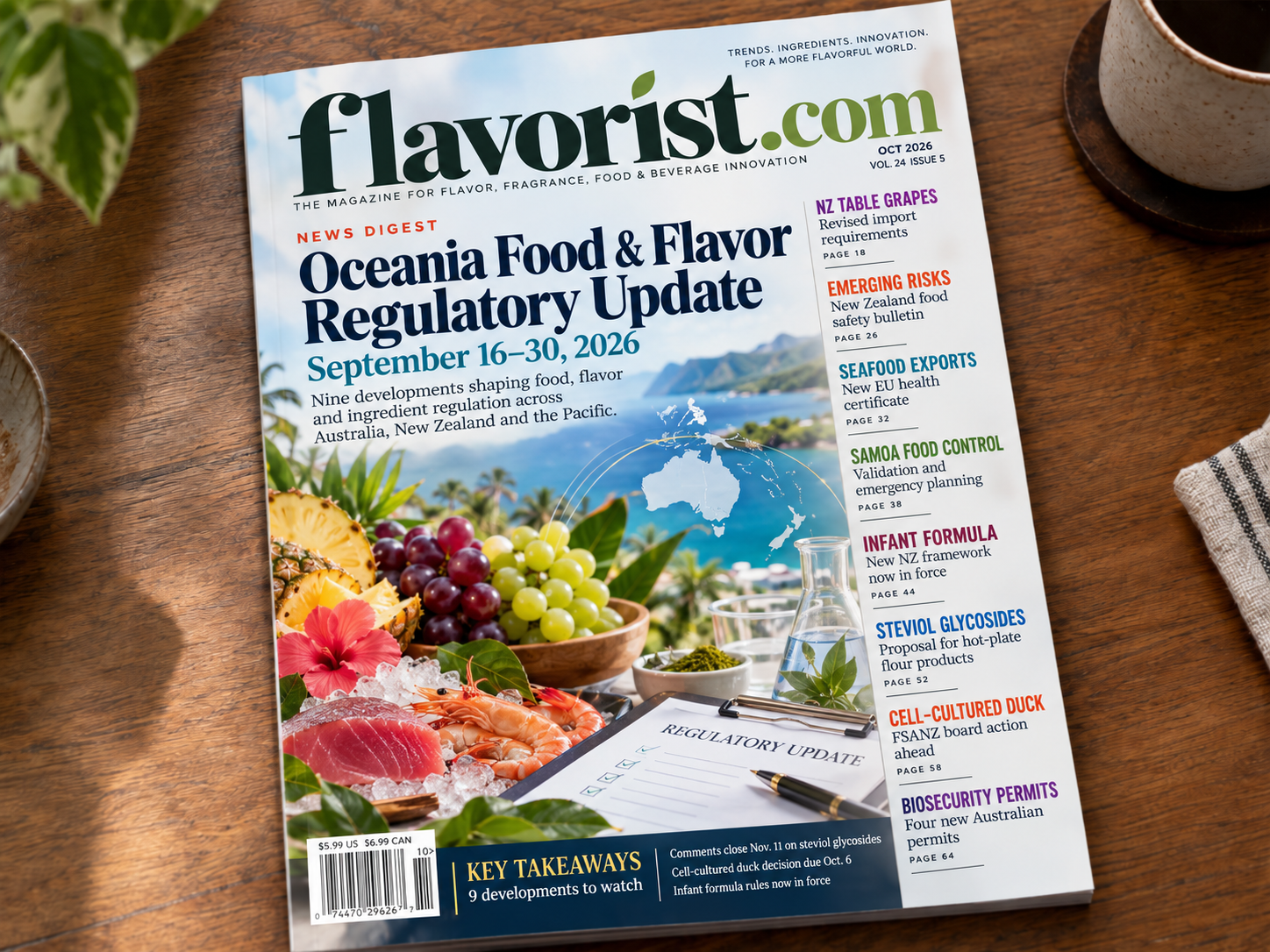
Coverage: official regulatory and government sources in Australia, New Zealand and the wider Pacific. Topics tracked include food and beverage regulation, flavors, ingredients, additives, processing aids, novel foods, labeling, infant nutrition, biosecurity and import controls, seafood, food safety and emerging policy.
It was a quiet fortnight for Oceania compared with Asia or North America. Nine developments are worth tracking. Several Australian and New Zealand measures landed just outside these dates and are not included.
1. New Zealand: revised import requirements for fresh table grapes (Sept. 16)
The Ministry for Primary Industries (MPI) brought in an updated Import Health Standard for Fresh Table Grapes (Vitis spp.) for Human Consumption, effective September 16 for the 2026–27 season. Australia's Department of Agriculture, Fisheries and Forestry (DAFF) followed with an industry notice for Australian exporters.
Pink hibiscus mealybug (Maconellicoccus hirsutus) is no longer treated as a pest of concern. The brown widow spider (Latrodectus geometricus) now needs targeted risk management along the lines already applied to redback spiders. SO₂/CO₂ treatment is an approved pathway. Ethyl formate fumigation is provided for but cannot be used until Australia's APVMA approves the relevant rates. This is a biosecurity measure first, but it feeds directly into fresh fruit trade and from there into juice, beverage, wine, flavor and fruit ingredient supply chains. Exporters need to meet the revised treatment and certification conditions before shipping.
Source: DAFF – Industry Advice Notice 2026-50
2. New Zealand: food safety emerging-risks bulletin (Sept. 16)
New Zealand Food Safety released its latest Food Safety Insights, Emerging Risks and Current Issues bulletin. It is not a regulation, but it is part of MPI's risk surveillance and points to hazards that may drive future monitoring, enforcement or standards work.
Emerging chemical, microbiological and authenticity concerns have a way of turning into supplier requirements, targeted testing or import checks, so the bulletin gives quality and regulatory teams early sight of what the government is watching. It is especially useful for companies handling botanicals, spices, extracts, fermented ingredients, alternative proteins and imported materials, where current specifications may not yet cover newer hazards. Companies selling into New Zealand can feed it into HACCP reviews, supplier assurance, contaminant specs and emerging-risk registers.
Source: MPI – Emerging risks bulletin
3. Australia: new health certificate for certain seafood exports to the EU (Sept. 16–18)
DAFF issued Market Access Advice 2026-09 on September 16, introducing a new EU health certificate for certain non-viable, wild-caught marine gastropods, echinoderms and tunicates. It took effect September 18.
The EUFXB6 certificate covers products ready for direct human consumption, such as sea urchin roe, canned abalone and abalone sauce. It responds to EU rules restricting antimicrobials used for growth promotion or yield enhancement in food-producing animals. For Australian seafood processors and exporters, the certificate is now a condition of continued EU access. It is also a good example of overseas rules creating new obligations for Oceania producers without any change to domestic standards. Suppliers of flavored or value-added seafood should check that certification, production records and export paperwork line up with the new pathway.
Source: DAFF – Market Access Advice 2026-09
4. Samoa: food control system validated, emergency response plan under way (Sept. 19)
Samoa's Ministry of Health, with FAO, WHO, the Ministry of Agriculture and Fisheries and other agencies, held a validation workshop for its National Food Control System Assessment and began work on a national Food Safety Emergency Response Plan.
Participants assessed the system across 11 areas, among them legislation and regulation, institutional coordination, laboratories, risk-based controls, foodborne disease surveillance, stakeholder engagement and emerging risks. The exercise identified gaps and set priority actions, and a roadmap was agreed for completing the emergency response plan by the end of 2026. WHO and FAO are supporting the work under a One Health approach.
Nothing changes yet for ingredients or labels. Over time, though, stronger risk-based controls, surveillance, lab capacity and coordinated enforcement will affect importers, manufacturers, distributors and exporters doing business in Samoa.
Source: WHO
5. New Zealand: new infant formula framework takes effect (Sept. 25)
New Zealand Food Safety announced updated requirements under the New Zealand Infant Formula Products Standard 2026. The new composition and labeling regime took effect on September 25, making this one of the most significant regulatory changes in the region this period.
The framework covers infant formula made in New Zealand or imported for sale there. Requirements now come from the national standard together with relevant parts of the Australia New Zealand Food Standards Code. Australia's Standard 2.9.1 no longer applies in New Zealand.
Infant formula is one of the most tightly controlled applications, so any change to permitted composition, nutrient specs, documentation or labeling can force reformulation. Manufacturers and their suppliers should update technical dossiers, labels, certificates and ingredient specs for the New Zealand regime and its transition arrangements, and should stop assuming the Australian and New Zealand rules are the same.
Source: MPI – Infant formula composition and labelling
6. New Zealand: consultation closes on seafood processing amendments (Sept. 23)
Consultation closed on proposed changes to the Animal Products Notice: Production, Supply and Processing 2026, covering fish and bivalve molluscan shellfish. It opened on September 9; it is included here because the deadline fell within the period.
The main change is a revised Part H3 on processing bivalve shellfish, with clearer rules for wet storage and depuration. Other proposals deal with verification of fish animal-material depots and the scientific names of fish in Schedule 5. MPI says the aim is partly to cut unnecessary burden, support market access and fix technical issues.
Changes to upstream processing controls can affect approved suppliers, raw material documentation and verification for companies making seafood-based flavors, stocks, extracts, sauces and seasonings.
Source: MPI – Consultation on Animal Products Notice amendments
7. FSANZ: steviol glycosides proposed for hot-plate flour products (Sept. 29)
Food Standards Australia New Zealand (FSANZ) opened consultation on Application A1325, which would permit steviol glycosides as a food additive in hot-plate flour products such as crumpets, pikelets and pancakes. The applicant is George Weston Foods Limited.
FSANZ has finished its assessment and prepared a draft variation, so this is well past the application-acceptance stage. Submissions close November 11, 2026.
High-intensity sweeteners change sweetness onset, linger and bitterness, and they often need flavor modulation to work well. Approval would open a new application area for steviol glycosides in Australia and New Zealand. Sweetener suppliers, bakery manufacturers and flavor houses should review the draft permission, proposed use levels and technological justification, and consider making a submission.
Source: FSANZ – Notification Circular 413-26
8. FSANZ: cell-cultured duck, Health Star Rating and a mycelium novel food (Sept. 29)
FSANZ's Board communiqué, released September 29, covered several items. In a preliminary discussion the Board supported in principle the proposed approach to permitting cell-cultured duck biomass as an ingredient in products such as foie gras and pâté. An extraordinary Board decision is scheduled for October 6, after Food Ministers asked for the application to be considered in-session.
The Board also reviewed progress on Proposal P1067 (Health Star Rating System), where consultation continues and stakeholders remain divided on mandatory implementation. Work also continued on P1066 (Young Child Formula Review) and on the review of food labeling in a digital environment.
Separately, the September 29 Notification Circular announced that FSANZ has accepted Application A1364 for Rhiza Neurospora crassa mycelium biomass as a novel food. Taken together, these items show steady movement on alternative proteins, fermentation-derived ingredients, nutrition labeling and digital food information, all of which bear on flavor design and ingredient commercialization.
Sources: FSANZ – Board communiqué · FSANZ – Notification Circular 413-26
9. Australia: four new standard biosecurity permits (Sept. 30)
DAFF announced four new standard biosecurity permits covering goods for animal-related purposes and goods not intended for livestock.
The permits separate ordinary goods from retail-ready goods, and animal-related uses from goods that must not be used for livestock. DAFF says importers currently using a mix of standard and non-standard permits may now qualify for the standardized conditions. This reaches beyond human food, but it matters for companies with food, pet food, animal nutrition and flavor portfolios, especially where biological ingredients or shared inputs move between human and animal supply chains.
Standard permits can cut paperwork, but importers should check whether their goods actually fit the new end-use and packaging conditions instead of assuming their current permit is still the best route. DAFF named brokers, freight forwarders and industry bodies as key stakeholders.
Source: DAFF – Industry Advice Notice 165-2026
Key takeaways for flavor and ingredient companies
- Steviol glycosides in hot-plate flour products: comments close November 11; directly relevant to sweetness and flavor modulation.
- Cell-cultured duck biomass: Board decision due October 6.
- Neurospora crassa mycelium biomass: novel food application accepted; relevant to fermentation-derived savory ingredients.
- New Zealand infant formula framework: in force from September 25; review specs and labels now.
No Food Standards Code amendment was gazetted between September 16 and 30. The most recent is Amendment No. 252 of September 1, which falls outside this period. (FSANZ – Gazette)
Scope: material developments from public sources in Australia, New Zealand and the wider Pacific that were released, or reached a significant regulatory milestone, between September 16 and 30, 2026. Routine recalls, inspection results and enforcement incidents are not covered. Items published before September 16 are excluded unless a key deadline fell within the period.
###