Oceania Food & Flavor Regulatory Update: Key legal and regulatory developments released August 1–14, 2026
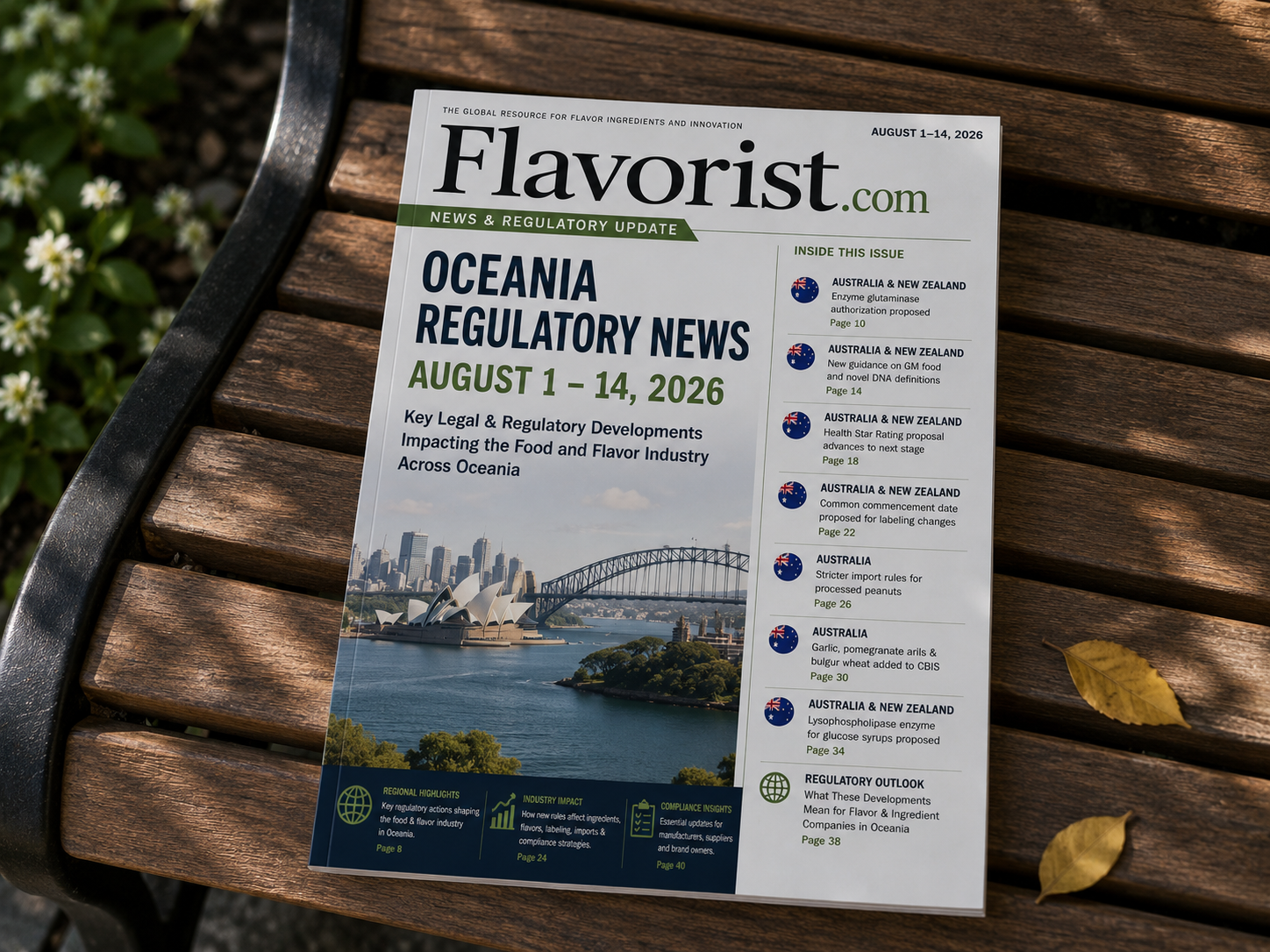
News below results from a search of the principal regulatory channels covering Australia, New Zealand and the joint Australia–New Zealand food-regulation system for developments released between August 1 and August 14, 2026. The strongest activity during this period came from Food Standards Australia New Zealand (FSANZ) and Australia's Department of Agriculture, Fisheries and Forestry.
The most commercially relevant developments involve food-processing enzymes, genetically modified food definitions, front-of-pack nutrition labeling, future food-label changeover dates, processed-peanut imports, and import controls for garlic, pomegranate and bulgur wheat.
1. FSANZ proposes authorizing protein-glutamine glutaminase as a food-processing aid
Australia & New Zealand | August 6, 2026 | Draft Food Standard | Very High Ingredient Relevance
FSANZ opened consultation on Application A1347, seeking authorization of protein-glutamine glutaminase produced using Bacillus licheniformis, with Chryseobacterium viscerum as the gene donor. The enzyme is proposed as a processing aid for a variety of food-manufacturing applications. FSANZ has prepared a draft regulatory measure, with consultation running from August 6 through September 17, 2026. (Food Standards Australia New Zealand)
This is particularly relevant to ingredient and flavor companies because glutaminase-related enzymatic processing can modify proteins and potentially influence technological properties such as functionality, texture and sensory characteristics.
Industry impact: Enzyme suppliers and manufacturers of protein-based ingredients should review the permitted applications, enzyme specifications, production-organism information and residual-enzyme considerations contained in the FSANZ assessment. Flavor companies should also monitor the authorization where enzyme treatment contributes to savory or protein-based ingredient development.
Sources: FSANZ — Application A1347 | FSANZ Notification Circular 408-26
2. FSANZ issues new guidance interpreting genetically modified food and “novel DNA”
Australia & New Zealand | August 5, 2026 | Regulatory Guidance | Very High Strategic Relevance
FSANZ announced new regulatory guidance designed to help food companies and enforcement authorities interpret the updated definitions of genetically modified food and novel DNA in the Australia New Zealand Food Standards Code. The underlying definitions were adopted in September 2025 following Proposal P1055, while the new guidance was released on August 5 to support consistent practical implementation. (Food Standards Australia New Zealand)
The issue is increasingly important as precision fermentation, gene editing and modern biotechnology generate ingredients whose regulatory status may not fit older GMO concepts.
Industry impact: Flavor and ingredient businesses using fermentation-derived proteins, enzymes, sweeteners, vitamins, aroma ingredients or other substances produced with genetically modified microorganisms should review the guidance. The distinction between the production organism, DNA remaining in the finished food and the finished ingredient itself can materially affect regulatory classification and labeling. Companies should align technical dossiers, supplier statements and customer GMO declarations with FSANZ's new interpretation.
Source: FSANZ — Guidance on GM food and novel DNA definitions
3. Mandatory Health Star Rating proposal advances in Australia and New Zealand
Australia & New Zealand | August 5, 2026 | Regulatory Proposal | Very High Finished-Food Impact
FSANZ announced on August 5 that the first consultation phase for Proposal P1067 — Health Star Rating System had closed and that the regulatory assessment was moving to its next stage. The proposal is considering whether packaged foods sold in Australia and New Zealand should be required to display the Health Star Rating (HSR) symbol. More than 380 submissions were received during the initial consultation. (Food Standards Australia New Zealand)
The HSR system has operated voluntarily since 2014, but food ministers asked FSANZ in 2026 to consider incorporating a mandatory system into food standards. A second consultation would occur if FSANZ develops a draft regulatory measure. (Food Standards Australia New Zealand)
Industry impact: Mandatory HSR labeling could strongly influence food reformulation. Companies may reconsider sugar, sodium, saturated-fat, fiber and protein levels to improve scores. Flavor companies could benefit from reformulation projects designed to reduce sugar or salt while maintaining sensory performance.
Source: FSANZ — Health Star Rating proposal progresses
4. FSANZ considers one annual commencement date for future food-labeling changes
Australia & New Zealand | August 5, 2026 regulatory update | Consultation | High Operational Impact
FSANZ highlighted its consultation on establishing a single annual commencement date for future FSANZ-initiated food-labeling changes. Under the concept, most new labeling requirements could begin on one predetermined date each year rather than becoming operative at different times. FSANZ says the approach could allow manufacturers to bundle label changes, provide greater planning certainty, reduce redesign expenses and limit manufacturing disruption. (Food Standards Australia New Zealand)
FSANZ also stresses that urgent public-health measures could still be implemented outside the common date and that the concept would apply only to future FSANZ-initiated labeling changes. (Food Standards Australia New Zealand)
Industry impact: This could materially benefit multinational food and flavor companies managing hundreds of Australian and New Zealand SKUs. Instead of repeated artwork and packaging changes throughout the year, companies might coordinate ingredient statements, allergen declarations, nutrition labels and other mandatory changes within a single annual cycle.
Source: FSANZ — Annual common commencement date for labeling changes
5. Australia tightens import requirements for processed peanuts
Australia | August 4, 2026 | Final Import-Control Change | Very High Ingredient & Snack Relevance
Australia's Department of Agriculture announced substantially revised import conditions for whole processed peanuts intended for human consumption, effective August 11. The change applies to shelled and unshelled peanuts that have been roasted, fried, boiled or blanched. Import documentation must now declare that processing has achieved 100% devitalization of peanut kernels. (DAFF)
Australia is also introducing mandatory arrival inspections for affected consignments. Authorities will check whether peanuts are sufficiently processed and whether shipments contain raw peanuts, contaminant seeds or other biosecurity-risk material. Suspected viable peanuts can be ordered for germination or seed-viability testing; noncompliant goods may ultimately require treatment, re-export or destruction. (DAFF)
Industry impact: Peanut importers, snack manufacturers, peanut-butter producers and flavor companies using roasted-peanut ingredients should revise supplier declarations and logistics planning. Importers should also expect potentially longer clearance times.
Source: Australian Department of Agriculture — Changes to processed-peanut import conditions
6. Australia expands risk-based import controls to garlic, pomegranate arils and bulgur wheat
Australia | August 11, 2026 | Import Compliance Measure | High Supply-Chain Relevance
Australia announced that three additional plant-food pathways will enter its Compliance-Based Intervention Scheme (CBIS) from August 26: offshore-treated fresh whole garlic from all countries, fresh/chilled ready-to-eat pomegranate arils from India, and commercially prepared bulgur wheat from all countries. (DAFF)
CBIS rewards importers that repeatedly demonstrate compliance with Australian biosecurity requirements by progressively applying risk-based intervention rather than identical inspection rates to every consignment. Importers must correctly classify goods, submit accurate documentation and meet existing import requirements to qualify. (DAFF)
Industry impact: Garlic is a major savory-flavor raw material, while pomegranate is used in juice, fruit preparations and natural flavor systems and bulgur is important to grain-based prepared foods. Reliable importers could ultimately experience faster clearance and lower intervention costs, while documentation errors can damage their CBIS compliance record and create delays.
Source: Australian Department of Agriculture — New plant commodities added to CBIS
7. Australia/New Zealand moves closer to possible authorization of lysophospholipase for glucose syrups and starch hydrolysates
Australia & New Zealand | Current as of August 14, 2026 | Draft Food Standard | High Ingredient Relevance
FSANZ's August 14 consultation listing shows Application A1350, concerning lysophospholipase produced by Trichoderma reesei using a gene from Aspergillus niger. The applicant, Danisco Australia, seeks permission to use the enzyme as a processing aid in carbohydrate processing to manufacture glucose syrups and other starch hydrolysates. FSANZ has prepared a draft regulatory measure and is accepting submissions through September 10. (Food Standards Australia New Zealand)
Industry impact: This is significant for flavor manufacturers because glucose syrups and starch hydrolysates are ubiquitous in confectionery, beverages, bakery products and flavor systems and can also function as carriers or bulking materials. Greater enzyme-processing flexibility may improve carbohydrate-processing efficiency or ingredient functionality. Companies purchasing Australian or New Zealand glucose syrups should monitor whether suppliers eventually adopt the processing aid and whether customer technical documentation must be updated.
Sources: FSANZ — Current food-standard consultations | FSANZ Consultation Hub
What matters most for flavor and ingredient companies
The GM-food/novel-DNA guidance is arguably the most strategically important development for advanced flavor and ingredient technologies because precision fermentation and genetically engineered microorganisms are becoming increasingly relevant to enzymes, proteins, vitamins and specialty ingredients. (Food Standards Australia New Zealand)
From an immediate operational standpoint, Australia's processed-peanut rule is the most concrete new obligation: revised documentation and mandatory inspection requirements took effect on August 11. Peanut, nut-flavor and snack companies importing whole processed peanuts should therefore treat it as an active compliance requirement rather than a proposal. (DAFF)
The Health Star Rating proposal could ultimately have the broadest finished-food impact. Making HSR mandatory could trigger extensive reformulation across beverages, snacks, cereals, dairy alternatives and prepared foods, creating additional demand for sweetness modulation, sodium reduction, masking and flavor optimization. (Food Standards Australia New Zealand)
Finally, FSANZ's enzyme activity—particularly protein-glutamine glutaminase and lysophospholipase—shows continued regulatory movement toward biotechnology-enabled food processing and deserves close attention from enzyme and flavor suppliers. (Food Standards Australia New Zealand)
Coverage note: Oceania includes numerous Pacific Island jurisdictions, but it is impossible to identify comparably material new flavor/additive/labeling measures released during this exact August 1–14 period from the smaller Pacific states that met the relevance threshold used here. The report therefore concentrates on the Australia–New Zealand regulatory system, where the material food-law activity during the period was concentrated.
###