Rebel Creamery Ice Cream Searches Surge After Chapter 11 Filing: What Happened to the Popular Keto Brand?
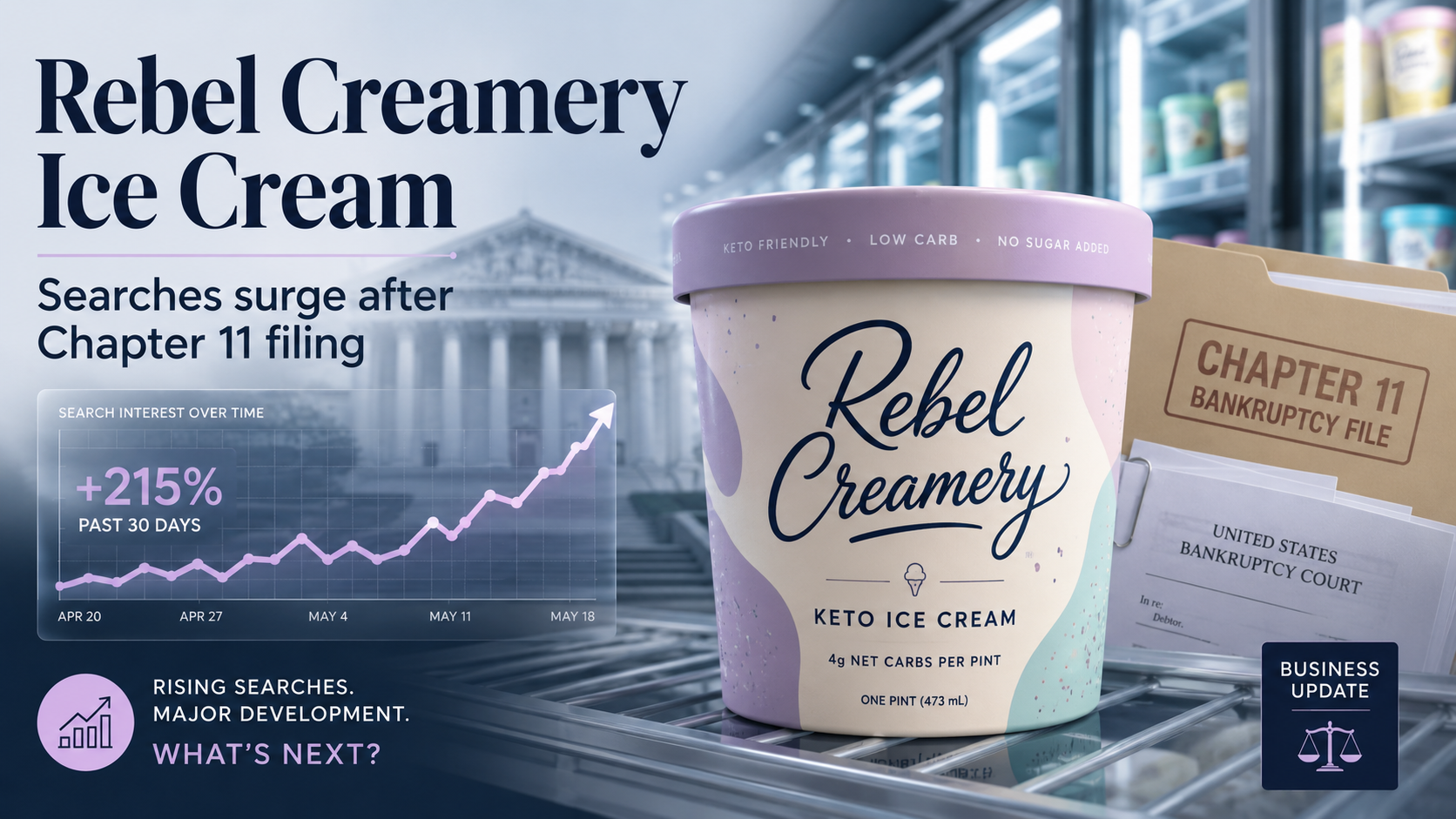
Sunday August 16, 2026 – Search interest in Rebel Creamery ice cream has jumped as consumers look for answers about the future of the popular low-carb frozen dessert brand. The sudden attention is not connected to a new Rebel flavor or a food-safety recall. Instead, Rebel Creamery has filed for Chapter 11 bankruptcy protection following a costly legal battle with rival ice cream company Van Leeuwen.
According to FOX Business, Utah-based Rebel Creamery filed for Chapter 11 protection on August 14, 2026, in the U.S. Bankruptcy Court for the District of Utah. The company reported approximately $13.78 million in assets and $23.85 million in liabilities, with one disputed claim accounting for the overwhelming majority of its listed fixed unsecured liabilities. (Fox Business)
That claim comes from Van Leeuwen Ice Cream and is worth nearly $23.8 million.
Why Did Rebel Creamery File for Bankruptcy?
The bankruptcy filing follows a long-running dispute over something shoppers see every time they walk through the freezer aisle: ice cream packaging.
Brooklyn-based Van Leeuwen sued Rebel Creamery in 2021, alleging that Rebel's pint containers copied the distinctive appearance of Van Leeuwen's packaging. The contested design included monochromatic pastel-colored pints and lids, prominent black script lettering and a simple, minimalist visual style.
On July 16, 2026, U.S. District Judge Eric Komitee ruled in Van Leeuwen's favor. The official federal court order available through Justia found Rebel liable for trade-dress infringement under the Lanham Act, as well as related New York claims. Rebel was ordered to stop selling products with packaging likely to be confused with Van Leeuwen's design and to redesign its packaging. (Justia Dockets & Filings)
Most significantly, the judge ruled that Van Leeuwen was entitled to $23.785 million of Rebel's profits from sales of the infringing ice cream pints. (Justia Dockets & Filings)
Reuters reported that the court found Rebel had intentionally adopted packaging sufficiently similar to Van Leeuwen's to create consumer confusion. Rebel had denied the infringement allegations and argued that its founders had not seen Van Leeuwen's packaging when developing their own design. (Reuters)
Rebel has not simply accepted the decision. Reports indicate that the company filed an appeal on August 12, just two days before its Chapter 11 filing. (New York Post)
Does Chapter 11 Mean Rebel Ice Cream Is Going Out of Business?
Not necessarily.
A Chapter 11 filing should not automatically be interpreted as a company closing its doors or disappearing from grocery stores. Chapter 11 is generally designed to allow a business to reorganize its financial obligations while attempting to continue operating.
The U.S. Courts' official Chapter 11 guide explains that filing typically creates an automatic stay, temporarily suspending many judgments, collection activities and other actions involving debts or claims that arose before the bankruptcy petition. That gives the debtor an opportunity to address its financial situation through the bankruptcy process. (United States Courts)
For Rebel, that distinction is important because the nearly $23.8 million Van Leeuwen judgment represents an enormous portion of its reported liabilities.
Consumers therefore should not interpret the bankruptcy headline as confirmation that Rebel Creamery ice cream has been discontinued. The company's ultimate future will depend on the Chapter 11 proceedings, its appeal and its ability to restructure its obligations.
What Is Rebel Creamery Ice Cream?
The attention surrounding the court case may introduce many consumers to Rebel for the first time, but the company has been an important player in the "better-for-you" frozen dessert category for years.
Rebel was founded in Utah and built its identity around full-fat, low-carbohydrate ice cream aimed particularly at keto and low-carb consumers. Unlike many diet-oriented frozen desserts that focus primarily on reducing fat or calories, Rebel emphasized keeping the creamy texture associated with traditional ice cream while dramatically reducing sugar.
On the official Rebel Creamery website, the brand describes its products as full-fat dairy products made without added sugar in many formulations. Its recipes commonly use ingredients such as cream, erythritol, monk fruit and chicory root fiber to reduce net carbohydrate levels. (Rebel Ice Cream)
That positioning helped Rebel stand out during the rapid expansion of the keto-food market.
The company also achieved notable mainstream distribution. Food Business News reported that Rebel Ice Cream generated about $97 million in sales in 2020 and reached approximately 50% distribution, a remarkable rise for a product that began with crowdfunding. (Food Business News)
More recently, Rebel products have been sold through major U.S. retailers including Walmart, Kroger, Target and other grocery chains, according to reports covering the bankruptcy. (Fox Business)
Rebel Creamery Flavors Remain a Major Part of Its Appeal
Although the current news concerns the company rather than an individual flavor, Rebel Creamery has built a wide assortment of keto-friendly ice cream varieties.
Its official flavor collection includes familiar options such as Vanilla, Chocolate, Strawberry, Mint Chip, Butter Pecan, Cookie Dough, Coffee Chip and Cookies & Cream, alongside richer varieties such as Triple Chocolate, Peanut Butter Cup, Salted Caramel, Banana Peanut Butter Chip and Chocolate Peanut Butter. (Rebel Ice Cream)
For example, Rebel lists its Vanilla ice cream at about 3.9 grams of net carbohydrates per pint, while Mint Chip is listed at about 3.6 grams per pint. Individual formulations vary by flavor. (Rebel Ice Cream)
That low-carb positioning is a major reason the brand developed a loyal following among consumers who wanted traditional-style dairy ice cream without the sugar load of conventional pints.
What Happens Next for Rebel Creamery?
The biggest questions now are whether Rebel can successfully restructure, what happens to the $23.785 million judgment during the bankruptcy and appeal processes, and how extensively the company must change the pint design that helped make Rebel recognizable in grocery freezers.
One thing is clear: the controversy demonstrates how valuable packaging and visual branding can become in the highly competitive ice cream market. The Van Leeuwen case was not about copying a recipe or flavor. It centered on trade dress—the overall visual appearance of a product that can identify its source to consumers.
For shoppers searching for Rebel Creamery ice cream news, the immediate takeaway is therefore less dramatic than some bankruptcy headlines might suggest: Rebel has entered Chapter 11 after a major legal judgment, but Chapter 11 does not by itself mean Rebel Ice Cream is disappearing.
The company's next chapter will be decided through both bankruptcy proceedings and its challenge to the Van Leeuwen ruling. Given Rebel's national retail presence and its established position in the keto ice cream category, consumers, retailers and competitors will be watching closely.
Sources: FOX Business | Reuters | Federal Court Order via Justia | Rebel Creamery | U.S. Courts – Chapter 11 Bankruptcy Basics
Primary keyword: Rebel Creamery ice cream
Related keywords: Rebel Ice Cream, Rebel Creamery bankruptcy, keto ice cream, low-carb ice cream, Van Leeuwen Ice Cream
###