FDA Clears Salt Substitutes in 139 Food Standards
Regulatory report | October 14, 2026
Draws on Sarah Zimmerman's Food Dive report of October 14, 2026, together with the FDA's announcement, the final rule published in the Federal Register, and FDA sodium-reduction guidance.
Overview
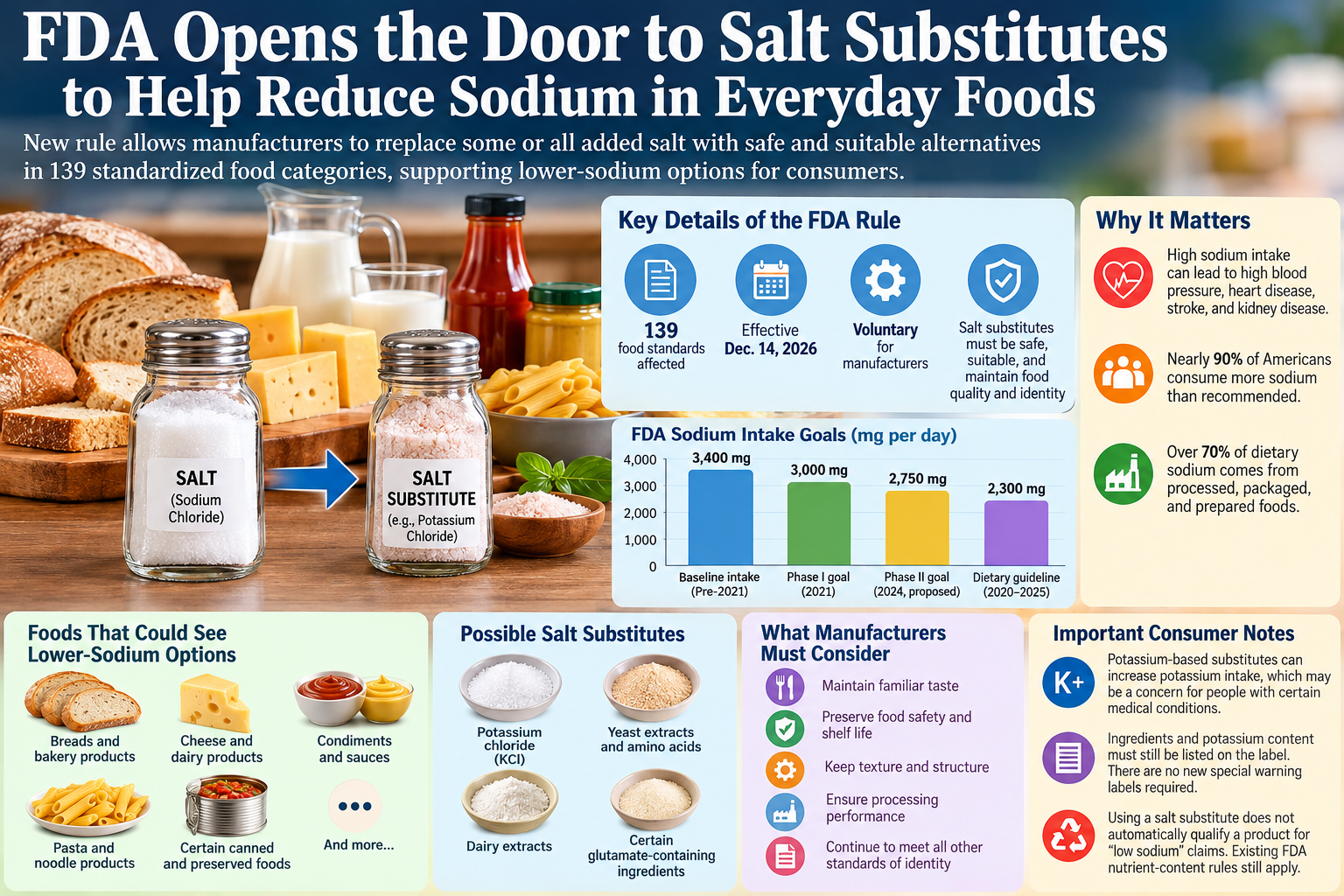
Food manufacturers can now replace some or all of the salt in many standardized foods with safe and suitable substitutes. The change covers breads, cheeses, milk products, condiments and other staples sold under federally defined names.
The FDA announced the final rule on October 9, 2026, and it was published in the Federal Register on October 13. It takes effect on December 14, 2026.
The rule doesn't require anyone to cut sodium. What it removes is an obstacle. Many standards of identity listed salt as an ingredient without allowing an alternative, so a manufacturer that reformulated with a substitute risked losing the right to use the product's standard name. Companies that already had the technology to make lower-sodium versions were held back by the regulations, not by the chemistry.
| At a glance | |
|---|---|
| Food standards affected | 139 (80 amended directly) |
| Announced | October 9, 2026 |
| Published | October 13, 2026 |
| Effective | December 14, 2026 |
| Dairy objections due | November 12, 2026 |
| Adoption | Voluntary |
Why the rule was needed
Standards of identity (SOIs) define what a food sold under a familiar name must contain and, in some cases, how it must be made. They can specify required and optional ingredients, proportions and processing steps for products such as certain cheeses, dairy foods, baked goods and condiments. Their purpose is to protect consumers from misleading or adulterated products and keep food names meaningful.
That same rigidity has made reformulation difficult. The FDA's March 2023 proposal recognized the problem. Rather than revise standards one at a time, it proposed a single cross-cutting fix. The final rule amends 80 standards directly, and related standards bring the total affected to 139. All other identity requirements stay in place.
The public-health case
The FDA and public-health groups have long been concerned about sodium because of its link to high blood pressure. High blood pressure is a leading risk factor for heart attack, heart failure, stroke and kidney disease.
Most of the sodium Americans eat is already in their food before they buy it, which limits how much individual choices can achieve:
- Before the first voluntary targets, average U.S. intake was about 3,400 mg per day.
- The 2020–2025 Dietary Guidelines recommend no more than 2,300 mg per day for people 14 and older.
- More than 70% of dietary sodium comes from processed, packaged and prepared foods, including restaurant meals.
- Nearly 90% of Americans exceed the recommended limit, according to the American Heart Association figure cited by Food Dive.
| Daily sodium intake | mg/day (rounded) |
|---|---|
| Pre-2021 baseline | ~3,400 |
| Phase I target (2021) | ~3,000 |
| Phase II draft target (2024) | ~2,750 |
| Dietary Guidelines limit (ages 14+) | 2,300 |
Phase II is a proposed voluntary target, not an achieved level.
This is why the FDA's strategy centers on reformulation across the food industry, not on asking consumers to put down the salt shaker.
How the strategy has developed
The 2026 rule is the latest step in a gradual, mostly voluntary program.
October 2021: Phase I targets. The FDA issued its first final voluntary sodium targets for processed, packaged and prepared foods, restaurant meals included. The aim was to bring average intake down from about 3,400 mg to 3,000 mg a day, roughly a 12% cut. Category-specific goals were encouraged but not required.
March 2023: Substitution proposal. The FDA proposed amending standards of identity to permit salt substitutes where salt was specified. It acknowledged that existing rules discouraged innovation in lower-sodium foods.
August 15, 2024: Phase II draft targets. Draft voluntary targets for 163 food categories aimed to lower average intake to about 2,750 mg a day over three years, around 20% below the pre-2021 baseline. The guidance remains a draft and sets no mandatory limits.
October 2026: Final rule. Salt substitutes are now permitted in standardized foods. The FDA also says it will publish an assessment of industry progress against the Phase I targets later in 2026.
The voluntary targets of 2021 and 2024 set numbers to aim for. The 2026 rule changes binding ingredient requirements so that manufacturers have more ways to reach those numbers.
Progress so far has been slow
Food Dive cites research finding a median sodium reduction of only 3% across the food categories evaluated after the 2021 guidance. Sodium content rose in many restaurant foods over the same period. This is a measure of sodium content within product categories. It is not a 3% drop in population intake, and the two shouldn't be confused.
Several factors help explain the slow pace:
- Cost. Salt is cheap and does several jobs at once. A replacement system usually costs more and may require process changes.
- Taste. Consumers notice changes in familiar products, and even small differences can cost repeat purchases.
- Validation. Lower-sodium formulas need additional testing for safety, quality and shelf life.
- Weak incentives. Voluntary targets don't create the compliance pressure that mandatory limits would.
- Regulatory barriers. Standards of identity blocked some reformulation routes. This is the one obstacle the new rule removes.
What can replace salt
The rule doesn't set a list of approved substitutes. It allows any safe and suitable ingredient, or combination of ingredients, that takes over some or all of salt's functions and lowers sodium content. The FDA chose this open approach so that it would cover both existing ingredients and future ones.
Potassium chloride (KCl) is the most familiar option. It tastes salty and supplies potassium in place of sodium. Depending on concentration and formulation, though, it can add bitter or metallic notes that developers have to mask. The rule's preamble also mentions yeast extracts, amino acids, dairy extracts and certain glutamate-containing ingredients. These are examples, not blanket approvals for every product.
Replacing salt is rarely a straight swap, because salt does far more than make food taste salty:
| Function of salt | What a substitute has to match |
|---|---|
| Flavor | A familiar salty taste without bitterness or off-notes |
| Preservation | Microbial control and shelf life |
| Texture and structure | Consistency, moisture behavior and physical properties |
| Processing | Performance during mixing, fermentation, heating and other steps |
| Identity | Every other requirement of the applicable standard |
In bread, salt affects dough handling and fermentation. In cheese, it shapes flavor development, moisture, texture and microbial behavior. In preserved foods, it can be central to shelf stability. Manufacturers have to show that a replacement works in their specific product under real processing, storage and distribution conditions.
Safety and labeling
The Federal Register text deals with several issues the Food Dive story only touches on.
Potassium exposure. People with chronic kidney disease, certain heart conditions, or on some medications may need to limit potassium. Commenters warned that widespread use of potassium chloride could raise their intake without their knowing. They were especially concerned about shoppers who pick low-sodium products assuming those products are safer. The FDA acknowledged the concern but said it couldn't predict how many products would be reformulated or how much potassium that would add to the food supply. For consumers who restrict potassium, reading the ingredient list and Nutrition Facts panel stays essential.
No new labeling rules. The rule adds no labeling specific to salt substitutes, but existing requirements still apply. Potassium chloride must appear in the ingredient list, and required potassium information must appear in Nutrition Facts. The FDA considered and rejected a mandatory potassium warning, concluding that current labels give enough information. Using a substitute doesn't by itself entitle a product to a "low sodium" claim; the FDA's existing nutrient-content criteria still apply.
Safety comes first. A substitute must be safe and suitable for its intended use, and its eligibility depends on its food-additive or GRAS status and conditions of use. Reformulation can't undermine the essential characteristics of the standardized food. This matters most in products where salt helps control microbial growth.
No forced reformulation. Companies that keep using salt face no penalty. Because adoption is voluntary, the FDA's regulatory impact analysis assigns the rule no mandatory costs. Companies that reformulate will bear their own costs for ingredients, testing, sensory work, process changes and labeling. How many products actually change will come down to commercial and technical decisions, not an FDA timetable.
Industry implications
Opportunities and difficulties will vary by category:
| Category | Opportunity | Main difficulty |
|---|---|---|
| Bread and bakery | Cut sodium while keeping the standard name | Dough performance, fermentation, taste |
| Cheese and dairy | Reformulate without losing standardized identity | Texture, flavor, moisture, microbial safety |
| Condiments and sauces | Lower sodium in high-consumption everyday products | Flavor balance, stability, preservation |
| Pasta and noodles | Introduce reduced-sodium standardized versions | Taste, consistency, cost |
| Some canned and preserved foods | Explore alternative formulations | Product-specific safety and quality validation |
These are possible applications. No reformulations in these categories have been announced.
Ingredient suppliers offering salt-replacement systems, flavor enhancers and reformulation support are well placed as manufacturers explore the new flexibility.
Product developers can now blend salt with substitutes instead of relying only on removing sodium chloride, which makes it easier to balance taste, function and nutrition.
Manufacturers still face the market. A reduced-sodium product has to compete on taste, texture, price and shelf life, and no rule can guarantee consumers will buy it.
Dairy is the sector to watch. The International Dairy Foods Association (IDFA) welcomed the rule. Its president and CEO, Michael Dykes, described it as a chance to lower sodium while protecting food safety, quality and consumer expectations. The association also asked the FDA to assess how industry has performed against existing targets before adding new measures, which signals wariness about further regulatory pressure.
What to watch
- November 12, 2026: deadline for objections and hearing requests on the dairy standards amendments.
- December 14, 2026: the rule takes effect.
- Later in 2026: the FDA's Phase I progress report, the first official measure of how far voluntary efforts have gone.
- Reformulation activity: whether manufacturers start or expand trials of potassium-based substitutes and alternative flavor systems.
- Sodium and potassium monitoring: how regulators and industry track changing nutrient levels as reformulated products spread.
- Population intake: the real test is whether average sodium consumption falls without losses in safety, quality or consumer acceptance.
Assessment
The rule resolves a contradiction that has frustrated manufacturers for years: the FDA urged companies to cut sodium while its own food standards limited the ingredients they could use to do it. That obstacle is now gone for 139 standards.
Three caveats temper the significance:
- Permission isn't obligation. Manufacturers may use substitutes but don't have to.
- Less sodium isn't automatically better nutrition. A reformulated product's overall composition still matters, and potassium intake is a real concern for some consumers.
- Flexibility doesn't guarantee results. Public-health gains depend on companies reformulating, consumers accepting the products, and measurable drops in intake.
The early record isn't encouraging: a 3% median reduction under Phase I and rising sodium in restaurant food. Still, removing a binding legal barrier is a different kind of intervention from setting voluntary targets. Whether it changes the pace will become clearer once the FDA's Phase I assessment is out and manufacturers' reformulation plans for 2027 are visible.
Sources
- Zimmerman, S. "FDA paves the way for salt reduction in dozens of food categories." Food Dive, October 14, 2026. https://www.fooddive.com/news/fda-salt-substitutes-sodium-reduction-food/832970/
- U.S. FDA. "FDA Issues Final Rule on Salt Substitutes in Standardized Foods." October 9, 2026. https://www.fda.gov/food/hfp-constituent-updates/fda-issues-final-rule-salt-substitutes-standardized-foods
- Federal Register. "Use of Salt Substitutes to Reduce the Sodium Content in Standardized Foods." October 13, 2026. https://www.govinfo.gov/content/pkg/FR-2026-10-13/html/2026-20848.htm
- U.S. FDA. "FDA to Propose to Permit Salt Substitutes to Reduce Sodium in Standardized Foods." March 2023. https://www.fda.gov/food/hfp-constituent-updates/fda-propose-permit-salt-substitutes-reduce-sodium-standardized-foods
- U.S. FDA. "FDA Announces Milestone in Sodium Reduction Efforts, Issues Draft Guidance to Lower Target Levels." August 15, 2024. https://www.fda.gov/news-events/press-announcements/fda-announces-milestone-sodium-reduction-efforts-issues-draft-guidance-lower-target-levels-certain
- U.S. FDA. "Sodium Reduction in the Food Supply." https://www.fda.gov/food/food-labeling-nutrition/sodium-reduction-food-supply
###