Food Allergens: What Flavorists Need to Know
Society of Flavor Chemists (SFC) Syllabus | Study Notes | October 2026
The SFC certification syllabus includes the following topic:
"Allergens – major allergens in the below mentioned geographical regions: United States, Canada, European Union."
Candidates for Certified Flavor Chemist should be able to:
- Identify the major food allergens recognized in each region.
- Explain the differences among U.S., Canadian, and EU regulations.
- Recognize allergenic ingredients and derivatives used in flavor formulations.
- Understand allergen declaration, ingredient labeling, and cross-contact.
- Review raw-material documentation and prepare an allergen statement for a flavor.
1. Major food allergens by region
United States: 9 major food allergens
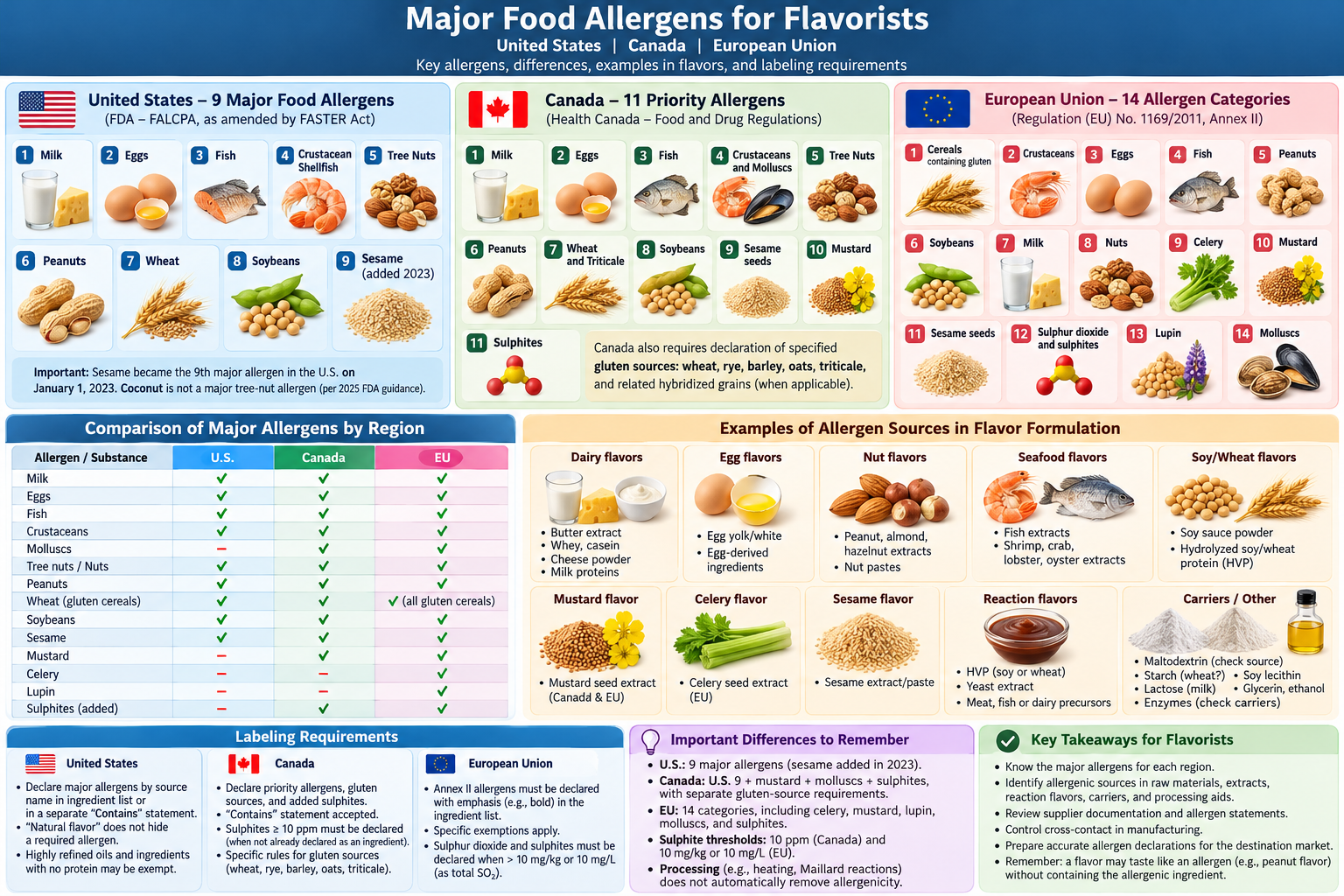
The FDA recognizes nine major food allergen categories under federal labeling law.
| No. | Major food allergen | Examples relevant to flavorists |
|---|---|---|
| 1 | Milk | Whey, casein, butter, cream, cheese powders |
| 2 | Eggs | Egg yolk, egg white, egg-derived ingredients |
| 3 | Fish | Fish extracts, anchovy, fish protein |
| 4 | Crustacean shellfish | Shrimp, crab, lobster extracts |
| 5 | Tree nuts | Almond, walnut, pecan, hazelnut |
| 6 | Peanuts | Peanut paste, peanut flour |
| 7 | Wheat | Wheat protein, hydrolyzed wheat protein |
| 8 | Soybeans | Soy protein, soy sauce, soy-derived ingredients |
| 9 | Sesame | Sesame seeds, tahini, sesame protein |
Sesame became the ninth U.S. major food allergen on January 1, 2023, under the FASTER Act.
Canada: 10 priority allergens plus sulphites
Canada identifies ten priority allergen food groups. Sulphites are usually grouped with them for labeling purposes, giving the 11 categories commonly taught.
| No. | Priority allergen / substance |
|---|---|
| 1 | Milk |
| 2 | Eggs |
| 3 | Fish |
| 4 | Crustaceans and molluscs |
| 5 | Tree nuts |
| 6 | Peanuts |
| 7 | Wheat and triticale |
| 8 | Soybeans |
| 9 | Sesame seeds |
| 10 | Mustard |
| 11 | Sulphites |
Canada also requires declaration of gluten sources where applicable: wheat, rye, barley, oats, triticale, and related hybridized grains.
Sulphites are not protein allergens in the immunological sense, but they can cause serious sensitivity reactions and are regulated on that basis.
European Union: 14 allergen categories
Annex II of Regulation (EU) No. 1169/2011 lists 14 categories of substances or products causing allergies or intolerances that generally require declaration.
| No. | Allergen category | Examples |
|---|---|---|
| 1 | Cereals containing gluten | Wheat, rye, barley, oats, spelt |
| 2 | Crustaceans | Shrimp, prawns, lobster, crab |
| 3 | Eggs | Egg proteins, egg yolk |
| 4 | Fish | Fish extracts and proteins |
| 5 | Peanuts | Peanut flour, peanut paste |
| 6 | Soybeans | Soy proteins, soy derivatives |
| 7 | Milk | Whey, casein, lactose |
| 8 | Nuts | Almond, hazelnut, walnut, cashew, pecan, Brazil nut, pistachio, macadamia |
| 9 | Celery | Celery seed, celery extract |
| 10 | Mustard | Mustard seed, mustard extracts |
| 11 | Sesame seeds | Sesame seed, tahini |
| 12 | Sulphur dioxide and sulphites | Above the specified concentration threshold |
| 13 | Lupin | Lupin flour, lupin protein |
| 14 | Molluscs | Oyster, mussel, squid, clam |
Unlike the U.S. and Canada, the EU regulates celery and lupin as allergens. It also lists crustaceans and molluscs as separate categories.
2. Comparison: U.S., Canada, and EU
| Allergen / substance | U.S. | Canada | EU |
|---|---|---|---|
| Milk | ✓ | ✓ | ✓ |
| Eggs | ✓ | ✓ | ✓ |
| Fish | ✓ | ✓ | ✓ |
| Crustaceans | ✓ | ✓ | ✓ |
| Molluscs | – | ✓ | ✓ |
| Tree nuts / specified nuts | ✓ | ✓ | ✓ |
| Peanuts | ✓ | ✓ | ✓ |
| Wheat | ✓ | ✓ | ✓ |
| Soybeans | ✓ | ✓ | ✓ |
| Sesame | ✓ | ✓ | ✓ |
| Mustard | – | ✓ | ✓ |
| Celery | – | – | ✓ |
| Lupin | – | – | ✓ |
| Sulphites | – | ✓* | ✓* |
| Other gluten-containing cereals | – | ✓* | ✓ |
✓ = listed as a major allergen category or regulated declaration group. – = not listed as a major allergen category (other labeling or safety rules may still apply). * = concentration or source-specific rules apply. In Canada, other gluten-containing cereals fall under separate gluten-source requirements.
Summary:
- U.S.: the Big 9.
- Canada: the U.S. Big 9 plus mustard, molluscs, and regulated sulphites, with separate gluten-source requirements.
- EU: 14 categories, including celery, mustard, lupin, molluscs, and sulphites.
The categories do not map one-to-one between jurisdictions. Canada groups crustaceans and molluscs together; EU law lists them separately.
3. Allergens in flavor formulation
Knowing the lists is only the starting point. Flavorists also need to know where allergens enter a formula, particularly through extracts, reaction flavor precursors, carriers, and processing aids.
| Flavor or material | Potential allergen source | What to check |
|---|---|---|
| Butter flavor | Butter extract, milk fat, whey, casein | Milk proteins and supplier declaration |
| Cheese flavor | Cheese powder, whey, caseinates | Milk |
| Cream flavor | Cream powder, dairy extracts | Milk |
| Peanut flavor | Peanut extract, peanut paste | Peanut proteins |
| Almond flavor | Almond extracts, almond-derived ingredients | Source material, protein content |
| Hazelnut flavor | Hazelnut paste, roasted hazelnut extract | Tree nuts |
| Soy sauce flavor | Soy sauce powder, hydrolyzed soy protein | Soy, and possibly wheat |
| Chicken or beef reaction flavor | Hydrolyzed vegetable protein, yeast extract, amino acids | Whether HVP comes from wheat or soy |
| Seafood flavor | Shrimp extract, fish sauce, oyster extract | Fish, crustaceans, molluscs |
| Mustard flavor | Mustard powder, mustard seed extract | Canadian and EU requirements |
| Celery flavor | Celery seed extract, celery powder | EU requirements |
| Sesame flavor | Tahini, sesame paste, seed extracts | Sesame |
| Smoked or processed flavors | Certain preservative-containing ingredients | Sulphites, where applicable |
These are possible sources only. A flavor's name does not by itself trigger a declaration.
A. A flavor name does not determine allergen status
Two hypothetical peanut flavors:
- Flavor A is built from permitted flavoring substances, with no peanut-derived ingredients and no allergenic protein. It tastes like peanut but contains no peanut.
- Flavor B contains peanut extract with residual peanut protein. A peanut declaration is required under the applicable rules.
Allergen status depends on the ingredient's source, composition, residual protein, any exemptions, and the law of the destination market.
B. Reaction flavors
Reaction flavors are usually made from reducing sugars and amino acids or protein hydrolysates, often through Maillard chemistry. Typical raw materials include:
- Hydrolyzed vegetable protein (HVP) from soy or wheat
- Whey protein or milk-derived amino acid preparations
- Meat, fish, or seafood extracts
- Yeast extracts (verify the manufacturing inputs and carriers)
Heating or reacting an allergenic raw material does not reliably eliminate its allergenicity, so the Maillard process should never be assumed to remove a declaration obligation.
C. Carriers, solvents, and processing aids
Materials that contribute little or nothing to flavor character still need review.
| Material | Allergen consideration |
|---|---|
| Maltodextrin | Botanical source and applicable exemptions |
| Starch | Whether wheat or another regulated cereal was used |
| Soy lecithin | Soy origin and jurisdiction-specific rules |
| Lactose | Milk origin; residual protein may require declaration |
| Glycerin | Source, processing, and residual allergen status |
| Ethanol | Grain source may matter for documentation; review applicable exemptions |
| Highly refined oils | Specific labeling exemptions may apply |
| Enzyme preparations | Carriers, production aids, and allergenic residues |
FDA guidance distinguishes between ingredients derived from a major allergen that contain no protein from it (which may fall outside major-allergen labeling) and highly refined oils, which have a specific statutory exemption. Verify these case by case rather than relying on the ingredient name.
4. Allergen labeling rules
United States (FALCPA and FASTER Act). Major allergens must be declared by source name, either in the ingredient list or in a separate "Contains" statement. Using the term "natural flavor" does not exempt a major allergen from declaration.
Canada (Food and Drug Regulations). Priority allergens, gluten sources, and added sulphites must be identified using the prescribed source names and component-declaration rules. A "Contains" statement is an accepted method.
European Union (Regulation (EU) No. 1169/2011). Annex II allergens used as ingredients or relevant processing aids must be declared and emphasized in the ingredient list, for example in bold. Specific Annex II exemptions apply.
Sulphite thresholds
| Region | Rule |
|---|---|
| United States | Sulphites are not one of the Big 9, but separate sulphite labeling requirements can apply. |
| Canada | Added sulphites at 10 ppm or more in the finished product must be declared if not already declared under ordinary ingredient rules. Directly added sulphites may need to be listed at lower levels. |
| European Union | Sulphur dioxide and sulphites must be declared above 10 mg/kg or 10 mg/L, expressed as total SO₂, in the product as consumed or reconstituted. |
The 10 ppm figures in Canada and the EU are declaration thresholds, not a general allowance to omit sulphites below that level.
5. Allergen management in a flavor laboratory
- Raw-material assessment. Obtain specifications, allergen declarations, and relevant manufacturing information from suppliers.
- Formula assessment. Review every ingredient, carrier, diluent, processing aid, and subcomponent for allergen sources.
- Cross-contact prevention. Assess shared mixing vessels, transfer hoses, weighing equipment, storage containers, and production lines.
- Cleaning and verification. Use validated cleaning procedures where appropriate and confirm that cross-contact risks are controlled.
- Documentation. Prepare a finished-flavor allergen declaration that separates intentional allergens from potential cross-contact.
- Regulatory review. Confirm compliance for the destination market before releasing the formula or supplying labeling information to the customer.
Precautionary statements such as "May contain milk" do not replace good manufacturing practices or preventive controls.
2025 U.S. update
FDA's January 2025 guidance (Edition 5):
- Removed coconut from the tree nuts considered U.S. major food allergens.
- Removed several other previously listed tree nuts.
- Clarified that milk from other ruminants and eggs from birds other than chickens fall within the milk and egg categories.
Keep these changes in mind when using older study materials or supplier allergen forms.
6. Practice questions
These are study questions written for this topic, not official SFC examination questions.
- How many major food allergen categories are recognized in the U.S.? a) 8 b) 9 c) 11 d) 14
- Which allergen is a priority allergen in Canada and the EU but not one of the U.S. Big 9? a) Milk b) Mustard c) Soy d) Peanut
- Which two categories are listed in the EU but not in Canada or the U.S.? a) Celery and lupin b) Fish and egg c) Milk and wheat d) Peanut and sesame
- A reaction flavor contains hydrolyzed wheat protein. What should the flavorist do? a) Assume heat destroys the allergen b) Ignore the source because it is a flavor c) Assess wheat allergen status and declaration requirements d) Check only the aroma
- Which statement about the 2025 U.S. guidance is correct? a) Sesame was removed b) Mustard was added to the Big 9 c) Coconut is no longer considered a major tree-nut allergen d) There are now 14 U.S. allergens
- Above what total SO₂ concentration does EU Annex II require sulphite declaration? a) 1 mg/kg b) 10 mg/kg or 10 mg/L c) 100 mg/kg d) 1,000 mg/kg
Answers: 1 b, 2 b, 3 a, 4 c, 5 c, 6 b
7. References
- Society of Flavor Chemists. Syllabus. https://flavorchemist.org/membership-policy/syllabus/
- U.S. FDA. Questions and Answers Regarding Food Allergen Labeling (Edition 5), Guidance for Industry, January 2025. https://www.fda.gov/regulatory-information/search-fda-guidance-documents/guidance-industry-questions-and-answers-regarding-food-allergen-labeling-edition-5
- Canadian Food Inspection Agency. List of ingredients and allergens. https://inspection.canada.ca/en/food-labels/labelling/industry/list-ingredients-and-allergens
- Regulation (EU) No. 1169/2011, Annex II. https://eur-lex.europa.eu/legal-content/EN/TXT/?uri=CELEX:32011R1169
Summary
Passing this section means evaluating what is actually in a flavor, not just reciting allergen lists. Be ready to explain how allergens enter flavors (extracts, hydrolyzed proteins, reaction precursors, carriers, processing aids), how declaration rules differ among the U.S., Canada, and the EU, and how cross-contact is controlled in production.
Priority review topics: regional differences, the U.S. sesame addition and 2025 tree-nut changes, EU celery and lupin, Canadian gluten-source labeling, sulphite thresholds, and exemptions for allergen-derived ingredients. (e)
###