Specifications: What Certified Flavorists Need to Know
Society of Flavor Chemists (SFC) — Certification Examination Study Guide
According to the Society of Flavor Chemists syllabus, Specifications is a required knowledge topic under Section VII: Flavor Organizations, Certifications, and Documentation, within Quality Assurance/Control.
The syllabus lists specifications alongside Certificates of Analysis (COAs), Safety Data Sheets (SDSs), Good Manufacturing Practices (GMPs), HACCP, natural certification, and food-safety considerations such as pH and water activity.
The SFC does not prescribe a detailed, standalone specifications curriculum. This guide covers the depth of understanding a Certified Flavorist should be prepared to demonstrate in the written examination and oral interview.
1. What is a specification?
A specification is a controlled document defining the identity, characteristics, requirements, and acceptable limits that a raw material or finished flavor must meet to be suitable for its intended use.
In flavor manufacturing, specifications help ensure:
- Identity: the correct raw material or finished flavor is being used.
- Consistency: different batches meet established quality requirements.
- Safety: relevant chemical, physical, and microbiological requirements are satisfied.
- Regulatory compliance: ingredients and flavors meet applicable legal and customer requirements.
- Performance: the flavor delivers its intended sensory characteristics and functionality.
A specification translates flavor development requirements into measurable manufacturing and quality standards.
2. Types of specifications
| Type | Purpose | Examples |
|---|---|---|
| Raw-material specification | Establishes acceptance criteria for purchased ingredients | Purity, odor, density, identity, refractive index |
| Finished-flavor specification | Defines quality requirements for the manufactured flavor | Appearance, sensory profile, pH, density, microbiology |
| In-process specification | Controls selected manufacturing steps | Mixing temperature, Brix, viscosity |
| Customer specification | Defines requirements agreed with the customer | Appearance, allergen restrictions, flavor profile |
| Packaging specification | Defines acceptable packaging and product-contact requirements | Container type, seal integrity, compatibility |
A Certified Flavorist should understand how these specifications relate to one another, and why a finished flavor can fail its requirements even when every incoming ingredient meets its own specification.
3. Essential specification parameters
Parameters must be chosen according to the material and its intended application. Not every test applies to every flavor.
| Parameter | What the flavorist must understand |
|---|---|
| Appearance and color | Visual consistency, clarity, haze, sedimentation, and discoloration |
| Odor and taste | Comparison with an approved sensory standard |
| Specific gravity/density | Identity, consistency, concentration, and temperature effects |
| Refractive index | Composition and concentration indicator, especially for oils and liquid flavors |
| pH | Acidity, stability, and microbial implications in aqueous systems |
| Brix | Soluble solids measurement and its limitations in complex formulations |
| Moisture content | Stability, powder flow, and potential degradation |
| Water activity (aw) | Availability of water for microbial growth and stability |
| Flash point | Flammability and handling, storage, or transportation implications |
| Assay/purity | Concentration of the specified chemical or principal constituent |
| GC profile | Chemical fingerprint, identity, and batch consistency |
| Particle size | Powder functionality, dispersibility, and handling |
| Microbiological criteria | Appropriate limits for pathogens and other microorganisms |
| Solubility/dispersibility | Behavior in the intended food or beverage system |
The syllabus also expects working knowledge of the theory, function, reporting, industrial relevance, advantages, and limitations of analytical instruments such as refractometers, density meters, pH meters, Karl Fischer titration equipment, GC, MS, and liquid chromatography.
4. Example: A finished-flavor specification
Illustrative only.
Product: Liquid Strawberry Flavor SF-101 | Revision: 03
| Test | Acceptance criteria |
|---|---|
| Appearance | Clear, colorless to pale yellow liquid |
| Odor | Characteristic strawberry profile |
| Taste | Matches approved sensory reference |
| Specific gravity, 20°C | 0.950–0.970 |
| Refractive index, 20°C | 1.420–1.440 |
| Water content | ≤ 5.0% |
| GC profile | Conforms to approved fingerprint |
| Microbiological requirements | As established by risk assessment |
These are hypothetical teaching values, not industry standards or SFC-required limits.
A Certified Flavorist should understand not only how to read this specification but how each limit was established and whether it is scientifically justified. An overly narrow density range can reject acceptable batches because of normal material variation or measurement uncertainty. An overly broad range may miss a significant formulation error.
Key concept: Specifications must be meaningful, measurable, achievable, documented, and appropriate to the intended product.
5. Specification versus Certificate of Analysis (COA)
- Specification — defines what is acceptable. Example: specific gravity at 20°C of 0.950–0.970.
- Certificate of Analysis — reports a particular lot's result. Example: specific gravity of 0.961, within specification.
The specification sets the acceptance criteria; the COA provides lot-specific results or statements of conformity. A COA may contain measured results, pass/fail results, or other reporting permitted by the applicable quality agreement.
A COA does not establish acceptance limits, and its existence does not guarantee the product is suitable for every intended application.
6. How specifications are established
Acceptance ranges should not be chosen arbitrarily. Limits are based on:
- A. Product development data — laboratory batches establish typical physical, chemical, and sensory characteristics.
- B. Manufacturing variability — multiple production batches show normal variation arising from processing conditions, raw materials, equipment, and batch size.
- C. Analytical method variability — instrument precision, calibration, reproducibility, test conditions, and measurement uncertainty.
- D. Regulatory and safety requirements — acceptance criteria must not conflict with regulations, safety limits, or customer requirements.
- E. Stability studies — whether parameters change during storage, transportation, and the intended shelf life. A citrus flavor may change in sensory character or composition through oxidation; an emulsion may separate or cream.
A specification should distinguish acceptable natural variation from a meaningful quality deviation.
7. Handling an out-of-specification (OOS) result
A strawberry flavor has an approved specific gravity range of 0.950–0.970 at 20°C. The QC laboratory measures 0.982, which is outside specification.
- Place the batch on hold to prevent release or use pending quality disposition.
- Verify the test — check equipment calibration, sample identity, temperature, and analytical procedure.
- Review production records — weighing, ingredient identity, batch calculations, and manufacturing conditions.
- Investigate the cause — incorrect solvent addition, substitution, raw-material variation, or measurement error.
- Determine disposition — authorized quality personnel decide whether the batch is rejected, reprocessed under approved procedures, or otherwise dispositioned in compliance with requirements.
- Document corrective actions — record the investigation, root cause, and actions to prevent recurrence.
A flavorist may assist with technical investigation and approved reformulation but should not independently authorize release of an OOS batch because it smells or tastes acceptable.
8. QA, QC, and specifications
| Quality assurance (QA) | Quality control (QC) |
|---|---|
| Focuses on preventing quality problems | Focuses on detecting quality problems |
| Establishes and maintains quality systems | Performs inspections and tests |
| Controls documentation and procedures | Compares results against specifications |
| Oversees change control and corrective action | Identifies and reports nonconforming results |
| Supports audits and supplier qualification | Produces analytical and sensory evidence |
Specifications connect the two: QA ensures specifications are established and controlled, and QC uses them to assess materials and batches. Both depend on the flavorist's understanding of formulation, ingredient behavior, and sensory performance.
9. Common specification problems in flavor manufacturing
- Natural variability: essential oils from different harvests may vary in composition and physical properties while remaining sensorially acceptable.
- Sensory inconsistency: a batch may pass density and refractive index but fail an approved organoleptic comparison.
- Oxidation: citrus oils can change chemically and develop off-notes that require sensory or analytical evaluation.
- Ingredient substitutions: a change in supplier or grade may affect sensory quality, specifications, labeling, and regulatory compliance.
- Storage instability: powder flavors can absorb moisture and cake; liquid flavors can separate or develop haze.
- Inadequate limits: overly wide limits may miss manufacturing errors; overly tight limits cause unnecessary rejections.
The core skill is selecting parameters that are scientifically related to the material and its intended application.
10. Practice questions
These are original practice questions based on the syllabus topic, not official SFC examination questions.
1. What is a specification, and why is it important in flavor manufacturing? A controlled document setting identity, quality characteristics, and acceptance limits. It ensures batch consistency and supports safety, regulatory compliance, customer requirements, and performance.
2. What is the difference between a specification and a COA? The specification defines what is acceptable; the COA reports a specific lot's results or conformity against it.
3. How would you develop a finished-flavor specification? Select parameters relevant to the product and application, then set limits from development data, production variability, analytical method performance, stability studies, and regulatory and customer requirements.
4. A flavor passes density and refractive index but has an off-note. Can it be released? No. Sensory conformance is part of the specification. The batch should be held and investigated, and disposition decided by authorized quality personnel.
5. Why might a natural orange oil specification require different considerations from a synthetic aroma chemical? Natural oils vary by origin, harvest, and processing and are prone to oxidation, so they need wider, profile-based limits (GC fingerprint, optical rotation, sensory). A synthetic chemical is typically controlled by a tight assay/purity limit and impurity profile.
6. How can GC be used in raw-material specifications? To confirm identity, measure assay/purity, compare the chromatographic fingerprint with an approved standard, and detect adulteration, contamination, or degradation.
7. What should happen when a production batch is out of specification? Hold the batch, verify the test, review production records, investigate root cause, have authorized quality personnel determine disposition, and document corrective actions.
8. Why should specifications be reviewed after changing a flavor formula? Formula changes can shift physical, chemical, and sensory properties, so existing limits may no longer reflect the product or detect errors, and labeling or regulatory status may change.
11. Model answer for the certification interview
If an examiner asks, "Explain specifications and their importance in quality assurance and quality control for flavor manufacturing," a strong response would be:
A specification is a controlled document that establishes the identity, quality characteristics, analytical requirements, sensory attributes, and acceptance limits for a flavor raw material or finished product. Specifications ensure consistent manufacturing and support product safety, regulatory compliance, and customer requirements.
Typical specifications may include appearance, odor, taste, specific gravity, refractive index, pH, water content, chromatographic characteristics, and microbiological criteria, depending on the product.
Specifications should be developed from scientific data, manufacturing capability, analytical method performance, stability studies, and intended applications.
Quality control evaluates materials against these requirements, while quality assurance ensures that specifications, procedures, changes, and nonconformances are properly managed.
The specification establishes what is acceptable; the Certificate of Analysis documents the results or conformity of a particular lot. When a product fails a specification, the deviation must be investigated and appropriately dispositioned before release.
12. Key points to know
Before the examination, be able to explain:
- What a specification is and why it is necessary.
- The differences between raw-material and finished-product specifications.
- The differences between a specification, a COA, and an SDS.
- Which physical, chemical, sensory, and microbiological parameters apply to different flavor systems.
- How acceptance limits are developed and justified.
- How natural raw-material variability affects specifications.
- The role of appropriate analytical methods and sensory evaluation.
- How to investigate an out-of-specification result.
- How changes in formulation, processing, suppliers, or storage affect specifications.
- The distinction between preventive QA systems and testing-based QC activities.
The SFC expects candidates to demonstrate working knowledge and practical application rather than recite terminology. Its syllabus also notes that candidates are not expected to know every aspect of flavor creation.
Primary source: The Society of Flavor Chemists — Official Syllabus and Testing Protocol: https://flavorchemist.org/membership-policy/syllabus/
For certification preparation, the most valuable skill is explaining how a flavor specification is established, verified, interpreted, and used to make sound quality decisions, using examples from your own experience. (e)
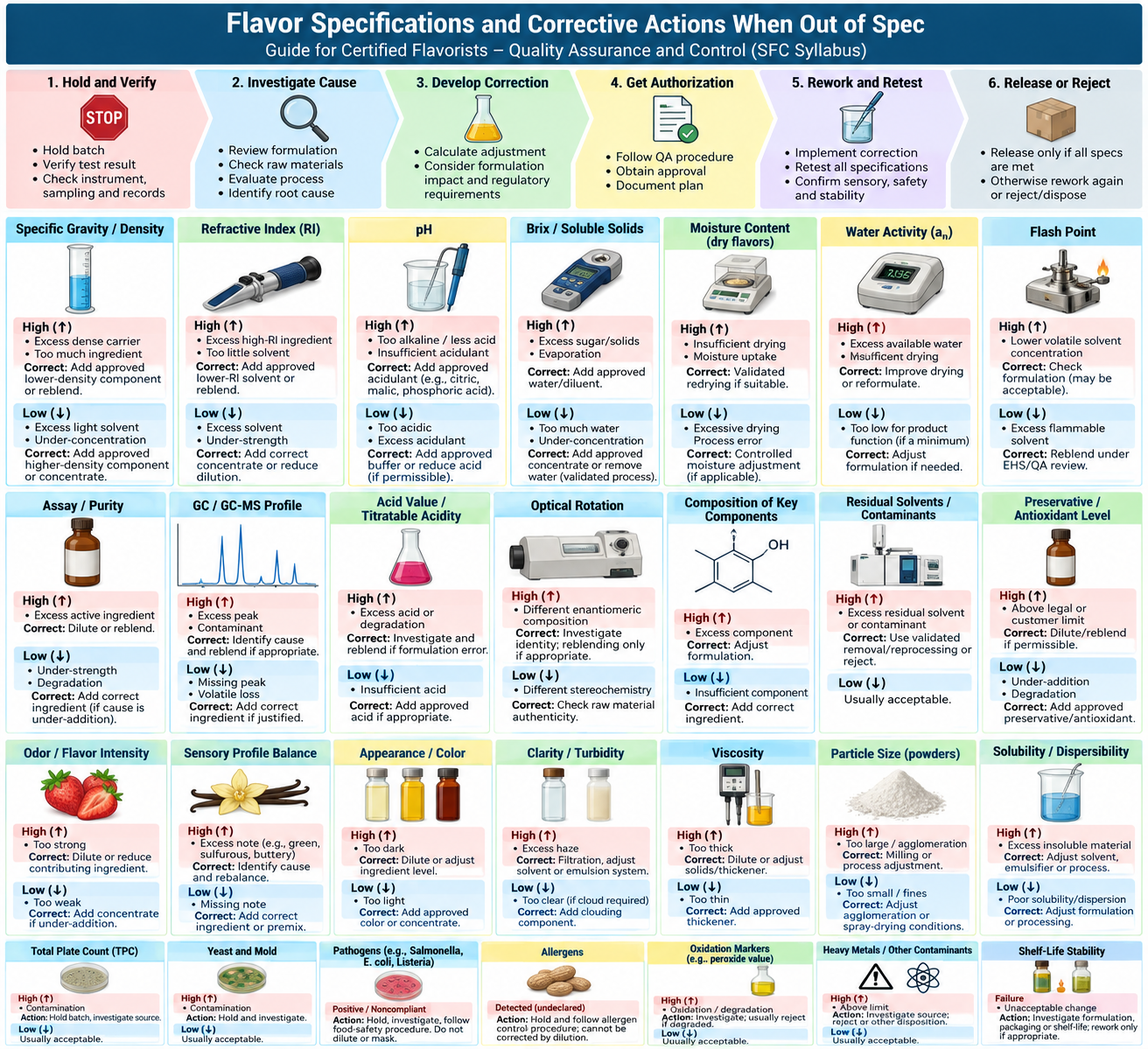
Corrective Actions for Out-of-Specification Flavor Parameters
Society of Flavor Chemists (SFC) Certification Preparation — Quality Assurance and Quality Control
A Certified Flavorist should understand what causes each quality parameter to run too high or too low, how to investigate the deviation, which adjustments may be scientifically appropriate, and when a batch must be rejected rather than corrected.
The January 2026 Society of Flavor Chemists syllabus includes specifications, QA/QC, HACCP, GMPs, food-safety considerations, and analytical methods. It does not prescribe individual corrective-action procedures. This guide expands those syllabus topics into practical flavor-manufacturing troubleshooting scenarios.
1. First rule: Investigate before correcting
An out-of-specification (OOS) result does not mean an ingredient should immediately be added or removed. The result could reflect a measurement error, ingredient error, process problem, contamination, degradation, or a genuine formulation imbalance.
Standard OOS response procedure
- Hold the batch. Notify QC/QA and prevent unauthorized release.
- Verify the result. Check sampling, temperature, calibration, method suitability, instrument operation, and calculations. Do not retest repeatedly just to obtain a passing result.
- Investigate the root cause. Review formulation sheets, ingredient lots, weighing records, processing conditions, and storage history.
- Assess safety and compliance. Determine whether there is a microbiological, chemical, allergen, labeling, or other safety risk.
- Propose a technically justified correction. The flavorist may develop an adjustment, reblending, or reprocessing plan if permitted.
- Obtain authorization. Follow approved rework and change-control procedures and QA disposition requirements.
- Retest and document. Confirm all affected specifications, sensory quality, stability, and regulatory requirements before authorized release.
This approach is consistent with U.S. food-safety corrective-action principles under 21 CFR § 117.150, which require affected food to be evaluated and corrective actions documented where applicable.
For each parameter below, corrective actions are conditional technical options, not automatic instructions to alter a production batch. Any adjustment should be validated on a representative laboratory sample before approved production-scale rework.
2. Physical and chemical specification failures
A. Specific gravity / density
Specific gravity can detect solvent concentration changes, ingredient proportion errors, and formulation variation.
| Result | Possible reasons | Flavorist's response |
|---|---|---|
| Above maximum | Too much dense carrier (e.g., propylene glycol or glycerin in some systems); insufficient lighter solvent; incorrect ingredient | Verify measurement temperature and ingredient identity. If the cause is confirmed, evaluate a calculated addition of the approved lower-density component or reblend under controlled conditions. |
| Below minimum | Excess lighter solvent (e.g., ethanol in some systems); insufficient dense carrier; wrong material | Verify batch weights and solvent composition. Evaluate restoration with the approved higher-density component or concentrated premix. |
Adding a dense carrier to raise density, or a lighter solvent to lower it, also changes flavor strength, solubility, and the ingredient declaration. Density alone cannot identify which ingredient is incorrect.
B. Refractive index (RI)
RI is useful for confirming identity, solvent ratio, and batch-to-batch consistency, particularly with essential oils and liquid flavors.
| Result | Possible reasons | Flavorist's response |
|---|---|---|
| Above maximum | Excess higher-RI ingredient; insufficient lower-RI solvent; wrong oil grade | Confirm temperature, calibration, and formulation records. Identify which component raised the RI. Consider authorized reblending or adjustment of the correctly identified component. |
| Below minimum | Excess lower-RI solvent; insufficient higher-RI constituent; raw-material variation | Check solvent levels, ingredient identity, and compositional data. If understrength, evaluate replenishing the correct concentrated premix. |
RI is not a direct assay of flavor strength. Different compositions can produce similar RI values, so a matching RI does not prove the flavor has the correct composition.
C. pH
pH matters most in aqueous flavor systems, acidified preparations, and products where acidity affects stability or microbial safety.
| Result | Possible reasons | Flavorist's response |
|---|---|---|
| Above maximum (too alkaline / not acidic enough) | Insufficient acidulant; excess alkaline material; incorrect buffer ratio | Verify meter calibration, measurement conditions, and the recipe. Where suitable, evaluate controlled addition of the approved acidulant, such as citric, malic, or phosphoric acid. |
| Below minimum (too acidic) | Excess acidulant; insufficient buffer; incorrect acid concentration | Verify the acid addition and investigate the cause. Consider an approved buffering adjustment or reblend, provided safety, taste, and labeling remain acceptable. |
Do not neutralize an over-acidic batch by casually adding an alkali; it may introduce an unapproved component, affect taste, or form salts that destabilize the system.
Exam point: Where pH controls a food-safety hazard, an unsafe pH excursion is not merely a taste problem. QA and the food-safety team must determine whether corrective processing is validated and permissible.
D. Brix / soluble solids
Brix expresses refractive behavior as sucrose-equivalent concentration. It is useful for syrups, juice-containing ingredients, and certain aqueous preparations.
| Result | Possible reasons | Flavorist's response |
|---|---|---|
| Above maximum | Excess sugar or soluble solids; insufficient water; excessive evaporation | Check temperature correction and concentration records. If the product permits dilution, evaluate measured additions of approved water or other specified diluent. |
| Below minimum | Excess water; insufficient soluble solids; incorrect ingredient concentration | Verify the solids balance. Evaluate addition of the approved concentrate or solids-containing premix; use evaporative concentration only if the process is validated and appropriate. |
In complex systems containing ethanol, acids, glycols, or other dissolved materials, a standard refractometer Brix reading does not represent sugar alone.
E. Moisture content
Relevant to dry flavor powders, spray-dried flavors, powdered extracts, and moisture-sensitive ingredients.
| Result | Possible reasons | Flavorist's response |
|---|---|---|
| Above maximum | Excess process water; insufficient drying; moisture absorption; unsuitable packaging | Investigate drying parameters, humidity exposure, and packaging integrity. Consider validated redrying only if it preserves volatiles, carrier properties, and microbiological safety. |
| Below minimum | Excessive drying; incorrect carrier balance; excess evaporation | Assess volatile loss, powder characteristics, and composition. Use only a validated, controlled process if moisture restoration is necessary. Never simply spray water into a finished powder. |
High moisture can cause caking, chemical degradation, and microbial concerns. Low moisture can indicate damaging process conditions even when the powder still flows freely.
F. Water activity (aw)
Water activity describes the availability of water for microbial growth and certain chemical reactions. It is not the same as total moisture content.
| Result | Possible reasons | Flavorist's response |
|---|---|---|
| Above maximum | Insufficient drying; excess available water; formulation changes; moisture uptake | Investigate moisture sources, humectants, process conditions, and packaging. Evaluate validated drying or reformulation where appropriate, with food-safety review. |
| Below minimum | Excess humectant; excessive drying; higher-than-planned dissolved solids | Investigate composition and functionality. If the low value causes texture, dispersibility, or other quality failures, consider approved formulation adjustments. |
A low water activity is not automatically a defect. If the specification has only a maximum, a low result may be fully acceptable.
Lowering water activity after microbial contamination has occurred does not make a contaminated batch safe.
G. Flash point
Relevant to volatile and flammable flavor systems, especially those containing ethanol or other flammable solvents.
| Result | Possible reasons | Flavorist's response |
|---|---|---|
| Above maximum | Lower-than-expected volatile solvent concentration; incorrect solvent system | Confirm the required test method and investigate composition. A higher flash point may be safer but still signals an identity or formulation deviation. |
| Below minimum | Excess volatile flammable solvent; unexpected volatile contamination; incorrect ingredients | Hold the batch, assess flammability and storage/transport classification, and verify composition. Consider reblending only after EHS, QA, and regulatory review. |
A lower flash point generally means a greater flammability hazard under comparable test conditions. Never heat a batch to evaporate solvent without a specifically engineered and authorized process.
3. Chemical composition and analytical failures
H. Assay / purity / active-component concentration
Used for individual aroma chemicals, extracts, and standardized flavor ingredients.
| Result | Possible reasons | Flavorist's response |
|---|---|---|
| Above maximum | Excess active ingredient; insufficient diluent; unexpectedly high-purity raw material | Verify the result and batch calculations. For a formulated dilution, assess adjustment with the specified diluent or a properly calculated reblend. |
| Below minimum | Insufficient active material; over-dilution; degradation; adulteration | Determine whether the cause is weighing, concentration, or chemical degradation. Replenish active material only when the correct ingredient and cause are verified and approved. |
If a pure aroma chemical fails purity because of unacceptable impurities, adding more pure chemical does not necessarily make it acceptable; the material may require rejection or a supplier investigation. Adding aroma chemicals to compensate for degradation does not remove potentially harmful degradation products.
I. Gas chromatography (GC) / GC-MS fingerprint
GC profiles evaluate volatile composition, identity, natural-material authenticity, degradation, and batch consistency.
| Result | Possible reasons | Flavorist's response |
|---|---|---|
| Specified peak above maximum | Excess ingredient containing that component; raw-material variation; contaminant; degradation product | Identify the peak, confirm the method, and determine whether the excess comes from formulation, raw-material composition, or reaction. Consider compliant reblending only if cause and identity are known. |
| Specified peak below minimum | Missing or insufficient ingredient; volatilization; oxidation; incorrect extract strength | Investigate ingredient addition, production losses, and stability. Replacing a missing constituent or premix may be possible if validated and permitted. |
| Unexpected additional peak | Contamination; incorrect ingredient; oxidation; adulteration | Identify the compound and investigate its origin. Do not assume dilution is an acceptable correction. |
If an essential oil shows an abnormally low level of a characteristic terpene, investigate origin, oxidation, fractionation, and authenticity before considering any adjustment. Interpret GC results alongside sensory data and the method's limitations.
J. Acid value / titratable acidity
Acid value helps monitor deterioration of oils and fatty materials; titratable acidity applies to various aqueous and extracted flavor products.
| Result | Possible reasons | Flavorist's response |
|---|---|---|
| Above maximum | Excess acid; hydrolysis; lipid degradation; excessive acidulant | Determine whether acidity comes from the intended formula or from deterioration. Reblend a formulation error only if appropriate; reject degraded material when quality or safety cannot be established. |
| Below minimum | Insufficient acid; over-dilution; wrong formulation | Verify ingredient balance and the analytical method. Evaluate adding the approved acid-containing premix when justified. |
A low acid value is often preferable for oils, so it is not automatically a defect. Interpretation of titratable acidity depends on the intended product.
K. Optical rotation
Optical rotation helps characterize certain essential oils and naturally derived materials.
| Result | Possible reasons | Flavorist's response |
|---|---|---|
| Above upper limit | Different enantiomeric composition; wrong oil grade; adulteration; supplier variation | Verify concentration, path length, temperature, solvent, and method. Investigate raw-material identity and supplier documentation. |
| Below lower limit | Different stereochemical profile; adulteration; substitution; natural variation | Repeat validated identity analysis and examine origin and authenticity. |
Do not correct optical rotation by adding another ingredient. That can disguise an authenticity problem without establishing that the raw material is genuine or suitable.
4. Sensory and appearance failures
L. Odor and flavor intensity
Sensory testing requires standardized sample preparation, dilution, serving temperature, controls, and comparison with an approved reference.
| Result | Possible reasons | Flavorist's response |
|---|---|---|
| Too strong | Excess concentrated flavor; insufficient carrier; excess high-impact ingredient | Confirm application testing and batch records. Evaluate controlled dilution, reblending, or a calculated reduction of the contributing component through an approved process. |
| Too weak | Too much carrier; insufficient concentrate; volatile loss; degradation | Compare with the reference and investigate the loss of impact. Add the correct premix only when the cause is under-addition, not contamination or irreversible deterioration. |
Evaluate the complete profile rather than simply raising or lowering total concentration. An overly strong strawberry top note may come from one high-impact ester, not excess total flavor.
M. Sensory profile imbalance
Sensory descriptors are usually judged against an approved sensory standard rather than a numerical limit.
| Result | Possible reasons | Flavorist's response |
|---|---|---|
| Excessive green, fruity, floral, sulfurous, buttery, or other character | Over-addition of a contributing aroma chemical; incorrect ingredient; component interaction | Identify the responsible compounds through formula review, sensory evaluation, and instrumental analysis where appropriate. Evaluate reblending rather than arbitrary counterbalancing additions. |
| Insufficient desired character | Missing key ingredient; incorrect concentration; degradation; masking | Identify the missing dimension and its cause. Restore the correct material or balance through an authorized, validated adjustment. |
A strawberry flavor lacking ripeness may have insufficient fruity esters, creamy notes, or characteristic ripe-fruit compounds. If the cause is oxidation or incorrect raw-material identity, however, adding a sweet-smelling compound is not an acceptable correction.
N. Appearance / color
| Result | Possible reasons | Flavorist's response |
|---|---|---|
| Too dark | Excess color; oxidation; heat damage; Maillard reactions; ingredient variation | Determine whether darkening is a processing or degradation problem. For a verified color-concentration error, approved blending may be possible. Reject material when discoloration signals unacceptable degradation. |
| Too light | Insufficient color; excess carrier; incorrect extract; fading | Verify formulation and color stability. Evaluate adding an approved color or correctly standardized premix when permitted. |
Color adjustments must preserve the product's declared composition and comply with color-additive requirements.
O. Clarity / turbidity / haze
Turbidity is normally specified as a maximum allowable haze. Some naturally cloudy products instead have an acceptable range.
| Result | Possible reasons | Flavorist's response |
|---|---|---|
| Excess haze | Ingredient insolubility; waxes; moisture ingress; incompatible solvents; precipitation | Investigate solvent balance, solubility, and storage temperature. Evaluate filtration, an approved solvent adjustment, or controlled processing if permitted. |
| Too little cloud (where cloudiness is required) | Insufficient clouding component; over-dilution; emulsion instability | Verify the emulsion or cloud system. Evaluate adding the correctly formulated cloud premix, followed by stability testing. |
For clear flavors, low turbidity is desirable, not an OOS issue. Filtration can improve clarity but may also remove flavor-active compounds or change the chemical profile.
5. Physical stability and powder performance failures
P. Viscosity
| Result | Possible reasons | Flavorist's response |
|---|---|---|
| Above maximum (too thick) | Excess gum or thickener; excess solids; low measurement temperature; water loss | Confirm test temperature and shear conditions. Evaluate controlled dilution or reblending when the formulation allows. |
| Below minimum (too thin) | Insufficient hydrocolloid; excess liquid; incomplete hydration; degradation | Verify mixing, hydration time, and thickener addition. Consider approved addition of a properly dispersed thickener premix. |
Adding dry gum directly to a finished flavor without a proper dispersion procedure causes lumps, poor hydration, and nonuniform viscosity.
Q. Particle size
Relevant to spray-dried, encapsulated, and granulated flavors and to suspensions.
| Result | Possible reasons | Flavorist's response |
|---|---|---|
| Too large | Agglomeration; poor milling; excess moisture; unsuitable spray-drying conditions | Investigate drying, agglomeration, and handling. Evaluate validated milling or screening only if encapsulation integrity and flavor retention remain acceptable. |
| Too small | Over-grinding; spray-drying conditions producing fines; attrition | Investigate processing. Consider approved agglomeration or reprocessing if functionality can be preserved. |
Fines can cause dust, handling, and flow problems; oversized particles can impair dissolution and mouthfeel.
R. Solubility / dispersibility
| Result | Possible reasons | Flavorist's response |
|---|---|---|
| Insoluble residue above maximum | Solvent incompatibility; excess oil; insufficient emulsifier; precipitation; incorrect ingredient | Identify the insoluble phase and review the carrier/emulsifier system. Evaluate approved solvent or dispersion-system changes. |
| Solubility or dispersion below required performance | Wrong solvent; inadequate emulsifier; poor processing; particle or carrier incompatibility | Perform application testing. Evaluate approved solvent, emulsifier, particle size, or processing adjustments. |
If the test reports percentage dissolved, the interpretation reverses: a low percentage is the failure. Evaluate corrections at the customer's actual use level and temperature.
S. Emulsion stability / droplet size
| Result | Possible reasons | Flavorist's response |
|---|---|---|
| Droplet size above maximum | Inadequate homogenization; unsuitable emulsifier; viscosity imbalance; incorrect phase ratio | Verify process and formulation. Evaluate validated rehomogenization if separation and ingredient integrity permit. |
| Droplet size below minimum (where specified) | Over-homogenization or unintended formulation changes | Assess effects on flavor release, appearance, and stability. No correction is needed unless a genuine specification or functionality failure exists. |
For separation or creaming, investigate both formulation and process. Rehomogenizing a badly unstable emulsion without fixing the underlying cause may improve appearance temporarily but not long-term stability.
6. Microbiological and safety-related failures
These differ fundamentally from physical-property deviations. A safety-related failure must never be "solved" by adjusting the formula.
T. Total plate count (TPC) / aerobic microbial count
| Result | Possible reasons | Required response |
|---|---|---|
| Above maximum | Contaminated raw materials; poor sanitation; contaminated process water; inadequate preservation; improper storage | Hold affected lots. Investigate contamination sources with QC, microbiology, and the food-safety team. Determine whether a validated process and applicable regulations allow reconditioning, or whether rejection/disposal is necessary. |
| Below minimum | Usually not applicable | Low counts are ordinarily desirable. |
Increasing preservatives, adding ethanol, lowering pH, or lowering water activity does not automatically make a contaminated batch acceptable.
U. Yeast and mold
| Result | Possible reasons | Required response |
|---|---|---|
| Above maximum | Moisture exposure; contaminated ingredients; inadequate preservation; packaging problems | Hold and investigate. Assess spoilage potential and relevant toxin hazards. Reject when safety cannot be established. |
| Below minimum | Usually not applicable | Low or nondetectable levels are normally desirable. |
Removing visible mold, filtering, or adding preservatives does not reliably eliminate toxins or establish safety.
V. Pathogen specifications
For pathogens such as Salmonella, pathogenic E. coli, or Listeria monocytogenes, acceptance criteria depend on the product, test method, and applicable requirements. A positive or nonconforming pathogen result is not a formulation problem.
The flavorist should:
- Refer the result immediately to QA and food-safety personnel and maintain product control.
- Support traceability and ingredient/process investigations.
- Avoid dilution, masking, or unvalidated antimicrobial additions.
- Leave the safety determination, any permissible validated treatment, and final disposition to authorized personnel.
The governing principle: food whose safety cannot be established must not enter commerce.
7. Other specification failures to recognize
| Parameter | Above the permitted maximum | Below the required minimum |
|---|---|---|
| Peroxide value / oxidation markers | Investigate oxidation, storage, packaging, and raw materials. Reject degraded material if suitability cannot be demonstrated. | Usually acceptable; lower is generally better. |
| Residual solvents | Investigate sources and manufacturing controls. Use only validated removal/reprocessing methods when permitted; otherwise reject. | Usually acceptable below the maximum. |
| Heavy metals / contaminants | Investigate contamination and suppliers; reject or disposition under applicable rules. Never dilute to reach a passing concentration. | Generally acceptable below applicable limits. |
| Preservative concentration | Verify assay; check legal maximums and customer specifications. Consider only permitted, validated reformulation. | Investigate under-addition or degradation; restore only where permissible and with efficacy testing. |
| Antioxidant concentration | Investigate weighing and regulatory limits; evaluate a controlled reblend if permitted. | Evaluate approved replenishment where justified; check whether oxidation has already occurred. |
| Salt concentration | Evaluate approved dilution/reblending after checking formulation and other attributes. | Evaluate correct salt addition if the product is otherwise acceptable. |
| Allergen presence | An undeclared or prohibited allergen requires immediate hold and formal safety/labeling assessment. It is not a dilution problem. | Low or absent allergen is not automatically a defect; verify composition and customer requirements. |
| Natural-status compliance | An impermissible ingredient or process may invalidate the claim; investigate, relabel where legally appropriate, or reject. | No meaningful low-side failure. |
| Shelf-life performance | Excessive degradation during stability testing requires investigation and possible formulation, packaging, or shelf-life revision. | Lower degradation is generally desirable. |
FDA specifically identifies allergen cross-contact risks from improper rework and emphasizes controlled rework practices and accurate labeling.
8. Case study: Correcting specific gravity
A liquid strawberry flavor has a specified gravity range of 0.950–0.970 at 20°C, with a target of 0.960. QC measures 0.982. Investigation confirms the deviation was caused solely by a shortfall of ethanol, the approved lower-density solvent (density 0.789 kg/L).
Theoretical carrier addition (assuming ideal, additive volumes):
x = (m − ρt × m/ρm) / (ρt/ρc − 1)
where m is batch mass, ρm the measured density, ρt the target density, and ρc the carrier density.
| Input | Value |
|---|---|
| Batch mass (m) | 100 kg |
| Measured density (ρm) | 0.982 kg/L |
| Carrier density (ρc) | 0.789 kg/L |
| Target density (ρt) | 0.960 kg/L |
- Current volume: 100 ÷ 0.982 = 101.83 L
- x = (100 − 0.960 × 101.83) ÷ (0.960 ÷ 0.789 − 1) = 2.240 ÷ 0.2167 ≈ 10.34 kg of ethanol
- Estimated final batch mass: 110.34 kg
Educational mass-balance example, not an authorized production recipe. It assumes homogeneous liquids, constant temperature, and additive volumes. Real mixtures such as ethanol and water contract on mixing, so laboratory trials and a measured final density are required. The proposed addition must also be checked for flavor strength, ingredient limits, solubility, labeling, and all other specifications before any authorized rework.
Correcting one measurable property does not prove the whole flavor is back in specification. If the batch were too dense because an important aroma chemical had been over-added, diluting with carrier might hit the density target while leaving the flavor too weak or out of balance.
9. Deciding whether a batch can be corrected
| Problem type | Example | Outcome |
|---|---|---|
| Physical deviation | A liquid flavor is too viscous because the correct amount of approved solvent was not added. | Potentially correctable. A calculated addition of the missing solvent may be evaluated, provided all other specifications and requirements remain satisfied. |
| Composition deviation | A key aroma chemical was over-added due to a confirmed weighing error. | Potentially correctable. A calculated reblend may restore balance, but it must be validated in the lab and confirmed by full testing, including sensory. |
| Degradation | A citrus flavor has oxidized off-notes and elevated peroxide value. | Usually not correctable. Oxidation products cannot be blended out; assess suitability and reject if acceptability cannot be established. |
| Contamination | A batch has a high microbial count, an unexpected GC peak, or an undeclared allergen. | Not a formulation issue. Hold under the food-safety system; disposition is decided by authorized personnel. Dilution or masking is never sufficient. |
10. Quality control after the correction
After approved rework, QC and QA must confirm that all relevant acceptance criteria are still met. Reducing viscosity, for example, may also change RI, density, flavor strength, pH, or solubility.
Post-correction verification checklist
- [ ] Documented root cause and safety assessment
- [ ] Approved rework instructions and calculations
- [ ] Correct identity and composition
- [ ] Physical and chemical specification testing
- [ ] Sensory comparison with the approved reference
- [ ] Microbiological and allergen assessment, where applicable
- [ ] Stability and packaging compatibility considerations
- [ ] Regulatory, customer, and labeling compliance
- [ ] Complete batch records and authorized QA disposition
Training checklist only; completing it does not constitute production release or QA approval.
11. What SFC examiners may expect
An examiner may present an OOS batch and ask how you would handle it. A sound answer demonstrates five capabilities:
- Interpret the measurement correctly — know what the parameter measures, its limitations, and the significance of a high or low result.
- Investigate before adjusting — distinguish analytical error from genuine formulation, manufacturing, or stability problems.
- Apply flavor chemistry — understand how correcting one ingredient or property affects the rest of the formula.
- Recognize irreversibility — oxidation, contamination, undeclared allergens, and some process damage cannot be reversed by blending.
- Respect quality-system authority — a flavorist may propose or validate a correction, but disposition requires authorized decisions and documented verification.
Final examination takeaway
| Scenario | Correct response |
|---|---|
| Missing or excess approved ingredient, with confirmed cause | Evaluate controlled adjustment or reblending if technically feasible and authorized. |
| Degradation, irreversible chemical reaction, or uncertain identity | Investigate, assess suitability, and reject where acceptability cannot be established. |
| Microbial, allergen, toxicological, or other safety failure | Hold, investigate under the food-safety system, and follow authorized disposition; never assume dilution or sensory masking is sufficient. |
Core principle: Correct the identified cause of the deviation, not merely the analytical number. Then demonstrate that the corrected material is safe, compliant, stable, and meets the complete specification before release.
References
- Society of Flavor Chemists — Syllabus and Testing Protocol: https://flavorchemist.org/membership-policy/syllabus/
- 21 CFR § 117.150 — Corrective Actions and Corrections: https://www.law.cornell.edu/cfr/text/21/117.150
- FDA — Water Activity in Foods: https://www.fda.gov/inspections-compliance-enforcement-and-criminal-investigations/inspection-technical-guides/water-activity-aw-foods
- FDA — Food Allergen Labeling and Cross-Contact Prevention: https://www.fda.gov/regulatory-information/search-fda-guidance-documents/cpg-sec-555250-statement-policy-labeling-and-preventing-cross-contact-common-food-allergens
These references provide the syllabus and relevant U.S. regulatory context. The parameter-by-parameter corrective actions are instructional applications of flavor chemistry and quality-management principles, not formally prescribed SFC procedures.
###