Genetically Engineered Ingredients (GMO/BE) Study guide for Certified Flavorists — Society of Flavor Chemists
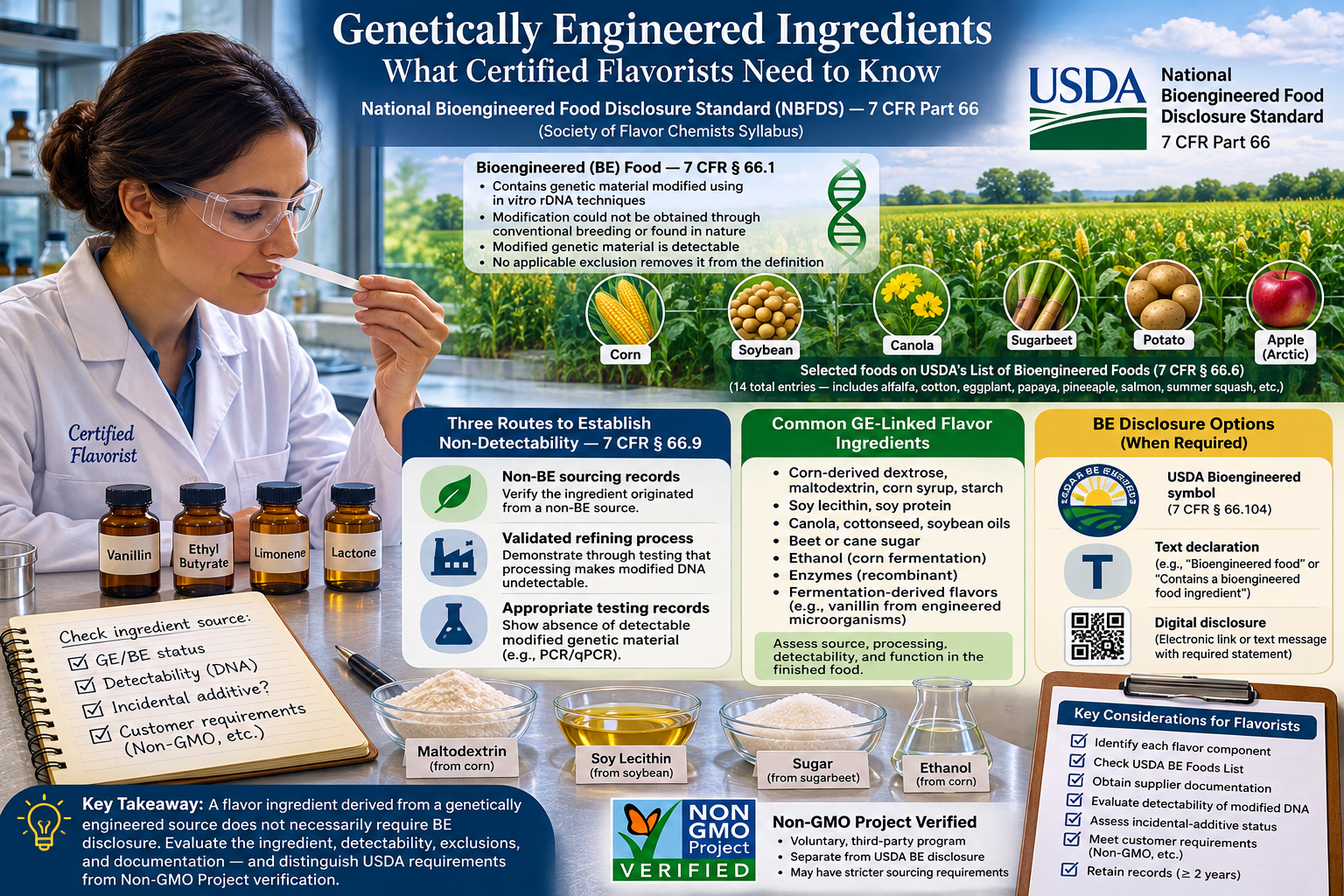
Regulatory focus: National Bioengineered Food Disclosure Standard (NBFDS), 7 CFR Part 66 | U.S. requirements reviewed October 2026
1. What the Society of Flavor Chemists expects you to know
The Society of Flavor Chemists (SFC) includes Genetically Engineered Ingredients under Section III, Flavor Regulations, of its syllabus.
The syllabus identifies two areas:
- The National Bioengineered Food Disclosure Standard, as defined in 7 CFR Part 66.
- Non-GMO Project Verified, including its relevance to flavor ingredients and formulations.
Certified Flavorist candidates are also expected to demonstrate working knowledge of regulatory considerations, raw materials, manufacturing processes, ingredient labeling, documentation, and formulation decisions.
A Certified Flavorist should therefore be able to explain not just the definition of a genetically engineered ingredient, but also how its origin, manufacturing process, detectability, function, and documentation affect the labeling of a finished food.
This guide distinguishes actual U.S. regulatory requirements from recommended flavor-industry practices and examination preparation.
2. Fundamental terminology: GMO, GE, and BE
These terms are related but not interchangeable.
| Term | Meaning | Importance to flavorists |
|---|---|---|
| GMO | Genetically Modified Organism | Broad term frequently used in supply-chain documentation and consumer claims |
| GE | Genetically Engineered | Organism or material altered through genetic engineering |
| BE | Bioengineered | Specific U.S. statutory and regulatory classification under the NBFDS |
| Non-GMO | Not genetically modified, as defined by the applicable claim or standard | Requires appropriate substantiation; not automatically equivalent to exemption from BE disclosure |
| Non-GMO Project Verified | Third-party verification under the Non-GMO Project's standard | Separate from USDA's mandatory BE disclosure system |
Definition of bioengineered food — 7 CFR § 66.1
Under the NBFDS, a food generally meets the BE definition when:
- It contains genetic material modified using in vitro recombinant DNA (rDNA) techniques.
- The modification could not otherwise be obtained through conventional breeding or found in nature.
- The modified genetic material is detectable.
- No applicable regulatory exclusion removes it from the definition.
The NBFDS is a disclosure standard, not a general definition of every GMO-derived material.
For instance, a highly refined ingredient derived from genetically engineered corn may not require mandatory BE disclosure when appropriate records demonstrate that modified genetic material is not detectable. That ingredient is nonetheless still derived from a genetically engineered crop.
This matters when a customer requests a non-GMO flavor, which may involve stricter sourcing criteria than federal BE disclosure rules.
What is genetic engineering?
Genetic engineering covers techniques used to modify the genetic characteristics of organisms. Relevant concepts include:
- Recombinant DNA technology: introducing or modifying DNA using laboratory techniques.
- Transgenic modification: introducing genetic material originating from a different organism.
- Gene editing: making targeted changes to DNA, including through CRISPR-based techniques.
- Conventional breeding: selecting and crossing organisms without laboratory-based DNA modification.
Not every gene-edited product falls within the NBFDS definition. The nature of the modification must be assessed against the regulatory definition.
Why it matters to flavorists
Genetic engineering may be relevant to the source of carbohydrates, fermentation organisms, enzymes, carriers, proteins, vegetable oils, and flavor substances. The chemical identity of an aroma molecule alone does not establish its BE classification.
For example, vanillin obtained through chemical synthesis, extraction from vanilla beans, or microbial fermentation may share the same molecular structure while raising different source, production, labeling, and customer-certification questions.
3. The National Bioengineered Food Disclosure Standard
The NBFDS was established by USDA's Agricultural Marketing Service (AMS) under federal legislation enacted in 2016. The final rule was published in December 2018, with mandatory compliance beginning January 1, 2022.
Its purpose is to inform consumers about bioengineered foods and foods containing bioengineered food ingredients. It is not a food-safety approval system, and a BE disclosure does not mean a food has been found unsafe.
Who is responsible for disclosure?
Regulated entities include food manufacturers, food importers, and certain retailers responsible for labeling foods for retail sale.
A flavor manufacturer supplying a flavor to a food company may not be the entity responsible for the finished retail label. Its ingredient-origin records, supplier statements, and processing documentation can nevertheless be essential to the customer's determination.
Foods within scope
The regulation generally covers foods subject to FDA labeling requirements and certain USDA-regulated meat, poultry, and egg products, depending on ingredient predominance.
Key exemptions under 7 CFR § 66.5 include:
- Food served in restaurants and similar retail food establishments.
- Very small food manufacturers, defined by annual receipts below $2.5 million.
- Foods without intentionally added BE substances, allowing up to 5% inadvertent or technically unavoidable BE presence per ingredient.
- Animal-derived foods that would be classified as BE solely because the animal consumed BE feed.
- Foods certified under the USDA National Organic Program.
The 5% allowance is not blanket permission to intentionally formulate with up to 5% genetically engineered ingredients without disclosure. An intentionally used BE ingredient cannot ordinarily rely on this exemption simply because it is present at a low level.
4. USDA's List of Bioengineered Foods — 7 CFR § 66.6
USDA maintains a list of foods commercially available in bioengineered forms. The list helps determine which ingredients require recordkeeping and further assessment. As of October 2026, it contains 14 entries.
| Listed food | Relevance to flavor development |
|---|---|
| Alfalfa | Botanical or agricultural source materials |
| Apple (Arctic varieties) | Apple preparations, juice concentrates, fruit ingredients |
| Canola | Canola oil and oil-derived flavor carriers |
| Corn | Corn syrup, glucose, dextrose, maltodextrin, starch, ethanol |
| Cotton | Cottonseed oil and derivatives |
| Eggplant (BARI Bt Begun varieties) | Vegetable ingredients and savory preparations |
| Papaya (ringspot virus-resistant varieties) | Papaya-derived preparations and concentrates |
| Pineapple (pink-flesh varieties) | Fruit preparations and pineapple-derived ingredients |
| Potato | Potato starch, flakes, powders, extracts |
| Salmon (AquAdvantage) | Seafood-derived flavor ingredients |
| Soybean | Soy lecithin, soy protein, soybean oil, hydrolyzed soy ingredients |
| Summer squash (specified virus-resistant varieties) | Vegetable powders and preparations |
| Sugarbeet | Beet-derived sucrose and other materials |
| Sugarcane (Bt insect-resistant varieties) | Cane-derived sugar and related ingredients |
Flavorists should know this list well, particularly corn, soy, canola, sugarbeet, sugarcane, cotton, and potato, which can enter flavor formulas through carriers, sweeteners, solvents, emulsifiers, and processing ingredients.
Two points to remember:
- Presence on the list does not make every ingredient from that crop bioengineered. A supplier may use a non-BE variety, or processing may eliminate detectable modified genetic material.
- Absence from the list does not automatically exempt a food. Under § 66.109, actual knowledge that a food or ingredient is bioengineered can establish a disclosure obligation, including for genetically engineered microorganisms not on the list.
5. Detectability of modified genetic material — 7 CFR § 66.9
A food derived from genetically engineered material does not necessarily meet the regulatory definition of BE food. This is one of the most important concepts for a Certified Flavorist.
For a material to be treated as having no detectable modified genetic material under § 66.9, records must support at least one of three routes:
- Route 1 — Non-BE sourcing records. Documentation verifies that the food originated from a non-bioengineered crop or source.
- Route 2 — Validated refining process. Records establish that the material underwent a process validated through testing to make modified genetic material undetectable.
- Route 3 — Appropriate testing records. Certificates of analysis or other suitable test records confirm the absence of detectable modified genetic material.
Examples of highly refined ingredients
In flavor development, these may include:
- Refined vegetable oils
- Highly purified sugars and syrups
- Distilled ethanol
- Certain isolated or purified aroma compounds
- Some highly processed carbohydrate derivatives
These materials may qualify as having no detectable modified genetic material, but this should never be assumed from the ingredient name or process category alone.
Corn starch and soy lecithin, for example, may still contain detectable modified genetic material depending on sourcing and manufacturing. USDA identifies these types of ingredients as requiring ingredient-specific assessment.
Analytical methods
Tests for modified DNA generally use molecular techniques, particularly PCR and quantitative PCR (qPCR).
| Concept | Significance |
|---|---|
| PCR | Amplifies targeted DNA sequences |
| qPCR | Detects and quantifies target DNA signals |
| Limit of detection (LOD) | Lowest concentration at which the method can reliably detect the target |
| Specificity | Whether the method detects the intended genetic sequence |
| Matrix effects | Interference from sugars, oils, proteins, or other formulation components |
| Positive and negative controls | Help establish that analytical results are valid |
| Validated refining process | Demonstrated to eliminate detectable modified genetic material under specified conditions |
USDA does not mandate a single analytical technique for every food. Section 66.9(c) requires appropriate laboratory quality assurance, method validation, reliable performance, and sufficient analytical sensitivity.
Once a process has been properly validated, repeated testing is not necessarily required for material processed under the same validated conditions, provided no significant process changes have occurred and appropriate records are retained.
Exam distinction: A negative PCR result is not universal proof of non-GMO origin. It supports a conclusion only within the method's scope, sensitivity, and tested matrix.
6. Genetically engineered ingredients used in flavor formulations
A Certified Flavorist should distinguish the source material, the manufacturing process, the actual ingredient, and its role in the finished food.
| Flavor ingredient | Potential GE connection | What to verify |
|---|---|---|
| Corn-derived maltodextrin | GE corn | Crop origin, source status, refining records |
| Dextrose | Corn starch hydrolysis | Source and detectability documentation |
| Corn syrup | GE corn | Manufacturing and supply-chain records |
| Soy lecithin | GE soybeans | Lecithin sourcing, residual DNA, functionality |
| Soy protein or HVP | GE soybeans | Source identity and presence of modified DNA |
| Canola oil | GE canola | Refining validation and supplier declaration |
| Ethanol | Fermentation of corn sugars | Feedstock origin, purification, finished ingredient status |
| Beet sugar | GE sugarbeet | Refining documentation |
| Cane sugar | GE sugarcane varieties | Varietal and sourcing documentation |
| Natural aroma chemicals from fermentation | Possible engineered production microorganism | Organism identity, processing, residual cells/DNA |
| Enzymes | Possible recombinant production microorganisms | Production process, residual genetic material, processing-aid function |
| Modified starches | Possible GE crop source | Crop origin and processing |
| Flavor emulsions | Possible GE lecithin or vegetable oil | Composition and finished-product functionality |
These are potential sourcing issues, not claims that every commercial form of these ingredients is bioengineered.
Case A: Corn-derived maltodextrin
A flavorist creates a spray-dried strawberry flavor containing maltodextrin made from genetically engineered corn. The analysis is:
- Determine whether the maltodextrin contains detectable modified genetic material.
- Obtain records supporting non-detectability, if claimed.
- Determine whether the maltodextrin has an independent technical effect in the finished food or may qualify as an incidental additive.
- Communicate the findings to the finished-food manufacturer.
If modified genetic material is demonstrably not detectable, the maltodextrin does not meet the NBFDS definition of BE food. Customers seeking Non-GMO Project verification, however, may impose requirements based on the corn source itself.
Case B: Soy lecithin in an emulsion
A beverage flavor contains soy lecithin derived from GE soybeans. Possible regulatory outcomes:
- Detectable modified genetic material, with a functional role in the food: potentially subject to BE disclosure.
- Documented absence of detectable modified genetic material: no mandatory BE disclosure on that basis.
- Qualifies as an incidental additive in the finished food: excluded from BE classification under § 66.1, even if modified genetic material is present.
The flavorist must consider actual use rather than assuming all emulsifiers are exempt.
Case C: Ethanol derived from GE corn
Ethanol produced from fermented GE corn may be distilled and purified. Although the corn was genetically engineered, the resulting ethanol may contain no detectable modified genetic material. A supplier's validated purification documentation can support the BE determination, but it would not by itself establish that the ethanol meets a private non-GMO standard.
Case D: Fermentation-derived vanillin
Consider vanillin made by fermentation using an engineered microorganism. Key questions:
- Was the microorganism genetically engineered?
- Is the organism present in the final ingredient?
- Does the final vanillin contain detectable modified genetic material?
- Is a validated downstream purification process used?
- What records support the determination?
- Does the customer's private certification standard restrict the production microorganism?
It would be incorrect to assume the vanillin requires BE disclosure merely because an engineered microorganism was used. It would be equally incorrect to assume purification makes it acceptable under every non-GMO certification. Federal disclosure status and customer-specific production restrictions must be assessed separately.
7. Genetically engineered microorganisms and biotechnology
Microbial systems can produce aroma compounds through fermentation, enzymatic conversion, and metabolic pathways. Fermentation-derived flavor substances include vanillin, lactones, esters, alcohols, and selected organic acids.
Production organisms may be:
- Naturally occurring microorganisms
- Conventionally selected or mutated strains
- Genetically engineered bacterial strains
- Genetically engineered yeasts or fungi
A useful distinction is between the production organism and the purified substance it produces. A purified molecule is not necessarily a BE food simply because the production organism was genetically engineered. Conversely, a food containing viable or residual GE microorganisms, or detectable modified genetic material, may raise disclosure considerations. USDA addresses enzymes, yeasts, and other microorganisms under its actual-knowledge provisions.
Enzymes and processing aids
Recombinant enzymes are used in food and flavor manufacturing for:
- Enzymolysis of proteins
- Formation or modification of flavor precursors
- Hydrolysis of fats and carbohydrates
- Bioconversion of aroma compounds
- Fermentation support
The BE assessment depends on the enzyme preparation, its composition, any modified genetic material present, its function, and whether it qualifies as an incidental additive in the finished product.
Using a GE microorganism, using a substance made by that microorganism, and consuming that microorganism are three different regulatory situations.
8. Incidental additives
Under 7 CFR § 66.1, incidental additives meeting the criteria in 21 CFR § 101.100(a)(3) are excluded from the definition of bioengineered food. To qualify, the additive must be present at an insignificant level and have no technical or functional effect in the finished food. This is particularly relevant to flavor carriers, processing aids, and materials introduced through compounded flavors.
Example: A flavor carrier in a beverage
A flavor concentrate contains corn-derived maltodextrin and is added to a beverage at a low usage rate. The question is whether the maltodextrin has a technical or functional effect in the finished beverage, not whether it served a purpose during flavor manufacture.
- If it meets the FDA incidental-additive criteria in the finished beverage, it is excluded from BE classification.
- If it has a functional effect in the finished beverage, the exclusion may not apply.
- If modified genetic material is independently shown to be undetectable, the ingredient may fall outside the BE definition regardless of the incidental-additive analysis.
An ingredient is not an incidental additive merely because it is present at a low concentration. Voluntarily listing a qualifying incidental additive on a label does not remove its exclusion under the NBFDS.
Exam takeaway: The BE status of a compounded flavor and the disclosure status of a finished product containing it may differ. Always consider the finished-food application.
9. Mandatory labeling requirements under 7 CFR Part 66
When a finished food is subject to mandatory BE disclosure, the responsible manufacturer, importer, or retailer must use one of the permitted formats:
- USDA BE symbol: placed on the label in accordance with § 66.104.
- Text disclosure: for example, "Bioengineered food" or "Contains a bioengineered food ingredient," as applicable.
- Digital disclosure: an electronic or digital link, or a text-message option, meeting the applicable accessibility, accompanying-statement, and procedural requirements.
Small food manufacturers and small packages have additional options under §§ 66.110–66.112. Required disclosures must be sufficiently prominent and appear in an authorized location on the label.
Voluntary disclosures
A refined ingredient derived from a BE source but without detectable modified genetic material may be eligible for a voluntary "derived from bioengineering" disclosure under § 66.116. This differs from a mandatory BE declaration. The rule also restricts voluntary disclosure based solely on incidental additives.
Final package language should not be determined solely from an ingredient's crop origin. The correct disclosure depends on the food, the documentation, and the applicable regulation.
10. Non-GMO Project Verified
The Non-GMO Project operates a voluntary, third-party verification program for GMO avoidance. It is not a USDA certification and is distinct from mandatory NBFDS compliance.
The Non-GMO Project published Version 17 of its standard on October 1, 2026. Consult the applicable version and its implementation requirements when preparing documentation for customer verification.
USDA BE disclosure versus Non-GMO Project verification
| Subject | USDA NBFDS | Non-GMO Project |
|---|---|---|
| Nature | Federal disclosure regulation | Voluntary third-party verification |
| Primary focus | Whether a food meets the regulatory BE definition | GMO avoidance throughout specified production and sourcing processes |
| Highly refined GE-derived ingredients | May not require disclosure if modified genetic material is not detectable | May still be restricted or require additional evaluation |
| GE microorganisms | Evaluate the food against the BE definition | Evaluate under the project's biotechnology and input requirements |
| Documentation | Records supporting regulatory compliance | Records required by the verification standard |
| Mark | USDA BE symbol is a disclosure, not a certification | Butterfly seal signifies verified status |
| Responsible organization | USDA AMS | Non-GMO Project and its verification system |
Why this matters to flavor creation
Consider a powdered flavor containing dextrose derived from GE corn. Valid records may show no detectable modified genetic material, so mandatory BE disclosure may not be required. The same dextrose might still be unsuitable for a customer's Non-GMO Project verification program.
Three different customer requests should be kept distinct:
- No mandatory BE disclosure: a regulatory claim based on 7 CFR Part 66.
- Non-GMO ingredients: a broader sourcing claim requiring a clear definition and substantiation.
- Non-GMO Project Verified: compliance with a specific third-party program.
11. Supplier documentation and regulatory compliance
Under § 66.302, regulated entities must maintain reasonable and customary records demonstrating compliance and retain them for at least two years beyond the date the food is sold or distributed for retail sale. Examples include supplier declarations, supply-chain records, invoices, certifications, laboratory test results, and process-validation records.
Under § 66.304, records generally must be provided to AMS within five business days of a request, unless an extension is granted.
Recommended ingredient review checklist
This is an industry-practice checklist, not a prescribed USDA form.
- [ ] Identify each flavor component, including carriers and processing aids
- [ ] Record the biological or agricultural source of each relevant component
- [ ] Check whether the source is on the USDA List of Bioengineered Foods
- [ ] Ask suppliers whether BE crops or engineered microorganisms are used
- [ ] Obtain supporting non-BE sourcing records, testing, or process validation
- [ ] Evaluate detectability of modified genetic material
- [ ] Assess incidental-additive status in the intended finished food
- [ ] Review separate customer non-GMO or certification requirements
- [ ] Communicate ingredient findings and uncertainties to regulatory affairs
- [ ] Retain controlled supplier documents and update them when sourcing changes
A useful supplier attestation identifies the ingredient, manufacturer, source material, manufacturing process, BE determination, supporting evidence, and the date or validity period of the statement. A statement that says only "GMO free" may not support a specific regulatory conclusion if its meaning and evidentiary basis are unclear.
12. Common errors to avoid
| Incorrect statement | Correct interpretation |
|---|---|
| All ingredients derived from GE crops require BE labels. | Detectability, exclusions, and exemptions must be considered. |
| The USDA list only contains crops grown in the United States. | It includes specified foods commercially produced in BE forms internationally. |
| A product containing less than 5% BE ingredients is automatically exempt. | The 5% allowance applies to inadvertent or technically unavoidable presence per ingredient, not intentional use. |
| Highly refined ingredients are always exempt. | Non-detectability requires appropriate supporting records. |
| A PCR-negative result proves an ingredient was never genetically engineered. | It establishes only the analytical finding within the method's capabilities. |
| Natural flavors are automatically non-GMO. | Natural flavor classification and GMO/BE status address different questions. |
| A flavor made by a GE yeast is always a BE food. | The resulting ingredient must be evaluated under the applicable definition and exclusions. |
| A flavor labeled "non-BE" is automatically Non-GMO Project Verified. | Third-party verification has separate requirements. |
| Incidental additives must trigger BE disclosure. | Qualifying incidental additives are excluded under § 66.1. |
| All GMOs are unsafe. | The NBFDS is a disclosure standard and does not establish comparative safety. |
13. Practice questions
These are study exercises, not official SFC examination questions. One correct answer each.
1. What primarily distinguishes a BE-derived highly refined ingredient from a BE food requiring disclosure? A. Its molecular weight B. Whether modified genetic material is detectable under the regulation C. Whether the supplier calls it natural D. Whether it is used below 1%
2. A supplier intentionally uses a BE ingredient at 2% of a formula. Can it rely solely on the 5% allowance to avoid disclosure? A. Yes, always B. Only when it is artificial C. No; the allowance concerns inadvertent or technically unavoidable BE presence D. Yes, if the flavor is liquid
3. Which item is NOT, by itself, proof of Non-GMO Project verification? A. A product's certification under the applicable verification program B. Documented verification status C. A USDA finding that modified genetic material is undetectable D. An authorized verified-product record
4. A GE-derived carrier is present at an insignificant level and has no technical or functional effect in the finished food. What may apply? A. Incidental-additive exclusion B. Automatic mandatory disclosure C. Automatic allergen exemption D. Automatic USDA organic certification
5. How long must regulated entities generally retain NBFDS compliance records? A. Six months after manufacture B. One year after purchase C. At least two years after retail sale or distribution D. Indefinitely for all suppliers
6. A yeast is not on the USDA list, but the manufacturer knows a food contains a qualifying BE yeast ingredient. What is the correct principle? A. The list excludes all microorganisms B. Actual knowledge can establish a disclosure requirement C. Yeasts are automatically incidental additives D. All fermented products are exempt
7. Which statement about distilled ethanol derived from GE corn is best? A. It must always carry BE disclosure B. It is automatically Non-GMO Project Verified C. It may not meet the BE definition if appropriate records establish no detectable modified genetic material D. Distillation always proves Non-GMO Project verification
8. Who ordinarily has responsibility for the BE disclosure on a finished packaged retail food? A. Only the flavorist B. The laboratory testing company C. The responsible food manufacturer or importer D. Only the farmer
Answer key: 1-B, 2-C, 3-C, 4-A, 5-C, 6-B, 7-C, 8-C
14. CFR sections to know
| Citation | What to remember |
|---|---|
| 7 CFR § 66.1 | BE definitions, detectability condition, incidental additives |
| § 66.3 | Foods subject to disclosure |
| § 66.5 | Exemptions, including 5% inadvertent presence, restaurants, organic |
| § 66.6 | List of Bioengineered Foods |
| § 66.7 | Updates to the list |
| § 66.9 | Non-detectability and validated refining processes |
| § 66.100 | Responsibility and disclosure formats |
| §§ 66.102–66.108 | Specific disclosure methods |
| § 66.109 | Disclosure based on actual knowledge |
| § 66.116 | Voluntary disclosures |
| § 66.302 | Recordkeeping and retention |
| § 66.304 | Access to records |
| 21 CFR § 101.100(a)(3) | Incidental additives |
15. Primary sources
- Society of Flavor Chemists — Official Syllabus, Section III, Flavor Regulations: https://flavorchemist.org/membership-policy/syllabus/
- 7 CFR Part 66 — National Bioengineered Food Disclosure Standard: https://www.ecfr.gov/current/title-7/subtitle-B/chapter-I/subchapter-A/part-66
- USDA AMS — Bioengineered Food Disclosure (overview, FAQs, guidance): https://www.ams.usda.gov/rules-regulations/be
- USDA — List of Bioengineered Foods: https://www.ams.usda.gov/rules-regulations/be/bioengineered-foods-list
- USDA — Detectability Testing and Validation: https://www.ams.usda.gov/rules-regulations/be/validation-process
- Non-GMO Project — Verification Standard: https://www.nongmoproject.org/the-standard/
Summary
The central skill tested by this syllabus topic is distinguishing genetically engineered origin, regulatory bioengineered status, and non-GMO verification.
A strong answer explains that a flavor ingredient derived from a genetically engineered source does not necessarily require BE disclosure under 7 CFR Part 66. The flavorist must evaluate the nature of the ingredient, whether modified genetic material is detectable, any incidental-additive exclusion or other exemption, and the evidence supporting the conclusion.
USDA disclosure compliance does not automatically satisfy customer specifications or Non-GMO Project requirements, and documentation of ingredient sourcing and processing is an essential part of responsible flavor development.
Practical principle: Never classify an entire flavor as BE, non-BE, non-GMO, or verified from its ingredient names alone. Evaluate the relevant components, source and manufacturing records, their function in the finished food, and the applicable standard.
This is a study interpretation of the SFC syllabus, not an official SFC answer key or a product-specific legal determination. (e)
###