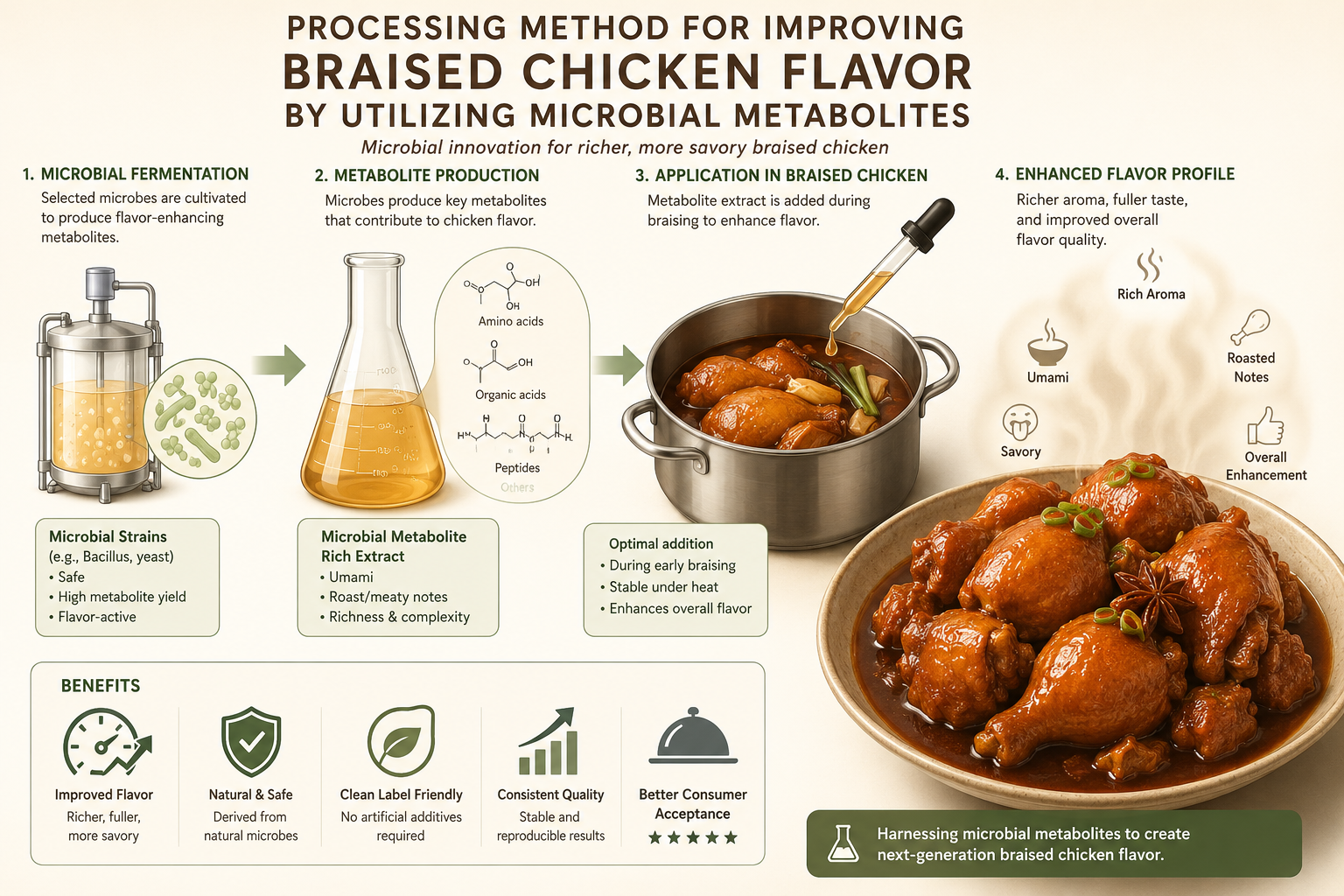
Patent Alert: Processing Method for Improving Braised Chicken Flavor by Utilizing Microbial Metabolites
Patent Information
- Patent Number: CN121774185A
- Country: China
- Application Number: CN202610103782.4A
- Status: Pending
- Publication Date: January 26, 2026
- Inventors: Not explicitly named in the document (the patent text does not list specific inventors)
- Current Assignee: Not explicitly named in the document (the patent text does not list a specific assignee)
Technical Field
The invention relates to the technical field of food processing, and specifically to a processing method for improving braised chicken flavor by utilizing microbial metabolites.
Background of the Invention
Braised chicken, as a traditional Chinese specialty meat product, is deeply favored by consumers for its unique qualities of tender meat that easily separates from the bone, fragrant red color, and aromatic sweetness. The traditional braised chicken processing technology, exemplified by the century-old intangible cultural heritage technique of Texas braised chicken, primarily relies on core steps including material selection, shaping, blanching, sugar coating, and stewing in aged marinade. Flavor formation mainly depends on the permeation of spice components from the aged marinade and the decomposition and conversion of chicken protein and fat. The quality of the aged marinade directly determines the flavor level of the braised chicken, and high-quality aged marinade can accumulate sufficient flavor substances only after long-term boiling and continuous maintenance.
However, the traditional process has several limitations:
- Long cultivation period: The cultivation period of aged marinade is lengthy, with high costs and difficult flavor stability control. Different batches of aged marinade, due to variations in spice proportions, boiling times, and other factors, can easily cause uneven product flavor.
- Limited flavor variety: The traditional process mainly relies on the flavor conversion of natural spices and chicken, resulting in limited types of flavor substances and difficulty in meeting modern consumers' demands for diversified flavors and richer layering.
- Chemical additive concerns: Some manufacturers add chemical synthetic flavoring agents to enhance flavor. Although this can quickly boost flavor intensity, it does not align with consumers' pursuit of natural and healthy foods.
Microbial Metabolites as Natural Flavor Enhancers
Microbial metabolites are various active substances produced by microorganisms during growth and reproduction, including organic acids, esters, alcohols, amino acids, nucleotides, etc., which serve as natural flavor enhancers. Research shows that metabolites produced by food-grade microorganisms such as Lactobacillus plantarum and Saccharomyces cerevisiae can effectively:
- Improve the flavor level of meat products
- Enhance delicate flavor and mellow sensation
- Inhibit the growth of harmful microorganisms
- Improve product safety
For example:
- Lactic acid produced by Lactobacillus plantarum metabolism can regulate the pH of meat products and promote protein hydrolysis to produce amino acids.
- Nucleotide substances such as guanylic acid (GMP) and inosinic acid (IMP) produced by yeast metabolism have remarkable freshness-enhancing effects.
- The synergistic effect of nucleotides with glutamic acid can greatly enhance the strength of delicate flavor.
However, under conventional culture conditions, the types and contents of flavor metabolites generated by microorganisms are limited, making it difficult to fully meet the requirements for improving braised chicken flavor.
Summary of the Invention
Aiming at the above technical problems, the present invention provides a processing method for improving braised chicken flavor by utilizing microbial metabolites. The method utilizes the technology of adding Lycium ruthenicum polysaccharide to Lactobacillus plantarum MRS culture medium and adding Cordyceps militaris fruiting body extracts to yeast YPD culture medium. This approach leverages:
- The sustained-release characteristics and antioxidant activity of Lycium ruthenicum polysaccharide as a carbon source to provide continuous and stable energy supply for Lactobacillus plantarum while protecting unsaturated aldehyde ketone substances generated during its metabolic process from oxidative decomposition.
- The cordycepic acid and nucleoside components in Cordyceps militaris fruiting body extracts to activate ester synthase activity in yeast, promoting the biosynthesis of aromatic ester substances such as phenethyl alcohol and ethyl acetate.
- Directional enrichment of characteristic volatile substances, enriching the types and contents of aromatic substances, and building a foundation of flavor substances for chicken from the metabolic source.
Processing Method Steps
The processing method for improving braised chicken flavor by utilizing microbial metabolites comprises the following steps:
S1: Performing expansion culture of Lactobacillus plantarum using an improved MRS culture medium under anaerobic conditions at 30-35°C for 24-36 hours. Simultaneously, performing expansion culture of Saccharomyces cerevisiae using an improved YPD culture medium under aerobic shaking conditions at 28-32°C for 18-24 hours with a shaking rate of 150-200 r/min.
S2: Centrifuging the cultured Lactobacillus plantarum bacterial liquid and Saccharomyces cerevisiae bacterial liquid separately at 8000-10000 r/min for 10-15 minutes. Collecting the supernatant and filter-sterilizing using a 0.22 μm filter membrane to obtain Lactobacillus plantarum metabolite stock solution and Saccharomyces cerevisiae metabolite stock solution.
S3: Taking healthy chickens, slaughtering, dehairing, removing viscera, and cleaning. Placing into a cold water pot, adding ginger slices, scallion sections, and cooking wine. Boiling with strong fire for 5-8 minutes, skimming, removing, washing with warm water, and draining.
S4: Uniformly mixing the composite microbial metabolite with sugar color. Uniformly coating the surface and inner cavity of the drained chicken body with a brush, with a coating amount of 10-15 g per chicken. Standing for 5-10 minutes after coating to allow the metabolite and sugar color to jointly permeate into the epidermis.
S5: Placing the sugar-coated chicken into marinade, ensuring the marinade covers over 2/3 of the chicken body. Boiling with strong fire, then slowly stewing with low fire, maintaining the marinade in a slightly boiling state (85-90°C) for 4-6 hours. Turning the chicken body every 1 hour. After stewing, turning off the fire, allowing the chicken to rest in the residual heat, removing, draining the marinade, and naturally cooling to room temperature to obtain the finished product.
Detailed Process Parameters
Improved MRS Culture Medium (S1) : Prepared by adding 1.5-2.5 g/L Lycium ruthenicum polysaccharide, 0.3-0.8 g/L L-theanine, and 8-12 g/L arabinose to conventional MRS culture medium.
Improved YPD Culture Medium (S1) : Prepared by adding 2-4 g/L Cordyceps militaris fruiting body extract, 0.2-0.5 g/L citric acid, and 6-10 g/L trehalose to conventional YPD culture medium.
Lycium ruthenicum Polysaccharide: Prepared by water extraction and alcohol precipitation method (extraction temperature 80°C, extraction time 2 hours, alcohol precipitation concentration 70%). The unique heteropolysaccharide structure can activate the aroma-producing metabolic pathway of Lactobacillus plantarum and promote the synthesis of organic acid and aromatic short-chain fatty acids.
Cordyceps militaris Fruiting Body Extract: Obtained by ultrasonic-assisted extraction at 300W power for 30 minutes. Rich in cordycepic acid and cordyceps polysaccharide, it can significantly induce Saccharomyces cerevisiae to synthesize high-activity nucleotide substances and ester precursor substances.
Metabolite Mixing Ratio (S2) : The volume ratio of Lactobacillus plantarum metabolite stock solution to Saccharomyces cerevisiae metabolite stock solution is 1:1 to 2:1.
β-Cyclodextrin Addition (S2) : Added at 2-5% of the mass of the mixed stock solution.
Sugar Color Preparation (S4) : Obtained by mixing clear water and white sugar at a volume ratio of 1:2 and decocting with low fire until the color is dark amber (temperature 160°C).
Metabolite to Sugar Color Ratio (S4) : The mass ratio of composite microbial metabolite to sugar color is 1:5 to 1:8.
Marinade Preparation (S5) : Preparing a basic marinade consisting of bone broth, spice bags, and flavoring agents. The bone broth is obtained by decocting chicken bones and pig bones at a mass ratio of 1:1 for 4-6 hours. The spice bags are prepared by adding 15g star anise, 10g cinnamon, 5g clove, 8g tsaoko cardamom, 8g pepper, and 5g bay leaves per 10 kg of bone broth. The flavoring agent consists of 150 mL soy sauce, 50g salt, 30g rock candy, and 100 mL cooking wine. Adding the composite microbial metabolites to the basic marinade at 3-5% of the basic marinade mass, stirring uniformly, boiling with strong fire, then transferring to low fire for heat preservation for 30 minutes, thus obtaining the marinade.
Braised Chicken Product
The invention also provides braised chicken prepared by the above processing method.
Advantageous Effects
1. Improved Culture Medium Technology
The invention provides a technology for improving the microorganism culture medium formula:
- Adding Lycium ruthenicum polysaccharide to Lactobacillus plantarum MRS culture medium utilizes the carbon source slow-release characteristic and antioxidant activity to provide continuous and stable energy supply for Lactobacillus plantarum, while protecting unsaturated aldehyde ketone substances generated in the metabolic process from oxidative decomposition.
- Adding Cordyceps militaris fruiting body extract to yeast YPD culture medium activates ester synthase activity in yeast, promoting the biosynthesis of aromatic ester substances.
2. Stable Flavor Retention
The invention employs β-cyclodextrin embedding treatment of the composite metabolite:
- Solves the problems of easy volatilization and easy decomposition of flavor substances during processing.
- Cooperates with sugar coating permeation and marinade gradient flavoring to achieve stable retention and uniform distribution of flavor components.
- Avoids the defect of over-strong or over-weak local flavor.
- Improves the coordination of aroma and flavor.
3. Natural Flavor Enhancement
The invention adopts the technology of replacing chemical flavoring agents with natural microbial metabolites:
- Avoids the problems of single flavor and off-odor residues caused by chemical additives.
- Achieves the effects of endowing braised chicken with mellow natural flavor and optimizing the acid-flavor balance degree through the synergistic effect of IMP, GMP, and other flavor substances in the metabolites with organic acids.
- Meets the consumption requirements of health foods.
Detailed Description of Embodiments
General Preparation Methods
Lycium ruthenicum Polysaccharide: Prepared by water extraction and alcohol precipitation method (extraction temperature 80°C, extraction time 2 hours, alcohol precipitation concentration 70%).
Cordyceps militaris Fruiting Body Extract: Extracted with 300W ultrasonic wave for 30 minutes.
Sugar Color: Obtained by mixing clear water and white sugar at a volume ratio of 1:2 and decocting with low fire until the color is dark amber (temperature 160°C).
Basic Marinade: Consists of bone broth, spice bags, and flavoring agents. Bone broth is prepared by decocting chicken skeleton and pig bone at a mass ratio of 1:1 for 4-6 hours. Spice bags are prepared by adding 15g star anise, 10g cinnamon, 5g clove, 8g tsaoko cardamom, 8g pepper, and 5g bay leaves per 10kg of bone broth. Flavoring agent comprises 150mL soy sauce, 50g salt, 30g rock candy, and 100mL cooking wine.
Examples 1-3: Modified MRS Culture Medium
Example 1: Conventional MRS culture medium + Lycium ruthenicum polysaccharide 1.5g/L + L-theanine 0.3g/L + arabinose 8g/L.
Example 2: Conventional MRS culture medium + Lycium ruthenicum polysaccharide 2.0g/L + L-theanine 0.5g/L + arabinose 10g/L.
Example 3: Conventional MRS culture medium + Lycium ruthenicum polysaccharide 2.5g/L + L-theanine 0.8g/L + arabinose 12g/L.
Examples 4-6: Modified YPD Culture Medium
Example 4: Conventional YPD medium + Cordyceps militaris fruiting body extract 2g/L + citric acid 0.2g/L + trehalose 6g/L.
Example 5: Conventional YPD medium + Cordyceps militaris fruiting body extract 3g/L + citric acid 0.3g/L + trehalose 8g/L.
Example 6: Conventional YPD medium + Cordyceps militaris fruiting body extract 4g/L + citric acid 0.5g/L + trehalose 10g/L.
Examples 7-8: Marinade Preparation
Example 7: Marinade prepared by adding composite microbial metabolite to basic marinade at 3% of basic marinade mass, stirring, boiling with strong fire, and maintaining temperature with low fire for 30 minutes.
Example 8: Marinade prepared by adding composite microbial metabolite to basic marinade at 5% of basic marinade mass, stirring, boiling with strong fire, and maintaining temperature with low fire for 30 minutes.
Example 9: Complete Processing Method
A processing method for improving braised chicken flavor by utilizing microbial metabolites comprises the following steps:
S1: Performing expansion culture of Lactobacillus plantarum using the modified MRS culture medium prepared in Example 1 at 30°C under anaerobic conditions for 24 hours. Performing expansion culture of Saccharomyces cerevisiae using the modified YPD culture medium prepared in Example 4 at 28°C under aerobic shaking conditions for 18 hours with a shaking rate of 150 r/min.
S2: Centrifuging the cultured bacterial liquids separately at 8000 r/min for 10 minutes. Collecting supernatant and filter-sterilizing using 0.22 μm filter membrane to obtain metabolite stock solutions. Mixing Lactobacillus plantarum and Saccharomyces cerevisiae metabolite stock solutions at a volume ratio of 1:1 to obtain a mixed stock solution. Adding β-cyclodextrin at 2% of the mixed stock solution mass for embedding treatment, stirring uniformly, and refrigerating at 4°C for 12 hours to obtain stabilized composite microbial metabolite.
S3: Taking healthy chickens (weight 1.5 kg), slaughtering, dehairing, removing viscera, and cleaning. Placing into a cold water pot, adding 15g ginger slices, 20g scallion sections, and 40mL cooking wine. Boiling with strong fire for 5 minutes, skimming, removing, washing with warm water, and draining.
S4: Uniformly mixing the composite microbial metabolite with sugar color at a mass ratio of 1:5. Uniformly coating the surface and inner cavity of the drained chicken body with a brush at a coating amount of 10g per chicken. Standing for 5 minutes after coating.
S5: Placing the sugar-coated chicken into marinade prepared in Example 7, ensuring marinade covers over 2/3 of the chicken body. Boiling with strong fire, then stewing with low fire at 85-90°C for 4 hours. Turning the chicken every 1 hour. After stewing, turning off fire, resting in residual heat, removing, draining marinade, and naturally cooling to room temperature.
Example 10: Complete Processing Method
S1: Lactobacillus plantarum using modified MRS from Example 1 at 32°C for 28 hours. Saccharomyces cerevisiae using modified YPD from Example 5 at 30°C for 20 hours, shaking at 170 r/min.
S2: Centrifugation at 8500 r/min for 12 minutes. Metabolite mixing ratio 1.2:1 (Lactobacillus plantarum:Saccharomyces cerevisiae). β-cyclodextrin at 3% of mixed stock solution mass. Refrigerating at 4°C for 15 hours.
S3: Chickens (weight 1.6 kg). Adding 18g ginger slices, 25g scallion sections, and 45mL cooking wine. Blanching for 6 minutes.
S4: Metabolite to sugar color ratio 1:6. Coating amount 11g per chicken. Standing for 6 minutes.
S5: Marinade from Example 7. Stewing for 4.5 hours.
Example 11: Complete Processing Method
S1: Lactobacillus plantarum using modified MRS from Example 1 at 35°C for 36 hours. Saccharomyces cerevisiae using modified YPD from Example 6 at 32°C for 24 hours, shaking at 200 r/min.
S2: Centrifugation at 10000 r/min for 15 minutes. Metabolite mixing ratio 2:1. β-cyclodextrin at 5% of mixed stock solution mass. Refrigerating at 4°C for 24 hours.
S3: Chickens (weight 1.6 kg). Adding 25g ginger slices, 35g scallion sections, and 60mL cooking wine. Blanching for 8 minutes.
S4: Metabolite to sugar color ratio 1:8. Coating amount 15g per chicken. Standing for 10 minutes.
S5: Marinade from Example 8. Stewing for 6 hours.
Examples 12-18: Additional Processing Methods
Example 12: Using modified MRS from Example 2 and modified YPD from Example 4. Lactobacillus plantarum at 30°C for 36 hours. Saccharomyces cerevisiae at 32°C for 18 hours, shaking at 200 r/min. Centrifugation at 9000 r/min for 12 minutes. Metabolite mixing ratio 1.5:1. β-cyclodextrin at 4%. Refrigerating for 20 hours. Chickens (1.6 kg). Blanching with 22g ginger, 30g scallion, 55mL cooking wine for 7 minutes. Metabolite:sugar color ratio 1:7. Coating 14g per chicken, standing 9 minutes. Marinade from Example 8. Stewing for 5.5 hours.
Example 13: Using modified MRS from Example 2 and modified YPD from Example 5. Lactobacillus plantarum at 32°C for 30 hours. Saccharomyces cerevisiae at 30°C for 22 hours, shaking at 180 r/min. Centrifugation at 8500 r/min for 13 minutes. Metabolite mixing ratio 1.3:1. β-cyclodextrin at 3.5%. Refrigerating for 18 hours. Chickens (1.7 kg). Blanching with 20g ginger, 28g scallion, 50mL cooking wine for 6.5 minutes. Metabolite:sugar color ratio 1:6.5. Coating 12g per chicken, standing 7 minutes. Marinade from Example 7. Stewing for 5 hours.
Example 14: Using modified MRS from Example 2 and modified YPD from Example 6. Lactobacillus plantarum at 35°C for 24 hours. Saccharomyces cerevisiae at 28°C for 24 hours, shaking at 150 r/min. Centrifugation at 9500 r/min for 14 minutes. Metabolite mixing ratio 1.8:1. β-cyclodextrin at 4.5%. Refrigerating for 22 hours. Chickens (1.6 kg). Blanching with 23g ginger, 32g scallion, 58mL cooking wine for 7.5 minutes. Metabolite:sugar color ratio 1:7.5. Coating 13g per chicken, standing 8 minutes. Marinade from Example 8. Stewing for 5.8 hours.
Example 15: Using modified MRS from Example 3 and modified YPD from Example 4. Lactobacillus plantarum at 30°C for 30 hours. Saccharomyces cerevisiae at 30°C for 24 hours, shaking at 160 r/min. Centrifugation at 8000 r/min for 15 minutes. Metabolite mixing ratio 1.1:1. β-cyclodextrin at 2.5%. Refrigerating for 16 hours. Chickens (1.5 kg). Blanching with 16g ginger, 22g scallion, 42mL cooking wine for 5.5 minutes. Metabolite:sugar color ratio 1:5.5. Coating 10.5g per chicken, standing 5.5 minutes. Marinade from Example 7. Stewing for 4.2 hours.
Example 16: Using modified MRS from Example 3 and modified YPD from Example 5. Lactobacillus plantarum at 32°C for 33 hours. Saccharomyces cerevisiae at 31°C for 21 hours, shaking at 190 r/min. Centrifugation at 9000 r/min for 11 minutes. Metabolite mixing ratio 1.6:1. β-cyclodextrin at 3.8%. Refrigerating for 19 hours. Chickens (1.7 kg). Blanching with 21g ginger, 29g scallion, 52mL cooking wine for 6.8 minutes. Metabolite:sugar color ratio 1:6.8. Coating 12.5g per chicken, standing 7.5 minutes. Marinade from Example 8. Stewing for 5.2 hours.
Example 17: Using modified MRS from Example 3 and modified YPD from Example 6. Lactobacillus plantarum at 34°C for 27 hours. Saccharomyces cerevisiae at 29°C for 20 hours, shaking at 175 r/min. Centrifugation at 9500 r/min for 13 minutes. Metabolite mixing ratio 1.7:1. β-cyclodextrin at 4.2%. Refrigerating for 21 hours. Chickens (1.8 kg). Blanching with 22g ginger, 31g scallion, 54mL cooking wine for 7.2 minutes. Metabolite:sugar color ratio 1:7.2. Coating 13.5g per chicken, standing 8.5 minutes. Marinade from Example 7. Stewing for 5.3 hours.
Example 18: Using modified MRS from Example 3 and modified YPD from Example 5. Lactobacillus plantarum at 35°C for 25 hours. Saccharomyces cerevisiae at 32°C for 19 hours, shaking at 185 r/min. Centrifugation at 10000 r/min for 10 minutes. Metabolite mixing ratio 1.9:1. β-cyclodextrin at 4.8%. Refrigerating for 23 hours. Chickens (1.9 kg). Blanching with 24g ginger, 33g scallion, 56mL cooking wine for 7.8 minutes. Metabolite:sugar color ratio 1:7.8. Coating 14.5g per chicken, standing 9.5 minutes. Marinade from Example 8. Stewing for 5.7 hours.
Comparative Examples
Comparative Example 1 (Conventional Media, No Modifications)
- Uses conventional MRS and YPD culture media without any modifications.
- All subsequent steps identical to Example 9.
Comparative Example 2 (Modified MRS Lacking Lycium ruthenicum Polysaccharide)
- Uses modified MRS culture medium (only L-theanine and arabinose added, no Lycium ruthenicum polysaccharide).
- All subsequent steps identical to Example 10.
Comparative Example 3 (Modified YPD Lacking Cordyceps militaris Fruiting Body Extract)
- Uses modified YPD culture medium (only citric acid and trehalose added, no Cordyceps militaris fruiting body extract).
- All subsequent steps identical to Example 11.
Comparative Example 4 (Metabolite Without Embedding Treatment)
- No β-cyclodextrin embedding treatment of metabolites.
- All subsequent steps identical to Example 12.
Comparative Example 5 (Metabolite:Sugar Color Ratio 1:9)
- Metabolite to sugar color ratio changed to 1:9.
- All subsequent steps identical to Example 13.
Comparative Example 6 (Metabolite Addition to Marinade 6%)
- Composite microbial metabolite added to marinade at 6% of basic marinade mass.
- All subsequent steps identical to Example 14.
Comparative Example 7 (Lactobacillus plantarum Metabolite Only)
- Only Lactobacillus plantarum cultured; no Saccharomyces cerevisiae cultured.
- Lactobacillus plantarum metabolite used as composite metabolite.
- All subsequent steps identical to Example 15.
Comparative Example 8 (Saccharomyces cerevisiae Metabolite Only)
- Only Saccharomyces cerevisiae cultured; no Lactobacillus plantarum cultured.
- Saccharomyces cerevisiae metabolite used as composite metabolite.
- All subsequent steps identical to Example 16.
Comparative Example 9 (Conventional Process, No Metabolites)
- No microbial culture or metabolite preparation.
- Braised chicken coated with sugar color only (no composite microbial metabolite).
- Stewed using conventional basic marinade (without composite microbial metabolites).
- All subsequent steps identical to Example 17.
Comparative Example 10 (Chemical Flavoring Agent Instead of Metabolites)
- No microbial culture or metabolite preparation.
- 0.1% I+G (inosinic acid + guanylic acid) chemical flavoring agent mixed with sugar color for coating.
- 0.1% I+G also added to marinade.
- All subsequent steps identical to Example 18.
Performance Test Results and Analysis
Test 1: Volatile Flavor Compounds Analysis
Method: Headspace solid-phase microextraction-gas chromatography-mass spectrometry (HS-SPME-GC-MS).
Sample Preparation: 5.0g braised chicken sample in a 20 mL headspace bottle, adding 1 μL internal standard (2-octanol, concentration 100 μg/mL), sealing, equilibrating in 60°C water bath for 30 minutes, then inserting 50/30 μm DVB/CAR/PDMS SPME fiber for adsorption for 30 minutes, desorbing at 250°C for 5 minutes.
GC Conditions: HP-5MS capillary column (30 m × 0.25 mm × 0.25 μm), carrier gas high purity helium (≥99.999%), flow rate 1.0 mL/min. Temperature program: initial 40°C, hold 3 minutes, ramp 5°C/min to 150°C, then 10°C/min to 250°C, hold 5 minutes.
MS Conditions: Electron bombardment ionization source (EI) 70eV, ion source temperature 230°C, quadrupole temperature 150°C, mass scan range m/z 35-450.
Table 1: Volatile Flavor Compounds Analysis Results
| Sample | Volatile Flavor Compound Types (species) | Hexanal Content (mg/L) | Phenethyl Alcohol Content (mg/L) | Ethyl Acetate Content (mg/L) |
|---|---|---|---|---|
| Example 1 | 82 | 32.5 | 28.3 | 25.1 |
| Example 2 | 85 | 34.2 | 30.1 | 26.8 |
| Example 3 | 91 | 36.8 | 32.5 | 29.3 |
| Example 4 | 88 | 35.4 | 31.2 | 27.9 |
| Example 5 | 86 | 34.7 | 30.5 | 27.2 |
| Example 6 | 89 | 35.8 | 31.6 | 28.4 |
| Example 7 | 83 | 33.1 | 29.0 | 25.7 |
| Example 8 | 87 | 34.9 | 30.8 | 27.5 |
| Example 9 | 89 | 35.6 | 31.4 | 28.1 |
| Example 10 | 90 | 36.2 | 32.0 | 28.8 |
| Comparative Example 1 | 58 | 22.3 | 19.5 | 17.2 |
| Comparative Example 2 | 68 | 26.8 | 23.7 | 21.1 |
| Comparative Example 3 | 70 | 27.5 | 24.3 | 21.8 |
| Comparative Example 4 | 72 | 28.2 | 25.0 | 22.4 |
| Comparative Example 5 | 75 | 29.5 | 26.2 | 23.5 |
| Comparative Example 6 | 80 | 31.8 | 28.4 | 25.6 |
| Comparative Example 7 | 65 | 25.1 | 22.3 | 19.8 |
| Comparative Example 8 | 68 | 26.7 | 23.6 | 21.0 |
| Comparative Example 9 | 62 | 23.6 | 20.8 | 18.4 |
| Comparative Example 10 | 70 | 27.4 | 24.2 | 21.7 |
Analysis: As shown in Table 1, the volatile flavor compound types and key flavor components (hexanal, phenethyl alcohol, and ethyl acetate) in all examples are significantly higher than those in the corresponding comparative examples. The volatile flavor compound types in the examples range from 82-91, with Example 3 showing the maximum (91 species). The comparative examples show only 58-80 species, with Comparative Example 9 (conventional process) showing the minimum (62 species). Key flavor components in the examples are: hexanal 32.5-36.8 mg/L, phenethyl alcohol 28.3-32.5 mg/L, and ethyl acetate 25.1-29.3 mg/L. This demonstrates that the processing method of the invention can effectively enrich the volatile flavor substances of braised chicken, improve the content of core flavor components, and enhance flavor intensity.
Test 2: Umami Substances and Organic Acids Analysis
Method for Umami Substances (IMP+GMP) : High Performance Liquid Chromatography (HPLC).
Sample Preparation: 2.0g braised chicken sample, adding 10mL of 5% perchloric acid solution, ice bath ultrasonic extraction for 30 minutes, centrifuging for 15 minutes, taking supernatant, fixing volume to 25mL with 5% perchloric acid solution, filtering through 0.45 μm PTFE filter membrane.
HPLC Conditions: C18 chromatographic column (250 mm × 4.6 mm × 5 μm), column temperature 30°C, mobile phase methanol:0.02 mol/L potassium dihydrogen phosphate buffer (pH 6.0) = 10:90, flow rate 1.0 mL/min, detection wavelength 254 nm, injection volume 20 μL. External standard method (IMP standard) for quantification.
Method for Organic Acids (Lactic Acid + Acetic Acid) : HPLC with differential refractive index detector.
Sample Preparation: 5.0g braised chicken sample, adding 20mL ultrapure water, extracting in 80°C water bath for 30 minutes, centrifuging at 10000 r/min for 10 minutes, collecting supernatant, fixing volume to 50mL with ultrapure water, filtering through 0.45 μm PES filter membrane.
HPLC Conditions: Aminex HPX-87H ion exchange column (300 mm × 7.8 mm), column temperature 60°C, mobile phase 0.005 mol/L sulfuric acid solution, flow rate 0.6 mL/min. External standard method (lactic acid and acetic acid standards) for quantification.
Table 2: Umami Substances and Organic Acids Analysis Results
| Sample | Key Umami Substance Content (IMP+GMP) (mg/100g) | Organic Acid Content (Lactic Acid + Acetic Acid) (g/L) |
|---|---|---|
| Example 1 | 185 | 10.2 |
| Example 2 | 192 | 10.8 |
| Example 3 | 205 | 11.5 |
| Example 4 | 198 | 11.2 |
| Example 5 | 190 | 10.5 |
| Example 6 | 202 | 11.0 |
| Example 7 | 188 | 10.3 |
| Example 8 | 195 | 10.7 |
| Example 9 | 200 | 10.9 |
| Example 10 | 203 | 11.3 |
| Comparative Example 1 | 112 | 6.5 |
| Comparative Example 2 | 145 | 8.2 |
| Comparative Example 3 | 152 | 8.5 |
| Comparative Example 4 | 158 | 8.8 |
| Comparative Example 5 | 162 | 9.0 |
| Comparative Example 6 | 181 | 9.9 |
| Comparative Example 7 | 132 | 7.8 |
| Comparative Example 8 | 140 | 8.0 |
| Comparative Example 9 | 105 | 6.2 |
| Comparative Example 10 | 165 | 8.5 |
Analysis: As can be seen from Table 2, the key umami substances (IMP+GMP) and organic acid (lactic acid+acetic acid) contents of the examples are significantly higher than those of the comparative examples. The IMP+GMP content in the examples ranges from 185-205 mg/100g, with Example 3 showing the highest (205 mg/100g), representing a 95.2% increase compared to Comparative Example 9 (105 mg/100g) of the traditional process. The organic acid content in the examples ranges from 10.2-11.5 g/L, with Example 3 also showing the highest (11.5 g/L), far exceeding the comparative example range of 6.2-9.9 g/L. This demonstrates that the method can effectively improve the key umami substance content of chickens, optimize organic acid composition, enhance umami taste and sour flavor consistency, and improve overall flavor texture.
Test 3: Sensory Evaluation
Method: Referring to GB/T 22210-2024 (Sensory Evaluation Specification of Meat and Meat Products). Evaluation group consisting of 10 trained panelists (5 male, 5 female, age 22-45 years). Each braised chicken sample numbered and randomly provided to panelists. Evaluation conducted in a sensory evaluation room at 25°C with no off-odors and sufficient lighting. Evaluation indices include four items: flavor layering, delicate flavor, aroma intensity, and overall acceptance. Each item scored out of 25 points, total score out of 100 points. Panelists independently score and average values calculated as final scores.
Table 3: Sensory Evaluation Results
| Sample | Total Sensory Score | Flavor Layering | Delicate Flavor | Aroma Intensity | Overall Acceptance |
|---|---|---|---|---|---|
| Example 1 | 92 | 24 | 23 | 23 | 22 |
| Example 2 | 93 | 24 | 24 | 23 | 22 |
| Example 3 | 95 | 25 | 24 | 24 | 22 |
| Example 4 | 94 | 24 | 24 | 24 | 22 |
| Example 5 | 93 | 24 | 23 | 23 | 23 |
| Example 6 | 94 | 25 | 24 | 23 | 22 |
| Example 7 | 92 | 23 | 23 | 23 | 23 |
| Example 8 | 93 | 24 | 24 | 23 | 22 |
| Example 9 | 94 | 24 | 24 | 24 | 22 |
| Example 10 | 94 | 25 | 24 | 23 | 22 |
| Comparative Example 1 | 75 | 18 | 17 | 19 | 21 |
| Comparative Example 2 | 82 | 20 | 20 | 20 | 22 |
| Comparative Example 3 | 83 | 21 | 20 | 21 | 21 |
| Comparative Example 4 | 84 | 21 | 21 | 21 | 21 |
| Comparative Example 5 | 86 | 22 | 22 | 21 | 21 |
| Comparative Example 6 | 88 | 22 | 22 | 22 | 22 |
| Comparative Example 7 | 79 | 19 | 18 | 20 | 22 |
| Comparative Example 8 | 80 | 20 | 19 | 20 | 21 |
| Comparative Example 9 | 73 | 17 | 16 | 19 | 21 |
| Comparative Example 10 | 85 | 21 | 23 | 20 | 21 |
Analysis: As can be seen from Table 3, the sensory evaluation scores of the examples range from 92-95, with Example 3 showing the highest score (95). Each sub-index score is also at a higher level (flavor layering 23-25, delicate flavor 23-24, aroma intensity 23-24, and overall acceptance 22-23). The comparative examples score only 73-88, with Comparative Example 9 showing the lowest score (73). Each sub-index score is significantly lower than the examples. Notably, Comparative Example 10 (with chemical flavoring agent) scored higher in delicate flavor (23), but lower in flavor layering and aroma intensity, with poor overall acceptance. This demonstrates that the braised chicken prepared by the processing method of the invention has obvious advantages in flavor layering, delicate flavor, aroma intensity, and overall acceptance, meeting the sensory requirements of consumers.
Summary of Performance Test Results
The comprehensive test results demonstrate:
- Volatile Flavor Compounds: The examples showed significantly higher numbers of volatile flavor compound types (82-91 vs. 58-80 in comparative examples) and higher contents of key flavor components (hexanal, phenethyl alcohol, ethyl acetate).
- Umami Substances and Organic Acids: The examples showed substantially higher IMP+GMP content (185-205 mg/100g vs. 105-165 mg/100g in comparative examples) and higher organic acid content (10.2-11.5 g/L vs. 6.2-9.9 g/L in comparative examples).
- Sensory Evaluation: The examples achieved significantly higher total sensory scores (92-95 vs. 73-88 in comparative examples) with superior performance in all sub-indices.
- Comparative Analysis:
- The modified culture media (Examples 1-6) showed progressive improvement with higher concentrations of additives.
- Complete processing methods (Examples 9-10) demonstrated the best overall performance, confirming the synergistic effect of all steps.
- The absence of modified media components (Comparative Examples 1-3) resulted in significant flavor quality reduction.
- The absence of β-cyclodextrin embedding (Comparative Example 4) reduced flavor retention.
- Suboptimal metabolite:sugar ratios (Comparative Example 5) or metabolite addition levels (Comparative Example 6) showed intermediate performance.
- Single-microorganism metabolites (Comparative Examples 7-8) were less effective than the composite metabolite.
- The conventional process (Comparative Example 9) showed the poorest performance across all metrics.
- Chemical flavoring agents (Comparative Example 10) could partially enhance delicate flavor but failed to achieve the comprehensive flavor improvement of the invention.
These results confirm that the processing method of the invention effectively improves braised chicken flavor through the synergistic effects of modified microbial culture media, composite metabolites, β-cyclodextrin embedding, and optimized processing parameters.
Claims (10)
- A processing method for improving braised chicken flavor by utilizing microbial metabolites, characterized by comprising the following steps:
- S1: Performing expansion culture of Lactobacillus plantarum using an improved MRS culture medium under anaerobic conditions at 30-35°C for 24-36 hours; performing expansion culture of Saccharomyces cerevisiae using an improved YPD culture medium under aerobic shaking conditions at 28-32°C for 18-24 hours at 150-200 r/min;
- S2: Centrifuging the cultured bacterial liquids separately at 8000-10000 r/min for 10-15 minutes, collecting supernatant, and filter-sterilizing with 0.22 μm filter membrane to obtain metabolite stock solutions; mixing Lactobacillus plantarum and Saccharomyces cerevisiae metabolite stock solutions at a volume ratio of 1:1-2:1 to obtain mixed stock solution; adding β-cyclodextrin at 2-5% of mixed stock solution mass for embedding treatment; stirring uniformly and refrigerating at 4°C for 12-24 hours to obtain stabilized composite microbial metabolite;
- S3: Taking healthy chickens, slaughtering, dehairing, removing viscera, cleaning, placing into cold water pot, adding ginger slices, scallion sections, and cooking wine, boiling with strong fire for 5-8 minutes, skimming, removing, washing with warm water, and draining;
- S4: Uniformly mixing the composite microbial metabolite with sugar color at a mass ratio of 1:5-1:8; uniformly coating the surface and inner cavity of the drained chicken body with a brush at a coating amount of 10-15g per chicken; standing for 5-10 minutes after coating;
- S5: Placing the sugar-coated chicken into marinade, ensuring marinade covers over 2/3 of the chicken body, boiling with strong fire, then stewing with low fire at 85-90°C for 4-6 hours, turning the chicken every 1 hour; after stewing, turning off fire, resting in residual heat, removing, draining marinade, and naturally cooling to room temperature.
- The method according to claim 1, wherein the improved MRS culture medium in S1 is prepared by adding 1.5-2.5 g/L Lycium ruthenicum polysaccharide, 0.3-0.8 g/L L-theanine, and 8-12 g/L arabinose to conventional MRS culture medium.
- The method according to claim 1, wherein the improved YPD culture medium in S1 is prepared by adding 2-4 g/L Cordyceps militaris fruiting body extract, 0.2-0.5 g/L citric acid, and 6-10 g/L trehalose to conventional YPD culture medium.
- The method according to claim 2, wherein the Lycium ruthenicum polysaccharide is prepared by water extraction and alcohol precipitation method at 80°C for 2 hours with 70% alcohol precipitation concentration, and its unique heteropolysaccharide structure activates the aroma-producing metabolic pathway of Lactobacillus plantarum and promotes synthesis of organic acid and aromatic short-chain fatty acid.
- The method according to claim 3, wherein the Cordyceps militaris fruiting body extract is obtained by ultrasonic-assisted extraction at 300W power for 30 minutes, and is rich in cordycepic acid and cordyceps polysaccharide capable of significantly inducing Saccharomyces cerevisiae to synthesize high-activity nucleotide substances and ester precursor substances.
- The method according to claim 1, wherein the sugar color in step S4 is obtained by mixing clear water and white sugar at a volume ratio of 1:2 and decocting with low fire until the color is dark amber at 160°C.
- The method according to claim 1, wherein the marinade in step S5 is prepared by preparing a basic marinade consisting of bone broth, spice bags, and flavoring agents, then adding the composite microbial metabolite at 3-5% of the basic marinade mass, stirring uniformly, boiling with strong fire, and then transferring to low fire for heat preservation for 30 minutes.
- The method according to claim 7, wherein the bone broth is obtained by decocting chicken bones and pig bones at a mass ratio of 1:1 for 4-6 hours; the spice bags are prepared by adding 15g star anise, 10g cinnamon, 5g clove, 8g tsaoko cardamom, 8g pepper, and 5g bay leaves per 10kg of bone broth; the flavoring agent consists of 150mL soy sauce, 50g salt, 30g rock candy, and 100mL cooking wine.
- Braised chicken prepared by the processing method according to any one of claims 1-8.
- The braised chicken according to claim 9, wherein the braised chicken has significantly increased volatile flavor compound types, enhanced key flavor components (hexanal, phenethyl alcohol, ethyl acetate), elevated umami substance content (IMP+GMP), optimized organic acid composition, and superior sensory qualities including flavor layering, delicate flavor, aroma intensity, and overall acceptance compared to traditionally processed braised chicken.
Final Remarks
The above description is only of the preferred embodiments of the present invention and is not intended to limit the present invention. Various modifications and variations can be made to the present invention by those skilled in the art. Any modification, equivalent replacement, improvement, etc. made within the spirit and principle of the present invention should be included in the protection scope of the present invention.
###