Patent Document: Flavor-Imparting Composition for a Smoky Aroma Profile - JP 2024-509662 A
https://patentimages.storage.googleapis.com/8b/7c/55/d3d21c83f4d49b/JP2024509662A.pdf
[Page 1]
JP 2024-509662 A 2024.3.5
(11) Publication Number of Published Application
Special Publication 2024-509662
(P2024-509662A)
March 5, Reiwa 6 (2024.3.5)
(19) Japan Patent Office (JP) (12) Published Patent Publication (A)
(43) Publication Date
(51) International Patent Classification F I Theme Code (Reference)
A23L 27/27 (2016.01) A23L 27/27 4B023
A23L 27/20 (2016.01) A23L 27/20 F 4B035
A23L 27/00 (2016.01) A23L 27/00 C 4B047
A23L 5/00 (2016.01) A23L 5/00 H
A23L 7/10 (2016.01) A23L 7/10 Z
Request for Examination: Not Requested
Request for Preferential Examination: Not Requested
(Total 34 pages)
|(21) Application Number
(86)(22) Filing Date
(85) Translation Submission Date
(86) International Application Number
(87) International Publication Number
(87) International Publication Date
(31) Priority Claim Number
(32) Priority Date
(33) Priority Claim Country/Region or Organization
China (CN)
(31) Priority Claim Number
(32) Priority Date
(33) Priority Claim Country/Region or Organization
European Patent Office (EP)
(81) Designated Countries/Regions
AP(BW,GH,GM,KEL,R,LS,MW,MZ,NA
Continued on last page|(71) Applicant 390009287
Firmenich SA
7, Rue de la Bergère, 1242 Satigny, Switzerland
(74) Agent 100114890
Patent Attorney Einzel Felix Reinhardt
(74) Agent 100098501
Patent Attorney Morita Taku
(74) Agent 100116403
Patent Attorney Maekawa Junichi
Continued on last page|
|---|---|
(54) [Title of Invention] Flavor-Imparting Composition
(57) [Abstract]
Various aspects presented in this specification relate to a flavor-imparting composition having a smoky aroma profile for use in flavored consumer products, and a method for preparing such a flavor-imparting composition.
10
[Page 2]
[Claims]
[Claim 1]
A flavor-imparting composition having a smoky aroma profile, comprising one or more aromatic compounds selected from the group consisting of 2-methylphenol, 3-methylphenol, 4-methylphenol, 3-ethylphenol, 4-ethylphenol, guaiacol, 4-methylguaiacol, 5-methylguaiacol, 4-ethylguaiacol, 4-vinylguaiacol, eugenol, E-isoeugenol, Z-isoeugenol, 4-vinylphenol, 4-propylguaiacol, and 2,6-dimethoxyphenol, characterized by having less than 300 ppb of polycyclic aromatic hydrocarbons and/or acrylamide.
[Claim 2]
The flavor-imparting composition according to claim 1, wherein the polycyclic aromatic hydrocarbon is selected from the group consisting of naphthalene, acenaphthylene, acenaphthene, fluorene, phenanthrene, anthracene, fluoranthene, pyrene, benzo[a]anthracene, chrysene, benzo[b]fluoranthene, benzo[k]fluoranthene, benzo[a]pyrene, indeno[1,2,3-c,d]pyrene, dibenzo[a,h]anthracene, benzo[g,h,i]perylene, benzo[j]fluoranthene, cyclopenta[cd]pyrene, dibenzo[a,e]pyrene, dibenzo[a,h]pyrene, dibenzo[a,i]pyrene, dibenzo[a,l]pyrene, 5-methylchrysene, and benzo[c]fluorene, preferably the PAH is benzo[a]pyrene.
[Claim 3]
The flavor-imparting composition according to claim 1 or 2, wherein the composition comprises less than 10 ppb of polycyclic aromatic hydrocarbons.
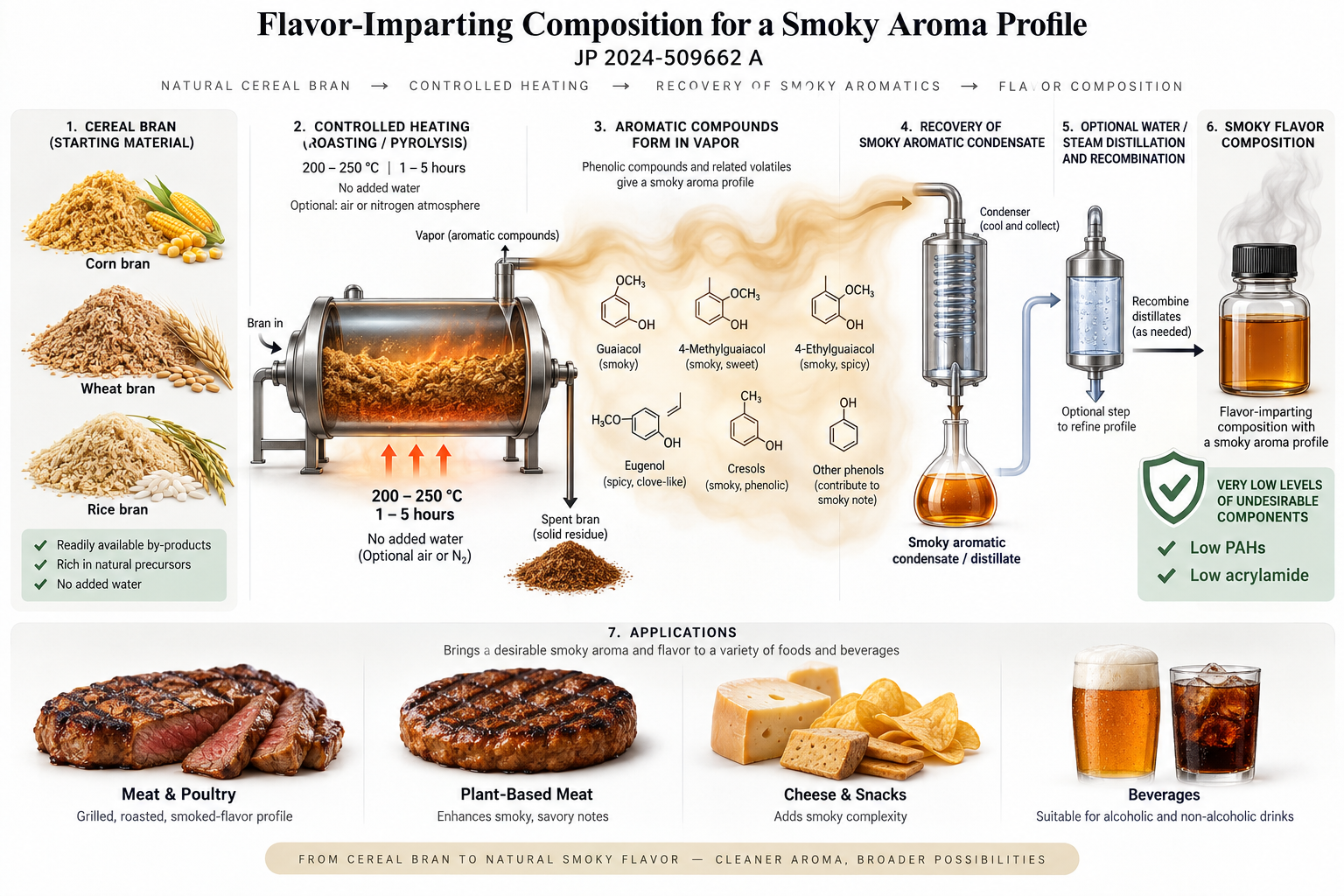
[Claim 4]
The flavor-imparting composition according to any one of claims 1 to 3, wherein the composition comprises less than 300 ppb of acrylamide.
[Claim 5]
The flavor-imparting composition according to any one of claims 1 to 4, wherein the flavor-imparting composition is prepared from cereal bran.
[Claim 6]
The flavor-imparting composition according to claim 5, wherein the cereal bran is corn, and the aromatic compounds comprise 2-methylphenol, 3-methylphenol, 4-methylphenol, 3-ethylphenol, 4-ethylphenol, guaiacol, 4-methylguaiacol, 5-methylguaiacol, 4-ethylguaiacol, 4-vinylguaiacol, eugenol, E-isoeugenol, Z-isoeugenol, 4-vinylphenol, 4-propylguaiacol, and 2,6-dimethoxyphenol.
[Claim 7]
The flavor-imparting composition according to claim 5, wherein the cereal bran is wheat, and the aromatic compounds comprise 2-methylphenol, 3-methylphenol, 4-methylphenol, 3-ethylphenol, 4-ethylphenol, guaiacol, 4-methylguaiacol, 5-methylguaiacol, 4-ethylguaiacol, 4-vinylguaiacol, eugenol, E-isoeugenol, Z-isoeugenol, 4-vinylphenol, 4-propylguaiacol, and 2,6-dimethoxyphenol.
[Claim 8]
The flavor-imparting composition according to claim 5, wherein the cereal bran is rice, and the aromatic compounds comprise 2-methylphenol, 3-methylphenol, 4-methylphenol, 3-ethylphenol, 4-ethylphenol, guaiacol, 4-methylguaiacol, 5-methylguaiacol, 4-ethylguaiacol, 4-vinylguaiacol, eugenol, E-isoeugenol, Z-isoeugenol, 4-vinylphenol, 4-propylguaiacol, and 2,6-dimethoxyphenol.
10
20
30
40
50
[Page 3]
[Claim 9]
Use of the composition according to any one of claims 1 to 8 for imparting a smoky aroma to a flavor-imparting composition.
[Claim 10]
A method for preparing the flavor-imparting composition according to any one of claims 1 to 8, comprising:
(i) heating cereal bran to a temperature of 200 to 250°C for 1 to 5 hours without adding exogenous water,
(ii) recovering the flavor-imparting composition produced by step (i).
[Claim 11]
The method according to claim 10, wherein step (i) further comprises heating the cereal bran in the presence of a stream of air or nitrogen.
[Claim 12]
The method according to claim 10 or 11, further comprising:
(iii) adding exogenous water to the heated cereal bran,
(iv) recovering the resulting hydrothermal distillate,
(v) combining the hydrothermal distillate of step (iv) with the flavor-imparting composition produced by step (ii).
[Claim 13]
The method according to claim 10 or 12, wherein the flavor-imparting composition of step (ii) is recovered as a condensate, hydrothermal distillate, or steam distillate.
[Claim 14]
A flavored consumer product comprising the flavor-imparting composition according to any one of claims 1 to 8.
[Claim 15]
The flavored consumer product according to claim 14, wherein the product is a meat-based product, a non-meat product, or a beverage.
[Claim 16]
The flavored consumer product according to claim 14 or 15, comprising the flavor-imparting composition of the present invention at a concentration of 10 to 2000 mg/kg.
[Detailed Description of the Invention]
[Technical Field]
[0001]
Various aspects presented in this specification relate to a flavor-imparting composition having a smoky aroma profile for use in flavored consumer products, and a method for preparing such a flavor-imparting composition.
[0002]
Background
Smoke flavor-imparting compositions used to mimic the taste and smell of grilled or cooked food are popular additives in ingestible products. For example, such flavors have long been used in the manufacture of meat, cheese, fish, and snacks. Furthermore, in recent years, alternative meats and vegetarian substitutes have become increasingly popular for health and environmental reasons. The use of smoke flavor-imparting compositions in such foods is desirable from a consumer perspective.
[0003]
Smoke flavors can be obtained by burning wood and condensing the smoke. The resulting smoke condensate (liquid smoke) is purified and further processed to be used in food to impart a smoky aroma. However, smoke flavors obtained by burning wood at high temperatures may contain toxic compounds such as polycyclic aromatic hydrocarbons (PAHs).
10
20
30
40
50
[Page 4]
This can mean that, under regulatory laws such as those of the EU, smoke flavors obtained from the combustion of wood may be considered unsafe or not natural.
[0004]
Therefore, there is a need to develop a flavor-imparting composition that has a smoky aroma profile but does not contain problematic amounts of toxic compounds such as polycyclic aromatic hydrocarbons (PAHs).
[0005]
An object of the present invention is to provide such a flavor-imparting composition.
[Brief Description of the Drawings]
[0006]
[Figure 1] is a diagram of the formation of phenolic compounds from ferulic acid.
[Figure 2] is a diagram of the chemical structures of the target phenols (numbers refer to Table 1).
[Figure 3] is a diagram of the formation of guaiacol during roasting of rice bran at various temperatures.
[Figure 4] is a diagram of the influence of cereal variety on phenol formation (235°C, 5 hours).
[Figure 5] is a diagram of the influence of other parameters on phenol formation (conditions in Table 4).
[0007]
Detailed Description
The present invention provides a flavor-imparting composition having a smoky aroma profile, comprising one or more aromatic compounds selected from the group consisting of 2-methylphenol, 3-methylphenol, 4-methylphenol, 3-ethylphenol, 4-ethylphenol, guaiacol, 4-methylguaiacol, 5-methylguaiacol, 4-ethylguaiacol, 4-vinylguaiacol, eugenol, E-isoeugenol, Z-isoeugenol, 4-vinylphenol, 4-propylguaiacol, and 2,6-dimethoxyphenol, characterized by having less than 300 ppb of polycyclic aromatic hydrocarbons and/or acrylamide.
[0008]
As used herein, the term "PAH" means polycyclic aromatic hydrocarbon.
[0009]
Flavor-imparting compositions having a smoky aroma profile are highly popular additives for various consumer products. However, due to increased awareness regarding the toxicity of certain compounds produced in manufacturing processes, some countries and regions have introduced minimum allowable amounts of such compounds in food for human consumption. For example, EU regulations limit the amount of PAHs and acrylamide contained in smoky aroma profiles. The PAH benzo[a]pyrene (BaP) is limited to 10 ppb. Acrylamide is another potentially toxic compound contained in heat-treated foods. The benchmark level in the EU is 300 ppb for cereal products.
[0010]
Existing methods for preparing flavor-imparting compositions having a smoky aroma profile involve using wood-based starting materials that are heated at high temperatures for extended periods. The use of such starting materials increases the likelihood that PAHs and acrylamide will be formed due to such reaction conditions.
[0011]
The smoky aroma profile of a flavor-imparting composition is primarily due to the presence of specific phenolic compounds.
[0012]
Therefore, an object of the present invention is to prepare a flavor-imparting composition having a smoky aroma profile that has a sufficient amount of aromatic compounds while reducing the levels of PAHs and acrylamide to acceptable amounts.
[0013]
As shown below, the present inventors have invented a novel and innovative process that significantly reduces the amount of PAHs and acrylamide to acceptable amounts while obtaining a sufficient amount of aromatic compounds.
[Page 5]
(5) JP 2024-509662 A 2024.3.5
As seen in the attached examples, this yields a flavor-imparting composition with attractive aroma performance. For example, this aroma is believed to be capable of imparting smoky and roasted notes to meat flavors, particularly pork and bacon.
[0014]
A "smoky aroma profile" includes cases where the flavor-imparting composition of the present invention imparts a smoke-like taste and/or smell, i.e., a smoky flavor. This term is well known in the field of flavors. For example, it is known to refer to something that has a smoky flavor and a smoked-like taste. Therefore, this term will be clearly understood by experts in this field.
[0015]
The aroma profile is provided by aromatic compounds. The "aromatic compounds" are selected from the group consisting of 2-methylphenol, 3-methylphenol, 4-methylphenol, 3-ethylphenol, 4-ethylphenol, guaiacol, 4-methylguaiacol, 5-methylguaiacol, 4-ethylguaiacol, 4-vinylguaiacol, eugenol, E-isoeugenol, Z-isoeugenol, 4-vinylphenol, 4-propylguaiacol, and 2,6-dimethoxyphenol.
[0016]
The compounds are well known in the art and can be detected and measured using commonly known analytical methods, examples of which are shown in the attached examples.
[0017]
Those skilled in the art can understand that the flavor-imparting composition may contain one or more of the aromatic compounds listed herein. For example, the composition can contain at least 2 aromatic compounds, preferably at least 3 aromatic compounds, preferably at least 5 aromatic compounds, preferably at least 7 aromatic compounds, preferably at least 9 aromatic compounds, preferably at least 10 aromatic compounds, preferably at least 11 aromatic compounds, preferably at least 12 aromatic compounds, preferably at least 13 aromatic compounds, preferably at least 14 aromatic compounds, preferably at least 15 aromatic compounds selected from the group consisting of 2-methylphenol, 3-methylphenol, 4-methylphenol, 3-ethylphenol, 4-ethylphenol, guaiacol, 4-methylguaiacol, 5-methylguaiacol, 4-ethylguaiacol, 4-vinylguaiacol, eugenol, E-isoeugenol, Z-isoeugenol, 4-vinylphenol, 4-propylguaiacol, and 2,6-dimethoxyphenol.
[0018]
In a preferred embodiment of the present invention, the flavor-imparting composition comprises 2-methylphenol, 3-methylphenol, 4-methylphenol, 3-ethylphenol, 4-ethylphenol, guaiacol, 4-methylguaiacol, 4-ethylguaiacol, 4-vinylguaiacol, eugenol, E-isoeugenol, Z-isoeugenol, 4-vinylphenol, 4-propylguaiacol, and 2,6-dimethoxyphenol.
[0019]
A preferred embodiment of the present invention is an embodiment wherein one or more aromatic compounds selected from the group consisting of 2-methylphenol, 3-methylphenol, 4-methylphenol, 3-ethylphenol, 4-ethylphenol, guaiacol, 4-methylguaiacol, 5-methylguaiacol, 4-ethylguaiacol, 4-vinylguaiacol, eugenol, E-isoeugenol, Z-isoeugenol, 4-vinylphenol, 4-propylguaiacol, and 2,6-dimethoxyphenol are present in an amount of at least 0.05 ppm of the flavor-imparting composition.
[0020]
[Page 6]
Preferably, the composition can contain at least 2 aromatic compounds, preferably at least 3 aromatic compounds, preferably at least 5 aromatic compounds, preferably at least 7 aromatic compounds, preferably at least 9 aromatic compounds, preferably at least 11 aromatic compounds, preferably at least 13 aromatic compounds, preferably at least 14 aromatic compounds selected from the group consisting of 2-methylphenol, 3-methylphenol, 4-methylphenol, 3-ethylphenol, 4-ethylphenol, guaiacol, 4-methylguaiacol, 5-methylguaiacol, 4-ethylguaiacol, 4-vinylguaiacol, eugenol, E-isoeugenol, Z-isoeugenol, 4-vinylphenol, 4-propylguaiacol, and 2,6-dimethoxyphenol, which are present in an amount of at least 0.05 ppm of the flavor-imparting composition.
[0021]
In a preferred embodiment of the present invention, the aromatic compounds comprise 2-methylphenol, 3-methylphenol, 4-methylphenol, 3-ethylphenol, 4-ethylphenol, guaiacol, 4-methylguaiacol, 5-methylguaiacol, 4-ethylguaiacol, 4-vinylguaiacol, eugenol, E-isoeugenol, Z-isoeugenol, 4-vinylphenol, 4-propylguaiacol, and 2,6-dimethoxyphenol, and the amount of the aromatic compounds is about 590 ppm or less.
[0022]
In a preferred embodiment of the present invention, the aromatic compounds consist of 2-methylphenol, 3-methylphenol, 4-methylphenol, 3-ethylphenol, 4-ethylphenol, guaiacol, 4-methylguaiacol, 5-methylguaiacol, 4-ethylguaiacol, 4-vinylguaiacol, eugenol, E-isoeugenol, Z-isoeugenol, 4-vinylphenol, 4-propylguaiacol, and 2,6-dimethoxyphenol, and the amount of the aromatic compounds is about 590 ppm or less.
[0023]
The flavor-imparting composition of the present invention is characterized by having a content of less than 300 ppb of polycyclic aromatic hydrocarbons and/or acrylamide.
[0024]
Polycyclic aromatic hydrocarbon (PAH) compounds are well known and well-defined in the art.
[0025]
Polycyclic aromatic hydrocarbons (PAHs) are hydrocarbons composed of multiple aromatic rings. The simplest of such chemicals are naphthalene, with two aromatic rings, and the tricyclic compounds anthracene and phenanthrene. The terms polyaromatic hydrocarbon or polynuclear aromatic hydrocarbon are also used for this concept.
[0026]
PAHs are non-polar molecules with no charge and have unique properties partly due to delocalized electrons in the aromatic rings. Many of them are found in coal and petroleum deposits, and are also produced by the thermal decomposition of organic matter, such as during the combustion of biomass in engines, incinerators, or forest fires.
[0027]
Examples of PAHs include naphthalene, acenaphthylene, acenaphthene, fluorene, phenanthrene, anthracene, fluoranthene, pyrene, benzo(a)anthracene, chrysene, benzo[b]fluoranthene, benzo[k]fluoranthene, benzo[a]pyrene, indeno[1,2,3-c,d]pyrene, dibenzo[a,h]anthracene, benzo[g,h,i]perylene, benzo[j]fluoranthene, cyclopenta[cd]pyrene, dibenzo[a,e]pyrene, dibenzo[a,h]pyrene, dibenzo[a,i]pyrene, dibenzo[a,l]pyrene, 5-methylchrysene, and benzo(c)fluorene. The benchmark PAH is benzo[a]pyrene.
[Page 7]
[0028]
Again, these can be detected and measured using commonly known analytical methods, examples of which are shown in the attached examples.
[0029]
In another embodiment, the PAH is benzo[a]pyrene, and it is less than 10 ppb, preferably less than 5 ppb, more preferably less than 4 ppb, more preferably less than 3 ppb, more preferably less than 2 ppb, more preferably less than 1 ppb, or less.
[0030]
In a preferred embodiment, the flavor-imparting composition has less than 300 ppb, preferably less than 200 ppb, more preferably less than 100 ppb, more preferably less than 50 ppb, more preferably less than 20 ppb, more preferably less than 10 ppb, or less of acrylamide.
[0031]
In a preferred embodiment of the present invention, the flavor-imparting composition is prepared from cereal bran.
[0032]
As used herein, "cereal bran" refers to the outer skin or husk of a cereal grain, which can consist of the pericarp, seed coat, and aleurone layer. Examples of cereal bran suitable for the method of preparing the composition of the present invention include bran from rice, corn, wheat, oats, rye, barley, sorghum, and spelt.
[0033]
The present inventors conducted a series of experiments outlined in the attached examples. In these experiments, the amount of aromatic compounds that could be prepared from different cereal brans was measured.
[0034]
As a result, when the cereal bran is corn, the aromatic compounds include 2-methylphenol, 3-methylphenol, 4-methylphenol, 3-ethylphenol, 4-ethylphenol, guaiacol, 4-methylguaiacol, 5-methylguaiacol, 4-ethylguaiacol, 4-vinylguaiacol, eugenol, E-isoeugenol, Z-isoeugenol, 4-vinylphenol, 4-propylguaiacol, and 2,6-dimethoxyphenol. Preferably, the amount of aromatic compounds is about 1841.3 ppm or less. Preferably, the amount of aromatic compounds is about 590 ppm or less.
[0035]
Preferably, the cereal bran is corn, and the aromatic compounds consist of 2-methylphenol, 3-methylphenol, 4-methylphenol, 3-ethylphenol, 4-ethylphenol, guaiacol, 4-methylguaiacol, 5-methylguaiacol, 4-ethylguaiacol, 4-vinylguaiacol, eugenol, E-isoeugenol, Z-isoeugenol, 4-vinylphenol, 4-propylguaiacol, and 2,6-dimethoxyphenol. Preferably, the amount of aromatic compounds is about 1841.3 ppm or less. Preferably, the amount of aromatic compounds is about 590 ppm or less.
[0036]
In another embodiment, the cereal bran is wheat, and the aromatic compounds include 2-methylphenol, 3-methylphenol, 4-methylphenol, 3-ethylphenol, 4-ethylphenol, guaiacol, 4-methylguaiacol, 5-methylguaiacol, 4-ethylguaiacol, 4-vinylguaiacol, eugenol, E-isoeugenol, Z-isoeugenol, 4-vinylphenol, 4-propylguaiacol, and 2,6-dimethoxyphenol. Preferably, the amount of aromatic compounds is about 792.4 ppm or less. Preferably, the amount of aromatic compounds is about 320 ppm or less.
[0037]
Preferably, the cereal bran is wheat, and the aromatic compounds consist of 2-methylphenol, 3-methylphenol, 4-methylphenol, 3-ethylphenol, 4-ethylphenol, guaiacol, 4-methylguaiacol, 5-methylguaiacol, 4-ethyl
[Page 8]
(8) JP 2024-509662 A 2024.3.5
guaiacol, 4-vinylguaiacol, eugenol, E-isoeugenol, Z-isoeugenol, 4-vinylphenol, 4-propylguaiacol, and 2,6-dimethoxyphenol. Preferably, the amount of aromatic compounds is about 792.4 ppm or less. Preferably, the amount of aromatic compounds is about 320 ppm or less.
[0038]
In another embodiment, the cereal bran is rice, and the aromatic compounds include 2-methylphenol, 3-methylphenol, 4-methylphenol, 3-ethylphenol, 4-ethylphenol, guaiacol, 4-methylguaiacol, 5-methylguaiacol, 4-ethylguaiacol, 4-vinylguaiacol, eugenol, E-isoeugenol, Z-isoeugenol, 4-vinylphenol, 4-propylguaiacol, and 2,6-dimethoxyphenol. Preferably, the amount of aromatic compounds is about 2005.2 ppm or less. Preferably, the amount of aromatic compounds is about 270 ppm or less.
[0039]
Preferably, the cereal bran is rice, and the aromatic compounds consist of 2-methylphenol, 3-methylphenol, 4-methylphenol, 3-ethylphenol, 4-ethylphenol, guaiacol, 4-methylguaiacol, 5-methylguaiacol, 4-ethylguaiacol, 4-vinylguaiacol, eugenol, E-isoeugenol, Z-isoeugenol, 4-vinylphenol, 4-propylguaiacol, and 2,6-dimethoxyphenol. Preferably, the amount of aromatic compounds is about 2005.2 ppm or less. Preferably, the amount of aromatic compounds is about 270 ppm or less.
[0040]
In another embodiment, the cereal bran is spelt, and the aromatic compounds include 2-methylphenol, 3-methylphenol, 4-methylphenol, 3-ethylphenol, 4-ethylphenol, guaiacol, 4-methylguaiacol, 5-methylguaiacol, 4-ethylguaiacol, 4-vinylguaiacol, eugenol, E-isoeugenol, Z-isoeugenol, 4-vinylphenol, 4-propylguaiacol, and 2,6-dimethoxyphenol. Preferably, the amount of aromatic compounds is about 190 ppm or less.
[0041]
Preferably, the cereal bran is spelt, and the aromatic compounds consist of 2-methylphenol, 3-methylphenol, 4-methylphenol, 3-ethylphenol, 4-ethylphenol, guaiacol, 4-methylguaiacol, 5-methylguaiacol, 4-ethylguaiacol, 4-vinylguaiacol, eugenol, E-isoeugenol, Z-isoeugenol, 4-vinylphenol, 4-propylguaiacol, and 2,6-dimethoxyphenol. Preferably, the amount of aromatic compounds is about 190 ppm or less.
[0042]
In another embodiment, the cereal bran is rye, and the aromatic compounds include 2-methylphenol, 3-methylphenol, 4-methylphenol, 3-ethylphenol, 4-ethylphenol, guaiacol, 4-methylguaiacol, 5-methylguaiacol, 4-ethylguaiacol, 4-vinylguaiacol, eugenol, E-isoeugenol, Z-isoeugenol, 4-vinylphenol, 4-propylguaiacol, and 2,6-dimethoxyphenol. Preferably, the amount of aromatic compounds is about 160 ppm or less.
[0043]
Preferably, the cereal bran is rye, and the aromatic compounds consist of 2-methylphenol, 3-methylphenol, 4-methylphenol, 3-ethylphenol, 4-ethylphenol, guaiacol, 4-methylguaiacol, 5-methylguaiacol, 4-ethylguaiacol, 4-vinylguaiacol, eugenol, E-isoeugenol, Z-isoeugenol, 4-vinylphenol, 4-propylguaiacol, and 2
[Page 9]
(9) JP 2024-509662 A 2024.3.5
,6-dimethoxyphenol. Preferably, the amount of aromatic compounds is about 160 ppm or less.
[0044]
In another embodiment, the cereal bran is sorghum, and the aromatic compounds include 2-methylphenol, 3-methylphenol, 4-methylphenol, 3-ethylphenol, 4-ethylphenol, guaiacol, 4-methylguaiacol, 5-methylguaiacol, 4-ethylguaiacol, 4-vinylguaiacol, eugenol, E-isoeugenol, Z-isoeugenol, 4-vinylphenol, 4-propylguaiacol, and 2,6-dimethoxyphenol. Preferably, the amount of aromatic compounds is about 110 ppm or less.
[0045]
Preferably, the cereal bran is sorghum, and the aromatic compounds consist of 2-methylphenol, 3-methylphenol, 4-methylphenol, 3-ethylphenol, 4-ethylphenol, guaiacol, 4-methylguaiacol, 5-methylguaiacol, 4-ethylguaiacol, 4-vinylguaiacol, eugenol, E-isoeugenol, Z-isoeugenol, 4-vinylphenol, 4-propylguaiacol, and 2,6-dimethoxyphenol. Preferably, the amount of aromatic compounds is about 110 ppm or less.
[0046]
In another embodiment, the cereal bran is oats, and the aromatic compounds include 2-methylphenol, 3-methylphenol, 4-methylphenol, 3-ethylphenol, 4-ethylphenol, guaiacol, 4-methylguaiacol, 5-methylguaiacol, 4-ethylguaiacol, 4-vinylguaiacol, eugenol, E-isoeugenol, Z-isoeugenol, 4-vinylphenol, 4-propylguaiacol, and 2,6-dimethoxyphenol. Preferably, the amount of aromatic compounds is about 110 ppm or less.
[0047]
Preferably, the cereal bran is oats, and the aromatic compounds consist of 2-methylphenol, 3-methylphenol, 4-methylphenol, 3-ethylphenol, 4-ethylphenol, guaiacol, 4-methylguaiacol, 5-methylguaiacol, 4-ethylguaiacol, 4-vinylguaiacol, eugenol, E-isoeugenol, Z-isoeugenol, 4-vinylphenol, 4-propylguaiacol, and 2,6-dimethoxyphenol. Preferably, the amount of aromatic compounds is about 110 ppm or less.
[0048]
In another embodiment, the cereal bran is barley, and the aromatic compounds include 2-methylphenol, 3-methylphenol, 4-methylphenol, 3-ethylphenol, 4-ethylphenol, guaiacol, 4-methylguaiacol, 5-methylguaiacol, 4-ethylguaiacol, 4-vinylguaiacol, eugenol, E-isoeugenol, Z-isoeugenol, 4-vinylphenol, 4-propylguaiacol, and 2,6-dimethoxyphenol. Preferably, the amount of aromatic compounds is about 42 ppm or less.
[0049]
Preferably, the cereal bran is barley, and the aromatic compounds consist of 2-methylphenol, 3-methylphenol, 4-methylphenol, 3-ethylphenol, 4-ethylphenol, guaiacol, 4-methylguaiacol, 5-methylguaiacol, 4-ethylguaiacol, 4-vinylguaiacol, eugenol, E-isoeugenol, Z-isoeugenol, 4-vinylphenol, 4-propylguaiacol, and 2,6-dimethoxyphenol. Preferably, the amount of aromatic compounds is about 42 ppm or less.
[Page 10]
[0050]
In a preferred embodiment, the composition is an aqueous composition or a powder composition, more preferably a powder composition. An aqueous composition means that the entire extracted substance is present in a solution, and the solvent comprises water. A powder composition means that the entire extracted substance is present in a solid powder form.
[0051]
A further aspect of the present invention provides the use of a composition as defined in any of the preceding embodiments of the present invention for imparting a smoky aroma to a flavor-imparting composition.
[0052]
Therefore, the composition for use in this method of the present invention comprises one or more aromatic compounds selected from the group consisting of 2-methylphenol, 3-methylphenol, 4-methylphenol, 3-ethylphenol, 4-ethylphenol, guaiacol, 4-methylguaiacol, 5-methylguaiacol, 4-ethylguaiacol, 4-vinylguaiacol, eugenol, E-isoeugenol, Z-isoeugenol, 4-vinylphenol, 4-propylguaiacol, and 2,6-dimethoxyphenol, characterized in that the composition has less than 300 ppb of polycyclic aromatic hydrocarbons and/or acrylamide. All other embodiments of the invention described herein relating to the composition, including the types and amounts of aromatic compounds, are included in this aspect of the invention.
[0053]
As mentioned above, the present inventors have developed a novel and innovative process that significantly reduces the amount of PAHs and/or acrylamide to acceptable amounts while obtaining a sufficient amount of aromatic compounds.
[0054]
Therefore, a further aspect of the present invention provides a method for preparing the flavor-imparting composition of the present invention, comprising:
(i) heating cereal bran to a temperature of 200 to 250°C for 1 to 5 hours without adding exogenous water,
(ii) recovering the flavor-imparting composition produced by step (ii).
[0055]
As mentioned above, aromatic compounds impart a smoke-like taste and/or smell. Typical "aromatic compounds" are often derived from phenols. Phenylpropanoids such as coumaric acid, ferulic acid, and sinapic acid are precursors to smoky phenols. Therefore, in inventing the present invention, the present inventors selected cereal bran as the starting material because it is rich in ferulic acid and other phenylpropanoids, is inexpensive, and is positioned as a food.
[0056]
As used herein, "cereal bran" refers to the outer skin or husk of a cereal grain, which can consist of the pericarp, seed coat, and aleurone layer. Examples of cereal bran suitable for use in the method of preparing the composition of the present invention include bran from rice, corn, wheat, oats, rye, barley, sorghum, and spelt.
[0057]
Preferably, the cereal bran is rice, corn, or wheat bran.
[0058]
In step (i) of the method of the present invention, the cereal bran is heated at a temperature of 200 to 250°C for 1 to 5 hours without adding exogenous water. It is important to select a temperature of 200 to 250°C because it is lower than the temperature typically used to prepare smoke extracts from wood-based starting materials, resulting in a lower amount of PAHs in the composition. In some countries, food preparation is required to be carried out below an upper limit of 240°C, so a temperature of 200 to 240°C is preferably used.
[Page 11]
[0059]
A time of 1 to 5 hours is selected because the greatest amount of aromatic compounds is produced within this time frame.
[0060]
The present inventors conducted a series of experiments outlined in the attached examples. In these experiments, the amount of aromatic compounds that could be prepared from cereal bran heated to different temperatures for about 5 hours was measured.
[0061]
Therefore, in one embodiment of the method of the present invention, the cereal bran is heated to 200°C for 5 hours, and the aromatic compounds in the flavor-imparting composition include 2-methylphenol, 3-methylphenol, 4-methylphenol, 3-ethylphenol, 4-ethylphenol, guaiacol, 4-methylguaiacol, 5-methylguaiacol, 4-ethylguaiacol, 4-vinylguaiacol, eugenol, E-isoeugenol, Z-isoeugenol, 4-vinylphenol, 4-propylguaiacol, and 2,6-dimethoxyphenol. Preferably, the amount of aromatic compounds is about 77 ppm or less. Preferably, the cereal bran is rice bran.
[0062]
Preferably, the cereal bran is heated to 200°C for 5 hours, and the aromatic compounds in the flavor-imparting composition consist of 2-methylphenol, 3-methylphenol, 4-methylphenol, 3-ethylphenol, 4-ethylphenol, guaiacol, 4-methylguaiacol, 5-methylguaiacol, 4-ethylguaiacol, 4-vinylguaiacol, eugenol, E-isoeugenol, Z-isoeugenol, 4-vinylphenol, 4-propylguaiacol, and 2,6-dimethoxyphenol. Preferably, the amount of aromatic compounds is about 77 ppm or less. Preferably, the cereal bran is rice bran.
[0063]
Therefore, in one embodiment of the method of the present invention, the cereal bran is heated to 220°C for 5 hours, and the aromatic compounds in the flavor-imparting composition include 2-methylphenol, 3-methylphenol, 4-methylphenol, 3-ethylphenol, 4-ethylphenol, guaiacol, 4-methylguaiacol, 5-methylguaiacol, 4-ethylguaiacol, 4-vinylguaiacol, eugenol, E-isoeugenol, Z-isoeugenol, 4-vinylphenol, 4-propylguaiacol, and 2,6-dimethoxyphenol. Preferably, the amount of aromatic compounds is about 140 ppm or less. Preferably, the cereal bran is rice bran.
[0064]
Preferably, the cereal bran is heated to 220°C for 5 hours, and the aromatic compounds in the flavor-imparting composition consist of 2-methylphenol, 3-methylphenol, 4-methylphenol, 3-ethylphenol, 4-ethylphenol, guaiacol, 4-methylguaiacol, 5-methylguaiacol, 4-ethylguaiacol, 4-vinylguaiacol, eugenol, E-isoeugenol, Z-isoeugenol, 4-vinylphenol, 4-propylguaiacol, and 2,6-dimethoxyphenol. Preferably, the amount of aromatic compounds is about 140 ppm or less. Preferably, the cereal bran is rice bran.
[0065]
Therefore, in one embodiment of the method of the present invention, the cereal bran is heated to 225°C for 5 hours, and the aromatic compounds in the flavor-imparting composition include 2-methylphenol, 3-methylphenol, 4-methylphenol, 3-ethylphenol, 4-ethylphenol, guaiacol, 4-methylguaiacol, 5-methylguaiacol, 4-ethylguaiacol, 4-vinylguaiacol, eugenol, E-isoeugenol, Z-isoeugenol, 4-vinylphenol, 4-propylguaiacol, and 2,6-dimeth
[Page 12]
oxyphenol. Preferably, the amount of aromatic compounds is about 232 ppm or less. Preferably, the cereal bran is rice bran.
[0066]
Preferably, the cereal bran is heated to 225°C for 5 hours, and the aromatic compounds in the flavor-imparting composition consist of 2-methylphenol, 3-methylphenol, 4-methylphenol, 3-ethylphenol, 4-ethylphenol, guaiacol, 4-methylguaiacol, 5-methylguaiacol, 4-ethylguaiacol, 4-vinylguaiacol, eugenol, E-isoeugenol, Z-isoeugenol, 4-vinylphenol, 4-propylguaiacol, and 2,6-dimethoxyphenol. Preferably, the amount of aromatic compounds is about 232 ppm or less. Preferably, the cereal bran is rice bran.
[0067]
Therefore, in one embodiment of the method of the present invention, the cereal bran is heated to 230°C for 5 hours, and the aromatic compounds in the flavor-imparting composition include 2-methylphenol, 3-methylphenol, 4-methylphenol, 3-ethylphenol, 4-ethylphenol, guaiacol, 4-methylguaiacol, 5-methylguaiacol, 4-ethylguaiacol, 4-vinylguaiacol, eugenol, E-isoeugenol, Z-isoeugenol, 4-vinylphenol, 4-propylguaiacol, and 2,6-dimethoxyphenol. Preferably, the amount of aromatic compounds is about 245 ppm or less. Preferably, the cereal bran is rice bran.
[0068]
Preferably, the cereal bran is heated to 230°C for 5 hours, and the aromatic compounds in the flavor-imparting composition consist of 2-methylphenol, 3-methylphenol, 4-methylphenol, 3-ethylphenol, 4-ethylphenol, guaiacol, 4-methylguaiacol, 5-methylguaiacol, 4-ethylguaiacol, 4-vinylguaiacol, eugenol, E-isoeugenol, Z-isoeugenol, 4-vinylphenol, 4-propylguaiacol, and 2,6-dimethoxyphenol. Preferably, the amount of aromatic compounds is about 245 ppm or less. Preferably, the cereal bran is rice bran.
[0069]
Therefore, in one embodiment of the method of the present invention, the cereal bran is heated to 235°C for 5 hours, and the aromatic compounds in the flavor-imparting composition include 2-methylphenol, 3-methylphenol, 4-methylphenol, 3-ethylphenol, 4-ethylphenol, guaiacol, 4-methylguaiacol, 5-methylguaiacol, 4-ethylguaiacol, 4-vinylguaiacol, eugenol, E-isoeugenol, Z-isoeugenol, 4-vinylphenol, 4-propylguaiacol, and 2,6-dimethoxyphenol. Preferably, the amount of aromatic compounds is about 274 ppm or less. Preferably, the cereal bran is rice bran.
[0070]
Preferably, the cereal bran is heated to 235°C for 5 hours, and the aromatic compounds in the flavor-imparting composition consist of 2-methylphenol, 3-methylphenol, 4-methylphenol, 3-ethylphenol, 4-ethylphenol, guaiacol, 4-methylguaiacol, 5-methylguaiacol, 4-ethylguaiacol, 4-vinylguaiacol, eugenol, E-isoeugenol, Z-isoeugenol, 4-vinylphenol, 4-propylguaiacol, and 2,6-dimethoxyphenol. Preferably, the amount of aromatic compounds is about 274 ppm or less. Preferably, the cereal bran is rice bran.
[0071]
Therefore, in one embodiment of the method of the present invention, the cereal bran is heated to 250°C for 5 hours, and the aromatic compounds in the flavor-imparting composition include 2-methylphenol, 3-methylphen
[Page 13]
(13) JP 2024-509662 A 2024.3.5
ol, 4-methylphenol, 3-ethylphenol, 4-ethylphenol, guaiacol, 4-methylguaiacol, 5-methylguaiacol, 4-ethylguaiacol, 4-vinylguaiacol, eugenol, E-isoeugenol, Z-isoeugenol, 4-vinylphenol, 4-propylguaiacol, and 2,6-dimethoxyphenol. Preferably, the amount of aromatic compounds is about 337 ppm or less. Preferably, the cereal bran is rice bran.
[0072]
Preferably, the cereal bran is heated to 250°C for 5 hours, and the aromatic compounds in the flavor-imparting composition consist of 2-methylphenol, 3-methylphenol, 4-methylphenol, 3-ethylphenol, 4-ethylphenol, guaiacol, 4-methylguaiacol, 5-methylguaiacol, 4-ethylguaiacol, 4-vinylguaiacol, eugenol, E-isoeugenol, Z-isoeugenol, 4-vinylphenol, 4-propylguaiacol, and 2,6-dimethoxyphenol. Preferably, the amount of aromatic compounds is about 337 ppm or less. Preferably, the cereal bran is rice bran.
[0073]
However, it is preferred to heat the cereal bran to 235°C or lower.
[0074]
The present inventors conducted a series of experiments outlined in the attached examples. In these experiments, the amount of aromatic compounds that could be prepared from cereal bran heated in the presence or absence of a stream of air or nitrogen was measured.
[0075]
From the data herein, it is clear that the presence of an air or nitrogen stream increased the amount of aromatic compounds that could be derived from the prepared cereal bran.
[0076]
Therefore, in a preferred embodiment of the method of the present invention, step (i) further comprises heating the cereal bran in the presence of a stream of air or nitrogen.
[0077]
It is preferred that exogenous water is not present, as water can alter the chemical reactions and act to change the amount of aromatic compounds and PAHs in the composition of the present invention.
[0078]
In a preferred embodiment of the method of the present invention, the method further comprises:
(iii) adding exogenous water to the heated cereal bran,
(iv) recovering the resulting hydrothermal distillate,
(v) combining the hydrothermal distillate of step (iv) with the flavor-imparting composition produced by step (ii).
[0079]
In this embodiment, some exogenous water is added to the heated cereal bran, allowing the heating reaction to be completed after the endogenous water is depleted.
[0080]
The remaining steps of the method of the present invention are clear and are also explained in the Examples section of the present application below. Preferably, the flavor-imparting composition produced by step (i) is recovered as a condensate, hydrothermal distillate, or steam distillate.
[0081]
A further aspect of the present invention provides a flavor-imparting composition prepared according to any of the methods of the present invention.
[0082]
The present invention also relates to the use of the flavor-imparting composition as a flavor ingredient. In other words, the present invention relates to a method or process for imparting, enhancing,
[Page 14]
improving, or modifying the taste characteristics of a flavor-imparting composition or a flavored article, the method comprising adding an effective amount of the flavor profile of the present invention to said composition or article, for example to impart its typical notes.
[0083]
A typical effective amount is about 0.001 ppm to 1000 ppm, more preferably 0.1 ppm to 500 ppm, more preferably 0.5 ppm to 350 ppm, most preferably 1 ppm to 100 ppm of the composition of the present invention, based on the weight of the composition or the article in which it is formulated.
[0084]
"Use of the composition" should also be understood herein as the use of any composition of the present invention that can be advantageously used in the flavor industry.
[0085]
"Taste" is intended to mean the perception of taste and the sensation of taste.
[0086]
Said compositions that can actually be advantageously used as flavor-imparting ingredients are also an object of the present invention.
[0087]
This aspect of the invention also includes cases where the flavor-imparting composition of the present invention or a flavor-imparting composition prepared according to any of the methods of the present invention is provided in a diluted form. For example, the flavor-imparting composition of the present invention can be diluted, for example with water, to a concentration of 75%, 50%, 40%, 30%, 20%, 10%, 5%, 1%, 0.5%, 0.25%, 0.1%, 0.05%, 0.025%, 0.01%.
[0088]
Therefore, the present invention also relates to a flavor-imparting composition comprising:
i. at least the flavor composition of the present invention;
ii. at least one component selected from the group consisting of a flavor carrier, a flavor-imparting co-ingredient, and mixtures thereof; and
iii. optionally at least one flavor auxiliary agent.
[0089]
"Flavor carrier" means a substance that is substantially neutral from a flavor standpoint, as long as it does not significantly alter the sensory properties of the flavor-imparting ingredient. The carrier can be liquid or solid.
[0090]
Suitable liquid carriers include, for example, emulsifying systems, i.e., solvent and surfactant systems, or solvents commonly used in flavors. A detailed description of the nature and type of solvents commonly used in flavors cannot be exhaustive. Suitable solvents include, for example, propylene glycol, triacetin, caprylic/capric triglyceride (neobee®), triethyl citrate, benzyl alcohol, ethanol, vegetable oils such as linseed oil, sunflower oil, or coconut oil, or terpenes.
[0091]
Suitable solid carriers include, for example, absorbent gums or polymers, as well as encapsulating materials. Examples of such materials include monosaccharides, disaccharides, or trisaccharides, natural or modified starches, hydrocolloids, cellulose derivatives, polyvinyl acetate, polyvinyl alcohol, wall-forming and plasticizing materials such as proteins or pectin, as well as materials listed in reference texts such as H. Scherz, Hydrokolloides: Stabilisatoren, Dickungs- und Geliermittel in Lebensmitteln, Band 2 der Schriftenreihe Lebensmittelchemie, Lebensmittelqualitaet, Behr's VerlagGmbH & Co. Hamburg, 1996. Encapsulation is a process well known to those skilled in the art and can be carried out using techniques such as spray drying,
[Page 15]
agglomeration, extrusion, coacervation, and the like.
[0092]
"Flavor-imparting co-ingredient" as used herein means a compound used in a flavor-imparting preparation or composition to provide a hedonic effect. In other words, such an ingredient must be recognized by those skilled in the art as being capable of imparting or modifying the taste of a composition in a positive or pleasant way, not merely having a taste, in order to be considered a flavor.
[0093]
The nature and type of flavor co-ingredients present in the flavor-imparting composition do not warrant a more detailed description herein, and those skilled in the art can select them based on their general knowledge and according to the intended use or application and the desired sensory effect. In general, these flavor co-ingredients belong to diverse chemical classes such as alcohols, aldehydes, ketones, esters, ethers, acetates, nitriles, terpenoids, nitrogen- or sulfur-containing heterocyclic compounds, and essential oils, and said co-ingredients may be of natural or synthetic origin. Many of these co-ingredients are, in any case, listed in reference texts such as the book by S. Arctander, Perfume and Flavor Chemicals, 1969, Montclair, New Jersey, USA or its more recent versions, or other works of similar nature, as well as in the abundant patent literature in the flavor field. It is also understood that said co-ingredients may be compounds known to release various types of flavor-imparting compounds in a controlled manner.
[0094]
"Flavor auxiliary agent" as used herein means an ingredient that can impart additional benefits such as color, specific light resistance, chemical stability, and the like. A detailed description of the nature and type of auxiliary agents commonly used in flavor-imparting compositions cannot be exhaustive. However, such auxiliary agents are well known to those skilled in the art, who can select them based on general knowledge and according to the intended use or application.
[0095]
A composition consisting of at least the flavor composition of the present invention and at least one flavor carrier, and a flavor-imparting composition comprising at least the flavor composition of the present invention, at least one flavor carrier, at least one flavor co-ingredient, and optionally at least one flavor auxiliary agent, represent particular embodiments of the present invention.
[0096]
Furthermore, the flavor composition of the present invention can be advantageously used in all fields of flavors to positively impart or modify the taste of consumer products to which said extract is added. As a result, the present invention relates to a flavored consumer product comprising the flavor composition of the present invention as defined above.
[0097]
The flavor composition of the present invention can be added to flavored consumer products. This can be added as is or as part of the flavor-imparting composition of the present invention.
[0098]
For clarity, "flavored consumer product" is intended to represent an edible product that may be a food or a beverage, may be fried or not, may be frozen or not, may be low-fat or not, and may be marinated, battered, refrigerated, dehydrated, instant, canned, reconstituted, retorted, or preserved. Thus, a flavored article according to the present invention comprises the extract of the present invention, as well as optional beneficial agents corresponding to the taste and flavor profile of the desired edible product, such as a flavor cube.
[0099]
[Page 16]
The nature and type of ingredients of the food or beverage do not warrant a more detailed description here, and those skilled in the art can select them based on general knowledge and according to the nature of said product.
[0100]
Typical examples of said flavored consumer products include the following:
- Flavorings or seasonings, such as stock, flavor cubes, powder mixes, flavored oils, sauces (e.g., relish, barbecue sauce, dressings, gravy, sweet and/or sour sauce), salad dressings, or mayonnaise;
- Meat-based products such as chicken, beef, or pork-based products, seafood, surimi, or fish sausages;
- Soups such as clear soups, cream soups, chicken or beef soups, or tomato or asparagus soups;
- Instant foods, carbohydrate-based products such as rice, pasta, potato flakes or fried foods, noodles, pizza, tortillas, wraps;
- Dairy or fat products such as spreads, cheese, regular or low-fat margarine, butter/margarine blends, butter, peanut butter, shortening, processed cheese, or flavored cheese;
- Savory products such as snacks, biscuits (e.g., chips or crisps) or egg products, potato/tortilla chips, microwave popcorn, nuts, pretzels, rice cakes, rice crackers;
- Imitation foods, such as dairy products (e.g., modified cheese made from fats and thickeners), or seafood or meat (e.g., vegetarian meat substitutes, veggie burgers), or the like;
- Pet or animal food; or
- Beverages such as hot drinks (e.g., tea or coffee), carbonated soft drinks, alcoholic beverages (e.g., whiskey), ready-to-drink beverages, or powdered soft drinks.
[0101]
Some of the flavored consumer products mentioned above may be aggressive media for the flavor composition of the present invention, and therefore the latter may need to be protected from premature degradation, for example by encapsulation.
[0102]
In a preferred embodiment, the flavor composition of the present invention is added to the food before the food is heat-treated, i.e., before, for example, cooking, roasting, or grilling.
[0103]
The proportion in which the flavor composition of the present invention can be incorporated into the various above-mentioned products varies within a wide range of values. These values depend on the nature of the flavored consumer product and the desired sensory effect, as well as the nature of the co-ingredients in the given base when the composition according to the invention is mixed with flavoring or flavor-imparting ingredients, solvents, or additives commonly used in the art.
[0104]
For example, in the case of flavored consumer products, typical concentrations are about 0.001 ppm to 1000 ppm, more preferably 0.1 ppm to 500 ppm, even more preferably 0.5 ppm to 350 ppm, most preferably 1 ppm to 100 ppm of the extract or composition of the present invention, based on the weight of the consumer product in which they are formulated.
[0105]
Hereinafter, the present invention will be described in more detail by the following examples, which explain the advantages and benefits of the present invention.
[0106]
[Page 17]
Examples
Example 1: Thermal generation of smoky phenols from cereal bran
Summary
Smoke flavor is not positioned as a natural flavor in the EU. Due to the business need for natural alternatives, the potential of cereal bran for thermally generated smoky odors was investigated. Bran is rich in precursors of phenols, which are the main odorants of smoked foods. Cereal bran was roasted in a round-bottom flask and the generated condensate was recovered. The influence of roasting time and temperature on the formation of target phenols and eight types of cereal bran was investigated. From 100 g of bran, 30-35 ml of distillate containing up to 1.9 mg/g of target phenols (including up to 0.9 mg/g of guaiacol) was obtained. Corn bran roasted at 235°C for 3 hours received the highest sensory evaluation and was selected for prototyping. It received positive reviews from the flavorists. The starting material, corn bran, is widely available as a food-grade by-product of starch production, and corn is not associated with food allergenicity.
[0107]
Introduction
Smoke flavor is obtained by burning wood and condensing the smoke. The resulting smoke condensate (liquid smoke) is purified and further processed to be used in food to impart a smoky aroma. However, smoke flavor is not positioned as a natural flavor in the EU. Also, the high temperatures during the pyrolysis of wood pose a significant risk of forming toxic compounds. Therefore, in the EU, the content of polycyclic aromatic hydrocarbons (PAHs) is limited to 10 μg/kg for benzo[a]pyrene (BaP) and 20 μg/kg for benz[a]anthracene¹.
[0108]
Phenols are essential key odorants in both smoked foods and smoke flavors²⁻⁸. Indeed, they are also indispensable in natural alternatives to smoke flavor. Phenylpropanoids such as coumaric acid, ferulic acid, and sinapic acid are precursors to smoky phenols⁹. Figure 1 shows the scheme proposed by Fiddler for the thermal decomposition of ferulic acid¹⁰.
[0109]
The present inventors are studying the generation of smoky phenols by heating foods rich in phenol precursors. Cereal bran was chosen because it is rich in ferulic acid and other phenylpropanoids¹¹, is inexpensive, and is positioned as a food. The chosen temperature of 200-250°C is lower than the temperature of a wood fire (about 600°C) and is close to the temperature used for baking bread or roasting meat or black malt¹².
[0110]
- Results and Discussion
1.1. Target phenolic odorants
The analysis focused on the quantification of aroma-related phenols. Phenols at concentrations exceeding their odor thresholds in smoked foods²,¹³,¹⁴ were selected as target phenols (Figure 2). Other related odorants such as acetic acid and carbonyl compounds were outside the scope of the study.
[0111]
1.2. Roasting of rice bran
In preliminary tests, rice bran (1-2 g) in a glass tube was heated in a heated metal block at 200-350°C for 2-4 hours. The condensed distillate was recovered via a short-path distillation bridge. Some of the distillates had a distinctive smoky odor.
[0112]
Based on the results, the test was continued on a larger scale. Rice bran (100 g) was placed in a round-bottom flask and connected to a cow-type receiver via short-path distillation. The flask containing the rice bran was immersed in a silicone oil bath and heated at 235°C for 5 hours. For safety reasons, silicone oil with a high flash point (>300°C) was used. During roasting, five fractions, each corresponding to 1 hour, were collected. After 5 hours, the flask was removed from the oil bath, water (20 ml) was added, and distillation was continued for another 30 minutes, after which the resulting distillate (fraction 6) was collected.
[0113]
Table 1 shows the volume of distillate for each fraction. From 100 g of bran, 20.6 ml was collected during the first 5 hours of heating (F1-F5), and 12.4 ml was collected after adding water and continuing distillation (F6), for a total of 33 ml of distillate. F3 was the fraction richest in target phenols, followed by F6. The phenol composition differed among the various fractions. 4-Vinylguaiacol (10) had a higher proportion in F1 (56%) and F2 (15%). In contrast, guaiacol (6) increased proportionally from F1 to F5. Fraction F6 contained proportionally more 4-ethylphenol (5) and 4-ethylguaiacol (9) than guaiacol (6) compared to F1-F5. It is believed that less 5 and 9 are carried over into the distillate during the first 5 hours because they have higher boiling points (218°C and 236°C) compared to guaiacol (205°C). After adding water, hydrothermal distillation may have been more efficient. Consequently, hydrothermal distillation after roasting may improve the yield of phenolic compounds from bran.
[0114]
[Table 1]
Table 1. Phenols from rice bran (100 g) roasted at 235°C for 5 hours.
20
30
40
50
[Page 19]
Heating time had a significant effect on phenol yield. The yield of guaiacol increased almost linearly over 5 hours at various temperatures (Figure 3). At a temperature of 235°C, 2.1 times more guaiacol (17.0 mg) was produced than at 220°C (8.1 mg). Other phenols studied showed similar trends (see Table 2). The main compound was guaiacol, followed by 4-ethylphenol, 4-ethylguaiacol, and 4-vinylguaiacol. Their ratio was almost constant from 220°C to 250°C (65:16:11:8). 4-Methylguaiacol is also believed to contribute significantly to the aroma because of its low odor threshold (21 μg/kg)¹⁵. The percentage of target phenols increased from 1% to 3.6% with temperature.
[0116]
[Table 2]
Table 2. Influence of roasting temperature on phenol formation from rice bran (100 g).
| Target Phenol (μg) | 200°C 26.1* | 220°C 23.7* | 225°C 28.9* | 230°C 25.9* | 235°C 31.9* | 250°C 25.7* |
|---|---|---|---|---|---|---|
| 1 2-Methylphenol | 184 | 407 | 592 | 624 | 630 | 736 |
| 2 3-Methylphenol | 64 | 126 | 195 | 208 | 194 | 244 |
| 3 4-Methylphenol | 81 | 168 | 300 | 324 | 376 | 571 |
| 4 3-Ethylphenol | 1.5 | 3.8 | 7.4 | 7.2 | 6.1 | 11 |
| 5 4-Ethylphenol | 1008 | 2094 | 3388 | 3615 | 3465 | 4768 |
| 6 Guaiacol | 4299 | 8056 | 13449 | 14337 | 17017 | 19767 |
| 7 4-Methylguaiacol | 74 | 200 | 425 | 510 | 716 | 1205 |
| 8 5-Methylguaiacol | 2.6 | 2.7 | 4.0 | 3.2 | 6.2 | 6.1 |
| 9 4-Ethylguaiacol | 749 | 1377 | 2405 | 2478 | 2640 | 3438 |
| 10 4-Vinylguaiacol | 1010 | 760 | 1545 | 1727 | 1754 | 2213 |
| 11 Eugenol | 122 | 204 | 311 | 312 | 258 | 374 |
| 12 E-Isoeugenol | 37 | 44 | 479 | 288 | 223 | 278 |
| 13 Z-Isoeugenol | 14 | 8.5 | 96 | 66 | 53 | 69 |
Total of compounds 1-13 (μg) 7645 13450 23198 24499 27340 33681
- Volume of distillate (ml)
Dry distillation for 5 hours, then water (20 ml) was added and distillation continued for another 30 minutes.
In order to keep below the 240°C limit for natural flavoring preparations in the EU¹⁶, a roasting temperature of 235°C was selected for subsequent tests.
[0117]
1.3. Influence of cereal variety
Different cereal brans have different nutritional components (carbohydrates, proteins, fats). Similarly, the content of phenolic acids (e.g., ferulic acid and coumaric acid) also differs¹¹, which may affect which phenols are formed and to what extent.
[0118]
Eight types of bran were roasted at 235°C for 5 hours. Corn bran produced the most phenols (total 59 mg/100 g), followed by wheat bran (32 mg/100 g), and then rice bran (27 mg/100 g) (Table 3). Figure 4 shows that guaiacol is the main phenol in rice bran distillate, whereas 4-
[Page 20]
ethylguaiacol and 4-vinylguaiacol have relatively large proportions in corn bran distillate. The formation of 4-ethylphenol appears to be favored from rice bran.
[0119]
[Table 3]
Table 3. Influence of cereal variety on phenol formation by roasting bran (100 g) at 235°C
| Barley | Corn | Oats | Rice | Rye | Sorghum | Spelt | Wheat |
|---|---|---|---|---|---|---|---|
| Target Phenol (μg) | 28.6* | 32.0* | 31.2* | 31.9* | 35.3* | 33.0* | 34.4* |
1 2-Methylphenol 474 1370 596 630 839 450 740 1208
2 3-Methylphenol 398 577 919 194 531 358 528 1229
3 4-Methylphenol 299 501 300 376 250 287 292 544
4 3-Ethylphenol 266 1029 71 6.1 541 245 531 831
5 4-Ethylphenol 641 1381 31 3465 109 595 138 192
6 Guaiacol 4294 28873 1298 17017 6373 3894 7536 15382
7 4-Methyl 115 1161 36 716 197 107 226 604
8 5-Methyl 0.0 1.1 11 6.2 0.0 0.0 0.4 42
9 4-Ethyl 1918 15927 253 2640 2877 1815 4497 5655
10 4-Vinyl 2560 7899 635 1754 4078 2441 4354 6136
11 Eugenol 5.9 77 5.9 258 34 5.6 25 159
12 E-Isoeugenol 9.7 93 14 223 81 10 51 384 30
13 Z-Isoeugenol 5.5 36 1.7 53 10 5.4 9.2 45
Total of compounds 1-13 (lg)
10987 58923 4170 27340 15919 10215 18928 32411
- Volume of distillate
Dry distillation for 5 hours, then water (20 ml) was added and distillation continued for another 30 minutes.
[0120]
1.4. Influence of other parameters
Air flow, nitrogen flow, vacuum during roasting.
[0121]
Since some reaction steps involve oxidation, the presence or absence of air during roasting may affect phenol formation (Figure 1). As a result, in a new series of experiments using the reference test (R1), experiments were conducted with a gentle air flow (R2), a gentle nitrogen flow (R3), and under reduced pressure (100 mbar, R4) (Table 4, illustrated in Figure 5). Both the air flow and the nitrogen flow increased the total amount of target phenols.
[0122]
In contrast, vacuum (100 mbar) generally decreased formation. Interestingly, the level of 4-vinylguaiacol increased 8-fold under vacuum. The high 4-vinylguaiacol concentration in R4 may be due to its low boiling point at 100 mbar. Since it is one of the first reaction products formed, it may have been partially distilled before further decomposition.
[0123]
[Table 4]
Table 4. Influence of various other parameters on phenol formation by roasting rice bran (100g) at 235°C (3 hours)
| New Treatment | R1 | R2 | R3 | R4 | R5 | R6 | R7 |
|---|---|---|---|---|---|---|---|
| 150°C/15h (water) | 150°C/15h (HCOOH) | ||||||
| Pre-roasting drying | Freeze-dried | Freeze-dried | |||||
| Roasting conditions | Air flow | N₂ flow | 100 mbar | ||||
| Target Phenol (μg) | 28.6ᵃ | 30.4ᵃ | 31.9ᵃ | 26.2ᵃ | 23.1ᵃ | 19.3ᵃ | 12.4ᵃ |
| 1 | 2-Methylphenol | 591 | 704 | 726 | 512 | 616 | 363 |
| 2 | 3-Methylphenol | 164 | 206 | 197 | 99 | 204 | 165 |
| 3 | 4-Methylphenol | 215 | 302 | 282 | 159 | 292 | 218 |
| 4 | 3-Ethylphenol | 13 | 13 | 11 | 4.7 | 12 | 0 |
| 5 | 4-Ethylphenol | 3099 | 3724 | 3932 | 1342 | 4120 | 2688 |
| 6 | Guaiacol | 16211 | 20586 | 20798 | 10694 | 19940 | 23916 |
| 7 | 4-Methylguaiacol | 508 | 759 | 724 | 440 | 725 | 481 |
| 8 | 5-Methylguaiacol | 8.9 | 3.8 | 4.2 | 4.7 | 5.5 | 4.2 |
| 9 | 4-Ethylguaiacol | 3263 | 3716 | 3970 | 1944 | 3597 | 2861 |
| 10 | 4-Vinylguaiacol | 1039 | 1364 | 843 | 8583 | 2984 | 389 |
| 11 | Eugenol | 360 | 376 | 362 | 284 | 403 | 215 |
| 12 | E-Isoeugenol | 257 | 452 | 285 | 396 | 927 | 284 |
| 13 | Z-Isoeugenol | 104 | 137 | 115 | 83 | 187 | 76 |
| Total of compounds 1-13 (μg) | 25832 | 32342 | 32250 | 24545 | 34013 | 31661 | 24865 |
- Volume of distillate mL
- Volume of distillate
Dry distillation at 235°C for 3 hours, then 20ml was added and distillation continued for another 30 minutes. R2 and R3 were heated in a gentle stream of air or nitrogen, R4 was heated in a vacuum. R6 and R7 were pre-treated by adding water or aqueous formic acid before roasting, and freeze-dried.
[0124]
The pressure-cooked samples R6 and R7 had lower total phenol concentrations than the freeze-dried reference R5 (Table 4, Figure 5). The amounts of all target phenols were lower in the water-treated sample R6 than in R5, especially 4-vinylguaiacol (389 μg vs 2984 μg). Only guaiacol was formed in multiple amounts (24 mg vs 20 mg). Similarly, rice bran treated with formic acid gave lower distillate amounts for all target phenols. Clearly, the pre-treatment did not give significantly different results compared to the reference test for the target phenols.
[Page 22]
This approach was not pursued further. In addition, the treatment conditions (150°C under pressure) would be excluded from natural flavor labeling in the EU (the pressure cooking limit is 120°C).
[0125]
1.5. Toxic compounds: benzo[a]pyrene and acrylamide
Due to the high combustion temperature of wood, there is a health concern regarding smoked foods, particularly the potential presence of polycyclic aromatic hydrocarbons (PAHs). EU regulations limit the concentration of PAHs in smoke flavorings. The main compound, benzo[a]pyrene (BaP), is limited to 10 μg/kg¹. Acrylamide is another potentially toxic compound found in heat-treated foods. The EU benchmark level for bran products, which are breakfast cereals, is 300 ppb¹⁸.
[0126]
Two rice bran distillate samples (235°C, 5 hours) were analyzed for BaP and acrylamide by an external laboratory. The distillates after 5 hours of heating (fractions 1-5), as well as the distillate after adding water and further distillation (fraction 6), were investigated. Neither sample contained BaP (Table 5). Acrylamide was detected in fraction 6, but at a level much lower than the EU benchmark value for acrylamide in breakfast cereals. Corn bran distillate is not consumed as is but is used at low levels in food. Therefore, the level of acrylamide in the final product would be even lower, probably far below 1 ppb. In summary, these preliminary results indicate that roasted cereal bran distillate does not pose a risk caused by PAHs and acrylamide.
[0127]
[Table 5]
Table 5. Concentration of benzo[a]pyrene (BaP) and acrylamide in roasted rice bran distillate
| Compound | Concentration | Fraction 1-5 ᵃ | Fraction 6 ᵃ | LOQ | EU Limit |
|---|---|---|---|---|---|
| Benzo(a)pyrene (BaP) | μg/kg | nd | nd | 0.5 | 10 ᵇ |
| Acrylamide | μg/kg | nd | 109.0 | 10 | 300 ᶜ |
a 100 g of bran was dry-distilled at 235°C for 5 hours (fractions 1-5), then 20 ml was added and distillation continued for another 30 minutes (fraction 6).
b EU Regulation 2065/2003: limit in smoke flavorings.
c EU Regulation 2017/2158: benchmark level in breakfast cereals (bran products).
[0128]
1.6. Sensory evaluation by flavorists
To obtain sensory comments, three roasted cereal extracts (rice, corn, wheat) were sent to several flavorists at various affiliated companies. These were produced from cereal bran by dry distillation at 235°C for 3 hours, followed by the addition of water and further distillation for 30 minutes. The smoky notes can be utilized in both savory foods (e.g., ham, sausage) and beverages (e.g., whiskey). Therefore, feedback was sought from both savory and beverage flavorists. Their comments indicated that a suitable tasting concentration is 500 ppm.
[0129]
All three prototypes had smoky characteristics, but also had other aroma notes (e.g., roasted, cracker-like, coffee-like). Overall, the corn and wheat prototypes were preferred over the rice prototype. The corn bran extract was overall
[Page 23]
preferred, and moreover, unlike wheat, it is not a major food allergen.
[0130]
- Conclusion
The hypothesis of using cereal bran as a starting material for dry heating to produce an ingredient with a smoky aroma, which is in high demand as a natural alternative to smoke flavor, was demonstrated. This is feasible. The resulting distillate has a smoky flavor and is positioned as natural.
[0131]
Summary:
- The higher the temperature and the longer the reaction time, the more target phenolic compounds are produced.
- Among the cereal brans tested, corn bran, wheat bran, and rice bran were the best.
- The formation of toxic compounds such as benzo[a]pyrene and acrylamide appears to be minimal.
- Sensory feedback from flavorists indicates that roasted corn bran distillate is a preferred smoke flavor alternative.
[0132]
2.1. Methods
Roasting (gram scale). Rice bran (1-2 g) was heated in a glass tube (10 x 1.5 cm, ground joint 14/20) in a high-temperature dry block heater (Grant BT5D, Grant Instruments, Cambridge, UK) at 200-350°C for 2-4 hours. The resulting distillate was collected via a short-path distillation bridge.
[0133]
Roasting (100 gram scale). Cereal bran (100 g) was placed in a 500 ml round-bottom flask connected to a cow-type receiver with a receiving flask via short-path distillation. The flask was immersed in a silicone oil bath. Then, heating was started. The oil bath was stirred with a magnetic stirrer using a magnetic stirring bar (IKA RCT basic, Guangzhou, PRC). This was heated using a protected electric heating coil from Systag (Rueschlikon, Switzerland). For safety reasons, silicone oil with a high flash point (>300°C) was used. In a typical experiment, one fraction was collected every hour, for a total of five fractions. Then, the round-bottom flask was removed from the oil bath, water (20 ml) was added from the short-path distillation section, and distillation was then continued for another 30 minutes (fraction 6). All fractions were centrifuged and stored refrigerated for analysis.
[0134]
Thermal pre-treatment of bran. As a reference, rice bran (100 g) was freeze-dried using an ALPHA 1-4 LSC basic freeze dryer (Martin Christ, Osterode, Germany). For pre-treatment with water, rice bran was mixed homogeneously with water (1:2.5 w/w), placed in a 100 ml autoclave (Xi'an Instruments Ltd., PRC), which was placed in a 150°C laboratory oven (Binder ED23, Binder, Shanghai, PRC). After 15 hours, the autoclave was returned to room temperature, and the pre-treated bran slurry was freeze-dried. A similar experiment was performed using 10% formic acid instead of water.
[0135]
- References
- European Parliament. REGULATION (EC) No 2065/2003 OF THE EUROPEAN PARLIAMENT AND OF THE COUNCIL of 10 November 2003 on smoke flavourings used or intended for use in or on foods. Official Journal of the European Union 2003, 46, L309/1.
- Kosowska, M.; Majcher, M.A.; Jelen, H.H.; Fortuna, T., Key Aroma Compounds in Smoked Cooked Loin. J Agric Food Chem 2018, 66, 3683-3690.
- Varlet, V.; Serot, T.; Cardinal, M.; Knockaert, C.; Prost, C., Olfacto
[Page 24]
metric determination of the most potent odor-active compounds in salmon muscle (Salmo salar) smoked by using four smoke generation techniques. J Agric Food Chem 2007, 55, 4518-25.
4. Poisson, L.; Schieberle, P., Characterization of the Most Odor-Active Compounds in an American Bourbon Whisky by Application of the Aroma Extract Dilution Analysis. J Agric Food Chem 2008, 56, 5813-5819.
5. Giri, A.; Zellnkova, Z.; Wenzl, T., Experimental design-based isotope-dilution SPME-GC/MS method development for the analysis of smoke flavouring products. Food Addit Contam Part A Chem Anal Control Expo Risk Assess 2017, 34, 2069-2084.
6. Cadwallader, D. E., Wood smoke flavor. In Handbook of Meat, Poultry and Seafood Quality, Nollet, L. M. L., Ed. 2007.
7. Knowles, M. E.; Gilbert, J.; McWeeny, D. J., Phenols in smoked cured meats. Phenolic composition of commercial liquid smoke preparations and Derived Bacon. J Sci Food Agr 1975, 26, 189-196.
8. Baloga, D. W.; Reineccius, G. A.; Miller, J. W., Characterization of ham flavor using an atomic emission detector. J Agric Food Chem 1990, 38, 2021-2026.
9. Wittkowski, R.; Ruther, J.; Drinda, H.; Raffei-Taghanaki, F., Formation of Smoke Flavor Compounds by Thermal Lignin Degradation. In Flavor precursors, Teranishi, R., Ed. ACS: Washington DC, 1992; pp 232-243.
10. Fiddler, W.; Parker, W. E.; Wasserman, A. E.; Doerr, R. C., Thermal decomposition of ferulic acid. J Agric Food Chem 1967, 15, 757-761.
11. Mattila, P.; Pihlava, J.-M.; Hellstroem, J., Contents of Phenolic Acids, Alkyl- and Alkenylresorcinols, and Avenanthramides in Commercial Grain Products. J Agric Food Chem 2005, 53, 8290-8295.
12. Hornsey, I. S., Malting. In Brewing, Royal Society of Chemistry: Cambridge, 2013; pp 25-65.
13. Shu, N. Starkenmann, C. Cured ham knowledge. Analysis of two European ham selected as golden standards; 2013, 5816-R.
14. Poisson, L. Charakterisierung der Schluesselaromastoffe in amerikanischem Bourbon Whisky und schottischem Single Malt Whisky. PhD thesis. Technical University Munich, 2003.
15. https://www.leibniz-lsb.de/en/databases/leibniz-lsb-tum-odorant-database/copyright-and-citation/
16. European Parliament. REGULATION (EC) No 1334/2008 OF THE EUROPEAN PARLIAMENT AND OF THE COUNCIL of 16 December 2008 on flavourings and certain food ingredients with flavouring properties for use in and on foods and amending Council Regulation (EEC) No 1601/91, Regulations (EC) No 2232/96 and (EC) No 110/2008 and Directive 2000/13/EC. Official Journal of the European Union 2008, 51, L354/34.
17. Esposito, D.; Antonietti, M., Redefining biorefinery: the search for unconventional building blocks for materials. Chem Soc Rev 2015, 44, 5821-35.
18. European Commission. COMMISSION REGULATION (EU) 2017/2158 of 20 November 2017 establishing mitigation measures and benchmark levels for the reduction of the presence of acrylamide in food. Official Journal of the European Union 2017, 60, L 304/24.
[0136]
Example 2: Composition
[Page 25]
The present inventors re-examined the composition of products reported in the following literature.
D1: Ross et al, J Analytical and Applied Pyrolysis 2011, vol 7, no 6, pages 763-776.
D2: Knowles et al J. Science of Food and Agriculture 1975, vol 26, no 2, pages 189-196
D3: Anonymous Guaiacol
D4: Wittkowski et al Chemistry, Process Design, and safety for the nitration industry ACS Symposium Series 13 May 1992, vol 190, pages 232-243
D5: Kosowska et al J Agricultural and Food Chemistry vol 66, no 14, page 3683-3690
[0137]
The results are shown in Table 6 below.
[0138]
[Page 26]
[Table 6]
| Phenols | D1-Overview | D2-Table | D3 | D4-Table 1 | D4-Page 238 | D5 |
|---|---|---|---|---|---|---|
| 2-Methylphenol | ✓ | ✓ | ✓ | ✓ | ✓ | ✓ |
| 3-Methylphenol | ✓ | ✓ | ✓ | ✓ | ✓ | ✓ |
| 4-Methylphenol | ✓ | ✓ | ✓ | ✓ | ✓ | ✓ |
| 3-Ethylphenol | ✓ | ✓ | ✓ | ✓ | ✓ | ✓ |
| 4-Ethylphenol | ✓ | ✓ | ✓ | ✓ | ✓ | ✓ |
| Guaiacol | ✓ | ✓ | ✓ | ✓ | ✓ | ✓ |
| 4-Methylguaiacol | ✓ | ✓ | ✓ | ✓ | ✓ | ✓ |
| 5-Methylguaiacol | ✓ | ✓ | ✓ | ✓ | ✓ | ✓ |
| 4-Ethylguaiacol | ✓ | ✓ | ✓ | ✓ | ✓ | ✓ |
| 4-Vinylguaiacol | ✓ | ✓ | ✓ | ✓ | ✓ | ✓ |
| Eugenol | ✓ | ✓ | ✓ | ✓ | ✓ | ✓ |
| E-Isoeugenol | ✓ | ✓ | ✓ | ✓ | ✓ | ✓ |
| Z-Isoeugenol | ✓ | ✓ | ✓ | ✓ | ✓ | ✓ |
| 4-Vinylphenol | ✓ | ✓ | ✓ | ✓ | ✓ | ✓ |
| 4-Propylguaiacol | ✓ | ✓ | ✓ | ✓ | ✓ | ✓ |
| 2,6-Dimethoxyphenol | ✓ | ✓ | ✓ | ✓ | ✓ | ✓ |
[0139]
The present inventors further analyzed the composition of products from various materials using the method of the present invention described herein.
[0140]
[Page 27]
Table 7
| Low-temperature smoke per 100 g bran (g) | 28.6° | 32 | 31.2 | 31.9 | 35.3 | 33 | 34.4 | 40.9 |
|---|---|---|---|---|---|---|---|---|
| Target Phenol (μg) | Barley | Corn | Oats | Rice | Rye | Sorghum | Spelt | Wheat |
| 1 | 2-Methylphenol | 474 | 1370 | 596 | 630 | 838 | 450 | 740 |
| 2 | 3-Methylphenol | 398 | 577 | 919 | 194 | 531 | 358 | 528 |
| 3 | 4-Methylphenol | 299 | 501 | 301 | 376 | 250 | 287 | 292 |
| 4 | 3-Ethylphenol | 1 | 46 | 5.6 | 5.8 | 19 | 5 | 22 |
| 5 | 4-Ethylphenol | 641 | 1380 | 30 | 3465 | 109 | 595 | 137 |
| 6 | Guaiacol | 4294 | 28873 | 1298 | 17017 | 6373 | 3894 | 7536 |
| 7 | 4-Methylguaiacol | 115 | 1161 | 36 | 716 | 198 | 108 | 226 |
| 8 | 5-Methylguaiacol | 0 | 1.1 | 11 | 6.2 | 0 | 0 | 0.4 |
| 9 | 4-Ethylguaiacol | 1918 | 15928 | 253 | 2641 | 2877 | 1815 | 4497 |
| 10 | 4-Vinylguaiacol | 2560 | 7898 | 634 | 1754 | 4078 | 2441 | 4354 |
| 11 | Eugenol | 5.9 | 77 | 5.9 | 258 | 34 | 5.6 | 25 |
| 12 | E-Isoeugenol | 9.7 | 93 | 13 | 223 | 81 | 10 | 51 |
| 13 | Z-Isoeugenol | 5.5 | 35 | 1.7 | 53 | 10 | 5.4 | 9.2 |
| 14 | 4-Vinylphenol | 416 | 698 | 49 | 3097 | 123 | 464 | 116 |
| 15 | 4-Propylguaiacol | - | Trace | - | Trace | - | - | - |
| 16 | 2,6-Dimethoxyphenol | 411 | 3130 | 989 | 2190 | 964 | 473 | 2254 |
JP 2024-509662 A 2024.3.5
40
50
[Page 28]
[Drawings]
[Figure 1]
FIGURE 1
[Figure 2]
FIGURE 2
[Figure 3]
[Figure 4]
20
15
10
5
0
1 2 3 4 5 6
Dispersion time (hours)
30
40
50
[Page 29]
[Figure 5]
40
35
30
25
20
15
10
5
0
81 82 83 84 85 86 87
Reference Air flow N2 flow 100 mbar Reference Water treatment HCOOH treatment
- Guaiacol [6]
- 4-Ethylphenol [5]
- 4-Ethylguaiacol [9]
- 4-Vinylguaiacol [10]
- 4-Ethylphenol [4]
- 2-Methylphenol [1]
- 4-Methylguaiacol [7]
- Others
10
20
30
40
50
[Page 30]
(30) JP 2024-509662 A 2024.3.5
[International Search Report]
INTERNATIONAL SEARCH REPORT
International application No
PCT/EP2022/056727
A. CLASSIFICATION OF SUBJECT MATTER
INV. A23L27/27 A23L5/10 A23B4/044 A23L13/40
ADD.
According to International Patent Classification (IPC) or to both national classification and IPC
B. FIELDS SEARCHED
Minimum documentation searched (classification system followed by classification symbols)
A23L A23B
Documentation searched other than minimum documentation to the extent that such documents are included in the fields searched
Electronic data base consulted during the international search (name of data base and, where practicable, search terms used)
EPO-Internal, WPI Data
C. DOCUMENTS CONSIDERED TO BE RELEVANT
Category* Citation of document, with indication, where appropriate, of the relevant passages
Relevant to claim No.
X KR ROSS ET AL: "Comparative analysis of pyrolysis products from a variety of herbaceous Canadian crop residues",
JOURNAL OF ANALYTICAL AND APPLIED PYROLYSIS,
vol. 7, no. 6, 1 January 2011 (2011-01-01), pages 763-776, XP055542996,
NL
ISSN: 0165-2370
abstract
MATERIALS AND METHODS
Pyrolysis-GC-MS
1-13,15, 16
20
30
Further documents are listed in the continuation of Box C.
See patent family annex.
- Special categories of cited documents :
"A" document defining the general state of the art which is not considered to be of particular relevance
"E" same application or patent but published on or after the international filing date
"L" document which may throw doubts on priority claim(s) or which is cited to establish the publication date of another citation or other special reason (as specified)
"O" document referring to an oral disclosure, use, exhibition or other means
"P" document published prior to the international filing date but later than the priority date claimed
Date of the actual completion of the international search
"T" later document published after the international filing date or priority date and not in conflict with the application but cited to understand the principle or theory underlying the invention
"X" document of particular relevance; the claimed invention cannot be considered novel or cannot be considered to involve an inventive step when the document is taken alone
"Y" document of particular relevance; the claimed invention cannot be considered to involve an inventive step when the document is combined with one or more other such documents, such combination being obvious to a person skilled in the art
"&" document member of the same patent family
Date of mailing of the international search report
31 May 2022 09/06/2022
Name and mailing address of the ISA/
European Patent Office, P.B. 5818 Patentlaan 2
NL - 2280 HV Rijswijk
Tel. (+31-70) 340-2040,
Fax: (+31-70) 340-3016
Authorized officer
1
Popa, Marian
Form PCT/ISA/210 (second sheet) (April 2005)
page 1 of 3
50
[Page 31]
(31) JP 2024-509662 A 2024.3.5
INTERNATIONAL SEARCH REPORT
International application No
PCT/EP2022/056727
C(Continuation). DOCUMENTS CONSIDERED TO BE RELEVANT
Category* Citation of document, with indication, where appropriate, of the relevant passages
Relevant to claim No.
X KNOWLES MICHAEL E. ET AL: "Phenols in smoked cured meats. Phenolic composition of commercial liquid smoke preparations and Derived Bacon",
JOURNAL OF THE SCIENCE OF FOOD AND AGRICULTURE,
vol. 26, no. 2,
1 February 1975 (1975-02-01), pages 189-196, XP055847347,
GB
ISSN: 0022-5142, DOI: 10.1002/jsfa.2740260209
cited in the application
2.1. Raw materials
3. Results and discussion
tables 1,2
X Anonymous: "Guaiacol",
, 13 August 2020 (2020-08-13), page 1, XP055847265,
Retrieved from the Internet:
URL:https://www.sigmaaldrich.com/specification-sheets/387/435/W253200-BULK-K__ALDRICH__.pdf
[retrieved on 2021-10-04]
the whole document
X "Chemistry, Process Design, and Safety for the Nitration Industry /ACS /Symposium Series",
American Chemical Society/Oxford University Press
,
vol. 490
13 May 1992 (1992-05-13), pages 232-243, XP055847381,
US
ISBN: 0097-6156, DOI: 10.1021/bk-1992-0490.ch018
Retrieved from the Internet:
URL:https://pubs.acs.org/doi/pdf/10.1021/bk-1992-0490.ch018
cited in the application
page 233, paragraph 3 - paragraph 4
figures
page 238, paragraph 1
page 242, paragraph 2 - last paragraph
--- /---
Form PCT/ISA/210 (continuation of second sheet) (April 2005)
page 2 of 3
[Page 32]
(32) JP 2024-509662 A 2024.3.5
INTERNATIONAL SEARCH REPORT
International application No
PCT/EP2022/056727
C(Continuation). DOCUMENTS CONSIDERED TO BE RELEVANT
Category* Citation of document, with indication, where appropriate, of the relevant passages
Relevant to claim No.
X KOSOWSKA MONIKA ET AL: "Key Aroma Compounds in Smoked Cooked Loin", JOURNAL OF AGRICULTURAL AND FOOD CHEMISTRY,
vol. 66, no. 14
11 April 2018 (2018-04-11), pages 3683-3690, XP055847440,
US ISSN: 0021-8561, DOI: 10.1021/acs.jafc.7b05996
Retrieved from the Internet:
URL:https://pubs.acs.org/doi/pdf/10.1021/acs.jafc.7b05996
cited in the application tables 1-3
MATERIALS AND METHODS
EP 3 060 071 B1 (BORGESIUS HOLDING BY [NL]) 10 April 2019 (2019-04-10)
claims; examples
EP 2 033 524 B1 (AJINOMOTO KK [JP]) 27 May 2015 (2015-05-27)
paragraphs [0005], [0015], [0016], [0023]
US 2018/042275 A1 (ORTIZ DEIRDRE E [US] ET AL) 15 February 2018 (2018-02-15)
the whole document
Anonymous: "Development of New Technologies to Minimize Acrylamide in Food",
, 1 January 2005 (2005-01-01), pages 1-82, XP055847154,
Retrieved from the Internet:
URL:https:// [retrieved on 2021-10-04]
page 22
ANONYMOUS: "Scientific Opinion on acrylamide in food",
THE EFSA JOURNAL
,
vol. 13, no. 6
1 June 2015 (2015-06-01), pages 1-321, XP055847594,
Parma, IT
ISSN: 1831-4732, DOI: 10.2903/j.efsa.2015.4104
Retrieved from the Internet:
URL:https://efsa.onlinelibrary.wiley.com/doi/pdfdirect/10.2903/j.efsa.2015.4104
table 6
international application No
PCT/EP2022/056727
1-16
14-16
14-16
1-16
1-16
20
30
40
Form PCT/ISA/210 (continuation of second sheet) (April 2005)
page 3 of 3
50
[Page 33]
(33) JP 2024-509662 A 2024.3.5
INTERNATIONAL SEARCH REPORT
Information on patent family members
International application No
PCT/EP2022/056727
| Patent document cited in search report | Publication date | Patent family member(s) | Publication date |
|---|---|---|---|
| EP 3060071 | B1 | 10-04-2019 | DK 3060071 T3 |
| EP 3060071 A1 | |||
| ES 2729401 T3 | |||
| NL 2011557 C2 | |||
| WO 2015050454 A1 | |||
| EP 2033524 | B1 | 27-05-2015 | EP 2033524 A1 |
| JP 5195423 B2 | |||
| JP 5708623 B2 | |||
| JP 5862719 B2 | |||
| JP 2013046638 A | |||
| JP 2014194373 A | |||
| JP WO207142086 A1 | |||
| KR 2009007692 A | |||
| RU 2008152753 A | |||
| TW 200824571 A | |||
| US 2009136638 A1 | |||
| WO 2007142086 A1 | |||
| US 2018042275 | A1 | 15-02-2018 | AU 2017311199 A1 |
| AU 2021203835 A1 | |||
| BR 112019001176 A2 | |||
| CA 3032758 A1 | |||
| CN 109688823 A | |||
| EP 3496541 A1 | |||
| EP 3884782 A1 | |||
| ES 2883641 T3 | |||
| JP 6889247 B2 | |||
| JP 2019524133 A | |||
| JP 2021212210 A | |||
| US 2018042275 A1 | |||
| US 2020383557 A1 | |||
| WO 2018031536 A1 |
30
40
Form PCT/ISA/210 (patent family annex) (April 2005)
50
[Page 34]
Continuation of front page
...,RW,SD,SL,ST,SZ,TZ,UG,ZM,ZW),EA(AM,AZ,BY,KG,KZ,RU,TJ,TM),EP(AL,AT,BE,BG,CH,CY,CZ,DE,DK,EE,ES,FI,FR,GB,GR,HR,HU,IE,IS,IT,LT,LU,LV,MC,MK,MT,NL,NO,PL,PT,RO,RS,SE,SI,SK,SM,TR),OA(BF,BJ,CF,CG,CI,CM,GA,GN,GQ,GW,KM,ML,MR,NE,SN,TD,TG),AE,AG,AL,AM,AO,AT,AU,AZ,BA,BB,BG,BH,BN,BR,BW,BY,BZ,CA,CH,CL,CN,CO,CR,CU,CZ,DE,DJ,DK,DM,DO,DZ,EC,EE,EG,ES,FI,GB,GD,GE,GH,GM,GT,HN,HR,HU,ID,IL,IN,IR,IS,IT,JM,JO,JP,KE,KG,KH,KN,KP,KR,KW,KZ,LA,LC,LK,LR,LS,LU,LY,MA,MD,ME,MG,MK,MN,MW,MX,MY,MZ,NA,NG,NI,NO,NZ,OM,PA,PE,PG,PH,PL,PT,QA,RO,RS,RU,RW,SA,SC,SD,SE,SG,SK,SL,ST,SV,SY,TH,TJ,TM,TN,TR,TT,TZ,UA,UG,US,UZ,VC,VN,WS,ZA,ZM,ZW
100134315
Patent Attorney Nagashima Hideo
100162880
Patent Attorney Ueshima Rai
Christophe Cerny
Firmenich Aromatics (China) Company Limited, No. 3901 Jindu Road, Xinzhuang Industry Park, Minhang District, Shanghai, People's Republic of China
Yi-Chun Ding
Firmenich Aromatics (China) Company Limited, No. 3901 Jindu Road, Xinzhuang Industry Park, Minhang District, Shanghai, People's Republic of China
Wen-Jian Shang
Firmenich Aromatics (China) Company Limited, No. 3901 Jindu Road, Xinzhuang Industry Park, Minhang District, Shanghai, People's Republic of China
(74) Agent
(74) Agent
(72) Inventor
(72) Inventor
F-Term (Reference)
4B023 LC02 LE08 LE30 LG01 LG06 LG08 LK02 LP07 LP20
4B035 LC01 LG04 LG32 LG34 LG36 LK02 LP01
4B047 LF04 LF07 LG05 LG06 LG41 LP02 LP05 LP20