Patent Summary: US 9,826,772 B2 Methods and Compositions for Affecting the Flavor and Aroma Profile of Consumables
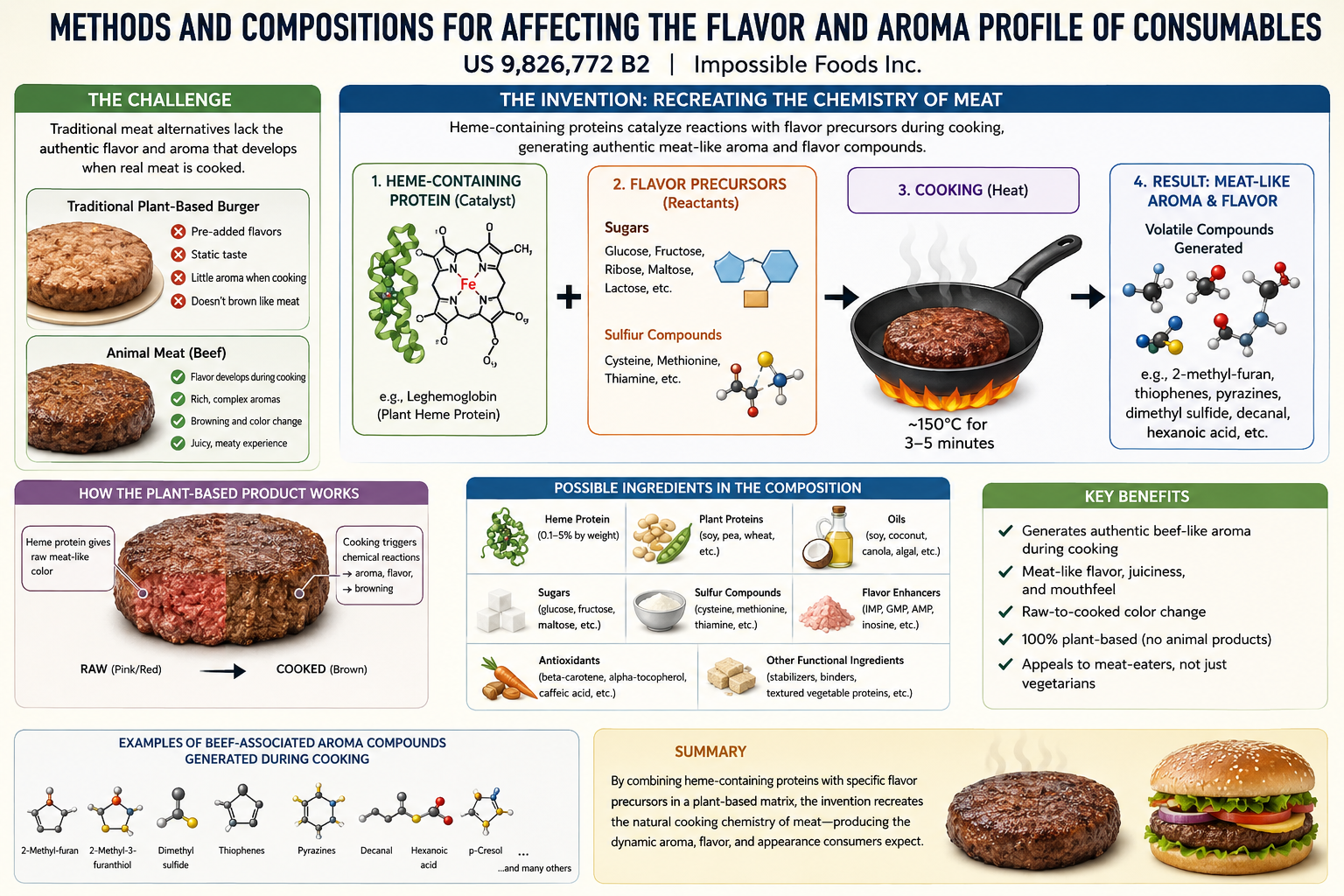
1. Patent Basics
Patent Title: Methods and Compositions for Affecting the Flavor and Aroma Profile of Consumables (Patent Images)
Patent Number: US 9,826,772 B2
Date of Patent: November 28, 2017 (Patent Images)
Applicant / Assignee: Impossible Foods Inc. (Patent Images)
Inventors:
- Rachel Fraser
- Patrick O'Reilly Brown
- Jessica Karr
- Celeste Holz-Schietinger
- Elysia Cohn (Patent Images)
Application Number: 15/624,513
Filed: June 15, 2017
Published: US 2017/0295833 A1 on October 19, 2017 (Patent Images)
Patent Family
This patent is part of a continuation chain tracing back to applications filed in 2013 and 2014. The patent forms part of Impossible Foods' foundational intellectual property portfolio surrounding heme-containing proteins and the creation of meat-like flavor in plant-based foods. (Patent Images)
2. Background of the Invention
The patent begins with a discussion of the challenge facing plant-based meat alternatives. The inventors observe that traditional meat substitutes have not succeeded in convincing mainstream consumers to replace animal meat because they fail to reproduce the sensory experience of cooking and eating meat. (Patent Images)
According to the patent, conventional vegetarian products generally rely on:
- Soy proteins
- Grain proteins
- Extruded vegetable materials
- Pre-added artificial flavors
These approaches may create products that are nutritionally acceptable but do not reproduce the dynamic flavor development that occurs when animal meat is cooked. (Patent Images)
The inventors identify several shortcomings:
A. Poor Flavor Authenticity
Most plant-based products do not generate authentic meat aromas during cooking. Instead, flavors are added beforehand and remain relatively static.
As a result, consumers do not experience:
- The smell of meat browning
- The development of savory aromas
- The release of characteristic volatile compounds during cooking
These sensory signals are a major component of consumer enjoyment of meat. (Patent Images)
B. Poor Texture and Mouthfeel
Existing meat substitutes often possess:
- Uniform textures
- Less fibrous structures
- Different moisture behavior
- Inferior mouthfeel
compared with animal meat. (Patent Images)
C. Lack of Consumer Adoption
The inventors argue that many meat substitutes mainly appeal to people who are already committed vegetarians or vegans.
Mainstream meat consumers generally continue eating animal meat because existing alternatives fail to replicate the complete sensory experience. (Patent Images)
D. Scientific Question
The inventors focused on a key question:
What molecular components in meat actually create meat flavor during cooking?
Their research led them to conclude that heme-containing molecules play a central role in generating meat-like aromas and flavors through catalytic reactions involving flavor precursors. (Patent Images)
3. What the Invention Is
At its core, the invention is based on the discovery that certain iron-containing molecules, especially heme-containing proteins, can catalyze flavor-generating reactions that produce authentic meat-like aromas and tastes during cooking. (Patent Images)
Central Insight
The inventors propose that many characteristic meat flavors arise from reactions between:
- Iron-containing compounds (especially heme)
- Sugars
- Sulfur-containing compounds
- Other flavor precursors
during heating and cooking. (Patent Images)
The patent refers to these iron-containing compounds broadly as:
highly conjugated heterocyclic rings complexed to iron ions
Examples include:
- Heme
- Porphyrins
- Chlorins
- Corrins
- Corrinoids
- Bacteriochlorophyll-related structures
and related iron-containing complexes. (Patent Images)
Why Heme Matters
The inventors argue that heme is not simply a colorant.
Instead, heme acts as a catalytic molecule that drives chemical transformations during cooking.
These reactions generate compounds associated with:
- Beefiness
- Savory notes
- Umami
- Brothy aromas
- Bloody aromas
- Metallic meat notes
- Bacon-like aromas
- Gravy-like characteristics
Plant-Based Heme
One of the most commercially significant aspects of the patent is the use of plant-derived heme proteins.
The patent specifically discusses:
- Leghemoglobin
- Plant globins
- Other heme-containing proteins
as sources of heme that can be incorporated into non-animal foods. (Patent Images)
This became a cornerstone technology behind Impossible Foods' products.
Flavor Precursors
The invention combines heme-containing proteins with flavor precursor molecules.
These include:
Sugars
- Glucose
- Ribose
- Fructose
- Lactose
- Xylose
- Arabinose
- Maltose
- Galactose
Sulfur-Containing Compounds
- Cysteine
- Cystine
- Methionine
- Thiamine
When heated together with heme-containing proteins, these ingredients undergo reactions that create meat-like flavor compounds. (Patent Images)
Mechanistic Concept
The patent effectively recreates the chemistry of meat cooking.
Rather than adding pre-made flavor compounds, it enables flavor generation during cooking.
This distinction is important because consumers experience:
- Aroma release
- Flavor evolution
- Browning-associated smells
as the food cooks. (Patent Images)
The invention therefore seeks to mimic the cooking chemistry of meat instead of merely mimicking the final flavor.
4. Embodiments and Examples
The patent contains numerous embodiments illustrating different ways of implementing the invention.
Embodiment 1: Ground Beef-Like Product
One major embodiment is a plant-based ground beef analog.
The formulation contains:
- Heme-containing proteins
- Plant proteins
- Sugars
- Sulfur-containing flavor precursors
and is free of animal products. (Patent Images)
When cooked, the composition generates volatile compounds associated with beef aroma. (Patent Images)
Embodiment 2: Leghemoglobin-Based Systems
The patent repeatedly emphasizes leghemoglobin.
Leghemoglobin is a heme-containing protein naturally found in root nodules of legumes.
The inventors identified it as particularly useful because:
- It contains heme.
- It can be produced without animal sources.
- It can create meat-like flavor chemistry.
This embodiment became highly significant commercially because Impossible Foods later used soy leghemoglobin as a key ingredient in the Impossible Burger.
Embodiment 3: Alternative Heme Proteins
The patent is intentionally broad.
It does not limit protection to leghemoglobin.
Instead, it lists many proteins from:
- Plants
- Animals
- Bacteria
- Fungi
- Algae
- Cyanobacteria
and other organisms. (Patent Images)
The patent includes dozens of protein sequences (SEQ ID NOs. 1–27) representing candidate heme-containing proteins. (Patent Images)
This broad disclosure helps support claims covering numerous alternative protein sources.
Embodiment 4: Oil-Containing Systems
The invention may additionally contain oils such as:
- Soybean oil
- Coconut oil
- Sunflower oil
- Palm oil
- Canola oil
- Rice bran oil
- Algal oil
among others. (Patent Images)
These oils contribute:
- Fat-like mouthfeel
- Flavor transport
- Cooking performance
and help mimic animal fat.
Embodiment 5: Color-Changing Meat Analog
An especially interesting embodiment concerns color.
The product can appear:
- Pink or red when raw
- Brown when cooked
similar to animal beef. (Patent Images)
The inventors recognize that visual cues strongly affect consumer perception.
Therefore the heme-containing protein serves multiple purposes:
- Flavor generation
- Aroma generation
- Raw-meat coloration
- Cooked-meat color transition
Embodiment 6: Antioxidants and Stability Agents
The patent describes optional additives including:
- Beta-carotene
- Alpha-tocopherol
- Caffeic acid
- Propyl gallate
- Epigallocatechin gallate
These compounds may improve:
- Oxidative stability
- Shelf life
- Flavor consistency
Embodiment 7: Nucleotide Flavor Enhancers
The patent describes optional inclusion of:
- Inosine
- IMP
- Guanosine
- GMP
- AMP
These compounds are well known for enhancing savory and umami flavor.
Their combination with heme systems further strengthens meat-like sensory characteristics.
Embodiment 8: Production of Specific Volatile Compounds
The patent identifies many volatile compounds associated with meat aroma.
Examples include:
- 2-methyl-furan
- 2-methyl-3-furanthiol
- Dimethyl sulfide
- Various thiophenes
- Pyrazines
- Decanal
- Hexanoic acid
- p-Cresol
and many others. (Patent Images)
These molecules are important because they contribute recognizable beef-like aromas.
The invention seeks to generate them naturally during cooking.
Embodiment 9: Controlled Cooking Conditions
The patent describes cooking conditions such as heating at approximately:
- 150°C
- for about 3–5 minutes
to promote flavor-generating reactions. (Patent Images)
These temperatures are similar to conditions encountered during frying or grilling.
5. Major Claims of the Invention
The claims define the legal scope of protection.
The patent contains 19 claims, with Claim 1 serving as the primary independent claim. (Patent Images)
Claim 1: Ground Beef-Like Food Product
The broadest claim covers a ground beef-like food product containing:
A. Heme-Containing Protein
0.1–5% by weight of a heme-containing protein. (Patent Images)
B. Sugar-Based Flavor Precursors
At least one sugar selected from:
- Glucose
- Ribose
- Fructose
- Lactose
- Xylose
- Arabinose
- Maltose
- Galactose
- Glucose-6-phosphate
C. Sulfur Precursors
At least 10 mM of:
- Cysteine
- Cystine
- Methionine
- Thiamine
or mixtures thereof. (Patent Images)
D. Plant Proteins
One or more plant proteins. (Patent Images)
E. Animal-Free Composition
The product contains no animal product. (Patent Images)
F. Functional Result
Cooking must produce at least two volatile compounds associated with beef aroma. (Patent Images)
This claim captures the central invention: a plant-based composition that chemically generates beef-like aroma during cooking.
Claim 2
Narrows Claim 1 by requiring that the heme-containing protein be a globin. (Patent Images)
Claim 3
Further specifies that the heme-containing protein possesses at least 80% sequence identity to one of the disclosed protein sequences. (Patent Images)
This expands protection beyond exact proteins while maintaining structural similarity.
Claim 4
Adds flavor-enhancing nucleotides such as:
- IMP
- GMP
- AMP
- Inosine
Claims 5–7
Cover additional ingredients:
- Antioxidants
- Vegetable oils
- Algal oils
- Textured vegetable proteins
Claims 8–9
Protect visual characteristics.
The product:
- Appears red or pink when raw.
- Turns brownish when cooked.
These claims protect an important consumer-facing aspect of the technology.
Claims 10–12
Define concentration ranges for:
- Sugars
- Cysteine
- Thiamine
These ranges likely reflect experimentally optimized flavor-generation conditions.
Claims 13–19
These claims focus on the volatile aroma compounds produced during cooking.
The patent identifies specific beef-associated molecules and requires production of:
- At least two
- At least five
- At least ten
- At least twenty
beef-associated aroma compounds depending on the claim. (Patent Images)
The final claim specifically identifies:
- 2-methyl-furan
- bis(2-methyl-3-furyl) disulfide
as aroma compounds generated by the composition. (Patent Images)
Overall Significance
US 9,826,772 is one of the foundational patents behind Impossible Foods' approach to plant-based meat. Rather than merely blending vegetable proteins and artificial flavors, the invention focuses on recreating the underlying chemistry of meat cooking. The central insight is that heme-containing proteins—particularly plant-derived heme proteins such as leghemoglobin—act as catalysts that transform sugars, sulfur compounds, and other flavor precursors into the volatile molecules responsible for the characteristic aroma and taste of cooked beef. (Patent Images)
From an intellectual-property perspective, the patent is significant because it does not merely claim a specific ingredient. It claims a broader system involving heme-containing proteins, flavor precursors, plant proteins, and cooking-induced flavor generation. This gave Impossible Foods a substantial patent position around the use of heme chemistry to create realistic meat analogs and helped distinguish its products from earlier generations of vegetarian burgers. (Patent Images)
In short, the invention is not simply a plant-based burger recipe; it is a platform technology for engineering meat-like flavor, aroma, color, and cooking behavior through controlled heme-mediated chemistry. (Patent Images)
Yes. Based on the disclosed principles in US 9,826,772 and publicly known food chemistry, it is possible to propose a commercial-style plant-based beef flavor system. However, it is important to distinguish between:
- A patent-inspired formulation (what I'll provide)
- Impossible Foods' actual commercial recipe (not public)
- An optimized industrial formulation (would require sensory testing, GC-MS analysis, shelf-life studies, and regulatory review)
The key insight from the patent is not a specific ingredient list but rather:
Heme + reducing sugars + sulfur amino acids + heat → beef aroma compounds
This chemistry produces pyrazines, thiophenes, furans, aldehydes, and sulfur-containing molecules associated with cooked beef.
How to Make your own Plant-based Beef Flavor?
Prototype Commercial Plant-Based Beef Flavor System
Flavor Core (1 kg Flavor Base)
Heme Catalyst System
| Ingredient | Amount |
|---|---|
| Soy leghemoglobin | 2–5 g |
| Iron-containing globin protein | alternative source |
| Fermentation-produced heme protein | optional |
Target concentration:
0.2–0.5 wt% active heme protein
Purpose:
- Catalyzes Maillard reactions
- Produces beef-like volatiles
- Creates bloody/raw notes
Sugar System
Reducing sugars drive Maillard chemistry.
| Ingredient | Amount |
|---|---|
| Ribose | 15 g |
| Glucose | 10 g |
| Maltose | 5 g |
Why Ribose?
Ribose is one of the most powerful meat-flavor precursors.
Many commercial reaction flavors use ribose because it rapidly generates:
- meaty notes
- roasted notes
- grilled notes
during heating.
Sulfur Precursor System
| Ingredient | Amount |
|---|---|
| L-Cysteine | 8 g |
| Methionine | 3 g |
| Thiamine HCl | 2 g |
These ingredients generate:
- thiophenes
- thiols
- sulfides
which are essential for beef aroma.
Without sulfur compounds, the flavor resembles toasted bread rather than meat.
Umami System
The patent mentions nucleotides.
A commercial formula would likely include:
| Ingredient | Amount |
|---|---|
| Yeast extract | 40 g |
| IMP | 2 g |
| GMP | 1 g |
These compounds dramatically increase perceived meatiness.
Protein Matrix
Commercial beef flavors almost always contain amino acid sources.
| Ingredient | Amount |
|---|---|
| Hydrolyzed pea protein | 60 g |
| Soy protein hydrolysate | 40 g |
Provides:
- amino acids
- peptides
- Maillard reactants
Fat Phase
Beef flavor is heavily influenced by lipid oxidation.
Fat Blend
| Ingredient | Amount |
|---|---|
| Coconut oil | 120 g |
| High oleic sunflower oil | 80 g |
This creates:
- animal-fat mouthfeel
- flavor release
- juiciness
Beef Fat Aroma Precursors
A significant improvement over the patent would be inclusion of oxidation precursors.
| Ingredient | Amount |
|---|---|
| Linoleic acid source | 2 g |
| Oleic acid source | 3 g |
These generate:
- aldehydes
- ketones
- fatty notes
associated with cooked beef fat.
Mushroom-Derived Components
Many modern plant-based meat systems use mushrooms.
| Ingredient | Amount |
|---|---|
| Shiitake extract | 10 g |
| Porcini extract | 5 g |
Provides:
- glutamates
- nucleotides
- savory depth
Color System
To mimic raw beef:
| Ingredient | Amount |
|---|---|
| Beet extract | 1 g |
| Leghemoglobin | primary color contributor |
Results:
Raw:
- pink/red
Cooked:
- brown
similar to ground beef.
Antioxidant System
The patent discloses antioxidants.
Commercial version:
| Ingredient | Amount |
|---|---|
| Mixed tocopherols | 0.2 g |
| Rosemary extract | 0.5 g |
Purpose:
- prevent rancidity
- stabilize flavor
Reaction Flavor Processing
This is where most commercial meat flavors are actually created.
Step 1
Mix:
- Ribose
- Cysteine
- Methionine
- Protein hydrolysates
- Yeast extract
with water.
Step 2
Heat:
120–140°C
for 30–90 minutes under controlled moisture.
This generates:
- pyrazines
- furans
- sulfur compounds
Step 3
Cool and blend with:
- leghemoglobin
- fats
- antioxidants
Expected Volatile Profile
A successful formulation should generate:
Sulfur Notes
- 2-methyl-3-furanthiol
- methanethiol
- dimethyl trisulfide
These create:
- grilled meat
- roasted beef
character.
Pyrazines
- methyl pyrazine
- trimethyl pyrazine
These provide:
- roasted
- browned crust
notes.
Fat-Derived Notes
- hexanal
- nonanal
- decanal
These contribute:
- cooked fat
- tallow-like aroma
Furan Compounds
- 2-methyl furan
- furfuryl alcohol
These produce:
- caramelized
- cooked meat
tones.
Prototype Plant-Based Ground Beef Formula
Per 1 kg finished product:
| Ingredient | Amount |
|---|---|
| Textured pea protein | 180 g |
| Soy protein concentrate | 120 g |
| Coconut oil | 140 g |
| Sunflower oil | 80 g |
| Water | 430 g |
| Yeast extract | 20 g |
| Ribose | 5 g |
| Cysteine | 2 g |
| Methionine | 0.5 g |
| Soy leghemoglobin | 3 g |
| IMP/GMP blend | 1 g |
| Salt | 15 g |
| Methylcellulose | 3 g |
| Beet extract | 0.5 g |
What to Improve Beyond the Patent?
What can be done to improve your flavor include
Fermented Flavor Fraction
Using:
- Koji fermentation
- Yeast fermentation
- Mushroom fermentation
to generate naturally occurring meat volatiles before cooking.
Precision Lipid Design
Most plant burgers still fail because fat flavor differs from beef fat.
Using structured fats rich in:
- oleic acid
- stearic acid
would improve authenticity dramatically.
Flavor Encapsulation
Encapsulate sulfur compounds so they are released during cooking rather than storage.
This improves shelf stability and creates stronger "burger-on-the-grill" aroma.
Multi-Heme System
Combine:
- leghemoglobin
- fungal globins
- bacterial hemoproteins
to broaden the volatile profile.
Overall Assessment
The patent's key contribution is the discovery that heme acts as a catalyst for meat-flavor generation rather than merely as a colorant. A modern commercial-grade plant-based beef flavor system would likely build on that foundation by combining:
Leghemoglobin + ribose + cysteine + methionine + yeast extract + protein hydrolysates + engineered fats + reaction-flavor processing
to create a volatile profile that more closely matches cooked ground beef. This is essentially the flavor-chemistry architecture that underlies many of today's highest-performing plant-based meat products, although the exact formulations remain proprietary.
###