Patent Watch: A Beef-Derived Umami Peptide with Salt-Enhancing and Flavor-Enhancing Effects and Its Applications
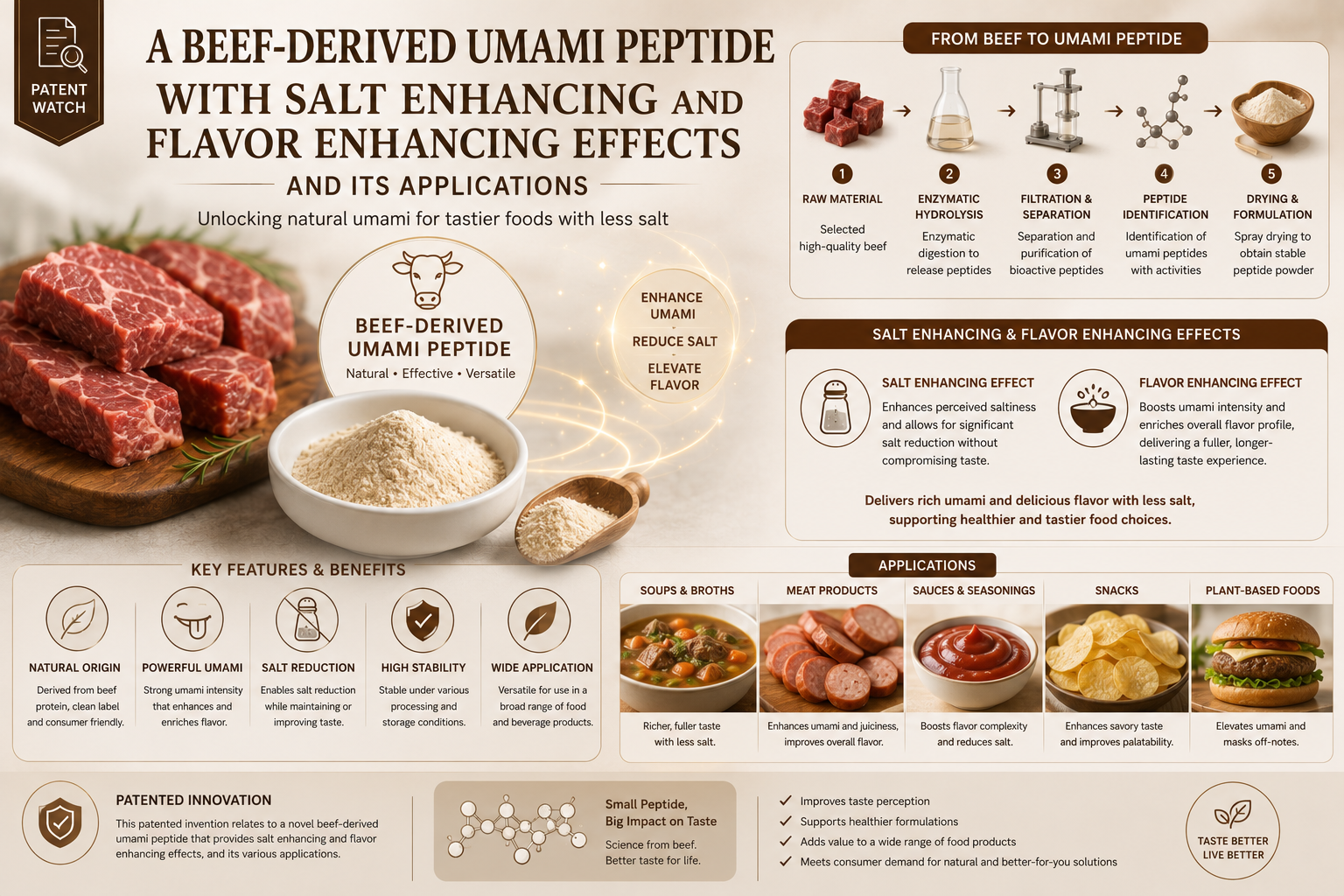
Patent Number: CN121930310A
Country: China
Status: Pending
Publication Date: January 30, 2026
Application Number: CN202610135042.9A
Priority Date: 2026
Inventors: [Not specified in the document]
Current Assignee: [Not specified in the document]
Technical Field
The invention relates to the field of polypeptides, and in particular to a beef-derived umami peptide with salt-enhancing and flavor-enhancing effects and its applications.
Background
With the popularization of healthy diet concepts, reducing the intake of salt (sodium chloride) has become a global consensus. However, directly reducing the amount of salt can severely impair the flavor of food, resulting in reduced consumer acceptance. Therefore, the development of natural additives that can maintain or enhance the salty taste and overall flavor of foods without increasing or decreasing the amount of sodium salt is a key challenge for the food industry.
Currently, salt-reduction strategies mainly include the use of sodium chloride substitutes such as potassium salts, flavor enhancers (e.g., yeast extract, monosodium glutamate), and peptides that are mined from natural foods for taste-enhancing activity. Peptides are of great interest due to their natural origin and potential health benefits. The prior art has reported the discovery and preparation of umami or taste-enhancing peptides from sources such as soybean (e.g., CN 115736085A), fermented bean curd (e.g., CN 118515725A), and edible fungi (e.g., CN 114158715A).
However, the prior art still has the following disadvantages:
- The complex peptide mixture with specific molecular weight distribution is protected by CN115736085A and its preparation method. The core effect is bound with complex enzymolysis technology and Maillard reaction depth, the product components are not clear, and the flavor enhancement effect is limited.
- Prior patents (such as CN118515725A and CN114158715A) disclose specific short peptide sequences, but the sources (fermented bean curd and bolete) and the sequence structures of these prior patents are greatly different from meat proteins.
Beef is a common food raw material with rich flavor, and its protein hydrolysate contains rich flavor precursor substances. However, up to now, no disclosure has been reported to identify specific long-chain polypeptides from beef that have dual efficacy of synergistic salty and fresh enhancement. Therefore, the development of specific polypeptides which are derived from beef, have definite sequences, and possess outstanding synergistic salty and fresh-increasing effects is of great significance to the development of a new generation of efficient, natural, and directional flavor regulators and salt-reducing solutions.
Summary of the Invention
Aiming at the defects of the prior art, the invention provides a beef-derived polypeptide with synergistic salty and fresh-increasing effects and its application. The polypeptide of the invention not only has its own flavor, but also can generate a remarkable synergistic effect with sodium chloride (NaCl) and/or sodium glutamate (MSG).
Technical Solutions
First Aspect: Polypeptide Sequences
The first aspect of the invention provides a polypeptide with synergistic salty and fresh-enhancing effects, wherein the amino acid sequence of the polypeptide is shown as SEQ ID NO. 1 or SEQ ID NO. 2:
- SEQ ID NO: 1: EDEADDWARR (designated as ER-10)
- SEQ ID NO: 2: DPDEEALRRSR (designated as DR-11)
Second Aspect: Use for Enhancing Salty Taste
The second aspect of the invention provides the use of the polypeptide in the preparation of a composition for enhancing the salty taste of a food product.
Third Aspect: Use for Enhancing Umami Taste
The third aspect of the invention provides the use of the polypeptide in the preparation of a composition for enhancing the umami taste of a food product.
Fourth Aspect: Use for Synergistically Enhancing Salty and Umami Taste
The fourth aspect of the invention provides the use of the polypeptide in the preparation of a composition for synergistically enhancing the salty and umami taste of a food product.
As a further preference to the above scheme, the food product is a low-sodium or reduced-salt food product. The polypeptide provided by the invention is particularly beneficial for preparing low-sodium or salt-reduced foods, so that the salty taste and the overall flavor profile of the product are not reduced and are, in fact, inversely increased while the addition amount of sodium salt is reduced.
Fifth Aspect: Food Composition
The fifth aspect of the invention also provides a food composition comprising a polypeptide as shown in SEQ ID NO. 1 or SEQ ID NO. 2 and a pharmaceutically acceptable carrier.
As a further preference to the above scheme, the composition is a seasoning (e.g., soy sauce, oyster sauce, compound sauce, spice powder), soup base, sauce, or nutritional supplement.
As a further preference to the above scheme, the composition further comprises a salty and/or umami agent.
As a further preference to the above, the salty taste agent is sodium chloride, the umami taste agent is sodium glutamate, and the polypeptide is capable of synergistically enhancing the salty taste of the salty taste agent and/or the umami taste of the umami taste agent in the composition. When the polypeptide is compounded with these conventional flavoring ingredients, a synergistic effect of "1+1>2" can be produced, rather than a simple flavor overlay.
As a further preference to the above scheme, the sodium chloride content of the composition is less than that required to achieve an equivalent salty taste perception without the addition of the polypeptide.
Beneficial Effects
Compared with the prior art, the invention has the following beneficial effects:
- The invention identifies and confirms two specific polypeptides with sequences EDEADDWARR and DPDEEALRRSR from beef protein for the first time. The sequences of these polypeptides are completely different from the umami peptides derived from soybeans, fermented bean curd, and edible fungi in the prior art, and belong to new polypeptides.
- Unlike existing taste-enhancing peptides which mostly present themselves in taste or freshness, the polypeptides of the present invention exhibit extremely strong synergistic effects with NaCl and MSG. Experimental data prove that the salty taste perception of a low-concentration salt solution (e.g., 18% improvement) and the umami taste intensity of a low-concentration monosodium glutamate solution (e.g., 36% improvement) can be obviously improved, and the effect is far superior to that of common flavor enhancers.
- This synergistic effect provides a direct and efficient technical scheme for developing healthy foods with "salt reduction without salt reduction" and even "salt reduction with salt increase and fresh increase". The salty taste and flavor plumpness of the product can be maintained or improved under the condition of reducing salt consumption by 20-30% by adding only a trace amount (e.g., 1 mg/mL level) of the polypeptide to the existing formula, demonstrating wide market application prospects.
- The polypeptide is derived from edible beef and has been experimentally verified to have no hemolytic toxicity, demonstrating good safety and aligning with the trend of clean labels.
Detailed Description
The following describes the technical scheme of the present invention in further detail with reference to the accompanying drawings and specific examples, but the present invention is not limited to the following technical scheme.
Example 1: Preparation and Identification of Beef-Derived Salt-Enhancing and Fresh-Increasing Peptides
1.1 Preparation of Crude Polypeptide from Deng Chuanhuang Beef
Fresh Deng Chuanhuang beef was taken, skin, fat, and tendon were removed, and distilled water was added for soaking for 30 minutes to remove fishy smell, followed by cleaning and draining. Three times the volume of deionized water was added to a homogenizer for homogenization. The mixture was heated to boiling in a water bath, maintained for 30 minutes after the central temperature reached 90°C, and then cooled to room temperature in an ice bath. The mixture was centrifuged (4°C, 8000 r/min, 15 minutes), filtered, and the supernatant was collected and stored at -80°C for further separation. This extraction process was repeated 3 times.
1.2 Ultrafiltration (UF)
The Deng Chuanhuang beef water extract prepared above was separated using ultrafiltration membranes with molecular weight cut-offs of 5 kDa and 3 kDa. Three different Molecular Weight (MW) ultrafiltration fractions were collected separately, named UF1, UF2, and UF3 (MW < 3 kDa, 3-5 kDa, and > 5 kDa, respectively). The collected components were placed in a freeze dryer at -40°C and a vacuum degree of 10-20 kPa to remove water. The collected and freeze-dried components were then stored in a refrigerator at -80°C for later use. Finally, the three different components were prepared into 5 mg/mL solutions, and the component with the strongest fresh taste was screened through sensory evaluation for further research.
2. Fresh Taste Difference Analysis of Deng Chuanhuang Beef Water Extract Ultrafiltration Components
To explore the umami peptide components in Deng Chuanhuang beef, the invention employed ultrafiltration technology to fractionate the water extract. Using 3 kDa and 5 kDa ultrafiltration membranes, three components with different molecular weights were obtained: UF1 (MW < 3 kDa), UF2 (3 kDa < MW < 5 kDa), and UF3 (MW > 5 kDa). After freeze-drying, the components with the strongest flavor were screened out through sensory evaluation for subsequent peptide sequence identification.
As shown in FIG. 1 (sensory evaluation radar of the ultrafiltration components of Deng Chuanhuang beef aqueous extracts), the water extract of Deng Chuanhuang beef underwent ultrafiltration fractionation, and the umami intensity of each component showed gradient change. In the ultrafiltration fraction of Deng Chuanhuang beef, the umami intensity of the UF1 fraction (MW < 3 kDa) was significantly higher than that of the UF2 and UF3 fractions (p < 0.05). Therefore, the invention selected the UF1 fraction for subsequent peptide structure identification to conduct an in-depth analysis of the peptide components within it.
3. Peptide Profiling of Deng Chuanhuang Beef Water Extract Protein Peptides
LC-MS/MS technology was used to identify the crude peptide fraction of Deng Chuanhuang beef with a molecular weight < 3 kDa. As shown in FIG. 2 (ion chromatogram of Deng Chuanhuang beef meat protein peptide), the total ion flow diagram (TIC) shows the chromatographic separation of small molecule peptides of beef, with retention time on the horizontal axis and ion peak intensity on the vertical axis. Based on the UniProt Bos Taurus database, the matching degree between the experimental mass spectrometry data and the database information was calculated using MaxQuant software to obtain a Score. The higher the Score, the more reliable the identification result. The invention set Score > 50 as a credible threshold and finally identified 4220 credible peptide fragments from Deng Chuanhuang beef.
4. Deng Chuanhuang Beef Flavor Peptide Screening
4.1 Virtual Screening of Potential Umami Peptides
The invention used the ratio of umami amino acids (aspartic acid D and glutamic acid E) ≥ 30% as a primary screening condition to screen potential umami peptides. Among the Deng Chuanhuang beef protein peptides, 599, 655, and 543 did not contain umami amino acids (D and E). A total of 143 peptide segments with umami amino acid content ≥ 30% were identified in Deng Chuanhuang beef samples, accounting for 3.39% of the total number of identified peptides. The invention selected peptide fragments with umami amino acid content ≥ 30% as key research objects for the next screening.
Only peptides predicted simultaneously by three predictors—iUmami_SCM, Umami_YYDS, and TASTEPEPTIDES_DM—were considered to have good umami taste intensity in the present invention. As shown in FIG. 3 (machine-learned prediction of potential umami peptides in Deng Chuanhuang beef protein peptides), 98 potential umami peptides with good umami intensity and low bitter value were identified from Deng Chuanhuang beef by combined machine learning prediction, based on the condition that the ratio of umami amino acids was ≥ 30%.
4.2 Virtual Screening of Potential Umami Peptides
Based on the research results of section 4.1, 17 peptides composed of 9-13 amino acids with flavor intensity > 650 were selected from the beef and subjected to targeted screening through physicochemical property prediction and molecular docking. The chemical properties of these peptide fragments are shown in Table 1. All 17 peptides exhibited good hydrophilicity. Additionally, good water solubility, safety, and non-toxicity are key to the normal metabolism of small molecule peptides in vivo and are also important issues for the future development of peptide-rich products. Physicochemical properties of the 17 potentially umami peptides were analyzed using the ToxinPred and Innovagen databases.
Table 1: Physicochemical Properties of the Characteristic Umami Peptides in Deng Chuanhuang Beef
| Peptide Sequence | SEQ ID NO | N/C | Hydrophilicity | Net Charge | pI | Instability Index | Aliphatic Index | Boman Index |
|---|---|---|---|---|---|---|---|---|
| (Data for 17 peptides would be listed here, including the 5 key peptides identified later) |
Note: The table in the original document lists all 17 candidate sequences and their physicochemical properties, including the five key peptides (ER-10, GK-10, EA-11, DR-11, HY-12) as well as other sequences such as AL-10 and ES-12.
4.3 Molecular Docking Screening of Potentially Umami Peptides
The more stably an umami peptide binds to the T1R1/T1R3 receptor, the higher the potential to produce umami. As shown in Table 2, the binding energy of the 17 peptides to the receptor was negative and less than -5 kcal/mol, indicating that they all bound stably to the T1R1/T1R3 receptor. Among them, the binding energy of peptide DEADDWARR was highest (-6.3 kcal/mol) and the binding energy of peptide EDEADDWARR was lowest (-9.5 kcal/mol). Subsequent studies selected 7 peptide fragments with binding energy below -7.6 kcal/mol for in-depth analysis of their structure-activity relationship and their inherent relationship for stable binding to the receptor.
Table 2: Binding Energy of 17 Peptides to Umami Taste Receptor T1R1/T1R3
| Peptide Sequence | SEQ ID NO | Binding Energy (kcal/mol) |
|---|---|---|
| EDEADDWARR (ER-10) | SEQ ID NO: 1 | -9.5 |
| DPDEEALRRSR (DR-11) | SEQ ID NO: 2 | -8.4 |
| ... (other sequences) | ... | ... |
Table 3 shows the basic mass spectrometry information of 7 potential umami peptides. The identification matching scores of the 7 umami peptides were all greater than 80, indicating that the peptide fragments have strong reliability. The molecular weight range was 1058.488-1435.5964 Da. The peptide sequences were:
- GDEESYTVFK (SEQ ID NO: 4, designated GK-10)
- EDEADDWARR (SEQ ID NO: 1, designated ER-10)
- EQAEEERYFRA (SEQ ID NO: 5, designated EA-11)
- DPDEEALRRSR (SEQ ID NO: 2, designated DR-11)
- HAKIDAAEEEKY (SEQ ID NO: 3, designated HY-12)
- AISEELDHAL (SEQ ID NO: 11, designated AL-10)
- EDEADDWARRSS (SEQ ID NO: 15, designated ES-12)
The precursor proteins were mainly from creatine kinase, troponin I, ATP enzyme inhibitor, LIM binding domain, tropomyosin-1 chain, and cytoplasmic fatty acid-binding domain protein of beef.
Table 3: Basic Mass Spectrometry Information for 11 Umami Peptides
(Table lists all identified peptide sequences, their molecular weights, scores, and precursor proteins)
Further combining virtual prediction and molecular docking revealed the structure-activity relationship and freshness mechanism of 5 long-chain umami peptides in Deng Chuanhuang beef. The peptides ER-10, GK-10, EA-11, DR-11, and HY-12 were found to have high umami intensity, rich umami active fragments, and the best binding stability with the receptor. The flavor development characteristics of these 5 umami peptides were subsequently determined through synthetic studies conducted at the South-kingdom Peptide Biotechnology Limited.
5. Deng Chuanhuang Beef Flavor Peptide Flavor Development Characteristics
5.1 Umami Threshold and Descriptive Analysis of Umami Peptides
In the present invention, Taste Dilution Analysis (TDA) was used to evaluate the umami threshold of these five peptides. As shown in Table 4, the umami taste thresholds of the peptides ER-10, GK-10, EA-11, DR-11, and HY-12 were 0.0625, 0.25, 0.125, and 0.125 mg/mL, respectively. The lower the threshold, the stronger the taste development ability and the higher the taste development efficiency of the substance, indicating that the 5 umami taste peptides have better umami taste. Furthermore, as can be seen from Table 4, the synthetic umami peptides generally have a variety of taste attributes, such as sour, bitter, salty, and sweet tastes. This suggests that synthetic umami peptides will not generally have a single umami taste but will also exhibit other basic taste attributes.
Table 4: Taste Threshold and Sensory Description of Five Umami Peptides
| Peptide | Sequence | SEQ ID NO | Umami Threshold (mg/mL) | Sensory Description |
|---|---|---|---|---|
| ER-10 | EDEADDWARR | SEQ ID NO: 1 | 0.0625 | Strong umami, salty, slightly sweet, low sourness |
| GK-10 | GDEESYTVFK | SEQ ID NO: 4 | 0.25 | Moderate umami, slight bitterness |
| EA-11 | EQAEEERYFRA | SEQ ID NO: 5 | 0.125 | Weak umami, low bitterness |
| DR-11 | DPDEEALRRSR | SEQ ID NO: 2 | 0.125 | Strong umami, salty |
| HY-12 | HAKIDAAEEEKY | SEQ ID NO: 3 | 0.125 | Moderate umami, higher bitterness |
5.2 Sensory Evaluation of Umami Peptide and Electronic Tongue Flavor Profile Analysis
FIG. 4A is a radar chart of five peptide sensory evaluations. The five peptides were subjected to sensory evaluation, showing that umami was the most obvious of the five basic tastes, and the intensity of umami was, in order: ER-10 (3.78) > HY-12 (3.30) > DR-11 (2.70) > GK-10 (2.40) > EA-11 (1.40). Among them, the umami score of peptide ER-10 was the highest. In terms of sweetness, the sweetness score of peptide ER-10 was highest, with a significant difference (p < 0.05) from other peptides. The difference between the five peptides was not significant in terms of sourness (p > 0.05), with the sourness score of ER-10 being the lowest. In terms of salty taste, the salty taste score of peptide ER-10 was highest, the salty taste score of EA-11 was lowest, and the salty taste of the remaining three peptides was not greatly different. In terms of bitterness, peptide HY-12 had the highest bitterness score and peptide EA-11 had the lowest bitterness score.
FIG. 4B shows the electronic tongue flavor profile, which corroborated the sensory evaluation findings, demonstrating distinct flavor profiles for each peptide, with ER-10 and DR-11 showing particularly strong umami and salty signals.
Example 2: Synergistic Flavor-Enhancing and Salt-Enhancing Effect Verification of Umami Peptide
Umami Peptide Dose Feedback Test Analysis
Umami peptides and monosodium glutamate can enhance the perception of umami through a synergistic effect. Previous research indicates that compared with short peptides, long peptide chains have a more obvious umami-enhancing effect. The invention further analyzed the regulation effect of the peptides on the umami flavor.
As shown in FIG. 5 (umami dose-feedback result for synthetic peptides), the 5 umami peptides showed similar trends in regulating the monosodium glutamate solution at different concentrations. Specifically, the umami intensity of the monosodium glutamate solution first increased and then decreased with the increase of the concentration of the peptides. At a concentration of 0-1 mg/mL, the umami intensity of the 5 umami peptides on the MSG solution all showed a sharp rising trend. The umami enhancement effect of peptides ER-10, DR-11, and GK-10 on the MSG solution reached the highest at a concentration of 1 mg/mL and showed a decreasing trend after exceeding 1 mg/mL. In contrast, peptides HY-12 and EA-11 also showed an increasing umami-enhancing effect at a concentration of 1 mg/mL, and the umami-enhancing effect of both peptides reached a maximum when reaching 2 mg/mL, and decreased in umami intensity when exceeding 2 mg/mL.
Fresh and Salty Enhancing Effect of Umami Peptide
To further evaluate the fresh-increasing and salty-increasing effects of the umami peptide, improving the research prospect of the umami peptide applied to a salt-reducing and fresh-increasing strategy in the future, the invention used 0.35% MSG (sodium glutamate) and NaCl solution as the mother solution, prepared a solution with a peptide concentration of 1 mg/mL, and further compared the flavor and salty taste enhancement effects of the five umami peptides.
FIG. 6A (enhancement of umami intensity in 0.35% MSG solution): In terms of enhancing freshness, after adding five umami peptides to 0.35% monosodium glutamate respectively, the umami taste intensity of the MSG solution was improved by:
- 36% with peptide ER-10
- 8.82% with peptide GK-10
- 28.57% with peptide DR-11
- 12.12% with peptide EA-11
- 20.69% with peptide HY-12
The umami taste enhancement effect of peptides ER-10, HY-12, and DR-11 was most obvious (p < 0.05), but the umami taste enhancement effect of peptides GK-10 and EA-11 on the MSG solution was lower.
FIG. 6B (enhancement of salty intensity in 0.35% NaCl solution): In terms of salty taste enhancement, after adding peptides to 0.35% NaCl solution respectively, the salty taste values of the saline solution were:
- Peptide ER-10: 5.55 (11% enhancement)
- Peptide GK-10: 5.40
- Peptide EA-11: 5.39
- Peptide DR-11: 5.90 (18% enhancement)
- Peptide HY-12: 5.27
Peptides DR-11 and ER-10 had the best salty taste enhancement effect. The other three peptides had differences from the 0.35% NaCl solution but had lower salty taste enhancement effects overall.
In conclusion, peptides ER-10 and DR-11 demonstrated good fresh and salty enhancing effects and good application prospects.
Example 3: Application of Polypeptide in Salt-Reduced Soy Sauce
Experimental Group 1: Low-salt soy sauce base (salt content 75% of conventional formulation) with 0.05% (w/w) of the polypeptide of SEQ ID NO: 2 (DR-11) added.
Control Group 1: Conventional salt content soy sauce (100% salt).
Control Group 2: Low-salt soy sauce base (75% salt, no polypeptide added).
Sensory evaluation of salty taste, umami taste, and overall acceptability of the three groups of samples was scored by 20 panelists.
Results:
- The salty taste perception score of the experimental group (75% salt + polypeptide) was not significantly different from that of Control Group 1 (100% salt) and was significantly higher than that of Control Group 2 (75% salt).
- The experimental group also had better umami taste and overall acceptability than the two control groups.
The addition of the polypeptide of the invention proves that the core salty taste and flavor of the product can be completely maintained under the condition of 25% salt reduction.
Example 4: Properties of Umami Peptides
Thermal Stability Analysis of Umami Peptides
The flavor intensity of the umami peptides at different heat treatment temperatures was studied using a sensory evaluation method, as shown in FIG. 7 (umami intensity of five umami peptides at different temperatures).
- Five umami peptides all showed lower umami intensity at low temperature 4°C.
- Peptides ER-10, EA-11, and DR-11 had the highest umami intensity at 25°C.
- Peptides GK-10 and HY-12 had the highest umami intensity at 50°C.
This is likely due to intramolecular derivatization reactions of the umami peptides during heating, such as intramolecular dehydration condensation of glutamic acid or glutamine to produce pyroglutamyl peptides, which have a positive effect on the umami-enhancing effect of the system. However, excessive thermal reaction may cause cleavage of the umami peptide, damage the structure of the umami peptide, and generate off-flavors. The umami taste intensity of the umami taste peptide under 100°C treatment was lower than that under normal temperature conditions (p < 0.05). The five umami peptides were shown to be more suitable for relatively mild processing conditions.
Safety Analysis of Umami Peptides
Whether a chemically synthesized peptide can be used depends not only on the umami taste intensity of the peptide but also on its safety. Research shows that a medicine with a hemolysis rate over 5% may produce certain toxic side effects to the human body. The invention detected the toxic effects of peptides ER-10, GK-10, EA-11, DR-11, and HY-12 on erythrocytes.
The hemolysis analysis result of the peptides is shown in FIG. 8 (hemolytic activity of five peptides on mouse erythrocytes). The rate of hemolysis of mouse erythrocytes by PBS of the blank group was 0.8506, and in the positive control containing 0.1% Triton X-100, the rate of hemolysis was as high as 100%, with the difference being obvious (p < 0.001). The hemolysis rate of the blank group and the five peptides with different concentrations on the red blood cells of the mice was lower than 5%, and the difference between the blank group and the positive control group was obvious (p < 0.001). This indicates that the five umami peptides are non-hemolytic peptides, which is consistent with the result predicted by the ToxinPred system, and indicates that peptides ER-10, GK-10, EA-11, DR-11, and HY-12 have good development and application prospects.
Summary of Key Peptide Sequences Identified
| Peptide Designation | SEQ ID NO | Amino Acid Sequence | Length | Molecular Weight (Da) | Key Properties |
|---|---|---|---|---|---|
| ER-10 | SEQ ID NO: 1 | EDEADDWARR | 10 | ~1210 | Highest umami intensity (3.78), best umami enhancement (36%), strong salt enhancement (11%), lowest umami threshold (0.0625 mg/mL) |
| DR-11 | SEQ ID NO: 2 | DPDEEALRRSR | 11 | ~1320 | Best salt enhancement (18%), strong umami enhancement (28.57%), low umami threshold (0.125 mg/mL) |
| HY-12 | SEQ ID NO: 3 | HAKIDAAEEEKY | 12 | ~1435 | Good umami enhancement (20.69%), higher bitterness |
| GK-10 | SEQ ID NO: 4 | GDEESYTVFK | 10 | ~1150 | Moderate umami intensity, slight bitterness |
| EA-11 | SEQ ID NO: 5 | EQAEEERYFRA | 11 | ~1370 | Weakest umami intensity (1.40), lower salty taste enhancement |
| AL-10 | SEQ ID NO: 11 | AISEELDHAL | 10 | ~1100 | Candidate peptide with good binding energy |
| ES-12 | SEQ ID NO: 15 | EDEADDWARRSS | 12 | ~1435 | Extended version of ER-10 |
Claims
Claim 1: A polypeptide with synergistic salty and fresh-enhancing effects, characterized in that the amino acid sequence of the polypeptide is shown as SEQ ID NO: 1 or SEQ ID NO: 2.
Claim 2: Use of the polypeptide according to Claim 1 in the preparation of a composition for enhancing the salty taste of a food product.
Claim 3: Use of the polypeptide according to Claim 1 in the preparation of a composition for enhancing the umami taste of a food product.
Claim 4: Use of the polypeptide according to Claim 1 in the preparation of a composition for synergistically enhancing the salty and umami taste of a food product.
Claim 5: The use according to any one of Claims 2 to 4, characterized in that the food product is a low-sodium or reduced-salt food product.
Claim 6: A food composition, characterized by comprising a polypeptide as shown in SEQ ID NO: 1 or SEQ ID NO: 2 and a pharmaceutically acceptable carrier.
Claim 7: The food composition according to Claim 6, characterized in that the composition is a seasoning (e.g., soy sauce, oyster sauce, compound sauce, spice powder), soup base, sauce, or nutritional supplement.
Claim 8: The food composition according to Claim 6 or 7, characterized in that the composition further comprises a salty and/or umami agent.
Claim 9: The food composition according to Claim 8, characterized in that the salty taste agent is sodium chloride, the umami taste agent is sodium glutamate, and the polypeptide is capable of synergistically enhancing the salty taste of the salty taste agent and/or the umami taste of the umami taste agent in the composition.
Claim 10: The food composition according to Claim 9, characterized in that the sodium chloride content of the composition is less than that required to achieve an equivalent salty taste perception without the addition of the polypeptide.
###