Patent Watch: Method for Preparing a Stable Citrus Flavoring for Low-Sugar Beverages
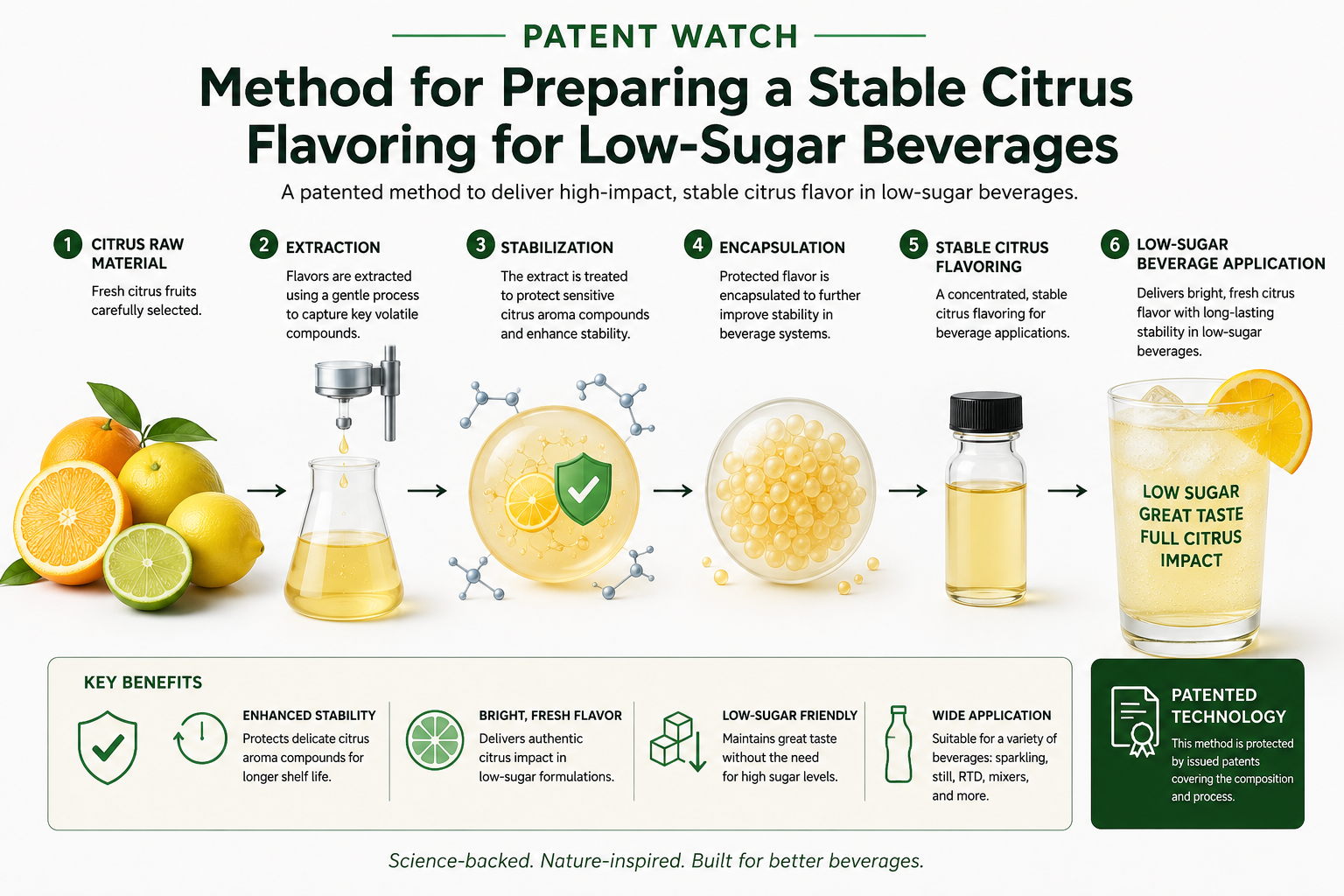
Patent Information
- Patent Number: CN121730419A
- Country: China
- Other Languages: Chinese
- Inventors: Deng Weizhan (邓伟战), Huang Hao (黄浩), Lai Gongchen (赖拱晨)
- Current Assignee: Guangdong Hengyu Biotechnology Co., Ltd.
- Application Number: CN202610025845.9A
- Status: Pending
- Publication Date: January 9, 2026
Technical Field
The invention belongs to the technical field of food additives, and specifically relates to a preparation method for a stable orange essence specially formulated for low-sugar beverages.
Background of the Invention
Citrus essence has long been an indispensable flavor source in the beverage industry, valued for its natural, fresh, and vibrant aroma characteristics. It is widely applied in various fruit juice beverages, carbonated soft drinks, tea beverages, and functional beverages. With the notable increase in global consumer health consciousness, market demand for low-sugar and sugar-free beverages has experienced explosive growth, driving the entire industry toward rapid sugar reduction transformation.
To maintain palatable sweetness while reducing or even completely eliminating sucrose, high-potency sweeteners or sugar alcohols such as sucralose, acesulfame potassium, and erythritol are widely used. However, this radical formulation change creates a series of new sensory technology challenges:
- Sweetener off-notes: Many high-potency sweeteners may impart non-sucrose-inherent sweetness sensations, such as excessively long after-sweetness, metallic astringency, or slight bitterness, resulting in an impure, unnatural sweetness profile and often an unpleasant sensation of a sweet tongue after consumption.
- Loss of mouthfeel: The reduction or absence of sugar causes beverages to lose the full "body texture" and mellow mouthfeel provided by sucrose, making the overall flavor structure thinner.
- Flavor weakening: Sugar itself has a 'flavor-fixing' and synergistic effect on some volatile flavor substances. The deficiency of sugar directly leads to weakened intensity and durability of fruit flavors such as orange in beverages, particularly causing serious loss of brightness and juiciness reminiscent of fresh squeezed juice, making the final product flavor dull and unrealistic compared to full-sugar versions.
Inherent Citrus Flavor Instability
Beyond the challenges presented by low-sugar environments, the inherent chemical instability of citrus flavors is a long-standing technical bottleneck. The main body of characteristic citrus aroma—terpene compounds like limonene and myrcene—has highly active chemical properties and is extremely sensitive to oxygen, light, heat, and pH changes. During production, storage, transportation, or shelf display of beverages, these aroma components are susceptible to auto-oxidation, photo-cyclization, or polymerization reactions, resulting in:
- Rapid decay of product aroma intensity
- Development of unpleasant stale, greasy rancid, or turpentine-like irritating off-flavors
This flavor deterioration phenomenon is particularly prominent and fatal in beverage products employing transparent packaging, requiring long-distance transportation at normal temperature, or requiring long-term storage. It not only seriously impairs consumer drinking experience but also directly limits product shelf life and sales radius.
Limitations of Prior Art Solutions
Common technical approaches to essence instability are mainly focused on physical isolation or packaging:
- Microemulsion preparation: Dispersing and wrapping essential oil drops using emulsifiers to reduce contact area with external water phase and oxygen.
- Microencapsulation: Encapsulating essence in microcapsule particles using maltodextrin, gum arabic, or cyclodextrin as wall materials via spray drying or freeze drying.
- Antioxidant addition: Adding vitamin C, rosemary extract, etc., directly to flavor formulations.
However, when applied specifically to the demanding scenario of low-sugar or zero-sugar beverages, these prior art solutions reveal significant limitations:
- Most prior art focuses on how to lock or store aroma substances—a relatively passive and single protection strategy—and fails to actively cope with and solve the complex problems of 'flavor expression distortion' and 'taste balance disorder' caused by sweetener defects and sugar deficiency in low-sugar formula systems.
- Essence only achieves slow release of aroma but cannot effectively mask bad aftertaste of sweeteners, cannot compensate for taste fullness, and cannot enhance the sense of juice reality—making limited contribution to improving overall sensory quality of low-sugar beverages.
- Some packaging processes, such as high-temperature spray drying, may cause irreversible damage to highly heat-sensitive citrus aroma components.
- Complex emulsification or multi-layer embedding processes may cause problems of high production cost, difficult process control, poor product batch stability, and may introduce excessive food additives, contradicting the 'clean label' trend promoted in the current market.
Therefore, there is a need for a preparation method of stable orange essence specifically designed for low-sugar beverages.
Summary of the Invention
To overcome the deficiencies in the prior art, the present invention provides a preparation method for a stable orange essence specially formulated for low-sugar beverages.
Technical Solution
A preparation method for a stable orange essence special for low-sugar beverages comprises the following steps:
S1. Extraction: Treating citrus peel using a combination mode of physical wall breaking and enzymatic hydrolysis to obtain citrus crude oil.
S2. Purification: Mixing the citrus crude oil with ethanol at a volume ratio of 1:15-1:80, standing for 35-55 days at 12-20°C, then heating to 22-34°C at a rate of 0.8-2.5°C per day, cooling back to 12-22°C at a rate of 0.5-1.5°C per day, filtering, and distilling under reduced pressure to remove ethanol, thus obtaining purified citrus essential oil.
S3. Inclusion Modification: Mixing the purified citrus essential oil and hydroxypropyl betacyclodextrin in a cosolvent at a mass ratio of 1:3-1:8, and carrying out ultrasonic-assisted reaction at 40-50°C for 30-90 minutes to obtain an inclusion compound initial body.
S4. Drying and Curing: Mixing the inclusion compound initial body with a wall material solution, and curing after freeze drying to obtain citrus essence microcapsule particles.
S5. Compounding: Mixing the citrus essence microcapsule particles, flavor excitant, sweet taste modifier, and water-soluble carrier to prepare the stable citrus essence special for low-sugar beverages.
Detailed Extraction Process (S1)
S1.1 Preprocessing: Cleaning and crushing fresh citrus peels.
S1.2 Physical Wall Breaking: Repeatedly freezing and thawing the crushed citrus peel, with freeze-thaw cycles repeated 3-5 times.
S1.3 Enzymolysis: Mixing the physically wall-broken citrus peel with a compound enzyme preparation at a mass ratio of 1:0.01-1:0.25. The compound enzyme preparation comprises pectase and cellulase at a mass ratio of 1:1-1:1.5. Enzymolysis is carried out for 2-4 hours at pH 4.0-5.0 and temperature 45-50°C.
S1.4 Separation: Centrifugally separating the mixture after enzymolysis and collecting the upper layer citrus crude oil. Alternatively, supercritical carbon dioxide fluid extraction can be used, with conditions of extraction pressure 25-35 MPa, extraction temperature 40-50°C, CO₂ flow rate 25-35 kg/hour, and extraction time 2-3 hours.
Detailed Purification Process (S2)
S2.1 Stabilization Pretreatment: Mixing the citrus crude oil with an ethanol aqueous solution (65-75% volume concentration) at a volume ratio of 1:25-1:50. Adding a directional crystallization inducer to the mixed solution, and performing ultrasonic dispersion for 15-30 minutes at 5-10°C. Subsequently, leaving the mixture to stand in an environment of 15-20°C for 40-50 days, during which pulsed ultrasonic treatment at 40 kHz for 10 minutes is applied every 120 hours.
S2.2 Nonlinear Programmed Temperature Change Treatment: After standing, first raising the temperature to 22-25°C at a rate of 0.8-1.2°C per day and maintaining constant temperature for 5-7 days. Then raising the temperature to 31-34°C at a rate of 2.0-2.5°C per day, and immediately starting cooling. The cooling process is divided into two stages: first cooling to 20-22°C at a rate of 1.0-1.5°C per day, then slowly returning to 15-20°C at a rate of 0.5-0.8°C per day.
S2.3 Antioxidant Addition: Synchronously adding a compound antioxidant equivalent to 0.1-0.5% of the citrus crude oil mass when the programmed temperature change treatment begins. After the entire temperature program is completed, filtering and distilling the filtrate under reduced pressure to remove ethanol, obtaining purified citrus essential oil.
Directional Crystallization Inducer: A compound of microcrystalline cellulose and silicon dioxide at a mass ratio of 1:1-1:3.
Compound Antioxidant: A mixture of rosemary extract and vitamin E at a mass ratio of 2:1.
Detailed Inclusion Modification Process (S3)
The inclusion modification comprises:
- First-stage inclusion: Including volatile components in the purified citrus essential oil with hydroxypropyl betacyclodextrin at 40-45°C for 20-40 minutes.
- Second-stage inclusion: Adding the remaining essential oil components and hydroxypropyl betacyclodextrin at 45-50°C for 40-60 minutes.
Cosolvent: One of absolute ethyl alcohol or propylene glycol, with the mass ratio of purified citrus essential oil to cosolvent being 1:5-1:15.
Detailed Drying and Curing Process (S4)
Wall Material Solution: Comprises gum arabic, maltodextrin, and sodium carboxymethylcellulose at a mass ratio of 1:2.5:0.3 to 1:3.5:0.6. The mass ratio of wall material solution to essential oil in the inclusion compound primary body is 4:1-6:1, with mass concentration of 25%-35%.
Freeze Drying Conditions:
- Pre-freezing: Temperature reduced to below -40°C and maintained for 3-5 hours.
- Sublimation drying: Cold trap temperature below -50°C, vacuum degree below 10 Pa.
- First stage: Shelf temperature controlled at -15°C to 10°C, drying for 18-24 hours.
- Second stage: Shelf temperature gradually increased to 30-35°C, drying for 8-12 hours.
Detailed Compounding Process (S5)
Compounded Raw Materials (parts by mass):
- Citrus essence microcapsule particles: 15-30 parts
- Flavor excitant: 1-5 parts
- Sweet taste modifier: 2-8 parts
- Water-soluble carrier: contains sodium starch octenyl succinate (8-12 parts), beta-cyclodextrin (2-5 parts), maltodextrin (25-35 parts), green tea extract (0.5-5 parts), and water (57-70 parts)
Flavor Excitant: A mixture of orange oil terpene and naringin extract at a mass ratio of 1:0.1-1:0.5.
Sweet Taste Modifier: A mixture of ammonium glycyrrhizinate and mogroside at a mass ratio of 1:0.5-1:2.
Beneficial Effects
Compared with the prior art, the present invention provides the following advantages:
1. Gentle Processing Conditions
The main process links—low-temperature enzymolysis extraction, programmed temperature control purification, medium-temperature ultrasonic inclusion, and freeze-drying solidification—avoid prolonged high-temperature treatment, ensuring the integrity and activity of citrus aroma components.
2. Comprehensive Protection System
Purification Stage:
- Directional crystallization inducer (microcrystalline cellulose + silicon dioxide): Actively regulates and controls crystallization behavior of macromolecular impurities such as waxes, facilitating their separation.
- Nonlinear programmed temperature change: Simulates a dynamic crystallization and fractionation process, achieving finer thermodynamic fractionation of impurities and aroma components in different solubility ranges.
- Compound antioxidant (rosemary extract + vitamin E): Provides in-situ protection of thermosensitive terpene substances during the tens-of-days purification process, inhibiting initial oxidation.
Inclusion Stage:
- Two-stage inclusion strategy: First includes volatile components with lower molecular weight under relatively mild conditions, then includes remaining components at slightly higher temperature. This differential temperature and time control ensures various components from top notes to body notes are fully and firmly embedded to form a composite inclusion compound primary body.
Drying and Curing Stage:
- Double protection barrier: The inclusion compound primary body combined with wall material solution (gum arabic, maltodextrin, sodium carboxymethylcellulose) constructs an inner inclusion layer and outer wall material, physically blocking oxygen, light, and moisture, delaying oxidation degradation, enabling controlled slow release of aroma in low-sugar beverage water phase environments, and effectively extending flavor stability during beverage shelf life.
3. Active Sensory Balance Enhancement
Flavor Excitant (orange oil terpene + naringin extract):
- Naringin extract (at concentrations far below bitter perception threshold) interacts with sweeteners to complicate sweetness perception signals.
- The slight fruit glycoside smell carried by naringin blends with orange oil terpene, enhancing flavor layering and a fresh, juicy character, compensating for thin aroma profiles due to sugar deficiency.
Sweet Taste Modifier (ammonium glycyrrhizinate + mogroside):
- Ammonium glycyrrhizinate provides long-lasting after-sweetness, filling possible cavities in the sweetness curve of high-potency sweeteners, making it more similar to the sweetness profile of sucrose.
- Mogroside features quick sweetness onset and relatively fast fading.
- The two components compound in appropriate proportion to smooth overall sweetness and weaken metallic, bitter, and lingering tongue sensations.
4. Safety and Clean Label Compatibility
Hydroxypropyl betacyclodextrin, gum arabic, maltodextrin, sodium starch octenyl succinate, and beta-cyclodextrin are all embedding and carrier materials commonly used and recognized as safe in the food industry. The invention addresses the problems of citrus flavor attenuation and lack of coordination with sweeteners in low-sugar beverages without introducing unnecessary additives.
Detailed Description of Embodiments
Raw Material Sources
- Pectase: Enzyme activity 30,000 U/g, Shanghai Enzyme-linked Biotechnology Co.
- Cellulase: Food grade, enzyme activity 30,000 U/g, Shandong Santa Biotechnology Co.
- Microcrystalline Cellulose: Pharmaceutical grade, PH101, Qufu Bei Studies Biological Medicine Co.
- Silicon Dioxide: Pharmaceutical grade, Huzhou Hope Pharmaceutical Co.
- Rosemary Extract: Food grade antioxidant, rosmarinic acid 25% or 98%, Shaanxi Xintian Biotechnology Co.
- Vitamin E: Vitamin E acetate dry powder, 50% cold water soluble, Zhejiang Medical Co.
- Ethanol: Food grade, purity ≥99.5%, Xilan Scientific Stock Co.
- Hydroxypropyl Betacyclodextrin: Technical grade, average substitution degree 4.0-6.0, Shandong Zhi Yuan Biotechnology Co.
- Propylene Glycol: Food/pharmaceutical grade, purity ≥99.9%.
- Gum Arabic: Xian Langse Cofactor Technology Co.
- Maltodextrin: Pharmaceutical grade, Xian Langsi Biotechnology Co.
- Sodium Carboxymethyl Cellulose: Food grade, viscosity 8000-9000 cps.
- Orange Oil Terpene: Food and flavor grade, CAS 8028-48-6, Shanghai Jiu Orange Industries.
- Naringin: Purity 98%, white powder, Xian Jin Cui Mill Plant Technology Development Co.
- Ammonium Glycyrrhetate: Food grade, purity 98%, CAS 53956-04-0, Hubei Xinghe Chemical Co.
- Mogroside: Food grade, mogroside V content 25%-55%, brown to yellowish white powder, Guilin Ji Momordica grosvenori Biotechnology Co.
- Sodium Starch Octenyl Succinate: Food grade, model N-CREAMER46, purity 99.8%.
- Beta-Cyclodextrin: Food grade, CAS 7585-39-9, Xi'an Langstrom Corp.
- Green Tea Extract: Instant green tea powder/concentrate, tea polyphenols ≥30%, caffeine ≥5%, food grade.
Example 1
S1. Extraction:
- Take 10 kg of fresh citrus peel, clean, and mechanically crush into fragments approximately 5mm in size.
- Freeze the crushed citrus peel at -40°C for 3 hours, thaw at 25°C, and repeat freeze-thaw cycles 5 times.
- Add compound enzyme preparation at 2.5% mass of the material (pectase:cellulase = 1:1.5, both 30,000 U/g activity).
- Adjust pH to 4.0 using citric acid solution and perform enzymolysis for 2 hours at 50°C.
- After enzymolysis, centrifuge at 4000 rpm for 15 minutes and collect upper layer citrus crude oil (approximately 180 mL).
- Alternative: Supercritical CO₂ extraction at 35 MPa, 40°C, CO₂ flow 25 kg/hour for 3 hours.
S2. Purification:
- Weigh 180 mL of citrus crude oil and mix with 75% ethanol aqueous solution at 1:25 volume ratio (total volume approximately 4.68 L).
- Add directional crystallization inducer (microcrystalline cellulose:silicon dioxide = 1:3) at 2% of citrus crude oil mass.
- Perform ultrasonic dispersion at 5°C, 400W power for 30 minutes.
- Stand in constant temperature environment at 15°C for 40 days, applying pulsed ultrasound (10 minutes, 40 kHz) every 120 hours.
- After standing, perform programmed temperature change:
- Raise to 25°C at 0.8°C/day, hold for 5 days.
- Raise to 34°C at 2.0°C/day, immediately cool.
- Cool to 22°C at 1.0°C/day, then slowly return to 20°C at 0.5°C/day.
- At the start of programmed temperature change, add compound antioxidant (rosemary extract:vitamin E = 2:1) at 0.5% of citrus crude oil mass.
- Filter with Buchner funnel, distill filtrate under reduced pressure at 45°C and -0.09 MPa to remove ethanol, yielding approximately 158 mL of purified orange essential oil.
S3. Inclusion Modification:
- Weigh 50 g of purified citrus essential oil and mix with hydroxypropyl betacyclodextrin at 1:8 mass ratio.
- Add absolute ethanol as cosolvent at 15 times the mass of essential oil (750 g).
- Place in water bath at 50°C and perform ultrasonic-assisted inclusion reaction at 40 kHz for 90 minutes to obtain inclusion compound initial body.
S4. Drying and Curing:
- Prepare wall material solution: gum arabic:maltodextrin:sodium carboxymethylcellulose = 1:3.5:0.6, mass concentration 35%.
- Mix wall material solution with inclusion compound primary body (wall material:essential oil mass ratio = 6:1).
- Pour into flat plate, pre-freeze at -40°C for 5 hours.
- Transfer to freeze dryer: cold trap temperature -55°C, vacuum 8 Pa.
- First stage: shelf temperature -10°C, dry for 18 hours.
- Second stage: shelf temperature 35°C, dry for 8 hours.
- Obtain loose citrus essence microcapsule particles.
S5. Compounding:
- By parts by weight, mix:
- Citrus essence microcapsule particles: 30 parts
- Flavor excitant (orange oil terpene:naringin extract = 1:0.1): 5 parts
- Sweet taste modifier (ammonium glycyrrhizinate:mogroside = 1:2): 8 parts
- Water-soluble carrier: 60 parts
- Water-soluble carrier composition: sodium starch octenyl succinate 12 parts, beta-cyclodextrin 2 parts, maltodextrin 25 parts, green tea extract 0.5 parts, water 60.5 parts.
- Mix in three-dimensional mixer for 30 minutes to obtain final stable citrus essence special for low-sugar beverages.
Example 2
(Similar to Example 1; only differences noted)
S1. Extraction:
- 3 freeze-thaw cycles.
- Compound enzyme preparation: 1.0% mass of material, pectase:cellulase = 1:1.
- pH 5.0, enzymolysis for 4 hours at 45°C.
- Yield approximately 175 mL citrus crude oil.
- Alternative supercritical CO₂: 25 MPa, 50°C, CO₂ flow 35 kg/hour, 2 hours.
S2. Purification:
- Mix 175 mL citrus crude oil with 65% ethanol at 1:50 volume ratio.
- Directional crystallization inducer (microcrystalline cellulose:silicon dioxide = 1:1) at 0.5% of citrus crude oil mass.
- Ultrasonic dispersion: 10°C, 200W power, 15 minutes.
- Stand at 20°C for 50 days, with same pulsed ultrasound treatment.
- Programmed temperature change:
- Raise to 22°C at 1.2°C/day, hold 7 days.
- Raise to 31°C at 2.5°C/day, immediately cool.
- Cool to 20°C at 1.5°C/day, then return to 15°C at 0.8°C/day.
- Compound antioxidant at 0.1% of citrus crude oil mass.
- Yield approximately 156 mL purified essential oil.
S3. Inclusion Modification:
- Purified essential oil:hydroxypropyl betacyclodextrin = 1:3.
- Propylene glycol as cosolvent at 5 times essential oil mass (250 g).
- Ultrasonic-assisted inclusion at 40°C for 30 minutes.
S4. Drying and Curing:
- Wall material solution: gum arabic:maltodextrin:sodium carboxymethylcellulose = 1:2.5:0.3, mass concentration 25%.
- Wall material:essential oil mass ratio = 4:1.
- Pre-freeze at -45°C for 3 hours.
- First stage: shelf temperature -15°C, dry 24 hours.
- Second stage: shelf temperature 30°C, dry 12 hours.
S5. Compounding:
- Citrus essence microcapsule particles: 15 parts
- Flavor excitant (orange oil terpene:naringin extract = 1:0.5): 1 part
- Sweet taste modifier (ammonium glycyrrhizinate:mogroside = 1:0.5): 2 parts
- Water-soluble carrier: 80 parts
- Water-soluble carrier composition: sodium starch octenyl succinate 8 parts, beta-cyclodextrin 5 parts, maltodextrin 35 parts, green tea extract 5 parts, water 47 parts.
Example 3
(Similar to Example 1; only differences noted)
S1. Extraction:
- Compound enzyme preparation: 1.75% mass of material, pectase:cellulase = 1:1.25.
- pH 4.5, enzymolysis at 47.5°C for 3 hours.
- Yield approximately 178 mL.
- Alternative supercritical CO₂: 30 MPa, 45°C, CO₂ flow 30 kg/hour, 2.5 hours.
S2. Purification:
- Mix 178 mL crude oil with 70% ethanol at 1:37.5 volume ratio.
- Directional crystallization inducer (microcrystalline cellulose:silicon dioxide = 1:2) at 1.25% of citrus crude oil mass.
- Ultrasonic dispersion: 7.5°C, 300W power, 22.5 minutes.
- Stand at 17.5°C for 45 days.
- Programmed temperature change:
- Raise to 23.5°C at 1.0°C/day, hold 6 days.
- Raise to 32.5°C at 2.25°C/day, immediately cool.
- Cool to 21°C at 1.25°C/day, then return to 17.5°C at 0.65°C/day.
- Compound antioxidant at 0.3% of citrus crude oil mass.
- Yield approximately 160 mL.
S3. Inclusion Modification:
- Purified essential oil:hydroxypropyl betacyclodextrin = 1:5.5.
- Absolute ethanol as cosolvent at 10 times essential oil mass (500 g).
- Ultrasonic-assisted inclusion at 45°C for 60 minutes.
S4. Drying and Curing:
- Wall material solution: gum arabic:maltodextrin:sodium carboxymethylcellulose = 1:3.0:0.45, mass concentration 30%.
- Wall material:essential oil mass ratio = 5:1.
- Pre-freeze at -42°C for 4 hours.
- First stage: shelf temperature -12.5°C, dry 21 hours.
- Second stage: shelf temperature 32.5°C, dry 10 hours.
S5. Compounding:
- Citrus essence microcapsule particles: 22.5 parts
- Flavor excitant (orange oil terpene:naringin extract = 1:0.3): 3 parts
- Sweet taste modifier (ammonium glycyrrhizinate:mogroside = 1:1.25): 5 parts
- Water-soluble carrier: 70 parts
- Water-soluble carrier composition: sodium starch octenyl succinate 10 parts, beta-cyclodextrin 3.5 parts, maltodextrin 30 parts, green tea extract 2.75 parts, water 53.75 parts.
Comparative Examples
Comparative Example 1
Same as Example 1, except that in the S2 purification step, no directional crystallization inducer is added. All other steps and parameters remain consistent.
Comparative Example 2
Same as Example 2, except that in the S2 purification step, no compound antioxidant is added. All other steps and parameters remain consistent.
Comparative Example 3
Same as Example 3, except that in the S3 inclusion modification step, a single-stage inclusion strategy is adopted instead of the two-stage strategy. All purified citrus essential oil and all hydroxypropyl betacyclodextrin undergo one-time ultrasonic inclusion for 90 minutes at 45°C.
Comparative Example 4
Same as Example 1, except that in the S5 compounding step, no flavor excitant or sweet taste modifier is added. Only citrus essence microcapsule particles and water-soluble carrier are mixed according to the original proportion.
Comparative Example 5
Same as Example 2, except that the S2 purification step adopts a conventional purification method: citrus crude oil and 75% ethanol are mixed at 1:25 volume ratio, left to stand for 7 days at 4°C, then filtered, and the filtrate is distilled under reduced pressure to obtain essential oil. All stabilization pretreatment, programmed temperature change treatment, and additives are omitted.
Comparative Example 6
Same as Example 3, except that in the S4 drying and curing step, conventional spray drying replaces freeze drying. The mixture of wall material solution and primary inclusion compound is spray-dried at 180°C inlet temperature and 90°C outlet temperature.
Performance Test Results and Analysis
To verify the technical effect of the present invention, performance tests were conducted on the essence products prepared in the three examples and six comparative examples.
Test Methods
Aroma Stability Test:
- Each sample was stored in a 40°C incubator for 30 days in the absence of light.
- Sampled on days 0 and 30.
- Retention rate of the key aroma component limonene was determined by gas chromatography.
- Trained sensory evaluation group assessed presence of off-flavors such as stale flavor, greasy rancid flavor, etc.
Low-Sugar Beverage Application Test:
- Each essence was dissolved in a simulated zero-sugar lemon-flavored carbonated beverage containing sucralose and erythritol at the same addition amount.
- Sensory evaluation group scored:
- Citrus flavor intensity
- Natural sense of reality of the flavor
- Pure degree of sweetness
- Refreshing degree of aftertaste
- 10-point scale used (10 = highest).
Table 1: Analytical Test Results
| Sample | Limonene Retention (%) | Off-Flavors | Citrus Flavor Intensity | Natural Flavor Realism | Sweetness Purity | Aftertaste Refreshment |
|---|---|---|---|---|---|---|
| Example 1 | 92.3 | None | 8.7 | 8.5 | 8.6 | 8.4 |
| Example 2 | 91.8 | None | 8.5 | 8.3 | 8.4 | 8.2 |
| Example 3 | 92.0 | None | 8.6 | 8.4 | 8.5 | 8.3 |
| Comparative Example 1 | 85.1 | Slight greasy | 8.0 | 7.8 | 8.1 | 7.9 |
| Comparative Example 2 | 78.6 | Pronounced stale | 7.5 | 7.2 | 7.6 | 7.3 |
| Comparative Example 3 | 90.2 | None | 8.2 | 7.9 | 8.3 | 8.0 |
| Comparative Example 4 | 90.5 | None | 6.5 | 6.0 | 6.8 | 6.2 |
| Comparative Example 5 | 65.3 | Strong | 6.8 | 6.5 | 7.0 | 6.5 |
| Comparative Example 6 | 82.7 | Burnt | 7.8 | 7.5 | 7.9 | 7.6 |
Analysis of Results
Aroma Stability:
- All three examples showed the highest limonene retention (>91%) and none produced off-flavors, verifying the effectiveness of the protective system constructed through purification and inclusion steps.
- Comparative Example 5 (conventional purification) had the lowest limonene retention (65.3%) and the most obvious off-flavors, directly proving the necessity of the novel purification technologies: directional crystallization induction, nonlinear programmed temperature change, and composite antioxidant in-situ protection. These technologies work together to achieve deep purification and pre-stabilization of thermosensitive, easily oxidized components.
- Comparative Example 1 (no crystallization inducer) showed reduced retention (85.1%) and slight greasy taste, demonstrating the positive effect of the microcrystalline cellulose and silicon dioxide compound on efficiently separating off-flavor-causing impurities such as waxes.
- Comparative Example 2 (no antioxidant) further reduced retention (78.6%) with pronounced stale taste, highlighting the key effects of rosemary extract and vitamin E for in-situ protection during the initial purification period (up to tens of days) to inhibit oxidative chain reactions and preserve fresh notes.
- Comparative Example 6 (spray drying) resulted in decreased retention (82.7%) and burnt smell, demonstrating the advantage of the low-temperature freeze-drying solidification process in preserving heat-sensitive aroma components.
Flavor Performance and Mouthfeel Modification:
- All three examples showed comprehensive leading scores in low-sugar beverage applications, indicating that the flavor excitant and sweet taste modifier added in the compounding step perform their intended functions.
- Comparative Example 4 (no flavor excitant or sweet taste modifier) showed drastically reduced scores for flavor intensity, natural feel, sweetness purity, etc., with thin taste and abrupt sweetness. This proves that the synergy of orange oil terpene and naringin extract indeed enhances and complicates the citrus flavor, while the combination of ammonium glycyrrhizate and mogroside effectively modifies the sweet feel profile of sweeteners such as sucralose.
- Comparative Example 3 (single-stage inclusion) produced no off-flavors but scored lower in flavor intensity and natural feel compared to the examples, indicating that the two-stage inclusion strategy—first including volatile components at lower temperature, then including other components—fixes and retains the complex aroma profile of citrus essential oil more completely and hierarchically, demonstrating superior flavor realism in application.
Conclusion
The test results demonstrate clear synergistic relationships among the steps of the invention:
- The high-stability essential oil produced by the purification step forms the foundation for effective subsequent inclusion.
- The mild inclusion and dry preservation process acts as a carrier capable of enabling functional compounding.
- The low-temperature enzymolysis extraction, programmed temperature control purification, medium-temperature ultrasonic inclusion, and freeze-drying solidification processes avoid prolonged high-temperature treatment, preserving the integrity and activity of citrus aroma components.
- The use of hydroxypropyl betacyclodextrin, gum arabic, maltodextrin, sodium starch octenyl succinate, and beta-cyclodextrin—all commonly used and recognized as safe embedding and carrier materials in the food industry—successfully addresses the problems of citrus flavor attenuation and lack of coordination with sweeteners in low-sugar beverages.
Claims (10)
- A preparation method for a stable orange essence special for low-sugar beverages, characterized by comprising the following steps:
- S1: Extracting citrus crude oil from citrus peel using a combination mode of physical wall breaking and enzymatic hydrolysis;
- S2: Purifying by mixing the citrus crude oil with ethanol at a volume ratio of 1:15-1:80, standing for 35-55 days at 12-20°C, then heating to 22-34°C at a rate of 0.8-2.5°C per day, cooling back to 12-22°C at a rate of 0.5-1.5°C per day, filtering, and distilling under reduced pressure to remove ethanol, obtaining purified citrus essential oil;
- S3: Inclusion modification by mixing the purified citrus essential oil and hydroxypropyl betacyclodextrin in a cosolvent at a mass ratio of 1:3-1:8, and carrying out ultrasonic-assisted reaction at 40-50°C for 30-90 minutes to obtain an inclusion compound initial body;
- S4: Drying and curing by mixing the inclusion compound initial body with a wall material solution, and curing after freeze drying to obtain citrus essence microcapsule particles;
- S5: Compounding by mixing the citrus essence microcapsule particles, flavor excitant, and sweet taste modifier to prepare the stable citrus essence special for low-sugar beverages.
- The method according to claim 1, wherein the extraction in step S1 comprises:
- S1.1: Cleaning fresh citrus peels and mechanically crushing;
- S1.2: Repeatedly freezing and thawing the crushed citrus peel for 3-5 cycles;
- S1.3: Mixing with a compound enzyme preparation (pectase and cellulase at 1:1-1:1.5) at a mass ratio of 1:0.01-1:0.25, and carrying out enzymolysis for 2-4 hours at pH 4.0-5.0 and 45-50°C;
- S1.4: Centrifugally separating and collecting upper layer oily matters to obtain citrus crude oil.
- The method according to claim 2, wherein in step S1.4, the citrus crude oil is obtained by supercritical carbon dioxide fluid extraction at 25-35 MPa, 40-50°C, CO₂ flow 25-35 kg/hour, for 2-3 hours.
- The method according to claim 1, wherein the purification in step S2 comprises:
- S2.1: Mixing citrus crude oil with 65-75% ethanol aqueous solution at 1:25-1:50 volume ratio; adding directional crystallization inducer; ultrasonic dispersion for 15-30 minutes at 5-10°C; standing for 40-50 days at 15-20°C with pulsed ultrasonic treatment (10 minutes, 40 kHz) every 120 hours;
- S2.2: Nonlinear programmed temperature change: raising to 22-25°C at 0.8-1.2°C/day, holding 5-7 days; raising to 31-34°C at 2.0-2.5°C/day; cooling in two stages: first to 20-22°C at 1.0-1.5°C/day, then slowly returning to 15-20°C at 0.5-0.8°C/day;
- S2.3: Synchronously adding compound antioxidant at 0.1-0.5% of citrus crude oil mass when programmed temperature change begins; filtering and distilling under reduced pressure to obtain purified citrus essential oil.
- The method according to claim 4, wherein the directional crystallization inducer is a compound of microcrystalline cellulose and silicon dioxide at a mass ratio of 1:1-1:3, and the compound antioxidant is a mixture of rosemary extract and vitamin E at a mass ratio of 2:1.
- The method according to claim 1, wherein the inclusion modification in step S3 comprises:
- First-stage inclusion: Including volatile components with hydroxypropyl betacyclodextrin at 40-45°C for 20-40 minutes;
- Second-stage inclusion: Adding remaining essential oil components and hydroxypropyl betacyclodextrin at 45-50°C for 40-60 minutes;
- The cosolvent is one of absolute ethyl alcohol or propylene glycol, with the mass ratio of essential oil to cosolvent being 1:5-1:15.
- The method according to claim 1, wherein the wall material solution in step S4 comprises gum arabic, maltodextrin, and sodium carboxymethylcellulose at a mass ratio of 1:2.5:0.3 to 1:3.5:0.6, with the mass ratio of wall material solution to essential oil in the inclusion compound primary body being 4:1-6:1, and mass concentration of 25%-35%.
- The method according to claim 1, wherein the freeze drying in step S4 comprises:
- Pre-freezing: temperature below -40°C for 3-5 hours;
- Sublimation drying: cold trap temperature below -50°C, vacuum below 10 Pa;
- First stage: shelf temperature -15°C to 10°C, drying 18-24 hours;
- Second stage: shelf temperature 30-35°C, drying 8-12 hours.
- The method according to claim 1, wherein in step S5, the compounded raw materials comprise, by mass:
- Citrus essence microcapsule particles: 15-30 parts
- Flavor excitant: 1-5 parts (orange oil terpene:naringin extract = 1:0.1-1:0.5)
- Sweet taste modifier: 2-8 parts (ammonium glycyrrhizinate:mogroside = 1:0.5-1:2)
- The method according to claim 9, wherein the compounded raw materials further comprise a water-soluble carrier comprising, by mass:
- Sodium starch octenyl succinate: 8-12 parts
- Beta-cyclodextrin: 2-5 parts
- Maltodextrin: 25-35 parts
- Green tea extract: 0.5-5 parts
- Water: 57-70 parts
Final Remarks
While the foregoing is directed to the preferred embodiments of the present invention, it will be appreciated by those skilled in the art that various modifications and adaptations can be made without departing from the principles of the present invention, and such modifications and adaptations are intended to be comprehended within the scope of the present invention.
###