Polymerization Reactions in Flavor Products
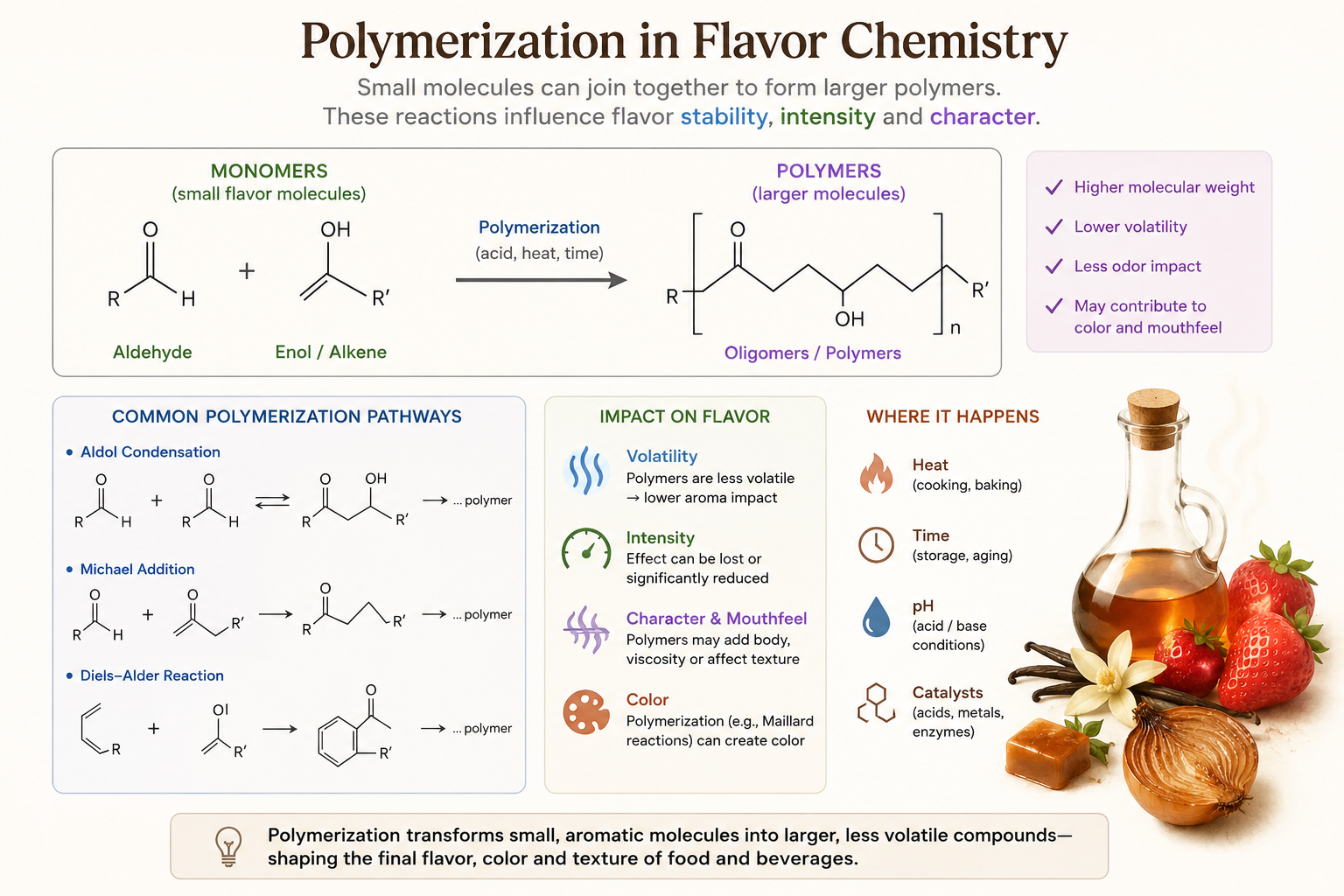
Polymerization in Flavor Chemistry
Polymerization is one of the main routes by which flavor compounds degrade over time. Unlike hydrolysis or simple oxidation to a single product, polymerization converts volatile, flavor-active monomers into larger, often non-volatile or off-odor species — so it's a central concern in flavor stability and shelf-life work.
1. Chemical Groups Involved and Conditions Required
Reactive functional groups commonly found in flavor molecules:
- Conjugated and isolated C=C double bonds — terpenes (limonene, myrcene, terpinolene, α-pinene) and unsaturated aldehydes (citral, cinnamaldehyde, hexenal) carry alkene systems that are prone to radical addition/polymerization.
- Aldehyde carbonyls with α-hydrogens — citral, cinnamaldehyde, many aliphatic aldehydes can self-condense via aldol mechanisms.
- Phenolic –OH groups — eugenol, guaiacol, vanillin-related phenolics undergo oxidative radical coupling.
- Allylic/benzylic C–H bonds — easily abstracted by radicals, initiating autoxidative chain reactions that precede polymerization.
Conditions required:
| Pathway | Typical trigger |
|---|---|
| Free-radical (autoxidative) polymerization | O₂, light (especially UV), heat, trace transition metals (Fe²⁺/Cu²⁺) |
| Acid-catalyzed (cationic) polymerization | Low pH, Lewis/Brønsted acids — common in citrus terpene "resinification" |
| Aldol condensation (step-growth) | Mild acid or base catalysis, heat |
| Oxidative phenolic coupling | O₂, alkaline pH, metal catalysts, enzymes (in natural extracts) |
Most flavor-relevant polymerization is not deliberately initiated — it's an unwanted side reaction driven by ambient oxygen, light, heat, and trace metal contamination during storage, rather than a controlled industrial polymerization.
2. Accelerating and Inhibiting Factors; Formulation Considerations
Accelerators:
- Headspace oxygen in packaging
- UV/visible light exposure (clear glass or plastic packaging)
- Elevated storage or processing temperature
- Trace metal ions (from water, equipment, or raw materials) catalyzing peroxide decomposition into radicals
- Autocatalysis — once hydroperoxides form, they decompose into radicals that propagate further reaction, so degradation accelerates over time
- High concentration of reactive monomer (e.g., terpene-rich citrus oils)
- Extremes of pH that favor aldol/cationic pathways
Inhibitors:
- Antioxidants (radical scavengers): tocopherols, BHA/BHT, ascorbyl palmitate, rosemary extract
- Chelating agents: EDTA, citric acid — sequester catalytic metal ions
- Oxygen exclusion: nitrogen flushing, vacuum packaging, oxygen-barrier films
- Light protection: amber glass, opaque or UV-filtering containers
- Cold-chain storage: slows both radical initiation and propagation
- pH buffering: away from ranges that favor aldol condensation or acid-catalyzed cyclization
Formulation considerations:
- Combine a primary antioxidant with a metal chelator (synergistic effect) rather than relying on one alone
- Avoid co-formulating reactive aldehydes with primary amines (risk of Schiff-base/Maillard-type side reactions in addition to self-polymerization)
- Use microencapsulation (spray-drying, coacervation, cyclodextrin complexation) to physically isolate reactive monomers from oxygen and from each other
- Select carriers/solvents that don't themselves promote radical formation
- Control trace metal contamination from processing equipment and water sources
- Build in accelerated stability testing (elevated temperature/humidity/light) during formulation to predict real-time shelf life
3. Examples
- Citrus oils (limonene-rich): Limonene autoxidizes to hydroperoxides, which decompose and contribute to oxidative polymerization — the classic "resinification" of citrus oils, where the oil becomes viscous, cloudy, and develops a waxy/off-citrus character with age.
- Citral: Prone to acid-catalyzed cyclization and resin formation, especially in acidic beverage matrices; this is a well-known driver of off-flavor development in citrus-flavored soft drinks.
- Cinnamaldehyde: Can polymerize under heat/light, forming resinous byproducts and losing its characteristic sharp cinnamon top note.
- Eugenol and other phenolics: Undergo oxidative coupling to dimeric/oligomeric species, often accompanied by browning/yellowing.
- Vanillin: Relatively stable but can oxidatively couple under alkaline or oxidative conditions to form colored dimers (e.g., dehydrodivanillin), affecting both flavor and appearance.
- Green/fatty aldehydes (e.g., hexenal, hexenol): Radical-initiated polymerization degrades the fresh "green" note into waxy or stale off-notes.
4. Impact on Flavor Aging and Shelf Life
Polymerization affects shelf life through several linked mechanisms:
- Loss of character-impact compounds — as reactive monomers (terpenes, unsaturated aldehydes, phenolics) are consumed into polymeric material, the flavor's signature top notes fade.
- Off-note formation — polymerization byproducts are often higher-molecular-weight, less volatile, and carry resinous, waxy, or stale sensory notes that mask or distort the original profile.
- Physical changes — increased viscosity, turbidity, or visible sediment/gum (especially in essential oils), which can be a quality-control red flag even before sensory thresholds are crossed.
- Color changes — oxidative coupling reactions, especially of phenolics, frequently produce chromophoric dimers, causing yellowing or browning that signals degradation to consumers.
- Autocatalytic kinetics — because peroxide-driven radical chains accelerate over time, shelf-life degradation curves are often not linear; product quality can decline slowly at first and then drop off more steeply, which is why accelerated-aging predictive models need to account for this non-linearity rather than simple zero-order assumptions.
In practice, shelf-life testing tracks polymerization indirectly through peroxide value, monomer loss by GC, viscosity changes, color (e.g., spectrophotometric), and sensory panels to detect the onset of resinification or off-note development — and antioxidant/packaging strategy is designed specifically around suppressing the radical and acid-catalyzed pathways described above.
Log in to view more details.