Professional Morel Mushroom Flavor System: Application-Specific Formulas for Cream Sauce, Soup, Snack Seasoning, and Vegan Meat Analog
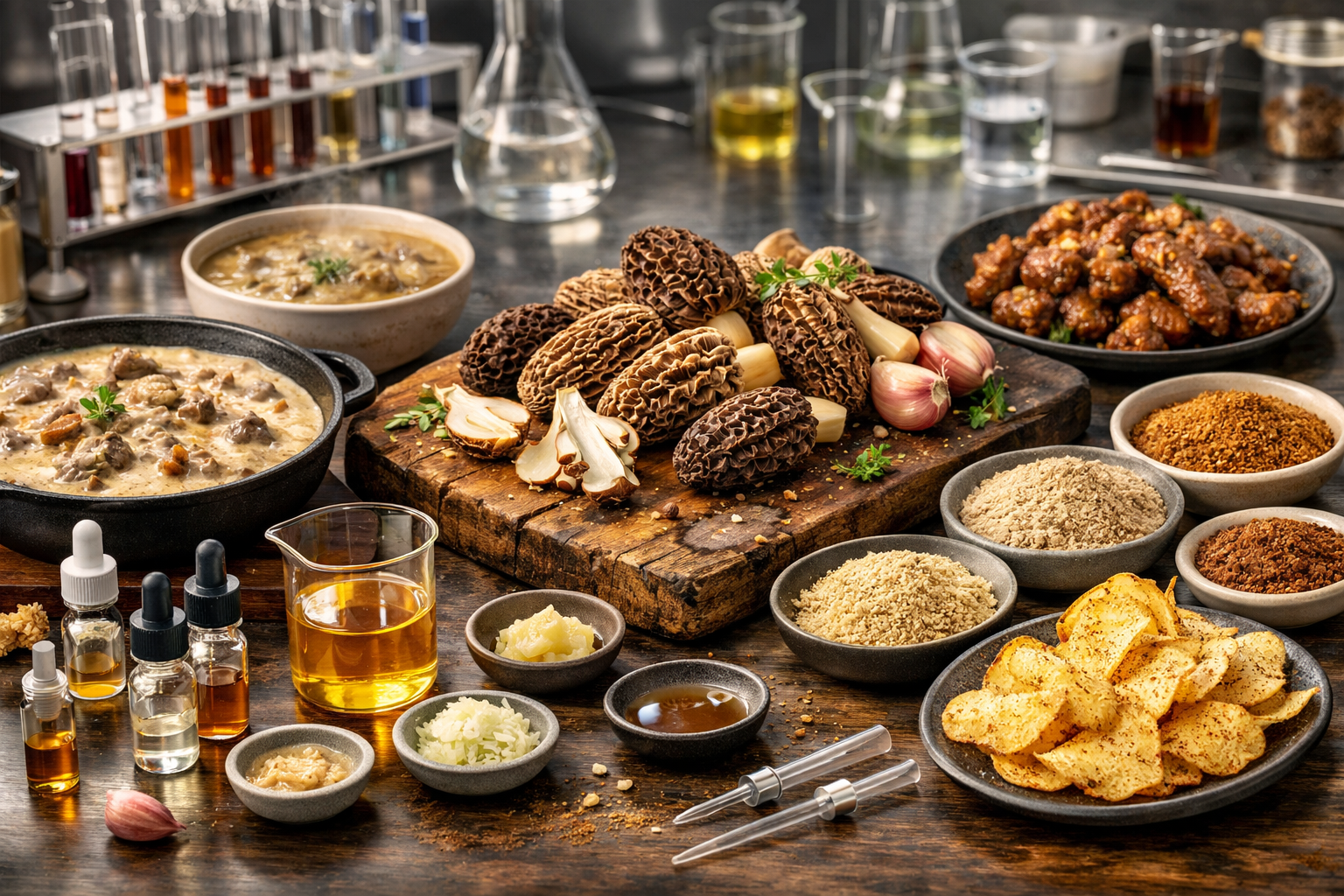
Step-by-step formulation of a morel mushroom flavor
Morel is not just a generic “mushroom” flavor. A good morel profile has to balance five sensory ideas at once:
- fresh mushroom body
- earthy forest character
- nutty-browned depth
- savory umami warmth
- a dry, elegant finish rather than a wet, moldy note
That last point matters a lot. Many mushroom flavors fail because they become muddy, moldy, sulfur-heavy, or potato-like instead of refined and culinary.
What follows is a training-style formulation guide. It is useful for learning flavor construction and internal development work. Real commercial use still needs stability testing, regulatory review, supplier verification, and application testing.
1) First define the sensory target
Before choosing compounds, decide what kind of morel you want.
A morel flavor can be pushed in different directions:
A. Fresh sautéed morel
- earthy
- lightly green-mushroom
- buttery
- elegant
- best for cream sauces, risotto, pasta, savory dairy
B. Dried reconstituted morel
- darker
- richer
- more umami
- more woody and brothy
- best for soup bases, bouillons, gravies, seasoning systems
C. Roasted gourmet morel
- nutty
- browned
- savory
- slightly meaty
- best for snack seasonings, reaction flavors, gourmet savory bases
For most flavor work, the best starting point is a fresh sautéed morel with mild dried depth, because that gives flexibility.
2) Understand the flavor architecture of morel
A morel is usually best built in the flavor pyramid like this:
Top note
This is the immediate aroma when the product is opened or smelled first.
For morel, the top is usually:
- fresh mushroom
- faint green humidity
- slight aldehydic lift
- gentle buttery diffusion
Too much top note makes it smell like raw button mushroom or wet cellar.
Heart note
This is the true identity of the morel.
The heart should contain:
- earthy mushroom body
- woody fungal richness
- nutty-browned character
- savory roundness
This is where morel “lives.”
Base note
This gives persistence and realism.
The base usually contains:
- dry earth
- gentle animalic savoriness
- roasted background
- broth-like umami support
Too much base makes it dirty, leathery, sulfuric, or old.
3) Key odor zones that define morel
A morel flavor usually needs these zones:
Fresh mushroom zone
This provides recognizable mushroom identity.
Typical character:
- damp mushroom
- cut mushroom
- fungal
- airy earthy
Earthy/forest floor zone
This gives wildness and authenticity.
Typical character:
- humus
- rooty
- woody
- truffle-adjacent dryness
Nutty-browned zone
This distinguishes morel from simple mushroom.
Typical character:
- toasted
- roasted nut skin
- warm cooked savory tones
Umami/brothy zone
This helps the morel read as edible and culinary.
Typical character:
- soup stock
- cooked savory
- gentle meatiness
- mouthwatering depth
Fat-compatible buttery zone
This helps the profile work in sauces and creamy applications.
Typical character:
- butter
- cooked cream
- warm dairy roundness
4) Important compounds and materials
Below is a practical list of materials commonly useful when constructing a morel-type profile. Usage levels are given as relative use in the flavor concentrate, not the final food unless stated otherwise. These are starting ranges, not mandatory limits.
A. Core mushroom materials
1-octen-3-ol
Odor: fresh mushroom, earthy, metallic green fungal
Role in pyramid: top to heart
Typical use in concentrate: 0.02% to 0.30%
Why it matters: this is one of the most important mushroom identity molecules.
What to watch: too much gives a raw, metallic, wet mushroom effect and can become harsh quickly.
1-octen-3-one
Odor: strong mushroom, metallic, earthy, penetrating
Role: top
Typical use: 0.001% to 0.03%
Why it matters: adds impact and realism.
What to watch: very powerful. Overuse makes the profile sharp, stale, or unpleasantly fungal.
3-octanone
Odor: mushroom, earthy, slightly fruity-ketonic
Role: heart
Typical use: 0.01% to 0.10%
Why it matters: rounds the mushroom body.
What to watch: too much may flatten the profile or make it generic.
3-octanol
Odor: mushroom, earthy, fatty, green
Role: heart
Typical use: 0.01% to 0.08%
Why it matters: softens and broadens the fungal heart.
What to watch: excess can smell oily or dull.
1-octanol
Odor: fatty, waxy, mushroom-like, green
Role: heart to base
Typical use: 0.01% to 0.08%
Why it matters: gives body and diffusion support.
What to watch: too much can smell soapy or waxy.
B. Earthy and forest-support materials
Geosmin
Odor: wet earth, beetroot, soil, damp forest
Role: base
Typical use: 0.00001% to 0.0005%
Why it matters: can provide realistic forest-floor nuance.
What to watch: extremely potent. Even trace excess can ruin the flavor and make it taste like muddy water or dirty beet.
2-methylisoborneol
Odor: earthy, musty, damp, rooty
Role: base
Typical use: trace only, often below 0.0001%
Why it matters: can add wild earthy realism in minute amounts.
What to watch: easily turns moldy and objectionable. Use only if you are highly controlled.
Vetiver-type natural fractions or very clean woody-earthy materials
Odor: dry wood, rooty earth, elegant forest dryness
Role: base
Typical use: 0.01% to 0.10% depending on material
Why it matters: helps give dry woodland character without wet rot.
What to watch: avoid perfumey or smoky grades.
Patchouli-heart style fractions, only if very clean
Odor: dry earth, woody, dark
Role: base
Typical use: trace to 0.03%
Why it matters: can support wild earthy depth.
What to watch: too much smells perfumery, muddy, or incense-like.
C. Nutty, roasted, browned materials
This is a major area for morel success.
2,5-dimethylpyrazine
Odor: roasted nut, cocoa, toasted, warm
Role: heart to base
Typical use: 0.005% to 0.05%
Why it matters: gives cooked sophistication.
What to watch: too much becomes peanutty or dry-roasted snack-like.
2,3,5-trimethylpyrazine
Odor: roasted nut, cocoa, coffee-like toasted warmth
Role: base
Typical use: 0.001% to 0.03%
Why it matters: contributes deeper cooked character.
What to watch: overuse pushes toward coffee or burnt cereal.
2,6-dimethylpyrazine
Odor: roasted, nutty, warm
Role: heart to base
Typical use: 0.003% to 0.04%
Why it matters: helps bridge mushroom and browned notes.
What to watch: excess gives a dry snack seasoning effect.
Methional
Odor: cooked potato, savory, warm broth
Role: heart
Typical use: 0.0005% to 0.01%
Why it matters: tiny amounts can create cooked savory realism.
What to watch: too much makes the profile potato-heavy and stops reading as morel.
Furaneol / maltol / ethyl maltol
Odor: sweet caramelized, cotton candy, jammy caramel
Role: base modifier
Typical use: very low, often trace to 0.01% for mushroom systems
Why it matters: sometimes a tiny amount can soften rough edges.
What to watch: usually dangerous in morel. Too much makes it sweet and artificial.
Sotolon
Odor: seasoning, curry-maple, fenugreek-like, savory
Role: base
Typical use: trace only
Why it matters: can add dry savory concentration.
What to watch: easily becomes curry-like and inappropriate.
D. Sulfur and savory materials
These materials can make or break the formula. Morel needs some savory sulfur depth, but not a garlic soup effect.
Dimethyl trisulfide
Odor: sulfurous, cooked onion, savory, meaty
Role: base
Typical use: trace to 0.002%
Why it matters: tiny amounts add cooked food realism.
What to watch: very easy to overdose. Excess gives onion soup, cabbage, or sulfur bomb notes.
Dimethyl disulfide
Odor: onion, sulfur, cooked vegetable
Role: base
Typical use: trace only
Why it matters: may help in meatier morel directions.
What to watch: can become dirty very quickly.
Methanethiol derivatives or savory sulfur preparations
Odor: meaty, sulfurous, cooked allium-like
Role: base
Typical use: trace only
Why it matters: useful in bouillon-style morel flavors.
What to watch: very high risk of turning the profile oniony or rotten.
Thiazoles / thiophenes, very carefully chosen
Odor: roasted savory, meaty, browned
Role: heart to base
Typical use: trace to 0.01%
Why it matters: can create gourmet cooked depth.
What to watch: too much becomes popcorn, roasted meat, or sulfur-burnt.
E. Buttery, creamy, and fatty support
Diacetyl
Odor: butter, creamy, rich
Role: top to heart
Typical use: 0.001% to 0.03%
Why it matters: supports sautéed morel style.
What to watch: too much turns it into butter popcorn.
Acetoin
Odor: creamy, buttery, dairy-like
Role: heart
Typical use: 0.01% to 0.20%
Why it matters: smoother than diacetyl and useful for cooked elegance.
What to watch: excess dulls the mushroom identity.
Butyric nuances, only if very controlled
Odor: buttery, cheesy, fatty
Role: base
Typical use: trace
Why it matters: sometimes helps culinary richness.
What to watch: quickly becomes rancid or cheesy.
Gamma- and delta-lactones, minimal use
Odor: creamy, coconut-peach-buttery depending on type
Role: base
Typical use: trace
Why it matters: can round harshness in creamy applications.
What to watch: easy to make the flavor sweet and wrong.
F. Umami and broth support materials
Some are flavor chemicals, some are process ingredients or extracts.
Monosodium glutamate / yeast extract / mushroom extract / HVP / reaction savory base
Odor/taste: umami, savory, brothy, mouthwatering
Role: mainly heart and base, more in taste than aroma
Typical use: application-dependent
Why it matters: morel is not just aroma. Taste support is essential in final food.
What to watch: these help in the application, but in a flavor concentrate they must be compatible with the format.
Guanylate / inosinate systems
Odor/taste: umami potentiation
Role: taste foundation
Typical use: low ppm in food application systems
Why it matters: improves realism and savory persistence.
What to watch: dosage depends heavily on final food matrix.
5) Build the flavor in layers
Now the actual formulation logic.
Step 1: Build the mushroom skeleton
Start with the core mushroom molecules only.
A simple skeleton might use:
- 1-octen-3-ol
- 1-octen-3-one
- 3-octanone
- 3-octanol
At this stage, your goal is not “morel.”
Your goal is simply recognizable edible mushroom.
What to smell for
- Is it clearly mushroom?
- Is it too metallic?
- Is it too raw?
- Does it resemble fresh button mushroom rather than a gourmet wild mushroom?
If it smells like supermarket mushroom, that is normal at this stage.
Step 2: Add earthy restraint
Now add very small amounts of earthy modifiers.
Possible additions:
- trace geosmin
- very dry woody-earthy support
- tiny natural mushroom extract or dried mushroom note
Goal
Move from “fresh mushroom” to “wild mushroom.”
What to watch
This stage is where many formulas die.
A morel should suggest forest earth, not swamp mud.
Step 3: Add browned nuttiness
This is the most important transformation step.
Add tiny pyrazine amounts:
- 2,5-dimethylpyrazine
- 2,6-dimethylpyrazine
- 2,3,5-trimethylpyrazine
Goal
Create the cooked, elegant, nutty-warm dimension that makes the flavor read as morel rather than generic mushroom.
What to watch
The pyrazines must stay underneath the mushroom.
If the pyrazines become obvious, the flavor turns into roasted nuts or seasoning powder.
Step 4: Add savory-cooked realism
Now use traces of:
- methional
- tiny sulfur savory support
- perhaps a minute meaty thiazole note if the target is darker
Goal
Make the flavor smell edible, cooked, and culinary.
What to watch
Do not allow onion, garlic, cabbage, or roast meat to dominate.
Step 5: Add creamy sautéed roundness if needed
For a butter-sautéed morel style:
- tiny diacetyl
- acetoin
- soft creamy support
Goal
Help the morel work in cream sauce and savory dairy systems.
What to watch
The morel must remain dry and elegant. It should not become buttery popcorn or mushroom soup powder.
Step 6: Add a dry woody finish
A finished morel often benefits from a dry finish:
- clean woody-earthy note
- faint bark-like dryness
- restrained root nuance
Goal
Stop the flavor from feeling wet and flat.
What to watch
Too much becomes perfumey or truffle-like in the wrong way.
6) Example training formula for a morel flavor concentrate
This is a training prototype, not a commercial gold-standard formula. Percentages total 100 for the concentrate.
Morel flavor concentrate, prototype A
Carrier/solvent
- Propylene glycol or triacetin q.s. to 100
Active materials
- 1-octen-3-ol — 0.180%
- 1-octen-3-one — 0.008%
- 3-octanone — 0.060%
- 3-octanol — 0.040%
- 1-octanol — 0.025%
- 2,5-dimethylpyrazine — 0.020%
- 2,6-dimethylpyrazine — 0.012%
- 2,3,5-trimethylpyrazine — 0.006%
- Methional — 0.003%
- Dimethyl trisulfide — 0.0005%
- Acetoin — 0.080%
- Diacetyl — 0.004%
- Geosmin — 0.00005%
- Clean woody-earthy modifier — 0.020%
- Mushroom extract or dried morel tincture note — 0.100% to 0.500% depending on strength
Balance with solvent.
7) What each material is doing in that prototype
1-octen-3-ol
Main mushroom recognizer. Without it, the flavor may stop reading as mushroom.
1-octen-3-one
Adds impact and realism. It acts like a sharpened edge.
3-octanone and 3-octanol
Round out the body and reduce the thinness of a one-note mushroom accord.
1-octanol
Gives body and slight fatty diffusion.
Pyrazines
These convert the profile from raw mushroom to cooked morel territory.
Methional
Adds warm savory cooked-food realism.
Dimethyl trisulfide
Very tiny amount for culinary depth.
Acetoin and diacetyl
Suggest sautéed butter handling.
Geosmin
Provides very restrained forest-earth realism.
Woody-earthy modifier
Keeps the finish dry and elegant.
Mushroom extract or morel extract note
Gives natural complexity and can hide the synthetic edges.
8) How to evaluate the formula correctly
Do not judge it only on a smelling strip.
A morel flavor should be tested in at least three ways:
On strip
This tells you the aroma structure.
- Is the mushroom note too raw?
- Is the earth note too dirty?
- Are the pyrazines too visible?
In warm water
This reveals how the flavor blooms in a soup-like condition.
- Does it become potato-sulfur?
- Does it vanish?
- Does the earthy note become muddy?
In a fat-containing base
For example:
- light cream
- butter sauce
- vegan cream
- soup base
This tells you whether the morel becomes luxurious or disappears in fat.
Many mushroom flavors smell fine neat but become weak, dirty, or overly sulfurous in real food.
9) Typical usage levels in finished foods
These vary a lot by strength and format, but practical starting points are:
Sauce or cream systems
0.03% to 0.20%
Soup or bouillon systems
0.05% to 0.30%
Dry seasoning
depends on encapsulation and carrier; often 0.10% to 1.00% seasoning system contribution
Plant-based meat analog savory systems
0.02% to 0.15% together with umami support
The correct level depends heavily on whether the flavor is:
- purely aromatic
- reaction-based
- extract-supported
- compounded with taste materials
10) Common formulation mistakes
Mistake 1: too much 1-octen-3-ol
This makes the flavor smell like sliced raw mushroom, not morel.
Mistake 2: too much geosmin
This creates beetroot mud or dirty pond water.
Mistake 3: too much pyrazine
This turns morel into roasted peanut skin or snack seasoning.
Mistake 4: too much sulfur
This makes onion soup, cabbage broth, or sulfury meat stock.
Mistake 5: too much dairy support
This gives creamy mushroom soup instead of elegant sautéed morel.
Mistake 6: no dry finish
Then the formula feels wet, flat, and cheap.
Mistake 7: no taste support in application
Aroma alone often cannot fully deliver gourmet morel in food. You usually need umami structure in the application.
11) What flavorists need to pay close attention to
Raw vs cooked balance
Morel should not smell raw. It needs cooked warmth.
Dryness vs wetness
A premium morel is usually drier and more elegant than button mushroom.
Earthiness control
Earthiness must be tiny and polished. Dirty earth ruins acceptability.
Pyrazine restraint
The roasted note should support, not dominate.
Sulfur restraint
The best morel formulas often use less sulfur than beginners expect.
Matrix effects
Salt, fat, starch, protein, and heat all change mushroom perception.
Examples
- fat can improve richness but suppress some delicate mushroom top notes
- salt can sharpen savory realism
- starch can mute top notes
- protein may absorb aroma and reduce impact
- high heat may destroy or distort the top mushroom note
Oxidation and stability
Unsaturated mushroom notes can shift over time.
Watch for:
- metallic growth
- stale fungal notes
- loss of freshness
- sulfur imbalance after storage
pH effects
Low pH savory systems can distort the profile and reduce naturalness.
Application context
A morel flavor for:
- cream sauce
- instant noodle seasoning
- bouillon cube
- plant-based burger
- snack seasoning
will not be built exactly the same. The target application changes the balance.
12) A practical development workflow
Here is a simple professional workflow.
Stage 1: Build a mushroom accord
Use only core C8 mushroom compounds.
Stage 2: Convert it to wild mushroom
Add controlled earthy dryness.
Stage 3: Convert it to morel
Add nutty browned pyrazine structure.
Stage 4: Make it edible
Add cooked savory realism.
Stage 5: Make it luxurious
Add tiny buttery/creamy sauté support if the target needs it.
Stage 6: Test in matrix
Always test in the real food base.
Stage 7: Adjust
- more raw mushroom → reduce 1-octen-3-one
- more muddy earth → reduce geosmin
- more roasted morel → slightly increase pyrazines
- more gourmet sauté → slightly increase acetoin and smooth savory support
- more dried morel/bouillon → increase umami and trace savory sulfur support
13) Two alternate directions
A. Fresh sautéed morel direction
Increase slightly:
- acetoin
- soft butter note
- 3-octanol
Keep low:
- sulfur
- geosmin
Result:
- elegant
- creamy
- restaurant-style
B. Dried morel bouillon direction
Increase slightly:
- pyrazines
- methional
- umami base
- extract contribution
Keep controlled:
- top mushroom freshness
Result:
- darker
- brothier
- richer
- better for soups and seasonings
14) Natural materials that can help
Depending on your system and regulatory target, these can help:
- morel extract
- mixed mushroom extract
- porcini extract in tiny support amounts
- yeast extract
- hydrolyzed vegetable protein
- reaction savory base
- very restrained roasted vegetable concentrate
- butter distillate for sauté style
Be careful with porcini or truffle materials. They can make the profile delicious, but then it stops being clearly morel.
15) A simple success checklist
A successful morel flavor usually does all of these:
- clearly reads as mushroom
- smells cooked rather than raw
- has gentle earthy wildness
- has nutty browned sophistication
- avoids obvious onion, garlic, or sulfur
- avoids obvious peanut/coffee pyrazine character
- remains elegant in fat-containing applications
- has enough umami support in the final food
- stays stable over storage
- does not become muddy after dilution
16) Final summary
To formulate a convincing morel flavor, think of it as:
mushroom identity + restrained forest earth + nutty browned warmth + tiny savory sulfur realism + dry gourmet finish
The core construction usually starts with C8 mushroom compounds, then gets shaped into morel by adding:
- controlled earthy nuance
- subtle pyrazines
- tiny savory support
- optional butter/cream roundness
- application-specific umami support
The biggest challenge is restraint. Morel is easy to overbuild.
A successful formula is usually subtle, layered, dry, and culinary, not loud.
Professional morel flavor formula set by application
Below is a training-oriented professional formula set built from the same morel concept, then adapted for four different end uses:
- cream sauce
- soup and bouillon
- snack seasoning
- vegan meat analog
The goal is not just to give formulas, but to show how a flavorist would change the balance of the same morel identity so it performs well in each food.
These are working flavor formulas for development and study. In actual commercial work, the final version still needs:
- regulatory review
- supplier-specific potency adjustment
- allergen review where relevant
- shelf-life testing
- heat-process testing
- sensory optimization in the target matrix
Professional Morel Mushroom Flavor System:
Application-Specific Formulas for Cream Sauce, Soup, Snack Seasoning, and Vegan Meat Analog
Abstract
A successful morel flavor is not a single formula used everywhere. Morel behaves differently in fat-rich sauces, aqueous soups, dry snack seasonings, and protein-heavy vegan meat systems. This guide converts a core morel accord into four application-specific professional formulas. Each formula includes a step-by-step rationale, material roles, odor descriptors, flavor pyramid placement, and practical usage guidance. Special attention is given to the balance between mushroom freshness, earthy wildness, browned nuttiness, umami depth, and application stability, so the final profile remains recognizably morel rather than drifting into generic mushroom, dirty earth, or sulfur-heavy savory notes.
1) Core professional strategy
Before dividing into applications, keep this central rule in mind:
The morel identity must stay constant
Across all four applications, the flavor should still suggest:
- wild mushroom
- gentle forest earth
- browned nutty warmth
- savory culinary realism
- dry elegant finish
What changes from application to application is not the identity itself, but:
- top-note intensity
- degree of buttery support
- level of umami reinforcement
- sulfur tolerance
- roasted depth
- stability strategy
- delivery format
2) Core morel master accord
This is the central accord from which the four formulas are derived.
Core morel master accord
Percent in flavor concentrate
- 1-octen-3-ol — 0.180%
- 1-octen-3-one — 0.008%
- 3-octanone — 0.060%
- 3-octanol — 0.040%
- 1-octanol — 0.025%
- 2,5-dimethylpyrazine — 0.020%
- 2,6-dimethylpyrazine — 0.012%
- 2,3,5-trimethylpyrazine — 0.006%
- methional — 0.003%
- dimethyl trisulfide — 0.0005%
- acetoin — 0.080%
- diacetyl — 0.004%
- geosmin — 0.00005%
- clean woody-earthy modifier — 0.020%
- mushroom extract / morel-style extract support — 0.200%
- propylene glycol / triacetin / other suitable carrier — q.s. to 100%
This is the reference point. Now we customize it.
3) Compound reference guide
Before moving into the four formulas, here is a short practical compound guide.
Mushroom identity materials
1-octen-3-ol
Odor: fresh mushroom, earthy, fungal, green-metallic
Role: top-heart
What it does: gives instant mushroom recognition
Risk: can become raw, metallic, or wet if too high
1-octen-3-one
Odor: sharp mushroom, metallic, penetrating, earthy
Role: top
What it does: sharpens realism
Risk: very easy to overdose
3-octanone
Odor: mushroom, earthy, soft fungal body
Role: heart
What it does: rounds the mushroom center
3-octanol
Odor: mushroom, green, fatty-earthy
Role: heart
What it does: broadens the body
1-octanol
Odor: fatty, waxy, mushroom support
Role: heart-base
What it does: helps persistence and body
Browned and cooked-support materials
2,5-dimethylpyrazine
Odor: roasted nut, toasted, warm
Role: heart-base
What it does: gives morel its cooked nutty elegance
2,6-dimethylpyrazine
Odor: roasted, nutty, dry warm
Role: heart-base
What it does: supports the browned profile
2,3,5-trimethylpyrazine
Odor: deep roast, cocoa-like, dark toasted
Role: base
What it does: increases dark cooked depth
methional
Odor: cooked potato, savory broth, warm
Role: heart
What it does: makes the flavor smell culinary rather than raw
Savory depth materials
dimethyl trisulfide
Odor: sulfurous, cooked onion, savory, meaty
Role: base
What it does: adds trace cooked-food realism
Risk: quickly becomes oniony or dirty
savory reaction base / yeast extract / mushroom extract
Odor/taste: umami, brothy, meaty, mouthwatering
Role: heart-base and taste phase
What it does: essential in some applications for realism
Earthy and finish materials
geosmin
Odor: wet earth, soil, damp forest
Role: base
What it does: gives wild forest nuance
Risk: too much = mud, beet, swamp
clean woody-earthy modifier
Odor: dry wood, rooty earth, forest floor dryness
Role: base
What it does: creates the elegant dry finish that morels need
Creamy support materials
acetoin
Odor: creamy, buttery, soft dairy
Role: heart
What it does: supports sautéed or creamy styles
diacetyl
Odor: butter
Role: top-heart
What it does: gives realistic butter-sauté effect
Risk: too much = popcorn butter
4) Formula set by application
A. Morel flavor for cream sauce
Sensory target
This version should smell like:
- sautéed morels in butter
- cream reduction
- elegant restaurant mushroom sauce
- mild woodland earth
- soft nutty finish
This version should avoid:
- excessive sulfur
- muddy earth
- too much roast
- dry powdery bouillon character
Because cream and fat naturally round flavors, this formula needs:
- more smoothness
- slightly reduced harsh mushroom top
- stronger buttery integration
- moderate earthy nuance only
Cream sauce formula
Percent in flavor concentrate
Mushroom core
- 1-octen-3-ol — 0.140%
- 1-octen-3-one — 0.004%
- 3-octanone — 0.070%
- 3-octanol — 0.055%
- 1-octanol — 0.035%
Browned-nutty support
- 2,5-dimethylpyrazine — 0.015%
- 2,6-dimethylpyrazine — 0.008%
- 2,3,5-trimethylpyrazine — 0.003%
Savory support
- methional — 0.0025%
- dimethyl trisulfide — 0.0002%
Cream-butter support
- acetoin — 0.140%
- diacetyl — 0.008%
- trace butter distillate type note — 0.020%
- optional soft cream lactone support — 0.003% to 0.010%
Earth / finish
- geosmin — 0.00002%
- clean woody-earthy modifier — 0.010%
- mushroom extract / morel extract support — 0.250%
Body / smoothness
- triacetin or suitable carrier — q.s. to 100%
Why the formula looks like this
Reduced 1-octen-3-one
Cream sauces do not need a sharp, penetrating mushroom top. Too much sharpness can seem metallic in dairy.
Increased 3-octanol and 1-octanol
These help the mushroom read as fuller, smoother, and more integrated in fat.
Lower pyrazines
Too much roast in cream sauce can make the profile seem scorched or powdery. Cream already gives warmth, so the pyrazines can be gentler.
Increased acetoin and controlled diacetyl
This creates the impression of mushrooms sautéed in butter before being folded into cream.
Reduced sulfur
Sulfur behaves strongly in dairy and can easily create onion-soup or stale-cooked notes. It should only whisper.
Minimal geosmin
A cream sauce should suggest forest luxury, not wet soil.
Usage level in finished food
A good starting range is:
- 0.03% to 0.12% in sauce systems
For concentrated culinary bases:
- 0.10% to 0.20%
What to pay attention to
- In dairy, sulfur expands quickly
- butter notes can dominate the mushroom if too high
- starch-thickened sauces may mute the mushroom top note
- cream reduces sharpness, so some body materials are more important than sharp top materials
Adjustment guide
If the flavor is:
- too raw → reduce 1-octen-3-ol slightly
- too buttery → reduce diacetyl first
- too generic mushroom → add a little more woody-earthy dryness
- too muddy → reduce geosmin immediately
- too weak in cream → increase extract support and 3-octanone before increasing sulfur
B. Morel flavor for soup and bouillon
Sensory target
This version should smell like:
- rehydrated dried morels
- clear savory broth
- deep mushroom soup base
- warm woodland complexity
- culinary umami with good bloom in hot water
This version should avoid:
- buttery dairy emphasis
- overly raw mushroom notes
- excessive muddy earth
- excessive onion-like sulfur
Soup systems usually require:
- stronger bloom in hot water
- more umami compatibility
- slightly darker cooked note
- improved diffusion under heat
Soup / bouillon formula
Percent in flavor concentrate
Mushroom core
- 1-octen-3-ol — 0.120%
- 1-octen-3-one — 0.006%
- 3-octanone — 0.080%
- 3-octanol — 0.045%
- 1-octanol — 0.030%
Browned-nutty support
- 2,5-dimethylpyrazine — 0.025%
- 2,6-dimethylpyrazine — 0.018%
- 2,3,5-trimethylpyrazine — 0.008%
Savory support
- methional — 0.005%
- dimethyl trisulfide — 0.0008%
- optional trace thiazole savory note — 0.001% to 0.005%
Umami support
- mushroom extract / morel extract support — 0.350%
- yeast extract-compatible savory support — 0.100% to 0.500% depending on system
- optional hydrolyzed vegetable protein compatible savory tone — low support level
Creamy note
- acetoin — 0.030%
- diacetyl — 0.001%
Earth / finish
- geosmin — 0.00004%
- clean woody-earthy modifier — 0.018%
Carrier
- propylene glycol / water-compatible carrier — q.s. to 100%
Why the formula looks like this
Slightly reduced fresh mushroom sharpness
Soup is hot and aromatic bloom is strong. Too much fresh-mushroom top can become harsh or stale in heat.
Higher 3-octanone
This helps the mushroom body survive in hot diluted systems.
Higher pyrazines
Soup and bouillon need a little extra cooked depth to avoid smelling watery.
Higher savory support
Warm aqueous systems expose weakness quickly. Methional and tiny sulfur support help the broth smell edible and complete.
Much lower buttery support
Soup morel should not suggest cream sauce unless that is the intended style.
Stronger extract support
Extracts help bridge aroma and taste in broth.
Usage level in finished food
Starting range:
- 0.05% to 0.20% in prepared soups
- 0.10% to 0.30% in bouillon or concentrated savory bases
What to pay attention to
- Hot water can expose metallic top notes
- salt changes savory perception dramatically
- sulfur becomes clearer in hot soup than on strip
- dried morel-style performance often needs taste support, not just aroma
- if the system is retorted or held hot, re-evaluate the top note after processing
Adjustment guide
If the flavor is:
- too thin in hot water → increase 3-octanone, extract support, and methional slightly
- too oniony → reduce dimethyl trisulfide first
- too earthy → reduce geosmin and woody-earthy modifier
- too raw → reduce 1-octen-3-ol and slightly increase pyrazine depth
- too dark / too roasted → reduce trimethylpyrazine first
C. Morel flavor for snack seasoning
Sensory target
This version should smell like:
- gourmet mushroom chips
- roasted morel dust
- savory browned mushroom seasoning
- dry elegant woodland umami
This version should avoid:
- wet mushroom impression
- excessive dairy
- muddy earth
- weak top note after dry blending
- excessive sulfur that becomes stale during storage
Snack seasonings are different because:
- the system is dry
- the flavor must survive on powders
- roast and impact matter more
- too much fresh mushroom note can feel wrong in a dry matrix
Snack seasoning formula
Percent in flavor concentrate or seasoning flavor base
Mushroom core
- 1-octen-3-ol — 0.080%
- 1-octen-3-one — 0.003%
- 3-octanone — 0.060%
- 3-octanol — 0.025%
- 1-octanol — 0.020%
Browned-nutty support
- 2,5-dimethylpyrazine — 0.040%
- 2,6-dimethylpyrazine — 0.028%
- 2,3,5-trimethylpyrazine — 0.012%
Savory support
- methional — 0.004%
- dimethyl trisulfide — 0.0004%
- trace roasted savory thiazole support — 0.002% to 0.008%
Umami / powder-phase support
- mushroom powder / mushroom extract powder — 0.500% to 3.000% depending on system
- yeast extract powder — 0.500% to 2.000%
- MSG / I+G / umami support — according to seasoning strategy
- reaction savory support — controlled low to moderate level
Creamy support
- acetoin — 0.020%
- diacetyl — trace only or none
Earth / finish
- geosmin — 0.00002%
- clean woody-earthy modifier — 0.015%
Carrier
- encapsulation carrier / gum / maltodextrin / suitable powder delivery — q.s.
Why the formula looks like this
Lower fresh mushroom top
In dry snack applications, high fresh fungal top notes can smell stale, dusty, or odd.
Stronger pyrazine structure
Snack seasonings usually benefit from more roast and brown warmth. This makes the morel read as savory and premium on chips, crackers, nuts, or popcorn.
Controlled sulfur
Dry systems can exaggerate stale sulfur over time. Sulfur must stay very low.
Powder-compatible umami support
This is essential because a snack seasoning needs impact immediately on the palate.
Almost no buttery top
Butter can work in some snacks, but too much makes the system greasy, artificial, or popcorn-like.
Usage level in finished food
Depending on strength and dilution:
- flavor base in seasoning: 0.10% to 1.00%
- complete seasoning application on snack: often 3% to 10% total seasoning load, with the morel flavor as one part of that system
What to pay attention to
- freshness degrades differently in dry systems
- pyrazines can dominate very quickly
- snack matrices often want more impact than soups do
- sulfur storage stability can be problematic
- top notes may flash off during seasoning process depending on heat and oil application
Adjustment guide
If the flavor is:
- too wet-mushroom → reduce 1-octen-3-ol and 3-octanol
- too roasted / peanut-like → reduce 2,5-dimethylpyrazine first
- too weak on chip → increase powder extract support and umami, not just aroma
- too stale after storage → reduce sulfur and improve encapsulation strategy
- too generic savory seasoning → slightly increase woody-earthy dry finish
D. Morel flavor for vegan meat analog
Sensory target
This version should smell like:
- sautéed wild mushrooms folded into plant-based meat
- dark savory mushroom richness
- umami-enhanced browned protein system
- culinary cooked morel depth
This version should avoid:
- smelling like soup powder
- overwhelming meat analog browning notes
- obvious onion sulfur
- excessive truffle or earthy mud
- disappearing into protein
Vegan meat analog is especially difficult because:
- protein binds flavor
- process heat changes volatiles
- base notes are often already roasted
- mushroom flavor can vanish or turn dirty
- sulfur interacts with plant protein notes
Vegan meat analog formula
Percent in flavor concentrate
Mushroom core
- 1-octen-3-ol — 0.110%
- 1-octen-3-one — 0.004%
- 3-octanone — 0.085%
- 3-octanol — 0.050%
- 1-octanol — 0.040%
Browned-nutty support
- 2,5-dimethylpyrazine — 0.030%
- 2,6-dimethylpyrazine — 0.020%
- 2,3,5-trimethylpyrazine — 0.010%
Savory support
- methional — 0.005%
- dimethyl trisulfide — 0.0005%
- trace meaty thiazole / thiophene support — 0.002% to 0.010%, depending on target
- optional very low reaction-meat style support if allowed by target concept
Umami support
- mushroom extract / morel-style extract — 0.300% to 0.800%
- yeast extract support — 0.100% to 0.500%
- HVP or savory taste support — system dependent
- MSG / I+G support in application phase as needed
Cream / fat support
- acetoin — 0.040%
- diacetyl — 0.001%
Earth / finish
- geosmin — 0.00003%
- clean woody-earthy modifier — 0.020%
Carrier
- heat-stable suitable carrier — q.s. to 100%
Why the formula looks like this
Stronger body materials
Plant protein absorbs or suppresses delicate mushroom aroma, so the formula needs stronger body rather than sharper top.
Controlled roast increase
Meat analog systems often already have Maillard and protein notes. The morel flavor should connect to those notes without becoming generic “roasted savory.”
Moderate umami support
This helps the mushroom note survive and taste integrated rather than floating above the protein.
Very limited dairy impression
The system should feel rich, but not dairy-based unless the concept is creamy.
Balanced sulfur
A little sulfur can help the cooked realism, but plant proteins can already bring sulfur-like or beany notes, so restraint is critical.
Usage level in finished food
Starting range:
- 0.05% to 0.20% in finished vegan meat analog
- can be higher in fillings, pâtés, burger blends, or mushroom-forward concepts
What to pay attention to
- protein can mute the top note strongly
- extrusion or high heat may distort the mushroom profile
- sulfur and plant proteins can produce off-notes together
- fat system matters a lot; coconut, canola, sunflower, shea, and other fats change flavor release
- salt level changes whether the flavor reads as gourmet or muddy
Adjustment guide
If the flavor is:
- lost in protein → increase 3-octanone, extract support, and woody-earthy modifier slightly
- too roast-meaty, not enough morel → increase mushroom core before increasing pyrazines
- too dirty in soy or pea systems → reduce geosmin and sulfur first
- too soupy → reduce methional and extract sweetness, add more dry finish
- too weak after cooking → improve encapsulation or process addition timing before simply raising dosage
5) Side-by-side application logic
Here is the core sensory difference across the four systems:
Cream sauce
Needs:
- smoothness
- butter integration
- gentle earth
- elegant top
Soup
Needs:
- bloom in hot water
- darker broth support
- umami compatibility
- moderate roast
Snack seasoning
Needs:
- dry impact
- stronger roast
- stable delivery
- minimal wet mushroom impression
Vegan meat analog
Needs:
- strong body
- protein survival
- cooked savory integration
- controlled sulfur and earth
6) Suggested testing order for professional development
A flavorist should not create all four at once. Build in this order:
Step 1
Perfect the core morel accord on strip and in simple warm water.
Step 2
Build the cream sauce version
This is often the easiest place to refine elegance.
Step 3
Build the soup version
This teaches whether the flavor has enough culinary depth.
Step 4
Build the snack seasoning version
This teaches dry system impact and pyrazine restraint.
Step 5
Build the vegan meat analog version
This is usually the hardest and should come after the identity is already clear.
7) Professional success checkpoints for each application
Cream sauce success signs
- smells like sautéed gourmet mushrooms
- butter supports rather than dominates
- no onion soup effect
- no muddy earth
- still identifiable in cream
Soup success signs
- blooms clearly in hot water
- not metallic
- not watery
- not too sulfurous
- tastes savory and complete with umami support
Snack seasoning success signs
- immediate impact on opening package
- dry gourmet mushroom impression
- no dusty stale fungal tone
- no popcorn-butter confusion
- survives storage
Vegan meat analog success signs
- survives protein matrix
- remains recognizable as morel
- integrates with browned protein
- avoids beany plus sulfur off-notes
- persists after cooking
8) Practical caution areas
Supplier differences
1-octen-3-ol, pyrazines, methional, sulfur materials, and extracts can vary in strength and cleanliness by supplier. A formula may need rebalancing when changing source.
Natural extract variability
Mushroom extracts can vary by:
- species
- drying process
- solvent
- concentration
- storage
Regulatory and labeling
Natural, natural-identical, artificial, extract-based, and reaction flavor classifications depend on jurisdiction and raw material source.
Storage
The highest-risk zones are:
- sulfur drift
- loss of delicate mushroom top
- pyrazine dominance after aging
- stale earthy development
Matrix mismatch
A formula that performs beautifully in sauce may fail badly in snack seasoning. Always optimize in target food.
9) Final summary
A professional morel flavor system should not be treated as one universal formula. The best approach is to start with a core morel accord built around:
- C8 mushroom compounds for identity
- restrained pyrazines for cooked nutty warmth
- tiny savory sulfur for culinary realism
- controlled earthy materials for wildness
- a dry woody finish for elegance
Then adapt the formula according to application:
- cream sauce → smoother, butter-integrated, less sulfur, less earth
- soup → darker, more blooming, more umami-compatible
- snack seasoning → drier, stronger roast, lower wet mushroom character
- vegan meat analog → stronger body, better protein survival, controlled savory integration
The most common cause of failure is overbuilding one area. Too much mushroom becomes raw. Too much earth becomes dirty. Too much pyrazine becomes peanut-like. Too much sulfur becomes onion soup. A successful morel flavor remains layered, restrained, and culinary.
🧪 Full Bench-Development Workbook
Professional Morel Flavor Development (Step-by-Step Lab Guide)
📘 Overview
This workbook is designed as a hands-on laboratory protocol for flavorists to systematically develop, evaluate, and optimize a morel mushroom flavor across applications.
It includes:
- Bench setup and dilution standards
- Stepwise formulation workflow
- Gram-scale pilot formulas
- Evaluation sheets and scoring systems
- Troubleshooting decision trees
- Application testing protocols
This is structured so a flavorist trainee or professional can follow it directly in the lab.
1) 🧰 Bench Setup & Preparation
Equipment Required
- Analytical balance (±0.001 g)
- Glass vials (10 mL, 30 mL, 100 mL)
- Pipettes (10 µL – 5 mL range)
- Stir bars or vortex mixer
- Blotter strips
- Hot plate + water bath
- Small sauce pan (for application testing)
- Sealed containers (for aging tests)
Standard Dilution System
To control powerful materials (especially sulfur, geosmin, pyrazines), prepare stock dilutions:
Primary Dilutions
- 1-octen-3-one → 1% in PG
- dimethyl trisulfide → 0.1% in PG
- geosmin → 0.01% in PG
- methional → 0.1% in PG
- pyrazines → 1% in PG
Why this matters
Without dilution:
- weighing errors destroy balance
- reproducibility becomes impossible
- sensory tuning becomes uncontrolled
2) 🧱 Stage 1: Build Mushroom Skeleton
Target
Create a clean mushroom base (not yet morel)
Pilot Formula A (10 g batch)
| Material | % | Weight (g) | Role |
|---|---|---|---|
| 1-octen-3-ol | 0.18 | 0.018 | core mushroom |
| 1-octen-3-one (1% sol.) | 0.80 | 0.080 | impact |
| 3-octanone | 0.06 | 0.006 | body |
| 3-octanol | 0.04 | 0.004 | roundness |
| 1-octanol | 0.025 | 0.0025 | diffusion |
| PG | balance | 9.8895 | carrier |
Evaluation Checklist
Smell on strip:
- clearly mushroom?
- too metallic?
- too raw/wet?
- thin or full?
Adjustment Rules
- Too sharp → reduce 1-octen-3-one
- Too weak → increase 1-octen-3-ol slightly
- Too fatty → reduce 1-octanol
3) 🌲 Stage 2: Add Earth & Wild Character
Target
Transform “button mushroom” → “wild mushroom”
Add to Pilot A
| Material | % addition | Weight (g) |
|---|---|---|
| Geosmin (0.01%) | 0.50 | 0.050 |
| Woody-earthy modifier | 0.02 | 0.002 |
Evaluation
- does it feel natural/wild?
- any muddy or beet-like note?
- still edible?
Critical Warning ⚠️
If you can clearly smell “dirt” → you already overdosed.
4) 🔥 Stage 3: Build Morel Identity (Nutty/Browned)
Target
Convert mushroom → morel character
Add
| Material | % addition | Weight (g) |
|---|---|---|
| 2,5-dimethylpyrazine (1%) | 2.0 | 0.200 |
| 2,6-dimethylpyrazine (1%) | 1.2 | 0.120 |
| 2,3,5-trimethylpyrazine (1%) | 0.6 | 0.060 |
Evaluation
- now smells cooked?
- nutty but not peanut-like?
- still mushroom-forward?
Adjustment Rules
- Too roasted → reduce trimethylpyrazine
- Too weak → increase 2,5-dimethylpyrazine
- Too snack-like → reduce all pyrazines slightly
5) 🍲 Stage 4: Add Savory Realism
Add
| Material | % addition | Weight (g) |
|---|---|---|
| Methional (0.1%) | 3.0 | 0.300 |
| DMTS (0.1%) | 0.5 | 0.050 |
Evaluation
- smells edible?
- any onion/cabbage?
- enhances or dominates?
Critical Control ⚠️
Sulfur is the most common failure point
6) 🧈 Stage 5: Optional Butter Layer
(Only for creamy applications)
Add
| Material | % addition | Weight (g) |
|---|---|---|
| Acetoin | 0.08 | 0.008 |
| Diacetyl | 0.004 | 0.0004 |
Evaluation
- sautéed feel?
- too buttery?
- popcorn note?
7) 🧪 Stage 6: Application Testing Protocols
A. Cream Sauce Test
Base Recipe
- 100 g cream
- 1 g butter
- 0.1 g flavor
Evaluation
- integrated into fat?
- still identifiable?
- too buttery?
B. Soup Test
Base Recipe
- 200 mL hot water
- 0.5% salt
- 0.1 g flavor
Evaluation
- blooms in heat?
- too thin?
- sulfur exposed?
C. Snack Test
Base
- potato chips or crackers
- oil spray + seasoning
Evaluation
- impact on opening?
- dry or wet?
- roasted balance?
D. Vegan Meat Test
Base
- plant protein patty
- 0.1–0.2% flavor
Evaluation
- survives cooking?
- absorbed by protein?
- off-notes?
8) 📊 Scoring Sheet (0–10 scale)
| Attribute | Score |
|---|---|
| Mushroom authenticity | |
| Morel identity | |
| Earth balance | |
| Roast balance | |
| Savory realism | |
| Clean finish | |
| Application performance |
Target Score
- 8+ in all key categories = strong formula
9) 🔧 Troubleshooting Decision Tree
Problem: Too raw / fresh mushroom
→ reduce 1-octen-3-one
→ slightly increase pyrazines
Problem: Too muddy / dirty
→ reduce geosmin immediately
→ reduce woody-earthy
Problem: Too roasted / peanut-like
→ reduce 2,5-dimethylpyrazine
Problem: Too onion/sulfur
→ reduce DMTS first
→ then methional
Problem: Too weak in food
→ increase:
- 3-octanone
- extract support
- umami (not top note)
Problem: Disappears in fat
→ increase:
- 1-octanol
- 3-octanol
- extract support
Problem: Disappears in protein
→ increase:
- body compounds (3-octanone)
→ not top note
10) 🧠 Advanced Development Tips
Tip 1: Build in layers, not all at once
Adding everything together hides problems.
Tip 2: Always evaluate in matrix
Strip evaluation alone is misleading.
Tip 3: Less is more
Morel is a restrained flavor
Tip 4: Control sulfur tightly
Use dilution + micro-dosing
Tip 5: Dry finish defines quality
High-end morel is never wet or muddy
11) 🧾 Final Development Workflow
- Build mushroom skeleton
- Add wild earth
- Add nutty cooked character
- Add savory realism
- Adjust for application
- Test in real food
- Score and refine
- Stability test
- Final optimize
12) ✅ Final Success Criteria
A finished morel flavor should:
- clearly read as mushroom
- feel wild but not dirty
- have cooked nutty depth
- smell edible and culinary
- remain stable over time
- perform in target application
- avoid sulfur dominance
- maintain a dry elegant finish
🧩 Closing Note
A professional morel flavor is not built by maximizing intensity—it is built by balancing restraint across competing dimensions:
fresh vs cooked
earth vs clean
savory vs sulfur
body vs sharpness
Mastering that balance is what separates a generic mushroom flavor from a true gourmet morel profile.
###