Regulatory News Digest for the North American Food and Flavor Industry: August 15 - 30, 2026
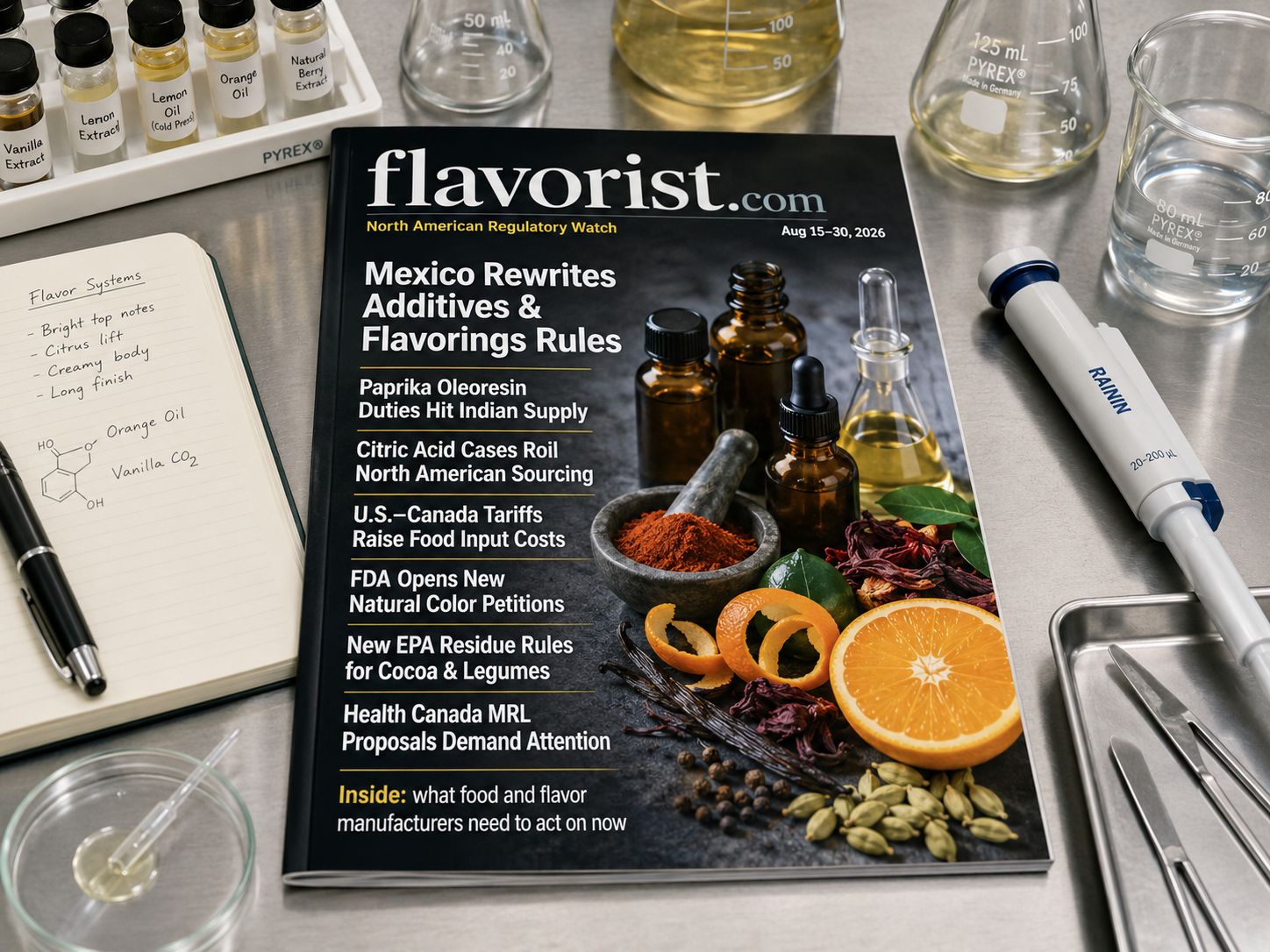
Below listed a comprehensive review of U.S., Canadian, and Mexican federal/national regulatory sources for releases dated August 15–30, 2026, focusing on developments that can materially affect food, beverage, ingredient, flavor, color, and food-packaging manufacturers.
This digest includes 22 developments worth attention. Excluded are routine recalls, meeting notices, paperwork-only renewals, agricultural marketing-order changes aimed principally at growers/handlers, and important actions published outside your requested window—for example, FDA's GRAS proposal of August 10 and its unsafe-food-additive import alert of August 14.
Executive priority list
| Priority | Development | Manufacturer impact |
|---|---|---|
| 🔴 Critical | Mexico overhauls food additives, processing aids and flavorings | Formulations, specifications, labeling, COFEPRIS filings |
| 🔴 Critical | U.S. AD/CVD case on Indian oleoresin paprika | Major landed-cost exposure for a core natural color/flavor ingredient |
| 🔴 Critical | U.S. AD case on Indian citric acid/citrate salts | Very large preliminary duties on a major acidulant/flavor input |
| 🔴 Critical | U.S.–Canada Section 338 tariffs | Immediate sourcing/cost exposure on covered food/beverage goods |
| 🔴 Critical | Mexico import permit for certain sugars/food preparations | Customs clearance requirement beginning Sept. 28 |
| 🟠 High | Canada retaliatory tariffs | Cost exposure on covered U.S.-origin goods |
| 🟠 High | FDA gardenia-blue, safflower and carrot-oil petitions | Future color portfolio/formulation opportunities and specifications |
| 🟠 High | EPA cacao/cypermethrin tolerance | Cocoa/chocolate residue compliance |
| 🟠 High | EPA carboxin tolerance changes | Grain/legume residue specifications |
| 🟠 High | Health Canada pesticide-MRL consultations | Supplier specifications/import compliance |
| 🟡 Monitor | FSIS safe-and-suitable ingredient revision | Meat/poultry/egg formulations and processing aids |
| 🟡 Monitor | Trade-remedy cases on strawberries, wheat gluten and food packaging | Procurement and cost risks |
Mexico
1. 🔴 New national framework for food additives, processing aids and flavorings — August 21
Mexico's Ministry of Health published a major new Agreement governing additives and processing aids in foods, beverages and dietary supplements, replacing the 2012 framework and subsequent amendments. This is probably the most important formulation-related development in the entire review period. The Agreement maintains 11 annexes covering colors, sweeteners, enzymes, processing aids and flavorings, but changes the authorization, specification, labeling and compliance structure. Where an intended product/category/use level is not explicitly covered by specified annexes, manufacturers may need a COFEPRIS evaluation supported by international references, exposure calculations and Mexican consumption information. Flavorings recognized by accepted international bodies may remain usable under defined conditions, including COFEPRIS notification requirements. The framework also addresses heavy-metal/contaminant specifications and labeling of additives and sweeteners. Transition provisions include 60 business days for general implementation, plus longer periods for specified reformulation and notification situations. Companies selling into Mexico should immediately map every additive, color, flavor and processing aid against the new annexes. (DOF)
Sources: · Detailed regulatory analysis of the new agreement
2. 🔴 Prior import permit for specified sugars and food preparations — August 21
Mexico's Ministry of Economy announced the implementation schedule for a new automatic/prior import-permit process affecting specified sugar products and food preparations under rules originally amended on May 28. The operational timetable is now critical: beginning August 21, importers can start the CENAM attestation/compliance-report process; the government's VUCEM/VUTCE system is scheduled to accept permit applications beginning August 31; and the permit becomes mandatory for customs clearance beginning September 28, 2026. Manufacturers importing sugar, sweetening materials or covered preparations into Mexico therefore need to determine whether their tariff classifications fall within the affected headings, obtain the required technical attestations and build permit lead times into purchasing and logistics. Failure to obtain the permit could prevent customs release rather than merely create a post-entry paperwork issue. Food and flavor companies using imported sweetener systems, premixes or certain preparations should have Mexican customs brokers validate HS/TIGIE classifications before shipments scheduled for late September. (gob.mx)
Source: Mexico Ministry of Economy implementation notice
United States — FDA / USDA / EPA
3. 🟠 FDA petition to substantially expand gardenia (genipin) blue uses — August 19
FDA announced the filing of Color Additive Petition 6C0343, seeking a substantial expansion of permitted uses of gardenia (genipin) blue. The petition would allow the color at levels consistent with good manufacturing practice in a broader range of foods and beverages, while also tightening the arsenic specification from 2 ppm to 1 ppm. Proposed applications encompass numerous categories such as beverages, cereals, chewing gum, frozen dairy products and ices, flavored dairy products, confectionery-related applications, toppings and other processed foods. This is not yet an authorization; the petition remains under FDA review. For color houses and flavor-system suppliers, however, the petition deserves early attention because gardenia blue could become another important naturally derived blue option as customers continue evaluating alternatives to synthetic colors. Quality teams should also note the proposed tighter arsenic specification because it could affect raw-material qualification and certificates of analysis even for suppliers already handling gardenia-derived ingredients. (FDA HFP App)
Sources: ·
4. 🟠 FDA petition for safflower extract as a food color — August 19
FDA also announced Color Additive Petition 5C0338, requesting authorization of safflower extract as a color additive in a wide variety of foods at levels consistent with good manufacturing practice. Potential categories described in the petition include beverages, cereals, chewing gum, ready-to-drink tea, tortilla-type products, pickled products, frostings and decorations, frozen dairy foods, confectionery, flavored milk/yogurt products, broths, syrups and other formulated foods. The petition is currently under review and therefore does not permit manufacturers to begin uses that are not already independently lawful. From a product-development perspective, however, it is significant because manufacturers are actively seeking expanded botanical/naturally sourced color palettes. R&D and regulatory teams should monitor the docket for FDA's safety assessment, identity/specification requirements and any limitations on food categories or use levels. Suppliers contemplating commercial scale-up should avoid representing the petition as an approval until FDA publishes a final color-additive regulation. (FDA HFP App)
Sources: ·
5. 🟠 FDA carrot-oil petition would change manufacturing specifications — August 19
FDA's third color-related notice on August 19 concerns Color Additive Petition 5C0339 for carrot oil. The petitioner is asking FDA to amend the existing color-additive regulation to permit acetone as a manufacturing solvent, establish or revise limits relating to heavy metals, and recognize additional names for the additive. Unlike the gardenia and safflower petitions, this action is particularly relevant to ingredient-production technology and specifications rather than simply adding many new food categories. If FDA grants the petition, carrot-oil manufacturers could gain greater processing flexibility, but finished-food manufacturers would need updated supplier specifications and documentation demonstrating compliance with the eventual solvent and contaminant limits. Procurement and QA functions using carrot-derived colors should monitor the docket because changes to identity, solvent residue or heavy-metal requirements often flow directly into COAs, vendor questionnaires and raw-material standards. The petition remains under FDA review and creates no new legal use authorization yet. (FDA HFP App)
Sources: ·
6. 🟠 EPA establishes cypermethrin tolerance for cacao — August 20
EPA issued a final rule establishing a 0.05 ppm tolerance for cypermethrin residues on cacao, dried bean. The rule became effective August 20; objections or hearing requests are due October 19. The petition originated with the National Confectioners Association and has particular importance for cocoa, chocolate and confectionery manufacturers sourcing cacao from countries where cypermethrin may be lawfully used. Before a U.S. tolerance exists, otherwise acceptable imported commodities can face adulteration issues if residues are detected without an applicable tolerance or exemption. The new tolerance therefore provides a defined U.S. compliance ceiling for the covered commodity. EPA noted that there were no corresponding U.S. pesticide registrations for this use when the rule was published, highlighting its relevance to imported cacao. Cocoa purchasers should incorporate 0.05 ppm into pesticide-residue specifications, surveillance programs and supplier communications while also checking destination-country MRLs where finished chocolate or cocoa products are exported. (thefederalregister.org)
Source: EPA/Federal Register final cypermethrin tolerance rule
7. 🟠 EPA revises carboxin tolerances for beans, peas and legume commodities — August 21
EPA issued a final carboxin tolerance rule effective August 21, explicitly identifying food manufacturers among potentially affected entities. The regulation removes the older “bean, dry, seed” entry and establishes updated commodity-group tolerances, including 2 ppm for legume forage/hay except soybean subgroup 7-22A, 0.2 ppm for dried shelled bean except soybean subgroup 6-22E, and 0.2 ppm for dried shelled pea subgroup 6-22F. Objections and hearing requests are due October 20. The practical impact is primarily on agricultural ingredient specifications, residue testing and import/supplier compliance for pulses and ingredients made from them. Companies buying bean or pea powders, proteins, starches or other derivatives should determine which raw agricultural commodity classification underlies the ingredient and ensure supplier residue programs use the updated legal tolerance. EPA also noted that no Codex MRL was established for carboxin, increasing the possibility of differing requirements in export markets. (thefederalregister.org)
Source: EPA/Federal Register carboxin final rule
8. 🟠 EPA grants tolerance exemption for sucrose-ester-type pesticide inert ingredient — August 28
EPA published a final rule exempting alpha-D-glucopyranoside, beta-D-fructofuranosyl, mixed palmitates and stearates (CAS 84066-95-5) from the requirement for a numerical food-residue tolerance when used as an inert surfactant in pesticide formulations applied to growing crops before harvest. The exemption is limited to formulations containing the substance at no more than 12% of the final pesticide formulation. The rule took effect August 28, with objections or hearing requests due October 27. This does not authorize direct addition of the substance to food; it concerns pesticide-residue regulation under the FFDCA. Nevertheless, ingredient manufacturers and food companies auditing agricultural pesticide programs may see the substance appear in crop-protection formulations without a corresponding numerical residue limit. Suppliers of the pesticide formulation must still comply with the 12% formulation limitation and all pesticide-registration requirements. Procurement teams should distinguish this tolerance exemption from food-additive or processing-aid authorization. (thefederalregister.org)
Source:
9. 🟡 USDA-FSIS releases Revision 62 of its “Safe and Suitable Ingredients” directive — August 20/21
USDA's Food Safety and Inspection Service released Revision 62 of Directive 7120.1, Safe and Suitable Ingredients Used in the Production of Meat, Poultry, and Egg Products. This directive is a key operational reference for processors and ingredient suppliers because it identifies substances FSIS accepts for specified uses in federally inspected meat, poultry and egg products, together with use restrictions and links to underlying FDA authorities such as food-additive regulations, GRAS status and food-contact notifications. FSIS's public update does not provide a convenient item-by-item redline of every Revision 62 change, so manufacturers should not assume that an ingredient appearing in an older internal copy remains unchanged. Companies supplying flavors, smoke systems, antimicrobials, processing aids, binders or other functional ingredients to FSIS establishments should obtain Revision 62 and compare relevant entries with their approved formulas, letters of guarantee and customer specification files. This is a policy-list update rather than a new general food-additive statute. (GovDelivery)
Source:
United States — trade measures affecting ingredients and foods
10. 🔴 U.S. activates 50% Section 338 duties on specified Canadian goods — August 22
U.S. Customs and Border Protection confirmed implementation of additional 50% Section 338 duties on specified Canadian-origin products, following a short suspension from August 19 until 12:01 a.m. Eastern on August 22. Covered entries are reported under designated HTSUS provisions, while specified exclusions use separate tariff numbers. Food-sector exposure includes certain covered dairy and alcoholic-beverage products, among other goods; the exact result depends on HTS classification and exclusion status. CBP also cautions that these duties may apply in addition to other applicable duties. U.S. manufacturers sourcing Canadian food products, beverage inputs or affected ingredients should therefore have customs teams revalidate classification, origin, tariff stacking and entry dates rather than relying on supplier descriptions. Because a 50% additional duty can radically alter landed cost, procurement should also review existing contracts for tariff-allocation provisions. The Federal Register subsequently published the presidential action on August 24, confirming the regulatory basis for implementation. (GovDelivery)
Sources: ·
11. 🔴 Final U.S. AD/CVD determinations on oleoresin paprika from India — August 21
This is particularly important to the flavor and natural-color sector. Commerce published final affirmative antidumping and countervailing-duty determinations covering oleoresin paprika from India. Final dumping margins were 5.78% for Synthite, 4.24% for Mane Kancor and 5.08% for other producers, although calculated AD cash-deposit rates were adjusted for subsidy offsets. Final countervailing-duty rates were much higher: 18.67% for Mane Kancor, 25.42% for Synthite and 21.90% for other producers/exporters. The scope encompasses qualifying paprika oleoresin/extract—including material identified by FEMA 2834/E160c—and can include products blended with carriers such as oil, water, emulsifiers or preservatives. Importers, flavor houses and color manufacturers should review supplier/product scope immediately because AD/CVD liability can significantly exceed normal customs duty and can apply on an importer-of-record basis. Final orders still depend on the U.S. International Trade Commission's injury determination. (Justia Regulations)
Sources: Commerce antidumping final determination · Commerce countervailing-duty final determination
12. 🟠 Preliminary antidumping duties on fresh winter strawberries from Mexico — August 21
Commerce published its preliminary affirmative antidumping determination concerning fresh winter strawberries from Mexico. Preliminary dumping margins were approximately 5.28% for Driscoll's, 3.37% for Mainland and 4.83% for other covered producers/exporters. Commerce instructed Customs to suspend liquidation of covered entries and collect applicable preliminary cash deposits beginning with entries on or after the Federal Register publication date. The investigation affects manufacturers that rely on Mexican winter strawberries as raw material for further processing, flavor preparation, fruit systems, fillings or other food production, although applicability depends on the investigation's detailed scope and entry characteristics. Buyers should not assume that processing after import removes trade-remedy exposure; duty status is determined by the merchandise entering the United States and the scope language. Procurement teams should identify importer-of-record responsibility, confirm supplier-specific rates and consider the investigation in autumn/winter sourcing contracts. This is a preliminary determination, not a final antidumping order. (Trade.gov)
Sources: U.S. Commerce strawberries investigation announcement · Federal Register preliminary determination
13. 🔴 Citric acid and citrate salts from India/Canada — major preliminary U.S. trade determinations, August 26
Commerce's August 26 preliminary antidumping determinations create very different sourcing implications for two major North American supply streams of citric acid and citrate salts, essential acidulants, flavor modifiers and pH-control ingredients. For India, Commerce calculated exceptionally high preliminary dumping margins: 151.73% for Daffodil and 100.21% for other covered producers/exporters, with slightly lower cash-deposit rates after applicable subsidy offsets. CBP was directed to suspend liquidation and collect deposits. The scope broadly covers citric acid, sodium citrate and potassium citrate in various grades/forms, including certain mixtures containing at least 40% covered material. For Canada, Commerce reached a preliminary negative determination, calculating 0.00% for Jungbunzlauer Canada, so no preliminary AD cash deposit was imposed. Both investigations remain pending final determinations. Food/flavor manufacturers should urgently identify country of origin—not merely distributor location—for every citric/citrate SKU and model landed-cost exposure. (thefederalregister.org)
Sources: ·
Canada — food regulation and pesticide residues
14. 🟠 Health Canada revises fortification policy; higher vitamin A ceiling for term infant formula — August 20
Health Canada revised its Interim Policy on the Use of Expired Interim Marketing Authorizations Related to Food Fortification. The policy continues to cover specified products marketed under expired IMAs, fortified plant-based beverages, corn masa flour and infant formula while permanent regulatory amendments are developed. The important August 2026 change is a new acceptable maximum vitamin A level for term infant formula of 600 IU per 100 kcal, including overage, compared with the existing regulatory level of 500 IU/100 kcal. Health Canada says its safety assessment supports the higher amount and notes alignment with Codex and Australia/New Zealand standards. This is an interim compliance/enforcement position rather than a completed amendment to Division 25 of the Food and Drug Regulations. Infant-formula manufacturers contemplating reformulation should therefore document reliance on the interim policy and continue meeting all other requirements, including premarket obligations where a composition change triggers them. CFIA remains responsible for enforcement. (Canada)
Source: Health Canada revised food-fortification interim policy
15. 🟠 Epyrifenacil herbicide registration proposal and food MRLs — August 21
Health Canada opened linked consultations on registration of epyrifenacil herbicide products and proposed corresponding food maximum residue limits. Proposed uses include soybeans, field corn, spring/winter wheat and canola. The proposed MRL is 0.005 ppm for dry soybeans, field corn, rapeseed/canola and wheat, and 0.01 ppm for eggs, milk and meat/fat/byproducts from specified livestock and poultry. Health Canada states that an MRL applies to the raw commodity and generally to processed foods containing it unless a separate processed-product limit exists. The crop limits align with U.S. tolerances, while the proposed Canadian livestock limits do not currently have U.S. counterparts; no Codex MRLs are established. Comments on the pesticide registration proposal are due September 20, while comments on the MRL proposal are due November 4. Grain, oilseed, animal-product and processed-food manufacturers should evaluate supplier specifications and cross-border MRL implications. (Canada)
Sources: Health Canada proposed epyrifenacil registration decision · Health Canada PMRL2026-08
16. 🟠 Proposed fludioxonil MRL revisions — August 27
Health Canada opened consultation PMRL2026-09 on substantial changes to maximum residue limits for fludioxonil across several produce commodities. Among the proposed changes are increases from 0.02 to 4.0 ppm for ginseng, approximately 0.01 to 2.0 ppm for broccoli, Brussels sprouts, cauliflower and Napa cabbage, and 0.01 to 15 ppm for Chinese broccoli. Other limits would decrease—for example cranberries from 3.0 to 0.04 ppm—and new MRLs are proposed for several specialty leafy/brassica commodities. The consultation closes October 11, 2026. Both increases and decreases matter to processors: increases may accommodate new approved pesticide-use patterns, while large decreases can require suppliers to modify application practices or residue-testing specifications before the new limits become enforceable. As with other Canadian MRLs, processed foods containing the commodity are generally tied to the underlying MRL unless a separate processed-food limit exists. Ingredient importers should compare Canadian, U.S. and Codex tolerances. (Canada)
Source:
17. 🟠 Proposed cyprodinil MRL changes — August 27
Health Canada simultaneously opened PMRL2026-10 for cyprodinil, proposing substantial revisions for leafy/brassica commodities and cranberries. Among the changes, radish leaves and turnip greens would rise from roughly 10 to 30 ppm, while Chinese broccoli would rise from 1 to 30 ppm. Other leafy commodities would move toward a 30-ppm limit, while the cranberry MRL would fall markedly, to approximately 0.4 ppm. The consultation remains open through October 11, 2026. This matters particularly to manufacturers of cranberry ingredients, vegetable preparations, juices, extracts, dehydrated powders and botanical/flavor systems because a downward MRL can create non-compliance risk even where the pesticide was lawfully used under an earlier agricultural program. Firms importing commodities should also check differences with U.S. and Codex limits. Regulatory and procurement groups should ask suppliers whether existing field programs would comply with the proposed Canadian levels and consider commenting if residue data or international trade considerations support a different limit. (Canada)
Source:
18. 🟡 Health Canada registers Captiva Prime for food crops — August 21
Health Canada issued final Registration Decision RD2026-17 authorizing Captiva Prime Technical Insecticide and Captiva Prime, whose active ingredients include canola oil, garlic oil, capsaicin and related capsaicinoids. The product is registered for suppression of two-spotted spider mites and thrips on terrestrial food crops, greenhouse food crops, certain greenhouse non-food crops and outdoor ornamentals. Health Canada determined that the health and environmental risks are acceptable when the products are used according to approved label directions. Although this action primarily affects agricultural production rather than downstream manufacturing, it is relevant for vertically integrated food businesses and suppliers of produce-derived ingredients because it adds a new crop-protection option for food crops. Manufacturers should remember that pesticide registration and food/flavor ingredient authorization are separate concepts: the use of garlic oil or capsaicin as pesticide active ingredients does not establish a new direct food-additive permission. Any person filing a scientific objection to the registration has 60 days from publication. (Canada)
Source: Health Canada Registration Decision RD2026-17
19. 🟡 Proposed restrictions on halohydantoin antimicrobial products — August 26
Health Canada opened a special-review consultation on halohydantoins, antimicrobial pesticide active ingredients used in swimming pools and also in certain industrial process fluids, cooling-water systems and industrial processing waters. Health Canada proposes cancelling outdoor-pool uses, certain uses combined with electrolysis/ozonation/UV systems, and open-pour granular formulations, because evaluated human-health risks were not shown to be acceptable. Some tablet, paste and pre-filled-cartridge uses would remain acceptable with appropriate mitigation; certain commercial-class paste/tablet products fall outside the concern reviewed. The consultation closes October 10. Food manufacturers should determine whether halohydantoin products appear anywhere in plant water-treatment, cooling or industrial utility systems and, if so, identify the exact Canadian product registration and formulation. The proposal does not automatically prohibit every commercial halohydantoin use, so decisions should be product/use-specific. Sanitation, EHS and engineering teams are the most relevant internal owners rather than food-formulation teams. (Canada)
Source: Health Canada proposed special review PSRD2026-02
Canada — trade and packaging
20. 🟠 Canada publishes 50% retaliatory tariffs on U.S. products — August 26
Canada's Department of Finance published the list for 50% counter-tariffs on approximately C$27.6 billion of U.S.-origin goods, scheduled to take effect at 12:01 a.m. on September 8, 2026. The targeted list spans multiple industrial sectors and includes certain dairy/agricultural goods as well as materials that may enter food-manufacturing supply chains. This action is separate from food-safety regulation but can materially alter ingredient, equipment and packaging costs. Canadian manufacturers buying U.S. inputs should review the actual tariff-item list rather than relying on category-level headlines, because coverage is determined through customs classification and origin. Businesses should identify affected purchase orders that will enter Canada on or after the effective time, confirm whether contracts assign responsibility for new tariffs, and model alternative Canadian or third-country supply where exposure is substantial. The measures are retaliatory to the U.S. Section 338 action and therefore carry continuing policy-change risk. (Canada)
Source:
21. 🟠 Canadian wheat-gluten trade case advances — August 18
The Canadian International Trade Tribunal determined that there is a reasonable indication that dumping of wheat gluten from Italy, Poland and the United Kingdom has caused or threatens injury to the Canadian industry. The finding allows the Canada Border Services Agency's dumping investigation to proceed; CBSA's preliminary determination was scheduled for September 17. Wheat gluten is extensively used in bread, noodles, pasta, pizza products, meat alternatives and other formulated foods, so potential antidumping duties can directly affect ingredient procurement. No final trade-remedy duty resulted from the August 18 Tribunal finding itself, but manufacturers importing covered wheat gluten should identify countries of origin and suppliers now rather than waiting for a provisional-duty decision. Importers should also distinguish the actual producer/origin from the distributor's location. Purchasing groups may want contingency quotations from Canadian or non-subject suppliers and should review contract clauses dealing with retroactive or provisional trade-remedy charges. (Canada)
Sources: ·
22. 🟡 Canadian investigation of Chinese paperboard cups and containers — August 17–18
CBSA initiated antidumping and countervailing-duty investigations involving specified paperboard cups, containers and related blanks/flats from China, and the Canadian International Trade Tribunal opened its preliminary injury inquiry the following day. Although this is a packaging rather than food-composition measure, it deserves attention from beverage, dairy, foodservice, prepared-food and co-manufacturing businesses that import food-contact paperboard cups or containers. If the investigations produce affirmative preliminary determinations, provisional duties can increase the landed cost of subject packaging, and final duties can materially alter long-term sourcing economics. Companies should map packaging SKUs to the investigation's precise scope; descriptions such as “paper cup,” “carton” or “food container” alone are not sufficient for customs analysis. Procurement should also identify the actual manufacturer and Chinese origin of blanks supplied through North American converters. The CITT's preliminary injury decision and CBSA's later dumping/subsidy determinations are the next major milestones. (Canada Border Services Agency)
Sources: CBSA investigation initiation · Canadian International Trade Tribunal inquiry
What manufacturers should act on first
A food/flavor manufacturer needs to pay attention to the immediate compliance listed below:
- Mexico additives/flavorings agreement: perform an SKU-by-SKU regulatory mapping of additives, flavors, processing aids, sweeteners and colors sold into Mexico.
- Oleoresin paprika from India: determine exposure by supplier, country of origin and importer-of-record; the CVD rates are commercially significant.
- Citric acid/citrates from India: quantify preliminary AD duty exposure immediately; 100%+ rates can completely change sourcing economics.
- U.S.–Canada and Canada–U.S. tariffs: customs-classify affected ingredients/products and review September shipments.
- Mexico sugar/food-preparation permits: identify affected tariff codes before the September 28 mandatory permit date.
- Canadian MRL proposals and U.S. EPA tolerances: update pesticide-residue matrices/specifications for cocoa, pulses, grains, oilseeds, cranberries and vegetables.
- FDA color petitions: place on the R&D/regulatory watchlist; they are promising formulation developments but not approvals yet.
- FSIS Directive 7120.1 Rev. 62: meat/poultry/egg suppliers should compare their permitted-use files against the new revision.
###