Regulatory News Digest for the South American Food and Flavor Industry: August 15 - 30, 2026
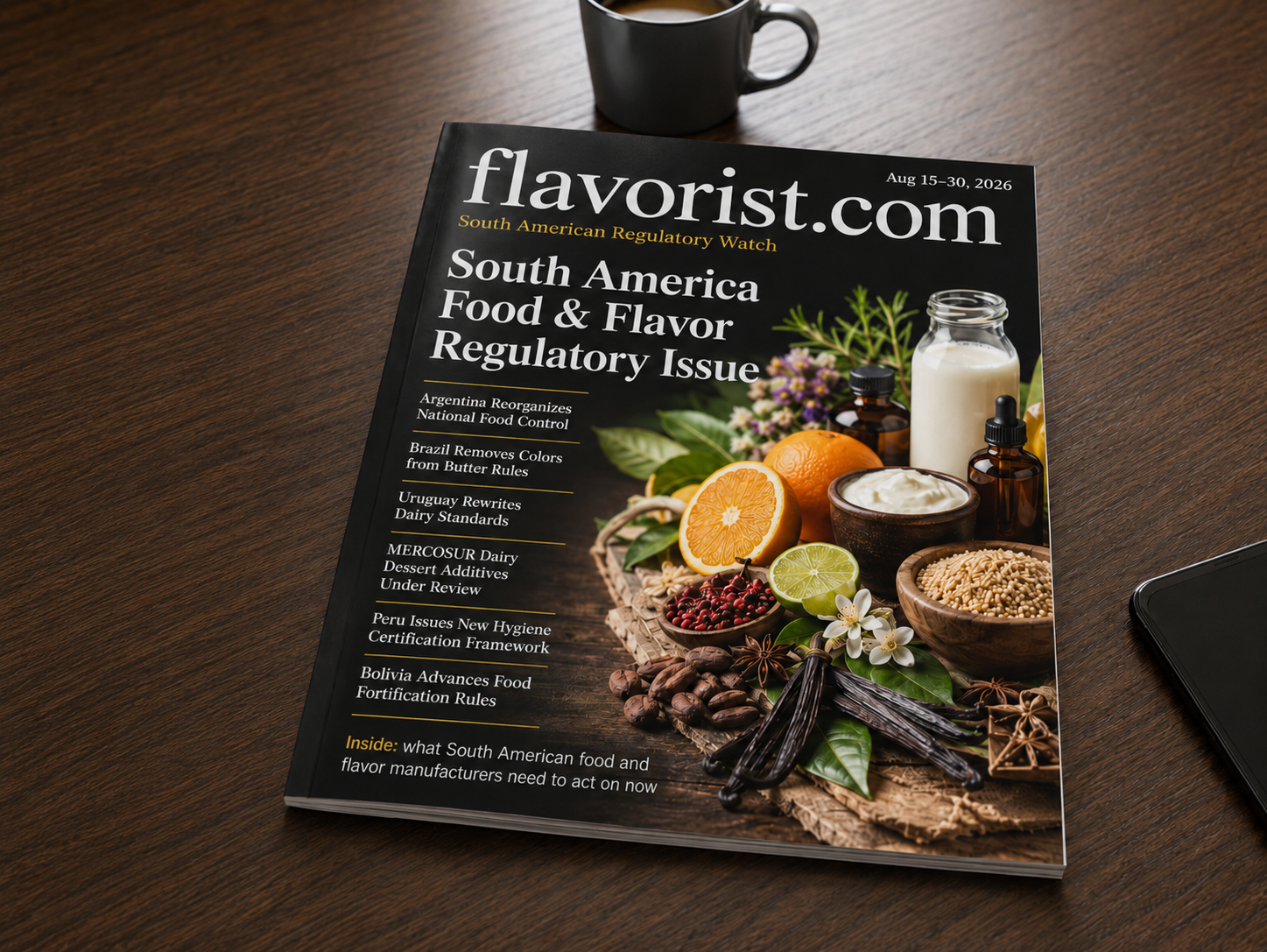
Below is a country-by-country review of South American national food/agriculture regulators, official gazettes, and relevant MERCOSUR activity for releases dated August 15–30, 2026. There are 12 developments that merit attention from food, beverage, ingredient, flavor, color, dairy, seafood, or closely connected agricultural manufacturers.
The news are only that released during the specific time period: a rule that merely became effective or remained open for comment during this period but was published before August 15 was excluded. Excluded are also routine recalls, individual facility approvals, and product-specific enforcement actions unless they represented a broader regulatory change.
Priority overview
| Priority | Country / Region | Development | Status |
|---|---|---|---|
| 🔴 Critical | Brazil | Removal of numerous colors from butter additive authorization | Binding |
| 🔴 Critical | Argentina | National food-control responsibilities reorganized | Binding |
| 🔴 Critical | Uruguay | Dairy identity, additive and processing-aid framework revised | Binding |
| 🟠 High | MERCOSUR / Paraguay | New additive rules proposed for dairy desserts | Consultation |
| 🟠 High | Peru | New hygiene-certification framework | Binding |
| 🟠 High | Bolivia | New fortification rules for salt, flour and vegetable oil advancing | Pre-rulemaking |
| 🟠 High | Brazil | Vegetable oil/fat standards under revision | Regulatory development |
| 🟠 High | Peru | New El Niño/La Niña framework can rapidly change seafood controls | Binding |
| 🟡 Monitor | Brazil | National citrus-canker program proposed | Consultation |
| 🟡 Monitor | Brazil | Import/export procedures for agricultural inputs proposed | Consultation |
| 🟡 Monitor | Colombia | Multiple biotechnology feed authorizations/cancellation | Binding, upstream |
| 🟡 Monitor | Chile | Poultry genetic-stock import requirements proposed | Consultation |
ARGENTINA
1. 🔴 Argentina reorganizes national responsibility for food regulation — August 21
Argentina published DNU 771/2026, significantly reorganizing federal responsibilities for food oversight. The Ministry of Economy is assigned responsibility for sanitary inspection, standardization, registration and control of the sanitary quality and safety of agro-food products, beverages, mineral waters, dietetic and packaged foods. Importantly for flavor and ingredient companies, the decree explicitly includes specific inputs, additives, colors, sweeteners and ingredients used in human food, and covers production, processing, storage, transportation, marketing, imports and exports. SENASA operates within the Economy Ministry structure and is identified in the decree's reasoning as responsible for executing national food policy and enforcing the Argentine Food Code. The Ministry of Health retains regulatory stewardship and norm-setting within its competence. Manufacturers should update regulatory-contact matrices, submission pathways and responsibility assignments for registrations, imports and inspections. Existing approvals are not automatically invalidated, but implementation changes could affect which authority handles future files and inspections. (Argentina)
Official Argentina text — DNU 771/2026
BRAZIL
2. 🔴 Anvisa removes a large group of colors from authorization for butter — August 20/21
Brazilian Anvisa issued Instrução Normativa 466/2026, immediately amending IN 211/2023 on authorized food additives and processing aids. The action removes a group of color authorizations specifically listed for food category 02.2.1 — butter, previously carrying the condition “Somente manteiga da terra.” Deleted entries include synthetic riboflavin, carmines, chlorophylls, vegetable carbon, paprika extract, several forms of lycopene, lutein, canthaxanthin, beet red, grape-skin extract, blackcurrant extract and other carotenoid/xanthophyll colors. The measure entered into force on publication rather than providing a lengthy transition. This warrants immediate review by butter manufacturers and suppliers of natural-color preparations because a formulation based on the former IN 211 table may no longer be permissible under that category. Regulatory teams should check finished-product formulas, supplier use letters, specification sheets and ERP formulation databases and determine whether any affected product requires reformulation, relabeling or category reassessment. (AnvisaLegis)
Anvisa — Instrução Normativa 466/2026
3. 🟠 Anvisa starts revision of vegetable oil and fat standards — August 17
Anvisa announced a regulatory dialogue on updating IN 87/2021, which defines authorized plant species, product designations, fatty-acid compositions, maximum acidity and peroxide values for vegetable oils and fats. The immediate focus is palm oil, palm-kernel oil and their fractions, after technical information indicated differences between the fatty-acid composition of Brazilian products and parameters currently written into the regulation. The August 27 sector dialogue was intended to present Anvisa's technical basis, gather industry input and explain subsequent regulatory steps. No new limits became binding from this announcement, but manufacturers should treat it as an advance warning of possible specification changes. Palm-derived oils and fractions are widely used in bakery, confectionery, fillings, flavor carriers, emulsions and fat systems. Procurement and QA teams should compare current supplier COAs and internal specifications with IN 87/2021 and preserve compositional data that could support comments or demonstrate the practical consequences of proposed limits. (Serviços e Informações do Brasil)
Anvisa — vegetable oils and fats regulatory dialogue
4. 🟡 MAPA proposes new import/export controls for agricultural inputs — August 19
Brazil's Ministry of Agriculture and Livestock published Portaria SDA/MAPA 1.673/2026, opening consultation on procedures controlling the import and export of agricultural inputs. MAPA's page identifies the proposal as a 45-day consultation and lists a contribution period running through October 23, 2026. This measure is upstream from most finished-food manufacturing rather than a direct food-ingredient regulation, but it can matter to vertically integrated businesses and suppliers whose agricultural raw materials depend on regulated crop inputs. Changes to documentary requirements, border controls or import/export procedures can affect availability and lead times for inputs used by farmers producing flavor botanicals, fruits, herbs, spices and other food commodities. Agricultural sourcing teams should determine whether their Brazilian operations or contracted growers import products covered by the proposed procedure and whether additional documentation could interrupt supply. The consultation also provides an opportunity for affected agricultural-input importers to submit technically substantiated comments through MAPA's SISMAN system. (Serviços e Informações do Brasil)
MAPA — agricultural-input import/export consultation
5. 🟡 Brazil proposes National Citrus Canker Prevention and Control Program — August 19–22
MAPA's Portaria SDA/MAPA 1.672/2026 opened public consultation on a proposed National Program for Prevention and Control of citrus canker caused by Xanthomonas citri subsp. citri. The consultation began August 22 and is scheduled through November 18, 2026. Although principally a plant-health measure, it deserves attention from orange, lemon, lime, mandarin, citrus-juice, citrus-oil and natural-flavor companies. National disease-control programs can influence orchard management, plant movement, geographic controls, inspection obligations and ultimately availability and cost of citrus raw materials. Citrus essential oils and extracts are particularly important flavor-industry inputs, so supply-chain consequences can propagate well beyond fresh-fruit producers. Flavor manufacturers sourcing Brazilian orange, lemon or other citrus oils should ask strategic suppliers how the proposed program may affect production regions, disease-management practices and movement of material. Companies with substantial citrus exposure may also wish to participate in MAPA's consultation before the November deadline. (Serviços e Informações do Brasil)
MAPA — proposed National Citrus Canker Program
URUGUAY
6. 🔴 Uruguay rewrites the legal framework for dairy identity, quality and additives — August 28
Uruguay published Decreto 199/026, revoking Decreto 96/024 and restoring a substantial group of earlier decrees to improve legal coherence in the country's dairy regulatory system. At the same time, Uruguay formally incorporates MERCOSUR GMC Resolutions 14/2023 and 15/2023 into the National Bromatological Regulation. Those resolutions address the use of starches in very-high-moisture cheeses and the allocation of food additives and processing aids for powdered milk and cream, fermented milks and cheeses. The decree states that those MERCOSUR resolutions are adopted from April 4, 2024, while the new corrective decree itself was published August 28, 2026. Dairy manufacturers therefore need more than a simple “new-versus-old” comparison: legal and regulatory teams should reconcile the restored historical decrees, MERCOSUR provisions and current formulation files. Suppliers of stabilizers, cultures, enzymes, colors, preservatives and other dairy systems should verify authorized functions and conditions of use for each affected subcategory. (Impo)
Uruguay IMPO — Decreto 199/026
MERCOSUR / PARAGUAY
7. 🟠 New MERCOSUR additive framework proposed specifically for dairy desserts — August 17
Paraguay's DINAVISA opened a 60-day public consultation beginning August 17 on MERCOSUR Resolution Project 02/26, covering the allocation of food additives and processing aids for Food Category 1, Dairy Products — Dairy Desserts. The proposal is designed to replace or repeal GMC Resolution 14/25. Because this is a MERCOSUR technical-regulation project, its significance goes beyond the Paraguayan market: a finalized regional measure can ultimately shape national requirements across MERCOSUR members after incorporation into domestic legislation. Manufacturers of puddings, dairy desserts, flavored creams and related products—and suppliers of stabilizer systems, emulsifiers, preservatives, colors and flavors—should compare the proposed additive list against every current regional formulation. Particular attention should be paid to technological function, maximum levels, restrictions and category definitions rather than assuming an additive permitted elsewhere in dairy is automatically acceptable in desserts. Companies selling one common formulation across Brazil, Argentina, Paraguay and Uruguay have a strong reason to comment before the consultation closes. (Dinavisa)
Paraguay DINAVISA — MERCOSUR dairy-dessert consultation
PERU
8. 🟠 Peru establishes new framework for regional Codex hygiene certification — August 25
Peru approved Directiva Sanitaria 169-MINSA/DIGESA-2026 through Resolution Ministerial 730-2026/MINSA. The directive establishes how regional health authorities demonstrate the technical suitability required to apply and verify certification under the Codex Alimentarius General Principles of Food Hygiene. DIGESA remains Peru's national authority for environmental health and food safety, including foods, beverages and industrially produced additives within its jurisdiction, while qualified regional health authorities may conduct certification under the national framework. For food and flavor manufacturers, the key impact is greater formalization of how regional certification competence is assessed and exercised. Plants should expect inspectors to use consistent Codex-based hygiene principles and should ensure sanitation procedures, pest programs, process controls, employee-hygiene records, corrective actions and verification documentation can withstand certification review. Businesses operating plants in multiple Peruvian regions should also monitor which regional authorities obtain technical approval, because certification interactions may increasingly occur locally while remaining subject to DIGESA oversight. (El Peruano)
El Peruano — RM 730-2026/MINSA and hygiene directive
9. 🟠 Peru creates rapid regulatory response framework for El Niño/La Niña impacts on fisheries — August 25
Peru's Ministry of Production established a new framework enabling fisheries and aquaculture authorities to respond to warm or cold ocean conditions associated with El Niño or La Niña. Under the measure, IMARPE must intensify biological, environmental and fishery monitoring when defined alert conditions arise, while PRODUCE can respond using management tools including exploratory fishing, temporary exceptional extraction regimes, changes to catch quotas, fishing seasons and closures, spatial restrictions and precautionary measures. Authorities must also consider effects on processing, commercialization, sanitation, food safety, logistics and infrastructure. This matters directly to manufacturers of fish ingredients, seafood, fish oil, marine extracts, savory flavor systems and other products dependent on Peruvian fisheries. The framework means supply rules can change comparatively quickly after scientific evidence identifies climate-related shifts. Purchasing teams should therefore connect regulatory monitoring with raw-material forecasting and build alternative sourcing into high-risk marine ingredients rather than treating fishing quotas and seasons as static annual assumptions. (El Peruano)
El Peruano — fisheries and aquaculture El Niño/La Niña measures
BOLIVIA
10. 🟠 Bolivia advances new mandatory food-fortification regulations — August 20
Bolivia's Ministry of Health reported that technical working groups had validated major proposed rules governing fortification of mass-consumption foods. The work covers salt fortified with potassium iodate, wheat flour enriched with ferrous sulfate, B-group vitamins and folic acid, and the addition of retinyl palmitate/vitamin A to vegetable oil. Importantly, this is not yet a final binding regulation. The Ministry said the texts will next proceed to a technical table with industry and UDAPE review, with an international notification period of approximately 180 days contemplated before companies are required to implement the fortification requirements. Nevertheless, this is a high-priority advance notice for flour mills, edible-oil refiners, salt manufacturers, premix suppliers and companies importing equivalent products into Bolivia. Manufacturers should begin comparing current nutrient concentrations, overages, analytical methods, stability assumptions and label declarations with the developing framework so that reformulation and validation work does not begin only after the final rules are notified. (Bolivia Health and Sports Ministry)
Bolivia Ministry of Health — food-fortification regulatory update
COLOMBIA
11. 🟡 ICA publishes package of biotechnology feed authorizations and one cancellation — August 18
Colombia's ICA published several decisions affecting genetically modified agricultural materials used as animal feed or raw material for production of animal feed. Among them, Resolution 16054 authorizes soybean event GTS 40-3-2 for Scheffer Colombia, while Resolution 16050 authorizes soybean COR23134 for Corteva and Resolution 16049 separately authorizes GTS 40-3-2 for Agroinsumos. Additional published decisions cover Bayer's KWS20-1 sugar beet and MON 94313 × MON 89788 soybean. ICA also published Resolution 16053 cancelling the prior authorization for soybean event SYHT0H2 held by Syngenta and BASF. These decisions should not be interpreted as new human-food approvals; their published scope is animal feed. Nevertheless, feed manufacturers, vertically integrated meat/dairy businesses and commodity-traceability programs should update approved-event lists and supplier documentation. Companies managing non-GM or identity-preserved supply chains should also incorporate the newly authorized events into testing and segregation risk assessments. (ICA)
Colombia ICA — official OVM resolutions database
CHILE
12. 🟡 Chile proposes updated sanitary requirements for imported poultry breeding material — August 25
Chile's Agricultural and Livestock Service, SAG, opened consultation on new sanitary requirements for imports of day-old poultry and hatching eggs, intended to replace Resolution 839/2007 and subsequent amendments. SAG says the proposed rules align the import framework with recommendations in the World Organisation for Animal Health terrestrial-animal code. The consultation runs from August 25 through November 25, 2026. This is mainly an upstream animal-health regulation, but it warrants attention from vertically integrated poultry processors and large food manufacturers whose supply security depends on imported breeding stock or hatchery material. Changes in veterinary certificates, disease-status conditions or admissibility can affect breeder availability, production schedules and ultimately poultry-meat and egg supply. Companies importing poultry genetic material should have veterinary/regulatory teams compare current certificates and origin-country requirements with the draft. Downstream food manufacturers without direct poultry operations generally need only monitor potential supply-chain effects rather than undertake immediate formulation or labeling changes. (SAG)
Chile SAG — poultry import sanitary requirements consultation
What requires the most immediate manufacturer attention
A food/flavor company operating across South America, should pay attention to items listed below:
- Brazil IN 466: immediately screen butter/dairy-color formulations for removed color permissions, especially paprika extract and other natural colors.
- Argentina DNU 771: update regulatory ownership and agency-contact procedures for additives, colors, sweeteners, ingredients, imports and registrations.
- Uruguay Decreto 199/026: reconcile dairy formulations against the restored national rules plus MERCOSUR 14/2023 and 15/2023.
- MERCOSUR dairy-dessert proposal: perform a formulation gap analysis now and consider submitting comments during Paraguay's consultation.
- Bolivia fortification: salt, flour, oil and vitamin-premix manufacturers should begin technical readiness work ahead of the contemplated 180-day international notification.
- Peru hygiene directive: verify Codex-based GMP/hygiene certification documentation at Peruvian manufacturing locations.
- Brazil oils/fats: palm and palm-kernel users should monitor upcoming specification changes.
- Citrus and seafood: flavor businesses heavily dependent on Brazilian citrus or Peruvian marine materials should integrate the new regulatory developments into sourcing-risk programs.
###