Safety Data Sheets (SDS): Essential Knowledge for Flavorists — Society of Flavor Chemists (SFC) Study Guide
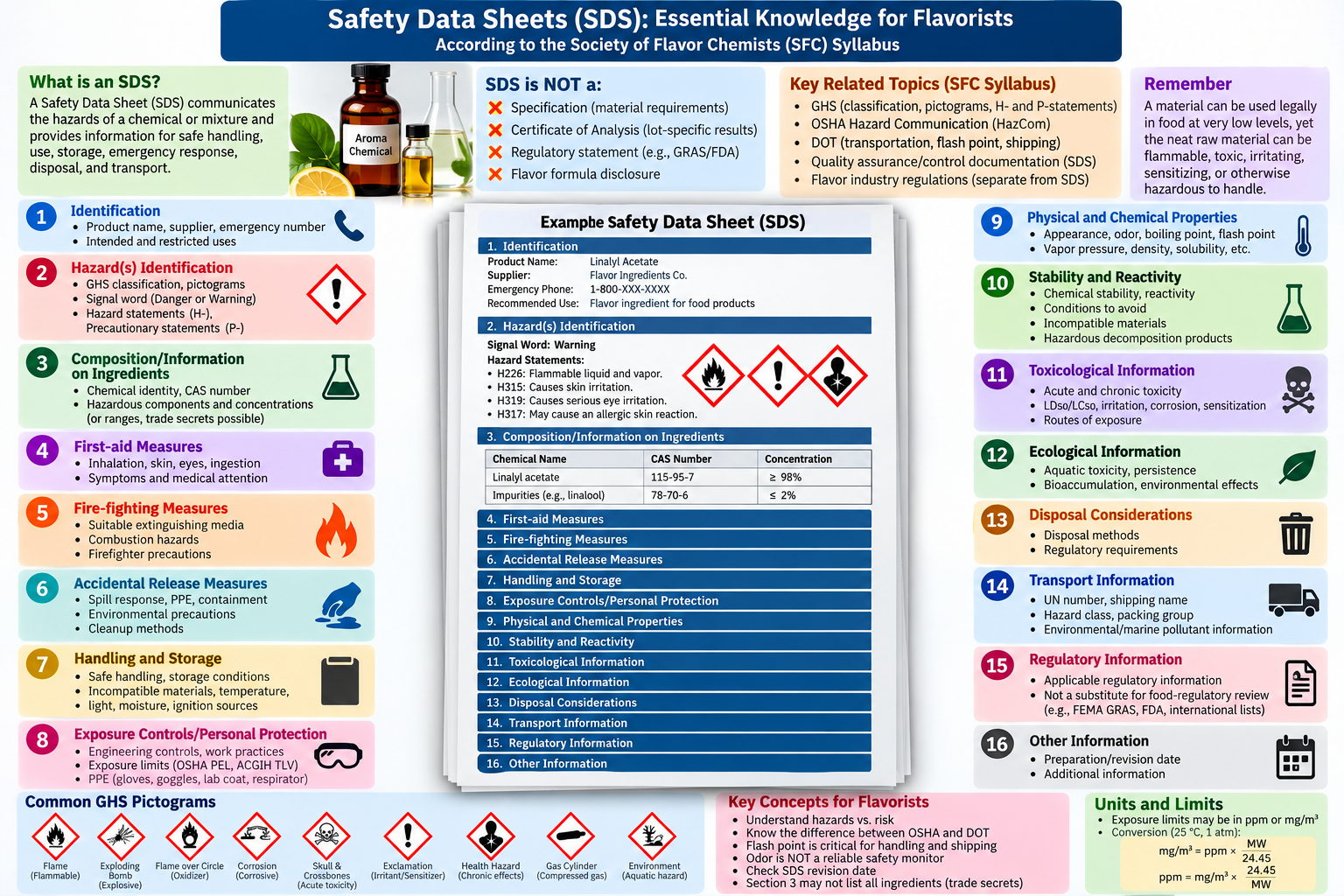
According to the January 2026 Society of Flavor Chemists (SFC) syllabus, SDS falls under VII. Flavor Organizations, Certifications, and Documentation → Quality Assurance/Control. The syllabus itself only names “Safety Data Sheets (SDS)” rather than prescribing a detailed SDS curriculum. However, it separately expects knowledge of GHS, OSHA/HazCom, DOT relevance including flash point and shipping, and other regulatory/documentation topics. So for SFC preparation, flavorists should be able to read an SDS intelligently and translate it into decisions in a flavor laboratory, rather than simply memorize the 16 headings. Flavor Chemists
1. What an SDS actually is
A Safety Data Sheet communicates the occupational hazards of a chemical or mixture and information needed to handle it safely. Under OSHA's Hazard Communication Standard, manufacturers/importers must develop or obtain an SDS for hazardous chemicals they produce/import, and employers must have SDSs for hazardous chemicals used in their workplaces. OSHA
An important distinction for a flavorist:
SDS ≠ specification ≠ COA ≠ regulatory statement.
A specification tells you what a material is supposed to meet; a Certificate of Analysis (COA) tells you the results/status of a particular lot; an SDS communicates hazards and safe handling. Likewise, the fact that a substance is permitted for use as a flavor ingredient does not mean it is harmless to handle as a concentrated raw material.
That distinction is particularly important in flavor chemistry. A material can be appropriate for food use at a very low use level while the neat raw material may be flammable, corrosive, sensitizing, irritating, acutely toxic, or otherwise hazardous occupationally.
2. Know the 16 SDS sections
An SFC flavorist candidate may want to memorize both the number and purpose of every section.
| Section | Name | What a flavorist should extract |
|---|---|---|
| 1 | Identification | What exactly is this product? Supplier? Emergency number? Intended/restricted uses? |
| 2 | Hazard(s) identification | First place to look. GHS classifications, pictograms, signal word, hazard statements, precautions |
| 3 | Composition/information on ingredients | Chemical identity, CAS numbers, hazardous components and concentrations/ranges |
| 4 | First-aid measures | What to do after eye, skin, inhalation or ingestion exposure |
| 5 | Fire-fighting measures | Extinguishing media, combustion hazards, firefighter precautions |
| 6 | Accidental release measures | What to do if you spill it |
| 7 | Handling and storage | How you should actually work with and store it |
| 8 | Exposure controls/personal protection | Ventilation, exposure limits, gloves, goggles, respiratory protection, etc. |
| 9 | Physical and chemical properties | Appearance, odor, flash point, boiling point, vapor pressure, density, solubility, etc. |
| 10 | Stability and reactivity | Incompatibilities, conditions to avoid, decomposition products |
| 11 | Toxicological information | Acute/chronic toxicity and routes/effects of exposure |
| 12 | Ecological information | Environmental toxicity, persistence, bioaccumulation, etc. |
| 13 | Disposal considerations | Disposal/waste information |
| 14 | Transport information | UN number, shipping name, hazard class, packing group, etc. |
| 15 | Regulatory information | Regulatory information specific to the material |
| 16 | Other information | SDS preparation/revision date and miscellaneous information |
OSHA requires the standardized sequence. Sections 1–11 and 16 contain OSHA-required information; headings 12–15 appear for GHS consistency, but OSHA does not enforce their informational content because those subjects fall outside OSHA's jurisdiction. OSHA
A useful memory grouping is:
1–3 = What is it and what's dangerous?
4–6 = What do I do in an emergency?
7–8 = How do I work with it safely?
9–11 = What are its chemical/toxicological properties?
12–15 = Environment, disposal, transport, regulation
16 = Revision/history
3. Section 2 is the most important section to interpret quickly
A flavorist should understand the GHS vocabulary appearing here.
Hazard classification
Examples you are likely to encounter in flavor raw materials include:
- Flammable liquid
- Acute toxicity
- Skin corrosion/irritation
- Serious eye damage/eye irritation
- Skin sensitization
- Respiratory sensitization
- Specific target organ toxicity
- Aspiration hazard
- Carcinogenicity
- Reproductive toxicity
- Aquatic/environmental hazards
Don't equate a hazard classification with the risk associated with the final food.
Hazard = inherent capacity to cause harm.
Risk depends additionally on exposure: concentration, dose, duration, route, frequency, controls, etc.
That distinction is fundamental.
4. Signal words
Know the two GHS signal words:
DANGER — generally the more severe hazard categories.
WARNING — generally less severe categories.
You don't choose severity by how unpleasant a chemical smells.
5. Know the GHS pictograms
A flavorist should recognize these immediately:
| Pictogram | Think |
|---|---|
| 🔥 Flame | Flammable, pyrophoric, self-reactive, etc. |
| 💥 Exploding bomb | Explosive/self-reactive/organic peroxide hazards |
| 🔥⭕ Flame over circle | Oxidizer |
| 🧪 Corrosion | Severe skin burns/eye damage; corrosive to metals |
| ☠️ Skull and crossbones | Severe acute toxicity |
| ❗ Exclamation mark | Irritation, sensitization, harmful acute toxicity, etc. |
| Person silhouette / chest star | Serious/chronic health hazards |
| Gas cylinder | Gas under pressure |
| Dead tree/fish | Aquatic environmental hazard |
The environmental pictogram is part of GHS but isn't mandatory under OSHA because environmental hazards are outside OSHA's jurisdiction. OSHA
6. H-statements versus P-statements
Be comfortable distinguishing:
Hazard statements (H-statements) describe the nature/severity of the hazard.
Examples conceptually:
Flammable liquid and vapor.
Causes serious eye irritation.
Harmful if swallowed.
Precautionary statements (P-statements) tell you what to do about it:
Keep away from ignition sources.
Wear protective gloves/eye protection.
Store in a well-ventilated place.
You do not need to treat every H/P code as a flavor-chemistry fact to memorize, but you should understand what these statements mean operationally.
7. Section 3 — Composition is especially important to flavorists
Flavor compounds frequently arrive as:
neat chemicals → solutions → compounded flavors → emulsions → extracts → reaction flavors → encapsulated/spray-dried materials.
Section 3 helps distinguish them.
For a substance, look for:
chemical name + synonyms + CAS number + relevant impurities/stabilizers.
For mixtures, hazardous ingredients and their concentrations or ranges may have to be disclosed subject to HazCom requirements and trade-secret provisions. OSHA
CAS numbers
Flavorists should appreciate why CAS numbers matter.
Names can vary:
- common name
- FEMA/common industry name
- IUPAC name
- synonym
- supplier trade name
The CAS Registry Number helps establish chemical identity independently of those naming differences.
Never assume two similarly named materials are identical solely from the name.
8. Trade secrets are normal in compounded flavors
A compounded flavor formula is commercially sensitive.
Therefore, an SDS may not disclose the entire formula.
This is a critical SFC-type concept:
An SDS is not a flavor formula disclosure document.
OSHA permits certain chemical identity and/or exact percentage information for hazardous ingredients to be withheld as trade secrets under prescribed conditions. Under current requirements, concentration ranges can also be used in appropriate circumstances. OSHA
Therefore:
“Section 3 doesn't list everything” does not mean the flavor contains nothing else.
9. Section 4 — First aid
Know the four major exposure routes:
Inhalation
Skin
Eyes
Ingestion
A flavorist should know where Section 4 is before an incident occurs.
For concentrated aroma chemicals, don't make the common mistake of assuming:
"It's a food ingredient, so ingestion isn't a problem."
Food-use status and accidental exposure to a concentrated industrial raw material are different questions.
Section 4 also identifies important symptoms/effects and circumstances requiring immediate medical attention.
10. Section 5 — Fire hazards
This is extremely relevant in flavor laboratories because many common flavor solvents and aroma chemicals are combustible/flammable.
Think about materials such as:
- ethanol-containing flavors
- ethyl acetate
- low-molecular-weight esters
- aldehydes
- ketones
- terpenes
- essential oils
- other volatile organic materials
You should connect Section 5 with Section 9.
Section 5 tells you how a fire involving the material should be handled.
Section 9 gives physical properties that help explain the fire hazard.
11. Flash point — especially important for SFC
The SFC syllabus explicitly mentions flash point and shipping considerations under DOT relevance. Flavor Chemists
Flash point is the lowest temperature, under specified test conditions, at which a liquid gives off sufficient vapor to form an ignitable mixture near its surface.
It is not:
- boiling point
- autoignition temperature
- melting point
- the temperature at which the liquid permanently catches fire
Lower flash point generally means greater concern about ignitable vapor under ordinary handling conditions.
For a flavorist, flash point can affect:
handling → storage → production → shipping classification → packaging/logistics.
So when someone asks:
"What's the flash point?"
you should immediately think:
SDS Section 9 + fire/transport implications.
12. Section 6 — Spills
This section answers:
Do I evacuate?
What PPE do I need?
Do I eliminate ignition sources?
How do I contain it?
What absorbent should be used?
Should it be prevented from entering drains?
A 5-g spill of a material at the flavorist's bench and a 200-kg drum spill are obviously different exposure situations. The SDS provides general guidance; site-specific procedures determine the actual response.
For volatile materials, also consider vapor exposure and ignition sources rather than focusing only on the visible liquid.
13. Section 7 — Handling and storage
This is one of the most practically useful sections for flavorists.
Look for:
temperature requirements
ventilation
container closure
light sensitivity
moisture sensitivity
incompatible materials
ignition sources
oxidizing agents
acids/bases
storage segregation
Connect it with your organic chemistry knowledge.
For example, if you know a compound is chemically unstable toward oxidation, acid, base, light, heat, or water, Section 7/10 should make chemical sense.
That is exactly where SFC chemistry knowledge and SDS knowledge overlap.
14. Section 8 — Exposure controls and PPE
Know the hierarchy conceptually:
Engineering controls → work practices/administrative controls → PPE
PPE is not the only control.
Section 8 can contain occupational exposure limits such as:
OSHA PEL — Permissible Exposure Limit
ACGIH TLV — Threshold Limit Value
OSHA specifically requires available OSHA PELs, ACGIH TLVs and other limits used/recommended by the preparer to be reported. OSHA
Common PPE considerations in a flavor lab include:
safety glasses/goggles
appropriate chemical-resistant gloves
lab coat/protective clothing
local exhaust ventilation/fume hood
Do not assume one glove material is suitable for every aroma chemical or solvent.
15. ppm versus mg/m³
You should recognize both because airborne exposure limits may use either.
ppm describes a volumetric concentration for gases/vapors.
mg/m³ is mass per volume of air.
For gases/vapors, conversion depends on molecular weight and conditions. A commonly encountered approximate conversion at 25 °C and 1 atm is:
\[ mg/m^3 = ppm \times \frac{MW}{24.45} \]
and:
\[ ppm = mg/m^3 \times \frac{24.45}{MW} \]
For SFC purposes, the important conceptual point is that molecular weight matters when converting vapor ppm to mg/m³.
16. Section 9 — the flavorist's physical-properties section
This is one of the most useful sections for a chemist.
Potential properties include:
physical state
color
odor
melting/freezing point
boiling point/range
flammability
explosive/flammability limits
flash point
autoignition temperature
decomposition temperature
pH
kinematic viscosity
solubility
partition coefficient
vapor pressure
density/relative density
relative vapor density
particle characteristics
Not every property will be relevant or available for every substance.
Connections a flavorist should make
High vapor pressure → greater volatility.
That can mean greater headspace concentration and potentially greater inhalation/flammability concern.
Low boiling point → generally greater volatility, all else equal.
Density helps with physical handling and can help explain layer orientation in immiscible systems.
Solubility matters for both formulation and spill behavior.
Log P / partition coefficient gives information about relative affinity for hydrophobic versus aqueous environments.
17. Odor is NOT a reliable safety monitor
This is particularly important for flavorists because your profession trains you to detect compounds by odor.
Being able to smell something does not establish:
- that the concentration is safe;
- that the concentration is dangerous;
- that exposure is below an occupational limit.
Odor threshold and toxicological exposure threshold are different concepts.
A flavorist should never substitute sensory acuity for industrial hygiene.
18. Section 10 — stability and reactivity
Know these concepts:
Reactivity
Chemical stability
Possibility of hazardous reactions
Conditions to avoid
Incompatible materials
Hazardous decomposition products
Flavor chemistry makes this section especially intuitive.
Potential issues include:
oxidation of aldehydes
oxidation/polymerization of some terpenes
acid/base reactions
hydrolysis
heat-induced decomposition
light sensitivity
reaction with strong oxidizers
The SDS tells you the safety implications; your chemistry knowledge helps explain why.
19. Section 11 — toxicology
Understand the major concepts rather than memorizing random toxicity numbers.
Acute vs chronic
Acute toxicity concerns harmful effects associated with relatively short-term exposure.
Chronic effects involve repeated or prolonged exposure and/or delayed outcomes.
LD50 and LC50
LD50 = median lethal dose.
Usually expressed in units such as:
\[ mg/kg\ body\ weight \]
LC50 = median lethal concentration.
Used for inhalation or aquatic exposures depending on context, with appropriate concentration units.
General principle:
A smaller LD50/LC50 represents greater acute toxicity under that specific test.
But don't use LD50 alone to declare one flavor material universally "more dangerous." Route, species, exposure duration, endpoints and real-world exposure matter.
20. Irritation, corrosion and sensitization are different
This distinction is highly relevant to flavor chemicals.
Irritation — inflammatory effect, generally reversible.
Corrosion — destruction/irreversible damage of tissue.
Sensitization — exposure can induce an allergic response so that later exposures may trigger a reaction.
Sensitization is particularly important because the issue isn't simply whether today's exposure produces obvious irritation.
21. Routes of exposure matter
A chemical can have very different hazard profiles through:
oral
dermal
inhalation
eye contact
So don't take an oral toxicology number and automatically apply it to inhalation.
This matters enormously in flavor work because concentrated volatile substances can produce meaningful inhalation exposure even when their eventual use in food is at ppm-level concentrations.
22. Section 12 — ecology
Potential concepts:
aquatic toxicity
persistence/degradability
bioaccumulation
mobility in soil
other environmental effects
This may affect spill response and environmental compliance even though OSHA doesn't enforce Section 12 content. OSHA
23. Section 13 — disposal
Do not translate:
"Food ingredient"
into:
"Okay to pour down the drain."
Concentrated flavor raw materials, solvents and laboratory waste may require controlled disposal.
Actual disposal obligations depend on the waste, amount and applicable federal/state/local requirements.
24. Section 14 — transportation
This is particularly important because the SFC syllabus explicitly calls out DOT relevance to the flavor industry, flash point and shipping considerations. Flavor Chemists
Recognize:
UN number
UN proper shipping name
hazard class/division
packing group
environmental/marine pollutant information
special transport precautions
Packing groups
Where applicable:
PG I — greater degree of danger
PG II — medium degree
PG III — lower degree
Do not assume that because a product has an SDS it is necessarily DOT-regulated hazardous material.
Likewise:
OSHA hazardous ≠ automatically DOT hazardous.
They are different regulatory systems with different purposes and classification criteria.
25. Section 15 — regulatory information
This may identify regulatory information applicable to the chemical/product.
But flavorists should understand a major limitation:
Section 15 is not a substitute for a complete food-regulatory review.
If you're determining whether an ingredient is permitted in a flavor formula, you may need separate information concerning FEMA GRAS, FDA/CFR status, international positive lists, customer restrictions, Prop 65, allergens, natural status, etc.
Those questions belong to the broader regulatory documentation system, not simply the SDS.
26. Section 16 — revision information matters
Always check the:
preparation/revision date.
If two suppliers provide apparently conflicting hazard information for the same chemical, check:
identity → concentration/purity → revision date → jurisdiction → classification basis.
Different SDSs aren't necessarily evidence that one supplier is wrong.
27. SDS versus GHS versus OSHA HazCom
These three concepts are related but not interchangeable.
GHS = UN-developed framework for harmonizing chemical hazard classification and communication.
OSHA Hazard Communication Standard (HazCom/HCS) = U.S. workplace regulation implementing hazard-communication requirements.
SDS = one of the principal hazard-communication documents used within that system.
The SFC syllabus specifically expects candidates to know GHS's basic scope and OSHA HazCom's relevance to the flavor industry, in addition to SDS documentation. Flavor Chemists
28. An important 2026 update for an SFC candidate
OSHA revised the Hazard Communication Standard in 2024, and OSHA subsequently extended implementation dates in January 2026. As of September 2026, the updated substance requirements have reached their May 19, 2026 compliance date; employer updates for substance workplace labeling/HazCom programs/training are due November 20, 2026. Mixture-related updated requirements have a later compliance date of November 19, 2027, followed by employer updates by May 19, 2028. OSHA
That is particularly relevant to flavor companies because compounded flavors are mixtures.
29. What a flavorist should do when receiving a new raw material
Rather than reading an SDS straight through like a textbook, develop a practical sequence:
- Section 1: Is this definitely the material I ordered?
- Section 2: What are its hazards?
- Section 3: What is actually in it, insofar as hazardous ingredients are disclosed?
- Section 7: How should I handle/store it?
- Section 8: What controls/PPE are required?
- Section 9: Flash point, volatility, solubility, density and other relevant properties.
- Section 10: What is it incompatible with?
- Section 4: What happens if exposure occurs?
- Section 6: What happens if I spill it?
- Section 14: Are there transportation implications?
Then consult the other sections as appropriate.
That's much closer to how an SDS becomes useful to a working flavorist.
30. High-yield SFC distinctions to know
These are the distinctions I would make sure you could explain verbally in an SFC interview:
SDS vs specification — safety/hazard information versus material requirements.
SDS vs COA — general hazard document versus lot-specific analytical/quality documentation.
Hazard vs risk — inherent harmful property versus likelihood/severity given exposure.
Flash point vs boiling point — ignitable vapor formation versus liquid-to-vapor phase transition.
Flash point vs autoignition temperature — ignition in the presence of an ignition source versus spontaneous ignition under specified conditions.
Acute vs chronic toxicity — short-term versus longer/repeated exposure effects.
LD50 vs LC50 — dose versus concentration.
Irritant vs corrosive vs sensitizer — reversible inflammation versus destructive damage versus induced allergic responsiveness.
PEL vs TLV — OSHA regulatory exposure limit versus ACGIH occupational exposure guideline.
OSHA hazard vs DOT hazardous material — workplace hazard communication versus transportation regulation.
Food-safe/use-permitted vs safe to handle neat — completely different questions.
SDS ingredient disclosure vs complete flavor formula — an SDS is not a formula sheet.
The SFC-level takeaway
The January 2026 syllabus places SDS in a broader competency encompassing GHS, OSHA HazCom, DOT, QA/QC documentation and flavor regulation. Flavor Chemists A strong candidate therefore shouldn't merely be able to recite “Section 1 Identification, Section 2 Hazards…” They should be able to pick up an unfamiliar aroma chemical SDS and answer:
What is it? What can hurt me? How can exposure occur? What PPE/engineering controls do I need? Is it flammable? What's its flash point? How should I store it? What is it incompatible with? What do I do after a spill/exposure/fire? Does it create transportation issues? And what information does this SDS not tell me about using the material in a flavor?
If you can answer those questions from an SDS, you're approaching the subject at the practical level the SFC syllabus is pointing toward.
Society of Flavor Chemists — current syllabus
OSHA — Safety Data Sheet requirements, Appendix D
OSHA — current Hazard Communication Standard
###