South America Food & Flavor Industry Business News Report: October 1–15, 2026
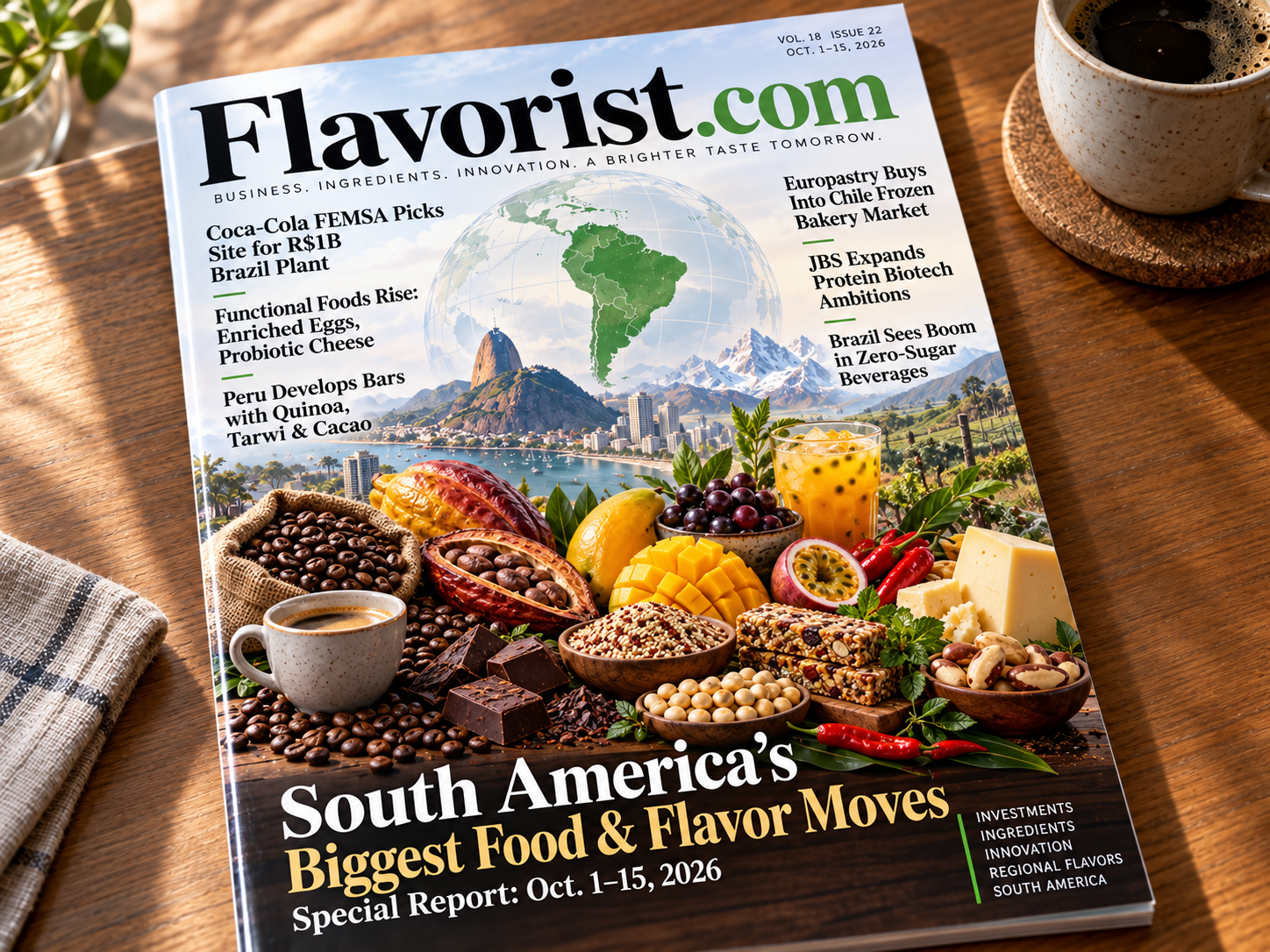
October 1–15, 2026 | Flavorist.com Industry Intelligence
Geographic coverage: Brazil, Argentina, Chile, Colombia, Peru, Ecuador, Uruguay, Paraguay, and neighboring South American markets.
This report presents significant business developments published between October 1 and October 15, 2026. The selection emphasizes investments, acquisitions, manufacturing expansion, natural ingredients, product innovation, specialty foods, foodservice, and regional market trends that matter to flavor and food professionals.
The report excludes legislative and regulatory news.
1. Major acquisitions, manufacturing investments and corporate strategy
1. Coca-Cola FEMSA selects site for R$1 billion beverage factory in Brazil
October 15, 2026 | Brazil | Beverage manufacturing
Coca-Cola FEMSA selected Caçapava, São Paulo, as the location for a new soft-drink manufacturing facility, representing an estimated investment of R$1 billion, approximately US$199 million.
The facility, developed through subsidiary Coca-Cola SPAL Indústria Brasileira de Bebidas, is expected to produce approximately 400 million liters annually. The investment follows a site-selection process lasting more than a year and forms part of the company's efforts to modernize production and logistics in Brazil.
Plans include extensive automation, artificial intelligence, energy-efficiency systems, and advanced water-management technologies. The project is also expected to generate hundreds of direct and indirect employment opportunities during construction and operation.
For beverage and flavor professionals, the investment signals long-term confidence in Brazil's soft-drink market and creates potential opportunities for flavor concentrates, sweeteners, packaging, processing equipment, and beverage innovation.
Industry significance: One of the largest food and beverage manufacturing investment announcements in South America during the reporting period.
Source:Industrial Info Resources — October 15, 2026
2. Europastry acquires majority stake in Chilean frozen bakery operation
October 7, 2026 | Chile | Mergers & acquisitions / Bakery
Spanish frozen-bakery manufacturer Europastry acquired a majority stake in a business combining its Chilean operations with Alicomer, a local producer associated with the Pan de Origen brand.
The transaction establishes Chile as a strategic platform for Europastry's next phase of Latin American expansion. Alicomer brings local manufacturing facilities and relationships with major retail and convenience customers, including Walmart and OXXO.
Europastry contributes international bakery expertise, product innovation capabilities, and extensive distribution experience.
The company believes Chile's frozen-bakery segment offers substantial growth potential. Frozen products currently represent less than 10% of the country's fresh bakery market, compared with approximately 40% in Europe.
Locally manufactured frozen bakery products can help retailers reduce waste, simplify preparation, and offer freshly baked products throughout the day.
Industry significance: The acquisition strengthens Chile's industrial bakery market and creates opportunities for flour suppliers, bakery ingredients, fillings, frozen dough technologies, and flavor development.
Source:FoodNewsLatam — October 7, 2026
3. Uruguayan investment group acquires stake in Argentine healthy-snack producer Zafrán
October 5, 2026 | Argentina / Uruguay | Private equity / Natural snacks
Uruguayan investment group Capibara acquired a 12% stake in Zafrán, an Argentine producer of better-for-you snack bars and other health-oriented foods. The transaction represents Capibara's first investment in Argentina.
Zafrán, founded by Charlie Rivero Haedo and Nito Anello, reported approximately US$3.8 million in 2025 revenue and expects sales of US$4.5 million in 2026. The business manufactures more than one million snack bars monthly, distributed through supermarkets, convenience stores, and specialty natural-food retailers.
According to the October report, the company plans to invest approximately US$500,000 in its manufacturing facilities while exploring opportunities for international growth.
The investment reflects interest in established regional brands that offer convenient nutrition and distinctive product positioning.
Industry significance: A meaningful transaction within South America's emerging natural-snack industry, creating potential opportunities for protein ingredients, natural flavors, seeds, nuts, cereals, and premium snack formulations.
Source:El Cronista — October 5, 2026
4. Colombia's Postobón enters new chapter following ownership restructuring
October 6, 2026 coverage | Colombia | Corporate restructuring / Beverages
Colombian beverage manufacturer Postobón was the subject of an October business report examining its transition from the corporate legacy of Carlos Ardila Lülle toward a broader multilatina ownership structure.
The company, founded more than 120 years ago, has a distribution footprint reaching approximately 90% of Colombian territory. Its portfolio includes some of the country's best-known soft drinks, including Manzana Postobón, a distinctive apple-flavored carbonated beverage introduced in the 1950s.
The report describes the transition as strategically important for the company's future direction and potential regional scale.
For the beverage industry, changes involving a company of Postobón's size are relevant to distribution strategy, procurement, brand investment, and innovation. Established domestic flavors also remain valuable assets in competition with multinational beverage brands.
Industry significance: A potentially important restructuring of one of Colombia's best-established beverage companies.
Source:FoodNewsLatam — October 6, 2026
5. MBRF invests R$13.6 million in Paraguayan pet-food factory and enters U.S. market
October 13–14, 2026 | Brazil / Paraguay | Pet-food manufacturing / International expansion
MBRF Pet, the companion-animal nutrition division of Brazilian food giant MBRF, announced its entry into the United States and an investment of R$13.6 million to expand its manufacturing and distribution capabilities in Paraguay.
The investment increased storage capacity at the company's Doctor Juan León Mallorquín facility by 165%. The plant supplies markets including Brazil, Chile, Bolivia, and Uruguay, serving as an important regional export center.
MBRF Pet has expanded from 15 to 20 international markets over the past two years and plans to reach 26 countries by the end of 2027.
The U.S. expansion will focus on premium pet-food products, particularly products for cats.
Industry significance: The development strengthens Paraguay's role in regional food manufacturing and shows how Brazilian protein companies are expanding into higher-value nutrition categories.
Sources: Mercado&Consumo — October 14, 2026; UOL / Estadão — October 14, 2026
2. Functional foods, natural products and ingredient innovation
6. Brazil's Tijuca Alimentos develops selenium- and omega-3-enriched eggs
October 8, 2026 | Brazil | Functional nutrition / Poultry
Tijuca Alimentos, a food producer based in Fortaleza with more than 50 years of history, outlined its strategy for developing eggs enriched with selenium and omega-3 fatty acids.
The initiative seeks to differentiate eggs through enhanced nutritional composition while building on the company's established position in northeastern Brazil.
Eggs remain an important and relatively affordable source of protein in the Brazilian market, where average annual consumption exceeds 250 eggs per person.
By emphasizing additional nutritional attributes, Tijuca is seeking opportunities beyond conventional commodity egg sales.
The strategy also illustrates the potential of nutritional improvements achieved through animal feeding and agricultural production rather than relying exclusively on fortified processed foods.
For food manufacturers, enriched eggs could support new premium ingredient and product-positioning opportunities in bakery, prepared meals, and nutrition-oriented foods, subject to suitable commercial specifications.
Industry significance: Regional agricultural businesses are increasingly pursuing value-added functional foods to improve differentiation and profitability.
Source:FoodNewsLatam — October 8, 2026
7. Uruguay's Farming introduces country's first probiotic requesón cheese
October 6, 2026 | Uruguay | Functional dairy / Product innovation
Farming, an artisanal cheese company based in Nueva Helvecia, launched what it describes as Uruguay's first locally produced probiotic requesón cheese.
The development combines a familiar dairy product with selected live probiotic cultures, extending functional-food innovation into a traditional cheese category.
Farming chose requesón because consumers commonly eat it at breakfast and during snacks, making it suitable for a product intended for regular consumption.
One of the company's principal formulation challenges was maintaining the viability of probiotic cultures throughout production, storage, and distribution. Such organisms may be sensitive to manufacturing temperatures and other processing conditions.
The launch follows more than a year of development work and represents a significant addition to Farming's artisanal dairy portfolio.
Industry significance: An important example of regional dairy innovation, demonstrating opportunities to combine traditional foods with specialized cultures, functional ingredients, and differentiated nutritional positioning.
Source:FoodNewsLatam — October 6, 2026
8. Peru develops functional bars using quinoa, tarwi and Amazonian ingredients
October 14, 2026 | Peru | Functional snacks / Indigenous ingredients
Peru's Instituto Tecnológico de la Producción (ITP), through its Ambo Agroindustrial Technical Unit in Huánuco, developed three nutritional bar formulations featuring native Andean and Amazonian ingredients.
The formulations combine ingredients including quinoa, tarwi, chia, cacao, aguaymanto, and macambo.
The project, presented October 10, includes an energy bar, a protein-oriented bar, and a product positioned around digestive nutrition.
Development involved evaluations of texture, moisture, compactness, aroma, taste, and overall sensory acceptance.
Further work will examine shelf stability, preservation requirements, and commercial feasibility before the products are ready for broader production.
The initiative aims to help small and medium-sized manufacturers develop higher-value foods from crops grown in Peru.
Industry significance: The research demonstrates how regional biodiversity can support differentiated functional snacks while creating opportunities for local farmers, natural ingredient suppliers, and smaller food manufacturers.
Source:FoodNewsLatam — October 14, 2026
9. Added-protein products gain penetration in Brazilian households
October 12, 2026 | Brazil | Consumer insights / Functional nutrition
Brazilian retail reporting highlighted increased consumer purchases of foods with added protein, demonstrating the continued mainstream expansion of functional nutrition.
According to the report, the category's sales grew 12% and reached 21% of Brazilian households during the rolling year ending in the first quarter of 2026.
The findings suggest that protein fortification is becoming relevant beyond sports nutrition, with manufacturers increasingly incorporating additional protein into familiar everyday food and beverage products.
This trend offers potential opportunities in dairy, snacks, bakery, ready-to-drink beverages, and convenient meals.
For food formulators, increased protein content can introduce challenges involving solubility, texture, flavor masking, moisture retention, and production costs.
Manufacturers must therefore balance nutritional differentiation with acceptable sensory performance and price.
Industry significance: The growth of protein-enriched products in Brazil points to expanding demand for dairy proteins, plant proteins, flavor-masking systems, and ingredients that support nutritionally enhanced mainstream foods.
Source:Mercado&Consumo — October 12, 2026
10. Whey protein reshapes Brazil's dairy ingredient business
October 15, 2026 | Brazil | Dairy ingredients / Market trends
A new Brazilian dairy-industry report examined the expansion of whey protein into beverages and food formats beyond conventional sports supplements.
The growing market includes protein waters, snack products, and even beer-inspired beverages.
One example is Ambev's Spaten Pro, a non-alcoholic beverage containing 10 grams of protein per 350-milliliter can, introduced earlier in 2026. Another is Mineral Pro, a whey-containing water beverage providing 10 grams of protein per 250 milliliters.
Mineral Pro reportedly sold between 200,000 and 250,000 units during its first six months.
The trend is placing greater attention on the processing capacity and commercial value of whey, traditionally a byproduct of cheese manufacturing.
Industry significance: Protein demand is creating opportunities for Brazilian dairy processors and ingredient manufacturers, particularly those capable of supplying high-quality whey concentrates and developing beverages with acceptable clarity, flavor, and texture.
Date note: This is an October 15 market analysis, not an October launch announcement for the products mentioned.
Source:FoodNewsLatam — October 15, 2026
11. JBS invests more than US$100 million in biotechnology and functional proteins
October 14, 2026 | Brazil | Protein ingredients / Biotechnology
Brazilian meat producer JBS is expanding into specialized protein ingredients, biotechnology, and personalized nutrition as consumer demand shifts toward functional and nutritionally differentiated products.
In an October 14 interview, global CEO Gilberto Tomazoni explained that consumers increasingly consider amino-acid composition, protein digestibility, and functionality rather than simply the amount of protein in a product.
JBS has invested more than US$100 million in its JBS Biotec operations in Brazil and Spain. The company intends to use technology to convert existing protein raw materials into higher-value ingredients suitable for nutritional supplements and additional food applications.
The strategy could create new revenue streams beyond conventional meat production while improving the commercial value of existing raw materials.
Industry significance: This is particularly important for food scientists, protein-ingredient suppliers, and manufacturers developing functional beverages, nutritional supplements, and high-protein foods. It demonstrates how one of the world's largest protein companies is positioning itself within the specialized nutrition market.
Date note: The creation of JBS's Genu-in protein initiative was reported in September; the October 14 interview provides new strategic detail.
Source: Mercado&Consumo — October 14, 2026
3. Agricultural ingredients, specialty products and regional supply chains
12. Chilean walnut exports reach US$644 million ahead of ExpoNut 2026
October 15, 2026 | Chile | Nuts / Agricultural exports
Chile's walnut industry reported export sales totaling US$644 million as producers prepared for ExpoNut 2026, the country's major walnut-industry conference scheduled for November.
The figures highlight the economic importance of walnuts within Chile's agricultural export sector and their continued relevance to international food manufacturers.
Walnuts are used extensively in bakery, confectionery, cereals, snacks, nut butters, and premium ingredient applications.
However, producers face challenges involving climate variability, production costs, international competition, and profitability. These factors can influence raw-material pricing, sourcing decisions, and the ability of exporters to remain competitive.
The industry is focusing on improved efficiency and maintaining the quality standards required by international buyers.
For food and flavor professionals, developments in Chilean walnut production can influence ingredient availability and the economics of premium nut-based formulations.
Industry significance: The export performance demonstrates the strategic importance of Chile as a supplier of tree nuts to international food manufacturers.
Source:FoodNewsLatam — October 15, 2026
13. Peruvian food producers report US$11.4 million in potential business at Expoalimentaria
October 8, 2026 | Peru | Food exports / Small businesses
Twenty-four Peruvian producer associations and small and medium-sized businesses reported US$11.4 million in prospective commercial opportunities following their participation in Expoalimentaria 2026.
The exhibition, held September 23–25 in Lima, brought together manufacturers, agricultural producers, importers, distributors, and international buyers.
Participants from 13 Peruvian regions held 757 business meetings, including 277 with international buyers and 480 with domestic customers.
According to the October report, projected international opportunities exceeded US$9.4 million, with additional domestic opportunities exceeding seven million Peruvian soles.
These amounts represent prospective transactions rather than confirmed sales.
The participating businesses received support through Peru's export and production-development programs.
Industry significance: The results demonstrate the commercial potential of regional Peruvian food businesses and the importance of international trade exhibitions in connecting natural ingredient suppliers and specialty producers with larger markets.
Date note: Results were published October 8; the exhibition itself occurred in September.
Source:FoodNewsLatam — October 8, 2026
14. Peru advances domestic cheese production through ProLácteos initiative
October 7, 2026 coverage | Peru | Dairy / Regional manufacturing
Peru's ProLácteos program is supporting the development of domestic cheese manufacturing capacity in an effort to reduce reliance on imported specialty cheeses.
According to October reporting, the country imports approximately 23,000 kilograms of cheese daily, particularly mature European varieties.
Peruvian cheese consumption has risen to approximately 5.2 kilograms per person annually, more than double the level recorded in 2009.
The program, launched in May 2025, includes planned investments exceeding 43 million soles over four years and targets more than 4,500 dairy producers and 115 processing facilities.
Its initiatives include technical assistance, business training, maturation chambers, and education for cheesemakers.
By July 2026, the program had provided assistance to more than 2,000 producers and 87 artisanal processing facilities.
Industry significance: The initiative could expand demand for dairy cultures, enzymes, specialty ingredients, cheese-processing technologies, and regional premium cheese products.
Date note: The underlying program predates October; the source is an October 7 progress report.
Source:FoodNewsLatam — October 7, 2026
15. Argentine dairy producer begins exporting lactose-free cheese to Dubai
October 5–12, 2026 | Argentina | Specialty dairy / Export expansion
Lácteos Capilla del Señor, a family-owned dairy manufacturer based in Villa María, Córdoba, completed its first shipment of lactose-free cheeses to Dubai, targeting premium foodservice customers in the United Arab Emirates.
The shipment comprised approximately 1,000 kilograms of mozzarella and provoleta sold under the Lombarde brand. The products were transported by air, allowing the company to test logistics, product acceptance, and commercial demand before committing to larger shipments.
Management plans to assess the initial order's performance and potentially move toward container shipments if demand justifies expansion.
The company has export experience dating to 2007, but its Dubai initiative represents a new opportunity in a specialized, value-added dairy category.
Industry significance: Although the transaction is small compared with multinational investments, it is meaningful for Argentina's regional dairy sector. It demonstrates how lactose-free formulations, specialty cheeses, and premium positioning can help smaller South American food manufacturers access international markets.
Sources: La Nación — October 5, 2026; FoodNewsLatam — October 12, 2026
4. Beverage innovation and consumer market trends
16. Sugar-free beverages gain market share in Brazil despite premium pricing
October 15, 2026 | Brazil | Beverages / Consumer demand
Brazilian retail data published by Mercado&Consumo showed substantial growth in sugar-free and reduced-ingredient beverage categories between 2024 and 2026.
According to research from Neogrid, the share of zero-calorie energy drinks in recorded retail purchases increased from 12.2% to 20.6%.
Sugar-free soft drinks also gained ground, increasing their share from 18.6% to 22.5%.
These changes occurred despite higher average prices. In 2026, zero-calorie energy drinks were approximately 14.4% more expensive per liter than conventional equivalents, while sugar-free soft drinks carried an average premium of 20.5%.
The findings indicate that certain consumers are willing to pay more for beverages positioned around sugar reduction and different nutritional preferences.
For flavor professionals, this increases the commercial importance of sweetener systems capable of delivering desirable taste without conventional sugar.
Industry significance: Brazil's shift toward sugar-free beverages creates opportunities for high-intensity sweeteners, sweetness modulators, bitterness masking, and functional beverage innovation.
Source:Mercado&Consumo — October 15, 2026
17. Argentine winery Huarpe Riglos enters Brazil's premium wine market
October 12, 2026 | Argentina / Brazil | Premium beverages / Market expansion
Argentine wine producer Huarpe Riglos Family Wines entered the Brazilian market through a distribution partnership with São Paulo-based importer SetWines.
The Mendoza-based producer aims to sell approximately 150,000 bottles in Brazil over the next three years.
Its market-entry strategy emphasizes premium positioning, product origin, and differentiated consumer experiences.
The company plans to establish an e-commerce channel while expanding distribution through restaurants, specialty wine retailers, distributors, and other commercial partners.
The move reflects growing interest in premium imported beverages among Brazilian consumers who place value on quality, provenance, and distinctive regional characteristics.
For the wider flavor industry, the development illustrates how geographic origin and sensory identity can support premium product positioning.
Industry significance: The expansion strengthens commercial connections between Argentina's established wine-production industry and Brazil's premium beverage market while creating new opportunities for specialty beverage distributors and foodservice operators.
Source:Mercado&Consumo — October 12, 2026
18. Froneri and Fini launch candy-inspired ice cream in Brazil
October 11, 2026 | Brazil | Confectionery / Frozen desserts
Froneri, the global ice cream company associated with brands including Häagen-Dazs, partnered with confectionery manufacturer Fini to introduce a popsicle inspired by Fini Minhocas gummy candy.
The new product combines green apple and raspberry flavors with a filling designed to reproduce the texture of gummy candy.
Priced at R$4.99, the product targets consumers looking for novelty, recognizable confectionery flavors, and affordable indulgence.
Froneri is supporting the launch through retail promotions, social media, and consumer activations.
The collaboration demonstrates how established confectionery brands can extend their sensory identities into adjacent categories. Recreating a gummy-candy experience in frozen desserts requires careful management of flavor intensity, acidity, texture, and temperature-dependent ingredient behavior.
Industry significance: The partnership illustrates the commercial potential of cross-category flavor innovation, particularly combinations involving familiar candy profiles, fruit flavors, and distinctive textures in ice cream.
Source:Mercado&Consumo — October 11, 2026
19. Nestlé signs multiyear NBA partnership for Nescau, Nesquik and Milo in 21 markets
October 8, 2026 | Brazil / International markets | Brand strategy / Nutritional beverages
Nestlé announced a long-term commercial partnership with the National Basketball Association, positioning Nescau, Nesquik, and Milo as official NBA brands across 21 markets on four continents.
The agreement takes effect January 1, 2027, and includes marketing initiatives connected with youth basketball development, athlete-focused programs, events, and retail promotions.
Nescau is particularly important in Brazil, where it has strong recognition in chocolate-flavored milk and powdered beverages. Milo and Nesquik provide Nestlé with additional regional brands serving different consumer markets.
The partnership illustrates how international food and beverage manufacturers are using sports associations to strengthen consumer engagement, brand relevance, and market differentiation.
For beverage professionals, it also demonstrates the commercial significance of established flavor identities, particularly chocolate and malt-based products, in highly competitive nutritional beverage categories.
Industry significance: A major international marketing investment involving well-established food and beverage brands, with implications for retail promotion, brand positioning, and consumer demand.
Source: Mercado&Consumo — October 8, 2026
20. Paraguay sends 12 food companies to SIAL Paris to pursue export opportunities
October 13, 2026 | Paraguay | Food exports / Specialty ingredients
Twelve Paraguayan food companies announced their participation in SIAL Paris 2026, with the objective of expanding international distribution, securing commercial partnerships, and showcasing the country's agricultural and food-processing capabilities.
The delegation includes Hypergrain, TGL Foods, Hilagro, Oleaginosa Raatz, Alpacasa, and other regional producers.
The initiative is organized by Paraguay's chia exporters association, Capachía, with support from the country's investment and export-promotion agency, Rediex.
The companies will present their products to international buyers during the exhibition, scheduled for October 17–21.
Paraguay's participation is especially relevant to buyers seeking agricultural ingredients and products from emerging South American suppliers.
The commercial results remain prospective until purchase commitments or distribution agreements are confirmed.
Industry significance: The initiative demonstrates how regional exporters are pursuing greater access to international ingredient and specialty-food markets, creating potential opportunities for natural ingredient buyers and manufacturers seeking diversified sources.
Source:FoodNewsLatam — October 13, 2026
Also noted
- October 14 | Brazil — Alagoas attracts dairy industry interest, with Alvoar, Piracanjuba and Natville participating in regional development discussions. (FoodNewsLatam)
- October 15 | Brazil — Minas Gerais artisan cheese industry highlighted through the Rica Nata symposium. (FoodNewsLatam)
South America: Key industry trends
Manufacturing modernization and consolidation
Coca-Cola FEMSA's Brazilian factory, Europastry's Chilean acquisition, and MBRF's Paraguayan expansion show continued investment in production capacity, technology, and regional distribution.
Natural and functional nutrition gains importance
Zafrán's investment, Tijuca's enriched eggs, Farming's probiotic cheese, and Lácteos Capilla del Señor's lactose-free cheese exports demonstrate opportunities for smaller businesses to differentiate through nutrition.
Protein and sugar reduction reshape formulations
Brazilian consumers' growing interest in protein-enriched foods and sugar-free beverages, along with JBS's investment in functional proteins, increases demand for specialized ingredients and improved sensory systems.
Regional agricultural ingredients offer differentiation
Peru's Andean grains and Amazonian ingredients, Chile's walnuts, and Paraguay's export-oriented producers demonstrate the potential of local agricultural specialties.
Sensory innovation creates opportunities across categories
Candy-inspired frozen desserts, premium wines, and functional dairy products show how flavor, texture, and product identity can help manufacturers distinguish their offerings.