What Is Blue Raspberry Flavor Made Of? The Science Behind the Bright Blue Taste
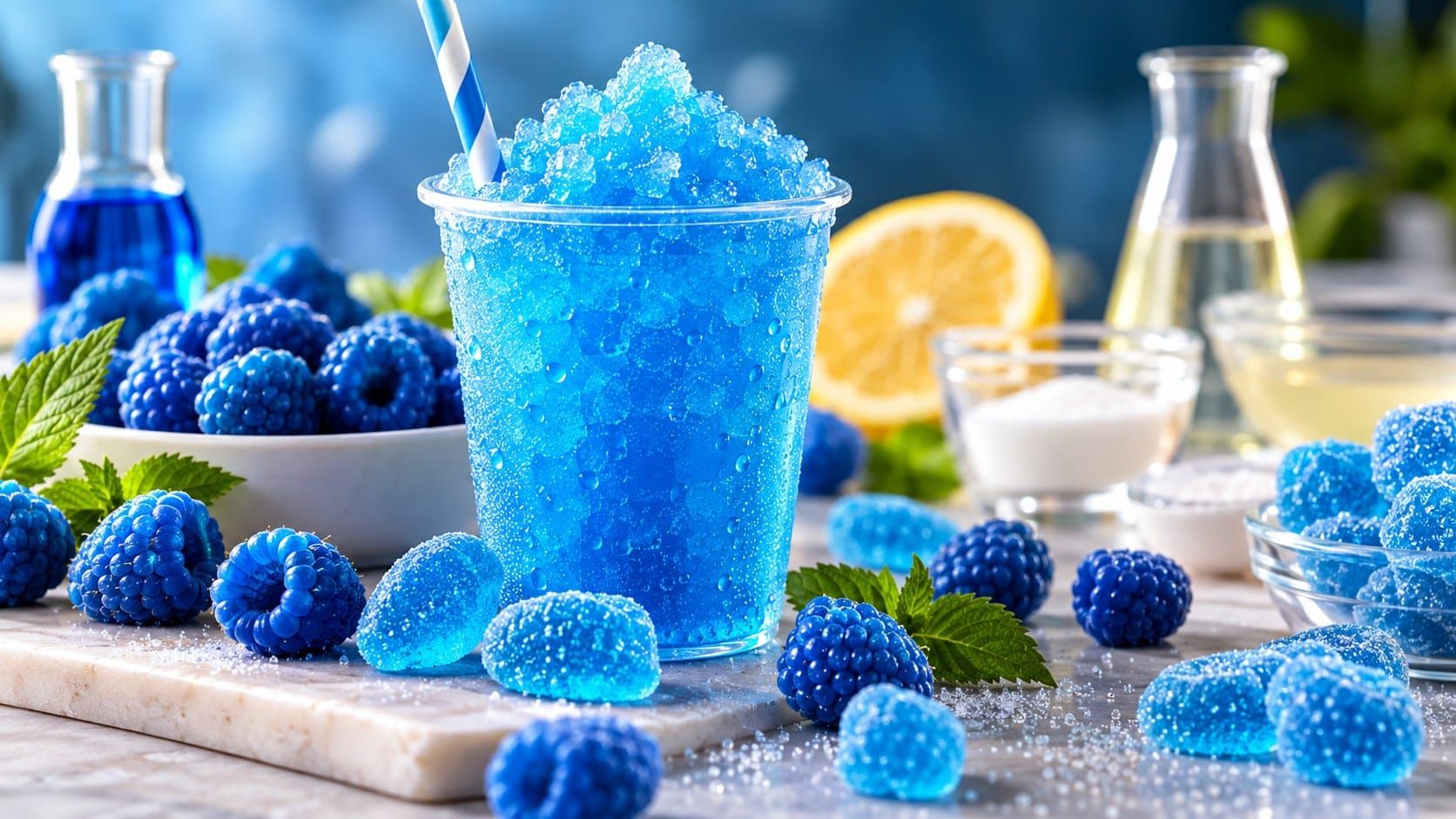
Blue raspberry is one of America's most recognizable candy and beverage flavors. But what exactly is it made of—and why does it taste nothing like the raspberries growing in your garden?
From frozen slushies and sour gummies to sports drinks and energy beverages, blue raspberry has become a familiar flavor. Its electric-blue appearance and intensely sweet-tart taste are immediately recognizable.
Yet the story behind blue raspberry is surprisingly complex. Unlike strawberry, lemon, or orange, blue raspberry is not a flavor typically extracted from a corresponding blue fruit. It is a carefully developed flavor profile created through food science.
Understanding what goes into blue raspberry reveals how flavor chemists design recognizable tastes—and how food manufacturers are adapting those flavors to changing consumer preferences and color regulations.
What Is Blue Raspberry Flavor Made Of?
Blue raspberry flavor is typically made from a blend of natural and/or artificial flavoring substances designed to produce a sweet, fruity, raspberry-like taste with a pronounced tart finish.
Depending on the manufacturer and product, blue raspberry-flavored foods may contain:
- Flavoring compounds: Aromatic substances that create fruity, berry-like, candy-like, and sometimes tropical notes.
- Sweeteners: Sugar, corn syrup, or alternative sweeteners that establish the desired sweetness.
- Food acids: Citric acid, malic acid, or combinations that produce the characteristic sour or tangy sensation.
- Color additives: Traditionally FD&C Blue No. 1, although manufacturers may use other permitted coloring solutions.
- Other formulation ingredients: Water, stabilizers, preservatives, or carriers depending on the application.
There is no single universal blue raspberry formula. A blue raspberry candy, frozen beverage, and energy drink may all share a recognizable flavor identity while using substantially different formulations.
Importantly, blue raspberry flavoring itself does not have to be blue. Flavor and color are separate components, even though consumers strongly associate them.
Is Blue Raspberry a Real Fruit?
The short answer is no—not in the electric-blue form associated with candy and frozen drinks.
Real raspberries come in several colors, including red, black, purple, and golden-yellow. A North American species called the whitebark raspberry (Rubus leucodermis) produces fruit that can appear dark purple or bluish-black.
However, this fruit is not the bright blue raspberry pictured on candy packaging, and commercial blue raspberry flavor is not necessarily derived from it.
The blue raspberry flavor familiar to consumers is largely a food-industry creation rather than a direct reproduction of a particular fruit.
Why Is Blue Raspberry Blue?
The blue color has more to do with product recognition and food marketing than with the natural appearance of raspberries.
During the mid-20th century, manufacturers commonly used red colors for strawberry, cherry, raspberry, and watermelon products. Having several flavors represented by similar shades of red made visual differentiation difficult.
Blue offered a distinctive alternative.
Historical accounts identify blue raspberry-flavored snow-cone products being promoted as early as 1958. The flavor became more widely recognized in the early 1970s through products such as blue raspberry ICEE beverages and Otter Pops.
Concerns surrounding the use of FD&C Red No. 2 also form part of this history. However, blue raspberry existed before the FDA banned Red No. 2 in 1976, so it would be inaccurate to say the ban itself invented the flavor.
FD&C Blue No. 1, also called Brilliant Blue FCF, eventually became closely associated with blue raspberry products.
The unusual color provided a powerful commercial advantage: consumers could identify the flavor at a glance.
What Does Blue Raspberry Actually Taste Like?
Blue raspberry usually tastes sweet, tart, intensely fruity, and more candy-like than fresh raspberries.
Compared with natural raspberry, the typical blue raspberry profile emphasizes immediate flavor impact rather than delicate botanical complexity.
| Flavor characteristic | Typical blue raspberry profile |
|---|---|
| Sweetness | High, especially in candy and slushies |
| Sourness | Noticeable, sometimes very intense |
| Berry character | Bright, raspberry-inspired, and often jammy |
| Fruity notes | May suggest cherry, pineapple, or other fruit nuances |
| Floral character | Usually less delicate than fresh raspberry |
| Finish | Lingering sweet-tart, candy-like sensation |
Fresh raspberries have a more complex aroma, with delicate green, floral, fruity, and sometimes woody nuances.
Blue raspberry products often exaggerate the fruit's sweetness and acidity, creating a flavor designed for immediate recognition.
That is why a blue raspberry gummy can taste dramatically different from a fresh raspberry while still delivering a recognizable berry-inspired impression.
The Science Behind Blue Raspberry Flavor: How Flavor Chemists Create It
For flavor professionals, blue raspberry is an interesting example of a constructed flavor identity—one defined as much by consumer expectations as by its resemblance to a natural reference.
Rather than trying to duplicate the aroma of one specific fruit, flavorists can develop a profile that combines selected berry-like, fruity, sweet, and acidic characteristics.
1. Building the fruity aroma
Fruit flavor perception involves volatile aromatic molecules that reach the olfactory receptors during eating or drinking.
Flavorists may use several classes of aroma compounds, including esters, ketones, aldehydes, and other molecules, to create a target sensory profile.
Esters are particularly useful for developing bright, fruity characteristics. Depending on the formulation, selected esters can contribute sweet, tropical, apple-like, or other fruit-associated notes.
Raspberry-associated compounds and supporting fruit notes may also be used to build the overall impression.
There is, however, no universal recipe requiring blue raspberry to contain specific banana, cherry, and pineapple flavor compounds. Although such descriptions appear in popular explanations, actual commercial formulations vary and are frequently proprietary.
2. Creating the raspberry impression
A successful blue raspberry flavor normally needs a recognizable berry foundation.
Flavorists can construct this using a combination of raspberry-associated aroma notes, additional fruity materials, and appropriate sweetness and acidity.
The goal is not always botanical realism.
In a sour candy, for example, consumers may expect a bold, high-impact berry character. In a sparkling beverage, the same flavor identity may need to be lighter, more refreshing, and less syrupy.
A flavorist therefore adjusts the profile to the food or beverage matrix.
3. Designing the sourness
Acid plays an especially important role in blue raspberry flavor.
Citric acid can provide a sharp, refreshing sourness. Malic acid can contribute a different, often more prolonged tart sensation.
For applications such as sour gummies, combining acids may help create a layered sourness experience.
However, an acid does more than increase sourness. It also affects overall flavor balance, perceived sweetness, and the release and perception of other sensory notes.
Two blue raspberry products using the same aromatic flavor concentrate can taste quite different when their sweetener and acid systems change.
4. Balancing sweetness and aroma
Sugar and other sweeteners influence how consumers perceive fruity aromas and acidity.
Without sufficient sweetness, a blue raspberry formulation may seem excessively sour or thin. Too much sweetness can suppress the desired refreshing character.
Flavorists must evaluate the entire system rather than considering aroma ingredients in isolation.
This is particularly important in reduced-sugar beverages, where replacing sucrose may change sweetness onset, aftertaste, mouthfeel, and overall flavor balance.
5. Matching color with flavor expectations
Research in sensory psychology demonstrates that visual cues can influence how people perceive flavors.
Blue raspberry provides an especially interesting example because the association between bright blue and raspberry-like sweetness is largely learned.
After decades of exposure to blue slushies, candies, and frozen treats, consumers have developed strong expectations about what a bright-blue raspberry product should taste like.
For flavor developers, this means color changes may influence sensory acceptance—even if the flavor formulation itself remains unchanged.
Is Blue Raspberry Flavor Natural or Artificial?
Blue raspberry can be formulated using natural flavors, artificial flavors, or combinations of both.
The distinction depends on the origins and regulatory classification of the flavoring materials, not simply on whether a blue raspberry fruit exists.
Under U.S. food-labeling regulations, natural flavors must meet defined source requirements. Artificial flavors are flavoring substances that do not meet the regulatory definition of natural flavor.
Therefore, a product may legitimately use natural flavoring substances to create a blue raspberry taste without containing actual raspberry juice.
Similarly, a product labeled as containing natural flavors is not necessarily made with whole fruit or fruit extract.
It also helps to distinguish the flavor system from the color system. A product might contain natural flavors alongside a synthetic color additive, or a mixture of artificial and natural flavors with a naturally derived color.
The ingredient label is the best starting point for understanding a particular product.
Does Blue Raspberry Contain Actual Raspberries?
Not necessarily.
Many blue raspberry-flavored foods contain little or no raspberry fruit. Their flavor can come from a specially formulated flavoring system rather than raspberry juice or puree.
Take ICEE's Blue Raspberry frozen beverage. Its published ingredient list includes water, a syrup blend, sugar, natural and artificial flavor, FD&C Blue No. 1, citric acid, ascorbic acid, and other formulation ingredients.
This shows the difference between a berry-inspired flavor and a product made from the actual fruit.
If real raspberry matters to you, check the ingredient statement for raspberry juice, puree, concentrate, or other raspberry-derived materials rather than relying on the flavor name alone.
Is Blue Raspberry Flavor Safe?
The safety of a blue raspberry-flavored product depends on its specific ingredients, amounts consumed, and applicable food regulations—not on the flavor name or bright color alone.
In the United States, food flavorings and color additives are subject to distinct regulatory requirements.
FD&C Blue No. 1 has been an FDA-listed color additive for permitted food uses. However, food-color policy is changing, and manufacturers should verify current regulations rather than assume every previously used color will remain commercially appropriate.
From a nutritional standpoint, many blue raspberry candies and frozen beverages can contain substantial added sugar.
A blue raspberry-flavored product should therefore be evaluated using its complete ingredient statement and Nutrition Facts label.
An artificial flavor is not automatically unsafe, and natural flavors do not automatically make a product healthier.
The Next Challenge for Flavor Professionals: Blue Raspberry Without Synthetic Blue Dye
One of the industry's current formulation challenges is maintaining the recognizable blue raspberry experience while reducing reliance on synthetic color additives.
The FDA has been working with manufacturers toward the voluntary removal of several petroleum-derived certified food colors, including FD&C Blue No. 1, by the end of 2027.
This has increased interest in naturally derived color alternatives and created new formulation challenges for beverages, confectionery products, and frozen desserts.
Why replacing Blue No. 1 is challenging
An alternative blue color must perform under the intended processing, packaging, and storage conditions.
Important variables include:
- pH stability: Some naturally derived blue pigments change color or lose stability in acidic products.
- Thermal stability: High-temperature candy manufacturing and heat processing can affect certain pigments.
- Light exposure: Beverages in transparent packaging may experience color changes during storage.
- Ingredient interactions: Minerals, preservatives, oxygen, and other formulation components can influence pigment behavior.
- Shelf-life performance: Manufacturers need a visually acceptable product throughout its intended commercial life.
Potential color options depend on the product and applicable regulations. FDA-authorized alternatives now include certain uses of colors such as Galdieria extract blue, gardenia blue, and butterfly pea flower extract.
None should be assumed to be a direct, one-for-one substitute for FD&C Blue No. 1 across all applications.
For flavor houses and finished-product manufacturers, color reformulation may require additional sensory testing because changes in appearance can alter perceived flavor intensity and identity.
Opportunities for Blue Raspberry Innovation
Although blue raspberry is a long-established candy flavor, it offers opportunities beyond traditional confectionery.
Functional and sports beverages: Blue raspberry's pronounced fruity and acidic profile can be useful when formulating electrolyte and other functional drinks, particularly where bitterness or mineral notes require balancing.
Reduced-sugar products: Developers can explore lower-sugar blue raspberry profiles, but must rebuild sweetness, mouthfeel, and acid balance to maintain the expected sensory experience.
Layered fruit profiles: Blue raspberry can be paired with lemonade, lime, strawberry, or tropical fruit notes to create more complex flavor experiences.
Sour confectionery: Different acid systems and flavor-release strategies offer opportunities to differentiate gummies, hard candies, and sour coatings.
Naturally colored products: As food-color strategies evolve, brands can investigate alternative color systems, lighter blue shades, or even products that deliberately separate the familiar blue raspberry taste from its traditional appearance.
The common objective is to preserve what consumers recognize while adapting to new product requirements.
Frequently Asked Questions About Blue Raspberry Flavor
What chemicals make blue raspberry flavor?
There is no single chemical responsible for blue raspberry flavor. Commercial flavor systems can use combinations of aroma compounds, including esters and other fruit-associated molecules. Their precise composition varies by supplier and application.
Is blue raspberry just raspberry and blueberry mixed together?
No. Blue raspberry is not generally created by simply combining raspberry and blueberry flavors. It is a distinct, commercially developed flavor profile, although individual manufacturers may choose to incorporate various berry notes.
Is blue raspberry made from beaver glands?
No. There is no basis for describing commercial blue raspberry flavor as being made from beaver glands. The myth is related to castoreum, a historically used flavoring material that is not a defining ingredient of blue raspberry.
Why is blue raspberry so sour?
Blue raspberry products often contain food acids such as citric or malic acid. These contribute the tart sensation consumers expect, particularly in sour candy and frozen beverages.
Is blue raspberry flavor always artificial?
No. Blue raspberry flavor can be formulated using natural or artificial flavoring materials, subject to applicable labeling requirements.
Does blue raspberry contain Blue 1?
Many traditionally formulated blue raspberry products use FD&C Blue No. 1, but not all do. Some products may use alternative color systems, and others may have no added blue color at all.
Why does blue raspberry taste different from regular raspberry?
Blue raspberry is typically designed for intense sweet-tart impact, while natural raspberries have a more delicate and complex aroma. The commercially familiar blue raspberry taste is a distinct sensory profile rather than an exact reproduction of fresh fruit.
Final Thoughts: Blue Raspberry Is a Flavor Designed by Science—and Defined by Consumers
Blue raspberry illustrates an important principle of flavor science: not every successful flavor must be a direct copy of something found in nature.
Its identity emerged through a combination of fruity flavor chemistry, acidity, sweetness, color, and consumer experience.
For consumers, the explanation is straightforward: blue raspberry flavor is generally a formulated blend of fruity aroma ingredients and sweet-tart taste components, not a flavor extracted from a bright-blue raspberry.
For flavor professionals, the story is more significant. It demonstrates how flavor perception is shaped by product formulation, sensory expectations, visual identity, and decades of consumer learning.
As manufacturers explore new sweetener systems, naturally derived colors, and evolving product formats, blue raspberry will remain a useful case study in how flavor science transforms familiar ingredients into distinctive experiences.