South America Food & Flavor Regulatory Update: Key legal and regulatory developments released August 1–14, 2026
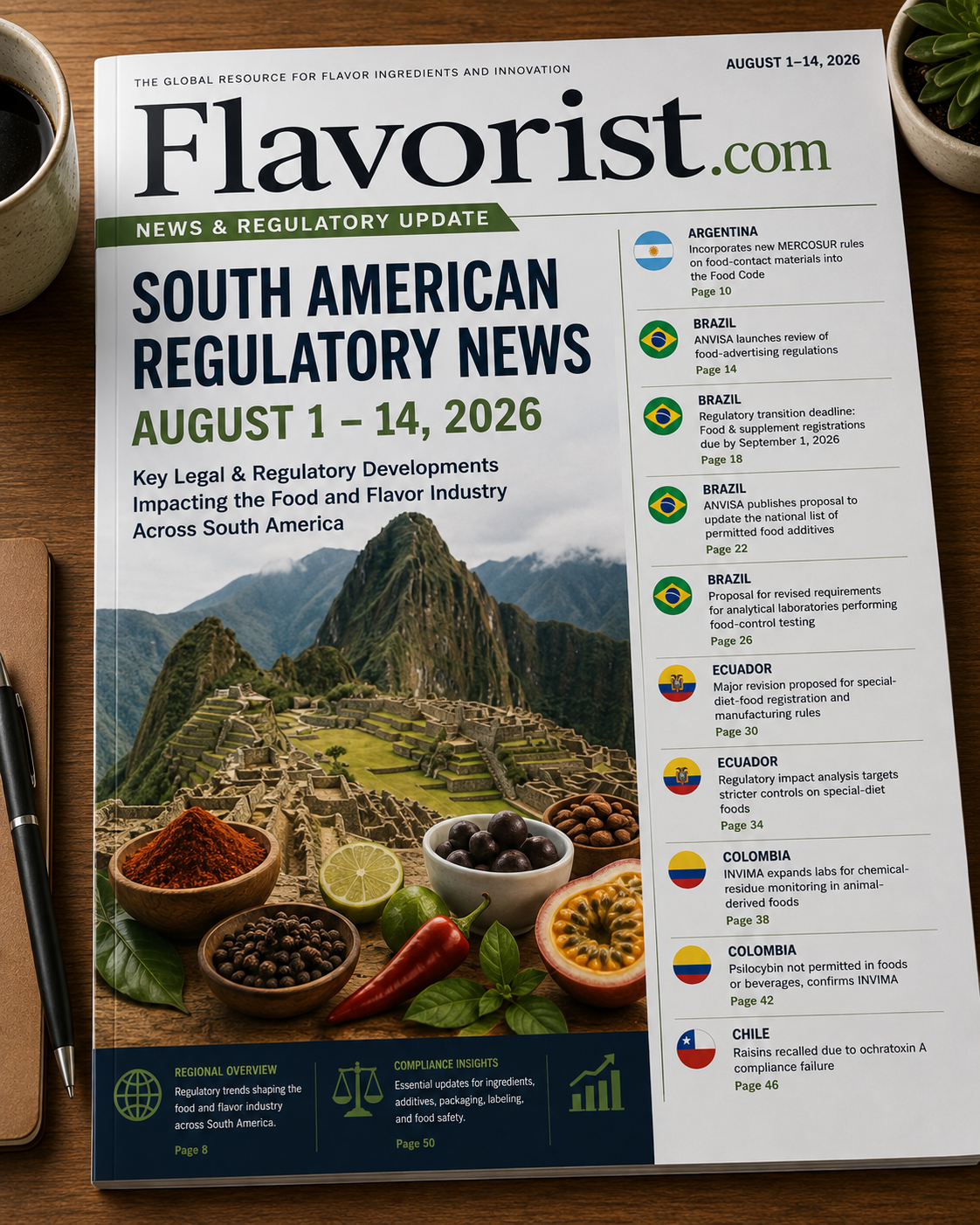
News below results from a search of the principal food-regulatory channels across Brazil, Argentina, Colombia, Chile, Ecuador, Peru, Uruguay, Paraguay and MERCOSUR, filtering for developments with a realistic impact on flavors, ingredients, additives, supplements, special-diet foods, packaging, labeling, contaminants, advertising, manufacturing and food safety.
The strongest activity during this period came from Brazil, Argentina, Ecuador and Colombia. The following nine developments are considered the most material regulatory or enforcement items released between August 1 and August 14, 2026.
1. Argentina incorporates new MERCOSUR food-contact-material rules into the Food Code
Argentina | August 6, 2026 | Final Rule | High Impact
Argentina published Joint Resolution 11/2026, incorporating two MERCOSUR technical regulations into the Argentine Food Code covering cellulosic materials, packaging and equipment intended to contact food, as well as regenerated-cellulose films. The regulation updates Chapter IV of the Código Alimentario Argentino and becomes effective the day after publication. It specifically requires diisopropylnaphthalene in finished products manufactured using recycled fibers to be kept as low as technically feasible. It also replaces Argentina's prior regenerated-cellulose-film requirements with MERCOSUR GMC Resolution 16/2025. (boletinoficial.gob.ar)
Industry impact: This matters to flavor and ingredient companies using paper, cellulose-based packaging, sachets, liners, filters, wraps or regenerated-cellulose films. Packaging suppliers will need to verify compliance with the updated specifications, particularly where recycled fibers are involved. Ingredient manufacturers should incorporate food-contact declarations into supplier qualification and packaging-change-control procedures.
Official source: Boletín Oficial de la República Argentina — Joint Resolution 11/2026 (boletinoficial.gob.ar)
2. Brazil launches review of its food-advertising regulations
Brazil | August 5, 2026 | Regulatory Review Initiated | High Strategic Impact
Brazil's ANVISA unanimously approved opening a regulatory process to reassess the country's rules governing food advertising. The agency specifically identified the expansion of e-commerce, social media, influencer marketing and online marketplaces as reasons why existing requirements need to be revisited. The food-advertising rules include RDC 24/2010, and ANVISA said its review is intended to evaluate whether the existing framework remains appropriate for today's communications environment. (Serviços e Informações do Brasil)
This is not yet a final amendment, but it is strategically significant because any future rule could change how food, beverage, ingredient and supplement products are promoted digitally.
Industry impact: Flavor suppliers may be indirectly affected when providing concepts or marketing language to customers. Food manufacturers should begin auditing influencer campaigns, health-oriented language, digital advertisements and marketplace content. Claims implying health, nutrition or functional benefits are likely to attract particular scrutiny as ANVISA modernizes the framework.
Official source: ANVISA — Review of food and medicine advertising rules (Serviços e Informações do Brasil)
3. Brazil warns food companies of September 1 registration and notification deadline
Brazil | August 11, 2026 | Regulatory Compliance Notice | Very High Operational Impact
ANVISA issued an important compliance notice reminding food companies that a transition period under RDC 843/2024 ends September 1, 2026. Companies with affected registered food categories must submit the required regulatory adjustment before that date; failure to do so can lead to cancellation of the product registration. The same September 1 deadline applies to notifications for certain dietary supplements and weight-control foods previously marketed through older manufacturing or import notification procedures. (Serviços e Informações do Brasil)
ANVISA also clarified transitional labeling rules. Products manufactured before notification may remain on the market through their original shelf life, while certain previously printed labels can be used for up to 180 days after notification if specified conditions are met. (Serviços e Informações do Brasil)
Industry impact: Brazilian food, supplement and ingredient companies should urgently confirm regulatory classification, composition, labeling, documentation and traceability. Flavor companies serving supplements and weight-management applications should verify that customers' products remain correctly regularized.
Official source: ANVISA — Food regularization transition deadline (Serviços e Informações do Brasil)
4. Brazil publishes proposal to update the national list of permitted food additives
Brazil | August 14, 2026 | Draft Regulatory Instrument | Very High Flavor-Industry Relevance
ANVISA released a draft Instrução Normativa on August 14 proposing amendments to IN 211/2023, Brazil's list of food additives authorized for use in foods. The proposal is part of ANVISA's 2026–2027 regulatory agenda for periodic updates of authorized food additives and processing aids and was scheduled for consideration by the agency's collegiate board. (Serviços e Informações do Brasil)
Because Brazil generally operates through positive lists, changes to IN 211 can determine whether a particular additive is permitted in a food category and under what conditions. Even incremental revisions can affect formulation decisions, specifications and commercialization.
Industry impact: This is one of the most important items for flavor houses during the period. Regulatory teams should compare the proposal with existing formulations and watch for changes involving carriers, preservatives, acidity regulators, stabilizers, colors or other substances commonly incorporated into flavor systems. Finished-food manufacturers should also examine whether currently used additive combinations remain permitted for their categories.
Official source: ANVISA — Regulatory drafts published August 14 (Serviços e Informações do Brasil)
5. Brazil proposes revised requirements for analytical laboratories performing food-control testing
Brazil | August 14, 2026 | Draft Regulation | Medium–High Impact
ANVISA also released a draft RDC establishing updated criteria, requirements and procedures for analytical laboratories conducting quality-control testing on products subject to sanitary surveillance. The proposal would revise laboratory good-practice requirements, rules for participation in Brazil's health laboratory network and accreditation for official fiscal and control analyses. The draft would also amend RDC 703/2022 and revoke two existing laboratory regulations. (Serviços e Informações do Brasil)
Although the draft covers more than food, it is important to the food sector because regulatory decisions involving contaminants, additives, microbiology, composition and food fraud frequently depend on laboratory results.
Industry impact: Ingredient manufacturers, flavor houses and food companies using third-party analytical laboratories should monitor qualification requirements carefully. Laboratory accreditation or methodological changes could affect which facilities can perform officially recognized analyses. Companies may need to update approved-laboratory lists, quality agreements, testing contracts and certificates of analysis.
Official source: ANVISA — Draft analytical-laboratory regulation (Serviços e Informações do Brasil)
6. Ecuador proposes major revision of special-diet-food registration and manufacturing rules
Ecuador | August 7, 2026 | Public Consultation | Very High Impact
Ecuador's ARCSA opened consultation on a substantial reform of rules governing foods for special dietary uses. The proposal covers infant foods, cereal-based foods for infants and young children, foods for special medical purposes, low-sodium products, foods intended for gluten-intolerant consumers, weight-control foods, infant formula, follow-on formula and foods intended for young children. (Control Sanitario)
The draft would require such foods marketed in Ecuador to hold an active sanitary notification or to be included within an appropriately registered GMP-certified production line. It also addresses imported products, labeling documentation and sanitary-notification procedures. For food additives used in these products, the proposal references the Codex General Standard for Food Additives and other applicable requirements.
Industry impact: This is highly relevant to flavor and ingredient suppliers serving infant nutrition, medical nutrition, gluten-free and weight-management products. Formulation dossiers, additive permissions and labels may require reassessment.
Official source: ARCSA — Public consultations (Control Sanitario)
7. Ecuador opens regulatory-impact consultation aimed at tighter controls on special-diet foods
Ecuador | August 14, 2026 | Regulatory Impact Analysis | Very High Strategic Impact
ARCSA launched a second consultation addressing the public-health risk posed by special-diet foods that fail quality, safety, composition or shelf-life requirements. The agency's regulatory-impact analysis identifies shortcomings in technical documentation, composition verification, microbiological and physicochemical testing, stability studies, post-market controls and procedures for imported products.
ARCSA also highlights gaps involving packaging, single-use plastics, certifications, contaminant limits and rules for infant-formula and breast-milk-substitute labeling, nutrition and health claims, advertising and promotion. Its stated objective is to strengthen technical and documentary requirements and harmonize Ecuadorian rules with appropriate national and international standards.
Industry impact: Flavor companies supplying highly regulated nutritional applications should expect increased requests for composition documentation, analytical data and ingredient justification. Manufacturers may eventually need stronger shelf-life evidence, laboratory testing and claim substantiation before or after market entry.
Official source: ARCSA — Regulatory Impact Analysis consultations (Control Sanitario)
8. Colombia expands laboratory capacity for chemical-residue monitoring in animal-derived foods
Colombia | August 11, 2026 | Regulatory/Control Initiative | Medium–High Impact
Colombia's INVIMA announced a call for laboratories seeking authorization to perform analyses of chemical contaminant residues in tissues of animal origin. The initiative comes through INVIMA's Food and Beverage Directorate and expands laboratory support for official sanitary monitoring. (Invima)
Although this action does not create a new maximum residue limit, it strengthens Colombia's ability to verify compliance with existing requirements for contaminants and residues in animal-derived foods. Additional officially authorized laboratories can increase testing capacity and potentially the intensity or geographical reach of surveillance.
Industry impact: Meat processors, animal-derived ingredient suppliers and manufacturers of savory flavor systems should monitor the development. Greater testing capacity can mean more systematic verification of residue compliance in meat and other animal tissues. Companies producing meat extracts, broths, stocks, proteins and reaction-flavor substrates should maintain strong raw-material specifications and residue-control documentation, particularly where international sourcing is involved.
Official source: INVIMA — August 2026 Food and Beverage regulatory news (Invima)
9. Colombia confirms that psilocybin cannot be used in foods or beverages
Colombia | August 5, 2026 | Enforcement / Regulatory Interpretation | High relevance to functional foods
INVIMA issued an alert against MELLOW/MELLOWXOCOLAT functional chocolate, stating that the product lacked the sanitary registration, permit or notification required for legal commercialization. The product was promoted online using stress-, anxiety- and emotional-health claims and suggested the presence of psilocybin in microdoses. INVIMA explicitly reiterated that psilocybin is not permitted in foods or beverages in Colombia and that foods cannot make medicinal, preventive or therapeutic claims without satisfying the applicable regulatory framework. (Invima)
The agency asked distributors and retailers to stop selling the product and requested stronger inspection and enforcement by local health authorities. (Invima)
Industry impact: This is an important signal for companies exploring mushrooms, adaptogens, functional botanicals and mood-positioned foods. Flavor companies should scrutinize both ingredient legality and customer marketing claims before developing concepts involving psychoactive or pharmacologically positioned substances.
Official source: INVIMA — MELLOW/MELLOWXOCOLAT alert (Invima)
10. Chile recalls raisins after ochratoxin A compliance failure
Chile | August 5, 2026 | Food-Safety Enforcement | High relevance to dried fruit and natural ingredients
Chile's Ministry of Health ordered the withdrawal of a lot of Cuisine & Co Pasas Morenas after the national mycotoxin surveillance program identified noncompliance with Chile's Reglamento Sanitario de los Alimentos. The affected lot was packed by Agroindustrial Las Tres Erres SpA, and health authorities initiated a sanitary proceeding while removing the product from sale. (Ministerio de Salud)
The issue involved ochratoxin A, a mycotoxin associated with fungal contamination of agricultural commodities. Chile's ministry highlighted agricultural practices, storage controls and analytical verification as measures important for reducing exposure. (Ministerio de Salud)
Industry impact: Raisins, dried fruits, spices, botanicals and other low-moisture agricultural ingredients can share similar mycotoxin risks. Flavor manufacturers using dried-fruit extracts or botanical concentrates should ensure specifications include appropriate mycotoxin limits and that supplier programs address agricultural and storage conditions.
Official source: Chile Ministry of Health — Raisin withdrawal (Ministerio de Salud)
What matters most for the flavor industry
For a flavor, ingredient or food-formulation company, I would prioritize the developments this way:
- Brazil's proposed update to permitted food additives — potentially direct consequences for flavor formulations and carriers. (Serviços e Informações do Brasil)
- Ecuador's overhaul of special-diet foods — substantial implications for infant nutrition, medical foods, weight-control products and additive use.
- Argentina's new food-contact-material rules — direct packaging and supply-chain compliance implications. (boletinoficial.gob.ar)
- Brazil's September 1 food-registration deadline — immediate commercial risk because missed deadlines can result in registration cancellation. (Serviços e Informações do Brasil)
- Brazil's review of food advertising — important longer-term implications for digital claims and marketing. (Serviços e Informações do Brasil)
- Colombia's psilocybin enforcement action — an important boundary for functional foods and novel botanical concepts. (Invima)
- Chile's ochratoxin enforcement — reinforces mycotoxin-control expectations for botanical and agricultural ingredients. (Ministerio de Salud)
One useful distinction is that Argentina's food-contact measure is already binding, while the major Brazilian additive change and Ecuadorian special-diet-food changes discussed above are still proposals or consultations. Companies should therefore treat the Argentine requirements as current compliance obligations while monitoring Brazil and Ecuador for final texts. (Boletín Oficial)
Coverage note: While the major national food regulators and regional MERCOSUR channels were searched, “all” South American regulatory news cannot be guaranteed literally because the region includes numerous ministries, provincial/state authorities and municipal gazettes.
###