The International Fragrance Association (IFRA): What Every Flavorist Needs to Know
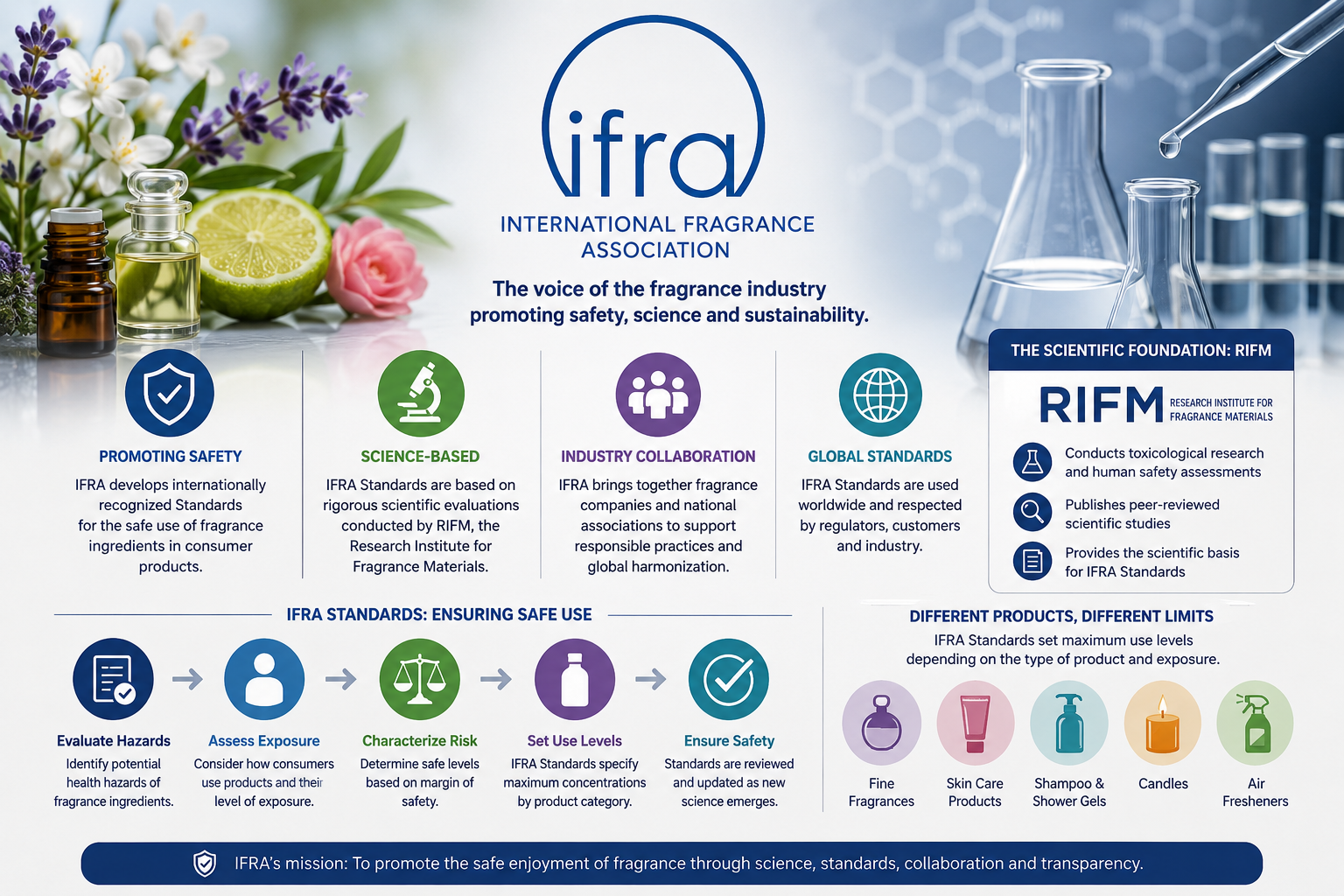
The International Fragrance Association (IFRA) is the global trade association representing the fragrance industry. Although it primarily focuses on fragrances rather than food flavors, every flavorist should understand IFRA because many flavor molecules are also used in fragrances, and regulatory, toxicological, and safety principles often overlap.
What is IFRA?
International Fragrance Association (IFRA) was established in 1973 to promote the safe use of fragrance ingredients worldwide. Its members include major fragrance houses such as companies in the global fragrance and flavor industry, along with national fragrance associations.
Its mission is to:
- Ensure fragrance ingredient safety.
- Develop industry standards.
- Support scientific research.
- Promote regulatory harmonization across countries.
IFRA's Role
The organization develops and maintains the IFRA Standards, which specify:
- Ingredients that are prohibited.
- Ingredients that are restricted.
- Maximum allowable concentrations.
- Safe conditions of use for different product categories.
Examples include restrictions on:
- Skin sensitizers
- Phototoxic compounds
- Certain natural essential oils
- Materials with carcinogenic, mutagenic, or reproductive toxicity concerns
These standards are updated regularly as new toxicological data become available.
The Scientific Basis: RIFM
IFRA works closely with Research Institute for Fragrance Materials (RIFM).
RIFM:
- Conducts toxicological studies.
- Performs safety assessments.
- Publishes peer-reviewed scientific research.
- Evaluates new fragrance ingredients.
IFRA uses RIFM's scientific assessments to create its standards.
IFRA Standards
The standards are legally voluntary in many countries but are widely followed because:
- Major fragrance companies require compliance.
- Many customers demand IFRA-compliant products.
- Regulatory agencies often recognize IFRA as an industry benchmark.
Examples of restrictions:
- Oakmoss extract
- Tree moss extract
- Certain aldehydes
- Eugenol
- Isoeugenol
- Coumarin (restricted depending on application)
Restrictions differ by product type.
IFRA Product Categories
IFRA divides products into categories because exposure differs.
Examples include:
- Fine fragrances
- Deodorants
- Creams
- Lotions
- Lip products
- Shampoo
- Soap
- Baby products
- Candles
- Air fresheners
- Household cleaners
Each category has its own maximum concentration limits.
Why Flavorists Should Care
Although IFRA does not regulate food flavors, flavorists frequently work with molecules that are used in both industries.
Examples include:
- Vanillin
- Ethyl vanillin
- Citral
- Limonene
- Linalool
- Eugenol
- Menthol
- Cinnamaldehyde
- Benzaldehyde
These ingredients may:
- Be approved for food use.
- Have IFRA restrictions for perfumes or cosmetics.
- Require different purity specifications depending on their application.
Understanding both perspectives helps when working with ingredients that cross between flavor and fragrance.
Difference Between IFRA and FEMA
A common point of confusion is the distinction between IFRA and Flavor and Extract Manufacturers Association (FEMA).
| IFRA | FEMA |
|---|---|
| Focuses on fragrances | Focuses on food flavors |
| Evaluates dermal and inhalation exposure | Evaluates oral ingestion safety |
| Uses IFRA Standards | Uses FEMA GRAS evaluations |
| Cosmetic and household products | Food and beverages |
A material may be:
- Allowed by FEMA for ingestion.
- Restricted by IFRA for skin application.
- Used under different limits depending on exposure route.
IFRA Certificate
Suppliers often provide an IFRA Certificate that states:
- Compliance with the current IFRA Standards.
- Maximum use levels by product category.
- Applicable restrictions or prohibitions.
- The IFRA Standards version used for evaluation.
This document is commonly requested by cosmetic manufacturers and contract formulators.
IFRA Amendment Process
IFRA periodically updates its standards (often referred to as "Amendments") when:
- New toxicological evidence emerges.
- Exposure assessments improve.
- International regulations change.
- New scientific methods become available.
Companies typically review and reformulate products as needed when new amendments are adopted.
IFRA and Global Regulations
While IFRA itself is not a government regulator, its standards strongly influence regulations and industry practices worldwide. They are frequently referenced by cosmetic manufacturers and align with broader safety frameworks in markets such as the European Union and elsewhere.
Practical Takeaways for Flavorists
If you work with aroma chemicals that may also be used in fragrances:
- Learn which ingredients have IFRA restrictions in addition to food regulations.
- Distinguish between oral safety (e.g., FEMA GRAS and food regulations) and dermal or inhalation safety (IFRA).
- Understand that the same molecule can have different permissible levels depending on how it is used.
- Request and review IFRA Certificates when sourcing materials intended for fragrance or cosmetic applications.
- Stay aware that IFRA Standards are updated periodically, so compliance is an ongoing process rather than a one-time check.
A flavorist with knowledge of IFRA is better equipped to collaborate with fragrance chemists, cosmetic formulators, and suppliers, particularly when working with aroma compounds that are shared between the flavor and fragrance industries.
Yes. While IFRA is primarily a fragrance organization, there are several aspects that are highly relevant for flavorists, especially those working with aroma chemicals, ingredient sourcing, or flavor–fragrance crossover products.
1. IFRA is not a regulatory authority
One of the biggest misconceptions is that IFRA is a government agency. It is not.
IFRA is an industry association that develops safety standards based on scientific risk assessments. However:
- Many multinational companies require IFRA compliance from suppliers.
- Cosmetic manufacturers often make IFRA compliance a contractual requirement.
- Regulators may consider IFRA Standards when developing or evaluating cosmetic regulations.
For a flavorist, this means IFRA requirements can become effectively mandatory in commercial practice, even if they are not laws.
2. Hazard vs. Risk
A core principle behind IFRA Standards is the distinction between hazard and risk.
- Hazard: A substance has the potential to cause harm.
- Risk: The likelihood of harm depends on exposure.
For example:
- Citral can cause skin sensitization.
- At the low concentrations permitted by IFRA in certain products, the risk is considered acceptable.
This risk-based approach is also used in modern food safety and toxicology.
3. Exposure Drives the Limits
Unlike food regulations, IFRA limits are based on how consumers are exposed.
Factors include:
- Skin contact area
- Frequency of use
- Product type
- Leave-on versus rinse-off use
- Inhalation exposure
- Age of the user (e.g., baby products)
The same fragrance ingredient may have very different allowable concentrations depending on the application.
4. IFRA Does Not Evaluate Flavor Performance
IFRA is concerned with safety, not sensory qualities.
It does not assess:
- Taste
- Odor quality
- Flavor stability
- Flavor intensity
- Consumer preference
These remain the responsibility of flavorists and product developers.
5. Natural Ingredients Are Not Automatically Safer
Many people assume natural essential oils are inherently safe. IFRA's evaluations show that this is not always true.
For example:
- Cinnamon bark oil
- Clove oil
- Bergamot oil
- Oakmoss extract
- Bitter orange oil
may be restricted because they contain constituents associated with skin sensitization or phototoxicity.
This reinforces an important lesson for flavorists: "natural" does not necessarily mean "low risk."
6. IFRA Covers Thousands of Ingredients
The IFRA Standards database includes restrictions and guidance for a very large number of fragrance ingredients, including:
- Essential oils
- Natural extracts
- Isolates
- Synthetic aroma chemicals
- Proprietary fragrance materials
Many of these are also encountered in flavor creation.
7. Reformulation Is Common
When IFRA updates a standard:
- Existing perfumes may need reformulation.
- Suppliers may discontinue certain ingredients.
- Alternative materials may be introduced.
- Product labels or documentation may need updating.
Flavorists working with dual-use ingredients should be aware that ingredient availability can change because of fragrance safety requirements.
8. Documentation Is Critical
Companies commonly maintain:
- IFRA Certificates
- Safety Data Sheets (SDS)
- Certificates of Analysis (COA)
- Allergen declarations
- Regulatory compliance statements
Being comfortable reviewing these documents is a valuable skill for flavorists involved in quality, regulatory affairs, or product development.
9. IFRA Is Increasingly Data-Driven
Modern IFRA assessments incorporate:
- Toxicology
- Exposure science
- Quantitative risk assessment
- Human clinical data
- Computational toxicology
- Updated analytical chemistry methods
Understanding these concepts can help flavorists interpret safety evaluations and communicate with regulatory specialists.
10. Global Supply Chains Depend on IFRA
Even if a flavorist never formulates perfumes, they may source aroma chemicals from suppliers that also serve the fragrance industry. Those suppliers often align their manufacturing, documentation, and quality systems with IFRA expectations.
As a result, IFRA can indirectly influence:
- Raw material specifications
- Product documentation
- Inventory decisions
- Reformulation timelines
- Supplier qualification
11. IFRA and Allergens
IFRA has played a significant role in identifying fragrance allergens and recommending restrictions or labeling considerations. Ingredients such as linalool, limonene, eugenol, isoeugenol, and citral are examples of compounds that are common in both fragrance and flavor contexts but may require special attention depending on their use.
12. Collaboration with Other Organizations
A flavorist should also recognize that IFRA is one part of a broader safety and regulatory ecosystem. Depending on the application, other organizations may be equally or more relevant:
- IFRA: Fragrance safety.
- RIFM: Scientific research supporting fragrance safety.
- FEMA: Generally Recognized as Safe (GRAS) evaluations for flavor ingredients in the U.S.
- JECFA: International safety evaluations of food additives and flavorings.
- Codex Alimentarius: International food standards.
- National regulatory agencies (e.g., food and cosmetic authorities): Legal requirements in specific jurisdictions.
Bottom line
A well-rounded flavorist doesn't need to be an expert in perfumery, but understanding IFRA provides several professional advantages:
- It helps distinguish oral safety from dermal and inhalation safety.
- It improves communication with fragrance chemists, cosmetic formulators, and regulatory teams.
- It supports informed sourcing and evaluation of aroma chemicals used across multiple industries.
- It reinforces modern toxicological thinking, particularly the importance of risk assessment based on exposure rather than assuming a substance is simply "safe" or "unsafe."
For flavorists working in flavors, fragrances, cosmetics, oral care, or consumer products, familiarity with IFRA is an important part of professional regulatory literacy.