🌿 The Professional Flavorist’s Green Note System: Chemistry, Formulation, Block Design, Libraries, Compatibility, and Application Mastery
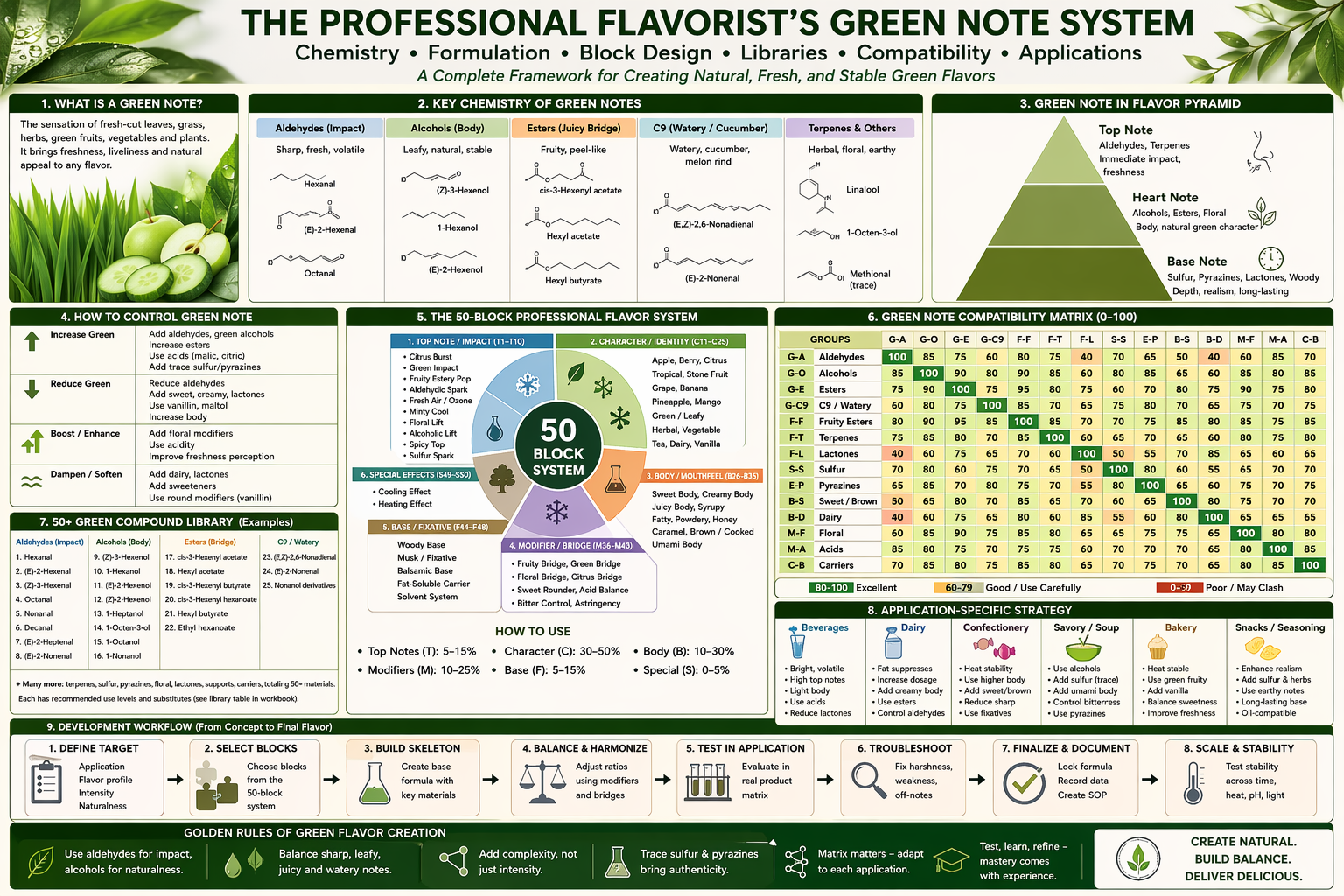
🌿 The Professional Flavorist’s Green Note System: Chemistry, Formulation, Block Design, Libraries, Compatibility, and Application Mastery

A green note is the part of a flavor that smells like fresh-cut leaves, crushed stems, raw peas, cucumber peel, snapped beans, grass, or the skin of an unripe fruit. In flavor chemistry, this note is usually created by a family of compounds called green leaf volatiles, especially C6 aldehydes, C6 alcohols, and some related esters that come from plant lipid breakdown. Common examples include hexanal, (Z)-3-hexenal, (E)-2-hexenal, (Z)-3-hexenol, (E)-2-hexenol, and 1-hexanol. Reviews of green-note chemistry consistently describe these compounds as the core materials behind fresh leafy and grassy character. (ScienceDirect)

1. What compounds define green note?

The most important compounds are usually these:

Hexanal
Often smells like cut grass, green beans, leafy peel, and slightly fatty green. It is one of the most widely used “green” building blocks because it is powerful, recognizable, and easy to dose.

(Z)-3-Hexenal
This is one of the most vivid “just-crushed leaf” materials. It can smell extremely fresh, wet, sharp, and natural. It often gives the impression of a leaf being torn open.

(E)-2-Hexenal
Usually greener, sharper, and more penetrating than many alcohols. It can smell leafy, apple-peel-like, and somewhat pungent. In many systems it gives a stronger, more pointed green than hexanol.

(Z)-3-Hexenol
Often called a classic leafy alcohol. It smells like fresh-cut grass and crushed green leaves, but softer and more rounded than the corresponding aldehydes.

1-Hexanol
Greener and heavier, but less sparkling. It can help support a more durable green tone when the very sharp materials are too fleeting.

(E)-2-Hexenol / related unsaturated alcohols
Useful when a flavorist wants green freshness without too much harsh aldehydic bite.

C6 esters such as hexenyl acetate
These do not smell “green” in the same way as the aldehydes, but they can make the green note feel more fruity, juicy, and pleasant.

Some C9 aldehydes and alcohols can also contribute green, cucumber, melon-rind, or watery-green effects in certain profiles. Research on green leaf volatiles describes the green family mainly as C6 and C9 aldehydes, alcohols, and esters. (PMC)

For a beginner flavorist, the easiest way to think about it is this:

  • Aldehydes = brighter, sharper, more diffusive green
  • Alcohols = softer, rounder, more natural green
  • Esters = greener-fruit lift, more pleasant and juicy
  • C9 materials = cucumber, rind, watery, vine-like green

2. Is green note a top note or a heart note?

Green note is mostly a top note, but some green materials also function in the heart.

Why? Because many classic green materials are small, volatile molecules. They escape quickly into the air, so the nose detects them early. That is the normal behavior of top notes. Flavor science reviews also note that aroma release depends strongly on volatility and on how compounds partition between the food matrix and the air phase. (Springer)

But not every green material behaves exactly the same way.

Top-note green materials

  • (Z)-3-hexenal
  • (E)-2-hexenal
  • hexanal

These give the first burst of freshness.

Heart-note green materials

  • (Z)-3-hexenol
  • 1-hexanol
  • some less volatile green-supporting compounds

These often stay a little longer and help the flavor continue to feel leafy rather than collapsing after the first impact.

A practical flavorist rule is:

  • If the green note smells like freshly cut grass in the first second, it is behaving like a top note.
  • If it still smells green after the first burst and supports the body of the flavor, it is contributing to the heart.

So the best answer is: green note is primarily a top note, but good green flavors usually need heart-note support to keep the effect natural and lasting.

3. How do you increase green note?

To increase green note, a flavorist usually does not just “add more hexanal.” That often makes the flavor harsh. A better approach is to build the note in layers.

A. Increase the sharp green top

Use small amounts of:

  • hexanal
  • (E)-2-hexenal
  • (Z)-3-hexenal

These are the quickest way to make a flavor smell fresher, leafier, and less cooked.

B. Add a softer leafy middle

Use:

  • (Z)-3-hexenol
  • 1-hexanol
  • related unsaturated alcohols

These make the green note feel more natural and less metallic or aggressive.

C. Add fruity-green bridge materials

In fruit flavors, green can feel more realistic when connected to fruitiness through:

  • hexenyl acetate
  • cis-3-hexenyl acetate
  • green apple / peel / unripe pear style materials

This makes the note feel like real fruit skin instead of cut lawn.

D. Adjust the surrounding notes

Green becomes more noticeable when you reduce:

  • heavy brown notes
  • creamy notes
  • sulfur-heavy savory notes
  • strong lactones
  • excessive sweet vanilla character

Sometimes you increase green note not by adding more green compounds, but by removing things that cover it up.

E. Use high-impact materials carefully

Many green aldehydes are potent at very low levels. A tiny increase can shift a flavor from “fresh” to “raw,” “peel-like,” or even “painty.” This is especially true because these compounds are low-threshold and highly volatile. (Springer)

4. How do you reduce green note?

There are several ways.

A. Lower the key aldehydes

If a flavor is too grassy, too raw, or too unripe, the first suspects are often:

  • hexanal
  • (E)-2-hexenal
  • (Z)-3-hexenal

Reducing these often works immediately.

B. Shift from aldehydes toward alcohols

Aldehydes are usually sharper. Alcohols are usually rounder. If you replace part of a green aldehyde package with green alcohols, the note becomes less piercing.

C. Add ripening or sweetening notes

Depending on the profile, green note can be softened by:

  • ripe fruity esters
  • jammy fruit notes
  • lactones
  • creamy notes
  • floral notes
  • mild sweet vanilla-type modifiers

For example, a green apple can be pushed toward ripe apple by decreasing leafy aldehydes and increasing sweet-fruity body.

D. Add warmer body notes

In savory flavors, green can be reduced by increasing:

  • cooked vegetable notes
  • umami body
  • browned notes
  • mild sulfur reaction notes

This changes the balance from raw green to cooked or processed savory.

E. Reduce release

A note may be chemically present but sensorially weaker if the matrix holds it more tightly. Reviews of flavor–matrix interactions show that proteins, lipids, carbohydrates, viscosity, and partition behavior all affect aroma release. (Springer)

5. What compounds boost green note?

Compounds that commonly boost or support green character include:

  • Hexanal
  • (E)-2-Hexenal
  • (Z)-3-Hexenal
  • (Z)-3-Hexenol
  • 1-Hexanol
  • cis-3-Hexenyl acetate / related green esters
  • selected C9 aldehydes/alcohols for cucumber-rind or watery-green effects

These can be grouped functionally:

Fast leafy impact

  • (Z)-3-hexenal
  • (E)-2-hexenal

Grass and peel support

  • hexanal
  • (Z)-3-hexenol

Round leafy body

  • 1-hexanol
  • related alcohols

Fresh fruity-green polish

  • hexenyl esters

Perfumer & Flavorist’s green-note review specifically lists trans-2-hexenol, cis-2-hexenol, trans-3-hexenol, 1-hexanol, 1-hexanal, and cis-2-hexenal among classic green-note materials. (Perfumer & Flavorist)

6. What compounds dampen green note?

There is no single universal “anti-green” compound. Green note is usually dampened by counterbalancing notes rather than by a direct chemical opposite.

Common dampeners include materials that add:

  • ripe fruit character
  • creamy notes
  • buttery notes
  • vanilla sweetness
  • cooked/browned character
  • caramelized character
  • savory reaction body
  • certain floral rounders

In practical formulation terms, green note gets pushed backward when the flavor becomes:

  • sweeter
  • riper
  • creamier
  • browner
  • more cooked
  • more sulfur-savory

So when a beginner asks, “What kills green?” the practical answer is:
heavy ripe, creamy, brown, cooked, and sweet body notes usually make green less noticeable.

7. What are the challenges in keeping green note in a flavor?

This is one of the most important parts for a flavorist.

A. High volatility

Many green-note compounds evaporate easily. That means they give excellent opening impact but can disappear during:

  • processing
  • drying
  • storage
  • heating
  • spray drying
  • mixing into hot food

Volatility is a major reason green flavors often smell great in the bottle but weaker in the final application. (Springer)

B. Chemical instability

Aldehydes and other flavor compounds can be chemically reactive. Reviews on flavor stability emphasize that food quality depends strongly on flavor stability and on degradation reactions within the food system. (ScienceDirect)

For green notes, important risks include:

  • oxidation
  • reduction/enzymatic conversion
  • isomerization
  • reaction with other matrix components

A useful example is that green-note aldehydes can be transformed into the corresponding alcohols under biological or enzymatic conditions, which changes the odor profile. (ResearchGate)

For a beginner, that means the flavor you designed on day 1 may smell less sharp and more dull or different after storage.

C. Extremely low sensory thresholds

Many green aldehydes are noticeable at very low concentrations. This creates a common formulating problem:

  • too little = no freshness
  • slightly more = excellent realism
  • a tiny bit too much = harsh, raw, metallic, fatty, or unripe

So green note is often a narrow target.

D. Easy imbalance with other notes

Green note can quickly dominate:

  • citrus
  • berry
  • tropical fruit
  • vegetable
  • tea
  • herb
  • cucumber
  • melon

A flavor that was supposed to smell “fresh strawberry” can suddenly smell “strawberry leaf” if the balance is off.

E. Processing losses

Heat, aeration, and long hold times can reduce green impact. Any manufacturing step that gives volatiles time to escape can weaken the note.

F. Matrix binding and release effects

Food matrices influence how much aroma reaches the nose. Reviews show that:

  • lipids/fats can retain aroma compounds depending on structure
  • proteins can interact with flavor compounds
  • sugars and polysaccharides can alter volatility and release
  • viscosity can reduce aroma release (Springer)

So a green flavor may behave very differently in water, yogurt, candy, soup, and a snack seasoning.

8. What food matrix is favorable for maintaining green note?

In general, green note is best maintained in matrices that are:

  • cool rather than hot
  • not heavily processed
  • not too fatty
  • not too viscous
  • not strongly reactive
  • served quickly after preparation

Usually favorable matrices

Aqueous beverages
Watery systems can present green top notes clearly because there is less masking from fat and heavy solids. However, they can also lose volatiles quickly if the product is open, warm, or stored poorly.

Light fruit beverages
Green apple, pear, grape, kiwi, cucumber, melon, lime, and some tropical systems often carry green notes well because the matrix and flavor concept already support freshness.

Fresh-style dairy alternatives or low-fat systems
If the matrix is not too fatty and not too protein-binding, green can still show reasonably well.

Cold sauces or dressings
Especially when the flavor concept is herbaceous, cucumber-like, or fresh vegetable-like.

Water-ice / frozen systems
Cold serving can help preserve the fresh impression during consumption, though formulation losses during processing still matter.

Less favorable matrices

High-fat matrices
Fat can retain certain aroma compounds and change release behavior, which may reduce the immediate green impact. (Springer)

High-protein systems
Proteins can interact with flavor compounds and sometimes lower release.

High-viscosity systems
Thick matrices often suppress release, so the same dosage smells weaker.

Heavily heated systems
Soups, baked goods, retorted products, and high-temperature processes often reduce delicate top-note green character.

Strong brown/savory systems
Even if the green note survives analytically, it may be sensorially buried.

9. Practical beginner guide: how to think about green note in formulation

A simple way to formulate green note is to imagine three layers:

Layer 1: Spark

  • fast aldehydes
  • gives cut-leaf freshness

Layer 2: Leaf

  • softer alcohols
  • gives natural leafy body

Layer 3: Context

  • fruity, floral, watery, vegetable, or herbal support
  • decides whether the green smells like apple peel, cucumber, tea leaf, herb, or raw bean

Examples:

Green apple flavor

  • use sharp green aldehydes lightly
  • support with peel-like fruity notes
  • avoid too much creamy sweetness

Cucumber flavor

  • use watery-green and C9 support
  • keep the profile cool and clean
  • avoid heavy fruity esters

Herbal citrus flavor

  • a little green can make lime, grapefruit, or mandarin feel more natural
  • too much makes it smell like stems instead of juice

Vegetable flavor

  • green can help realism in pea, bean, lettuce, celery, spinach
  • but too much becomes raw and unpleasant

10. The simplest direct answers

What defines green note?
Mostly C6 and some C9 aldehydes, alcohols, and esters, especially hexanal, hexenals, and hexenols. (ScienceDirect)

Is green note top or heart?
Mostly top note, with some heart-note support materials.

How do you increase it?
Add green aldehydes for impact, green alcohols for body, and remove notes that mask freshness.

How do you reduce it?
Cut the aldehydes, soften with riper/creamier/cooked notes, and use rounder support materials.

What boosts it?
Hexanal, hexenals, hexenols, green esters, and some C9 watery-green materials.

What dampens it?
Ripe fruit, creamy, brown, cooked, sweet, and heavy savory notes.

What makes it hard to keep?
Volatility, instability, low threshold, heat, oxidation, and matrix interactions. (ScienceDirect)

What matrix is favorable?
Cool, light, low-fat, low-viscosity, fresh-style systems usually show green note best. Matrix composition strongly affects aroma release and retention. (Springer)

Log in to read more