The National Association of Flavors & Food-Ingredient Systems (NAFFS): Mission, Scope, and Industry Impact
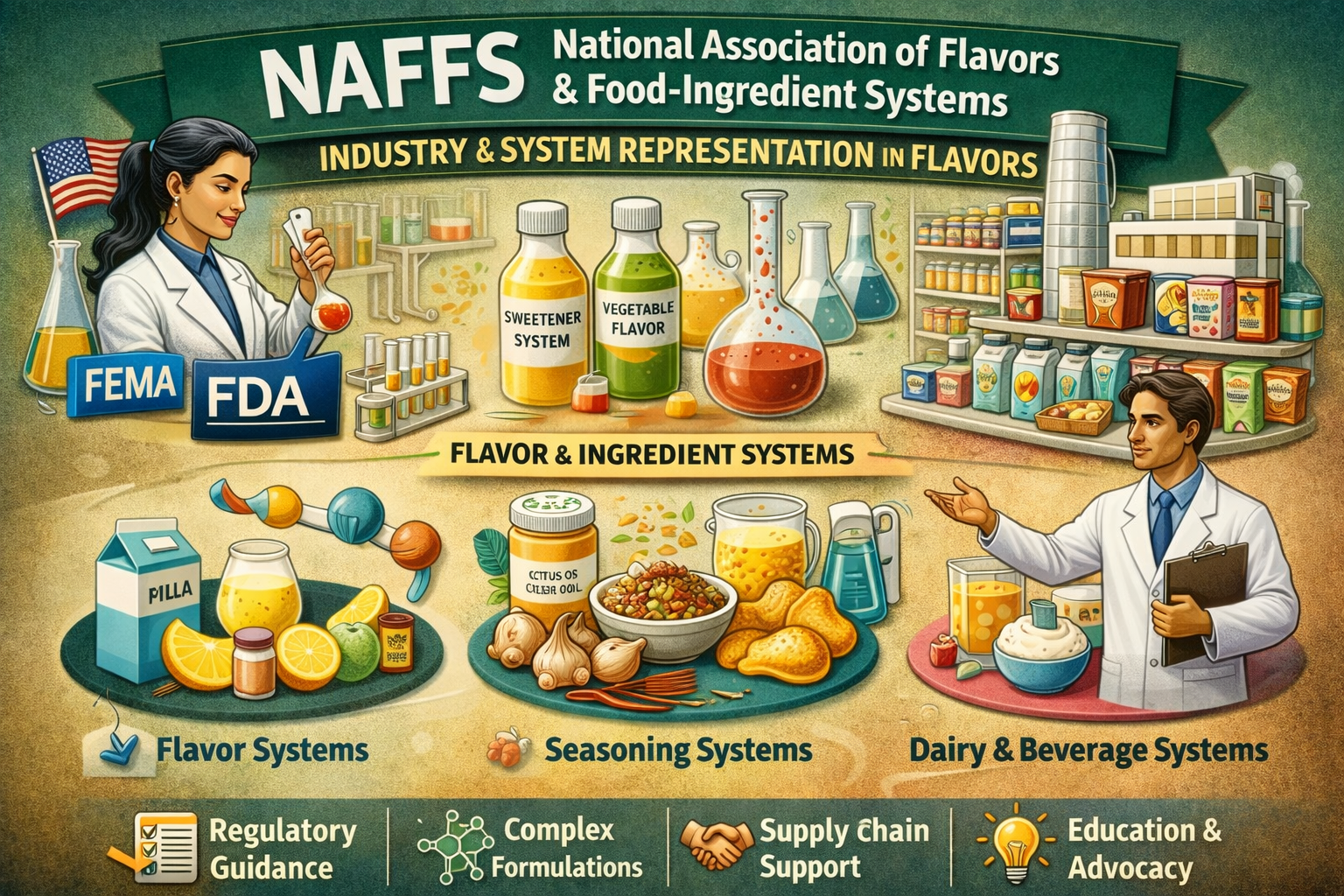
National Association of Flavors & Food-Ingredient Systems — Core Overview
What NAFFS Stands For
The National Association of Flavors & Food-Ingredient Systems (NAFFS) is a U.S.-based industry trade organization representing companies that develop, manufacture, and supply flavors, seasonings, and functional ingredient systems used across the food and beverage sector.
At its core, NAFFS exists to support the technical, regulatory, and commercial interests of flavorists and ingredient system developers—especially in complex, multi-component formulations.
1. What NAFFS Represents in Practical Terms
Unlike organizations focused purely on raw materials or regulatory science, NAFFS focuses on “systems thinking” in flavor creation:
A. Flavor Systems (not just single compounds)
- Compound blends (natural & artificial flavors)
- Reaction flavors (e.g., Maillard-derived savory notes)
- Encapsulated or stabilized flavors
- Multi-phase delivery systems (oil/water/emulsions)
B. Food-Ingredient Systems
- Seasoning blends (snacks, savory applications)
- Functional systems (sweetener systems, masking systems)
- Beverage flavor bases (acidulant + flavor + sweetener integration)
- Texture + flavor integrated systems (e.g., dairy bases, sauces)
👉 In short: NAFFS represents the “finished flavor solution” level, not just individual molecules.
2. Where NAFFS Is Used in the Flavor Industry
A. Regulatory & Compliance Interface
NAFFS helps companies navigate U.S. regulatory frameworks, including:
- U.S. Food and Drug Administration (flavor labeling, GRAS status)
- Flavor and Extract Manufacturers Association (GRAS determinations for flavor ingredients)
Practical use:
- Guidance on labeling (“natural flavor,” “artificial flavor”)
- Interpretation of complex formulations under U.S. law
- Harmonization across multi-ingredient systems
B. Technical Formulation Support (Industry-Level)
NAFFS promotes best practices in:
- Stability (oxidation, volatilization, crystallization)
- Delivery systems (spray drying, encapsulation)
- Compatibility in complex matrices (beverages, dairy, snacks)
Where this shows up:
- Beverage flavor houses
- Savory seasoning manufacturers
- Dairy and dessert system developers
- Alcohol flavor formulation
C. Supply Chain & Ingredient Integration
Because NAFFS members often work with multi-component systems, the organization plays a role in:
- Ingredient sourcing strategies
- Supplier standardization
- Quality and traceability frameworks
Example:
A snack seasoning system may involve:
- Flavor compounds
- Carriers (maltodextrin, gum arabic)
- Enhancers (MSG, yeast extract)
- Anti-caking agents
NAFFS helps align how these are combined, declared, and standardized.
D. Industry Advocacy
NAFFS acts as a collective voice for flavor system companies on:
- Regulatory changes
- Trade policies
- Labeling laws
- Ingredient restrictions
This is particularly important for:
- Mid-sized flavor houses
- System integrators (not just raw material suppliers)
E. Education & Knowledge Sharing
NAFFS contributes to:
- Technical seminars
- Regulatory updates
- Best practice documents
These are used by:
- Flavor chemists
- Application technologists
- Regulatory specialists
3. How NAFFS Differs from Other Organizations
Compared to Flavor and Extract Manufacturers Association
- FEMA → Focus on ingredient safety (GRAS)
- NAFFS → Focus on formulated systems + application reality
Compared to Food Chemicals Codex
- FCC → Purity standards for individual substances
- NAFFS → Real-world multi-ingredient system usage
Compared to European Flavour Association
- EFFA → European regulatory + industry body
- NAFFS → U.S.-focused, system-oriented approach
4. Why NAFFS Matters to a Flavorist
For an experienced flavorist, NAFFS is most relevant when dealing with:
A. Complex Formulations
- Multi-phase beverage systems
- Encapsulated flavors
- Reaction flavors in savory systems
B. Labeling Strategy
- “Natural flavor” vs “flavor system”
- Carrier and processing aid declarations
C. Stability & Shelf Life
- How systems behave over time (not just molecules)
- Interaction with food matrices
D. Scale-Up & Commercialization
- Bench → pilot → production transitions
- Supplier coordination
5. Real-World Example
Carbonated Soft Drink Flavor System:
- Citrus oil fraction
- Aldehyde top notes
- Sweetener system (HFCS or alternatives)
- Acidulant system (citric + malic)
- Emulsifier system
👉 NAFFS relevance:
- Ensures the entire system is compliant, stable, and label-correct—not just each ingredient individually.
6. Key Takeaway
NAFFS sits at a critical intersection:
Chemistry + Formulation + Regulation + Application
It represents the practical reality of how flavors are actually built and used in food systems, making it especially valuable for:
- Flavor houses
- Application labs
- Product development teams
###