Saponification in Flavor Chemistry: Mechanisms, Kinetics, Formulation Strategy, and Shelf-Life Impact
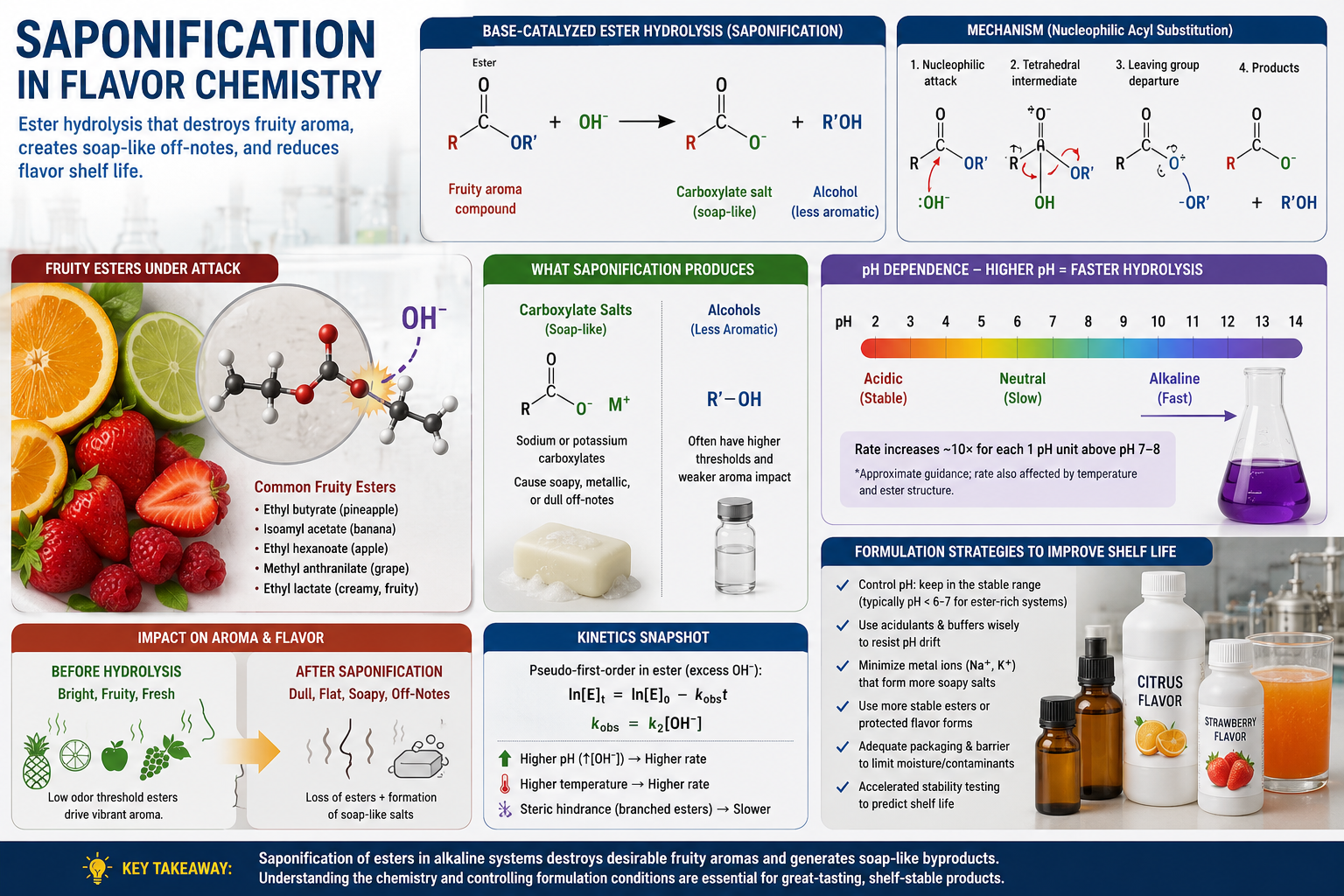
Saponification is among the dozens of chemical reactions and physical processes related to flavors that the Society of Flavor Chemists requires certified flavorists to understand and consider when formulating flavors.
Here is a comprehensive, deeply detailed guide to saponification as it applies to flavor chemistry.
1. Chemical groups, mechanism, and conditions
Saponification, in the context of flavor chemistry, is the base-catalyzed hydrolysis of an ester bond. The ester functional group — a carbonyl (C=O) bonded to an oxygen (O–C) — is cleaved by a hydroxide ion (OH⁻), producing a carboxylate salt (the "soap") and an alcohol as byproducts. This is irreversible under the reaction conditions, which distinguishes it from acid-catalyzed hydrolysis (which is equilibrium-driven and reversible).
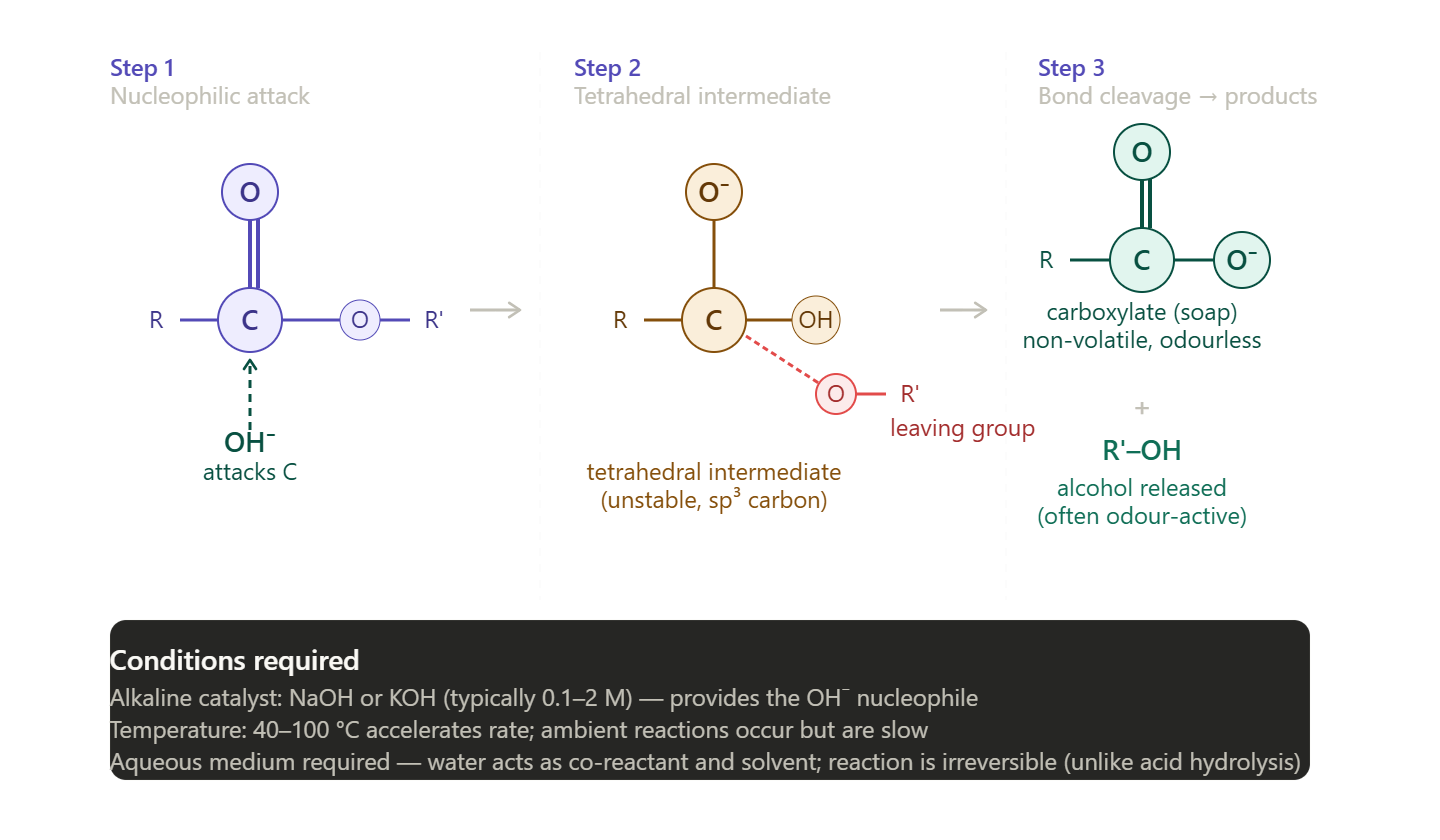
The chemical group at the center of saponification is the ester linkage (R–COO–R'). In flavor chemistry, this means every ester aroma compound — ethyl butanoate, allyl hexanoate, isoamyl acetate, γ-decalactone, and hundreds more — is a potential saponification target. The reaction requires three things to co-exist: (1) an ester substrate, (2) a source of hydroxide ions (a basic environment), and (3) water. The absence of any one of these stops the reaction entirely.
The reaction proceeds through a tetrahedral intermediate at the carbonyl carbon, then collapses by ejecting the alkoxide (R'O⁻), which immediately picks up a proton from water to become the free alcohol R'OH. Because the carboxylate product is stabilized by resonance and is not itself electrophilic, the reaction cannot reverse — this is what makes saponification fundamentally different from and more destructive than simple acid-catalyzed ester hydrolysis.
In flavor terms, the ester (which smells like fruit) is consumed and replaced by a carboxylate salt (which is odourless or soapy at best) and an alcohol (which may or may not have its own aroma character, and is usually weaker and less desirable than the original ester).
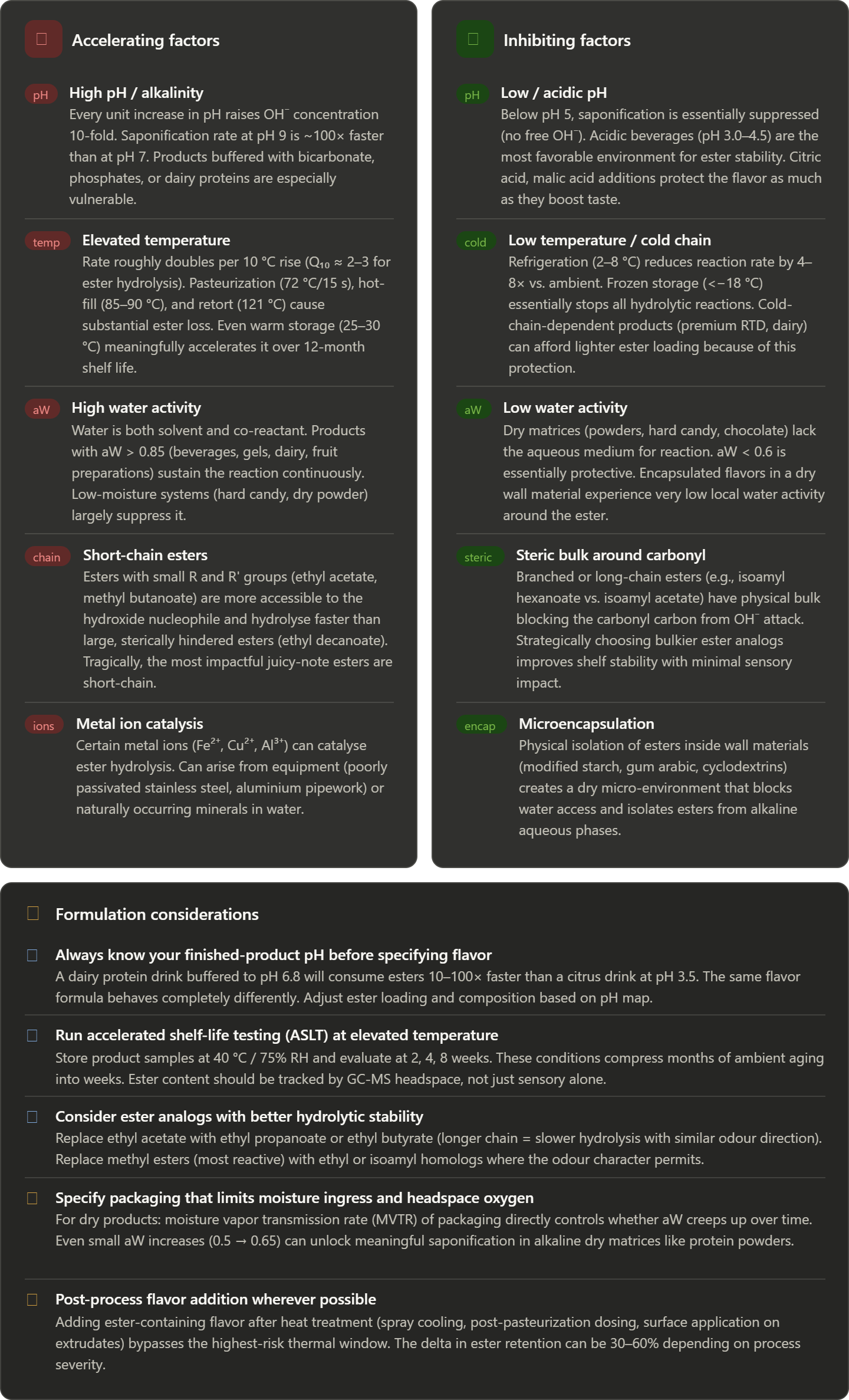
2. Factors that accelerate or inhibit saponification, and formulation considerations
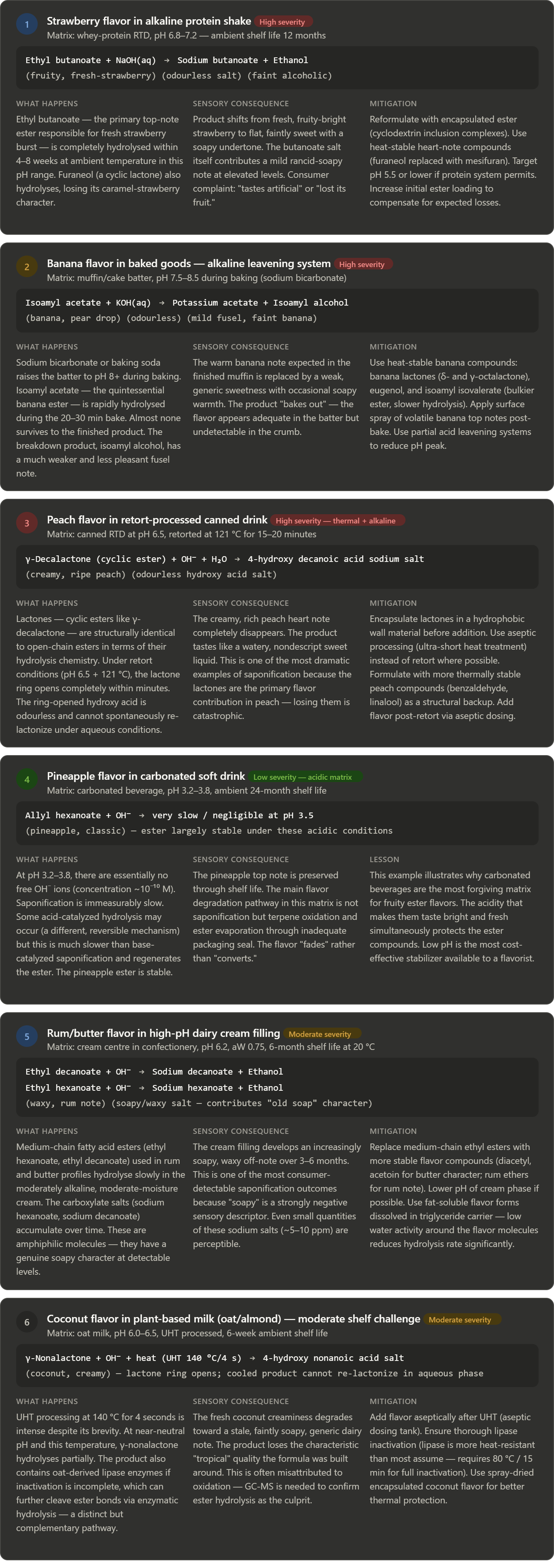
3. Real-world examples of saponification in flavor systems
These examples span different flavor types, matrices, and severity levels to give you a complete picture of where and how saponification manifests in practice.
4. How saponification impacts flavor aging and shelf life
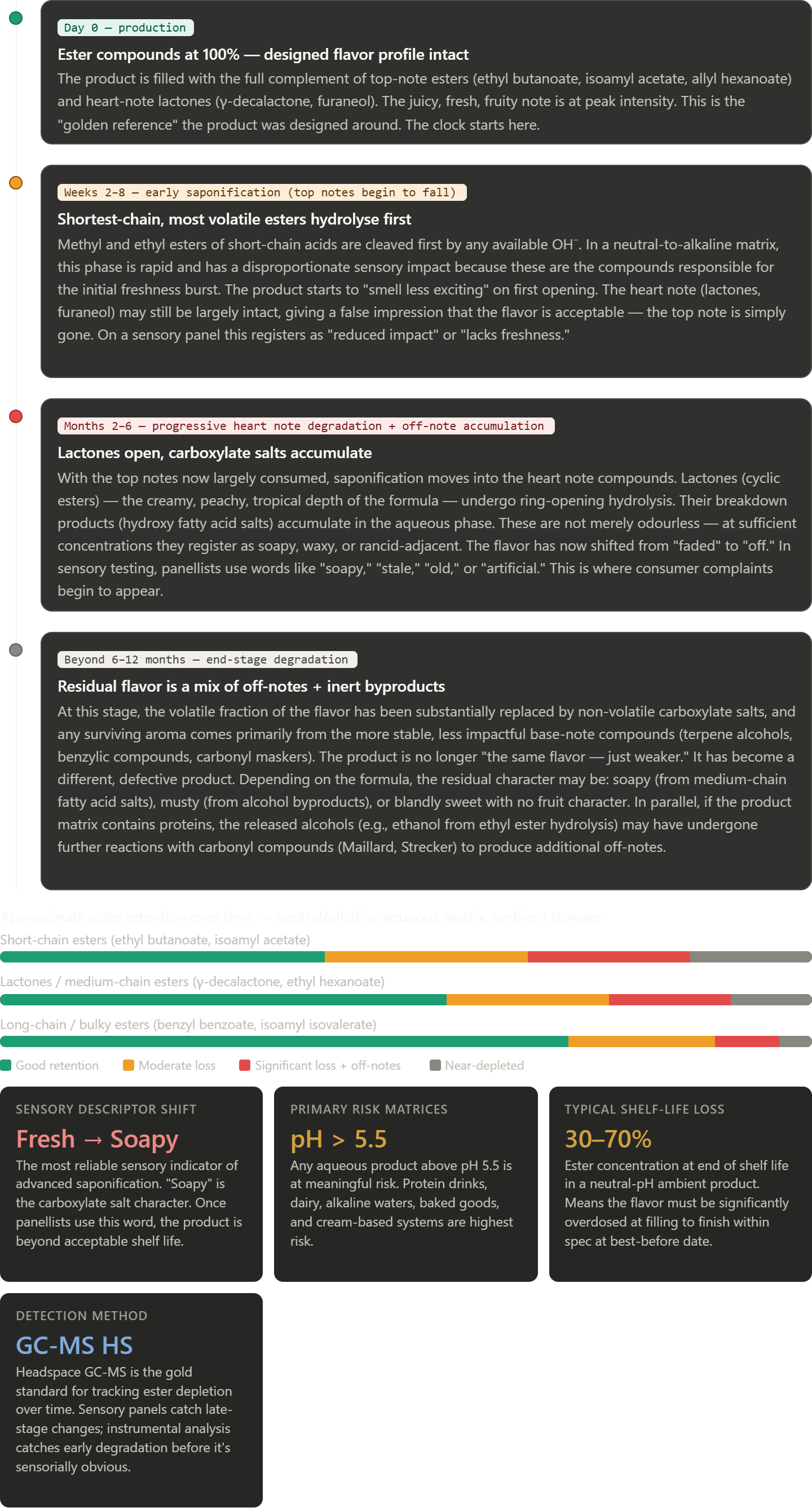
This is where saponification moves from chemistry lecture to commercial reality. It is arguably the single most important degradation pathway for fruity and juicy flavor notes over time, and understanding it mechanistically changes how you approach every specification and product brief.
The practical mindset every flavorist should carry
Saponification is not an exception or an accident — it is a predictable, thermodynamically driven process that happens on a schedule determined by pH, temperature, water activity, and ester structure. A formulation that smells magnificent on the day of blending can be a completely different product six months later simply because those conditions were not accounted for.
The most important shift in thinking is this: you are not only formulating a flavor for Day 0 — you are formulating a flavor whose degradation curve ends at an acceptable point on the last day of shelf life. That means working backwards from your target end-of-life sensory specification, accounting for the expected percentage of ester loss over the shelf life at the product's actual pH and storage temperature, and dosing accordingly — with the best available stability technologies layered on top.
In alkaline matrices especially, the carboxylate byproducts are not just neutral absences of a desired note. They are active, perceptible contributors to an "old soap" defect that no amount of overcorrection with fresh-smelling top notes at filling can hide once the conversion is well underway. The only winning strategy is prevention: encapsulation, pH control, cold chain, post-process addition, and intelligent ester selection.
###