Salt Analysis in the Flavor Industry: Theory, Function, Reporting, Relevance, Advantages, and Limitations of Major Salt Analysis Methods
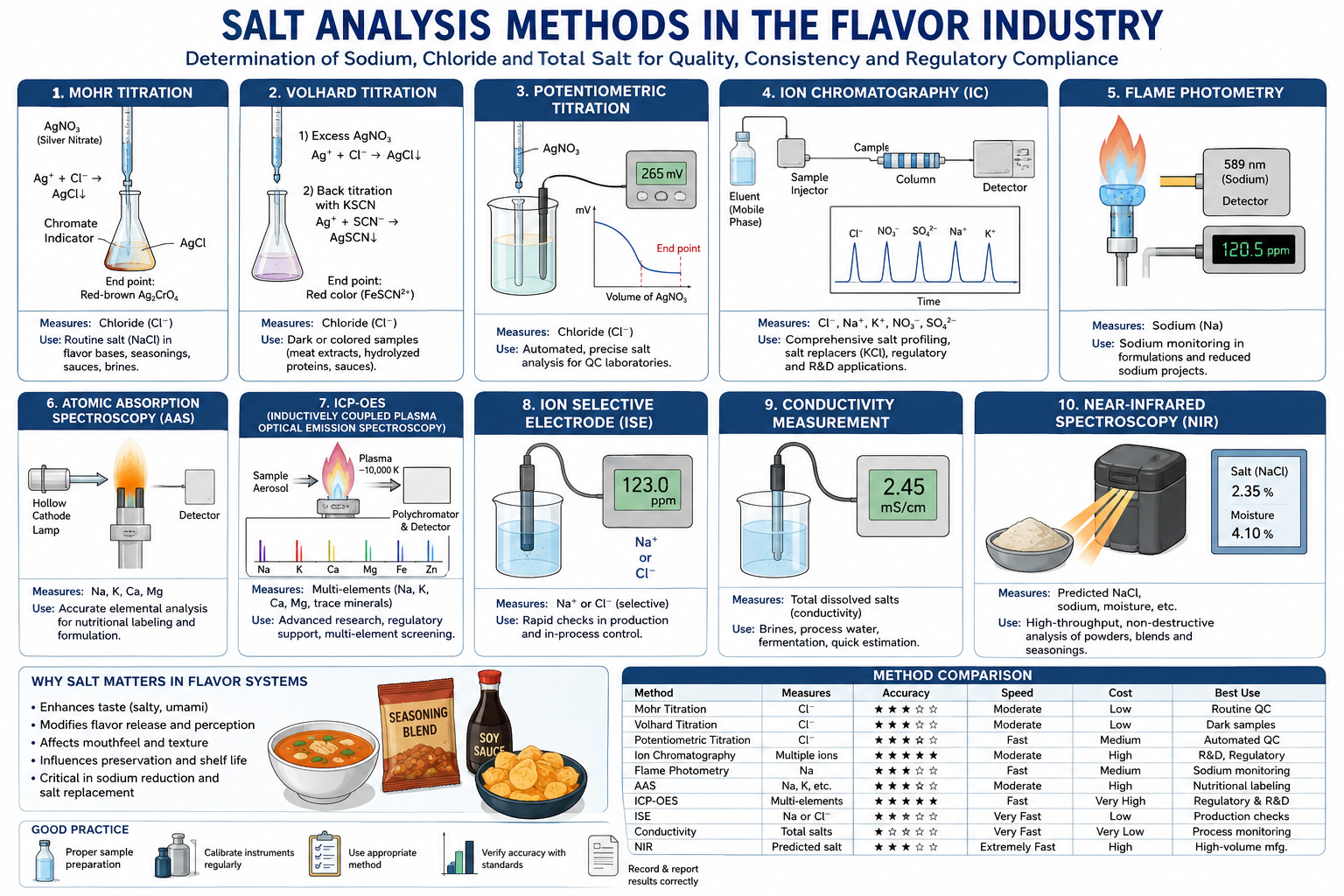
Salt analysis is an important part of flavor development, food formulation, quality control, regulatory compliance, nutritional labeling, and shelf-life studies. In flavor manufacturing, salt affects not only taste but also flavor release, mouthfeel, preservation, and interactions with flavor compounds.
The term "salt analysis" generally refers to determination of:
- Sodium chloride (NaCl)
- Total sodium
- Chloride ion
- Potassium chloride (KCl)
- Salt substitutes
- Salt distribution in food matrices
- Salt content for nutritional labeling
1. Mohr Titration Method
Theory
The Mohr method is a precipitation titration based on the reaction between chloride ions and silver nitrate.
Reaction:
Ag⁺ + Cl⁻ → AgCl↓
A potassium chromate indicator is used.
Once all chloride is precipitated as silver chloride, excess silver reacts with chromate:
2Ag⁺ + CrO₄²⁻ → Ag₂CrO₄↓
Formation of red-brown silver chromate indicates the endpoint.
Function
Measures:
- Chloride ion concentration
- Salt (NaCl) concentration after calculation
Commonly used for:
- Flavor compounds
- Seasonings
- Savory bases
- Brines
- Sauces
Reporting
Typically reported as:
- % NaCl
- % Chloride
- g salt/100 g
- mg sodium/g
Example:
NaCl = 8.45%
Relevance to Flavor Industry
Used for:
- Savory flavor quality control
- Soup flavor concentrates
- Seasoning blends
- Snack seasonings
- Meat flavors
Ensures batch-to-batch consistency.
Advantages
- Simple
- Inexpensive
- Good precision
- Widely recognized
Limitations
- Only works in near-neutral pH
- Colored samples interfere
- Cannot distinguish NaCl from KCl
- Manual endpoint subjectivity
2. Volhard Titration
Theory
Back-titration technique.
Excess silver nitrate is added:
Ag⁺ + Cl⁻ → AgCl↓
Remaining silver is titrated with potassium thiocyanate.
Ag⁺ + SCN⁻ → AgSCN↓
Ferric ion indicator forms a red ferric thiocyanate complex at endpoint.
Function
Determines chloride in:
- Dark-colored flavor systems
- Meat extracts
- Hydrolyzed proteins
Reporting
- % NaCl
- Chloride concentration
- Sodium equivalent
Relevance
Useful when Mohr titration is impossible because of color interference.
Advantages
- More accurate for dark samples
- Applicable over wider pH range
Limitations
- More labor intensive
- Additional reagents required
- Longer analysis time
3. Potentiometric Silver Nitrate Titration
Theory
Measures voltage change using a silver electrode during titration.
Endpoint detected electronically.
No color indicator needed.
Function
Measures:
- Chloride
- Salt concentration
Used extensively in automated food laboratories.
Reporting
- % NaCl
- ppm chloride
- g/kg salt
Relevance
Common for:
- Flavor houses
- Food ingredient manufacturers
- Seasoning plants
Advantages
- High accuracy
- Automated
- Suitable for colored samples
- Reduced analyst variability
Limitations
- Higher equipment cost
- Electrode maintenance required
4. Ion Chromatography (IC)
Theory
Separates ions using ion-exchange columns.
Measures:
- Chloride
- Sodium
- Potassium
- Nitrate
- Sulfate
Each ion elutes at a different retention time.
Function
Comprehensive salt profiling.
Can differentiate:
- NaCl
- KCl
- Calcium salts
- Magnesium salts
Reporting
- ppm
- mg/L
- mg/kg
- % concentration
Chromatogram generated.
Relevance
Important for:
- Reduced-sodium flavor development
- Salt replacement projects
- Regulatory studies
Advantages
- Extremely accurate
- Multi-ion analysis
- Excellent sensitivity
Limitations
- Expensive instrumentation
- Skilled analysts required
- Higher operating costs
5. Flame Photometry
Theory
Measures light emitted by excited sodium atoms.
Sodium emits strongly at:
589 nm
Emission intensity is proportional to concentration.
Function
Measures:
- Sodium
- Potassium
Not chloride.
Reporting
- ppm sodium
- mg/kg sodium
- % sodium
Relevance
Common for sodium reduction projects.
Advantages
- Rapid
- Relatively inexpensive
- Good sodium sensitivity
Limitations
- Single-element focused
- Matrix interferences possible
- Less accurate than ICP methods
6. Atomic Absorption Spectroscopy (AAS)
Theory
Atoms absorb specific wavelengths of light.
Amount absorbed corresponds to concentration.
Function
Measures:
- Sodium
- Potassium
- Calcium
- Magnesium
Reporting
- ppm
- mg/kg
- % sodium
Relevance
Useful for:
- Sodium claims
- Salt replacement systems
- Mineral salt studies
Advantages
- Excellent accuracy
- Good sensitivity
Limitations
- Measures elements only
- Requires digestion
- One element at a time
7. ICP-OES (Inductively Coupled Plasma Optical Emission Spectroscopy)
Theory
Sample enters plasma (~10,000 K).
Excited atoms emit characteristic wavelengths.
Emission intensity correlates with concentration.
Function
Simultaneously measures:
- Sodium
- Potassium
- Calcium
- Magnesium
- Trace metals
Reporting
- ppm
- mg/kg
- mg/L
Relevance
Increasingly used for:
- Reduced sodium flavor systems
- Salt replacer validation
- Regulatory support
Advantages
- Multi-element analysis
- Very high accuracy
- Fast throughput
Limitations
- High capital cost
- Requires trained personnel
8. Ion Selective Electrode (ISE)
Theory
A sodium-selective or chloride-selective membrane generates a voltage proportional to ion activity.
Based on the Nernst equation.
Function
Measures:
- Sodium
- Chloride
Directly.
Reporting
- ppm
- mg/L
- % salt
Relevance
Common in production environments.
Used for rapid checks.
Advantages
- Fast
- Portable
- Minimal sample preparation
Limitations
- Lower accuracy
- Electrode drift
- Matrix effects
9. Conductivity Measurement
Theory
Salt ions conduct electricity.
Higher ion concentration produces higher conductivity.
Function
Estimates total dissolved salts.
Reporting
- mS/cm
- µS/cm
- Estimated salt %
Relevance
Useful for:
- Brines
- Flavor process water
- Fermentation media
Advantages
- Extremely fast
- Simple
- Low cost
Limitations
- Non-specific
- Cannot distinguish ions
- Requires calibration
10. Near-Infrared Spectroscopy (NIR)
Theory
Measures absorption of near-infrared light.
Uses chemometric models to correlate spectra with salt concentration.
Function
Rapid prediction of:
- Salt content
- Moisture
- Fat
- Protein
Simultaneously.
Reporting
- % NaCl
- Sodium concentration
Predicted values based on calibration models.
Relevance
Widely used in high-volume flavor and food manufacturing.
Particularly useful for:
- Seasoning powders
- Dry blends
- Snack coatings
Advantages
- Non-destructive
- Seconds per sample
- No chemicals
- High throughput
Limitations
- Requires extensive calibration
- Lower accuracy than IC or ICP
- Model maintenance needed
Comparison of Salt Analysis Methods for Flavor Laboratories
| Method | Measures | Accuracy | Speed | Cost | Best Use |
|---|---|---|---|---|---|
| Mohr Titration | Chloride | Good | Moderate | Low | Routine QC |
| Volhard Titration | Chloride | Good | Moderate | Low | Dark samples |
| Potentiometric Titration | Chloride | Excellent | Fast | Medium | Automated QC |
| Ion Chromatography | Multiple ions | Excellent | Moderate | High | Research & Regulatory |
| Flame Photometry | Sodium | Good | Fast | Medium | Sodium monitoring |
| AAS | Sodium/Potassium | Excellent | Moderate | High | Nutritional labeling |
| ICP-OES | Multi-elements | Excellent | Fast | Very High | Regulatory & R&D |
| ISE | Sodium/Chloride | Moderate | Very Fast | Low | Production checks |
| Conductivity | Total salts | Low | Very Fast | Very Low | Process monitoring |
| NIR | Predicted salt | Good | Extremely Fast | High | High-volume manufacturing |
What Flavorists Need to Know
For flavorists, salt analysis is not merely a sodium measurement exercise. Salt strongly influences:
- Taste intensity
- Flavor release
- Umami perception
- Sweetness suppression
- Bitterness masking
- Mouthfeel
- Shelf life
- Preservation
- Regulatory compliance
- Sodium reduction programs
In modern flavor houses, potentiometric titration is the most common routine QC method, while ion chromatography and ICP-OES are considered the gold standards for advanced flavor research, sodium-reduction projects, nutritional labeling validation, and regulatory investigations.
###