Vegetable Flavor Creation — Certified Flavorist Study Guide
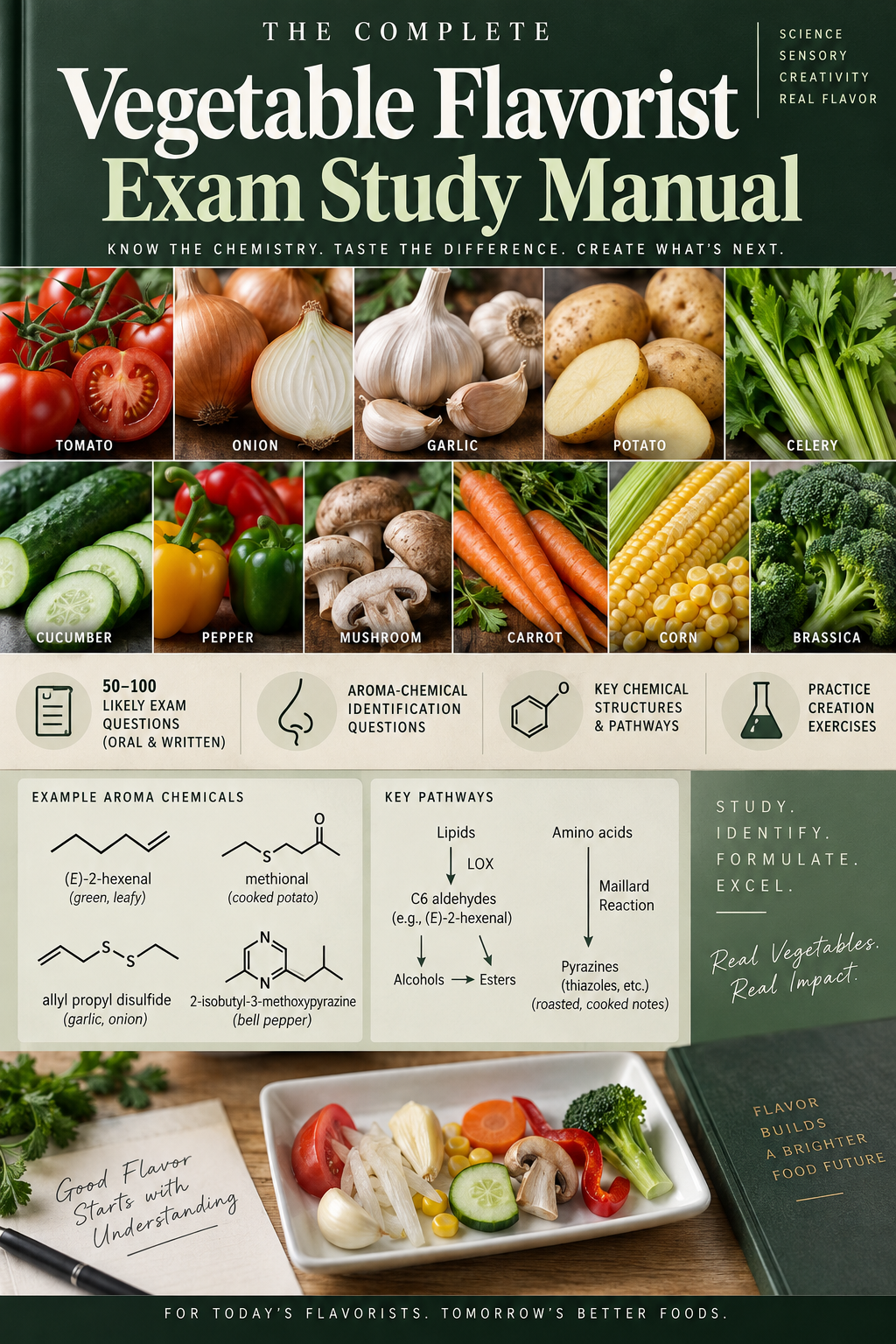
The Society of Flavor Chemists’ current syllabus explicitly lists Vegetable under Flavor Creation and says Certified candidates should demonstrate broad/deep knowledge consistent with successful independent and original flavor creation. The syllabus also expects candidates to connect creation to raw materials, chemistry, analytical methods, production, application, stability, regulations, and economics—not merely name a few vegetable aroma chemicals. (Flavor Chemists)
What follows is the framework a Certified Flavorist candidate is expected to be able to discuss confidently.
Vegetable Flavor Creation — Certified Flavorist Study Guide
1. What the SFC is really testing
For a question such as “How would you create a vegetable flavor?”, an expert answer should not start with a memorized formula.
It should start with the target.
“Vegetable” could mean fresh-cut cucumber, ripe tomato, canned tomato, roasted tomato, raw onion, sautéed onion, caramelized onion, raw carrot, cooked carrot, sweet corn, boiled potato, fried potato, green bell pepper, peas, celery, mushroom, asparagus, broccoli, beet, etc. Their chemistries are dramatically different.
The SFC syllabus specifically expects knowledge of chemical functionality, structure–odor relationships, oxidation, enzymolysis, fermentation, Maillard chemistry, Strecker degradation, volatilization, stability and analytical techniques such as GC, GC-O, MS and SPME. (Flavor Chemists)
A strong flavorist therefore thinks in terms of:
Reference → sensory architecture → chemical architecture → raw materials → taste system → processing character → application → stability → regulatory compliance → economics.
That thought process matters almost as much as the final material selection.
2. The fundamental architecture of vegetable flavors
Most vegetable flavors can be mentally broken into several interacting dimensions.
| Dimension | What it contributes | Typical chemistry |
|---|---|---|
| Fresh/green | freshly cut plant, leaf, stem, watery freshness | C6/C9 aldehydes and alcohols |
| Character impact | unmistakable identity | methoxypyrazines, sulfur compounds, nonadienals, phthalides, terpenes, etc. |
| Ripe/sweet | mature vegetable, flesh, sweetness | ketones, carotenoid degradation products, mild fruity materials |
| Earthy/root | soil/root/mushroom dimension | geosmin, pyrazines, terpenes, C8 mushroom compounds |
| Sulfur/pungent | onion, garlic, Brassica, asparagus | thiols, sulfides, polysulfides, thiosulfinates, isothiocyanates |
| Cooked | boiled, steamed, canned | DMS, methional, thermal sulfur chemistry, Strecker products |
| Brown/roasted | grilled, fried, roasted | pyrazines, pyrroles, furans, sulfur heterocycles, Strecker aldehydes |
| Taste/body | vegetable flesh rather than perfume | sugars, organic acids, salt, glutamate, amino acids, nucleotides, kokumi/taste modulators |
| Mouthfeel | pulpy, juicy, starchy, creamy | carrier/matrix effects and nonvolatile ingredients |
Vegetable aroma literature likewise describes aldehydes, alcohols, terpenes, sulfur compounds and other heterocycles as major classes, with fatty-acid, amino-acid, terpene and carotenoid pathways all contributing. (PubMed Central (PMC))
3. The single most important pathway: green-leaf volatile chemistry
A Certified Flavorist should understand LOX/HPL chemistry.
When vegetable tissue is damaged by cutting, crushing or chewing, lipoxygenase-related chemistry acts on unsaturated fatty acids such as linoleic and linolenic acids. Hydroperoxide lyase pathways then generate highly odor-active aldehydes and related alcohols.
Important examples include:
Hexanal → green, grassy, somewhat fatty.
(Z)-3-Hexenal → intensely fresh-cut green/leafy.
(E)-2-Hexenal → green, leafy, sharp.
(Z)-3-Hexenol → leafy, crushed grass.
1-Hexanol → softer green.
C9 chemistry produces materials important in cucumber and melon-like vegetable profiles.
This is why chopping a vegetable can produce an aroma that was far weaker in intact tissue: enzymatic chemistry is literally generating aroma after disruption. The recent vegetable-aroma review identifies C6 and C9 aldehydes/alcohols as classic green-leaf volatiles derived from fatty-acid metabolism. (PubMed Central (PMC))
For flavor creation, the lesson is crucial:
“Green” is not one ingredient.
Hexanal gives a different green from cis-3-hexenol. A cucumber green is different from tomato-leaf green. Bell-pepper green is different again because methoxypyrazines dominate it.
4. Aroma concentration is not aroma importance
A flavorist must understand odor threshold and odor activity value (OAV).
A volatile present at 1 ppm is not automatically more important than something present at 1 ppb.
A compound with an extraordinarily low threshold may dominate the character despite being analytically minor.
This explains compounds such as:
2-isobutyl-3-methoxypyrazine in bell pepper.
β-Ionone in tomato.
Geosmin in beet.
1-octen-3-one in mushroom.
Sulfur compounds in onion, garlic and Brassica.
This is why GC-MS alone is insufficient for flavor creation. GC-O, AEDA, OAV calculations, recombination and omission studies are much more informative for identifying what actually drives perception. The SFC syllabus specifically expects knowledge of GC, GC-O, MS and SPME/SPDE. (Flavor Chemists)
5. Vegetable families you should know
Tomato
Tomato is one of the best demonstrations of a multi-pathway vegetable flavor.
Important fresh-tomato odorants include:
| Chemical | Function in profile |
|---|---|
| (Z)-3-Hexenal | powerful fresh leafy/tomato-green |
| Hexanal | green/grassy |
| (E)-2-Hexenal | leafy green |
| (Z)-3-Hexenol | fresh green |
| 1-Penten-3-one | pungent/green |
| 3-Methylbutanal | ripe/malty nuance |
| 6-Methyl-5-hepten-2-one | tomato/carotenoid character |
| β-Ionone | floral/woody ripe depth |
| β-Damascenone | ripe/fruity complexity at very low levels |
| 2-Isobutylthiazole | distinctive tomato-vine/green character |
| Methyl salicylate | green/herbal nuance |
Only a relatively small subset of the hundreds of detected tomato volatiles makes a major sensory contribution. (PubMed Central (PMC))
But a realistic tomato cannot be made with volatiles alone.
Tomato taste depends strongly on the sugar/acid balance, and tomato additionally benefits from savory amino-acid/umami character. Glucose, fructose and organic acids materially affect perceived quality. (PubMed Central (PMC))
Creative construction
A fresh tomato build might therefore contain a green aldehydic skeleton, a very restrained carotenoid/ripe complex, the characteristic thiazole dimension, mild sweetness and acidity, plus savory body.
A cooked tomato changes direction. Heat reduces some fresh-green impact while thermal/sulfur characters become relatively more important; dimethyl sulfide is associated with thermally processed tomato products. (ACS Publications)
So:
fresh tomato ≠ tomato paste ≠ canned tomato ≠ roasted tomato ≠ ketchup tomato.
A Certified Flavorist should immediately ask which one.
6. Cucumber
Cucumber is an excellent example of a flavor dominated by a few extraordinarily characteristic C9 compounds.
The classic key odorants are:
(E,Z)-2,6-nonadienal — characteristic fresh cucumber.
(E)-2-nonenal — green/fatty cucumber support.
Other related C9 aldehydes/alcohols provide watery, melon-like, green and peel effects.
Aroma dilution studies identify (E,Z)-2,6-nonadienal as the dominant cucumber odorant, followed by nonenal isomers. (Institute of Food Technologists)
The compounds arise largely through fatty-acid/LOX chemistry. (PubMed Central (PMC))
Flavorist lesson
Do not make cucumber by simply adding “green notes.”
The nonadienal character establishes the identity, while C6 materials, watery effects and subtle peel/vegetal notes make it believable.
There is also an important stability lesson: (E,Z)-2,6-nonadienal is reactive and processing conditions can greatly affect its formation and persistence. Acidification can alter production and stability. (Institute of Food Technologists)
7. Green bell pepper
The classic molecule a flavorist must know is:
2-isobutyl-3-methoxypyrazine — IBMP.
It has an extremely low sensory threshold and strongly communicates bell pepper/green vegetable character. Modern pepper studies continue to identify IBMP as a major contributor to green-pepper aroma. (PubMed Central (PMC))
Supporting materials can include green aldehydes, ketones and subtle fruity/floral materials depending on ripeness.
Critical creation principle
Methoxypyrazines are impact materials.
Using too much does not create “more realistic pepper.” It creates an aggressive raw-pepper/pea/earthy character that can dominate the entire formulation.
A flavorist commonly builds the surrounding body first and approaches the pyrazine carefully through dilution.
Red or fully ripe pepper requires a different balance: less aggressive green impact and more sweet/ripe/fruity character.
8. Peas, green beans and leguminous vegetables
The important conceptual combination is:
green fatty-acid volatiles + characteristic pyrazine/beany notes + sweet vegetable body.
Green beans produce volatile compounds from linoleic and linolenic acids including hexanal, hexanol, 1-octen-3-ol, trans-2-hexenal and cis-3-hexenol. (Institute of Food Technologists)
Methoxypyrazines are particularly important to pea-like/earthy-green character.
The creative danger is turning pea into bell pepper. The same family of high-impact pyrazines can occur across several vegetables, so the ratio to sweet, green, fatty and cooked notes determines identity.
Cooked peas additionally move toward sweet/starchy, sulfurous and cooked-vegetable dimensions.
9. Sweet corn
A flavorist should immediately associate cooked sweet corn with dimethyl sulfide (DMS).
Classical sensory/GC work found DMS to be the major cooked-corn aroma contributor, with hydrogen sulfide, methanethiol and ethanethiol also contributing because of their sensory potency. (Institute of Food Technologists)
But aroma is only half the problem.
Sweet corn needs:
sweetness,
grain/starch body,
creamy or milky kernel character where appropriate,
green/fresh notes for raw corn,
and sulfur character for cooked corn.
DMS by itself smells sulfurous/corn-like but does not reproduce the eating experience.
For roasted corn, add another chemistry layer: Maillard/roasted pyrazine and grain effects.
10. Potato
Potato demonstrates the distinction between raw, boiled and fried/roasted chemistry.
One of the most important molecules to know is:
Methional, 3-(methylthio)propanal.
It is strongly associated with boiled/baked potato character and originates from methionine/Strecker chemistry.
Boiled-potato aroma also involves lipid-degradation products, sulfur compounds and methoxypyrazines. (ScienceDirect)
A roasted/fried potato flavor adds Maillard chemistry. Potato snack work has identified methional together with compounds such as 2-acetylpyrazine and 2-acetyl-1-pyrroline as powerful contributors to cooked/roasty profiles. (PubMed)
Flavorist construction
Think in layers:
starchy potato body → methional potato identity → mild earthy/green support → butter/fat if appropriate → roasted/pyrazinic layer for baked or fried character.
Too much methional quickly becomes strongly sulfurous.
11. Carrot
Carrot belongs primarily to a very different chemical world:
terpenes.
Important carotenoid-looking color does not mean carotenoid volatiles dominate the fresh carrot aroma; monoterpenes and sesquiterpenes are major contributors.
Especially useful conceptual markers include:
Sabinene, β-myrcene, α/β-pinene → carrot top, fresh green, terpenic.
Limonene, γ-terpinene, terpinolene → sweeter/fruity/citrus-terpene dimensions.
β-Caryophyllene, α-humulene, bisabolene-type materials → spicy/woody depth.
Studies associate sabinene, β-myrcene and p-cymene with carrot-top character and sesquiterpenes with spicy/woody notes. (PubMed Central (PMC))
Terpenes can also contribute harshness and bitterness when excessive. (PubMed Central (PMC))
Therefore a convincing carrot flavor usually requires sweet root/flesh body underneath a relatively restrained terpene complex.
Raw carrot should be greener and more terpenic.
Cooked carrot should become sweeter, softer, less sharply green and more root-like.
12. Celery
Celery is a classic flavorist profile because of its distinctive phthalides.
Important compounds include:
3-n-butylphthalide
sedanolide
sedanenolide
These were found to be potent characteristic odorants in raw and boiled celery and to contribute to celery's flavor-enhancing effect in savory systems. (ACS Publications)
A celery flavor is usually supported with:
green leafy material,
herbal/terpenic material,
fresh stalk character,
earthy root character where appropriate,
and savory/salty body.
Celery seed and celery stalk should not be treated as identical targets. Seed character is much more intense and spice-like.
13. Beet
The molecule you absolutely should know is:
Geosmin.
Geosmin has an extremely characteristic earthy/musty character and is important in beet perception. (PubMed)
Cooked beet also contains pyridines, sulfur compounds, aldehydes and methoxypyrazines; classical work confirmed geosmin and 2-methoxy-3-sec-butylpyrazine as potentially important because of their very low thresholds. (Institute of Food Technologists)
Creation trap
Geosmin is so potent that overdosing creates soil/mold rather than beet.
The beet identity needs sweetness, root body, mild green character and sometimes cooked/earthy support around it.
14. Mushroom
Botanically a fungus, but indispensable in savory/vegetable flavor work.
The classic materials are:
1-octen-3-ol
1-octen-3-one
They produce unmistakable mushroom/fungal character.
For several mushrooms, 1-octen-3-one has extremely high sensory significance despite low concentration. (DOI)
Fresh mushrooms combine C8 mushroom chemistry with green/fatty aldehydes and subtle earthy notes.
Drying changes the profile substantially.
For shiitake, drying reduces some fresh C8 character while sulfur chemistry, including lenthionine, becomes highly important. (PubMed Central (PMC))
Dry porcini likewise develops stronger methional and pyrazine/roasted dimensions. (ScienceDirect)
A flavorist therefore distinguishes:
fresh button mushroom,
cooked mushroom,
fried mushroom,
porcini,
shiitake,
truffle-like profiles.
“Mushroom flavor” is no more a single flavor than “fruit flavor.”
15. Onion, garlic, leek and other Alliums
This is essential Certified Flavorist chemistry.
Intact Allium tissue stores relatively nonvolatile sulfur precursors.
When tissue is cut or crushed, enzymes encounter those precursors and rapidly produce reactive sulfur compounds.
In onions, S-alk(en)yl cysteine sulfoxides are cleaved by alliinase to sulfenic acids. Onion also forms the lachrymatory factor propanethial S-oxide through lachrymatory-factor synthase. (PubMed Central (PMC))
Garlic differs.
Alliinase acting on alliin ultimately generates allicin, a highly reactive thiosulfinate; allicin subsequently decomposes into numerous sulfur volatiles. (PubMed Central (PMC))
This explains why:
fresh crushed garlic,
garlic oil,
fried garlic,
roasted garlic,
black/fermented garlic
are profoundly different sensory targets.
A flavorist should conceptually recognize
Fresh garlic → sharp thiosulfinate/allium character.
Garlic oil → sulfide/disulfide/trisulfide spectrum.
Cooked garlic → softer sulfur, sweet and browned character.
Roasted garlic → sulfur plus Maillard/caramelized sweetness.
Fresh onion → green/pungent/lachrymatory sulfur.
Cooked onion → softer sweet sulfur.
Fried onion → sulfur + fatty + Maillard.
Caramelized onion → sweet brown/caramelized character with diminished raw pungency.
The 2026 literature emphasizes that garlic sulfur compounds are highly sensitive to processing, heat and other conditions. (ScienceDirect)
16. Brassicas: cabbage, broccoli, cauliflower, Brussels sprouts
Here the flavorist needs glucosinolate/myrosinase chemistry.
Brassica tissues contain glucosinolates. Tissue damage permits enzymatic hydrolysis, generating products including isothiocyanates responsible for pungent mustard/horseradish-like effects.
Heating changes the profile further and can generate powerful volatile sulfides.
Cooked cauliflower studies identify:
allyl isothiocyanate
dimethyl sulfide
dimethyl trisulfide
methanethiol
as key sulfur odorants. (ACS Publications)
Critical sensory principle
A little sulfur communicates cooked vegetable.
Too much DMTS communicates overcooked cabbage.
That distinction is extremely important in savory flavor creation.
The flavorist has to reproduce the desired degree of cooking, not merely the identity of the plant.
17. Asparagus
Cooked asparagus is another important sulfur profile.
The major association is again:
Dimethyl sulfide.
But cooked asparagus is more complex and can involve methional, methoxypyrazines, green aldehydes, diketones and mushroom-like materials.
Published work identifies DMS, 2-methoxy-3-isopropylpyrazine and methional among key cooked-asparagus odorants. (PubMed Central (PMC))
The precursor S-methylmethionine is important in thermally generated DMS. (ScienceDirect)
So a convincing asparagus flavor is not simply cabbage sulfur; it needs green stalk, earthy/pyrazine and cooked vegetable complexity.
18. Raw versus cooked is one of the most important exam discussions
Flavorists should be able to explain the transformation conceptually.
| Raw/fresh | Heated/cooked |
|---|---|
| enzyme-generated aldehydes | enzymes become inactivated |
| crisp green C6/C9 notes | green notes often diminish |
| methoxypyrazine impact | may remain but changes balance |
| fresh thiosulfinates/isothiocyanates | thermal sulfur degradation products |
| watery/leafy | sweeter/softer |
| minimal browning | Strecker/Maillard products |
| little pyrazinic roast | pyrazines, furans, pyrroles |
| vegetal bitterness/astringency | bitterness may soften or change |
| freshness | boiled/steamed/canned character |
This is exactly where the SFC requirement for knowledge of enzymolysis, oxidation, Maillard reaction, Strecker degradation and aging becomes relevant. (Flavor Chemists)
19. Maillard chemistry and vegetables
For roasted, baked, grilled or fried vegetable flavors, a flavorist needs a working model of:
Reducing sugar + amino compound → Schiff base → Amadori/Heyns chemistry → reactive carbonyls → Strecker degradation → heterocyclic aroma products.
The important output classes include:
pyrazines,
pyrroles,
furans,
thiazoles,
thiophenes,
Strecker aldehydes,
sulfur heterocycles.
The exact balance depends on substrate composition, water activity, temperature, pH, time and sulfur/amino-acid availability.
The SFC syllabus specifically names Schiff-base formation, Strecker degradation, Amadori and Heyns rearrangements and aldol condensation under Maillard chemistry. (Flavor Chemists)
For an oral examination, be able to explain why a roasted potato requires chemistry absent from a boiled potato, or why a caramelized onion cannot simply be made by increasing the raw-onion sulfur system.
20. Taste is not optional
An aroma that smells exactly like tomato on a blotter may taste completely wrong in soup.
Vegetable flavor includes nonvolatile perception.
The flavorist should think about:
Sweetness — glucose/fructose/sucrose or sweetness modulation.
Acidity — citric, malic and other organic-acid effects depending on vegetable.
Saltiness — crucial in savory applications.
Umami — glutamate and synergistic nucleotides.
Bitterness — Brassica glucosinolates, carrot terpenoid-associated harshness, leafy vegetables.
Astringency — phenolic/plant effects.
Kokumi/body — continuity, fullness and broth-like depth.
Starchiness — potatoes, corn, peas.
Umami substances can include amino acids, nucleotides, peptides and related materials, and can alter the perception of saltiness, bitterness and overall savory intensity. (ScienceDirect)
The certified-level principle is:
A vegetable flavor should taste like eating the vegetable, not merely smell like a GC standard.
21. Natural raw materials versus aroma chemicals
The SFC syllabus expects familiarity with vegetable juice concentrates, extracts, essential oils, oleoresins, distillates, natural and synthetic aroma molecules, yeast products, HVP and related materials. (Flavor Chemists)
A practical vegetable flavor may therefore combine natural materials and selected aroma chemicals.
| Raw-material approach | Advantage | Limitation |
|---|---|---|
| Vegetable concentrate | authentic body/taste | variable, bulky, microbiological/stability issues |
| Distillate | authentic volatile signature | often weak body |
| Extract | complexity | color/solubility/stability variability |
| Essential oil | strong concentrated top notes | may poorly reproduce fresh flesh |
| Oleoresin | broad natural profile | color, insolubility, harshness |
| Reaction/process flavor | excellent cooked character | not appropriate for raw profile |
| Individual aroma chemicals | precise, reproducible | easily becomes simplistic |
| HVP/yeast | savory body/umami | may introduce generic broth character |
| Natural flavor complex | convenient complexity | cost and natural-source constraints |
A sophisticated flavor is often a hybrid, using natural character for complexity and individual materials to repair, strengthen or standardize specific sensory attributes.
22. How a Certified Flavorist should create an original vegetable flavor
A defensible creative workflow would be:
- Define the target precisely. Identify vegetable, variety if relevant, maturity, raw/cooked state, cooking method, freshness, desired authenticity and application. “Tomato” is insufficient; “fresh vine-ripe tomato for a low-pH beverage” is a real brief.
- Evaluate an actual reference. Smell orthonasally and retronasally; taste it; examine peel, flesh, juice, seed, cooked fractions or other relevant components separately.
- Write a sensory map before formulating. For example: green 6/10, watery 7/10, sweet 4/10, earthy 1/10, sulfur 0/10, fruity 2/10.
- Identify character-impact chemistry. Determine which one or two chemical families establish identity: cucumber nonadienal, bell-pepper methoxypyrazine, celery phthalides, mushroom C8 chemistry, beet geosmin, potato methional, etc.
- Build the skeleton conservatively. Begin with impact materials at controlled dilution rather than attempting immediate realism.
- Add bridging notes. Use green aldehydes/alcohols, terpenes, fatty notes, floral/ripe materials, sulfur or earthy materials to connect the impact chemical to the reference.
- Construct the nonvolatile taste architecture. Sweet, sour, salty, bitter, umami and mouthfeel should match the vegetable and application.
- Add the processing layer. For boiled, roasted, grilled, fried, fermented or canned profiles, introduce the corresponding thermal, Maillard, sulfur or fermentation dimensions.
- Evaluate in the actual food matrix. Never approve a savory flavor solely from a smelling strip or neat solution. Fat, protein, starch, salt, pH and processing alter release and perception.
- Iterate by sensory attribute rather than random ingredient changes. Ask “too green?”, “missing flesh?”, “sulfur onset too sharp?”, “cooked note too long?” and adjust deliberately.
- Stress-test stability. Look at heat, oxygen, light, pH, water activity, packaging, interactions and storage.
- Finish with manufacturing, regulatory and economic reality. A brilliant flavor that cannot be legally sold, manufactured consistently or hit the cost target is not a successful commercial flavor.
23. Flavor modification questions Candidates should expect
The 2026 SFC syllabus explicitly says candidates should also know how to modify flavors toward attributes such as fresh, green, umami, brown, juicy, sweet, earthy, creamy and mouthfeel, as well as cooking processes. (Flavor Chemists)
For a vegetable profile, you should therefore be prepared to explain something like this:
| Requested modification | Flavorist thinking |
|---|---|
| Make it fresher | increase appropriate C6/C9 fresh-green character, reduce cooked/heavy components |
| More leafy | cis-3-hexenyl/aldehydic direction, appropriate leaf/herbal materials |
| More ripe | soften harsh green, increase sweet/ripe/carotenoid-derived nuances |
| More earthy | carefully add root/mushroom/pyrazine/geosmin dimensions appropriate to target |
| More juicy | increase watery/fresh impression and coordinate sweet-acid balance |
| More cooked | decrease raw-green impact, introduce appropriate sulfur/Strecker notes |
| More roasted | pyrazine/furan/Maillard direction |
| More caramelized | sweet brown/Maillard direction while reducing raw pungency |
| More savory | glutamate/nucleotide/yeast/HVP/taste-modulation strategy as permitted |
| More creamy | fatty/dairy/mouthfeel support where contextually appropriate |
| Less bitter | adjust bitter contributors and increase sweetness/salt/umami or masking appropriately |
| Less sulfurous | reduce highest-impact sulfur materials rather than simply adding sweetness |
24. Application changes everything
Candidates should be able to discuss how the same vegetable flavor would change for:
Soup: savory body, salt, umami, thermal stability.
Bouillon: highly concentrated savory system, strong salt and umami interaction.
Snack seasoning: dry delivery, encapsulation, fat compatibility, high impact.
Sauce: acid/fat interactions and processing.
Plant-based meat: vegetable notes may either help authenticity or become undesirable “planty” off-notes.
Beverage: water solubility, low use level, pH stability and extreme sensitivity to sulfur/green impact materials.
Frozen meal: freeze/thaw plus reheating.
Retort: significant thermal loss/transformation.
Dry mix: oxidation and shelf-life issues.
The SFC requires candidates to know liquid, oil-soluble, emulsion, process/paste and numerous dry-delivery systems, including spray drying and other encapsulation/drying technologies. (Flavor Chemists)
25. Vegetable flavor stability
Several characteristic vegetable materials are chemically delicate.
Aldehydes
Unsaturated aldehydes can oxidize, polymerize, react with amino groups or otherwise change during storage.
The fresh top note may disappear first.
Sulfur compounds
Extremely potent and often reactive.
Oxidation can drastically alter character.
Trace changes can be perceptually enormous.
Terpenes
Susceptible to oxidation, producing altered woody, resinous or off characters.
Methoxypyrazines
Powerful enough that small formulation or processing changes can become obvious.
Natural extracts
Composition can vary with cultivar, crop, origin, harvesting, processing and storage.
Vegetable volatile profiles are known to vary with genotype, developmental stage, environment and postharvest handling. (PubMed Central (PMC))
A certified answer should therefore mention antioxidants, oxygen exposure, light, packaging, pH, solvent system, encapsulation and storage where relevant.
26. Analytical work a flavorist should understand
A Certified Flavorist does not have to be the analytical chemist running every instrument, but should understand what information each technique provides.
GC-MS: What volatile compounds are present?
GC-FID: Useful quantitative profiling.
GC-O: Which chromatographic peaks actually smell?
AEDA: Which odorants remain perceivable at high dilution?
OAV: Concentration relative to sensory threshold.
HS-SPME: Convenient headspace extraction useful for volatile profiling.
SAFE/distillation techniques: More comprehensive isolation in specialized aroma research.
HPLC/LC-MS: Nonvolatile precursors, sugars, acids, glucosinolates, etc.
Sensory descriptive analysis: What does the food actually taste/smell like?
Recombination: Can the identified chemicals reconstruct the target?
Omission testing: Which compounds are genuinely necessary?
These concepts are much more useful than memorizing a GC peak list.
27. The impact materials that deserve instant recognition
For exam preparation, candidates should know these associations:
| Target | Association to know |
|---|---|
| Cucumber | (E,Z)-2,6-nonadienal |
| Bell pepper | 2-isobutyl-3-methoxypyrazine |
| Tomato | (Z)-3-hexenal + 2-isobutylthiazole + carotenoid-derived compounds |
| Celery | 3-n-butylphthalide / sedanolide / sedanenolide |
| Mushroom | 1-octen-3-ol / 1-octen-3-one |
| Potato | methional |
| Beet | geosmin |
| Sweet corn | dimethyl sulfide |
| Cooked asparagus | dimethyl sulfide |
| Raw garlic | allicin/thiosulfinate chemistry |
| Onion | propanethial S-oxide + onion sulfur chemistry |
| Brassica | glucosinolate/isothiocyanate chemistry + thermal sulfides |
| Carrot | terpene complex: myrcene, sabinene, terpinolene, caryophyllene etc. |
| Green bean | C6 green volatiles / fatty-acid oxidation chemistry |
These are anchors, not complete formulas.
That distinction would be worth stating in an interview.
28. Important sensory traps
Overusing an impact compound
A trace of IBMP gives natural pepper.
Ten times as much does not give ten times better pepper.
The same applies to geosmin, DMTS, methional, mushroom ketones and many sulfur materials.
Confusing analytical abundance with sensory importance
High concentration does not equal high sensory contribution.
Making everything “green”
Hexanal is not a universal solution for vegetables.
Cucumber, green pepper, tomato, pea and carrot have different types of green.
Forgetting taste
A vegetable aroma without sugar/acid/salt/umami/body often resembles perfume rather than food.
Ignoring cooking history
Raw onion cannot simply be diluted to become caramelized onion.
Using brown notes indiscriminately
Different thermal processes create different profiles: boiled, roasted, grilled, fried, toasted, smoked and caramelized are not interchangeable.
Forgetting temporal profile
A real vegetable has an onset, middle and finish.
High-impact pyrazines and sulfur compounds can produce an unnaturally persistent finish.
29. Regulatory knowledge
A Certified SFC candidate is expected to demonstrate legal/regulatory awareness. The current syllabus includes U.S. flavor declarations under 21 CFR 101.22, USDA Organic/NOP considerations, FEMA GRAS, and international considerations including EU Regulation 1334/2008. (Flavor Chemists)
For vegetable creation, the most important professional principle is:
Natural occurrence in a vegetable does not automatically mean you may add that compound freely as a flavor ingredient.
Each raw material should be checked for:
identity,
FEMA/JECFA or relevant status,
conditions of intended use,
purity/specification,
jurisdiction,
natural/artificial labeling consequences,
category use levels,
customer restrictions,
organic status where relevant,
allergen or other labeling implications.
FEMA's Flavor Ingredient Library provides GRAS status and related safety information for flavor ingredients evaluated under intended conditions of use. (FEMA)
So when discussing specific chemicals above, treat them as chemical/sensory teaching examples, not blanket recommendations for legal use at any level or in every country.
30. Economics matters
The syllabus explicitly includes economics in Certified-level knowledge. (Flavor Chemists)
Suppose two tomato formulas smell equally good.
Formula A depends heavily on a rare natural isolate with crop variability.
Formula B obtains most complexity from a stable natural extract plus small amounts of cost-effective reinforcing materials.
If B has better continuity of supply, stability, reproducibility and cost while meeting the labeling requirement, B may be the superior professional flavor.
A Certified Flavorist should be able to articulate this.
31. How I would answer an SFC oral question
If asked:
“Describe your approach to creating a vegetable flavor.”
A strong answer would sound roughly like:
I first define the exact sensory target because raw, cooked and processed vegetables can have fundamentally different chemistry. I evaluate a reference and divide it into character-impact, fresh-green, ripe/sweet, earthy, sulfurous, cooked/brown and taste/body components. I identify the dominant biosynthetic or process pathways—for example LOX-derived C6/C9 aldehydes in cucumber and tomato, methoxypyrazines in green pepper, terpenes in carrot, sulfur chemistry in Alliums and Brassicas, or Strecker/Maillard chemistry in cooked potato.
I establish identity with the minimum amount of the impact system, then build supporting notes around it rather than overdosing the character chemical. I separately construct the taste system—sweetness, acidity, salt, umami, bitterness and mouthfeel. For a cooked target I add the correct thermal chemistry rather than simply reducing the fresh notes.
I then evaluate the flavor in its intended application because pH, fat, protein, starch, salt and processing alter release and stability. Finally I optimize the formula for shelf life, manufacturing, regulatory status, labeling, cost and supply continuity.
That demonstrates creative reasoning instead of reciting chemicals.
32. What I would memorize vs. what I would understand
For SFC preparation, memorize the character-impact associations in the table above and the major functional groups.
But spend more study time understanding these relationships:
LOX → fresh green.
Methoxypyrazines → green/earthy vegetables.
Terpenes → carrot/herbal/root dimensions.
Glucosinolate + myrosinase → Brassica pungency/isothiocyanates.
Alliinase + cysteine sulfoxides → Allium sulfur chemistry.
S-methylmethionine/thermal chemistry → DMS in certain cooked vegetables.
Methionine/Strecker → methional/cooked potato.
Reducing sugar + amino acid + heat → roasted/Maillard character.
Carotenoid degradation → ripe/floral tomato dimensions.
C8 lipid chemistry → mushroom.
Geosmin → beet/earthy.
Then understand how concentration, threshold, application and processing change all of them.
That is much closer to Certified Flavorist thinking than memorizing a hundred vegetable formulas.
One final point from the Society itself is worth keeping in mind: SFC states that it does not expect every candidate to know every aspect of flavor creation. What differentiates the Certified level is broad and deep knowledge plus evidence of independent, original creation ability. (Flavor Chemists)
Vegetable Flavorist Exam Study Manual
50–100 likely oral/written questions, aroma-chemical identification questions, key chemical structures/pathways, and practice creation exercises for tomato, onion, garlic, potato, celery, cucumber, pepper, mushroom, carrot, corn and Brassica.
Log in to continue your reading