Water-Soluble Flavors and Washed Extracts: Formulation, Production, Troubleshooting, Applications, Stability, and SFC Examination Guide
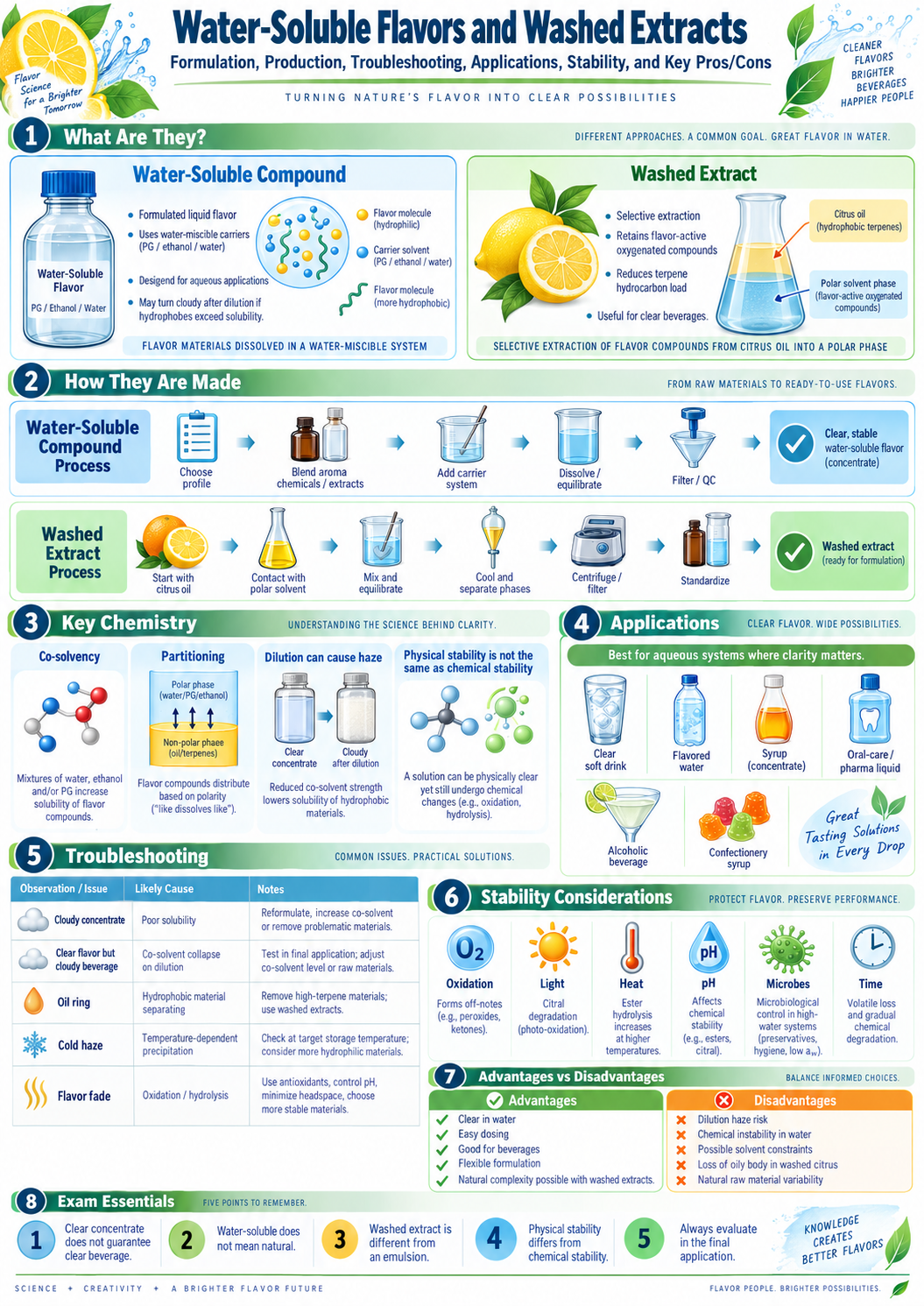
The January 2026 Society of Flavor Chemists (SFC) syllabus places “Water soluble – compound; washed extracts” under Liquid Flavor Forms and specifically expects a candidate to be able to describe formulation, production, troubleshooting, applications, stability considerations, and advantages/disadvantages. (flavorchemists.com)
Below is what flavorists may need to know, according to the society's syllabus for an SFC interview/examination.
Water-soluble liquid flavors: the essential concept
A water-soluble flavor is a liquid flavor designed to dissolve or become molecularly/colloidally clear at its intended use level in an aqueous application.
This does not mean every flavor molecule in the concentrate is inherently soluble in pure water. Many important aroma materials—terpenes, esters, aldehydes, ketones and essential-oil components—have limited water solubility. The flavorist commonly uses water-miscible solvents/co-solvents, especially propylene glycol and ethanol, to keep these materials in solution.
The most useful examination distinction is:
| Water-soluble compound | Washed extract |
|---|---|
| A formulated flavor made by blending flavoring substances with water-miscible solvent(s) | A selectively extracted flavor obtained by partitioning desired components of an oil/extract into a more polar, water-compatible phase |
| Built by compounding | Built primarily by extraction/separation, then often standardized or compounded |
| Can contain aroma chemicals, extracts, distillates, reaction products, etc. | Common classical example: washed citrus oil/extract |
| Composition chosen by flavorist | Composition partly dictated by partition chemistry of the starting natural material |
| Usually highly reproducible | More raw-material and process variation |
| Can create almost any profile | Often retains characteristic natural complexity |
| Clarity achieved through formulation | Clarity achieved largely by removing poorly water-soluble oil components |
A strong interview answer should immediately make that distinction.
1. Water-soluble compound
What it is
A water-soluble compound is a homogeneous liquid flavor composition in which flavoring materials are dissolved in a water-compatible carrier system.
A typical flavor may contain:
| Component | Purpose |
|---|---|
| Aroma chemicals | Character, impact, top/middle/base notes |
| Natural extracts/distillates | Authenticity, complexity |
| Propylene glycol | Carrier/co-solvent |
| Ethanol | Carrier/co-solvent; particularly useful for many volatile hydrophobes |
| Water | Diluent where appropriate |
| Glycerin | Water-miscible carrier where appropriate |
| Acids/buffers | Occasionally for stability/profile; application dependent |
| Antioxidants | Oxidation protection where permitted/needed |
| Preservatives | Where water activity and formulation require microbiological control |
The solvent is not merely there to make up weight. It affects solubility, flavor release, volatility, flash point, processing behavior, regulatory status, shelf life and sensory performance.
2. The physical chemistry a flavorist must understand
Co-solvency
Suppose an ester or terpene is practically insoluble in water. It may dissolve readily in ethanol or PG.
Therefore:
flavor oil + ethanol/PG → clear concentrate
but
that concentrate + large quantity of water → possibly cloudy beverage
Why?
Because dilution decreases the effective co-solvent concentration. At some point the aqueous phase can no longer solubilize the hydrophobic component.
This is why checking the concentrate alone is insufficient.
A flavorist must test:
flavor concentrate → actual finished application → intended use level → intended pH/Brix/alcohol → actual processing conditions.
A crystal-clear flavor bottle can still create a cloudy beverage.
3. Solvent selection
| Solvent | Important characteristics | Advantages | Limitations |
|---|---|---|---|
| Propylene glycol (PG) | Water-miscible, high boiling, low volatility | Excellent general flavor carrier; helps dissolve many aroma chemicals; low evaporative loss | Does not dissolve every oil indefinitely; viscosity; may suppress/restrain top-note release; regulatory/customer limitations must be considered |
| Ethanol | Completely miscible with water; volatile; strong co-solvent for many aroma materials | Excellent for top notes, botanical extracts and essential-oil oxygenates; low viscosity | Flash point/flamability; evaporation; alcohol-related customer/regulatory/religious considerations |
| Water | Most polar; inexpensive | Ideal compatibility with aqueous food | Poor solvent for many aroma molecules; microbial and hydrolytic stability issues |
| Glycerin | Water-miscible, hygroscopic, viscous, low volatility | Useful in certain flavor/pharma applications; low evaporative loss | Very viscous; can alter flavor release/mouthfeel; weaker solvent for many hydrophobic flavor chemicals |
| Mixed solvent systems | Tunable polarity | Often gives best compromise | Dilution can cause unexpected precipitation/oiling |
PG itself is recognized in FDA/FEMA materials as a food substance/flavor-related material; FEMA identifies propylene glycol under FEMA 2940 and cites 21 CFR 184.1666. (femaflavor.org)
An interview examiner may ask:
“Why not simply use more PG or ethanol?”
A good answer is that solvent choice has organoleptic, cost, viscosity, flash-point, labeling, regulatory, customer, processing and final-application consequences. The objective is the minimum appropriate solvent system that provides adequate physical and chemical stability and acceptable flavor release.
4. How a water-soluble compound is formulated
The professional workflow begins with the application, not the flavor bottle.
Flavorists should know the customer matrix first:
pH → Brix/solids → fat → protein → alcohol → processing temperature → carbonation → packaging → shelf-life target → flavor use level.
A flavor that works in a neutral syrup may fail badly in a pH-2.8 beverage.
Conceptual formulation sequence
First establish the flavor profile in a convenient carrier. Then identify the least-soluble ingredients. Determine whether they can remain below their practical solubility limits at both concentrate level and final dilution.
Solvent is normally charged first or early. Less problematic soluble materials can then be added. Difficult solids such as vanillin-type materials may require controlled predissolution. Hydrophobic materials are normally added gradually while observing clarity.
Heat can aid dissolution, but a flavorist should use the minimum useful temperature because heat can drive off low-boiling top notes and accelerate chemical reactions.
After blending, the material is allowed to equilibrate and, if necessary, filtered before QC.
5. One of the most important practical tests: dilution stability
A flavorist should make a solubility ladder.
For example, if the intended dosage is 0.10%, evaluate roughly:
0.05%, 0.075%, 0.10%, 0.125%, 0.15% or another range appropriate to the project.
Evaluate each in:
- DI water,
- actual finished base,
- actual pH,
- intended sugar/Brix,
- intended alcohol if applicable,
- room temperature,
- refrigerated temperature,
- elevated-temperature stability samples.
The appearance immediately after mixing is not enough.
Look again after 24 hours, several days and through the application stability program.
6. Calculating solvent carry-through
This is a very useful interview calculation.
If a flavor contains:
60% PG
and the flavor is used at:
0.10% in the finished beverage
then PG contribution is:
0.60×0.10%=0.060%0.60 \times 0.10\%=0.060\%
Similarly, if a flavor contains 20% ethanol and is used at 0.15%:
0.20×0.15%=0.030%0.20\times0.15\%=0.030\%
That kind of calculation matters for regulatory review, customer specifications and finished-product formulation.
7. Production of a water-soluble compound
At manufacturing scale, the flavorist must think beyond laboratory formulation.
The critical variables are order of addition, mixing energy, temperature, batch size, headspace, volatile losses, filtration and material compatibility.
Excessively aggressive agitation can entrain air, increasing oxidation and sometimes producing misleading temporary haze. Excessive heat can destroy top notes. Poor mixing can leave local pockets of high oil concentration that never properly dissolve.
A scale-up formula that worked in a 500-g beaker can behave differently in a several-thousand-kilogram tank because mixing time, temperature gradients, volatilization and shear are different.
For highly volatile compounds, closed mixing and minimal headspace are advantageous.
8. What is a washed extract?
This term is especially associated with citrus oils, although the underlying principle applies more broadly.
Citrus peel oil contains a very high proportion of nonpolar hydrocarbons—particularly terpenes such as limonene—along with lower concentrations of highly flavor-important oxygenated compounds.
The objective of washing is to selectively extract desirable flavor-active materials from an oil into a more polar, water-compatible solvent phase while leaving much of the hydrocarbon/terpene fraction behind.
A published citrus-wash process describes the desired selectivity toward oxygenated citrus compounds such as neral, geranial, their acetates, decanal and nootkatone, and specifically identifies clear beverages as an intended application. (Google Patents)
That is the science examiners want you to understand.
9. Partitioning: the chemistry behind washing
Imagine two phases:
oil-rich phase
and
polar solvent phase.
A molecule distributes itself between them according to its relative affinity for the two phases.
Conceptually:
Distribution Coefficient
In a washed-extract system, a flavor compound distributes between the polar phase and the oil phase. A simple distribution coefficient can be written as:
where DD is a distribution coefficient under the defined conditions.
Highly nonpolar hydrocarbons prefer the oil phase.
Many oxygenated compounds have enough polarity to partition more strongly toward ethanol/PG/water-compatible phases.
Therefore washing can produce a flavor that contains disproportionately more character-impact oxygenated material relative to terpene hydrocarbons.
That is fundamentally different from merely diluting an essential oil.
10. Typical washed-extract production
Commercial processes vary and are often proprietary, but the general scheme is:
oil selection → polar solvent contact → controlled mixing → equilibration → cooling → phase separation → centrifugation/coalescence → filtration → standardization → QC.
A published citrus process used a mixture consisting approximately of 10% citrus oil, 83% PG and 6% ethanol, followed by controlled mixing, cooling to around 0°C, phase separation and fine filtration/centrifugation. The published process is a useful illustration, not an SFC-required formula or universal industrial recipe.
The important examination concept is selective extraction, not memorizing those percentages.
11. Why cooling is often useful
Lower temperature can reduce solubility of residual hydrocarbons, waxes and other oil-soluble material in the polar phase.
Cooling therefore encourages unwanted material to separate or coalesce.
The flavorist can then remove it through settling, centrifugation, coalescing filtration or polishing filtration.
Failure to allow adequate equilibration or cooling can result in a product that looks clear at release but develops haze later.
12. Washed extract versus folded oil
This distinction is frequently confused.
| Washed extract | Folded citrus oil |
|---|---|
| Selective liquid-liquid extraction/partitioning | Usually concentration/de-terpenation using physical separation/distillation-type processing |
| Produces a relatively polar flavor fraction | Remains primarily an oil-phase material |
| Designed for aqueous compatibility/clarity | Often still oil soluble |
| Useful in clear drinks | Commonly requires emulsion/solubilization for water systems |
| Removes much hydrocarbon burden by phase partitioning | Concentrates oxygenated portion by reducing terpene fraction |
Do not tell an examiner they are the same thing.
13. Washed extract versus beverage emulsion
Also very important.
A washed extract seeks true or near-molecular aqueous compatibility and clarity.
A beverage emulsion takes a hydrophobic flavor oil and disperses it as very small droplets in water, using emulsifiers/stabilizers and sometimes weighting systems.
Therefore:
washed flavor = remove/extract away much of the troublesome oil
whereas
emulsion = keep the oil but suspend/disperse it successfully.
A cloudy citrus beverage may deliberately use an emulsion.
A crystal-clear lemon water will more often favor a washed flavor, distillate or appropriately designed water-soluble compound.
14. Troubleshooting: what an SFC candidate should be able to diagnose
| Observation | Likely causes | Flavorist response |
|---|---|---|
| Flavor concentrate is cloudy | Hydrophobic load exceeds solvent capacity; raw material insoluble; temperature too low; water added too early | Adjust solvent ratio, reduce hydrophobes, pre-dissolve material, change order of addition, filter if appropriate |
| Flavor is clear but beverage becomes cloudy instantly | Co-solvent collapses upon dilution | Reduce oil-soluble components; use washed/distilled versions; increase permitted compatible solvent; consider emulsion if cloud acceptable |
| Beverage becomes cloudy only after refrigeration | Temperature-dependent solubility; wax/terpene precipitation | Cold-stability testing; reduce problematic fractions; chill/filter wash |
| Oil ring forms at bottle neck | Insoluble hydrophobic component migrated to surface | Lower oil burden, reformulate, use water-compatible ingredient/wash/emulsion |
| Sediment/crystals form | Vanillin/ethyl vanillin/other solid above solubility limit; interaction with matrix | Determine crystal identity, adjust solvent/carrier, concentration or temperature |
| Flavor fades during storage | Oxidation, volatilization, acid degradation, light exposure | Review ingredient chemistry, antioxidants where appropriate, oxygen/light barrier, packaging, pH exposure |
| Flavor turns terpene-like/piney/stale | Oxidation of citrus/terpene material | Reduce oxygen exposure, use fresh raw material, antioxidant strategy, improve packaging |
| Lemon changes to harsh/stale note | Citral degradation | Evaluate pH, oxygen, heat, light and delivery system |
| Finished flavor is weaker than expected despite correct assay | Matrix partitioning, binding, volatility or sensory suppression | Evaluate in application rather than smelling concentrate; reformulate note balance |
| Batch varies from standard | Natural raw-material variation, extraction yield, mixing/temperature differences | Raw-material QC, GC/sensory standardization, tighter process control |
| Washed extract hazes later | Incomplete phase separation or residual terpene/wax | Longer equilibration, colder separation, centrifugation/polishing filtration |
| Emulsion-like haze appears during wash | Excessive agitation/entrained droplets | Reduce shear, allow coalescence, centrifuge/filter |
| Alcohol note is noticeable | Excess ethanol or poor profile balance | Reduce ethanol if possible, change solvent system, application evaluation |
| PG flavor seems muted | High PG load can alter release | Optimize solvent system and top-note design |
| Gas/off odor/microbial evidence | Too much water and inadequate microbiological control | Stop release; investigate contamination, sanitation, water activity/preservative system |
A professional flavorist never “fixes” haze with filtration until establishing what the haze actually is. If dissolved material has exceeded its solubility, filtration may provide only temporary clarity.
15. Chemical stability: water changes everything
A water-compatible flavor may be physically stable but chemically unstable.
Oxidation
Oxygen can damage terpenes, aldehydes, sulfur compounds and other highly reactive odorants.
Risk increases with:
oxygen + heat + light + trace metals + time.
Control measures include appropriate raw-material handling, minimizing headspace, suitable packaging, metal control, temperature control and properly selected antioxidants where permitted.
16. Citral is the classic examination example
Citral is extremely relevant to lemon/citrus flavors.
It is an α,β-unsaturated aldehyde and is susceptible to both acid-catalyzed and oxidative degradation in aqueous systems. Low pH, oxygen, heat and light accelerate deterioration, causing loss of fresh lemon character and generation of off-notes. (PubMed)
This explains an important practical paradox:
A washed lemon flavor can have excellent clarity in an acid beverage yet still have poor chemical shelf stability.
Physical stability and chemical stability are different questions.
That sentence alone is a good examination point.
17. Ester hydrolysis
Water-soluble fruit flavors commonly contain esters.
An ester can undergo:
ester + water⇌acid + alcohol\text{ester + water} \rightleftharpoons \text{acid + alcohol}
Hydrolysis can be accelerated by strongly acidic or alkaline conditions and elevated temperatures.
Therefore an ester-rich tropical or fruity flavor can slowly change character in storage even though there is no haze or visible physical change.
This is another reason sensory shelf-life work cannot be replaced by appearance testing.
18. Aldehyde chemistry
Aldehydes are often powerful and useful but reactive.
Flavorists should remember that they may undergo:
oxidation → acids,
condensation/polymerization,
reaction with amines,
acid-mediated reactions,
or reactions with sulfur-containing species.
The matrix therefore matters as much as the neat flavor.
A strawberry flavor stable in PG may behave differently in a protein beverage.
19. Water activity and microbiological stability
Adding appreciable water changes microbiological risk.
A concentrate containing mostly ethanol or PG often presents a very different microbial environment from a highly aqueous flavor.
Do not assume “it is a flavor, therefore microbes cannot grow.”
Professional practice requires a risk assessment using composition, water activity, pH, processing, preservative system, sanitation and shelf-life requirements.
Microbiological control is particularly important with natural extracts because they can introduce nutrients or microbial load that pure aroma chemicals do not.
20. Temperature stability
Temperature can change both:
chemical reaction rate and physical solubility.
Cold storage may precipitate poorly soluble materials.
Hot storage can accelerate oxidation, hydrolysis, acid degradation and volatile loss.
For that reason both cold and accelerated warm stability are valuable.
Accelerated testing should be used comparatively—not treated as a magical exact prediction of real-time shelf life.
21. Light stability
Light can initiate or accelerate oxidative and photochemical reactions.
Transparent packaging can therefore expose flavor to conditions not represented by an amber laboratory retention bottle.
A professional flavorist tests the customer's packaging, not merely the concentrate in the laboratory.
22. Oxygen/headspace
Headspace matters disproportionately for high-impact oxidation-sensitive molecules.
Repeated opening of a flavor sample introduces oxygen.
Production tanks with large air headspaces can similarly accelerate deterioration.
Industrial practice may use tightly closed systems or inert-gas handling where justified by sensitivity and economics.
23. Applications
Water-soluble flavor systems are especially useful where oil droplets are undesirable.
Typical applications include clear carbonated beverages, still waters, flavored waters, alcoholic beverages where appropriate, clear syrups, pharmaceutical liquids, oral-care systems, certain sauces, confectionery syrups and other aqueous matrices.
Washed citrus flavors are particularly valuable in clear beverages. Published washed-citrus work specifically identifies clear drinks as an intended application. (Google Patents)
But “water-soluble” does not mean universally appropriate.
In a high-fat product, an oil-soluble flavor may provide better distribution and release.
In a cloudy juice drink, an emulsion may produce greater authenticity.
In a powdered drink mix, spray-dried flavor may provide better processing and storage.
The form must follow the application.
24. Advantages and disadvantages
| Feature | Water-soluble compound | Washed extract |
|---|---|---|
| Clarity | Excellent when correctly designed | Often excellent |
| Flexibility | Very high | Moderate |
| Reproducibility | Usually high | Natural variation possible |
| Natural complexity | Depends on composition | Often excellent |
| Cost | Often efficient | Extraction loss/process adds cost |
| Solubility ceiling | Important limitation | Much hydrophobic burden already removed |
| Profile control | Extremely high | Constrained by source material |
| Natural authenticity | Can be excellent but formulation-dependent | Usually strong |
| Production simplicity | Straight compounding | More process steps |
| Raw-material dependence | Lower with synthetic/aroma molecules | High |
| Yield | Usually near-total compounding yield | Some starting oil fraction intentionally discarded |
| Shelf stability | Ingredient-dependent | Oxygenated natural fraction may still be chemically sensitive |
| Beverage ring risk | Low if properly formulated | Usually low |
| Oil-body/peel character | May need deliberate reconstruction | Often lighter after terpene removal |
| Scalability | Straightforward if solubility understood | Separation equipment may be required |
25. One disadvantage of washing that candidates often overlook
Removing hydrocarbons improves water compatibility, but those hydrocarbons also contribute to the overall sensory architecture and release behavior of an essential oil.
Consequently a washed citrus flavor may smell cleaner and more oxygenated but also less peel-like, juicy, rich or oily than the original oil.
The flavorist frequently rebuilds missing body with compatible materials.
That is practical flavor creation rather than merely extraction chemistry.
26. Quality-control tests the flavorist should expect
The current SFC syllabus separately expects knowledge of instruments including refractometer, density meter, pH meter, flash-point tester, Karl Fischer/moisture analysis, GC, MS and turbidity-related measurement, among others. (Flavor Chemists)
For a water-soluble liquid flavor, appropriate QC may therefore include:
| Test | What it tells you |
|---|---|
| Appearance/clarity | Gross physical stability |
| Sensory against standard | Most important functional identity |
| Specific gravity/density | Batch consistency |
| Refractive index | Composition/identity consistency |
| GC-FID/GC-MS | Volatile-composition consistency |
| GC-O | Which peaks actually matter sensorially |
| pH | Important for water-containing systems |
| Karl Fischer/moisture | Water level |
| Flash point | Especially important with ethanol |
| Turbidity | Quantitative clarity |
| Color | Oxidation/process variation |
| Microbiology | Where formulation warrants |
| Dilution test | Actual water compatibility |
| Application test | True performance |
| Accelerated stability | Relative shelf-life behavior |
A key professional principle is:
GC conformity does not guarantee sensory conformity, and sensory conformity does not guarantee physical stability.
You need all three dimensions when appropriate.
27. Flash point is not merely an EHS problem
Ethanol improves extraction and solubilization but can lower flash point.
That affects: manufacturing classification, tank requirements, warehousing, shipping, customer handling, and sometimes process choice.
Published washed-citrus work explicitly treated clarity and flash point as optimization requirements. (Google Patents)
That is exactly the sort of cross-functional answer that distinguishes an experienced flavorist in an interview.
28. Regulatory thinking
Do not equate “water soluble” with “natural.”
Those are unrelated categories.
“Water soluble” describes physical form/performance.
Natural/artificial status concerns source and applicable regulatory definitions.
FDA regulations allow flavor ingredients to be declared under terms such as “natural flavor” and “artificial flavor” when the applicable requirements are satisfied. (U.S. Food and Drug Administration)
Similarly, the presence of a solvent has to be assessed according to its function, level, regulations and target market.
An incidental additive generally must be present at an insignificant level and have no technical or functional effect in the finished food to qualify for the U.S. ingredient-declaration exemption; allergens have additional requirements. (U.S. Food and Drug Administration)
So the flavorist should work with regulatory specialists rather than assuming that “carrier = automatically exempt.”
29. Natural-status trap with washed extracts
The act of washing a natural citrus oil does not automatically make the product artificial.
But the complete formula matters: source of the citrus, extraction solvent, other flavoring materials, standardization materials, processing, target-country regulations, and customer labeling requirements.
Likewise, adding an artificial aroma chemical to an otherwise natural washed extract may change how the resulting flavor must be classified for a particular finished product.
30. Flavorist development strategy
When I would choose each form:
| Situation | Preferred starting direction |
|---|---|
| Crystal-clear lemon water | Washed citrus, distillate or highly water-soluble compound |
| Cloudy orange drink | Beverage emulsion may be preferable |
| Clear fruit soda requiring artificial profile | Water-soluble compound |
| Authentic clear citrus alcoholic drink | Washed extract/appropriate natural compound |
| Fat-rich bakery filling | Oil-soluble system often better |
| Dry powdered beverage | Spray-dried or other dry system |
| Customer requires peel-cloud appearance | Emulsion rather than washed extract |
| Severe low-pH citrus application | Water solubility and citral chemistry must be addressed |
31. How to investigate a haze professionally
Do not immediately reformulate.
Ask whether the haze is: an oil droplet, a precipitated flavor chemical, a wax, a crystallized solid, a protein interaction, a gum interaction, a microbial event, or a temperature-induced phase change.
Then determine when it occurs.
If it appears immediately on dilution, suspect co-solvent collapse.
If it appears only when cold, suspect temperature-dependent solubility or wax.
If it appears after weeks, investigate chemical transformation, precipitation, microbial effects or slow phase separation.
If centrifugation produces an oil layer, the problem differs from a crystalline sediment.
That reasoning process is more important than memorizing a corrective ingredient.
32. What a strong flavorist does before releasing the flavor
The most useful professional checklist is:
- Define the intended application and dosage. Know pH, Brix, fat, alcohol, processing temperature, carbonation, packaging and shelf life.
- Evaluate concentrate stability. Appearance, sensory, analytical parameters.
- Perform dilution/application clarity tests. Never infer water solubility from neat-flavor appearance.
- Run cold and warm stability. Include actual application.
- Evaluate oxidation/light risk.
- Check volatile-loss/process stability.
- Confirm regulatory status and solvent carry-through.
- Verify production scalability and filtration/separation requirements.
- Compare sensory against a retained standard.
- Document the failure modes you tested, not only the successful result.
That is essentially how the syllabus concept becomes professional practice.
33. High-value SFC interview questions and the answers they are looking for
| Question | Strong answer |
|---|---|
| What makes a flavor water soluble? | Adequate compatibility of its flavor materials and carrier system with the intended aqueous matrix at actual use level; not every molecule must be intrinsically water soluble. |
| Why can a clear flavor become cloudy after dilution? | Dilution reduces co-solvent concentration, causing hydrophobic materials to exceed their solubility limit. |
| What is a washed flavor? | A selectively extracted polar flavor fraction obtained by partitioning desirable components of an oil, classically citrus oil, into a water-compatible solvent phase while leaving much of the hydrocarbon fraction behind. |
| Why wash citrus oil? | Reduce poorly water-soluble terpene/hydrocarbon load while retaining valuable oxygenated flavor compounds, producing better clarity in aqueous products. |
| What compounds are you seeking in a citrus wash? | Oxygenated character compounds such as aldehydes, alcohols, esters and ketones; examples include citral components, decanal and nootkatone depending on citrus type. |
| Why is PG useful? | Water-compatible carrier/co-solvent; low volatility and useful solvency. |
| Why is ethanol useful? | Strong water-miscible co-solvent and extraction solvent, especially useful for many volatile flavor components. |
| Downside of ethanol? | Volatility, flash point, handling and regulatory/customer constraints. |
| How does a wash differ from an emulsion? | Wash removes/partitions away much hydrophobic oil; emulsion retains oil as dispersed droplets. |
| How does a wash differ from folded oil? | Washing is selective phase extraction; folding concentrates an oil/de-terpenates it but generally leaves an oil-soluble product. |
| How do you test a water-soluble flavor? | Concentrate QC plus dilution and actual-application evaluation at relevant pH, temperature, process and shelf-life conditions. |
| What is the biggest stability problem in lemon beverage flavors? | Citral's acid/oxidative degradation is a classic issue, plus oxidation of citrus components generally. |
| Why can a flavor be physically stable but chemically unstable? | It can remain perfectly clear while flavor molecules slowly hydrolyze, oxidize or undergo acid-catalyzed reactions. |
| What causes an oil ring? | Hydrophobic flavor materials escaping the aqueous/co-solvent system and accumulating at the interface. |
| Would you simply filter a cloudy flavor? | Not before determining the cause; precipitation from inadequate solubility will often recur. |
| Does water soluble mean natural? | No. Physical form and regulatory flavor classification are separate issues. |
34. A polished 60-second examination answer
If the examiner asks, “Tell me about water-soluble liquid flavors,” an excellent answer would sound approximately like this:
A water-soluble liquid flavor is formulated to give a homogeneous, preferably clear system at the intended level in an aqueous application. The SFC category includes both compounded flavors and washed extracts. A compounded flavor is built from aroma materials, extracts or distillates using water-compatible carriers such as propylene glycol, ethanol, water or sometimes glycerin. Because many flavor molecules are hydrophobic, apparent water solubility often depends on co-solvency, so the flavor must be tested after dilution in the actual application.
A washed extract, classically a citrus wash, is produced by selectively partitioning desirable oxygenated flavor constituents from an essential oil into a polar solvent phase while leaving much of the terpene hydrocarbon fraction behind. It is then separated, often chilled, centrifuged or filtered and standardized. This makes washed citrus especially useful for clear beverages.
Major concerns are haze or oiling on dilution, cold precipitation, oxidation, ester hydrolysis, acid instability—especially citral—volatile loss, microbiological risk in high-water systems, flash point where ethanol is used, and regulatory effects of the carriers. Advantages are clarity, easy aqueous incorporation and flexible flavor design; disadvantages include solvent limitations, chemical instability in water, loss of some oil body in washed extracts and potential raw-material variability.
If a candidate can deliver that answer confidently and then expand on co-solvency, extraction/partitioning, troubleshooting and stability chemistry, he is covering the heart of this SFC syllabus item.
The five concepts I would make absolutely non-negotiable for the exam
First: clear concentrate ≠ guaranteed clear finished beverage.
Second: water solubility ≠ regulatory natural status.
Third: washed extract ≠ folded oil ≠ emulsion.
Fourth: physical stability ≠ chemical stability.
Fifth: flavor-form selection must be based on the finished application, not convenience in the flavor laboratory.
Those five distinctions are also the ones most useful in day-to-day flavorist work.
###