Processes

A collection of 19 posts
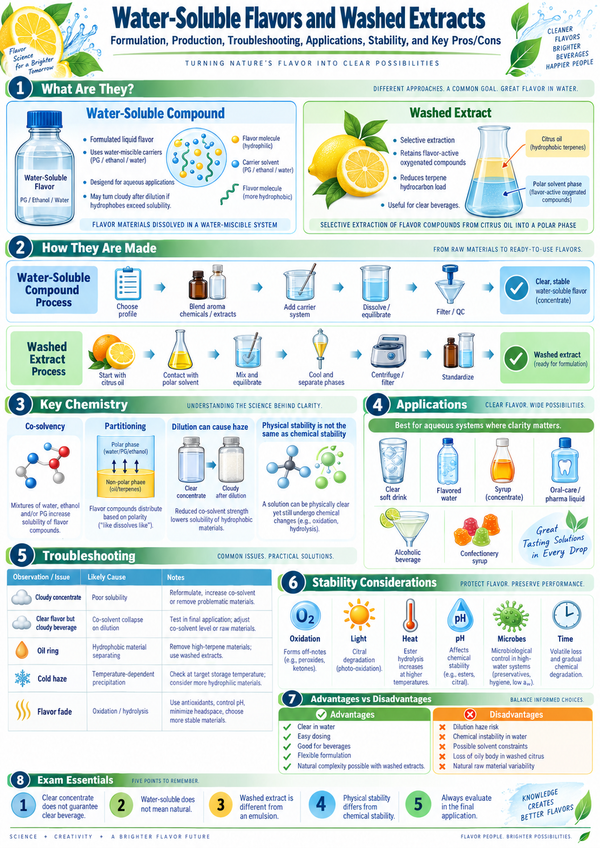
Water-Soluble Flavors and Washed Extracts: Formulation, Production, Troubleshooting, Applications, Stability, and SFC Examination Guide
Processes

Water-Soluble Flavors and Washed Extracts: Formulation, Production, Troubleshooting, Applications, Stability, and SFC Examination Guide

The January 2026 Society of Flavor Chemists (SFC) syllabus places “Water soluble – compound; washed extracts” under Liquid Flavor Forms and specifically expects a candidate to be able to describe formulation, production, troubleshooting, applications, stability considerations, and advantages/disadvantages. (flavorchemists.com) Below is what flavorists may need to know, according to
16 min read
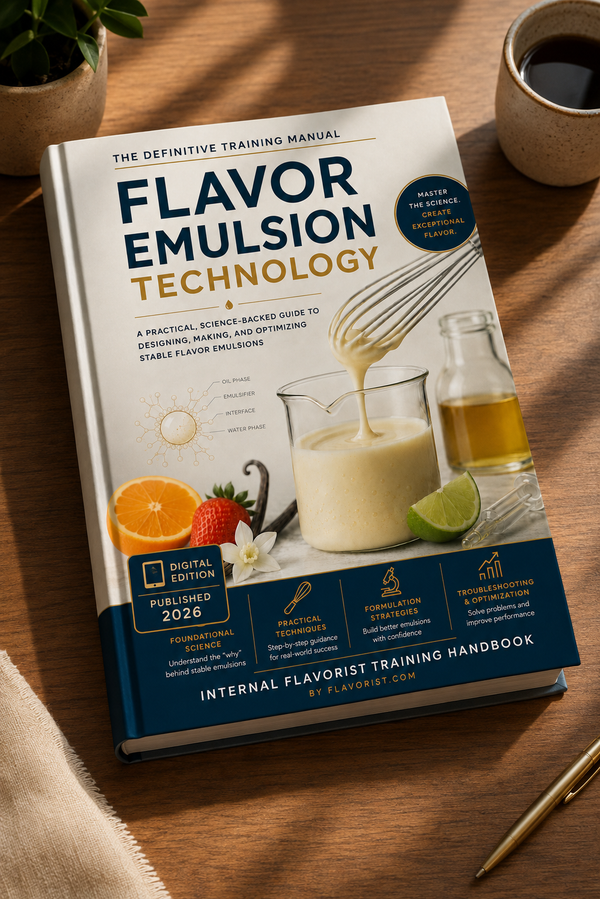
Flavor Emulsion Technology: A Comprehensive Training Manual for Flavorists, Food Scientists, and Product Developers
Training

Flavor Emulsion Technology: A Comprehensive Training Manual for Flavorists, Food Scientists, and Product Developers

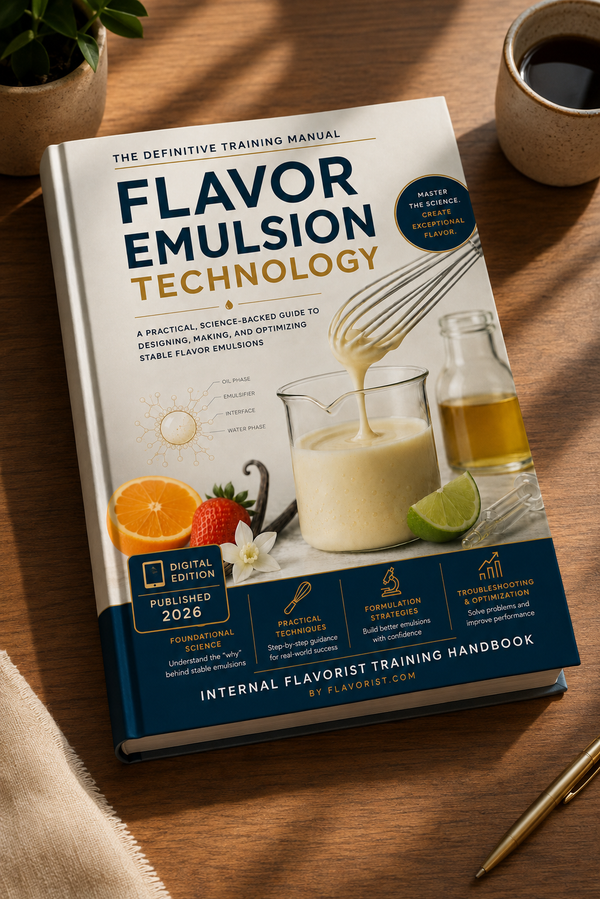
Flavor Emulsion Technology is a comprehensive professional training reference devoted to the science, formulation, processing, stability, analysis, and practical application of flavor and food emulsions. Designed to take readers from foundational principles through advanced troubleshooting and real-world application, this book brings together the scientific knowledge and practical reasoning required
4 min read
Smoke Concentrates: Physical Form, Production, Organoleptic Characteristics, and Solubility
Training

Smoke Concentrates: Physical Form, Production, Organoleptic Characteristics, and Solubility

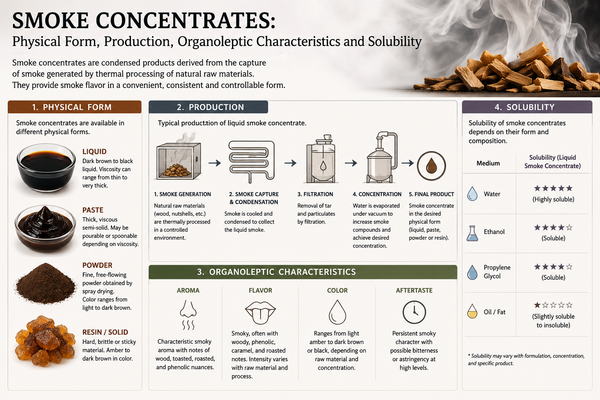
Smoke concentrates are one of several categories of natural flavoring substances that the Society of Flavor Chemists requires certified flavorists to understand thoroughly—particularly in terms of physical forms, production/manufacturing methods, organoleptic properties, and solubility. This topic is explicitly included on the Society’s qualification examination syllabus. What follows
7 min read
Recrystallization in Flavor Systems: Training Material for Flavorist Trainees
Processes

Recrystallization in Flavor Systems: Training Material for Flavorist Trainees

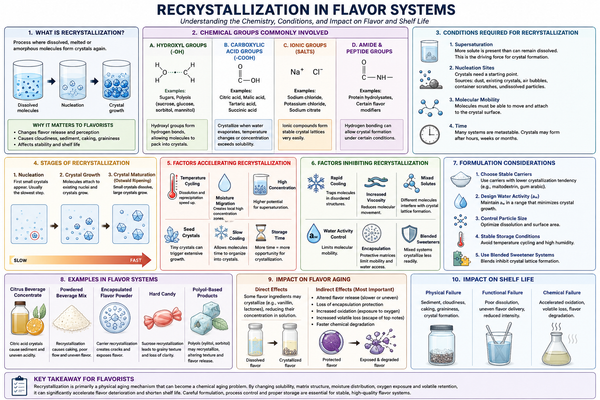
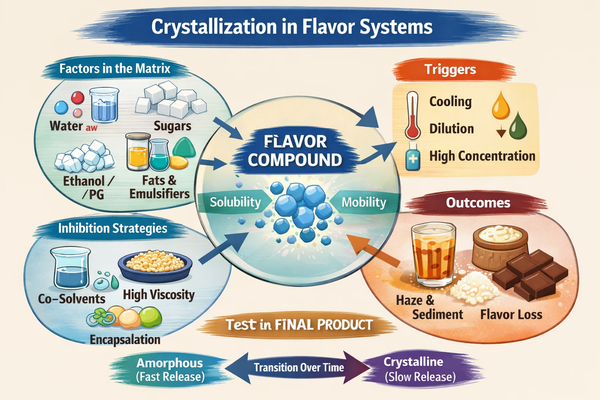
1. Introduction: What is Recrystallization? Recrystallization is the process by which a substance that was previously dissolved, melted, or present in an amorphous (non-crystalline) state forms crystals again. In flavor products, recrystallization most commonly involves: * Sugars * Polyols (sugar alcohols) * Organic acids * Salts * Encapsulating materials * Occasionally flavor ingredients themselves Although
5 min read
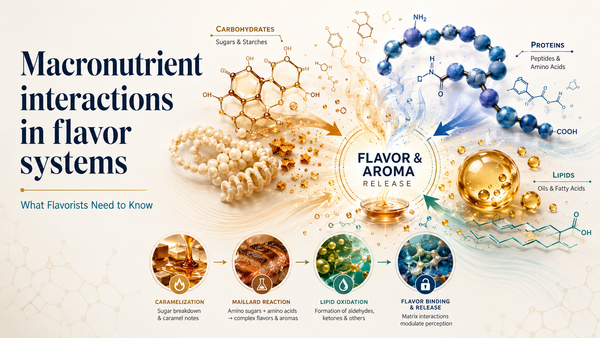
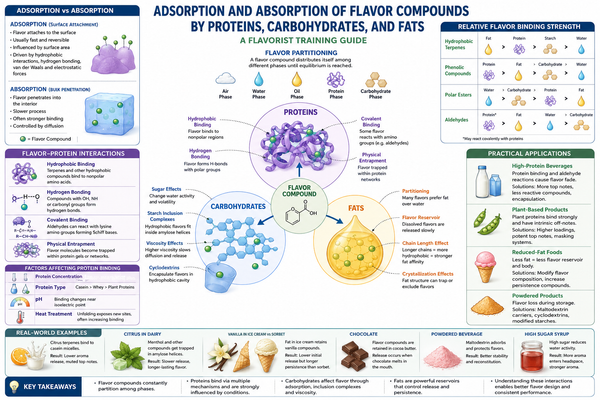
Adsorption and Absorption of Flavor Compounds by Proteins, Carbohydrates, and Fats - A Flavorist Training Guide
Members only
Processes

Adsorption and Absorption of Flavor Compounds by Proteins, Carbohydrates, and Fats - A Flavorist Training Guide

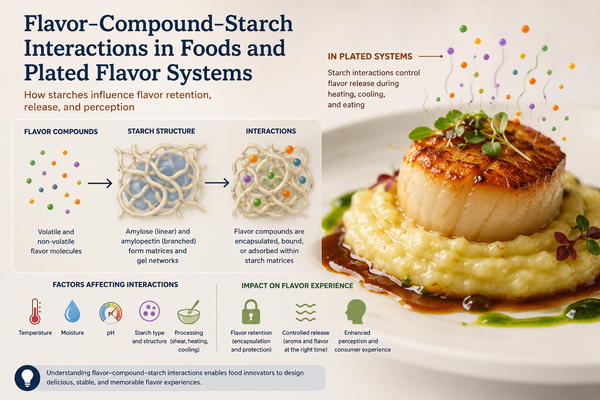
Adsorption and absorption of flavor compounds are critical factors that determine flavor intensity, release, stability, and perception in food systems. Adsorption refers to flavor molecules attaching to the surface of food components, while absorption involves their penetration into the interior of a material. In practice, both processes often occur simultaneously.
6 min read
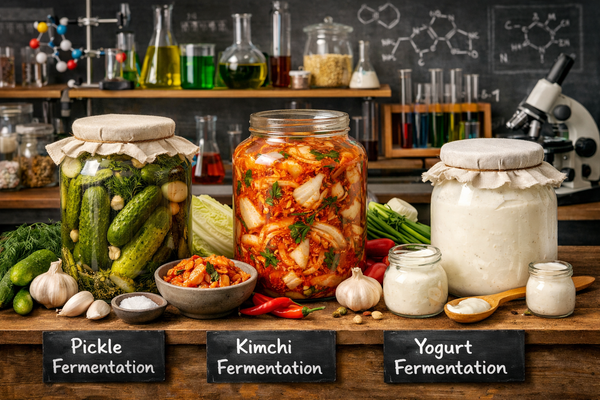
Fermentation in Flavor Formulation: Chemistry, Process Control, and Shelf-Life Impact
Processes

Fermentation in Flavor Formulation: Chemistry, Process Control, and Shelf-Life Impact

Fermentation is a microbial or microbiological transformation process in which microorganisms such as yeast strain Saccharomyces Cerevisias, which is typically used to make beer, convert substrates (primarily sugars, amino acids, and lipids) into chemical compounds (considered natural) including flavor-active compounds such as alcohols, acids, esters, aldehydes, and sulfur compounds.
8 min read
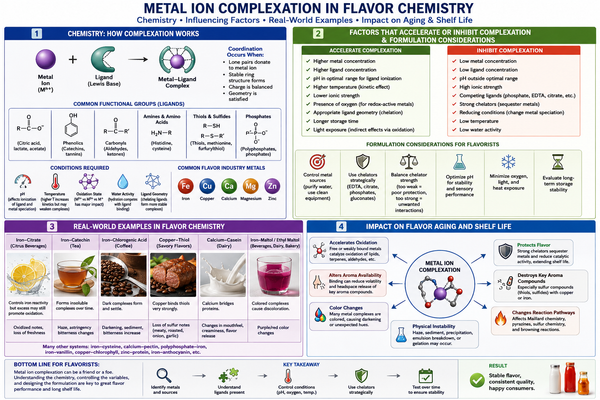
Metal Ion Complexation in the Flavor Industry: Fundamental Theory, Mechanisms, Formulation Challenges, Industrial Examples, and Critical Effects on Flavor Stability, Aging, and Shelf Life
Processes

Metal Ion Complexation in the Flavor Industry: Fundamental Theory, Mechanisms, Formulation Challenges, Industrial Examples, and Critical Effects on Flavor Stability, Aging, and Shelf Life

Metal Ion Complexation in Flavor Chemistry Chemical principles, accelerating and inhibiting factors, real-world flavor examples, and the impact of metal complexation on flavor aging, stability, and shelf life. Table of Contents 1. Chemical Groups Involved and Conditions Required 2. Factors Accelerating or Inhibiting the Process and Formulation Considerations 3.
10 min read
Sedimentation in Flavor Systems:  What the Society of Flavor Chemists Requires Flavorist to Know
Processes

Sedimentation in Flavor Systems: What the Society of Flavor Chemists Requires Flavorist to Know

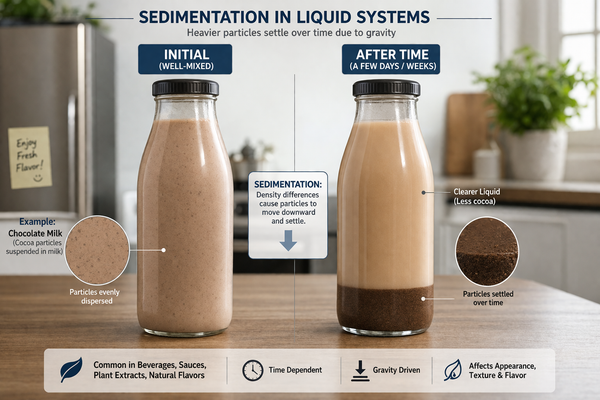
Quantitative Predictive Model for Sedimentation in Flavor Systems A professionally formatted HTML reference based on Stokes’ law, adapted for real flavor systems containing emulsions, suspensions, botanical solids, reaction products, gums, and non-Newtonian matrices. 1. Classical Stokes’ Law For a small spherical particle settling in a still Newtonian liquid under
24 min read