Smoke Concentrates: Physical Form, Production, Organoleptic Characteristics, and Solubility
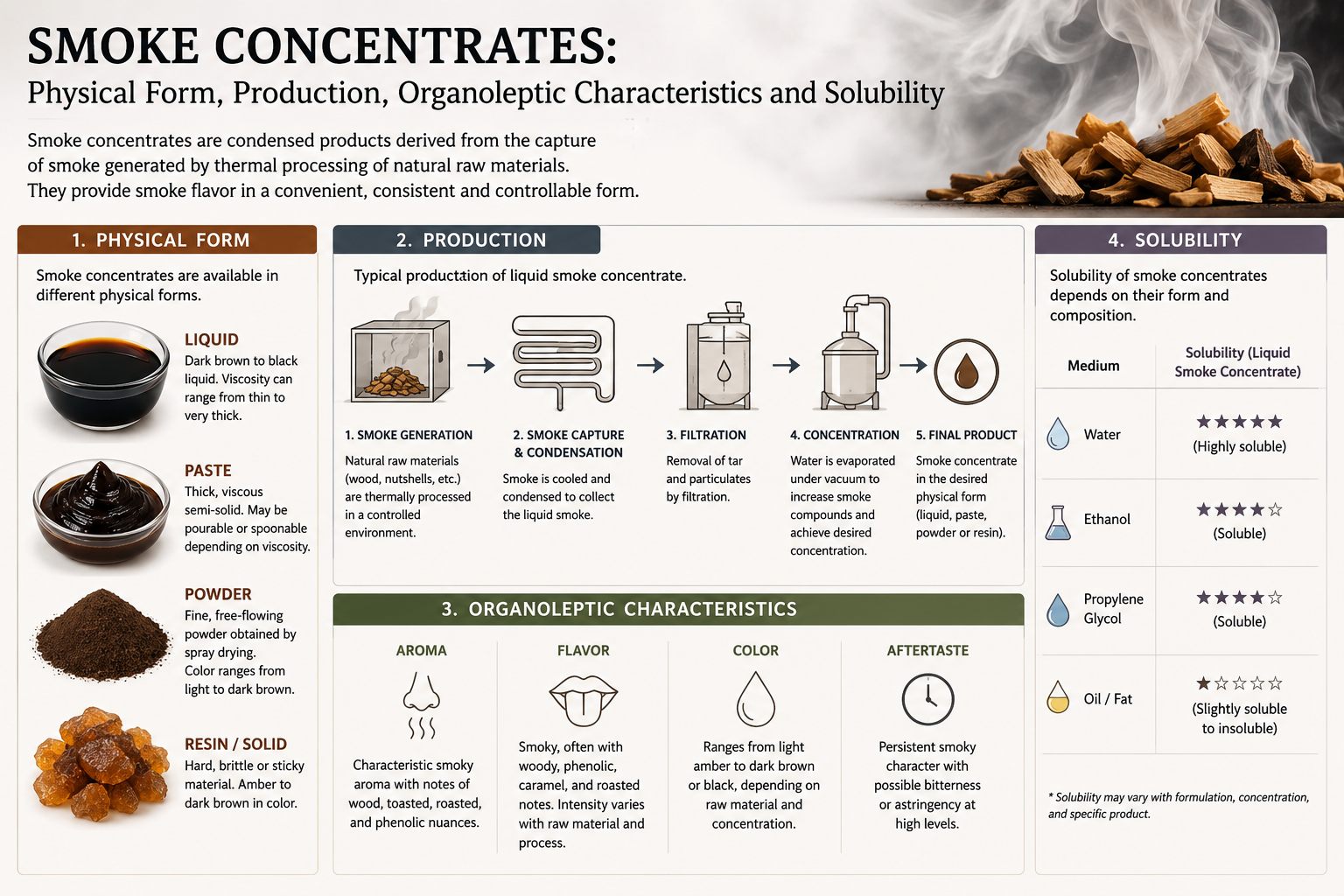
Smoke concentrates are one of several categories of natural flavoring substances that the Society of Flavor Chemists requires certified flavorists to understand thoroughly—particularly in terms of physical forms, production/manufacturing methods, organoleptic properties, and solubility. This topic is explicitly included on the Society’s qualification examination syllabus. What follows is a foundational overview of what trainees need to know about smoke concentrates as a flavoring category. It should be noted, however, that this covers only the basics; trainees are expected to gain much deeper knowledge in areas such as applications, regulatory requirements, and beyond.
Introduction
Smoke concentrates (also called liquid smoke, smoke flavorings, or smoke flavor concentrates) are flavoring materials produced by capturing and processing the vapor phase and condensable fractions generated during controlled combustion or pyrolysis of wood. They are widely used in the food industry to impart smoky, roasted, and grilled notes to meats, cheeses, sauces, snacks, and processed foods without requiring actual smoking of the product. For a flavorist, understanding their physical characteristics, production methods, sensory profile, and solubility behavior is essential to selecting and applying them correctly in formulations.
1. Physical Form
Smoke concentrates are commercially available in several physical forms, each suited to different application needs:
1.1 Liquid Smoke Concentrates
- Appearance: Ranges from pale yellow to dark reddish-brown or nearly black liquids, depending on concentration and wood source.
- Consistency: Typically thin and water-like to slightly viscous, similar to a light syrup in more concentrated grades.
- Types:
- Water-soluble (aqueous) liquid smoke – the most common form, produced by condensing wood smoke into water.
- Oil-soluble liquid smoke – smoke flavor compounds dispersed or dissolved in an oil/fat carrier for use in fat-based systems.
- Tar-fraction concentrates – darker, more viscous, resinous liquids containing higher-boiling phenolic and tar components; used mainly for color and intense flavor in small dosages.
1.2 Powder (Dry) Smoke Flavorings
- Appearance: Light tan to dark brown free-flowing powder.
- Production basis: Liquid smoke concentrate is spray-dried or absorbed onto a carrier (e.g., maltodextrin, salt, silicon dioxide, modified starch) to convert it into a dry, stable form.
- Advantages: Easier to handle, blend into dry seasoning mixes, rubs, and powdered soup bases; improved shelf stability and reduced VOC/odor during handling.
1.3 Paste/Gel Forms
- Occasionally encountered as thickened pastes for direct surface application (e.g., basting, glazing) — less common industrially but used in artisanal or specialty products.
1.4 Emulsions
- Smoke flavor emulsified in a fat/water system for specific applications such as marinades or injection brines, offering improved dispersion in both aqueous and lipid phases simultaneously.
2. Method of Production
The production of smoke concentrates involves several controlled stages designed to generate, capture, and refine the flavor-active compounds from wood pyrolysis while removing or minimizing undesirable and potentially harmful constituents.
2.1 Raw Material Selection
- Wood type: Hardwoods are preferred over softwoods because softwoods contain higher resin (terpene) content, which produces harsh, bitter, and sooty off-notes. Common woods include:
- Hickory – strong, bacon-like, classic BBQ character
- Mesquite – earthy, robust, slightly sharp
- Applewood/Cherrywood – mild, sweet, fruity-smoky
- Oak – balanced, medium-intensity, versatile
- Beech, Maple, Alder – used heavily in European smoke flavoring production
- Wood form: Sawdust, wood chips, or wood pellets are used, often with controlled moisture content (typically 25–50%) since moisture influences the smoke composition generated during pyrolysis.
2.2 Controlled Combustion / Pyrolysis
- Wood is subjected to controlled, limited-oxygen combustion (pyrolysis) at temperatures typically in the range of 300–600°C.
- This thermal decomposition breaks down the three major wood polymers:
- Cellulose → furans, furanones, small carbonyls (contributes to caramelized, sweet notes)
- Hemicellulose → similar furan/carbonyl compounds, contributes acidic and caramel notes
- Lignin → phenolic compounds (guaiacol, syringol, and their derivatives) — the primary contributors to the characteristic "smoky" aroma
- The combustion generates a complex vapor stream containing:
- Phenols and phenolic ethers (guaiacol, 4-methylguaiacol, syringol, eugenol, cresols)
- Carbonyl compounds (formaldehyde, acetaldehyde, glyoxal, diacetyl, hydroxyacetone)
- Organic acids (acetic acid, formic acid, propionic acid) — contribute preservative and sour notes
- Polycyclic aromatic hydrocarbons (PAHs) — undesirable, minimized through process control
- Furans and furanones
- Tars and particulate matter
2.3 Smoke Collection and Condensation
- The smoke vapor is passed through condensation and scrubbing systems, typically using water as a scrubbing medium, to capture the water-soluble flavor fractions.
- Multiple condensation stages may be used, separating fractions by boiling point/volatility:
- Primary condensate – contains the majority of flavor-active phenolics and carbonyls
- Secondary/tar condensate – heavier, more viscous, contains higher-boiling phenolics and resinous material
2.4 Fractionation and Purification
This is the most critical step distinguishing food-grade smoke concentrates from crude smoke condensate, primarily aimed at reducing PAH content to meet regulatory limits (e.g., EU regulations under EC 2065/2003 and EU 1321/2013 set strict limits on benzo[a]pyrene and other PAH markers in smoke flavorings).
- Settling/decanting: Removes insoluble tar and particulate matter.
- Filtration: Removes remaining suspended solids.
- Liquid-liquid extraction: Separates flavor phenolics from heavier tar/PAH fractions using differential solubility (often using organic solvents like ethyl acetate or supercritical CO₂ in advanced processes, followed by solvent removal).
- Distillation/rectification: Further purifies and concentrates the aqueous flavor fraction, removing excess water and adjusting concentration.
- Activated carbon treatment: Sometimes used to adsorb residual PAHs and undesirable tar compounds while retaining lighter phenolic flavor compounds.
2.5 Standardization and Formulation
- The purified concentrate is standardized for:
- Total phenol content (a key quality/potency marker, often expressed in mg/mL or as a percentage)
- Color intensity
- pH (typically acidic, in the range of 2.5–4.0, due to organic acid content)
- Density/specific gravity
- May be blended with carriers, diluted with water, or converted to oil-soluble/powder forms as described in Section 1.
2.6 Regulatory Note
In the EU, smoke flavorings for food use must be produced from an approved "Primary Smoke Condensate" and are subject to specific authorization (Regulation (EC) No 2065/2003), with authorized products listed individually. In the US, smoke flavorings are regulated under FDA and are commonly labeled "natural smoke flavor" or "natural flavor" derived from wood smoke condensation; some products carry GRAS status.
3. Organoleptic Characteristics
3.1 Aroma
- Primary character: Smoky, woody, campfire-like, roasted, charred
- Key aroma contributors:
- Guaiacol and 4-methylguaiacol – sweet, smoky, phenolic, reminiscent of bacon and BBQ
- Syringol and derivatives – smoky, spicy, slightly medicinal
- Cresols and phenol – sharp, tarry, medicinal, can become harsh/unpleasant at high levels
- Furfural and furan derivatives – sweet, bready, caramel-like undertones
- Diacetyl and carbonyls – buttery, slightly sweet nuances
- Secondary/nuance notes: Depending on wood source — sweet and fruity (applewood), earthy and robust (mesquite), balanced and mild (oak), pungent and strong (hickory)
3.2 Taste
- Primary taste: Smoky, savory, slightly bitter, mildly acidic/tangy (due to organic acid content)
- Mouthfeel contribution: Can impart a warming, slightly astringent, or drying sensation on the palate at higher use levels due to phenolic and tannin-like compounds
- Aftertaste: Lingering smoky-phenolic character; can become medicinal, sooty, or bitter if overdosed or if derived from poorly refined/tar-heavy fractions
3.3 Color
- Ranges from light golden-amber to deep reddish-brown or near-black
- Contributes visually to browning/coloring effects in finished products (e.g., giving sausages, jerky, or smoked cheese their characteristic surface color) independent of actual heat-induced browning
3.4 Intensity and Sensory Threshold
- Smoke concentrates are typically highly potent; usage levels in finished food products are often very low (fractions of a percent, e.g., 0.01–0.5%) because the phenolic compounds have very low sensory detection thresholds (guaiacol threshold is in the low ppb range in water).
- Overdosing quickly leads to harsh, acrid, medicinal, or ashy notes rather than a pleasant smoky character — a critical practical consideration in formulation work.
3.5 Quality Variation
- Sensory quality varies significantly with:
- Wood species and quality
- Combustion temperature control (too high → burnt, acrid, tarry notes; too low → weak, green, unrefined notes)
- Degree of purification/fractionation (well-refined concentrates are cleaner, less bitter, and less harsh)
- Age/storage conditions (oxidation and polymerization of phenolics over time can dull or muddy the aroma)
4. Solubility
Solubility behavior is a key practical consideration for flavorists selecting the correct smoke concentrate form for a given application system.
4.1 Water-Soluble (Aqueous) Smoke Concentrates
- Fully miscible with water in typical use concentrations
- Ideal for:
- Brines and marinades
- Water-based sauces, dressings, and glazes
- Beverage-type applications
- Injection into meat products
- Because the primary flavor compounds (phenols, carbonyls, organic acids) are polar and water-soluble, this is the most widely used and versatile form.
4.2 Oil-Soluble Smoke Concentrates
- Formulated by dissolving or dispersing smoke flavor compounds (often the less polar phenolic fractions) into edible oils or fats, sometimes with emulsifiers to aid incorporation.
- Ideal for:
- Fat-based systems: shortenings, oil-based marinades, snack seasoning oils, spray applications onto chips/snacks
- Products where water addition is undesirable (e.g., moisture-sensitive dry mixes, fried snack coatings)
- Not directly miscible with water-based systems without emulsification.
4.3 Powder Forms
- Solubility depends on carrier:
- Maltodextrin- or starch-carried powders disperse and largely dissolve in water upon reconstitution, though the carrier itself dilutes flavor intensity per gram compared to liquid concentrate.
- Silica- or salt-carried powders may show partial solubility/dispersibility, with some insoluble carrier residue.
- Useful for dry-blend applications (seasoning blends, rubs, dry soup mixes) where liquid addition is impractical.
4.4 General Solubility Notes for Flavorists
- pH sensitivity: Because smoke concentrates are acidic (pH ~2.5–4.0) and contain organic acids, they can affect the pH of the final formulation and may interact with pH-sensitive systems (e.g., causing protein denaturation/coagulation in dairy or egg-based systems if added carelessly).
- Compatibility testing: Always test compatibility in the target matrix — aqueous smoke concentrates may cause phase separation or clouding in oil-continuous systems, and vice versa for oil-soluble types in aqueous systems, unless proper emulsification technology is used.
- Volatility considerations: Key aroma-active phenolics (guaiacol, syringol) are moderately volatile; heat processing (retorting, baking, frying) can cause some loss of top-note smoky character, so slight overdosing or heat-stable carrier selection may be needed in high-heat applications.
- Solvent-based dilution: For flavor compounding purposes, smoke concentrates may also be diluted in propylene glycol, glycerin, or ethanol-based carrier systems for use in flavor bases, though this is more common in the flavor house/compounding stage than in final food product application.
Summary Table
| Attribute | Water-Soluble Liquid | Oil-Soluble Liquid | Powder |
|---|---|---|---|
| Appearance | Amber to dark brown liquid | Amber to brown oil dispersion | Tan to brown free-flowing powder |
| Carrier/Base | Water | Oil/fat, often emulsified | Maltodextrin, starch, silica, salt |
| Best Use | Brines, sauces, marinades | Fat systems, snack oils, sprays | Dry seasoning blends, rubs |
| Solubility | Fully water-miscible | Miscible in oil; needs emulsifier for water | Dependent on carrier |
| Typical pH | 2.5–4.0 | Variable (carrier-dependent) | N/A (dry) |
| Flavor Intensity | High, concentrated | High, concentrated | Diluted by carrier |
This material covers the essential technical and sensory foundation needed to work confidently with smoke concentrates as a flavorist — from understanding how they are made and why processing choices affect flavor quality, to selecting the correct physical form and solubility profile for a target application, to anticipating sensory behavior and pitfalls (such as overdosing or matrix incompatibility) during formulation.
###