Animal Broths, Stocks, and Powders: Physical Forms, Production, Organoleptic properties, Solubility - Flavorist Training Reference
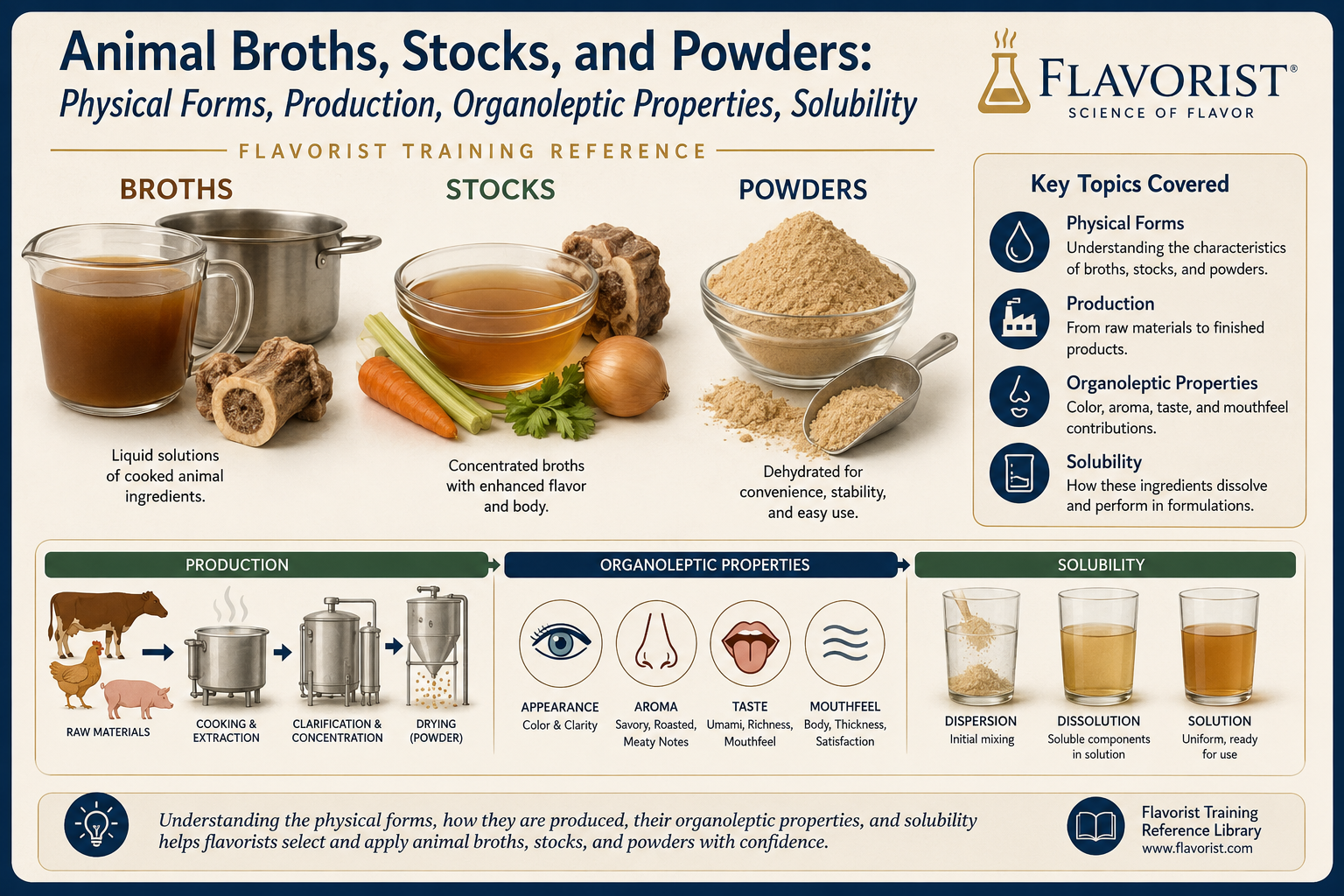
Animal broths, stocks, and powders are one of several categories of flavoring substances that the Society of Flavor Chemists requires certified flavorists to understand thoroughly—particularly in terms of physical forms, production/manufacturing methods, organoleptic properties, and solubility. This topic is explicitly included on the Society’s qualification examination syllabus.
What follows is a foundational overview of what trainees need to know about animal broths, stocks, and powders as a flavoring category. It should be noted, however, that this covers only the basics; trainees are expected to gain much deeper knowledge in areas such as applications, regulatory requirements, and beyond.
Although the application and regulation of animal broths, stocks, and powders appear to fall outside the scope of the Society's requirements, flavorists in practice still need to determine whether production using these substances requires USDA inspection. Please consult your regulatory department for further guidance.
1. Introduction
Animal broths, stocks, and powders are among the most important "building block" raw materials in savory flavor creation. They are natural, animal-derived process materials that supply authentic, complex meaty/savory character that is very difficult to replicate with single chemical compounds alone. This reference covers their physical form, manufacture, sensory profile, solubility, application in flavor work, and the regulatory framework (USDA/FSIS) that governs them.
Terminology note, since these three terms are often used loosely in the trade:
| Term | Typical meaning |
|---|---|
| Broth | A liquid obtained by simmering meat, poultry, or fish (with or without bones) in water; generally lighter-bodied, less concentrated than stock. |
| Stock | A liquid obtained primarily by simmering bones (often roasted), cartilage, and connective tissue, sometimes with some meat; longer cook times extract more collagen/gelatin, giving more body. |
| Powder (or "dried stock/broth," "meat/poultry extract powder") | The dehydrated, concentrated solid form of a broth or stock, typically produced by evaporation followed by spray-drying or drum-drying, often with a carrier added. |
In commerce, "stock" and "broth" are frequently used interchangeably, and many commercial "powders" are actually stock or broth concentrate spray-dried with salt, maltodextrin, or other carriers rather than a 100% pure dried extract.
2. Physical Form
Animal broths, stocks, and powders are supplied in several commercial forms, each suited to different manufacturing and dosing needs:
- Liquid broth/stock — Thin to moderately viscous liquid. May be clear/clarified (filtered, defatted, skimmed) or naturally cloudy/turbid (retaining fine particulates, emulsified fat, and suspended protein). Color ranges from pale straw (chicken, fish) to light amber (pork) to deep brown (beef, roasted bone stock).
- Concentrated liquid / paste — Produced by vacuum evaporation of the broth/stock to remove much of the water. Ranges from a pourable syrupy concentrate to a thick, spoonable paste (similar to bouillon paste or "meat glace"). Highly viscous, often tacky, and may set into a semi-solid gel on cooling due to gelatin content (this is literally how classical French "glace de viande" behaves).
- Powder — Free-flowing to moderately hygroscopic dry solid. Particle size ranges from fine dust to coarse granules depending on drying method (spray-dried powders are typically fine and can be slightly "fluffy" or agglomerated; drum-dried or roller-dried material is flaked and then milled, giving a coarser, sometimes brittle particle). Color: off-white/tan (chicken, defatted), tan to light brown (pork, fish), medium to dark brown (beef, roasted stocks).
- Granules / compressed forms — Powders can be agglomerated into granules or compressed into cubes/tablets (bouillon cubes) for direct-use or consumer-facing products; these are less common as flavor-industry raw materials and more common as finished foodservice/retail products.
- Fat content variants — Both liquid and dried forms may be sold "regular" (retaining natural fat) or "defatted/low-fat" (fat mechanically or thermally removed), which materially changes both flavor carry-through and solubility behavior (see Section 5).
3. Method of Production
3.1 Raw materials
- Bones (often roasted or blanched first), meat trim, cartilage, tendons, and connective tissue from beef, pork, chicken, turkey, or other poultry.
- Fish and shellfish frames, heads, and trim for seafood stocks/broths.
- Sometimes combined with vegetables, mirepoix, or aromatics for classical "stock" flavor profiles, though pure flavor-industry raw materials are usually produced without these to keep the flavor base "clean" and formulation-flexible.
3.2 Extraction
- Simmering/cooking — Raw materials are simmered (not boiled hard, to avoid excessive emulsification of fat and clouding) in water for an extended period — several hours up to 12+ hours for bone stocks — to solubilize collagen (converting it to gelatin), extract soluble proteins, peptides, free amino acids, minerals, and fat-soluble and water-soluble flavor precursors.
- Roasting/browning (optional but common) — Bones and/or meat may be roasted before extraction to develop Maillard reaction products, giving deeper, roasted, more "cooked meat" notes versus the cleaner, lighter character of a simply-simmered stock.
- Enzymatic/hydrolytic assistance (optional) — Some producers use controlled enzymatic hydrolysis (proteases) to break down proteins further, increasing yield of soluble solids, amino acids, and peptides, which boosts both flavor intensity and solubility of the final dried product.
3.3 Clarification and defatting
- Skimming removes surface fat during or after cooking.
- Filtration/centrifugation removes insoluble particulates and additional fat for a clear, brilliant liquid stock where required.
- Fat separation is important because residual fat affects shelf life (oxidative rancidity), clarity, and solubility.
3.4 Concentration
- Vacuum evaporation removes water at lower temperatures than atmospheric boiling, preserving heat-labile flavor compounds while concentrating solids from a dilute broth into a paste-like concentrate.
3.5 Drying (to produce powder)
- Spray drying — The most common method. The concentrate is atomized into a hot air stream, flash-drying droplets into fine powder particles. Preserves volatile flavor better than drum drying but can be limited by the natural stickiness/hygroscopicity of high-protein, high-mineral concentrates (often requiring a carrier such as maltodextrin, salt, or gum arabic to aid drying and flowability).
- Drum/roller drying — The concentrate is spread as a thin film on a heated rotating drum, dried, then scraped off and milled into powder. Produces a more "cooked/roasted" flavor note due to higher surface temperature exposure; economical for higher-viscosity, higher-fat pastes that don't atomize well.
- Freeze drying — Rare due to cost, but used for premium/delicate seafood or specialty broths where maximum volatile retention is desired.
3.6 Compounded "stock powders"
Many commercial "stock powder" or "broth powder" products are not pure dried broth — they are blended flavor bases: dried broth/stock combined with salt, autolyzed yeast extract, hydrolyzed vegetable protein (HVP), monosodium glutamate (MSG) or other glutamate sources, sugar, spice extracts, and sometimes process/reaction flavors, then dried or dry-blended together. Flavorists should always check the ingredient declaration/spec sheet to know whether they are working with a pure natural stock/broth powder versus a compounded savory seasoning base that happens to be sold under the same "stock powder" name.
4. Organoleptic Characteristics
4.1 Aroma
- Species-characteristic: "beefy," "chickeny/poultry," "porky," "fishy/marine," etc.
- Roasting/browning during production shifts aroma from clean, brothy, and slightly "boiled" to deeper, roasted, meaty, and Maillard-driven (more "cooked meat," "grilled," or "gravy-like").
- Fat content contributes species-specific fatty/tallowy or poultry-fat notes and carries lipid-derived aroma compounds (important for realism — defatted powders often smell "flatter" or less rounded).
- Collagen/gelatin-rich stocks can carry a subtle "gelatinous" or "bony" note distinct from pure meat broths.
4.2 Taste
- Umami-forward: naturally elevated glutamic acid and 5'-nucleotides (inosinate, guanylate) released during protein breakdown give a strong inherent umami/savory taste — this is a key reason these materials are prized (see Section 6).
- Salt: pure natural stock is only mildly salty from natural minerals; seasoned/compounded stock powders are usually salted deliberately and can be quite salty.
- Fat/mouthfeel: residual fat contributes richness and a coating mouthfeel; gelatin contributes body/viscosity and a slight "stickiness" or fuller mouthfeel in solution, distinct from added starches or gums.
- Bitterness/off-notes: over-processed, over-hydrolyzed, or scorched (over-roasted/over-drum-dried) material can develop bitter or burnt off-notes; rancid fat in aged product gives cardboard/tallowy off-flavor.
4.3 Appearance/Color
- Ranges from pale straw/off-white (chicken, fish, defatted) through amber/tan (pork) to deep brown (beef, roasted bone stocks).
- Powders: off-white to dark brown depending on species, roast level, and drying method (drum-dried tends to be darker/more roasted-looking than spray-dried from the same raw stock due to higher processing heat).
4.4 Texture (physical handling)
- Liquids: thin and pourable to thick and syrupy/gel-setting depending on concentration and gelatin content.
- Powders: fine and slightly fluffy (spray-dried) to coarser, flake-milled granules (drum-dried); can range from free-flowing to hygroscopic/clumping depending on carrier system and storage humidity.
5. Solubility
- Water solubility: The protein, peptide, amino acid, and mineral fraction of broths/stocks/powders is generally water-soluble and dissolves readily, especially in warm to hot water; cold-water solubility is slower and less complete, particularly for gelatin-rich material (gelatin swells/hydrates but disperses more fully with heat).
- Fat fraction: Any residual fat is not water-soluble and will not dissolve — it disperses as an emulsion (giving cloudiness/turbidity) or separates out on standing, especially after temperature drops (fat can re-solidify, causing a "ring" or surface film). Defatted stocks/powders give clearer, more stable solutions.
- Gelatin/collagen effect: High-gelatin stocks can thicken or set into a soft gel when concentrated and cooled, and rehydrated powders can appear cloudy or slightly viscous even at fairly low concentrations due to this protein network.
- Powder reconstitution: Spray-dried powders (especially those with maltodextrin or salt as carrier) generally reconstitute faster and more completely than drum-dried flakes, which may require more vigorous mixing or pre-soaking.
- Practical implication for flavor compounding: when a broth/stock/powder is used in an aqueous flavor system, expect some turbidity unless a defatted/clarified grade is specified; when used in oil-based or emulsion systems, the fat fraction will partition into the oil phase while the water-soluble umami/savory compounds remain in the aqueous phase — this split behavior is often exploited deliberately in dual-phase flavor systems (e.g., a seasoning oil plus a water-soluble base).
6. Applications in Flavor Work: Which Flavors, and Why
6.1 Flavor categories where these materials are used
- Savory/umami flavors generally: beef, chicken, turkey, pork, ham, bacon, seafood/fish, and "meaty" vegetarian-adjacent profiles.
- Soup, sauce, and gravy flavors (bouillon, consommé, pan gravy, brown sauce, cream soup bases).
- Snack seasonings (chips, crackers, extruded snacks — "chicken," "beef," "bacon," "seafood" seasoning blends).
- Bouillon and stock cube products, dry soup mixes, ramen/instant noodle seasoning packets.
- Processed meat and prepared foods (as a functional/flavor ingredient within sausages, deli products, ready meals, canned soups).
- Pet food and animal feed flavor systems (palatants), which rely heavily on animal digest, broth, and stock materials for palatability.
- Reaction/process flavor bases — used as a natural precursor or "backbone" input into Maillard-reaction ("thermal process") flavor generation, since they already carry amino acids, peptides, sugars, and lipids needed for further reaction flavor development.
6.2 Why they are used
- Authenticity and complexity: A real animal-derived broth/stock/powder contains hundreds of interacting flavor and flavor-precursor compounds (amino acids, peptides, nucleotides, organic acids, Maillard products, lipids and lipid-oxidation products) that are extremely difficult to fully reconstruct from a small palette of synthetic chemicals. They give a "rounded," believable, full-bodied character rather than a one-dimensional or "flat" flavor.
- Natural umami contribution: The natural glutamate and nucleotide content contribute genuine umami taste, which synergizes with (and can reduce the need for) added MSG or other flavor enhancers, and supports "natural flavor" or clean-label positioning when formulated appropriately.
- Mouthfeel/body: Gelatin and residual protein/fat contribute body, richness, and a "coating" mouthfeel that pure aroma chemicals cannot provide — important in soups, gravies, and sauces where a thin, watery mouthfeel would read as unrealistic.
- Flavor-base/building-block function: They serve as the savory "backbone" onto which a flavorist layers top notes (roasted, grilled, smoky, spice, vegetable, dairy notes) and modifiers (process flavors, reaction flavors, HVP, yeast extract) to build a complete, balanced, on-target flavor profile.
- Labeling/clean-label positioning: Where regulations and formulation allow, natural broths/stocks can support "natural flavor," "made with real chicken/beef," or similarly consumer-facing claims that purely synthetic systems cannot support — though see Section 7 for important labeling caveats specific to meat/poultry-derived materials.
- Cost/functionality balance: Compared to using large quantities of fresh meat or bones directly in a finished product, concentrated stocks and dried powders are shelf-stable, easy to dose precisely, easy to blend into dry seasoning systems, and dramatically reduce logistics/handling costs versus fresh or frozen meat ingredients.
7. Regulatory Status: Are These Products Subject to USDA Inspection?
This is a nuanced area, and the correct answer depends on species, composition/quantity, and intended use of the specific broth, stock, or powder in question. The following is general regulatory orientation, not legal advice — always confirm current classification with FSIS or qualified regulatory counsel for a specific product and use case.
7.1 The basic jurisdictional split
In the U.S., meat and poultry products are regulated by the USDA's Food Safety and Inspection Service (FSIS) under the Federal Meat Inspection Act (FMIA) and the Poultry Products Inspection Act (PPIA). The FDA regulates virtually all other food products, including seafood, and any product that does not meet the FSIS definitions of a "meat food product" or "poultry product."
7.2 Amenable vs. non-amenable species
- "Amenable" species under FSIS jurisdiction include cattle, sheep, swine, goats (meat) and chickens, turkeys, ducks, geese, and certain other poultry, plus (since a 2016 statutory change) catfish.
- "Non-amenable" species — including fish (other than catfish), shellfish, and other seafood — are not under FSIS jurisdiction; they fall under FDA jurisdiction instead, even though a fish stock/broth/powder is just as "animal-derived" as a beef or chicken one.
- Plant-derived "meaty" flavor bases (e.g., vegetable-protein "beef-style" or "chicken-style" broth substitutes with no real meat/poultry) are also FDA-regulated, since no amenable animal product is present.
Practical takeaway: beef, pork, chicken, and turkey broths/stocks/powders are the ones that raise USDA/FSIS questions. Fish and shellfish stocks, and purely plant-based "meaty" broth flavor bases, do not — they stay under FDA.
7.3 When FSIS jurisdiction (and inspection) applies
Products made from amenable meat or poultry species that are intended for human food and contain meat/poultry beyond a purely incidental ("condimental") amount are generally treated as "meat food products" or "poultry products" and fall under FSIS jurisdiction. In practice:
- Producing a broth, stock, meat extract, or dried stock/broth powder itself — where the product is essentially concentrated meat or poultry extract (i.e., the meat/poultry content is the product, not a trace addition) — is squarely within FSIS's regulatory scope. Establishments producing such products for the commercial/interstate human-food market are generally required to operate under federal (or a cooperative state) inspection, and the product is expected to bear the USDA/FSIS inspection legend and establishment number when it leaves an official establishment.
- There is a narrow regulatory exemption for poultry (9 CFR 381.15(c)) covering bouillon cubes, poultry broths, gravies, sauces, seasonings, and flavorings where poultry meat/fat is present only in "condimental quantities" (i.e., a very minor flavoring amount within a larger multi-ingredient product) and certain other conditions are met — including that the poultry broth not be used to further process another poultry product in an official establishment. This exemption is meant for finished multi-ingredient consumer products with only trace poultry content, not for a raw stock/broth/powder ingredient that is itself concentrated animal extract.
- By statute, USDA/FSIS may (not must) exempt products containing meat/poultry "only in relatively small portion," but as a matter of long-standing agency practice, FSIS treats essentially all products containing any non-trivial amount of amenable meat or poultry as falling under its jurisdiction by default.
7.4 Downstream/carry-through effect
If a beef, pork, chicken, or turkey stock/broth/powder is incorporated as an ingredient into another food (a soup, sauce, seasoning blend, snack coating, etc.) in more than a purely condimental amount, that finished product generally also falls under FSIS jurisdiction and inspection requirements, even if the flavor house or food manufacturer thinks of the stock as "just a flavoring ingredient." This is a common compliance trap: adding real chicken or beef stock to a product can shift the entire finished product from FDA to USDA oversight, triggering requirements such as on-site inspection, label pre-approval, and FSIS-compliant HACCP documentation.
7.5 Labeling implications specific to meat/poultry stock and broth ingredients
FSIS has a specific rule that is highly relevant to flavorists: dried meat or poultry stocks, dried broth, meat extracts, and similar meat/poultry-derived flavor materials cannot be declared simply as "natural flavor" or "flavoring" on a meat or poultry product label. They must be declared by a specific common or usual name (e.g., "chicken broth," "beef stock," "dried beef stock"), and the animal source must be disclosed. This differs from spices, spice extracts, essential oils, and vegetable-derived flavor materials, which can be declared generically as "natural flavor" under FSIS rules. Flavorists formulating for the meat/poultry label space need to flag to customers that using real animal stock/broth ingredients will require explicit ingredient declaration, not a generic "flavor" listing.
7.6 The specific percentage thresholds for flavor products
This is the single most useful number for a flavorist to know, and FSIS has addressed it directly for flavor products (not just finished consumer foods).
FSIS Notice, "FSIS Jurisdiction Over Flavor Products Containing Meat or Poultry" (72 FR 3779; Docket No. FSIS-2006-0035):
Flavor products — e.g., flavor bases and blended or reaction/process flavors — with greater than 3% raw meat or poultry, or 2% or more cooked meat or poultry, in their formulation are amenable to FSIS jurisdiction.
FSIS issued this notice specifically because it found flavor manufacturers formulating with 30–70% meat/poultry byproducts who did not realize their product was already subject to federal inspection.
| Meat/poultry content of the flavor formulation | Jurisdiction |
|---|---|
| Raw meat/poultry ≤ 3% | FDA |
| Raw meat/poultry > 3% | USDA/FSIS |
| Cooked meat/poultry < 2% | FDA |
| Cooked meat/poultry ≥ 2% | USDA/FSIS |
For poultry specifically, FDA's own published guidance gives a second, more forgiving threshold that is often the one that actually applies to stock and broth (since these are typically bone/skin/fat-derived rather than pure lean meat):
| Poultry tissue type | FDA (below) | USDA (at/above) |
|---|---|---|
| Cooked poultry meat alone | < 2% | ≥ 2% |
| Cooked poultry skin, giblets, fat, and meat in combination | < 10% | ≥ 10% |
Regulatory status note: In 2005, FSIS and FDA held a joint public meeting (70 FR 67490) to consider changing which agency has jurisdiction over flavor products like these, and the 2007 notice states that jurisdiction remains with FSIS unless and until a final rule says otherwise. No evidence of a completed final rule on this specific question was found; treat the 3%/2%/10% thresholds above as the current operative FSIS policy, but confirm directly with FSIS before relying on this for a compliance decision, since this is exactly the kind of narrow regulatory point that can change.
7.7 Why this threshold is easy to miscalculate: concentration factor matters more than % inclusion
The 3%/2%/10% thresholds are calculated on raw- or cooked-meat tissue equivalent — not on the percentage of stock, broth, or powder ingredient you weigh into the formula. Because broths, stocks, and especially powders are concentrated extracts, a small inclusion rate can represent a much larger raw-meat-equivalent percentage than it appears to be on the formulation sheet.
To calculate correctly, you need the concentration/yield factor for the specific ingredient — how many pounds of raw meat, poultry, or bone went into producing one pound of the finished broth, stock, or powder. This must come from the supplier's documentation; it cannot be estimated from the ingredient name alone.
- Liquid broth/stock: generally the lowest concentration factor (commonly on the order of 3:1 to 8:1, raw material to finished liquid) — it takes a comparatively higher inclusion rate in the flavor formula to cross the threshold.
- Concentrated paste: higher concentration factor than liquid broth/stock — crosses the threshold at a lower inclusion rate.
- Dried powder: highest concentration factor (often in the range of 15:1 to 40:1 or more, once both evaporation and drying are accounted for) — even a small inclusion percentage, sometimes well under 1%, can already exceed the 2–3% raw-meat-equivalent threshold.
Illustrative example (numbers are for teaching purposes only — always confirm against the actual supplier concentration data for a real formulation):
- A chicken stock powder produced at roughly a 20:1 concentration from raw chicken would already reach ~3% raw-chicken-equivalent at only about 0.15% inclusion in the flavor formulation.
- A more dilute liquid chicken broth at roughly 5:1 concentration would need roughly 0.6% inclusion to reach the same 3% raw-equivalent mark.
Practical takeaway for trainees: because these materials are concentrated by design, almost any inclusion level high enough to contribute meaningful, functional flavor — as opposed to a truly trace/incidental amount — will tend to push a flavor base over the FSIS threshold. The percentage exemption realistically protects only very minor, non-functional trace use, not the levels a flavorist would normally use to build a genuine meaty profile. When in doubt, request the raw-material concentration factor from the ingredient supplier and calculate the raw/cooked meat-equivalent percentage explicitly, rather than relying on the visible inclusion rate in the formula.
7.8 Practical summary for flavorists
| Raw material | Species status | Regulatory home | Key implication |
|---|---|---|---|
| Beef, pork, chicken, turkey broth/stock/powder (real meat/poultry, non-trace amount) | Amenable | USDA/FSIS | Production facility generally needs federal/state inspection; product carries inspection legend; must be labeled by specific name, not "natural flavor"; use in a finished food can shift that food's regulatory jurisdiction to USDA as well |
| Same, but used only in a truly condimental/trace amount within a multi-ingredient poultry-related product | Amenable | Possible narrow FSIS exemption (poultry, 9 CFR 381.15(c)) | Case-by-case; confirm with FSIS/regulatory counsel — does not generally apply to the concentrated ingredient itself |
| Fish/shellfish/seafood broth, stock, powder | Non-amenable (except catfish) | FDA | Not subject to USDA inspection; standard FDA food regulation applies |
| Vegetable-based "beef-style"/"chicken-style" broth/flavor base (no real meat) | N/A — no animal meat/poultry present | FDA | Not subject to USDA inspection |
| Catfish stock/broth/powder | Amenable (since 2016) | USDA/FSIS | Treated like other amenable species |
Bottom line: Yes — genuine beef, pork, chicken, and turkey broths, stocks, and powders are, in general, subject to USDA/FSIS regulation and inspection when produced and sold as human food in more than incidental amounts, and this status carries through into any finished flavor or food product that incorporates them in more than a trace amount. Fish/seafood and plant-based "meat-style" broths and stocks are not USDA-regulated; they fall under FDA. Always verify the specific product's regulatory status and required label declarations with the supplier's specification sheet and, where needed, directly with FSIS, since exemptions are narrow and fact-specific.
8. Quick-Reference Summary Table
| Attribute | Broth | Stock | Powder |
|---|---|---|---|
| Physical form | Thin-to-moderate liquid, clear or cloudy | Liquid, often more body/gelatin than broth; can be concentrated to paste | Free-flowing to hygroscopic dry solid; fine (spray-dried) or coarse (drum-dried) |
| Production basis | Simmered meat/poultry/fish, light extraction | Simmered bones/cartilage/connective tissue, longer extraction, often roasted first | Broth/stock concentrated (evaporation) then dried (spray, drum, or freeze) |
| Key sensory driver | Clean, lighter meaty/savory aroma; moderate umami | Deeper, often roasted/Maillard notes; more body from gelatin | Concentrated version of source liquid's flavor; drying method affects roasted character |
| Solubility | Water-soluble fraction dissolves readily; fat disperses/emulsifies, not true solution | Same, plus gelatin gives viscosity/gelling on concentration/cooling | Reconstitutes in warm/hot water; fat content and carrier type affect clarity and speed |
| Primary flavor use | Base liquid flavor/soup/sauce systems | Richer, higher-body savory bases; reaction flavor precursor | Dry seasoning blends, snack coatings, bouillon/soup mixes, convenient dosing format |
| USDA/FSIS status (if from beef/pork/chicken/turkey) | Generally yes, if non-trace amount, human food | Generally yes, if non-trace amount, human food | Generally yes, if non-trace amount, human food |
| USDA/FSIS status (if from fish/shellfish or plant-based) | No — FDA regulated | No — FDA regulated | No — FDA regulated |
This document is intended as internal flavorist training material. Regulatory content reflects general FSIS/FDA jurisdictional principles as of mid-2026; always confirm current requirements for a specific product with FSIS and/or the ingredient supplier's regulatory documentation before making compliance decisions.
###