Spices: Physical Form, Production, Organoleptic Characteristics & Solubility - A Reference Manual for Flavorist Training
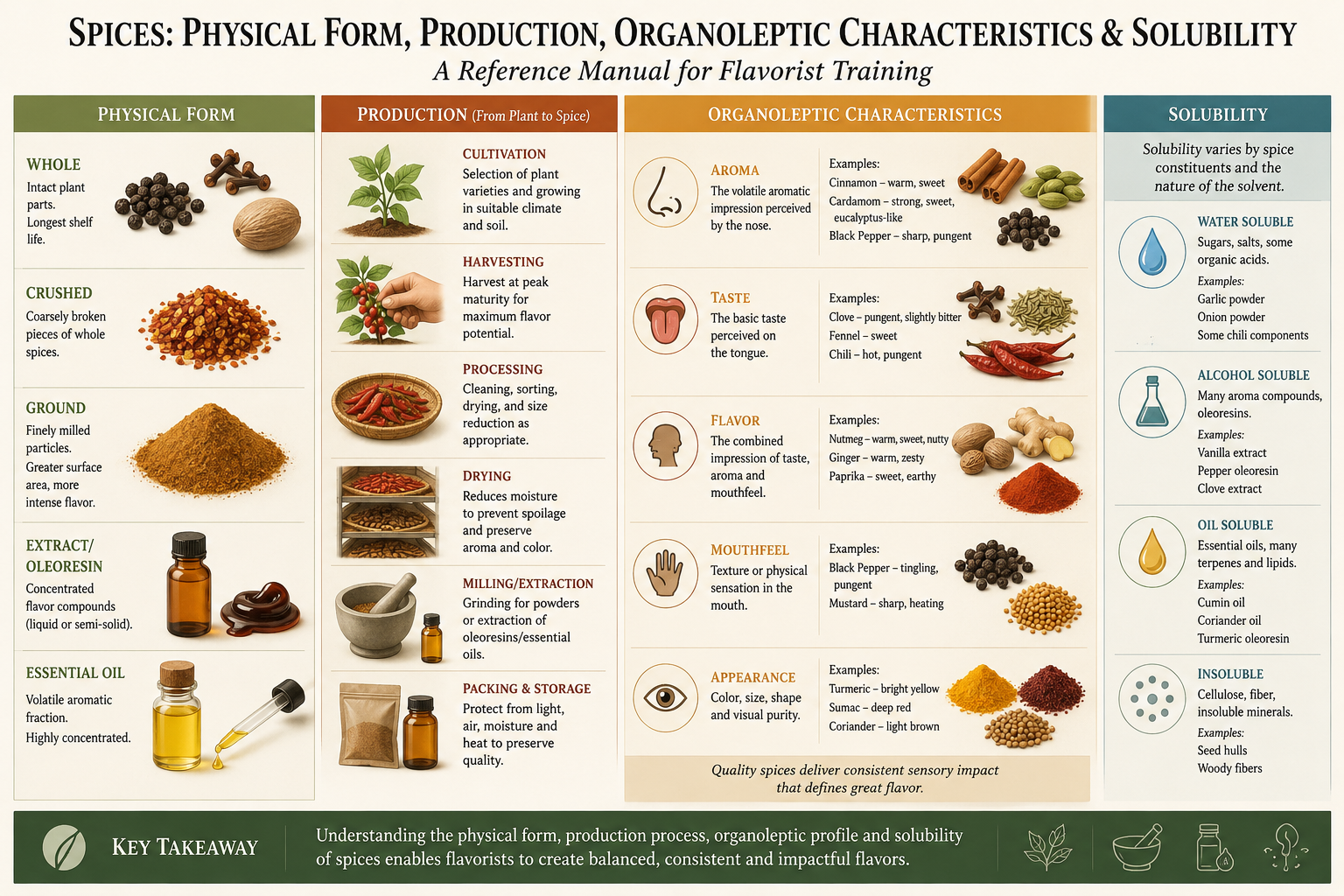
Spices are one of several categories of natural flavoring substances that the Society of Flavor Chemists requires certified flavorists to understand thoroughly—particularly in terms of physical forms, production/manufacturing methods, organoleptic properties, and solubility. This topic is explicitly included on the Society’s qualification examination syllabus. What follows is a foundational overview of what trainees need to know about spices as a flavoring category. It should be noted, however, that this covers only the basics; trainees are expected to gain much deeper knowledge in areas such as applications, regulatory requirements, and beyond.
1. Introduction
Spices are aromatic, pungent, or flavorful parts of plants — seeds, fruits, bark, buds, roots, rhizomes, or bulbs — used to impart flavor, aroma, color, or pungency to food. Unlike herbs (typically the leafy, soft green parts of plants used fresh or dried), spices are usually derived from woodier, more concentrated plant tissues and are almost always used in dried or otherwise processed form.
For a flavorist, understanding a spice requires four interlocking lenses:
- Physical form — how the raw material and its derivatives are physically presented for use
- Method of production — the agricultural and processing pathway that determines quality, potency, and consistency
- Organoleptic characteristics — the sensory profile (aroma, taste, appearance, mouthfeel) driven by the underlying chemistry
- Solubility — how the flavor-active constituents behave in different solvent systems, which governs how a spice is incorporated into a formulation
These four dimensions are covered systematically below, followed by a spice-by-spice reference table.
2. Physical Form
Spices reach the flavorist's bench in several distinct physical forms, each with different handling, dosing, and stability implications.
2.1 Whole/Natural Forms
- Whole seeds — cumin, coriander, fennel, mustard, cardamom pods, nutmeg
- Bark — cinnamon quills/sticks, cassia bark
- Buds — cloves
- Rhizomes/roots — ginger, turmeric, galangal (fresh or dried "fingers"/"hands")
- Fruits/berries — black pepper, allspice, star anise, juniper
- Stigmas — saffron
- Bulbs — garlic
Whole spices retain volatile oils longest because the intact cell structure and outer surface (low surface area to volume ratio) slow oxidation and evaporation. They are the reference standard against which processed forms are benchmarked.
2.2 Comminuted (Size-Reduced) Forms
- Cracked/kibbled — coarsely broken (e.g., cracked pepper, cracked coriander)
- Ground/powdered — milled to a defined mesh size (e.g., ground cinnamon, ground ginger, chili powder)
- Flaked/granulated — dehydrated and cut into flakes or granules (e.g., garlic flakes, onion granules)
- Coarse grind vs. fine grind vs. superfine (micronized) — mesh size directly affects release rate, surface area for oxidation, and visual specks in a finished product
Grinding increases surface area dramatically, which accelerates loss of volatile top-notes and increases susceptibility to oxidative rancidity (especially in high-fat-content spices like nutmeg or fresh chili).
2.3 Extracted/Concentrated Forms
These are the forms most relevant to flavor compounding:
- Essential oils (EOs) — obtained by steam or hydro-distillation; contain the volatile, largely lipophilic aromatic fraction; free of pigments, fats, and non-volatile pungent principles (e.g., clove oil, cinnamon bark oil, black pepper oil)
- Oleoresins — obtained by solvent extraction (hexane, ethanol, acetone, or supercritical CO₂) followed by solvent removal; contain both the volatile oil fraction AND the non-volatile resinous/pungent fraction (color pigments, capsaicinoids, curcuminoids, piperine, gingerols); far more representative of "whole flavor" than EO alone (e.g., paprika oleoresin, capsicum oleoresin, ginger oleoresin, turmeric oleoresin)
- CO₂ extracts (supercritical fluid extracts) — a cleaner, solvent-residue-free alternative to solvent oleoresins; often closer in profile to the fresh/whole spice because of lower processing temperatures
- Spice extracts/tinctures — alcohol- or water-based extractions, common in beverage and pharma-adjacent flavor work
- Encapsulated/spray-dried spice oils — EO or oleoresin emulsified and spray-dried onto a carrier (maltodextrin, modified starch, gum arabic) for free-flowing powder handling, improved oxidative stability, and controlled release
- Standardized/decolorized extracts — e.g., decolorized (deresinated) capsicum extract standardized to Scoville Heat Units, or curcumin standardized to % curcuminoids
2.4 Blended/Compound Forms
- Spice blends (curry powder, garam masala, five-spice, ras el hanout, etc.) — pre-combined for functional or regional flavor profiles
- Encapsulated blends and flavor bases built from multiple spice extracts plus carriers, used as building blocks in compounded flavors
3. Method of Production
3.1 Cultivation and Harvesting
Quality begins in the field. Key variables:
- Species/varietal (e.g., Cinnamomum verum "true cinnamon" vs. Cinnamomum cassia)
- Terroir — soil, altitude, climate (e.g., Tellicherry vs. Lampong black pepper; Alleppey vs. Madras turmeric)
- Harvest timing — maturity at harvest strongly affects volatile oil content (e.g., unripe green peppercorns vs. mature black peppercorns vs. fully ripe white peppercorns are the same fruit at different maturities)
3.2 Primary (Post-Harvest) Processing
- Cleaning/sorting — removal of stems, stones, foreign matter; grading by size/density
- Drying — sun-drying (traditional, variable, risk of contamination) or mechanical/hot-air drying (controlled, more consistent, better microbial control). Drying reduces moisture from >70–80% (fresh rhizomes) or high-turgor fruit down to 8–12%, arresting enzymatic and microbial degradation while concentrating volatiles.
- Curing/fermentation — a biochemical transformation step essential to certain spices:
- Vanilla: pods are blanched/killed, then sweated and sun-dried over weeks-months; enzymatic hydrolysis of glucovanillin releases free vanillin and develops hundreds of secondary aromatics
- Black pepper: fresh green drupes are briefly blanched or simply left to ferment slightly on the vine/heap before sun-drying, which blackens the skin via enzymatic browning
- Cardamom: careful low-temperature curing preserves the green color and cineole-rich aroma
- Cocoa/vanilla-adjacent botanicals use similar fermentation logic though technically outside strict "spice" classification
- Decortication/peeling — removal of outer hull or pericarp (e.g., white pepper is black pepper with the outer skin removed via retting/soaking then rubbing; cardamom bleaching for "white" cardamom)
- Bleaching (occasionally) — e.g., white cardamom
3.3 Secondary Processing
- Grinding/milling — hammer mills, pin mills, or cryogenic grinding (grinding under liquid nitrogen or CO₂ cooling) to minimize heat-driven volatile loss, critical for heat-sensitive spices (nutmeg, cinnamon, clove)
- Sieving/grading — classification by mesh size (US mesh or micron specification) for culinary or industrial use
- Blending — combining single spices into functional/regional mixtures
- Decontamination — steam sterilization, irradiation (gamma or e-beam, where regulatory-permitted), or ethylene oxide (largely phased out) to reduce microbial load (critical because whole/ground spices are a recognized food-safety risk category for Salmonella)
3.4 Extraction Processing (for Essential Oils, Oleoresins, CO₂ Extracts)
- Steam distillation / hydrodistillation — steam passed through comminuted spice; volatile aromatic compounds co-distill with water vapor, condense, and are separated (essential oil floats or sinks depending on density relative to water). Yields the essential oil; leaves behind the non-volatile pungent/color compounds in the spent material.
- Solvent extraction — organic solvents (hexane most common industrially, also ethanol, acetone, ethyl acetate) percolate through the milled spice; solvent is evaporated under vacuum to leave the oleoresin. Regulatory limits apply to residual solvent (e.g., hexane residue limits in food-grade oleoresins).
- Supercritical CO₂ extraction (SC-CO₂) — CO₂ above its critical point (31.1°C, 73.8 bar) behaves as a tunable solvent; low-temperature process avoids thermal degradation, leaves no solvent residue, and can be tuned (via pressure/temperature) to selectively extract volatile vs. waxy/resinous fractions
- Cold pressing/expression — mechanical pressing without heat, used mainly for citrus peel oils (adjacent to spice category) rather than true spices
- Molecular distillation/rectification — further purification/fractionation of crude essential oils to remove waxes, adjust specific constituents, or produce "terpeneless" or "folded" oils with higher potency per unit volume
3.5 Standardization and Formulation for Sale
Commercial spice extracts are typically standardized — diluted or fortified with a carrier (vegetable oil, propylene glycol, ethanol, or a solid carrier like dextrose/salt/maltodextrin) to hit a target potency (e.g., pungency in Scoville units, % volatile oil, or % of a marker compound like piperine, curcumin, or capsaicin) — ensuring batch-to-batch consistency for the flavorist despite natural agricultural variability in the raw material.
4. Organoleptic Characteristics
Organoleptic profile is the composite of appearance, aroma, taste, and mouthfeel/tactile sensation, all traceable back to specific chemical constituent classes.
4.1 Chemical Drivers of Sensory Profile
| Constituent Class | Sensory Contribution | Representative Spices |
|---|---|---|
| Monoterpenes/sesquiterpenes (e.g., limonene, pinene, cineole, caryophyllene) | Fresh, citrusy, woody, camphoraceous top-notes | Cardamom, coriander, black pepper, nutmeg |
| Phenolic aromatics (e.g., eugenol, cinnamaldehyde, vanillin, anethole) | Warm, sweet-spicy, "clove-like," "cinnamon-like" character | Clove, cinnamon, vanilla, anise/fennel |
| Sulfur compounds (e.g., allicin, diallyl disulfide, isothiocyanates) | Pungent, sharp, sulfurous, lachrymatory notes | Garlic, onion, mustard, horseradish, wasabi |
| Capsaicinoids | Hot/burning pungency (trigeminal, not gustatory) | Chili peppers |
| Piperine | Sharp, biting pungency | Black/white pepper |
| Gingerols/shogaols | Warm, biting pungency (shogaols form on drying/heating, sharper than fresh gingerol) | Ginger |
| Curcuminoids | Bitter, earthy, mustard-like undertone plus intense yellow-orange color | Turmeric |
| Safranal, picrocrocin, crocin | Hay-like/metallic aroma, bitter taste, deep red-orange color | Saffron |
| Sugars, mucilage | Subtle background sweetness, textural body | Fennel, licorice root |
4.2 Sensory Evaluation Parameters
A trained flavorist should describe each spice against a consistent framework:
- Appearance — color (and colorfastness/bleeding in aqueous vs. oil systems), particle morphology, whether whole/cracked/ground
- Aroma (olfactory, both orthonasal sniffing and retronasal in-mouth)
- Top notes — light, volatile, first impression (often terpenes)
- Middle/heart notes — the characteristic "identity" of the spice
- Base/dry-down notes — heavier, less volatile, lingering (often resinous/woody sesquiterpenes or phenolics)
- Taste (gustatory) — sweet, bitter, salty, sour, umami contributions (spices rarely deliver salt/sour; bitterness and subtle sweetness are common)
- Chemesthesis (trigeminal) — pungency, heat, cooling, tingling, numbing (e.g., capsaicin = hot; menthol-bearing spices = cooling; Sichuan pepper hydroxy-alkylamides = tingling/numbing)
- Mouthfeel/texture — astringency, oiliness, grittiness of particulates, warming or cooling physical sensation
- Aftertaste/persistence — how long the character lingers and whether it changes character over time (e.g., black pepper's initial citrusy top note giving way to a lingering woody-pungent dry-down)
4.3 Representative Organoleptic Profiles
| Spice | Appearance | Aroma Character | Taste/Pungency | Notes for Flavorists |
|---|---|---|---|---|
| Black pepper | Dark brown-black wrinkled sphere / grey-black powder | Fresh, woody, slightly citrus-piney top note | Sharp, biting pungency (piperine) | Top note volatilizes fast; oleoresin needed to retain full pungency + aroma balance |
| White pepper | Cream-tan smooth sphere/powder | Less top-note, more fermented/"barnyard," muskier | Similar or slightly sharper pungency, less aromatic complexity | Preferred where dark specks are undesirable (light sauces) |
| Cinnamon (Ceylon) | Thin, light tan quills | Delicate, sweet, floral-woody | Mildly sweet, subtly pungent | Lower cinnamaldehyde, higher eugenol than cassia — more delicate |
| Cassia ("cinnamon") | Thick, dark reddish-brown bark | Strong, sweet, hot-spicy, resinous | Distinctly hot/pungent, sweet | Higher cinnamaldehyde content; the dominant commercial "cinnamon" |
| Clove | Dark brown nail-shaped bud | Intensely warm, sweet, medicinal-phenolic | Strongly pungent, numbing (topical anesthetic effect) | Eugenol-dominant (>70–90% of EO); very potent — used at low dose |
| Nutmeg | Hard oval seed / greyish-tan powder | Warm, sweet, slightly camphoraceous/piney | Mildly bitter-pungent | High fat content (~30–40%) — prone to rancidity once ground |
| Cardamom (green) | Small pale-green pod, black seeds inside | Bright, camphoraceous, eucalyptus-like, slightly citrus/floral | Mild pungency, faintly sweet | Cineole/terpinyl acetate driven; volatiles lost quickly once pods are cracked |
| Ginger (dried) | Beige gnarled rhizome / cream powder | Warm, woody, lemony | Sharp, warming pungency (gingerols, shogaols) | Drying converts some gingerol to shogaol, increasing pungency and sharpness vs. fresh |
| Turmeric | Deep orange-yellow rhizome/powder | Earthy, musty, slightly bitter, mustard-like | Bitter, faintly pungent, astringent | Intense color (curcuminoids) often the primary functional driver over flavor |
| Chili/capsicum | Red-orange dried pod/powder | Fruity, smoky (if smoke-dried, e.g., chipotle), grassy | Pure heat via capsaicinoids, minimal aromatic taste itself | Heat measured in Scoville Heat Units (SHU); capsaicinoids are non-volatile — no "hot smell" |
| Saffron | Deep red thread | Hay-like, honeyed, slightly metallic-medicinal | Bitter | Extremely high value/potency; small doses transform both color and flavor |
| Star anise | Dark brown star-shaped pod | Sweet, licorice-like, warm | Mildly sweet, anise-like | Anethole-dominant; overlaps sensorially with fennel/anise despite unrelated botany |
| Garlic (dried) | Cream-white flake/granule/powder | Pungent, sulfurous, "cooked" once dried (raw fresh garlic is sharper/rawer) | Savory, pungent | Allicin (from fresh) degrades on drying/heating into different sulfur volatiles — dried garlic tastes distinctly different from fresh |
5. Solubility
Solubility behavior is the single most practically important property for a flavorist because it dictates which carrier/solvent system a spice component will perform in, how it will partition in a multiphase food system (e.g., emulsion, beverage, baked good), and how it should be delivered (neat oil, oleoresin diluted in carrier oil, encapsulated powder, water-dispersible emulsion, alcohol tincture).
5.1 General Solubility Classes
| Fraction | Solubility Behavior | Typical Carriers | Comments |
|---|---|---|---|
| Essential oil (volatile terpenes/phenolics) | Lipophilic; insoluble/poorly soluble in water; freely soluble in oils, fats, and most organic solvents (ethanol, propylene glycol at high concentration, hexane) | Vegetable oil, MCT oil, ethanol (for tinctures/extracts), propylene glycol | Will "cream" or separate/float on top of aqueous systems unless emulsified; volatilizes readily, so top-loaded aroma is easily lost in open systems or during heat processing |
| Oleoresin (volatile oil + resin + pigment + pungent principles) | Predominantly lipophilic; often viscous/sticky; generally insoluble in water; soluble in oils and, partially, in ethanol depending on resin content | Vegetable oil, propylene glycol, glycerin (limited), ethanol blends | Higher viscosity than EO alone; often needs warming or co-solvents to handle/dose accurately |
| Non-volatile pungent principles (piperine, capsaicinoids, gingerols, curcuminoids) | Lipophilic, largely water-insoluble at neutral pH; some solubility improves in ethanol or with surfactant/emulsifier assistance | Oil, ethanol, emulsified aqueous systems (with polysorbates, lecithin, etc.) | Because these are non-volatile, they persist through cooking/processing far better than the aromatic top notes — this is why "heat" survives baking while top aroma often does not |
| Water-soluble minor constituents (some glycosides, sugars, mucilage, certain phenolic acids) | Hydrophilic | Water, aqueous ethanol | Generally minor contributors to overall flavor impact but relevant to mouthfeel/background sweetness (e.g., fennel, licorice) |
| Color pigments (curcuminoids, capsanthin/capsorubin in paprika, crocin in saffron) | Curcuminoids and capsicum carotenoids are fat-soluble; crocin (saffron) is unusually water-soluble for a carotenoid-derived pigment | Oil (curcumin, paprika); water or aqueous alcohol (saffron) | Saffron's crocin is a notable exception to the "carotenoids are fat-soluble" rule, which is why saffron colors water-based dishes (rice, broths) directly |
5.2 Practical Formulation Implications
- Emulsification is usually required to disperse oil-soluble spice actives (EO/oleoresin) into an aqueous food or beverage matrix; typical emulsifiers include gum arabic, modified starch, lecithin, or polysorbates, often combined with weighting agents to control creaming/settling.
- Encapsulation (spray-drying onto a starch/gum matrix, or coacervation) converts a liquid, oil-soluble EO/oleoresin into a free-flowing, water-dispersible powder for dry mixes (soup bases, seasoning blends, powdered beverages) and improves oxidative shelf-life by isolating the oil from atmospheric oxygen.
- Alcohol-based tinctures/extracts are the classic delivery form for beverage and confectionery flavor work because ethanol solubilizes both the lipophilic aromatic fraction and, to a useful degree, some of the resinous pungent fraction, while remaining miscible with water at typical beverage dilutions.
- Propylene glycol is widely used as an intermediate-polarity carrier — more water-miscible than vegetable oil, but still able to dissolve most terpenes/phenolics — making it a workhorse solvent for diluting oleoresins to standardized potency for e-liquids, oral care, and some beverage applications.
- Solubility mismatch causes instability: adding a straight oleoresin to a clear aqueous beverage without proper emulsification will cause oiling-off, ringing, or cloudiness; conversely, using a water-dispersible/encapsulated spice powder in an oil-based product (e.g., a fat-based coating) may fail to release properly and can even hydrate/cake.
- Volatility ≠ solubility, but the two interact: an EO fraction is both volatile and lipophilic — in an aqueous system it will tend to both separate (poor water solubility) and flash off (high volatility) unless protected by emulsification/encapsulation, whereas the non-volatile pungent principles (capsaicin, piperine) remain in the product (though still generally needing a lipophilic carrier/emulsifier) even after aroma volatiles are lost.
- pH sensitivity: some spice pigments and flavor compounds shift color or degrade under acidic/alkaline conditions (e.g., curcumin degrades and shifts color under alkaline conditions and UV light; anthocyanin-adjacent natural colors are pH-sensitive), which must be considered when a spice component is intended to also contribute color in a finished formulation.
6. Quick-Reference Summary Table
| Spice | Common Physical Forms | Extraction Method(s) | Key Aroma Compounds | Solubility Class |
|---|---|---|---|---|
| Black pepper | Whole, cracked, ground, oleoresin, EO | Steam distillation (EO), solvent/CO₂ (oleoresin) | Piperine (non-volatile pungency), limonene, caryophyllene | Lipophilic (EO/oleoresin); piperine oil/ethanol soluble |
| Cinnamon/Cassia | Sticks, ground, EO, oleoresin | Steam distillation, solvent extraction | Cinnamaldehyde, eugenol | Lipophilic |
| Clove | Whole buds, ground, EO, oleoresin | Steam distillation | Eugenol | Lipophilic |
| Nutmeg/Mace | Whole, ground, EO, oleoresin | Steam distillation, CO₂ | Myristicin, sabinene, pinene | Lipophilic |
| Cardamom | Whole pods, ground seed, EO | Steam distillation | 1,8-cineole, α-terpinyl acetate | Lipophilic |
| Ginger | Fresh, dried, ground, EO, oleoresin, CO₂ extract | Steam distillation, solvent/CO₂ | Zingiberene (aroma); gingerols/shogaols (pungency, non-volatile) | Aroma lipophilic; pungent principles lipophilic, ethanol-assisted |
| Turmeric | Fresh, dried, ground, oleoresin, standardized curcumin extract | Solvent/CO₂ extraction | Turmerone (aroma); curcuminoids (color, non-volatile) | Lipophilic; color pH- and light-sensitive |
| Chili/Capsicum | Fresh, dried, ground, oleoresin, standardized SHU extract | Solvent/CO₂ extraction | Minimal characteristic aroma; capsaicinoids drive heat | Lipophilic, non-volatile pungency |
| Saffron | Whole threads, ground | Direct use; minor solvent extraction | Safranal (aroma), picrocrocin (taste), crocin (color) | Crocin uniquely water-soluble; safranal lipophilic/volatile |
| Garlic | Fresh, dried flake/granule/powder, EO, oleoresin | Steam distillation, solvent extraction | Allicin (fresh) → diallyl disulfide/trisulfide (processed) | Lipophilic, volatile sulfur compounds |
| Vanilla | Whole cured pod, extract, oleoresin | Alcohol/aqueous-alcohol extraction (percolation) | Vanillin, plus hundreds of minor congeners from curing | Vanillin moderately soluble in hot water; fully soluble in ethanol |
7. Key Takeaways for Flavor Compounding
- Match physical form to application — whole/cracked spices for visible/rustic products, ground for uniform dry blends, EO/oleoresin/CO₂ extracts for liquid or encapsulated flavor systems requiring precision dosing.
- Know which fraction you're buying — an EO gives aroma without full pungency/color; an oleoresin gives the fuller "whole spice" impression including non-volatile heat and color; a standardized extract gives batch consistency but may lack minor trace constituents that contribute complexity.
- Processing changes chemistry, not just physical state — curing, drying, and heat can convert precursor compounds into different, more potent, or entirely different-tasting compounds (vanilla curing, ginger drying, garlic cooking, black pepper fermentation-drying).
- Solubility dictates delivery format — always match the spice fraction's polarity to the target matrix (aqueous vs. fat-based vs. alcohol-based) and use emulsification/encapsulation to bridge mismatches.
- Volatile top notes and non-volatile pungency/color behave differently under processing stress (heat, storage, pH) — anticipate that aroma may fade while heat/color persist, and formulate/dose accordingly.
This manual is intended as foundational reference material for flavorist trainees. For quantitative specifications (Scoville units, % volatile oil, % curcuminoids, GC-MS volatile profiles, etc.), consult current supplier Certificates of Analysis and pharmacopeial/food-grade monographs, as agricultural variability and regulatory standards evolve.
###