Yeast, Yeast Extract, Autolyzed Yeast Extract (AYE), and Hydrolyzed Vegetable Protein (HVP) - Flavorist Training Reference
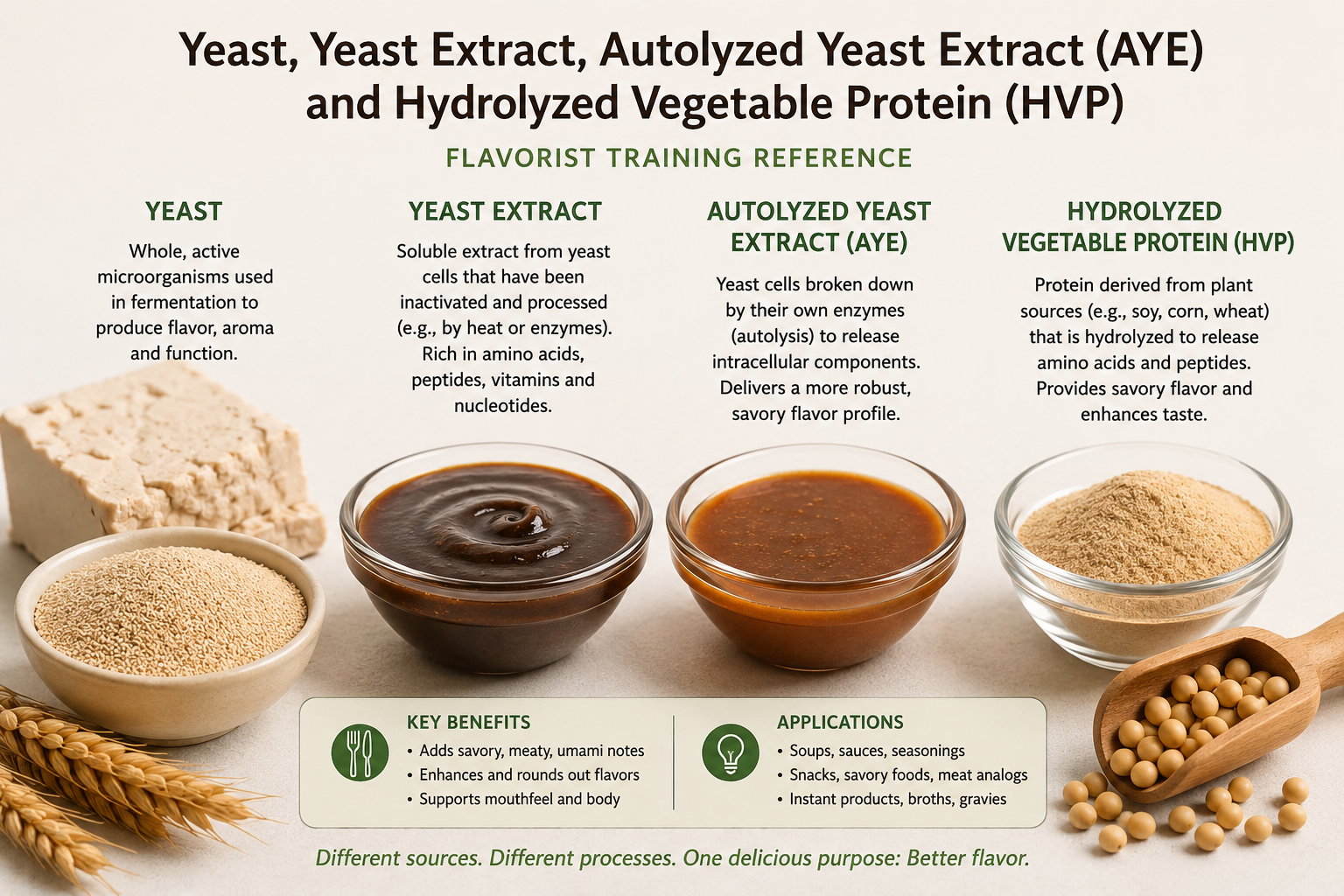
Yeast, Yeast extract, autolyzed yeast extract (AYE), and hydrolyzed vegetable protein (HVP) are one of several categories of flavoring substances that the Society of Flavor Chemists requires certified flavorists to understand thoroughly—particularly in terms of physical forms, production/manufacturing methods, organoleptic properties, and solubility. This topic is explicitly included on the Society’s qualification examination syllabus.
What follows is a foundational overview of what trainees need to know about yeast extract, AYE, and HVP as a flavoring category. It should be noted, however, that this covers only the basics; trainees are expected to gain much deeper knowledge in areas such as applications, regulatory requirements, and beyond.
These three ingredients are foundational "process flavor" building blocks used to deliver umami, savory depth, meaty/brothy notes, and body in soups, sauces, snacks, seasonings, and processed meats. Understanding their production chemistry explains their sensory profile and functional behavior in formulation.
1. YEAST EXTRACT (including Autolyzed Yeast Extract, AYE)
Physical Form
- Paste/liquid form: dark brown, viscous, sticky paste (like a thick molasses) — used industrially in bulk drums
- Powder/granular form: light tan to dark brown free-flowing powder or agglomerated granules, most common commercial form for dry seasoning blends
- Hygroscopic — powders can cake or clump if exposed to humidity; often supplied with anti-caking agents (silicon dioxide) or in low-moisture spray-dried form
- Available in low-salt, standard-salt, and nucleotide-enhanced (high-GMP) grades
Method of Production
- Substrate: Baker's or brewer's yeast (Saccharomyces cerevisiae), or Candida / Kluyveromyces strains, grown in molasses-based fermentation media
- Autolysis (self-digestion): Yeast cells are heat-shocked (~50-55°C), often salt-triggered, under controlled pH, which activates the yeast's own intracellular proteolytic and nucleolytic enzymes. These enzymes break down cell proteins into peptides and free amino acids (glutamic acid, aspartic acid, etc.). Cell wall glucans/mannans are largely left behind as insoluble residue.
- Nucleotide chemistry — important nuance: Yeast cells contain substantial RNA, and 5'-nucleotides (especially 5'-GMP, with smaller amounts of 5'-IMP) are the key flavor-active, umami-synergistic compounds producers want to retain. However, plain, uncontrolled autolysis does not reliably deliver these — left to run, yeast's native nucleases tend to degrade RNA straight past the flavor-active 5'-nucleotide stage into non-flavoring nucleosides and free bases. To produce a genuinely GMP-rich extract, manufacturers must deliberately add an exogenous 5'-phosphodiesterase enzyme (classically extracted from malt rootlets) under tightly controlled time/temperature/oxygen conditions — autolysis time is typically limited to roughly 8 hours, since longer autolysis or enzyme-incubation periods measurably reduce GMP yield as it gets further degraded. This is a distinct, deliberate processing step, not an automatic byproduct of self-digestion.
- Additives to reduce bitterness: Some processes add chitosan (from crustacean shells) during autolysis, which has been found to both improve autolysis efficiency and bind/reduce bitter compounds generated during protein breakdown.
- Separation: Cell wall debris ("hulls") is centrifuged/filtered off, leaving the soluble cytoplasmic fraction — this soluble fraction is the "extract," distinguishing it from whole autolysate, which retains cell wall material.
- Concentration/Drying: Liquid extract is concentrated under vacuum to paste, or spray-dried/drum-dried to powder.
Organoleptic Characteristics
- Primary note: Strong umami/savory taste, driven by free glutamic acid and synergistic 5'-nucleotides (primarily GMP)
- Aroma: Yeasty, bread-like, slightly meaty/broth-like, sometimes described as "bouillon-like" or "Marmite/Vegemite-like"
- Notes of roasted, nutty, and sometimes savory sulfurous undertones depending on strain and process conditions
- Can carry background bitterness if autolysis/protein breakdown is pushed too far or not well-controlled — this is a known troubleshooting issue, sometimes mitigated with chitosan treatment during processing
- Adds body/mouthfeel and a lingering savory finish to soups and sauces
- Contributes brown color to finished products (relevant in clear broths/light-colored applications)
Solubility
- Fully water-soluble (paste and powder both dissolve readily in warm/hot water; powders may need brief stirring)
- Not soluble in oils or non-polar solvents
- Solutions typically clear-to-hazy brown; cheaper grades with incomplete cell-wall removal may show slight sediment
2. HYDROLYZED VEGETABLE PROTEIN (HVP)
Physical Form
- Liquid: dark brown to almost black viscous liquid (traditional acid-HVP, visually similar to soy sauce/dark caramel)
- Powder: light-to-dark tan powder, often blended with carriers (maltodextrin, salt) for flowability
- Contains substantial residual salt, particularly acid-HVP, since neutralization generates sodium chloride as a byproduct
Method of Production
Two main routes:
A. Acid Hydrolysis (traditional, chemical)
- Plant protein substrate (soy protein, wheat gluten, corn gluten, or defatted oilseed meal) is treated with concentrated hydrochloric acid under heat and pressure, breaking proteins into free amino acids and small peptides
- The acid is then neutralized with sodium hydroxide or sodium carbonate, generating salt (NaCl) as a byproduct
- Chloropropanol contaminants (3-MCPD, 1,3-DCP) — corrected mechanism: These carcinogenic byproducts are not generated by the neutralization step. They form during the acid hydrolysis step itself, when chloride ions react with residual glycerol/lipid fragments present in the protein raw material (from incompletely defatted substrate), under the heat and hydrochloric acid conditions. This is a well-documented, internationally regulated food safety issue — the EU sets a maximum of 0.02 mg/kg 3-MCPD in liquid HVP (40% dry matter basis). Mitigation strategies used industrially include:
- Selecting low-fat/well-defatted raw material going into hydrolysis
- Tightly controlling reaction time and temperature
- Substituting HCl with other acids (e.g., sulfuric acid) in some processes
- Adding a post-hydrolysis alkaline step specifically to destroy 3-MCPD already formed
- Filtered, decolorized (activated carbon) as needed, and concentrated to liquid or spray-dried to powder
- Regulatory note: Acid-hydrolyzed HVP cannot be labeled "natural flavor" under EU flavoring regulation (1334/2008), since natural flavor status requires physical, enzymatic, or microbiological processing — chemical hydrolysis is excluded.
B. Enzymatic Hydrolysis (modern, cleaner-label alternative)
- Same plant protein substrates treated with exogenous proteolytic enzymes (e.g., papain, bromelain, or microbial proteases) under controlled temperature/pH
- No strong acid/base neutralization step, so essentially no chloropropanol risk — commonly labeled "hydrolyzed plant protein" or "enzyme-hydrolyzed vegetable protein," and can qualify as "natural flavor" in the EU where acid-HVP cannot
- Filtered and dried similarly
Organoleptic Characteristics
- Primary note: Intense savory/meaty/brothy umami, often described as more "meat-like" or "beefy/chicken-like" than yeast extract
- Acid-HVP carries characteristic Maillard-reaction-adjacent roasted, dark, soy-sauce-like notes, since its high free amino acid content readily reacts with residual sugars during subsequent thermal processing
- Distinct from yeast extract in having no yeasty/bready background — cleaner, more purely "protein-hydrolysate" in character
- Noticeable inherent saltiness (acid-HVP especially), relevant to overall sodium budgeting in formulation
- Enzymatic HVP tends to be milder, less roasted/dark, more neutral savory compared to acid HVP
- Widely used as the umami/amino-acid backbone for building "chicken," "beef," and "soy sauce" type process flavors
Solubility
- Fully water-soluble in both liquid and powder form, even in cold water, due to small peptide/free amino acid size
- Not oil-soluble
- Hygroscopic in powder form due to high free amino acid/salt content — requires proper packaging to prevent caking
Summary Comparison Table
| Attribute | Yeast Extract / AYE | HVP |
|---|---|---|
| Source | Yeast cells | Plant protein (soy, wheat, corn) |
| Process | Enzymatic autolysis + deliberate phosphodiesterase step for GMP retention | Acid or enzymatic hydrolysis |
| Physical form | Paste or powder, tan-dark brown | Liquid or powder, tan-dark brown |
| Key taste drivers | Glutamic acid + 5'-GMP (requires controlled processing to retain) | Glutamic acid + free amino acids |
| Character | Yeasty, bready, broth-like, umami | Meaty, roasted, clean savory, often salty |
| Solubility | Water-soluble | Water-soluble |
| Key process risk | Uncontrolled autolysis destroys GMP / causes bitterness | Acid route → 3-MCPD/1,3-DCP from chloride-lipid reaction (regulated) |
| Typical use | Soups, snacks, seasoning blends, savory bases | Soy sauce-type flavors, meat flavor bases, Asian-style seasonings |
Formulation Notes for Flavorists
- Both are flavor enhancers/potentiators rather than standalone flavors — they amplify and round out reaction flavors, meat flavors, and savory profiles rather than providing a specific "identity" note on their own
- Often used in combination: yeast extract for body/roundness + HVP for meaty/roasted top notes
- Sodium content of both must be tracked carefully against label claims — low-sodium yeast extract grades exist specifically for this reason
- Both are precursors in Maillard/thermal reaction flavor systems (combined with reducing sugars, thiamine, cysteine, etc., and heated) to generate meat, roasted, or savory process flavors
- When specifying yeast extract for umami intensity, confirm with the supplier whether the grade has been processed with a dedicated nucleotide-retention (phosphodiesterase) step — standard/undifferentiated autolyzed yeast extract may be much lower in GMP than a grade specifically engineered for it, even though both are labeled "yeast extract"
- When choosing between acid- and enzyme-HVP for a "clean label" or natural-flavor claim, enzymatic HVP is the compliant choice in markets following EU-style flavoring regulation.
Yeast (Whole Cell / Biomass)
Flavorist Training Reference
This entry covers yeast itself — the intact microbial biomass — as distinct from yeast extract, which is the downstream soluble fraction released from yeast cells via autolysis (covered separately). Understanding whole yeast is important because it's both a distinct functional/flavor ingredient in its own right (e.g., nutritional yeast, inactive dry yeast) and the raw material from which extract is made.
Physical Form
Whole yeast is supplied in several commercial forms depending on moisture content and cell viability:
- Compressed (cake) yeast: Moist, putty-like block, ~65-70% moisture, pale beige/cream color. Highly perishable, requires refrigeration. Used mainly in baking, rarely in flavor applications.
- Active dry yeast (ADY) / Instant dry yeast: Granular, light tan, low moisture (~5-8%). Cells are dehydrated but remain viable/living — this form is for fermentation/leavening use, not typically a flavor ingredient itself.
- Inactive dry yeast (IDY) / deactivated yeast: Same dehydration process as ADY, but cells are heat-killed during or after drying so they can't ferment. This is the relevant form for flavor and nutritional applications — light tan to golden-brown powder or fine granules.
- Nutritional yeast (deactivated, often torula or S. cerevisiae): Fine, light yellow to golden flakes or powder, free-flowing, low moisture. A well-known flavorist-adjacent ingredient valued for a savory, "cheesy/nutty" character.
- Yeast cream: A liquid slurry form (concentrated suspension of live or inactive cells in water), used in some industrial bakery/brewing contexts — not common in flavor houses.
- Spent yeast (brewer's/distiller's byproduct): Wet slurry or cake recovered after fermentation, dark and somewhat bitter due to residual hop compounds (if brewer's) — typically the raw material sent onward for extract production rather than sold as a finished flavor ingredient itself.
Across all dried forms, whole yeast powders/flakes are finer and lighter in color than yeast extract (tan/golden rather than dark brown), because the cell walls (which carry much of the color-contributing melanoidin/browning reaction products) haven't been concentrated the way they are in extract processing, and because whole yeast hasn't undergone the same degree of protein/peptide breakdown and subsequent color development.
Method of Production
- Strain selection and propagation: Primarily Saccharomyces cerevisiae (baker's/brewer's strains) or Candida utilis (torula yeast, used heavily for nutritional yeast and some flavor bases). Cells are grown aerobically in large fermenters on a carbon source — classically molasses (cane or beet), sometimes supplemented with ammonium salts, phosphates, and trace minerals as nitrogen/mineral sources.
- Fermentation/growth phase: Conditions (aeration, temperature, feed rate) are controlled to maximize biomass yield rather than ethanol production (this is the key process difference from brewing/distilling, where ethanol is the target and yeast growth is almost a byproduct).
- Harvesting: Cells are separated from the fermentation broth by centrifugation, yielding a wet yeast cream/cake.
- Washing: The cell mass is typically washed to remove residual fermentation medium components (sugars, salts) that would otherwise affect flavor and shelf stability.
- Inactivation (for non-leavening forms): Cells intended for flavor/nutritional use (rather than baking) are heat-killed — this stops metabolic activity and also denatures the yeast's own autolytic enzymes, which is an important distinction from yeast extract production, where those same enzymes are deliberately preserved and activated. In other words: whole inactive yeast and yeast extract start from the same raw biomass, but diverge based on whether the internal enzymes are destroyed (whole yeast) or deliberately unleashed (extract).
- Drying: Spray-drying or drum-drying to the target moisture (~5% or lower) for shelf stability. Torula/nutritional yeast is commonly drum-dried and then flaked or milled.
- Milling/sizing: Dried material is screened or milled to the target particle size (flakes, fine powder, or granules) for the intended application.
Key contrast with yeast extract production: whole yeast processing is designed to preserve the intact cell (walls, membrane, and internal contents together) and stop enzymatic activity; yeast extract processing is designed to rupture the cell's internal enzyme systems on purpose (via autolysis) to break down proteins/RNA into flavor-active soluble compounds, then discard the cell wall residue.
Organoleptic Characteristics
- Aroma: Yeasty, bready, slightly cereal-like; nutritional yeast in particular carries a distinctive savory, nutty, "cheesy" aromatic note (this is well known in vegan cooking as a parmesan-like flavor contributor)
- Taste: Milder umami than yeast extract — whole yeast cells still contain glutamic acid and nucleic acids, but they are locked inside intact cell walls and not yet liberated as free amino acids/nucleotides, so the umami impact is muted and background rather than pronounced
- Texture/mouthfeel: Powdery, slightly gritty in cell-wall-intact forms (nutritional yeast flakes have a characteristic slightly fibrous, flaky mouthfeel from residual glucan/mannan cell wall material); can impart a mild thickening or absorbent quality in wet applications due to the cell wall polysaccharide content
- Color contribution: Light tan to golden — much lighter than extract, since concentrated Maillard/browning reaction products haven't developed to the same degree
- Off-notes/limitations: Because internal enzymes are typically deactivated, whole yeast doesn't continue "developing" flavor over time or during processing the way extract precursors can; it's flavor-stable but comparatively flavor-flat. Spent brewer's yeast specifically can carry bitter, hoppy off-notes carried over from the brewing process, which limits its direct use as a flavor ingredient (this is part of why it's typically routed to extract production, where the bitterness can sometimes be mitigated, e.g., via chitosan treatment as discussed for extract processing, or through a debittering wash step).
Solubility
This is the most important functional distinction from yeast extract for a flavorist to keep in mind:
- Whole intact yeast cells are not truly water-soluble — the cell wall (composed largely of insoluble glucans and mannoproteins) keeps the cell's contents physically enclosed
- In water, whole yeast disperses/suspends rather than dissolves — it will hydrate and swell somewhat, and fine powders can form a cloudy, opaque suspension, but given time it will settle out rather than remain in true solution
- This is functionally very different from yeast extract, which is fully water-soluble because its production process specifically ruptures the cells and isolates only the soluble intracellular fraction
- Not soluble in oils or non-polar solvents
- In formulation, whole yeast/nutritional yeast is generally used as a dry-blended ingredient (dusted onto snacks, incorporated into dry seasoning mixes, baked into products) rather than dissolved into liquid systems, precisely because of this lack of true solubility
Quick Reference: Whole Yeast vs. Yeast Extract
| Attribute | Whole Yeast (inactive/nutritional) | Yeast Extract |
|---|---|---|
| Cell structure | Intact (wall + contents together) | Ruptured; wall removed, only soluble contents retained |
| Internal enzymes | Deliberately deactivated (heat-killed) | Deliberately activated (autolysis) then typically heat-stopped once desired breakdown achieved |
| Solubility | Disperses/suspends, not soluble | Fully water-soluble |
| Umami intensity | Mild, background | Strong, pronounced |
| Color | Light tan/golden | Dark tan to brown |
| Typical use | Dry seasoning dusting, nutritional flavor topnote, texture/absorbency | Liquid/paste savory base, soup/sauce umami backbone |
###