Flavor Compound–Starch Interactions in Foods and Plated Flavor Systems
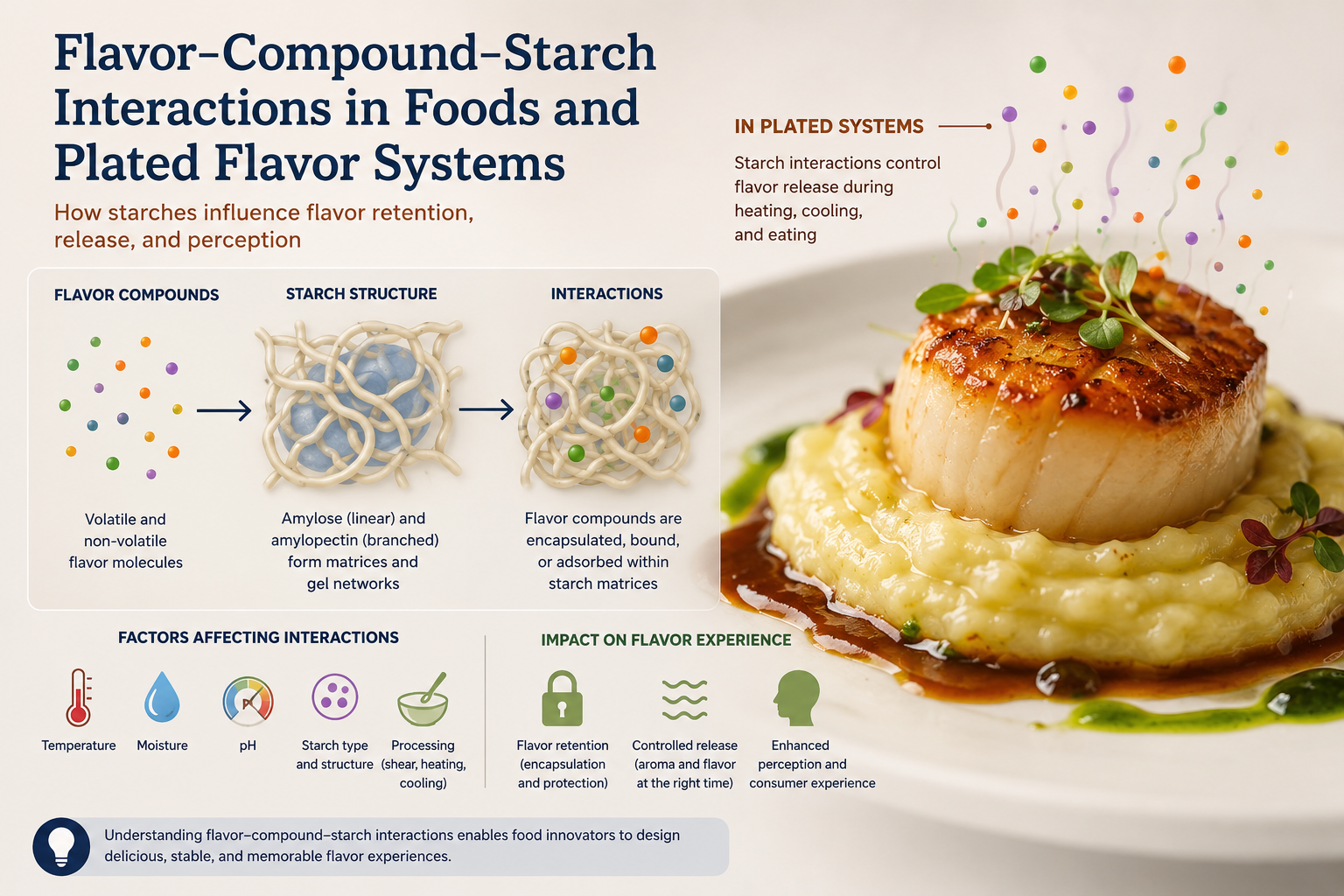
Table of Contents
- Practical Definition
- Main Interaction Mechanisms
2.1 Amylose Inclusion Complexation
2.2 Amylopectin Interaction
2.3 Adsorption onto Starch Surface
2.4 Physical Entrapment in Gelatinized Starch
2.5 Retrogradation and Flavor Release - Effect on Volatility and Headspace
3.1 General Rule
3.2 Top Notes
3.3 Middle Notes
3.4 Base Notes - Effect on Shelf-Life
4.1 Positive Effects
4.2 Negative Effects - Starch Type Selection Guide
- Flavor Chemistry: Compound-by-Compound Behavior
- Moisture and Water Activity
- Processing Effects
- Plated Flavor: Does Starch–Flavor Interaction Work?
9.1 What Plated Flavor Does Well
9.2 What Plated Flavor Does Poorly
9.3 Plated Flavor on Maltodextrin or Starch
9.4 Plated Flavor on Silica or Porous Carriers - Shelf-Life Expectations: Plated vs. Spray-Dried vs. Inclusion Complex
- Formulation Decision Tree
- Flavorist Troubleshooting Guide
- Practical Training Examples
- Key Rules for Junior Flavorists
Flavorist Handbook: Flavor Compound–Starch Interactions
1. Practical definition
In foods, “starchy material” includes native starch, gelatinized starch, modified starch, maltodextrin, dextrin, pregelatinized starch, flour systems, cereal bases, snack matrices, starch-based coatings, and porous starch carriers. Flavor compounds interact with these materials through physical entrapment, adsorption, hydrogen bonding, hydrophobic binding, viscosity effects, and amylose inclusion complexation.
The most important point for a flavorist:
Starch does not only dilute flavor. It can change flavor volatility, headspace release, onset, linger, oxidation rate, and shelf-life.
2. Main interaction mechanisms
2.1 Amylose inclusion complexation
Amylose is the mostly linear fraction of starch. It can coil into a helix with a relatively hydrophobic inner cavity. Certain flavor molecules can enter or partially enter that cavity, forming a V-type amylose inclusion complex. Reviews describe amylose as especially important because it can form helical inclusion complexes with volatile flavor compounds. (ScienceDirect)
Flavor compounds likely to complex
More likely:
- medium-chain aldehydes
- lactones
- terpenes
- certain esters
- ketones
- alcohols with hydrophobic chain character
- phenolics with compatible size and polarity
Less likely:
- very small, highly water-soluble compounds
- very bulky terpenoids
- highly polar acids
- compounds with poor geometric fit
Flavorist outcome
Amylose complexation generally:
- lowers immediate headspace release
- reduces top-note flash-off
- improves retention during drying or storage
- slows flavor release during consumption
- may reduce perceived freshness or impact if over-bound
- can protect sensitive notes from oxidation or evaporation
2.2 Amylopectin interaction
Amylopectin is highly branched. It does not form inclusion complexes as efficiently as amylose, but it can still retain aroma through surface binding, branch-chain association, entrapment, and viscosity effects. Studies show aroma retention can depend on the amylose/amylopectin ratio, and even waxy starches with little amylose can retain compounds such as linalool and ethyl hexanoate. (ACS Publications)
Flavorist outcome
Amylopectin-rich or waxy starches often give:
- less true inclusion protection than amylose starch
- more matrix/viscosity-controlled release
- softer binding
- faster flavor availability than high-amylose starch
- less “locked-in” character
2.3 Adsorption onto starch surface
Flavor oils can adsorb onto starch granule surfaces, maltodextrin particles, porous starch, flour particles, or dry carriers. Binding may occur by:
- van der Waals forces
- hydrophobic patches
- hydrogen bonding
- capillary retention in pores
- oil film formation on particles
Flavorist outcome
Surface adsorption is weaker than true encapsulation. It gives:
- good initial aroma
- easier release
- higher volatility loss during storage
- higher oxidation risk
- possible caking if oil load is high
- strong dependency on carrier surface area and moisture
2.4 Physical entrapment in gelatinized starch
When starch is heated in water, it gelatinizes. Granules swell, amylose leaches, viscosity increases, and the system can trap aroma physically.
Flavorist outcome
Gelatinized starch systems often:
- reduce aroma diffusion
- suppress headspace release
- increase flavor linger
- delay perception
- protect some volatiles during short processing
- but may lose top notes during heating before the matrix sets
This matters in sauces, gravies, puddings, fillings, noodles, bakery batters, soups, and starch-thickened beverages.
2.5 Retrogradation and flavor release
After gelatinized starch cools, amylose and amylopectin can reassociate. This is retrogradation. As the matrix firms, aroma mobility changes.
Flavorist outcome
Retrogradation may:
- trap aroma more tightly over time
- reduce fresh top notes after storage
- increase stale or cardboard perception if oxidation proceeds
- change flavor balance between day 1 and day 30
- cause flavor release to become slower and duller
High-amylose systems retrograde faster and bind more strongly than waxy starch systems.
3. Effect on volatility and headspace
3.1 General rule
When a flavor compound interacts strongly with starch, its free concentration decreases. Only the free fraction contributes strongly to headspace aroma.
So:
More binding = lower volatility in headspace = lower immediate aroma impact.
But this can be beneficial if the target is long shelf-life or delayed release.
3.2 Top notes
Highly volatile top notes such as ethyl acetate, acetaldehyde, light esters, short-chain aldehydes, and some sulfur compounds may be lost quickly unless protected.
Starch can help, but only if the carrier or matrix captures them before evaporation. Ordinary plated starch or maltodextrin often gives limited protection because much of the flavor remains on the particle surface.
Practical effect
In dry mixes:
- plated top notes give strong bag aroma
- but fade quickly
- spray-dried or inclusion-complexed top notes last longer
- cyclodextrin or high-amylose systems can improve retention
3.3 Middle notes
Middle notes such as fruity esters, lactones, ketones, and terpenes often interact more noticeably with starch.
Practical effect
- peach lactones may become smoother and longer lasting
- citrus terpenes may lose fresh sparkle but gain stability
- creamy/dairy ketones may become rounded
- brown notes may linger more
3.4 Base notes
Less volatile compounds are less dependent on headspace loss but may still adsorb or partition into starch.
Practical effect
- vanilla, caramel, cocoa, malt, and cooked notes may become more persistent
- high starch may mute sharpness
- sweetness perception may feel rounder
- release may become slow and heavy
4. Effect on shelf-life
4.1 Positive effects
Starch-based interaction can improve shelf-life by:
- reducing evaporation
- slowing oxidation
- reducing flavor migration
- decreasing exposure to oxygen
- protecting heat-sensitive compounds
- improving powder handling
- reducing liquid flavor bleeding
Starch inclusion complexes are being studied as carriers because they can reduce evaporation, prevent volatile loss, and improve storage stability. (ACS Publications)
4.2 Negative effects
Starch can also harm flavor stability when:
- moisture is high
- carrier is hygroscopic
- flavor sits on the surface rather than being encapsulated
- oil load is excessive
- oxygen is present
- starch contains trace metals, lipids, enzymes, or cereal off-notes
- powder water activity allows mobility
- packaging has poor oxygen or moisture barrier
Typical defects
- top-note fade
- citrus oxidation
- aldehyde loss
- cardboard/stale notes
- caking
- flavor migration into packaging
- loss of impact after opening
- flavor imbalance over time
5. Starch type selection guide
Native corn starch
Good for:
- low-cost dry systems
- bakery mixes
- snack seasonings
Limitations:
- limited solubility if not cooked
- moderate flavor retention
- possible cereal note
- not ideal for high oil loading
Waxy starch
High amylopectin, low amylose.
Good for:
- faster release
- less firm gel
- smoother texture
- less amylose complexation
Limitations:
- lower inclusion protection
- more volatile loss than high-amylose systems
High-amylose starch
Good for:
- stronger flavor retention
- controlled release
- heat protection
- inclusion-complex systems
Limitations:
- can mute flavor
- may slow release too much
- harder to process
- may need heat/shear for complex formation
Maltodextrin
Common spray-dry or plating carrier.
Good for:
- dry flavor dilution
- spray drying
- cost-effective carrier
- low sweetness depending on DE
- good powder handling
Limitations:
- weak emulsification by itself
- limited protection if simply plated
- hygroscopic depending on DE
- can dull top notes
- often needs gum arabic, modified starch, protein, or emulsifier for better encapsulation
Hydrolyzed starches are widely used as wall materials in spray-dried flavors and can provide resistance to oxidation and heat compared with some other wall materials. (Wiley Online Library)
Modified food starch
Good for:
- spray-dried citrus oils
- emulsification
- encapsulation
- beverage cloud/flavor systems
- improved oil retention
Limitations:
- regulatory labeling considerations
- possible flavor release differences
- may interact differently by modification type
Porous starch
Good for:
- adsorbing liquid flavor
- dry delivery
- controlled release
- higher oil loading than standard starch
Limitations:
- surface oil may still oxidize
- needs packaging protection
- may require anti-caking support
6. Flavor chemistry: compound-by-compound behavior
Esters
Examples: ethyl butyrate, isoamyl acetate, ethyl hexanoate.
Behavior:
- high volatility
- fruity top/middle notes
- can be retained by starch depending on hydrophobicity and structure
- susceptible to hydrolysis in moist systems
Outcome:
- starch may reduce initial fruit impact
- improves retention if complexed or encapsulated
- plated systems may lose esters quickly
Flavorist advice:
Use higher-impact ester top notes in protected form when shelf-life is required. Consider spray-dried, cyclodextrin-complexed, or high-amylose complexed systems for dry beverage and powder applications.
Aldehydes
Examples: hexanal, nonanal, cinnamaldehyde, benzaldehyde, citral.
Behavior:
- reactive
- oxidation-sensitive
- can bind or adsorb
- may react with proteins or amino compounds if present
Outcome:
- starch may reduce volatility
- protection depends strongly on oxygen and moisture
- surface-plated aldehydes can fade or oxidize
Flavorist advice:
For citrus, green, and nut aldehydes, avoid simple plating when long shelf-life is required. Use encapsulation, antioxidants, low water activity, and oxygen-barrier packaging.
Terpenes
Examples: limonene, pinene, myrcene, linalool.
Behavior:
- hydrophobic
- oxidation-prone
- strongly affected by surface exposure
- can interact with amylose or cyclodextrins
Outcome:
- reduced headspace release when bound
- improved shelf-life when encapsulated
- risk of dull citrus character if over-retained
Flavorist advice:
For citrus powders, plated terpene oils are high-risk unless turnover is fast. Spray-dried modified starch/gum systems usually outperform simple plating.
Lactones
Examples: gamma-decalactone, gamma-undecalactone, delta-decalactone.
Behavior:
- hydrophobic
- medium volatility
- good candidates for starch interaction
- creamy/fruity character can be retained well
Outcome:
- longer release
- smoother perception
- less top-note burst
- good shelf-life improvement possible
Flavorist advice:
Useful in dry dairy, peach, coconut, cream, and bakery flavors where slow release is acceptable.
Ketones
Examples: diacetyl, acetoin, acetophenone, maltol-related systems.
Behavior:
- polarity varies
- some are volatile and water soluble
- some bind moderately
Outcome:
- creamy notes may be rounded
- high-volatility ketones may still escape
- maltol/ethyl maltol are more solubility- and crystallization-driven than volatility-driven
Flavorist advice:
Balance with free top notes if the starch system makes the flavor too flat.
Phenolics and vanillin-type compounds
Examples: vanillin, eugenol, guaiacol.
Behavior:
- hydrogen bonding possible
- moderate volatility
- may adsorb to starch or cereal solids
Outcome:
- lingering sweetness/warmth
- reduced sharpness
- possible binding-related flavor dulling
Flavorist advice:
In bakery mixes, starch usually supports rounded vanilla/brown profiles, but high carrier levels can flatten impact.
7. Moisture and water activity
Moisture is one of the biggest controls on starch-flavor interaction.
Low moisture dry powder
- flavor mobility is low
- oxidation still possible at surfaces
- plated flavor may smell strong initially
- shelf-life depends heavily on packaging
Intermediate moisture
- mobility increases
- flavor migration increases
- hydrolysis and oxidation risk increase
- caking risk increases
High moisture cooked food
- starch gelatinizes
- viscosity suppresses release
- heat drives off volatiles before serving
- flavor must survive cooking and release during eating
Practical rule
Dry starch can hold flavor physically. Hydrated starch can suppress flavor release. Heated starch can both lose and trap flavor.
8. Processing effects
Dry blending
Used for powdered beverages, seasonings, bakery mixes.
Risk:
- volatile loss during mixing
- poor distribution at low dosage
- dusting
- oxidation on exposed surface
Best practice:
- add plated flavor late in blending
- avoid long high-shear mixing
- control powder temperature
- use moisture-barrier packaging
- test headspace after storage, not only day 1
Spray drying
Spray drying creates a matrix around flavor droplets. It is usually more protective than simple plating. Spray-drying reviews emphasize that wall material selection controls flavor retention, stability, and release. (ScienceDirect)
Best for:
- citrus oils
- beverage powders
- high-volume dry flavors
- better shelf-life than plated systems
Limitations:
- heat exposure
- top-note loss during drying
- carrier taste
- oxidation if encapsulation is poor
Extrusion or agglomeration
Can improve protection and controlled release, but heat and shear may damage sensitive notes.
Best for:
- seasonings
- instant products
- controlled release systems
Cooking in starch systems
Examples: soup, sauce, gravy, custard, bakery.
Effects:
- top notes evaporate during heating
- starch thickening lowers release
- amylose may complex hydrophobic notes
- cooling can further trap flavor
Flavorist adjustment:
- increase heat-stable middle/base notes
- add post-process flavor where possible
- use encapsulated top notes for late release
- evaluate after realistic cook/hold/reheat cycles
9. Plated flavor: does starch-flavor interaction work?
Yes, but with limits.
A plated flavor is generally made by applying or spraying a liquid flavor onto a dry carrier such as maltodextrin, dextrose, starch, salt, sugar, gum arabic, or silica to create a free-flowing powder. Industry descriptions define plating as loading liquid flavor onto solid matrix material by powder/liquid blending. (Google Patents)
In plated flavor, the interaction is mostly:
- surface adsorption
- pore absorption
- capillary holding
- weak hydrogen bonding
- physical dilution
- limited molecular inclusion
It is usually not true encapsulation unless the carrier has a specific complexing or porous structure and the process is designed for it.
9.1 What plated flavor does well
Plated flavor is useful when the goal is:
- low cost
- fast turnaround
- simple dry conversion
- strong opening aroma
- seasoning impact
- bakery mix flavoring
- low to moderate shelf-life demand
- flavor oils with low oxidation sensitivity
- applications where flavor is consumed quickly
Typical applications:
- snack seasonings
- dry soup mixes
- powdered sauces
- bakery mixes
- spice blends
- instant noodles
- dry rubs
- powdered drink systems with short shelf-life
9.2 What plated flavor does poorly
Plated flavor is weaker when the goal is:
- long shelf-life
- strong protection of citrus oils
- protection of aldehydes
- high top-note retention
- high heat stability
- high humidity stability
- controlled release
- oxidation protection
A patent background notes that plated flavors are not properly encapsulated in a shell and are therefore prone to evaporation and oxidation during storage. (Google Patents)
9.3 Plated flavor on maltodextrin or starch
Expected behavior
- easy powder conversion
- moderate oil loading
- good dry blending
- limited protection
- possible top-note loss
- moisture sensitivity
- caking at high oil or high humidity
Best use
- brown flavors
- cheese powders
- savory seasonings
- vanilla/bakery profiles
- less volatile fruit systems
- short shelf-life dry mixes
Avoid or protect carefully
- lemon, lime, orange top-note oils
- citral-heavy systems
- fresh green aldehydes
- delicate berry esters
- sulfur top notes
- highly volatile solvent-like notes
9.4 Plated flavor on silica or porous carriers
High surface-area carriers can hold more liquid and improve flow. Specialty silica suppliers describe dual-carrier systems such as maltodextrin plus silica to balance absorption capacity, cost, solubility, dustiness, and flavor profile. (l-i.co.uk)
Advantages
- higher oil load
- better free-flowing powder
- less wet appearance
- improved handling
- sometimes better oxidative stability
Limitations
- labeling considerations
- insoluble mineral carrier
- possible dusting
- possible release differences
- not always appropriate for beverages
10. Shelf-life expectations: plated vs spray-dried vs inclusion complex
Plated flavor
Protection level: low to moderate
Release: fast
Opening aroma: high
Shelf-life: shortest
Cost: lowest
Best for: dry seasonings and quick-use powders
Spray-dried flavor
Protection level: moderate to high
Release: medium
Opening aroma: moderate
Shelf-life: better
Cost: medium
Best for: beverage powders, citrus oils, dairy flavors, powdered systems
Amylose or cyclodextrin inclusion complex
Protection level: high for suitable molecules
Release: slow to controlled
Opening aroma: lower
Shelf-life: high
Cost/process complexity: higher
Best for: volatile protection, controlled release, oxidation-sensitive materials
Cyclodextrins are starch-derived cyclic oligosaccharides that form inclusion complexes with flavor and aroma compounds, improving stability and protecting sensitive lipophilic constituents. (PMC)
11. Formulation decision tree
Use plated starch/maltodextrin flavor when:
- product is dry
- flavor is consumed within a moderate time
- top-note fade is acceptable
- cost is important
- strong initial aroma is desired
- flavor oil is not highly oxidation-sensitive
Use spray-dried flavor when:
- longer shelf-life is needed
- volatile retention matters
- citrus, fruit, or dairy notes must last
- product is powdered beverage, instant mix, or dry base
- oil needs better distribution
Use inclusion complex or encapsulated system when:
- flavor is very volatile
- flavor oxidizes easily
- controlled release is desired
- heat stability is needed
- flavor must survive storage and processing
- low aroma loss is critical
12. Flavorist troubleshooting guide
Problem: strong aroma at blending, weak aroma after storage
Likely cause:
- surface-plated volatiles evaporated
- poor package barrier
- high storage temperature
Fix:
- reduce plated top notes
- use spray-dried top-note fraction
- use oxygen/moisture barrier packaging
- add antioxidant if appropriate
- lower oil load on carrier
Problem: flavor tastes flat in starch-thickened food
Likely cause:
- viscosity suppresses release
- amylose binding
- top notes lost during heating
Fix:
- increase free top notes
- use post-added flavor
- reduce high-amylose starch
- use waxy starch
- increase heat-stable middle notes
Problem: citrus powder develops stale note
Likely cause:
- terpene oxidation
- surface oil exposure
- oxygen ingress
- high humidity
Fix:
- use spray-dried citrus oil
- add antioxidant system
- lower surface oil
- improve packaging
- use modified starch/gum encapsulation
Problem: powder cakes
Likely cause:
- high oil load
- hygroscopic maltodextrin
- high humidity
- insufficient carrier surface area
Fix:
- reduce flavor load
- use lower-DE maltodextrin
- add anti-caking agent
- use silica or porous carrier
- improve moisture barrier
Problem: flavor release is too slow
Likely cause:
- over-complexation
- high amylose
- dense matrix
- low water activity during consumption
Fix:
- use lower-amylose carrier
- blend protected and free flavor
- increase more volatile fractions
- use faster-dissolving carrier
13. Practical training examples
Example 1: Lemon powder drink
Risk compounds:
- limonene
- citral
- light aldehydes
- fruity esters
Bad choice:
- simple plated lemon oil on maltodextrin for long shelf-life
Better choice:
- spray-dried lemon oil on modified starch/gum system
- small plated top-note booster for opening aroma
- oxygen-barrier packaging
Expected result:
- better shelf-life
- less oxidation
- more stable lemon character
Example 2: Cheese snack seasoning
Flavor profile:
- dairy acids
- sulfur notes
- buttery ketones
- enzyme-modified cheese powders
- starch/maltodextrin carrier
Plated flavor works well because:
- dry application
- fast release desired
- strong bag aroma desirable
- shelf-life can be managed with packaging
Watch-outs:
- sulfur loss
- oxidation of dairy fat notes
- caking
Example 3: Vanilla cake mix
Flavor profile:
- vanillin
- ethyl vanillin
- maltol
- butter notes
- brown notes
Starch interaction:
- generally beneficial
- rounds flavor
- supports linger
- less dependent on high top-note volatility
Plated flavor works well.
Example 4: Strawberry powdered beverage
Risk compounds:
- ethyl butyrate
- ethyl 2-methylbutyrate
- methyl anthranilate
- lactones
- aldehydes
Plated-only risk:
- fresh top notes fade
- flavor becomes jammy/heavy
Better approach:
- spray-dried top-note fraction
- plated lactone/base booster
- acid/sugar balance tested after storage
14. Key rules for junior flavorists
- Starch can protect flavor, but it can also mute it.
- Amylose binds more strongly than amylopectin.
- Plating is not the same as encapsulation.
- A strong day-1 aroma can mean poor shelf-life.
- Top notes need protection; base notes usually need release balance.
- Moisture changes everything.
- Always evaluate flavor after processing and storage, not only fresh.
- Carrier choice is part of flavor design, not just cost control.
- For plated flavors, oil load, carrier surface area, water activity, and packaging determine success.
- For long shelf-life citrus or delicate fruit, plated starch/maltodextrin alone is usually not enough.
###