Water Activity: What Flavorists Need to Know
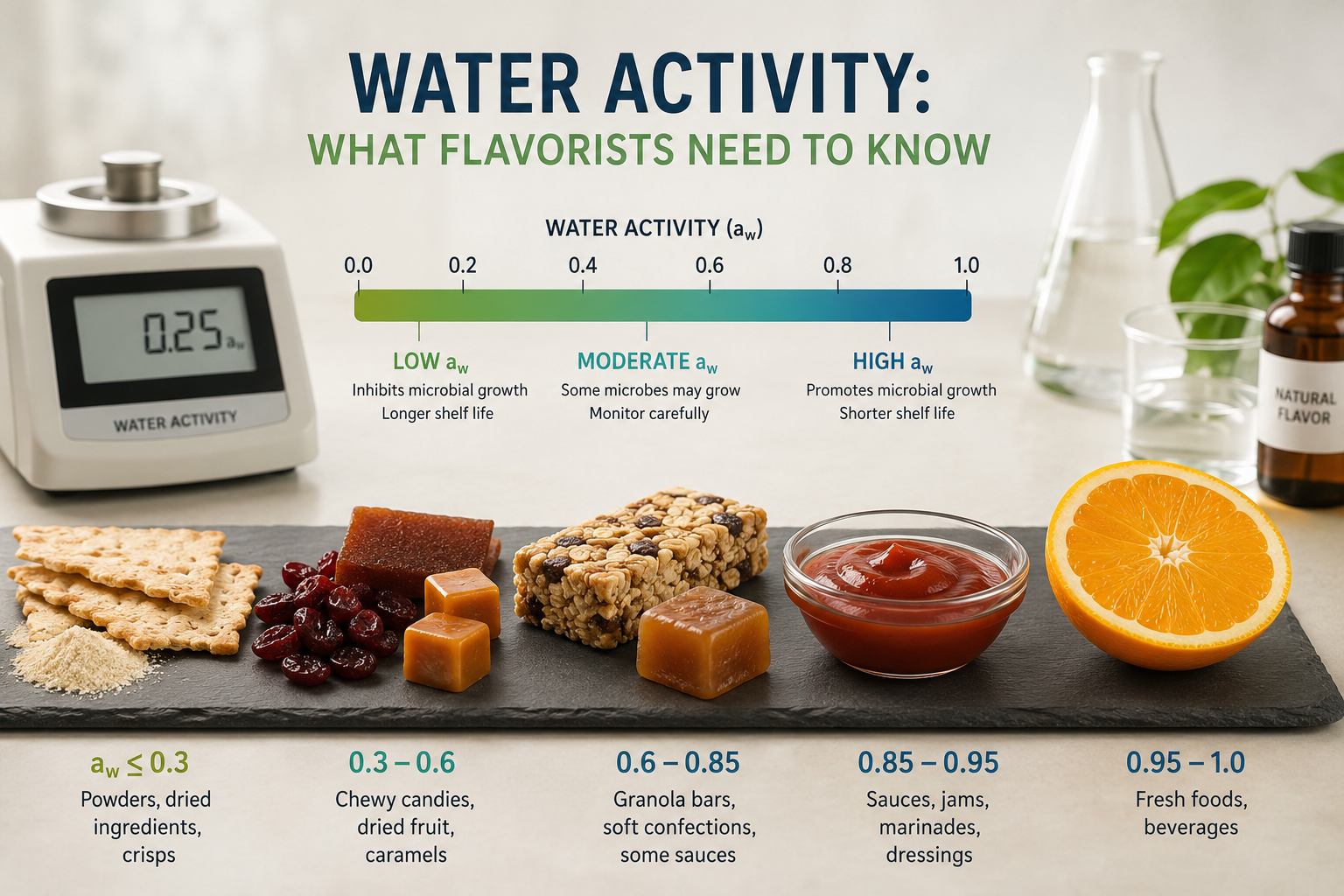
Water Activity aw
📑 Table of Contents
1. Core Definition: What is Water Activity?
aw = P / P0
P = partial vapor pressure of water in the food matrix at a given temperature.
P0 = saturation vapor pressure of pure water at the same temperature.
practical aw represents the “free” or “available” water – water not bound to solutes (sugars, salts) or structural polymers (starches, proteins). Range: 0 (bone-dry) to 1.0 (pure water).
Flavorist distinction: Moisture content = how much water · aw = how energetic that water is.
2. How aw Influences Flavors: Chemical & Physical Pathways
🔹 Physical influences (volatile release & retronasal perception)
| aw range | Physical effect on flavor | Mechanism |
|---|---|---|
| High aw > 0.85 | Suppressed top‑notes. Volatiles are “held back.” | Water is polar; hydrophobic aroma compounds partition slowly into air. High aw increases Kair/water for many esters, reducing headspace. |
| Intermediate 0.4 – 0.7 | Maximum volatility & flavor burst – ideal for baked goods & snacks | Water plasticizes amorphous matrices. At mastication, saliva raises local aw > 0.95 → rapid “burst” release (glass transition Tg effect). |
| Low aw < 0.3 | Flavor “shut‑down.” Volatiles cannot migrate to surface. | Glassy matrix – aroma compounds entrapped. Release only upon physical breakdown (crunching). |
⚡ “Water bridge” effect: At intermediate aw, water clusters hydrogen‑bond with polar volatiles (pyrazines, aldehydes) → slows diffusion (D) until saliva releases them.
🔸 Chemical influences (reaction kinetics & stability)
| Reaction | Optimal aw | Chemical consequence for flavor |
|---|---|---|
| Maillard reaction | 0.60 – 0.75 | Maximum generation of roasted, meaty, baked notes (pyrazines, furans, thiazoles). Below 0.4 reactants immobile; above 0.85 dilution slows. |
| Lipid oxidation (rancidity) | 0.30 – 0.40 ⚠️ danger zone | Monolayer water activates metal catalysts (Fe, Cu); maximum off‑flavor (hexanal, trans‑2‑nonenal). Above 0.6 water hydrates peroxides → slows oxidation. |
| Enzymatic browning (PPO) | > 0.90 | Polyphenol oxidase mobilises → bitter/astringent quinones in fruits/veg. |
| Hydrolysis (esters) | > 0.85 | Short‑chain esters (fruity) hydrolyse → soapy/rancid free fatty acids, loss of fruity character. |
| Strecker degradation | 0.55 – 0.70 | Generation of aldehydes (e.g. methional – cooked potato) optimal, but over‑progression leads to stale cardboard notes. |
3. Factors That Affect Water Activity (the Flavorist’s Levers)
| Factor | Effect on aw | Application in flavor design |
|---|---|---|
| Solutes (humectants) | Depress aw (colligative) | Sugars, salts, polyols (glycerol, PG) bind water. Small molecules (NaCl) depress more than large (maltodextrin). PG instead of PEG lowers aw for microbial stability. |
| Matrices (hydrocolloids) | Depress aw via capillary/matrix effects | Starches, gums, proteins trap water (hysteresis: desorption aw > adsorption). Critical for dry snack coatings. |
| Temperature | Increases aw (critical!) | aw rises with T because P0 increases exponentially. A product at 0.60 at 25°C may reach 0.68 at 40°C – crossing Maillard/oxidation danger zones during shipping. |
| Crystallization (phase change) | Spikes aw suddenly | Amorphous sugars (spray‑dried flavours) crystallise → release bound water → “water spike” triggers caking, stickiness, and sudden oxidation. |
4. Direct Impact of aw on Flavor Perception (Sensory)
| Application aw | Flavorist strategy |
|---|---|
| Low aw (0.20 – 0.30) Hard candies, biscuits | Use low‑volatility, high‑boiling molecules (vanillin, ethyl maltol, lactones). Top‑notes (limonene, ethyl butyrate) are locked in glass. Solution: encapsulate top‑notes in modified starches for release upon mastication. |
| Intermediate (0.50 – 0.65) Cakes, soft cookies, peanut butter | Reaction zone. Design flavour to complement Maillard products. Use sulfur notes (thiazoles, furanthiols) generated in‑situ. Caution: add antioxidants (tocopherols, rosemary) proactively – this is also oxidation peak. |
| High aw (> 0.90) Beverages, sauces, yogurt | Volatiles partition rapidly. Use hydrophobic encapsulants (oil‑soluble) to increase headspace partition. Include binding agents (cyclodextrins, modified gums) to complex bitter off‑notes (naringin in citrus) while releasing desired esters. |
5. Practical Flavorist “Rules of Thumb” for aw Management
- The 0.6 Rule: If powder (soup mix, seasoning) has aw > 0.6, never use spray‑dried flavor with high glucose syrup – carrier will absorb moisture, crystallise, collapse → volatiles lost to headspace.
- Solvent switch: In liquids, replace water with propylene glycol (PG) or ethanol to lower aw without changing sweetness. Every 10% PG substitution reduces aw by ~0.05.
- The Saliva Test: Always evaluate flavours by chewing for 30 s. Salivary aw ≈ 0.99. If flavour designed for 0.4, burst is intense but short‑lived – plan release profile (top/middle/base).
- Monitor moisture migration: In multi‑component (chocolate‑coated cookie), moisture migrates from high‑aw filling to low‑aw coating → changes aw, fat bloom, and adsorbs volatile chocolate notes. Use edible barrier (shellac, ethyl cellulose).
6. Summary Cheat Sheet for Flavorists
0.00 – 0.30
Risk: Flavour entrapment (no release)
Opportunity: Long shelf‑life; no oxidation
Carrier: Lipophilic oils, crystalline encapsulants
0.30 – 0.45 ⚠️
Risk: MAXIMUM OXIDATION
Opportunity: Good volatility for dry snacks
Carrier: Add chelators (EDTA, citric acid) + oil‑soluble antioxidants
0.45 – 0.65
Risk: Maillard over‑progression (burnt/bready)
Opportunity: Max generation of savory, roasted, caramelised
Carrier: Add sulfur precursors + reducing sugars
0.65 – 0.85
Risk: Hydrolysis of esters; mold risk >0.75
Opportunity: Excellent release of fruity & citrus top‑notes
Carrier: Emulsified oil‑in‑water systems
> 0.85
Risk: Enzymatic degradation; rapid loss of fresh notes
Opportunity: Full retro‑nasal impact upon ingestion
Carrier: Add natural preservatives (cultured dextrose, fermented whey)
🎯 Final Takeaway for the Trainee
“Water activity is not a shelf‑life metric; it is a flavor partition coefficient.”
Your most creative work as a flavorist will not be in the GC‑MS library—it will be in managing the matrix’s aw to ensure the consumer perceives the molecule you designed at the exact moment of mastication, while simultaneously preventing that same molecule from turning into a stale off‑note six weeks later. Master aw, and you master flavor delivery.