Metal Ion Complexation in the Flavor Industry: Fundamental Theory, Mechanisms, Formulation Challenges, Industrial Examples, and Critical Effects on Flavor Stability, Aging, and Shelf Life
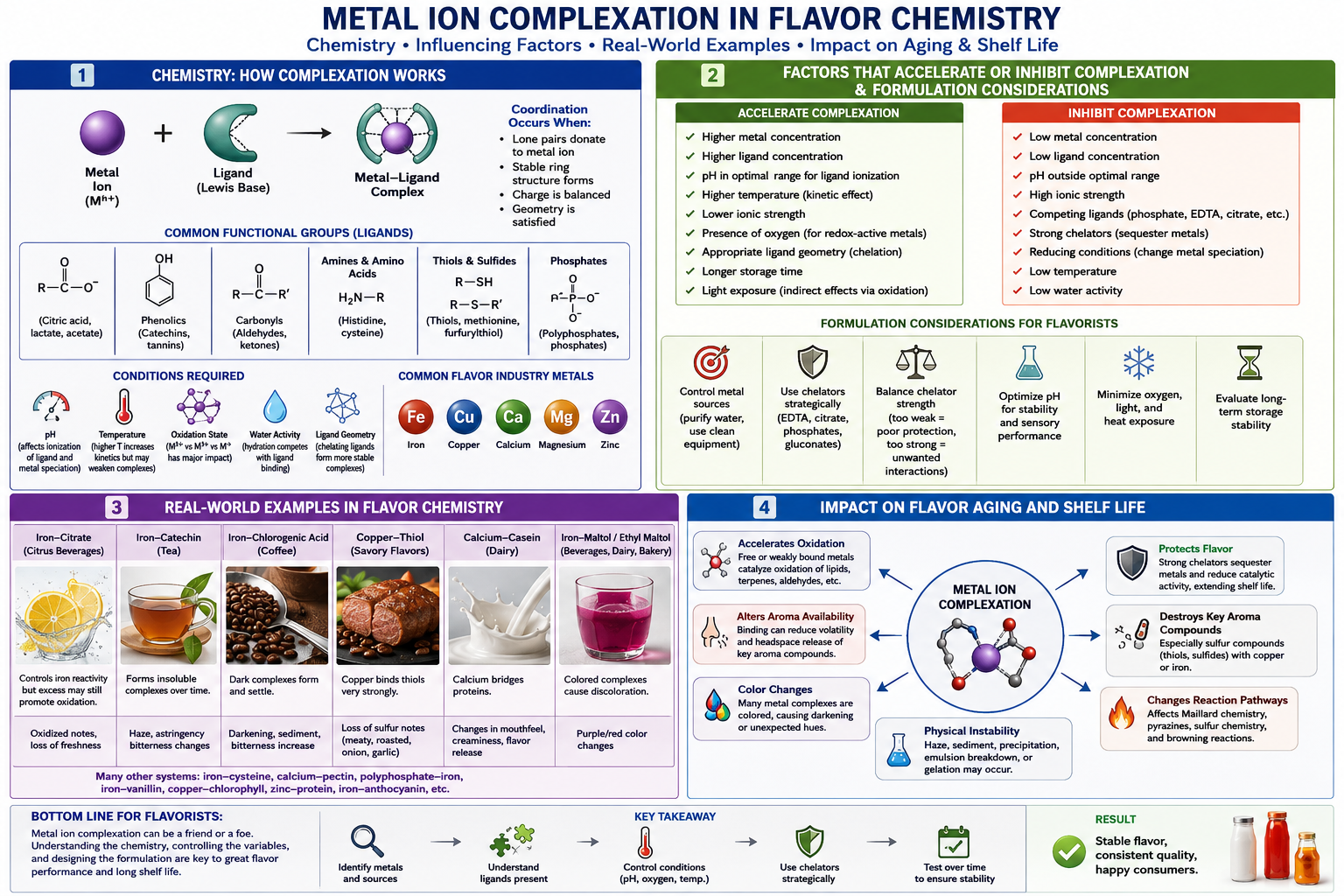
Metal ion complexation is among the dozens of chemical reactions and physical processes related to flavors that the Society of Flavor Chemists requires certified flavorists to understand and consider when formulating flavors. Below is what certified flavorists need to know about metal ion complexation.
Metal Ion Complexation in Flavor Chemistry
Chemical principles, accelerating and inhibiting factors, real-world flavor examples, and the impact of metal complexation on flavor aging, stability, and shelf life.
Table of Contents
Part 1. Chemical Groups Involved and Conditions Required
Metal ion complexation, also called coordination, chelation, or metal binding, influences flavor stability, oxidation rate, color, shelf life, off-note formation, aroma retention, and ingredient functionality.
Fundamental Mechanism
A metal complex forms when a metal ion such as \(Fe^{2+}\), \(Fe^{3+}\), \(Cu^{2+}\), \(Zn^{2+}\), \(Ca^{2+}\), \(Mg^{2+}\), \(Mn^{2+}\), or \(Al^{3+}\) accepts electron pairs from surrounding molecules called ligands.
A metal ion acts as a Lewis acid, while the ligand acts as a Lewis base.
In this example, \(RCOO^-\) is a carboxylate group. The metal-ligand bond is stronger than ordinary ionic attraction because electron pairs are donated directly to the metal.
Major Chemical Groups Capable of Complexation
1. Carboxyl Groups \( -COOH \)
Carboxyl groups are among the most common metal-binding groups in foods. After deprotonation, the carboxylate oxygen strongly coordinates metals.
Common compounds: citric acid, malic acid, tartaric acid, lactic acid, succinic acid, and gluconic acid.
Metals bound: calcium, magnesium, iron, copper, and zinc.
2. Phenolic Hydroxyl Groups \( -OH \)
Polyphenols are excellent metal chelators. Important examples include catechol structures, guaiacol, eugenol, tannins, catechins, and gallic acid. Adjacent hydroxyl groups can simultaneously bind the same metal, forming strong chelates.
Metals bound: \(Fe^{3+}\), \(Cu^{2+}\), and \(Al^{3+}\).
3. Carbonyl Groups \( C=O \)
Ketones and aldehydes can coordinate metals. Simple aldehydes bind weakly, while alpha-dicarbonyls and molecules with additional donor groups bind more strongly.
Examples: vanillin, ethyl vanillin, maltol, ethyl maltol, acetylpyrazine, diacetyl, glyoxal, and methylglyoxal.
4. β-Dicarbonyl Systems
β-Dicarbonyl systems are strong food ligands because they form stable chelate rings.
Examples: curcumin, acetylacetone-like structures, and certain Maillard intermediates.
Metals bound: \(Fe^{3+}\), \(Cu^{2+}\), and \(Al^{3+}\).
5. Amino Groups \( -NH_2 \)
Amino groups coordinate metals through nitrogen lone pairs. Amino acids, peptides, proteins, and ammonia-derived flavor intermediates may all participate.
Strong examples: histidine, lysine, and arginine.
6. Imidazole Rings
Histidine’s imidazole ring contains nitrogen donor atoms and is especially important in meat systems, protein hydrolysates, and yeast extracts.
Metals bound: \(Cu^{2+}\), \(Zn^{2+}\), and \(Fe^{2+}\).
7. Sulfur Groups
Sulfur groups are extremely strong metal-binding sites. Their interactions with copper and iron can strongly alter roasted, meaty, onion, garlic, coffee, and sulfurous notes.
Examples: methanethiol, furfurylthiol, cysteine, sulfides, and disulfides.
Metals bound: \(Cu^{2+}\), \(Hg^{2+}\), \(Ag^+\), and \(Fe^{2+}\).
8. Phosphate Groups
Phosphates, polyphosphates, phospholipids, and biological molecules such as ATP can bind calcium, magnesium, and iron. Sodium hexametaphosphate can sequester iron and calcium in food and beverage systems.
9. Hydroxamate Groups
Hydroxamate groups are less common in ordinary flavor systems but strongly bind ferric iron.
10. Multiple Functional Group Systems
The strongest food chelators usually contain several coordinating groups. Citric acid contains three carboxyl groups plus one hydroxyl group. EDTA contains four carboxyl groups plus two amino groups.
Conditions Required for Complexation
1. Available Metal Ions
Common food-related metals include iron, copper, zinc, manganese, calcium, and magnesium. Sources include raw materials, water, equipment, processing lines, and packaging.
2. Suitable pH
Most ligands bind metals more strongly after deprotonation.
| pH Range | General Complexation Tendency |
|---|---|
| 2–3 | Weak, because many ligands remain protonated. |
| 4–6 | Moderate, as more donor groups become available. |
| 6–8 | Strong, especially for carboxylates, phosphates, amino groups, and polyphenols. |
| >8 | Very strong, although precipitation or instability may also occur. |
3. Proper Ligand Geometry
Chelation is strongest when multiple donor atoms can simultaneously contact the same metal. Citrate, EDTA, and catechol-type polyphenols are much stronger than simple monodentate ligands.
4. Metal Oxidation State
\(Fe^{3+}\) usually binds more strongly than \(Fe^{2+}\), and \(Cu^{2+}\) often complexes more strongly than \(Cu^+\).
5. Temperature, Water Activity, and Competing Ligands
Higher temperature increases diffusion and collision frequency. High-water systems allow faster complexation than low-moisture powders. Competing ligands such as citrate, phosphate, polyphenols, proteins, and added chelators may all compete for the same metal ion.
Part 2. Factors Accelerating or Inhibiting the Process and Formulation Considerations
Complexation behavior depends on metal level, ligand level, pH, temperature, water activity, oxidation state, competing ligands, processing conditions, and storage time.
Factors Accelerating Metal Ion Complexation
1. Higher Metal Concentration
As metal concentration increases, ligand-metal encounters increase. Iron and copper are especially important because they can form complexes and catalyze oxidative flavor aging.
Sources: water, fruit concentrates, botanical extracts, processing equipment, tanks, piping, packaging, and mineral fortification systems.
2. Increased Ligand Concentration
More ligand usually means faster complex formation and greater metal-binding capacity. Important ligands include organic acids, polyphenols, proteins, peptides, amino acids, phosphates, and sulfur compounds.
3. Favorable pH
Many ligands bind metals after deprotonation.
4. Elevated Temperature
Higher temperature increases molecular motion and diffusion, accelerating complex formation during blending, pasteurization, UHT processing, retorting, cooking, or hot-fill operations.
5. Greater Water Activity
High-moisture products such as beverages, dairy drinks, sauces, broths, dressings, and syrups allow faster metal-ligand interactions.
6. Multidentate Ligands
Acetic acid behaves mainly as a simple monodentate ligand.
Citric acid has several oxygen donor sites.
EDTA has multiple carboxylate and amine donor sites.
7. Metal Oxidation State
8. Polyphenols and Storage Time
Catechins, tannins, chlorogenic acid, gallic acid, and anthocyanin-related structures can bind metals strongly. Many products appear stable immediately after production but develop haze, sediment, darkening, bitterness, or flavor dulling after weeks or months.
Factors Inhibiting Metal Ion Complexation
1. Very Low pH
Strongly acidic conditions protonate many ligand groups, reducing their ability to bind metals.
2. Competitive Chelators
Stronger ligands such as EDTA, citrate, polyphosphates, and gluconates can prevent weaker ligands from binding metals.
3. Metal Precipitation
If a metal precipitates, dissolved concentration decreases, making it less available for soluble flavor-ligand complexation.
4. Low Moisture, Encapsulation, and Low-Metal Processing
Dry systems have reduced molecular mobility. Encapsulation physically separates metals from sensitive ligands or aroma compounds. Deionized water, low-metal raw materials, and avoidance of reactive metal contact surfaces help prevent problems.
5. Antioxidant Systems
Antioxidants may reduce downstream oxidation, but ascorbic acid can become pro-oxidant in the presence of iron or copper under some conditions.
Critical Formulation Considerations
| Source | Likely Metals | Possible Flavor Impact |
|---|---|---|
| Water | Fe, Cu, Mn, Ca, Mg | Oxidation, haze, mineral taste, terpene loss. |
| Equipment | Fe, Ni, Cr, Cu | Metal-catalyzed oxidation, sulfur loss. |
| Packaging | Fe, Al | Color shift, oxidation, metallic notes. |
| Vitamins/minerals | Fe, Zn, Ca, Mg | Complexation, nutrition-flavor interaction. |
| Natural extracts | Fe, Cu, Mn | Polyphenol complexes, darkening, sediment. |
Promotes lipid oxidation, sulfur degradation, color changes, and metallic notes.
Extremely active oxidation catalyst, especially damaging to thiols and sulfur notes.
Affects protein interactions, pectin gelation, emulsion behavior, cloud stability, and mouthfeel.
Can alter protein, peptide, and yeast-extract interactions.
Match Chelator Strength to Application
| Control Level | Typical Chelators | Common Uses |
|---|---|---|
| Mild | Citric acid, malic acid, gluconic acid | Beverages, fruit systems, mild oxidation control. |
| Moderate | Phosphates, polyphosphates | Dairy, meat, seafood, sauces, emulsion systems. |
| Strong | EDTA | High-risk oxidation systems, dressings, beverages, sauces. |
Successful flavor systems are not necessarily those with the least metal content. They are systems where metal ion activity is intentionally controlled.
Part 3. Examples Encountered in Flavor Chemistry
Metal complexation is often first noticed as flavor fade, sulfur loss, discoloration, haze, sediment, darkening, or oxidative off-note formation.
Real-World Examples
Example 1: Iron-Citrate Complexes in Citrus Beverages
Metal: \(Fe^{2+}\), \(Fe^{3+}\)Ligand: citrateSystem: citrus beverage
Citric acid rapidly binds iron. Low levels may reduce free iron activity, while excessive iron can still promote citrus oxidation, top-note loss, oxidized peel character, and flavor flattening.
Example 2: Iron-Catechin Complexes in Tea
Metal: \(Fe^{3+}\)Ligands: catechinsSystem: tea beverage
Tea catechins such as EGCG, ECG, and EGC bind iron strongly. The result may be haze, sediment, darkening, bitterness shift, and dull flavor.
Example 3: Iron-Chlorogenic Acid Complexes in Coffee
Metal: \(Fe^{3+}\)Ligand: chlorogenic acidsSystem: coffee concentrate
Iron can form dark complexes with coffee chlorogenic acids, causing darkening, sediment, harshness, bitterness, and aged coffee character.
Example 4: Copper-Thiol Complexes in Savory Flavors
Metal: \(Cu^{2+}\)Ligands: thiolsSystem: savory, coffee, meat, onion, garlic
Copper binds sulfur compounds strongly, causing loss of roasted, meaty, onion, garlic, coffee, and sulfur impact.
Example 5: Iron-Cysteine Complexes in Meat Flavors
Cysteine participates in Maillard chemistry and sulfur aroma generation. Iron binding changes cysteine reactivity and can alter meaty character, sulfur intensity, roasted profile, and metallic notes.
Example 6: Copper-Methional Interaction
Methional gives cooked-potato and cooked-vegetable aroma. Copper can accelerate degradation or reduce sensory availability, weakening potato and savory depth.
Example 7: Calcium-Casein Complexes in Dairy
\(Ca^{2+}\) can bridge casein proteins and influence protein network structure, affecting creaminess, body, emulsion behavior, and aroma release.
Example 8: Calcium-Pectin Complexes
\(Ca^{2+}\) cross-links pectin, increasing viscosity or forming gels. Flavor may be present analytically but less available sensorially because it is trapped in the matrix.
Example 9: Iron-Vanillin Complexes
Vanillin contains phenolic and carbonyl functionality that may interact with metals. Iron contamination can affect color, oxidation stability, and vanilla freshness.
Example 10: Iron-Ethyl Maltol and Iron-Maltol Complexes
\(Fe^{3+}\) can bind maltol or ethyl maltol, creating pink, red, or purple discoloration in sweet brown, caramel, vanilla, dairy, and bakery systems.
Example 11: Polyphosphate-Iron Complexes
Polyphosphates such as sodium tripolyphosphate and sodium hexametaphosphate can sequester iron, reducing lipid oxidation, rancidity, warmed-over flavor, and shelf-life deterioration.
Example 12: Iron-Anthocyanin Complexes
Anthocyanins can interact with iron and other metals, leading to color shifts or dulling in berry, grape, botanical, and natural color beverage systems.
Example 13: Zinc-Protein Complexes in Yeast Extracts
Zinc can interact with proteins, peptides, and amino acids in yeast extracts, altering umami perception, mouthfeel, and savory balance.
Example 14: Copper-Chlorophyll Complexes
Copper can form stable green complexes with chlorophyll-related structures. This can improve perceived color stability, but copper may also catalyze oxidation.
Example 15: Iron-Lipid Oxidation Catalyst Complexes
Iron may be complexed but still catalytically active, promoting lipid oxidation and generating aldehydic, fatty, rancid, cardboard, metallic, painty, or fishy off-notes.
Examples Most Frequently Encountered by Flavorists
| Rank | Complex | Typical Problem | Common Product Area |
|---|---|---|---|
| 1 | Iron-citrate | Citrus oxidation and top-note loss. | Citrus beverages, sports drinks, fruit drinks. |
| 2 | Iron-catechin | Tea haze, darkening, bitterness shift. | Tea beverages and tea concentrates. |
| 3 | Iron-chlorogenic acid | Coffee darkening, sediment, harshness. | Coffee concentrates, RTD coffee, cold brew. |
| 4 | Copper-thiol | Sulfur aroma loss and roasted-note collapse. | Meat, coffee, onion, garlic, savory reaction flavors. |
| 5 | Iron-cysteine | Meat flavor instability and sulfur profile shift. | Chicken, beef, broth, gravy flavors. |
| 6 | Iron-maltol | Purple or red discoloration. | Caramel, dairy, vanilla, bakery flavors. |
| 7 | Iron-ethyl maltol | Pink, red, or purple discoloration. | Sweet brown, vanilla, dairy, caramel systems. |
| 8 | Calcium-casein | Flavor release and texture changes. | Dairy beverages, yogurt, cheese. |
| 9 | Calcium-pectin | Flavor trapping, viscosity increase, gel particles. | Fruit preparations and fruit beverages. |
| 10 | Polyphosphate-iron | Oxidation control. | Processed meats, seafood, savory systems. |
Part 4. Impact on Flavor Aging and Shelf Life
Metal ion complexation can either protect a flavor system or accelerate deterioration depending on the metal, ligand, pH, oxygen level, and storage conditions.
1. Acceleration of Oxidation
Free or weakly bound iron and copper can catalyze oxidation throughout shelf life. This is important in citrus oils, terpenes, aldehydes, unsaturated lipids, sulfur compounds, dairy fat notes, coffee, tea, and meat flavors.
Typical Aging Symptoms
- Fresh top notes disappear.
- Citrus notes become dull.
- Sulfur notes collapse.
- Rancid, metallic, cardboard, or painty notes appear.
- Color darkens.
- Haze or sediment appears.
2. Protection Through Metal Sequestration
Strong chelators can bind metals and reduce catalytic activity. Examples include citric acid, polyphosphates, EDTA, gluconates, polyphenols, amino acids, and peptides.
When metals are tightly bound into stable, non-reactive complexes, oxidation rates can decrease and shelf life can improve.
- Improved citrus oil stability.
- Reduced rancidity.
- Improved sulfur retention.
- Better color stability.
- Reduced metallic taste.
- Lower oxidative browning.
3. Weak Complexes Can Make Aging Worse
Some iron complexes remain soluble and redox-active. A weak iron-organic acid complex may keep iron mobile throughout the product, allowing repeated oxidation cycles. Outcome depends on metal concentration, oxygen, storage temperature, pH, ligand strength, and antioxidant system.
4. Direct Binding of Aroma Compounds
Metal ions can bind aroma compounds directly, reducing volatility and aroma release. Affected classes include thiols, sulfides, aldehydes, phenolics, maltol, ethyl maltol, vanillin, pyrazines, and some lactones.
A roasted coffee flavor may lose its signature impact because copper has bound or destroyed key sulfur compounds even though the rest of the formula remains unchanged.
5. Color Changes During Aging
| Complex | Observed Color Change |
|---|---|
| Iron + maltol | Red-purple coloration. |
| Iron + ethyl maltol | Pink to red-purple. |
| Iron + polyphenols | Darkening and browning. |
| Iron + anthocyanins | Blue-gray or dull shifts. |
| Copper + chlorophyll | Stable green coloration. |
6. Haze, Sediment, and Precipitation
Some metal complexes become insoluble during storage, producing tea haze, coffee sediment, wine precipitation, fruit beverage particles, and dairy instability. Many products pass initial QC but fail later because precipitation develops slowly.
7. Influence on Maillard and Reaction Flavor Aging
Metals influence Maillard-derived aroma stability by interacting with cysteine-derived sulfur compounds, methionine derivatives, pyrazines, thiazoles, dicarbonyl intermediates, and peptides.
- Loss of meaty sulfur notes.
- Shift toward burnt character.
- Accelerated browning.
- Increased metallic aftertaste.
- Reduced roast authenticity.
8. Sweet Brown Flavor Deterioration
Maltol, ethyl maltol, vanillin, and related sweet-brown compounds may interact with metals, causing color shifts, reduced sweetness perception, duller creamy notes, increased bitterness, and greater metallic character.
9. Changes in Emulsion and Cloud Stability
Metal ions can interact with hydrocolloids, proteins, gums, and emulsifiers. Calcium and magnesium are particularly important.
These ions may interact with pectin, alginate, casein, whey protein, modified starch, and gum arabic.
Shelf-life consequences include cloud-ring formation, sediment, creaming, viscosity increase, reduced flavor release, and mouthfeel changes.
10. Interference with Antioxidants
Some antioxidants behave differently in the presence of metals. Ascorbic acid can reduce metal ions and support redox cycling in systems containing iron or copper.
Under certain conditions, ascorbic acid may become pro-oxidant rather than antioxidant.
Practical Shelf-Life Consequences
| Failure Type | Typical Result |
|---|---|
| Aroma failure | Loss of fresh, sulfur, citrus, roasted, fruity, or dairy notes. |
| Off-note formation | Metallic, cardboard, rancid, painty, bitter, or harsh notes. |
| Color failure | Darkening, pinking, browning, graying, purple discoloration. |
| Physical failure | Haze, sediment, precipitation, emulsion instability. |
| Performance failure | Reduced flavor release, sweetness, mouthfeel, or top-note impact. |
What Flavorists Should Monitor During Aging Studies
- Iron and copper levels.
- Water quality.
- pH drift.
- Headspace oxygen.
- Package oxygen transmission.
- Storage temperature.
- Light exposure.
- Chelator concentration.
- Antioxidant behavior.
- Color changes.
- Haze and sediment development.
- Sulfur compound retention.
- Terpene oxidation markers.
- Aldehyde stability.
- Metallic aftertaste development.
Metal complexation improves shelf life when metals are locked into stable, non-reactive forms. It shortens shelf life when metals remain soluble, redox-active, mobile, or capable of binding key aroma molecules.
The critical question is not simply:
but rather: