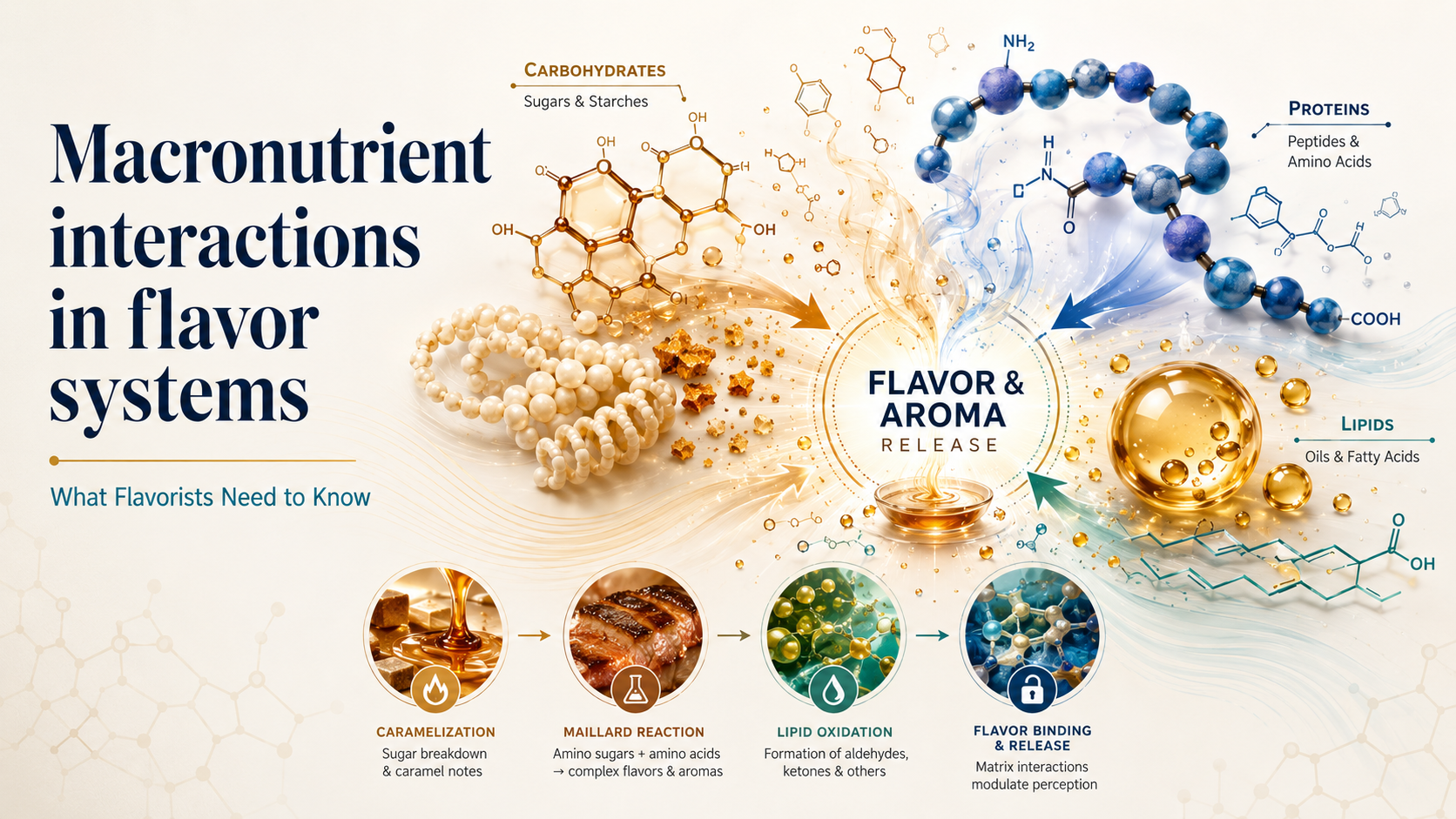
Macronutrient interactions in flavor systems: What Flavorists Need to Know
The Society of Flavor Chemists requires certified flavorists to demonstrate a thorough understanding of macronutrient interactions, including the ability to:
"discuss in detail about the following: Chemical groups involved and conditions required;
Factors accelerating or inhibiting the process, and what to consider during flavor formulation;
Examples of the process/reaction;
Understanding how the process/reaction impacts aging of a flavor and shelf life. this is for a flavorist training program. so include all relevant content about these topics."
Below is some reference material not only for flavorists, but also flavor application scientists, food scientists, and technologists.
Flavorist training program — comprehensive guide
What are macronutrient interactions?
Macronutrients — carbohydrates, proteins, and lipids — are not passive flavor carriers. They are reactive chemical systems that generate, bind, release, modify, and destroy flavor-active compounds continuously from the moment of formulation through the end of shelf life. Understanding how these three macronutrient classes interact with each other and with flavor molecules is foundational knowledge for any flavorist. The chemistry covered here governs browning, rancidity, flavor release, flavor retention, off-note formation, and the trajectory of every flavor over time.
I. Chemical groups involved and conditions required
1. The Maillard reaction — carbohydrates and proteins / amines
The Maillard reaction is the single most important flavor-generating reaction in food science. It proceeds between a free carbonyl group (typically from a reducing sugar) and a free amine (typically the epsilon-amino group of lysine, or the alpha-amino group of free amino acids, peptides, and ammonium salts).
The carbonyl donors relevant to macronutrient interactions include all reducing sugars: glucose, fructose, lactose, maltose, ribose, xylose, and arabinose. Ribose and xylose are considerably more reactive than glucose because their open-chain (aldehyde) form is more prevalent in equilibrium. Non-reducing sugars (sucrose, trehalose) are inert until hydrolyzed to their reducing monosaccharides by acid or invertase.
The amine donors include free lysine residues in proteins, free amino acids released by proteolysis, ammonia from amino acid degradation, phosphatidylethanolamine headgroups on phospholipids (creating a rare carbohydrate–lipid Maillard pathway), glucosamine from glycoproteins, and taurine, creatine, and other nitrogenous muscle components.
The reaction pathway proceeds through three mechanistically distinct stages. In the initial stage, the reducing sugar condenses with the amine to form a glycosylamine (Schiff base), which rearranges through the Amadori rearrangement (for aldoses) or the Heyns rearrangement (for ketoses) to form stable but colorless ketoamines. These Amadori products are the precursors to all subsequent flavor and color development. In the intermediate stage, Amadori products dehydrate and fragment to produce highly reactive alpha-dicarbonyls: 3-deoxyosones, 1-deoxyosones, methylglyoxal, diacetyl, glyoxal, and glucosone. These intermediate compounds are themselves flavor-active (diacetyl is intensely buttery at low ppb) and are key branch points leading to different product families. In the advanced stage, these dicarbonyl compounds undergo further condensation, cyclization, fragmentation, and polymerization to produce: pyrazines (roasted, nutty, earthy), furans (caramel, sweet, ethereal), furanones (sweet, caramel, meaty — particularly HEMF and HDMF), thiophenes and thienothiazoles (when sulfur amino acids are present), pyrroles (burnt, nutty), oxazoles and thiazoles, and high-molecular-weight melanoidin polymers (brown pigments with antioxidant properties).
Conditions required: Maillard chemistry initiates detectable flavor formation at about 50°C in solution; it becomes the dominant flavor-generating reaction above 100°C. In dry systems (spray-dried flavors, baked goods, snack seasonings), significant Maillard chemistry occurs at room temperature when water activity sits between 0.4 and 0.8. The reaction requires the presence of both reactants in mobile form — below Aw 0.2, molecular mobility is too restricted; above Aw 0.9, reactants are too dilute. pH strongly modulates the reaction: alkaline conditions (pH > 7) accelerate condensation, Amadori rearrangement, and melanoidin formation; acidic conditions (pH < 4) retard browning but can favor acid-catalyzed fragmentation products such as furfural, 5-hydroxymethylfurfural (HMF), and levulinic acid.
2. Caramelisation and pyrolysis of carbohydrates
Caramelisation is the thermal degradation of carbohydrates in the absence of amino compounds. While it is often conflated with the Maillard reaction, it is chemically distinct: no nitrogen is involved, and the products differ systematically. Caramelisation requires higher temperatures: sucrose begins caramelising visibly above 160°C; glucose and fructose above 150°C; lactose above 170°C.
The chemistry involves enolization, dehydration (loss of water from hydroxyl groups), intramolecular cyclization, glycosidic bond cleavage, retro-aldol fragmentation, and polymerization. Key flavor compounds produced include: furans (furfural, 5-methylfurfural, HMF — caramel, sweet, almond), furanones (gamma-butyrolactone, delta-valerolactone — coconut, buttery), pyranones (maltol, ethyl maltol — caramel, jam, sweet), diacetyl and acetoin (butter, cream), and at high temperatures and long times, acrylamide (from asparagine + reducing sugars — a food safety concern rather than a flavor compound).
Pyrolysis refers to the thermal decomposition of macromolecules under dry-heat conditions at very high temperatures (above 200°C). Under pyrolysis conditions, carbohydrates yield a complex mixture of furans, pyrans, lactones, phenolics (including guaiacol, catechol, and cresols from pectin/hemicellulose demethylation), and aliphatic aldehydes. Proteins pyrolyze to pyrazines, pyridines, imidazoles, sulfur heterocyclics, and indole. Lipids under high-heat pyrolysis generate acrolein, ketones, lactones, and cyclic structures (cyclopentanone, cyclohexanone). In a controlled process flavor context (reaction flavor manufacturing), this distinction between caramelisation, Maillard, and pyrolysis is critical because the temperature, time, and water activity profile of the reaction dictates which pathway dominates and which flavor profile results.
3. Lipid oxidation
Lipid oxidation is the most commercially significant source of off-notes and shelf-life failure in fatty flavor systems and emulsions. It proceeds through a free-radical chain mechanism with three classical phases.
The initiation phase requires the generation of a primary lipid radical. This can occur through thermal homolysis (elevated temperatures), photocatalysis (light + singlet oxygen sensitized by chlorophyll, riboflavin, or myoglobin), enzymatic action (lipoxygenase acting on polyunsaturated fatty acids), or metal-catalyzed decomposition of trace hydroperoxides via Fenton chemistry. The rate-limiting step is abstraction of a bis-allylic hydrogen from polyunsaturated fatty acids (PUFAs) — linoleic acid (18:2), linolenic acid (18:3), arachidonic acid (20:4), EPA (20:5), and DHA (22:6) are progressively more oxidizable, with relative rates approximately 1:10:40:80:120 compared to oleic acid (18:1).
The propagation phase involves the conjugated diene rearrangement of the carbon-centered lipid radical, followed by molecular oxygen addition to form a lipid peroxyl radical, followed by hydrogen abstraction from an adjacent lipid molecule to form a lipid hydroperoxide (primary oxidation product) and a new carbon-centered radical. This chain reaction can propagate thousands of cycles before termination. Lipid hydroperoxides are odorless and tasteless but are the reservoir from which all secondary oxidation products (the actual flavor compounds) are generated.
The termination phase occurs when two radicals combine: peroxyl + peroxyl, peroxyl + alkyl, or alkyl + alkyl. Termination produces non-radical products including dimers, polymers, and epoxides.
Secondary oxidation products are generated by homolytic or acid-catalyzed decomposition of hydroperoxides, producing a complex mixture that depends on the fatty acid composition of the substrate. From linoleic acid (18:2 n-6), the dominant products are hexanal (painty, green, grassy — detection threshold ~5 ppb), 2,4-decadienal (deep-fried, fatty), and 2-nonenal (cardboard, stale — threshold ~0.08 ppb). From linolenic acid (18:3 n-3), propanal (pungent), (Z)-3-hexenal (green, leafy), and 1-penten-3-ol (mushroom, metallic) predominate. From oleic acid (18:1 n-9), nonanal (waxy, fatty, rose-like), 2-decenal, and octanal accumulate. The specific signature of lipid oxidation in a flavor product is therefore diagnostic of the fatty acid profile of the carrier oil or fat — a palm oil carrier produces different off-notes than a fish oil or flaxseed oil carrier.
Conditions required: Lipid oxidation rate is governed primarily by the concentration of peroxyl radicals and their propagation rate. This is modulated by: oxygen partial pressure (rate is first-order in O₂ at low concentrations but becomes independent at high concentrations), temperature (activation energy of propagation ~80–100 kJ/mol, so rate doubles roughly every 10°C), presence of transition metals (iron and copper at ppb levels are catalytic), and exposure to light (UV and visible radiation through photosensitizers). The notable paradox is that lipid oxidation accelerates at very low water activity (Aw < 0.2) because the protective water monolayer around lipid-water interfaces is absent, exposing lipid headgroups to metal catalysts and oxygen directly.
4. Protein–lipid interactions and flavor binding
Proteins interact with lipids through hydrophobic, electrostatic, and covalent mechanisms, each with different implications for flavor retention, release, and off-note development.
Hydrophobic binding occurs between non-polar lipid acyl chains and hydrophobic amino acid residues (leucine, isoleucine, valine, phenylalanine, tryptophan) buried within globular protein structures. This is the dominant mechanism of flavor binding in protein matrices: volatile flavor compounds (particularly carbonyl compounds, esters, and terpenes) partition into hydrophobic protein domains and are released slowly upon digestion or thermal denaturation. Beta-lactoglobulin (in whey) has a hydrophobic binding pocket that specifically binds medium-chain fatty acids, retinol, and many flavor compounds. Zein, gluten, and soy protein also bind hydrophobic flavor molecules extensively.
Electrostatic binding involves charged residues (lysine, arginine, histidine as cationic centers; aspartate and glutamate as anionic centers) attracting polar lipid headgroups (phosphatidylserine, phosphatidylethanolamine, free fatty acids). At pH below the protein's isoelectric point, net positive surface charge favors binding to anionic fatty acid anions. This is particularly relevant in emulsification: the protein–lipid interface is stabilized by both electrostatic and hydrophobic forces, and changes in pH or ionic strength alter this balance with direct consequences for emulsion stability and flavor release rate.
Covalent protein–lipid adducts form through oxidative mechanisms. Secondary lipid oxidation products — particularly alpha,beta-unsaturated carbonyl compounds (4-hydroxynonenal, 4-oxononenal, acrolein, malondialdehyde) — react with protein nucleophilic residues through Michael addition (cysteine, histidine, lysine) and Schiff base formation (primary amines of lysine and N-terminal amino groups). These covalent adducts: reduce the available lysine for Maillard reaction, alter protein conformation and solubility, produce measurable off-notes (aldehyde character fused into protein matrix), and generate cross-linked protein polymers that alter texture. This oxidative protein modification is the dominant chemistry of protein-oxidation damage in stored meat flavors, dairy powders, and protein-fortified functional beverages.
Protein denaturation strongly modulates all of the above. Native globular proteins have buried hydrophobic pockets that bind flavor compounds tightly. Upon thermal denaturation, unfolding exposes hydrophobic residues and releases bound volatiles — this is a major source of the "burst" of aroma during cooking, baking, and extrusion. Aggregation of denatured proteins can re-trap volatiles or exclude them depending on the specific aggregation mechanism (disulfide bonding versus hydrophobic aggregation).
5. Starch, polysaccharides, and flavor binding/release
Starch — both amylose (linear alpha-1,4 glucan) and amylopectin (branched alpha-1,4/alpha-1,6 glucan) — interacts with flavor compounds through inclusion complexation, surface adsorption, and moisture-mediated partitioning.
Amylose inclusion complexes are the most important mechanism: the amylose helix (6-8 glucose units per turn, internal diameter ~4–5 Å) can accommodate linear aliphatic molecules of appropriate chain length within its hydrophobic interior. The guest molecule is stabilized by van der Waals interactions with the glucopyranose CH groups lining the channel interior. Guest molecules that form stable complexes include fatty acids (C12–C18), their methyl esters, some alcohols and esters with suitable chain geometry, aroma compounds with linear hydrocarbon chains (nonanal, decanal, 1-naphthol, ibuprofen), and iodine (the classical blue starch-iodine complex). The inclusion complex forms most readily during gelatinisation and retrogradation: when starch granules are heated in water above the gelatinisation temperature, amylose leaches out and is free to adopt its helical conformation around available guest molecules. As the system cools and amylose retrogrades (crystallises), the complexes become thermally stable and resistant to amylase digestion.
The practical consequence for flavourists is that aroma compounds present during starch gelatinisation can be partially or completely entrapped, reducing their perceived intensity and altering their release profile. Conversely, retrograded starch acts as a slow-release flavor reservoir in baked and cereal-based applications.
Other polysaccharides interact with flavor compounds primarily through surface adsorption (pectin, guar gum, xanthan) and through their influence on the aqueous phase viscosity, which reduces diffusion rates of volatile compounds and slows their release from the food matrix into the headspace. This effect is independent of direct chemical binding but dramatically alters sensory perception of flavor intensity and temporal profile.
Conditions required for polysaccharide-flavor interactions: Starch inclusion complex formation requires temperatures above gelatinization (typically 60–90°C for most starches), liquid water, and an appropriate guest molecule. Retrograded amylose complexes are stable up to ~100°C and begin to dissociate at higher temperatures. Viscosity effects from hydrocolloids are maximal at low temperature and shear; they diminish as temperature or shear rate increases.
II. Factors accelerating or inhibiting reactions, and flavor formulation considerations
Factors accelerating macronutrient interactions
Temperature is the primary accelerant for all macronutrient-based reactions. The Maillard reaction rate increases exponentially with temperature above 50°C, with activation energies of 100–160 kJ/mol for browning and pyrazine formation. Lipid oxidation propagation accelerates with a Q₁₀ of approximately 2 (doubles per 10°C rise), but the induction period decreases more dramatically than this — small temperature differences compound into large shelf-life differences over months. Caramelisation requires temperatures above 150°C and is essentially irrelevant in ambient-temperature systems. Protein denaturation is highly temperature-dependent; each protein has a characteristic melting temperature (Tm) above which rapid unfolding and aggregation occur.
Oxygen availability profoundly affects both lipid oxidation and, indirectly, Maillard product profiles. In aerobic systems, oxidized intermediates (alpha-dicarbonyls from ascorbate and lipid oxidation) contribute additional carbonyl partners for amine condensation, accelerating browning beyond what reducing sugars alone would produce. Eliminating oxygen reduces not only lipid oxidation but also secondary carbonyl-driven Maillard browning.
Water activity modulates molecular mobility and reactant concentration simultaneously. The Maillard reaction peaks between Aw 0.5 and 0.8, where both mobility and concentration are favorable. Lipid oxidation, as noted above, paradoxically accelerates at very low Aw. Enzymatic hydrolysis (proteases, lipases) requires liquid water and is generally inactive below Aw 0.9.
Reducing sugar type controls Maillard reaction rate and product profile dramatically. Pentose sugars (ribose, xylose, arabinose) react 10–100× faster than hexoses (glucose, galactose, fructose) under equivalent conditions. Lactose reacts slowly, but its partial hydrolysis (through lactase or heat) releases rapidly reactive galactose and glucose. Glycation of proteins with ribose generates predominantly pyrazines and imidazoles; with glucose, furanones and melanoidins dominate; with xylose, a different furan and lactone profile emerges. Flavorists designing reaction flavors have precise control over the product profile by selecting the sugar species.
Amino acid composition of protein hydrolysates determines the specific Maillard product families generated upon thermal treatment. Cysteine and methionine yield thiophenes, thienothiazoles, and polysulfides — the sulfur character of meat and garlic flavors. Proline yields pyrroles and their conjugated products. Glycine and alanine produce pyrazines and furanones. Lysine is the preferred substrate for browning (fastest reaction, clearest product) and its availability in a protein depends on prior processing history — heat-damaged proteins with blocked lysine residues react more slowly.
pH is often underestimated as a practical tool. Raising pH from 6 to 7.5 in a process flavor reaction can triple the browning rate and shift the pyrazine/furan ratio dramatically. In a finished product, acidification to pH 3.5–4.0 can extend Maillard stability considerably. Buffer selection also matters: phosphate buffers at moderate concentration can act as mild catalysts for Maillard browning through their ability to donate and accept protons at the transition state.
Enzymes — particularly proteases, lipases, and amylases — accelerate macronutrient degradation and thereby expand the pool of reactive substrates. Residual protease activity in a yeast extract or meat hydrolysate continues liberating free amino acids over time, progressively feeding the Maillard reaction during storage. Residual lipase activity in dairy-derived carriers can produce free fatty acids from triglycerides, raising the free fatty acid pool available for beta-oxidation off-notes and rancid character. Controlling enzyme inactivation through sufficient heat treatment is critical in any flavor system derived from biological raw materials.
Metal contamination at trace levels (iron from process equipment, copper from pipes and heat exchangers) catalyzes both lipid oxidation (via Fenton/Haber-Weiss chemistry) and can affect protein oxidative modification. Even sub-ppm iron contamination can halve the effective induction period of a lipid-based flavor.
Factors inhibiting macronutrient interactions
Antioxidant systems interrupt lipid oxidation chain propagation. Tocopherols (vitamin E) are the primary chain-breaking antioxidants in lipid phases, donating hydrogen to lipid peroxyl radicals and terminating the chain. Mixed tocopherol concentrates (high in gamma- and delta-tocopherol, more thermally stable than alpha-tocopherol) are the most effective practical antioxidants for lipid flavor carriers. Rosemary extract (carnosic acid, carnosol) provides both radical-chain interruption and metal chelation. BHA (butylated hydroxyanisole) and BHT (butylated hydroxytoluene) are synthetic chain-breaking antioxidants with high efficacy but regulatory and consumer acceptance constraints. TBHQ (tert-butylhydroquinone) is highly effective for polyunsaturated systems and frying fats. Antioxidant combinations exploit synergy: tocopherol + ascorbyl palmitate (lipid-soluble vitamin C ester) regenerates tocopherol from its radical, extending the total chain-breaking capacity. The system fails once antioxidant reserves are depleted — the induction period ends abruptly and oxidation accelerates.
pH reduction slows Maillard browning very effectively below pH 5 and dramatically below pH 4. This is particularly useful in ambient-temperature systems where browning is a slow but progressive shelf-life issue. However, many finished flavor applications are pH-constrained by taste considerations, limiting this strategy.
Reducing water activity through drying or humectant addition controls Maillard browning in powder systems. Spray-drying into low-hygroscopicity carriers (modified starch, maltodextrin of appropriate DE) maintains Aw below the critical Maillard range. Desiccant sachets in packaging prevent moisture ingress that would raise Aw during storage.
Reducing sugar type substitution: replacing glucose or fructose with trehalose (a non-reducing disaccharide) eliminates Maillard reactivity while retaining the sweetness and humectant properties of the sugar. Trehalose has gained significant use in heat-processed flavors and model systems where browning must be avoided. Similarly, replacing dextrose in a spray-dry carrier with modified starch containing no free reducing sugar eliminates most ambient-temperature Maillard activity.
Sugar blocking: reactive lysine residues can be protected by prior glycation with non-flavor-affecting sugars (though this is rarely practical) or by controlling protein hydrolysis to retain peptide bonds that protect epsilon-amino groups.
Nitrogen atmosphere packaging eliminates oxygen and arrests both lipid oxidation and aerobic browning contributions. This is standard practice in lipid-based flavor manufacturing and is increasingly used for powdered flavors in laminated foil packaging with nitrogen flush.
Chelating agents (EDTA, citric acid, phytic acid, rosemary polyphenols) sequester catalytic metals and dramatically reduce the rate of both lipid oxidation initiation and protein oxidative modification.
Flavor formulation considerations
When designing a flavor that contains macronutrient-derived ingredients — yeast extract, meat hydrolysate, dairy concentrate, vegetable protein hydrolysate, or any carbohydrate carrier — the flavorist must consider the following:
What is the processing temperature history? A flavor destined for UHT or retort processing will undergo far more Maillard development during the customer's manufacturing than during the flavorist's own lab work. The flavor must be designed "ahead" of this — slightly underseasoned for the top notes that will be generated, overloaded with heat-stable base notes that won't be destroyed. A fresh herb flavor going into a retort product must include a substantially larger portion of heat-stable character compounds to survive the process and still represent the herb profile after processing.
What is the fatty acid profile of all oils and fats in the formula? Each fatty acid class produces a distinct oxidation signature. Formulas containing fish-derived ingredients, flaxseed, or walnut oils must be designed with aggressive antioxidant systems because the PUFA content (particularly EPA and DHA) is highly susceptible to oxidation and produces objectionable fishy, metallic, and painty off-notes at very low concentrations. The ratio of polyunsaturated to saturated fatty acids (P:S ratio) is a practical predictor of oxidative stability.
What are the reducing sugar and free amino acid levels in every ingredient? Yeast extracts, vegetable hydrolysates, and malt extracts all contain significant free amino acids and reducing sugars. Combining two such ingredients in a formula that will be heated creates an uncontrolled Maillard reaction that can substantially alter the intended flavor profile. Flavorists should require suppliers to declare free amino acid profiles and reducing sugar content for all biological raw materials, and should conduct heat stability testing of the complete formula at the customer's specified process conditions before sign-off.
Does the application matrix contain starch or hydrocolloids that will bind flavor compounds? For baked goods, cereals, and sauces thickened with starch, the initial flavor dosage must account for the fraction of volatile compounds that will be retained in amylose inclusion complexes and only released upon further heating or enzymatic digestion. This requires that flavor evaluation be conducted in the actual finished product matrix after the full manufacturing process, not in a simple water or oil solution.
III. Examples of macronutrient interactions in flavor systems
Example 1: Formation of meat flavor via Maillard and protein–sugar reactions
In a beef reaction flavor, the base system consists of hydrolyzed vegetable protein (HVP) or yeast extract (providing free amino acids — particularly cysteine, methionine, glycine, alanine, proline — and reducing sugars), glucose (additional carbonyl donor), and water at controlled Aw.
At 120°C and pH 6.0 over 60 minutes:
Glucose + cysteine → N-substituted Amadori compound → 3-deoxy-2-osuloses → hydrogen sulfide (from cysteine thermal decomposition) + acetaldehyde/glycolaldehyde → 2-methyl-3-furanthiol (threshold ~0.005 ppb; primary roasted meat odorant)
Ribose + cysteine → hydrogen sulfide + furans → 2-furfurylthiol (threshold ~0.01 ppb) and thienothiazole derivatives
Glucose + proline → dihydroxymethylfuranone → condensation with glycine → 2-acetylpyrroline (threshold ~0.1 ppb; "jasmine rice," "crusty bread" note found in certain meat flavors) — note this compound arises from both rice and grilled meat via different pathways but the Maillard route is operative here
Maillard melanoidins (brown polymers) → bind free thiol odorants, reducing perceived sulfur intensity and rounding the aroma profile
The resulting flavor profile — meaty, savory, sulfurous, roasted — reflects the specific amino acid composition and the temperature-time profile. A longer cook at lower temperature shifts the profile toward more caramel/furan character and less sulfur. A higher temperature for a shorter time produces more pyrazine and thiophene character (more roasted). The flavorist controls this precisely.
Example 2: Rancidity development in a spray-dried dairy flavor
A cream flavor spray-dried on a maltodextrin carrier at 4% fat load (butter oil) with no added antioxidants:
Butter oil contains predominantly saturated (palmitic, stearic) and monounsaturated (oleic) fatty acids with small but significant amounts of linoleic acid (18:2). The low PUFA content gives intrinsically good oxidative stability, but processing introduces trace iron from equipment.
At Aw 0.3 and 25°C over 6 months:
Linoleic acid + Fe²⁺/trace O₂ → linoleate hydroperoxide (13-HPODE, 9-HPODE) → homolysis → hexanal (painty, grassy, metallic — threshold ~5 ppb in water), 2,4-decadienal (deep fried, fatty)
Short-chain fatty acids from butter oil (butyric, caproic, caprylic) — which are responsible for the desirable dairy character — remain largely unchanged but are perceived against the growing oxidized background as increasingly "dirty" and rancid as hexanal accumulates.
After 6 months, the hexanal level (measurable by SPME-GC) has increased 3–5 fold from initial values; nonanal, 2-nonenal, and octanal have begun contributing waxy, cardboard, and stale notes. The overall profile has shifted from fresh cream toward stale, buttery-rancid dairy — still recognizable but clearly aged.
Intervention: addition of 200 ppm mixed tocopherols + 50 ppm ascorbyl palmitate + nitrogen flush packaging extends the induction period by 2–3× and maintains hexanal below the perceptible threshold for the target shelf life of 18 months.
Example 3: Starch inclusion complex affecting flavor delivery in a cereal seasoning
A cheese flavor designed for a baked corn snack is formulated at 0.8% on the finished product. After baking at 180°C for 4 minutes, sensory evaluation shows dramatically reduced flavor intensity compared to the predicted dosage — particularly the short-chain ester and aldehyde top notes (diacetyl, butyric acid methyl ester, acetic acid, hexanal) that define fresh cheese character.
Analysis reveals that during baking, starch gelatinisation from the corn dough releases amylose that forms inclusion complexes with the linear aliphatic flavor compounds — particularly the C6–C10 aldehydes and the medium-chain fatty acid esters. The complexes are stable at the eating temperature and release flavor only upon chewing (mechanical disruption and amylase activity in saliva), giving delayed rather than immediate top-note perception.
The solution involves reformulating to use thermally resistant character compounds (pyrazines, methyl ketones, dimethyl sulfide for processed cheese note) that are not prone to starch complexation, and increasing the dosage of top-note esters by approximately 40% to compensate for the fraction bound in complexes. Alternatively, adding some of the volatile top notes post-bake as a topical spray avoids gelatinisation entirely.
Example 4: Protein oxidation producing off-notes in a protein-fortified sports nutrition flavor
A vanilla flavor is added at 0.5% to a whey protein isolate-based ready-to-drink beverage. After 6 months at ambient temperature, consumer complaints focus on a metallic, beany, and painty off-note overlying the vanilla.
Investigation reveals:
Whey protein isolate contains trace polyunsaturated phospholipids. In the presence of trace iron from the processing water and ambient oxygen, linoleate and linolenate chains within the phospholipids undergo oxidation → generate 4-hydroxynonenal (4-HNE) and hexanal.
4-HNE + histidine residues on beta-lactoglobulin → Michael adduct (covalent protein-lipid crosslink) → permanently modified protein with reduced solubility and altered surface hydrophobicity.
Hexanal (from phospholipid oxidation) + amino groups (lysine residues, N-termini) → Strecker degradation → pentanal, butanal, Schiff base intermediates → perceivable as metallic, green, beany notes at low ppb levels.
Meanwhile, the vanilla benzaldehyde and vanillin are themselves partially oxidized in the presence of the pro-oxidant radical pool → producing benzoic acid (no vanillin note) and other phenolic degradation products, reducing the vanilla character.
Mitigation requires a multi-front approach: iron chelation with EDTA (75 ppm) or phytic acid, replacement of whey protein with a more oxidatively stable protein source or a specially processed low-phospholipid whey, nitrogen headspace in the bottle, and a higher initial vanilla dosage to compensate for oxidative loss during shelf life.
Example 5: Pyrazine formation in a coffee-type reaction flavor
A flavorist designing a coffee-type process flavor for a heat-not-burn application uses a blend of sucrose (5%), glycine (2%), and alanine (1%) in water at pH 6.5, processed at 160°C for 20 minutes in a pressure reactor.
Sucrose hydrolyzes rapidly under these conditions → glucose + fructose (invert sugar)
Glucose + glycine → Amadori product → 3-deoxy-osuloses → methylglyoxal + glycolaldehyde + formaldehyde + CO₂
Methylglyoxal + glycine → 2-methylpyrazine (nutty, roasted — threshold ~400 ppb), 2,5-dimethylpyrazine, trimethylpyrazine
2,3-Butanedione (diacetyl, formed from sugar fragmentation) + ammonium (from glycine thermal deamination) → tetramethylpyrazine (cocoa, roasted — threshold ~1000 ppb)
Simultaneously, glucose → HMF (5-hydroxymethylfurfural, caramel sweet), furfural (almond, bread), and a range of lactones and ketones
Alanine contributes strecker aldehyde (acetaldehyde) + methylglyoxal → additional pyrazine precursors, and produces 2-methylpropanal (malty, chocolate)
The pyrazine fingerprint of the resulting process flavor can be tuned by adjusting the sugar:amino acid ratio, temperature, time, and pH. Higher temperature favors trimethyl- and tetramethylpyrazine (more cocoa/roasted). Lower temperature (140°C) favors 2-methylpyrazine and 2,3-dimethylpyrazine (lighter, more toasted-nut character). Longer reaction time drives browning and melanoidin formation, which bind some volatile pyrazines back into the matrix and reduce volatile intensity.
Example 6: Caramelisation in a butterscotch flavor base
A butterscotch flavor base is produced by melting sucrose at 170°C with butter and a trace of cream. The following chemistry occurs:
Sucrose → glucose + fructose (acid-catalyzed hydrolysis at high temperature) → both monosaccharides begin caramelisation pathways independently
Fructose dehydration pathway (faster than glucose): fructose → 5-hydroxymethylfurfural → 2-furfuryl alcohol → soluble caramel polymers
Glucose pathway: glucose → isomerizes to fructose and mannose → similar dehydration but through different intermediate sequence → diacetyl, acetoin (butter-cream notes), and maltol (jam, caramel, sweet-enhancement compound)
Fatty acids from butter undergo partial thermal oxidation → butyric acid (rancid/dairy), diacetyl (butter), gamma-butyrolactone (butter, cream, sweet)
The combined product is a complex mixture of caramel polymer (color and body), maltol and ethyl maltol (caramel-sweet enhancement compounds), diacetyl and acetoin (butter-cream), and gamma-butyrolactone (creamy) — the classical butterscotch profile.
For the flavorist, the practical implication is that small changes in temperature (±5°C) and cook time dramatically shift the maltol:HMF ratio and the depth of color, requiring precise process control to achieve batch-to-batch consistency. Controlled cooling rate also matters: rapid cooling arrests the reaction at one profile; slow cooling under residual heat continues pushing toward darker, more bitter caramel character.
IV. How macronutrient interactions impact flavor aging and shelf life
Lipid oxidation and the three-phase aging model
Lipid-based flavors exhibit a classical three-phase oxidative aging curve. The lag (induction) phase can last weeks to years depending on antioxidant load, metal content, and oxygen. During this phase, primary oxidation products (hydroperoxides, measured as peroxide value, PV) accumulate while volatile off-notes remain below sensory thresholds. When antioxidants are depleted, propagation accelerates exponentially — PV rises steeply and volatile aldehydes (measured as p-anisidine value, AV) appear and accumulate. Sensory deterioration is rapid during this phase. The termination/plateau phase sees PV begin to decline (hydroperoxides are consumed) while AV and volatile secondary products remain high and some polymerization of oxidized lipids occurs, producing viscosity increase and gel formation in some systems.
For a flavorist, the critical practical insight is: the sensory shelf life ends close to the beginning of the propagation phase, not at the plateau. This means that accelerated shelf-life testing at elevated temperature must be interpreted carefully. If the accelerated test pushes through the induction period much faster than real conditions (due to different relative activation energies of initiation, propagation, and antioxidant consumption at high vs. ambient temperature), predictions can be off by months. The most reliable shelf-life prediction for lipid-based flavors combines Rancimat induction times at three temperatures with the Arrhenius equation, validated by real-time PV, AV, and volatile aldehyde data at 20°C and 37°C.
Key analytical markers for lipid oxidation aging: peroxide value (PV, primary oxidation), p-anisidine value (AV, secondary oxidation, specifically 2-alkenal content), TOTOX value (2PV + AV, combined), specific volatile aldehydes by headspace GC (hexanal, 2-nonenal, propanal), and tocopherol content by HPLC (remaining antioxidant reserve).
Maillard aging in powder and dry flavor systems
Maillard browning in powder flavors is a slow, cumulative process that progressively alters flavor character, reduces top-note intensity, increases caramel/cooked notes, and produces visible color change. The rate depends on Aw, temperature, and the specific combination of reactive precursors, but even optimally stored powders (Aw 0.3, 20°C) show measurable Amadori product accumulation over 12–18 months. Amadori products are colorless and largely odorless, but they are the source of all subsequent browning and flavor change upon further processing or prolonged storage.
For an aqueous liquid flavor, Maillard aging at room temperature is typically much slower than in a dry system at the same temperature, because the greater dilution lowers effective reactant concentrations. However, even in liquid flavors, measurable changes in the carbonyl profile (diacetyl, acetoin, HMF) occur over 12–24 months, and these changes are perceptible to trained evaluators.
Practical shelf-life assessment for Maillard aging uses color measurement (absorbance at 420 nm, CIE Lab* colorimetry), HMF content by HPLC (a marker of advanced caramelisation and heat damage), and headspace profiling by GC or GC-olfactometry to track the evolution of furans, pyrazines, and furanones during storage.
Protein hydrolysis and progressive off-note development
In flavors containing protein hydrolysates — yeast extract, HVP, meat extract, enzymatic dairy hydrolysate — residual enzyme activity can continue slowly during storage, progressively releasing free amino acids and short peptides. Each increment of free amino acid availability increases the Maillard reactant pool and can shift flavor character toward more cooked, meaty, or sulfurous notes over time, even at ambient temperature. Additionally, liberation of bitter peptides (from casein, soy, or gluten hydrolysis) can increase the bitterness perception of a flavor baseline over shelf life.
Residual lipase activity is equally important in fat-containing protein-based flavors. Triglyceride hydrolysis by lipases releases free fatty acids, elevating the free fatty acid (FFA) content over time. Short-chain FFAs (butyric, caproic, caprylic) are intensely rancid at ppm levels. Long-chain FFAs increase the substrate pool for beta-oxidation pathways and lower the pH of the system, affecting Maillard reaction rates.
Thermal inactivation of all relevant enzymes is a critical step in flavor manufacture. Time-temperature equivalent (TTE) calculations for the specific enzymes of concern should be part of the process design. Verification through residual enzyme assay (lipase activity, protease activity) in the finished flavor at release and at intervals during the stability study is best practice.
Starch retrogradation and flavor re-uptake during aging
In starch-containing systems — sauce flavors, baked good flavors, instant powder applications — amylose retrogradation occurs progressively during refrigerated and frozen storage. Retrograded starch binds flavor molecules more strongly than native starch. This means a flavor designed and evaluated in a fresh product may become perceptibly weaker and more "dull" after the product has been stored and reheated, because aroma compounds have been re-bound into retrograded starch matrices. This is a particularly significant issue for cook-chill ready meal applications, frozen entrees, and bakery products sold at ambient temperature after initial baking.
The solution involves either avoiding volatile flavor compounds prone to amylose complexation (selecting flavors with thermally stable character impact compounds), or overdesigning the initial volatile level to account for the retrograded uptake, or incorporating starch-degrading enzymes (amylase, amyloglucosidase) to disrupt retrogradation and release bound volatiles.
Integrated aging: multiple pathways operating simultaneously
In a real flavor system, all of the above pathways operate in parallel and interact with each other. Lipid oxidation products (alpha-dicarbonyls, 4-HNE) feed additional carbonyl donors into the Maillard pathway. Maillard melanoidins can act as pro-oxidants (chelating metals and concentrating them at reactive interfaces) or as antioxidants (donating electrons to lipid radicals) depending on their structure. Protein oxidation reduces the lysine pool available for desirable Maillard browning while simultaneously generating covalent protein-lipid adducts. Free fatty acids from lipase activity lower pH and alter Maillard kinetics. The result is a complex, non-linear aging trajectory that cannot be predicted by modeling each pathway in isolation.
This complexity is why accelerated shelf-life testing must always ultimately be validated by real-time ambient storage data, and why sensory panel evaluation — conducted by trained evaluators against flavor specifications defined at release — remains the definitive measure of flavor shelf life, regardless of analytical marker data.
Summary reference table
| Interaction type | Macronutrients involved | Key chemical groups | Critical conditions | Primary flavor impact | Shelf-life consequence | Key controls |
|---|---|---|---|---|---|---|
| Maillard reaction | Carbohydrates + proteins | Reducing carbonyl + free amine | T > 50°C, Aw 0.4–0.8, pH 6–9 | Roasted, meaty, caramel, sulfurous | Progressive browning, top-note loss | Temperature, Aw, sugar selection, pH |
| Caramelisation | Carbohydrates | Hydroxyl groups, reducing carbonyls | T > 150°C, no nitrogen | Caramel, butter, sweet-enhancement | Irreversible at process; stable post-cook | Temperature-time control |
| Lipid autoxidation | Lipids (PUFAs) | Bis-allylic C–H bonds, peroxyl radicals | O₂, metals, light, heat | Rancid, painty, fishy, cardboard | Induction period → rapid off-note accumulation | Antioxidants, chelators, N₂, packaging |
| Protein–lipid oxidative adduction | Proteins + lipids | Lysine/histidine/cysteine + 4-HNE/MDA | Oxidative conditions, metals | Metallic, beany, stale | Progressive protein modification, flavor entrapment | Antioxidants, chelators, low O₂ |
| Starch–flavor inclusion | Carbohydrates + flavors | Amylose helix + linear aroma compounds | Gelatinisation (60–90°C), then retrogradation | Reduced release, delayed top-note | Flavor dulling on storage, cooking loss | Dose adjustment, post-process application, amylase |
| Protein hydrolysis aging | Proteins | Peptide bonds, enzyme active sites | Aw > 0.9, residual enzyme activity | Bitter peptides, increased free amines → Maillard drift | Progressive flavor drift, bitterness increase | Heat inactivation of enzymes, Aw control |
| Caramelisation | Carbohydrates | Hydroxyl groups, reducing carbonyls | T > 150°C | Caramel, butter, enhancement | Irreversible at process; stable afterward | Temperature–time precision |
This framework equips the working flavorist to diagnose the source of any macronutrient-driven flavor defect, predict how a formula will evolve over its intended shelf life, and design the formulation controls — ingredient selection, antioxidant systems, carrier choice, packaging specification, and process design — to deliver a flavor that stays on profile from production through expiry.
###