Tyson Foods to Close or Sell Three Beef Plants as U.S. Cattle Shortage Deepens
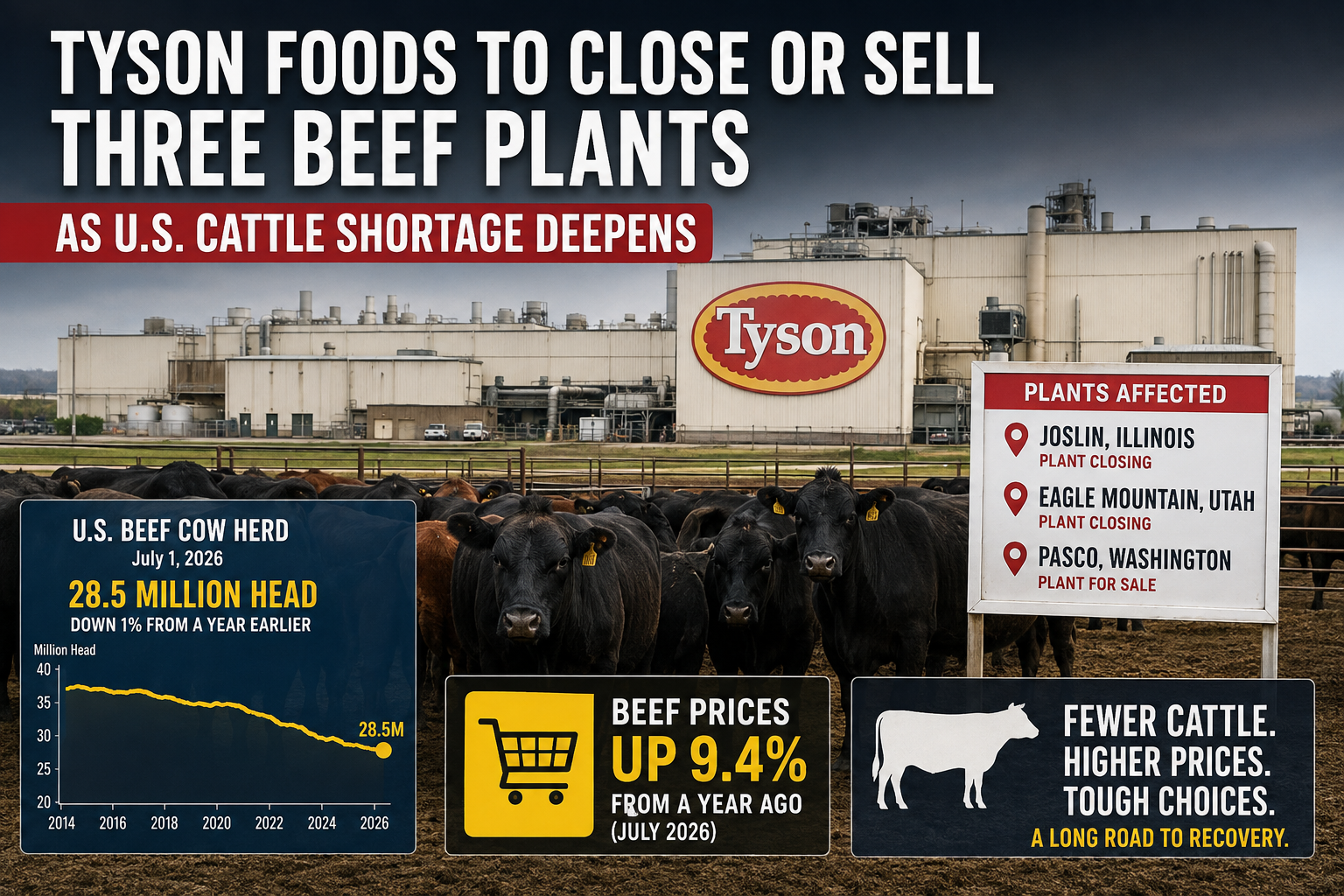
Tyson Foods beef plant closures
Sunday August 15, 2026 – Tyson Foods is making another major reduction to its U.S. beef-processing network as a prolonged cattle shortage squeezes margins, pushes beef prices higher and leaves processors competing for a limited supply of animals.
According to Food Dive, Tyson plans to end operations at its beef facility in Joslin, Illinois, and its case-ready beef facility in Eagle Mountain, Utah. The company is also pursuing the sale of its Pasco, Washington, beef plant. Production handled by those facilities will be transferred to other Tyson operations with available capacity. (Food Dive)
The restructuring represents the latest sign that the historic contraction in the U.S. cattle herd is reshaping the economics of the beef industry. Rather than simply waiting for cattle numbers to recover, Tyson is concentrating production in fewer, larger plants in an effort to lower costs and keep its remaining facilities operating more efficiently.
Tyson Concentrates Beef Production in Three Key Locations
In its August 13 announcement, Tyson said its beef-processing network will now be anchored around three major facilities: Dakota City, Nebraska; Holcomb, Kansas; and Amarillo, Texas. The company said the changes should allow it to maintain a similar level of cattle processing while operating a more efficient network. (Tyson Foods)
Tyson also plans to restore a second shift at its Amarillo facility as cattle become available. That is notable because the company reduced operations there in late 2025, eliminating roughly 1,760 positions, while also closing its large Lexington, Nebraska, beef plant. The Lexington closure affected more than 3,000 workers. (Food Dive)
The latest restructuring will have another substantial employment impact. Roughly 2,500 union workers are expected to lose their jobs at the Joslin plant, according to a statement from Illinois lawmakers. The ultimate employment impact in Utah and Washington remains less certain, particularly because Tyson is seeking a buyer rather than closing the Pasco facility outright. (Tammy Duckworth)
Why Is Tyson Closing Beef Plants?
The underlying problem is straightforward: U.S. beef processors have more slaughter capacity than the current cattle supply can economically support.
The latest USDA cattle inventory report estimated that the United States had 28.5 million beef cows on July 1, 2026, down 1% from a year earlier. The 2026 calf crop was estimated at 32.5 million head, down 2% from 2025. (NASS)
There are some tentative signs that producers may be thinking about rebuilding. Beef replacement heifers were up 3% year over year in the July USDA report. But that has not yet translated into a larger beef cow herd or more calves, meaning processors are unlikely to see a quick improvement in slaughter-ready cattle supplies. That interpretation is consistent with Tyson's warning that cattle constraints are likely to persist. (NASS)
Cattle production also cannot respond as rapidly to high prices as poultry or pork. A beef herd takes years to rebuild because ranchers must first retain young females instead of sending them into the beef supply, breed them, wait through pregnancy and then raise the resulting calves. The USDA Economic Research Service has previously noted that the cattle production cycle can keep beef supplies tight and retail prices elevated for several years following a major herd contraction. (Economic Research Service)
Years of drought, expensive feed and forage, weather volatility and difficult ranching economics contributed to the herd decline. These pressures encouraged producers in many regions to reduce cattle numbers rather than expand them, helping create today's imbalance between cattle supplies and processing capacity. (Economic Research Service)
Tyson's Beef Business Is Losing Money
The shortage has become an expensive problem for Tyson.
In its third-quarter 2026 earnings report, the company said USDA expects domestic beef production to decline by about 3% in fiscal 2026. Tyson forecasts an adjusted operating loss of between $500 million and $650 million for its beef segment for the full fiscal year. (Tyson Foods)
During the third quarter alone, Food Dive reported that Tyson's beef business posted a $138 million operating loss. Beef sales volume fell 15.9%, while prices increased 12.1%, illustrating the difficult economics processors face when they must pay heavily for scarce cattle but cannot necessarily pass all those costs through without hurting demand. (Food Dive)
That helps explain why plant consolidation has become so important. A meatpacking plant carries significant fixed costs for labor, refrigeration, maintenance, sanitation and logistics. When fewer cattle are available, running numerous plants below their efficient capacity can become significantly less profitable. Concentrating the available animals into fewer plants can therefore improve utilization even if total cattle processing changes relatively little.
Beef Prices Remain a Concern for Consumers
Consumers are also feeling the cattle shortage at supermarkets.
The latest Bureau of Labor Statistics inflation data showed that U.S. beef and veal prices were 9.4% higher in July 2026 than a year earlier. Ground beef was up 9%, steaks 9.6% and beef roasts 13.5%. (Bureau of Labor Statistics)
That creates another challenge for companies such as Tyson: processors need sufficiently high wholesale and retail prices to compensate for expensive cattle, but pushing prices too high can encourage shoppers, restaurants and food manufacturers to substitute less-expensive proteins such as chicken or pork.
Mexico Cattle Imports May Help, but Not Immediately
Imports could provide some relief, although they are unlikely to solve the shortage quickly.
Cattle movements from Mexico have been disrupted because of the spread of New World screwworm, a destructive livestock pest. USDA suspended livestock imports through southern ports and has since announced a phased reopening. Under the current plan, the Douglas, Arizona, port is scheduled to reopen to cattle on August 24, 2026, with possible reopenings at Santa Teresa and Columbus, New Mexico, to be considered afterward. USDA says imported animals will undergo inspection for signs of the pest. (USDA)
However, imported feeder cattle still need months of feeding before becoming ready for slaughter. Tyson CEO Donnie King has therefore cautioned that reopening Mexican cattle trade may produce some improvement in 2027 and beyond but will not eliminate the company's current beef-supply gap. (Food Dive)
What the Tyson Plant Closures Mean for the U.S. Beef Industry
Tyson's restructuring suggests that the cattle shortage has moved beyond a temporary supply problem and is now forcing structural changes across U.S. beef processing.
For ranchers, scarce cattle can support historically strong livestock prices. For processors, however, the same shortage creates intense competition for animals and makes it harder to keep large slaughter plants operating efficiently. Consumers sit at the other end of the equation, facing higher beef prices as the industry works through a slow cattle-rebuilding cycle.
Tyson is effectively betting that a smaller, more concentrated processing footprint will put its beef business in a stronger position until cattle supplies recover. The difficult part is timing: rebuilding America's beef herd takes years rather than months.
That means the Joslin and Eagle Mountain closures—and the proposed sale of Pasco—may not be isolated cost-cutting measures. They could be part of a broader realignment of the U.S. beef industry as processors adapt to fewer cattle, persistently high beef prices and a recovery that is likely to be gradual rather than immediate. (Tyson Foods)
###