Chelation in Food Chemistry: Chemical Groups, Formulation Factors, Examples, and Impact on Flavor Aging & Shelf Life
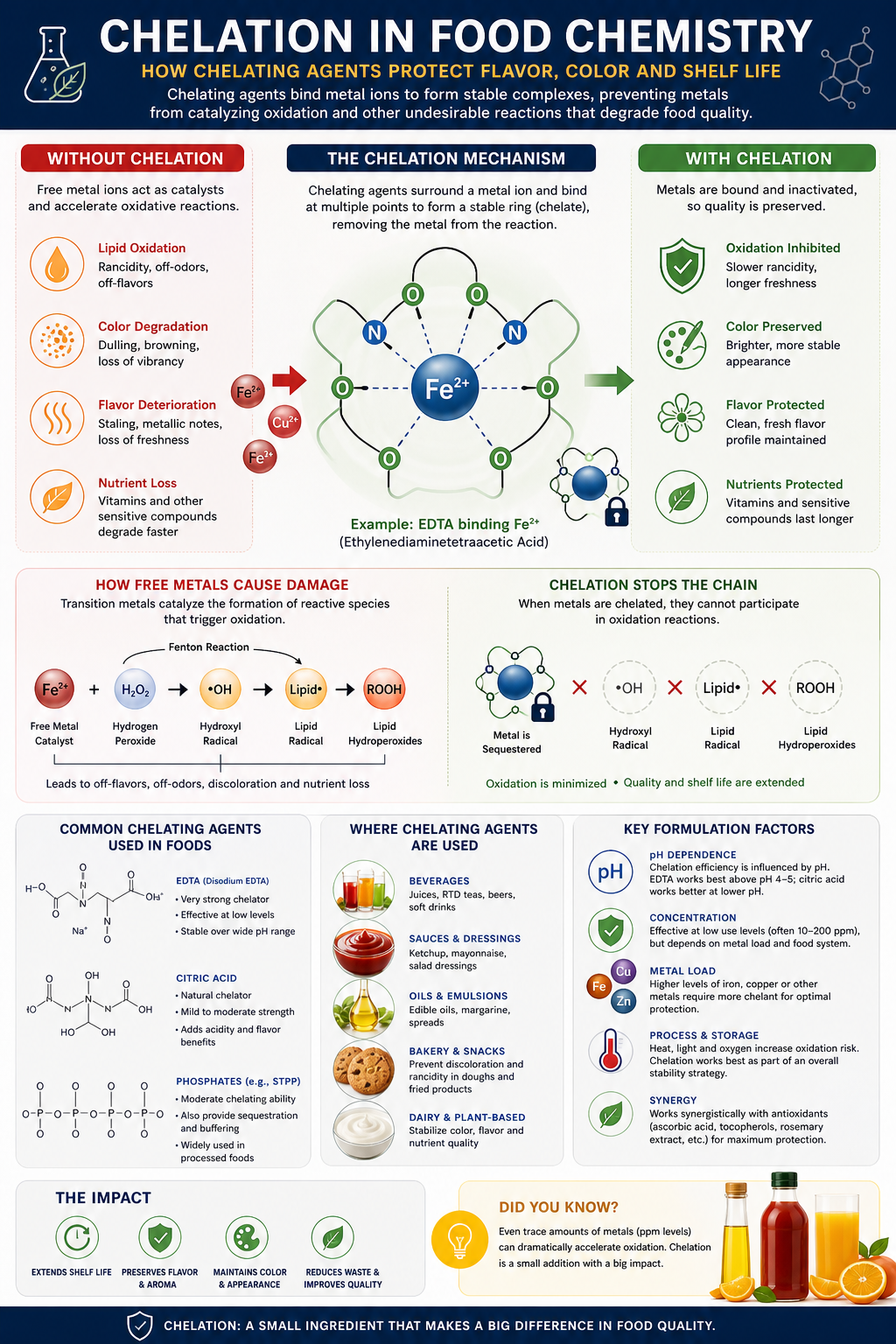
Chelation is one of several key reactions that the Society of Flavor Chemists requires certified flavorists to understand when formulating flavors. The following detailed summary explains chelation in the context of food chemistry, flavor stability, and product shelf life, and serves as a study resource for trainees preparing for the qualification exam.
1) Chemical Groups Involved and Conditions Required for Chelation
Chelation (from Greek chele = "claw") is a chemical process where a ligand (chelating agent) binds to a metal ion at two or more points, forming a stable ring structure called a chelate.
Chemical Groups Involved:
- Metal Ions (Substrates): Transition metals, especially iron (Fe²⁺/Fe³⁺) and copper (Cu²⁺). Also, zinc, manganese, and cobalt.
- Ligands (Chelators) – Must contain electron-donating atoms:
- Oxygen donors: Carboxyl groups (–COOH) and hydroxyl groups (–OH) – found in citric acid, tartaric acid, EDTA.
- Nitrogen donors: Amino groups (–NH₂) – found in EDTA, amino acids.
- Sulfur donors: Thiol groups (–SH) – found in cysteine, glutathione.
Conditions Required:
- pH: Most effective near neutral to slightly alkaline (pH 6–8) for weak acids like EDTA. For natural acids (citric), optimal around pH 4–6.
- Water activity (Aw): Chelation occurs in aqueous or moist environments – minimal in dry powders.
- Temperature: Faster at elevated temperatures (e.g., pasteurization, cooking), but slow at refrigeration.
- Ionic strength: High salt concentrations can compete with metal binding.
2) Factors Accelerating or Inhibiting Chelation & Formulation Considerations
Accelerating Factors:
- Low pH (for certain chelators): Citric acid binds metals better at pH 4–5.
- Heat: Speeds up molecular collisions and complex formation.
- High water activity: Increases ion mobility.
- Stirring/mixing: Enhances contact between chelator and metal ions.
Inhibiting Factors:
- High competing ion concentration (Ca²⁺, Mg²⁺): These can bind to chelators more weakly but still reduce efficiency.
- Very low or very high pH: Outside the optimal range for the specific chelator.
- Lipid-rich environments: Hydrophobic chelators (e.g., phytates) work, but hydrophilic ones (EDTA, citrates) may be less effective in oil phases.
- Protein binding: Some proteins naturally chelate metals, reducing free chelator availability.
Formulation Considerations (for Food & Beverage):
- Choose the right chelator:
- EDTA (E385): Powerful, stable, broad pH range – but regulatory limits in some foods.
- Citric acid: Natural, common in soft drinks and dressings.
- Phosphates (e.g., sodium hexametaphosphate): Good for dairy and meat.
- Glucose oxidase + catalase: Enzymatic oxygen scavenging + indirect chelation.
- Order of addition: Add chelator before metal-sensitive ingredients (e.g., ascorbic acid, polyphenols).
- Synergism: Combine chelator with an antioxidant (e.g., BHA, tocopherols) for stronger oxidative stability.
- Label appeal: Use "natural chelators" (citric acid, rosemary extract) for clean-label products.
3) Examples of Chelation in Food & Flavor Systems
| Example | Metal Chelator | Metal Ion | Result |
|---|---|---|---|
| Preventing oxidation in mayonnaise | EDTA or calcium disodium EDTA | Fe²⁺, Cu²⁺ | Slows rancidity and off-flavors |
| Clarifying fruit juices | Citric acid + ascorbic acid | Fe³⁺ | Prevents browning and metal-catalyzed oxidation |
| Stabilizing beer flavor | Phytate (from malt) | Cu²⁺, Fe²⁺ | Reduces staling aldehydes (trans-2-nonenal) |
| Preserving color in canned vegetables | Calcium disodium EDTA | Fe²⁺ | Precribes ferric tannate discoloration |
| Dairy beverages | Sodium hexametaphosphate | Ca²⁺, Fe²⁺ | Prevents sedimentation and oxidation |
4) Impact of Chelation on Flavor Aging & Shelf Life
How Chelation Extends Shelf Life:
- Prevents metal-catalyzed oxidation:
Metals like iron and copper are pro-oxidants that accelerate lipid peroxidation, leading to rancidity, cardboard-like flavors, and loss of unsaturated fatty acids. Chelation removes them, dramatically slowing oxidative flavor deterioration. - Inhibits enzymatic browning:
Polyphenol oxidase (PPO) requires copper cofactors. Chelating copper inactivates PPO, preventing browning in fruit cuts, juices, and vegetable purees. - Protects ascorbic acid (vitamin C):
Copper and iron catalyze ascorbic acid degradation, producing off-flavors (furfural, browning). Chelators stabilize vitamin C, preserving both nutrition and fresh taste. - Reduces formation of volatile off-flavors:
In beer, chelating copper reduces staling aldehydes (e.g., (E)-2-nonenal – "cardboard" flavor). In wine, chelating iron prevents ferric casse (cloudiness + metallic taste).
Aging Without Chelation:
- Accelerated Maillard reactions (in savory products) – overly dark colors and bitter notes.
- Loss of fresh/fruity notes – esters degrade via metal-dependent hydrolysis.
- Increased bitterness – from lipid oxidation products and degraded peptides.
Practical Shelf-Life Gains:
- Oil-in-water emulsions (salad dressings, sauces): Chelation can double shelf life from 3 to 6–9 months.
- Beverages (tea, coffee, juices): Chelation extends from 6 to 12–18 months without flavor drift.
Final Takeaway for Product Developers:
Chelation is not just a preservation tool – it is a flavor stability strategy. By controlling trace metals, you directly control the rate of aging, protecting delicate notes and ensuring a consistent taste profile throughout shelf life.
Key phrases: chelating agents in food, metal chelation for flavor stability, EDTA shelf life, citric acid as chelator, preventing oxidative rancidity, natural chelators clean label, iron and copper in food spoilage, flavor aging mechanisms.
Here’s a custom visual illustration that captures the core ideas from the chelation article—metal binding, oxidation control, and flavor stability.
Members please log in to read.