Global Food Law & Regulatory Intelligence Report: Weekly Digest of Food Safety, Labeling, and Compliance Developments Across North America, South America, Europe, Asia, Africa, and Oceania (April 27 – May 3, 2026)
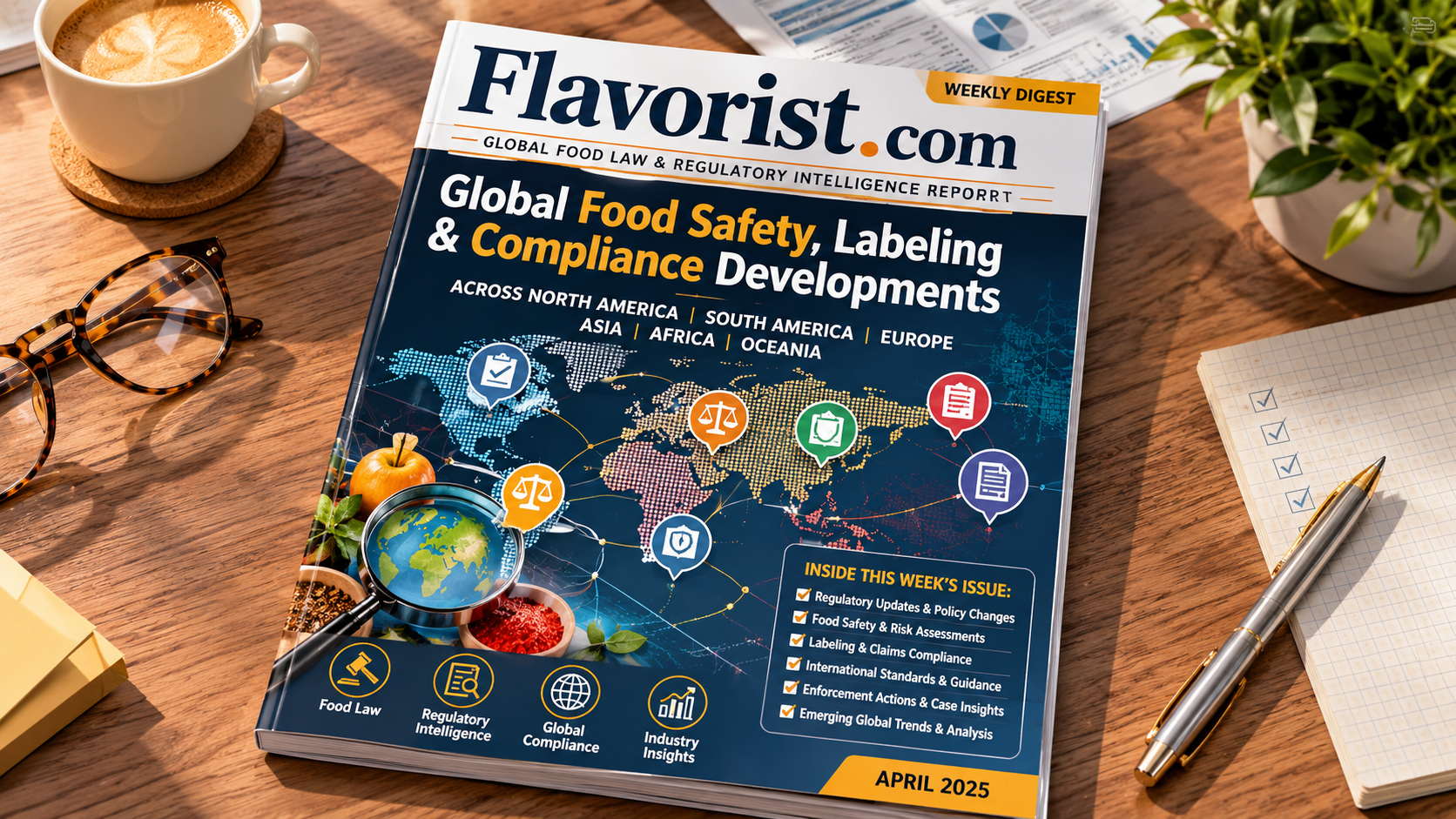
Below is a curated, source-linked regulatory & legal news digest for North America (April 27 – May 3, 2026), focused on food law, safety, labeling, and regulatory enforcement. Each item includes an active link for deeper reading.
🇺🇸 United States — Federal Food Law & Regulatory Developments
1. FDA Expands Import Enforcement & Food Safety Alerts
During this week, the U.S. Food and Drug Administration (FDA) continued strengthening enforcement via import alerts targeting contamination risks (e.g., Salmonella, pesticides, heavy metals). These alerts allow the agency to detain products at the border without physical inspection, signaling tighter oversight of global supply chains. (Food Safety News)
👉 Source: FDA import enforcement updates
Regulatory significance:
- Reinforces FDA authority under the Food Safety Modernization Act (FSMA) to proactively prevent unsafe imports.
- Signals continued prioritization of preventive controls and foreign supplier verification.
2. Congressional Pressure to Expand FDA Data-Sharing Authority
A legislative proposal discussed during the week would allow FDA to share food safety data with state regulators, addressing current restrictions on proprietary information. (Food Safety News)
👉 Source: Food Safety News coverage of proposed FDA authority changes
Regulatory significance:
- Could materially improve outbreak response coordination between federal and state agencies.
- Reflects broader policy momentum toward greater transparency in food safety enforcement.
3. Multi-State Outbreak & Recall: Raw Dairy Under Scrutiny
The FDA and CDC continued investigation of a multi-state E. coli outbreak linked to raw cheddar cheese, with ongoing regulatory action and recalls. (U.S. Food and Drug Administration)
👉 Source: FDA outbreak investigation (raw cheddar cheese)
Regulatory significance:
- Highlights ongoing tension between raw dairy producers and federal regulators.
- Reinforces FDA’s authority to push voluntary recalls and conduct facility inspections.
4. Nationwide Recalls Triggered by Allergen Mislabeling
Several recalls issued or active this week involved undeclared allergens (nuts, milk, soy, sesame)—including a widely distributed chocolate product across 40+ states. (Good Housekeeping)
Key issue: labeling non-compliance.
👉 Source:
Regulatory significance:
- Demonstrates continued enforcement of the “Big 9” allergen labeling rules.
- Confirms that mislabeling remains one of the most frequent compliance failures.
🇨🇦 Canada — Federal Food Regulation & Enforcement
1. Mandatory Front-of-Package (FOP) Labeling Now Enforced
Canada’s front-of-package nutrition labeling regulations (for high sodium, sugar, or saturated fat foods) are now fully enforceable as of 2026, with active compliance monitoring. (Foster)
👉 Source: Canada FOP labeling rules update
Regulatory significance:
- Marks a major shift toward consumer-facing nutritional transparency.
- Aligns with global trends (e.g., Chile, Mexico warning labels).
2. Ongoing CFIA Enforcement on Labeling & Misrepresentation
The Canadian Food Inspection Agency (CFIA) continues enforcement actions against misleading origin claims (“Product of Canada”), including financial penalties. (Canada)
👉 Source: CFIA enforcement on misleading labeling
Regulatory significance:
- Reinforces stricter interpretation of country-of-origin claims.
- Signals increased scrutiny of marketing language and traceability.
3. Food Recall Activity: Listeria & Contamination Risks
Recent regulatory activity includes recalls tied to Listeria contamination (e.g., prepared salads and ready-to-eat foods). (Food Safety News)
👉 Source: Canada Listeria-related recall example
Regulatory significance:
- Confirms continued priority on ready-to-eat product safety.
- Highlights microbiological hazards as a dominant regulatory risk category.
4. Updated Import Certification Requirements for U.S. Products
Canada updated requirements for FDA-issued export certificates for products containing meat ingredients, requiring more detailed manufacturer information. (National Law Review)
👉 Source: Canada import certification update
Regulatory significance:
- Tightens cross-border compliance documentation.
- Impacts U.S. exporters supplying composite food products.
🇲🇽 Mexico — Regional Context (Limited Major Updates This Week)
No major standalone federal food law announcements were identified for Mexico during this specific week window. However, Mexico continues operating under its established frameworks:
- COFEPRIS oversight of food safety and labeling
- Existing front-of-package warning label system (NOM-051) enforcement
Regional implication:
North American regulatory convergence continues, especially in front-of-pack labeling and consumer transparency policies, aligning Mexico with Canada’s newer enforcement phase.
Key North America Regulatory Themes (Week Summary)
1. Labeling enforcement dominates
- Allergen mislabeling (U.S.)
- Nutritional warning labels (Canada)
- Origin claims enforcement (Canada)
2. Food safety remains reactive + preventive
- Recalls (Listeria, E. coli, allergens)
- Import controls tightening (U.S.)
3. Cross-border compliance increasing
- Canada tightening import certification
- FDA expanding import surveillance
Below is a curated, source-linked regulatory & legal news digest for South America covering April 27 – May 3, 2026, focused on food law, safety, labeling, and regulatory policy developments.
(Regional coverage is more limited this week compared to North America, but key regulatory signals are still emerging.)
🇧🇷 Brazil — Federal Food Regulation & International Alignment
1. ANVISA Advances International Regulatory Cooperation
Brazil’s health regulator, Agência Nacional de Vigilância Sanitária (ANVISA), continued advancing international cooperation agreements with countries such as Mexico and Cape Verde, with implications for food, pharmaceutical, and health product regulation.
👉 Source: ANVISA international cooperation updates
Regulatory significance:
- Reinforces Brazil’s push toward regulatory convergence and harmonization across regions.
- Facilitates faster approvals and mutual recognition frameworks, which may impact food ingredient and additive approvals.
- Signals increasing alignment with global regulatory standards and reliance models.
2. Continued Modernization of Regulatory Approval Systems
ANVISA highlighted ongoing efforts to modernize approval pathways and digitalize regulatory processes, including faster issuance of certificates and reliance-based review models. (Serviços e Informações do Brasil)
👉 Source:
Regulatory significance:
- Supports reduced approval timelines for regulated products, including food-contact materials and ingredients.
- Expands use of “regulatory reliance”, meaning Brazil may increasingly accept decisions from trusted foreign regulators.
- Important for multinational food companies seeking faster market entry in Brazil.
3. Strengthened Inspection & GMP Oversight (Including Food Sector)
ANVISA continues to expand Good Manufacturing Practices (GMP) inspections, including international inspections of facilities supplying Brazil. (Serviços e Informações do Brasil)
👉 Source:
Regulatory significance:
- Reinforces supply chain compliance requirements for imported food and ingredients.
- Confirms Brazil’s emphasis on post-market surveillance and inspection-based enforcement.
- Requires foreign producers to maintain local regulatory representation and certification.
🇦🇷 Argentina — Regulatory Stability with Ongoing Food Code Enforcement
1. Continued Enforcement of Argentine Food Code (CAA)
Argentina maintained enforcement of its Código Alimentario Argentino (CAA), focusing on labeling compliance, ingredient standards, and sanitary controls.
👉 Source:
Regulatory significance:
- No major new legislation this week, but ongoing enforcement remains active.
- Emphasis on accurate labeling, additives compliance, and traceability.
- Aligns with regional trends toward consumer protection and transparency.
🇨🇱 Chile — Front-of-Pack Labeling System Remains a Regional Benchmark
1. Continued Enforcement of Warning Label System
Chile continues strict enforcement of its front-of-package (FOP) warning label law, one of the most advanced globally (black stop-sign labels for high sugar, salt, or fat).
👉 Source:
Regulatory significance:
- Serves as a policy benchmark influencing other South American countries.
- Maintains pressure on reformulation and nutritional compliance strategies.
- Continues to shape regional harmonization discussions, especially with Brazil’s modernization efforts.
🇨🇴 Colombia & 🇵🇪 Peru — Ongoing Implementation of Labeling & Health Policies
1. Gradual Implementation of Nutritional Labeling Rules
Countries such as Colombia and Peru continue implementing front-of-pack labeling frameworks similar to Chile’s system.
👉 Source:
Regulatory significance:
- Confirms a regional shift toward mandatory consumer-facing nutrition warnings.
- Drives reformulation and market-wide compliance changes across South America.
🇲🇽 (Regional Influence Note)
While geographically North America, Mexico continues influencing South America through its NOM-051 labeling system, reinforcing regional policy convergence.
Key South America Regulatory Themes (Week Summary)
1. Regulatory Convergence Accelerating
- Brazil actively pursuing international cooperation and reliance models
- Regional alignment growing around labeling and safety frameworks
2. Labeling Policy Dominates the Region
- Chile remains the gold standard for FOP labeling enforcement
- Colombia and Peru continue phased adoption
3. Enforcement > New Legislation (This Week)
- Limited new laws issued during this specific week
- Strong emphasis on inspection, compliance, and system modernization
Below is a curated, source-linked regulatory & legal news digest for Asia covering April 27 – May 3, 2026, focused on food law, safety, labeling, and regulatory policy developments.
(As with South America, Asia saw limited brand-new rulemaking this specific week, but several recently enacted or newly implemented measures continued to drive regulatory activity and enforcement.)
🇨🇳 China — Expanding Food Safety Standards & Import Oversight
1. Continued Implementation of New National Food Safety Standards (GB System)
China continued implementing its recently released 50 new national food safety standards (GB standards) covering labeling, additives, and testing methods. (flavorist.com)
👉 Source:
Regulatory significance:
- Represents one of the largest system-wide updates to China’s food regulatory framework in recent years.
- Expands oversight across food additives, labeling, and analytical testing.
- Signals China’s continued shift toward science-based and risk-based regulation.
2. Enforcement of Overseas Manufacturer Registration (Decree 280)
China’s General Administration of Customs (GACC) continued enforcing Decree 280, requiring overseas food manufacturers to register before exporting into China. (ChemLinked)
👉 Source:
Regulatory significance:
- Strengthens import control and traceability requirements.
- Places compliance burden on foreign producers and exporters.
- Reinforces China’s move toward pre-market approval and risk classification systems.
3. Ongoing “New Food” and Additive Approval Pipeline
China’s National Health Commission (NHC) continued reviewing applications for new food ingredients and additives (“three new foods”). (CIRS Group)
👉 Source:
Regulatory significance:
- Indicates an active pipeline for novel ingredients and functional food components.
- Important for innovation in alternative proteins, nutraceuticals, and specialty ingredients.
🇯🇵 Japan — Additives & Labeling Reform Progress
1. Revised Food Additive Standards Enter Force
Japan’s Consumer Affairs Agency finalized updated use standards for certain food additives (e.g., zinc gluconate, sulfites). (ChemLinked)
👉 Source:
Regulatory significance:
- Tightens control over additive usage levels and applications.
- Aligns Japan with international safety evaluations and Codex standards.
- Impacts formulation strategies for processed and functional foods.
2. Continued Reform of Food Labeling Standards
Japan continues advancing comprehensive reforms to its food labeling system, including allergen and product-specific labeling requirements. (Label Bank)
👉 Source:
Regulatory significance:
- Introduces extended transition periods (through 2028–2030) for compliance.
- Reflects growing emphasis on consumer transparency and allergen disclosure.
- Increases complexity for exporters entering the Japanese market.
🇰🇷 South Korea — Food Code & Additive Regulation Updates
1. Ongoing Revisions to Food Code and Additive Regulations
South Korea continues updating its Food Code and additive regulations, including ingredient classifications and pesticide residue limits. (ChemLinked)
👉 Source:
Regulatory significance:
- Enhances safety thresholds and contaminant controls.
- Aligns with global standards on maximum residue limits (MRLs).
- Requires reformulation for products exceeding updated limits.
🇮🇳 India — Compliance & Testing Enforcement
1. Strengthened Compliance Requirements for Food Testing Laboratories
India’s Food Safety and Standards Authority (FSSAI) has issued compliance orders targeting food testing laboratories and certification practices. (ChemLinked)
👉 Source:
Regulatory significance:
- Reinforces analytical accuracy and accreditation standards.
- Improves reliability of food safety verification systems.
- Signals tighter enforcement of quality assurance infrastructure.
🇻🇳 Vietnam & 🇮🇩 Indonesia — Regulatory Transitions & Reforms
1. Vietnam Adjusts Implementation Timeline for Food Safety Decree
Vietnam has temporarily delayed implementation of a new food safety decree, allowing additional time for industry adaptation. (ChemLinked)
👉 Source:
Regulatory significance:
- Reflects regulatory flexibility in major structural reforms.
- Provides industry time to adjust to new compliance obligations.
2. Indonesia Overhauls Food Safety Regulation Framework
Indonesia continues implementing a comprehensive overhaul of its food safety regulations, affecting classification and compliance requirements. (ChemLinked)
👉 Source:
Regulatory significance:
- Introduces modernized food categorization and safety controls.
- Aligns Indonesia more closely with international regulatory frameworks.
🇹🇼 Taiwan — Emerging Ingredient & Labeling Controls
1. Draft Regulations on Novel Ingredients and Labeling
Taiwan regulators are advancing draft rules on usage limits and labeling requirements for novel ingredients (e.g., inulin, HMOs). (Foodmate)
👉 Source:
Regulatory significance:
- Expands oversight of functional and specialty ingredients.
- Signals increased focus on scientific substantiation and labeling clarity.
Key Asia Regulatory Themes (Week Summary)
1. Implementation Phase Dominates (Not New Laws)
- Most activity involves rolling out previously announced regulations
- Strong focus on compliance, enforcement, and transition periods
2. Labeling & Additives Remain Central
- Japan: labeling overhaul
- China & Korea: additive and standards updates
- Taiwan: ingredient labeling expansion
3. Import & Supply Chain Control Tightening
- China’s Decree 280 enforcement
- Regional emphasis on traceability and foreign manufacturer compliance
Bottom Line
Asia’s regulatory environment this week reflects a maturing, enforcement-driven phase—less about announcing new laws and more about implementing large structural reforms already in motion, particularly in China, Japan, and Southeast Asia.
Below is a curated, source-linked regulatory & legal news digest for Africa covering April 27 – May 3, 2026, focused on food law, safety, standards, and regulatory policy developments.
(This week shows a notable emphasis on continental harmonization, Codex engagement, and national regulatory updates, rather than large volumes of new standalone legislation.)
🌍 Africa (Continental) — Harmonization & Codex Engagement
1. Africa Strengthens Role in Global Food Additive Regulation (Codex)
African countries continued strengthening participation in Codex Alimentarius processes, particularly in food additive regulation and international standard-setting. (FAOHome)
👉 Source:
- https://foodcomplianceinternational.com/industry-insight/news/6121-africa-actively-participates-in-the-international-regulation-of-food-additives
- https://www.fao.org/fao-who-codexalimentarius/committees/codex-regions/africa/about/en/
Regulatory significance:
- Marks a shift from passive participation to active influence in global food standards.
- Supports harmonization of additives, contaminants, and labeling rules across African markets.
- Strengthens Africa’s negotiating power in international food trade frameworks (WTO/Codex).
2. Continued Push Toward Harmonized Food Safety Legislation
African regulators continue aligning national laws with FAO/WHO Codex-aligned frameworks (CCAFRICA guidelines) to harmonize food safety systems across the continent. (TechPalate Insights)
👉 Source:
Regulatory significance:
- Promotes regional legal alignment without forcing identical laws.
- Emphasizes consumer health protection as the primary legal objective.
- Facilitates smoother trade under frameworks like the African Continental Free Trade Area (AfCFTA).
🇿🇦 South Africa — National Standards & Product Regulations
1. New Regulations on Product Standards (Agricultural Products Act)
South Africa published new or updated regulations governing classification, packing, and marking of agricultural products, strengthening compliance requirements. (Facebook)
👉 Source:
Regulatory significance:
- Tightens labeling, grading, and quality standards.
- Enhances traceability and export readiness.
- Aligns domestic rules with international trade expectations.
2. Regulatory Updates on Mayonnaise & Emulsified Products
South Africa’s Department of Agriculture has gazetted updates to regulations governing mayonnaise and similar products, refining compositional and labeling requirements. (Instagram)
👉 Source:
Regulatory significance:
- Clarifies product identity standards and ingredient definitions.
- Reduces ambiguity in food classification and labeling claims.
- Impacts formulation and marketing of emulsified food products.
🇰🇪 Kenya — Regulatory Effectiveness Under Scrutiny
1. Sugar Sector Crisis Highlights Regulatory Weakness
A major policy discussion emerged around Kenya’s sugar sector, where governance and regulatory enforcement challenges have been highlighted amid import and compliance issues. (Dawan Africa)
👉 Source:
Regulatory significance:
- Raises concerns about regulatory capacity and enforcement gaps.
- Highlights risks of non-compliant imports and market distortion.
- Signals potential for future regulatory reform or intervention.
🌍 Regional Economic Policy & Food Security Linkages
1. Fertilizer Policy and Food Security Regulation Discussions
African Union–aligned discussions this week emphasized the link between fertilizer supply regulation, food security, and economic stability across sub-Saharan Africa. (Tralac)
👉 Source:
Regulatory significance:
- Reinforces that agricultural input regulation is central to food law systems.
- Highlights vulnerability to import dependence and global supply shocks.
- Connects regulatory policy to broader food system resilience strategies.
Key Africa Regulatory Themes (Week Summary)
1. Continental Harmonization Accelerates
- Strong alignment with Codex Alimentarius standards
- Continued push toward regionally compatible food safety laws
2. Enforcement & Standards > New Legislation
- Limited brand-new laws this week
- Focus on updating standards, improving compliance, and strengthening institutions
3. Regulatory Capacity & Governance in Focus
- Kenya case highlights institutional enforcement challenges
- AU-level initiatives aim to build centralized coordination mechanisms
Bottom Line
Africa’s regulatory landscape this week reflects a transition toward coordinated, continent-wide food safety governance, with increasing emphasis on harmonization, international engagement, and enforcement capacity rather than isolated national rulemaking.
Below is a curated, source-linked regulatory & legal news digest for Europe covering April 27 – May 3, 2026, focused on food law, safety, labeling, and regulatory policy developments.
(This week reflects a strong emphasis on EU-level scientific regulation, risk assessment frameworks, and consumer-facing safety initiatives, rather than large volumes of brand-new legislation.)
🇪🇺 European Union — Scientific Regulation, Risk Assessment & Consumer Policy
1. EFSA Launches New Allergenicity Risk Assessment Initiative
On April 27, the European Food Safety Authority (EFSA) launched a major call to develop new methodologies for allergenicity risk assessment of proteins in food and feed. European Food Safety Authority
👉 Source:
Regulatory significance:
- Signals future evolution of EU allergen risk assessment frameworks.
- May reshape how novel proteins, alternative proteins, and biotech-derived ingredients are evaluated.
- Reinforces the EU’s commitment to science-based regulatory decision-making. (EU Transition Pathways)
2. EU-Wide “Safe2Eat 2026” Campaign Expands Consumer Protection Efforts
The EU expanded its Safe2Eat 2026 campaign, coordinated by EFSA, aimed at improving consumer understanding of food safety risks and labeling information. European Food Safety Authority
👉 Source:
- https://www.efsa.europa.eu/en/news/safe2eat-2026-science-backed-guidance-all-europeans
- https://euroneo.eu/2026/04/27/safe2eat-2026-science-backed-guidance-for-europeans
Regulatory significance:
- Reflects growing regulatory focus on risk communication and transparency, not just rulemaking.
- Expands reach to 23 countries, reinforcing harmonized messaging across Europe.
- Supports compliance with EU food information and labeling laws by improving consumer literacy. (European Food Safety Authority)
3. Continued Implementation of EU Food Additive Restrictions (2026 Regulations)
Although adopted earlier in 2026, EU regulations tightening food additive use—especially for infants and vulnerable populations—continue entering implementation and enforcement phases.
👉 Source:
Regulatory significance:
- Introduces stricter maximum levels, purity criteria, and usage restrictions.
- Removes or limits certain additives (e.g., guar gum in infant formula contexts).
- Signals continued tightening of high-risk population protections. (Complife Group)
4. EU Advances Research Funding for Food Safety & Sustainability
The European Commission and EFSA continue supporting funding calls linked to food safety, sustainability, and risk reduction, including allergenicity and food system resilience.
👉 Source:
Regulatory significance:
- Demonstrates the EU’s reliance on scientific research to drive future legislation.
- Aligns with long-term goals such as climate-neutral food systems and safer supply chains. (EU Transition Pathways)
🇬🇧 United Kingdom — Post-Brexit Regulatory Continuity & Divergence
1. Continued Alignment with EU-Derived Food Safety Frameworks
The UK continues operating under retained EU food law frameworks, with ongoing oversight from agencies such as the Food Standards Agency (FSA).
👉 Source:
Regulatory significance:
- Maintains high alignment with EU safety standards, particularly in labeling and additives.
- However, gradual divergence remains possible in areas like novel foods and gene-edited products. (Food Safety)
🇪🇺 Europe (Regional Trend) — Data, Transparency & Digital Enforcement
1. Growing Use of Data & Technology in Food Safety Governance
EU institutions continue expanding data-driven approaches to food safety, including monitoring systems and analytical databases supporting regulatory decisions.
👉 Source:
Regulatory significance:
- Reflects a shift toward predictive, AI-supported food safety systems.
- Enhances ability to detect food fraud, contamination, and cross-border risks.
- Supports enforcement under systems like the Rapid Alert System for Food and Feed (RASFF). (Food Safety)
Key Europe Regulatory Themes (Week Summary)
1. Science-Driven Regulation Leads Policy
- EFSA initiatives (allergenicity, research funding) highlight evidence-based policymaking
- Strong reliance on risk assessment before legislation
2. Consumer Transparency Expands Beyond Labeling
- Safe2Eat campaign shows regulators focusing on education and communication
- Complements strict EU labeling and information laws
3. Implementation Phase of Major 2026 Rules
- Additive restrictions and safety frameworks are entering enforcement stage
- Industry impact now shifting from awareness → compliance execution
4. Digital & Data-Driven Enforcement Rising
- Increased use of AI tools, monitoring systems, and cross-border alert networks
- Strengthens EU’s ability to manage complex, global food supply chains
Bottom Line
Europe’s regulatory landscape this week reflects a highly mature, science-led system, where new policy is increasingly shaped through research, risk assessment, and coordinated EU-wide initiatives, rather than frequent headline legislation.
Below is a curated Oceania food law & regulatory news digest for April 27–May 3, 2026, with active source links.
🇦🇺 Australia — FSANZ Code Amendments, Recalls & Food Safety Enforcement
1. FSANZ published Amendment No. 249 to the Food Standards Code
On April 30, 2026, FSANZ published Amendment No. 249 to the Australia New Zealand Food Standards Code. The amendment includes changes from P1065 – Code Revision – 2025 Amendments, including compositional requirements for special medical purpose products for infants and other miscellaneous amendments. (Food Standards Australia New Zealand)
Source: FSANZ — Notification Circular 391-26 / Amendment No. 249.
2. FSANZ accepted new processing-aid application
On April 28, 2026, FSANZ accepted application A1350, concerning lysophospholipase from Trichoderma reesei, with Aspergillus niger as gene donor, for use as a food processing aid. Public comment will be notified later. (Food Standards Australia New Zealand)
Source: FSANZ — Notification Circular 390-26.
3. Enoki mushroom recall due to Listeria monocytogenes
On April 30, 2026, Concordia Traders recalled Enoki Mushroom 350g sold in Asian grocers in VIC, NSW, and SA due to Listeria monocytogenes contamination. (Food Standards Australia New Zealand)
Source: FSANZ recall notice.
4. Organic garlic powder recall due to undeclared peanut
On May 1, 2026, Planet Organic recalled Certified Organic Garlic Powder 50g, sold online nationally, due to an undeclared peanut allergen. (Food Standards Australia New Zealand)
Source: FSANZ recall notice.
5. FSANZ released updated food recall statistics
On April 30, 2026, FSANZ published updated recall statistics showing 866 recalls from 2016–2025, including 92 recalls in 2025, with allergen and contamination causes tracked for trend analysis. (Food Standards Australia New Zealand)
Source: FSANZ food recall statistics.
🇳🇿 New Zealand — Food Act Compliance & Shellfish Safety Alerts
1. Updated food control plans became required
New Zealand food businesses using the Simply Safe & Suitable Food Control Plan needed to be operating under the updated plan by April 30, 2026. MPI states verifiers will check updated plans at the next scheduled verification. (MPI)
Source: MPI food control plan guidance.
2. Eastern Bay of Plenty shellfish biotoxin warning
On April 30, 2026, New Zealand Food Safety warned the public not to collect or eat shellfish from Opape to Matakaoa Point near Hicks Bay, after paralytic shellfish toxins exceeded the safe limit. (MPI)
Source: MPI shellfish biotoxin warning.
3. Marlborough shellfish biotoxin warning
On May 1, 2026, MPI listed a warning for Port Underwood, Marlborough, after shellfish analysis detected 0.81 mg/kg paralytic shellfish toxin, above the safe limit. (MPI)
Source: MPI shellfish biotoxin alerts.
Key Oceania Themes This Week
Oceania’s food regulatory activity this week centered on Food Standards Code amendments, processing-aid review, allergen and microbial recalls, and New Zealand public health controls for shellfish biotoxins.
###