Coors Light Enters Non-Alcoholic Market with ‘Coors 0.0%’ as Consumer Trends Shift
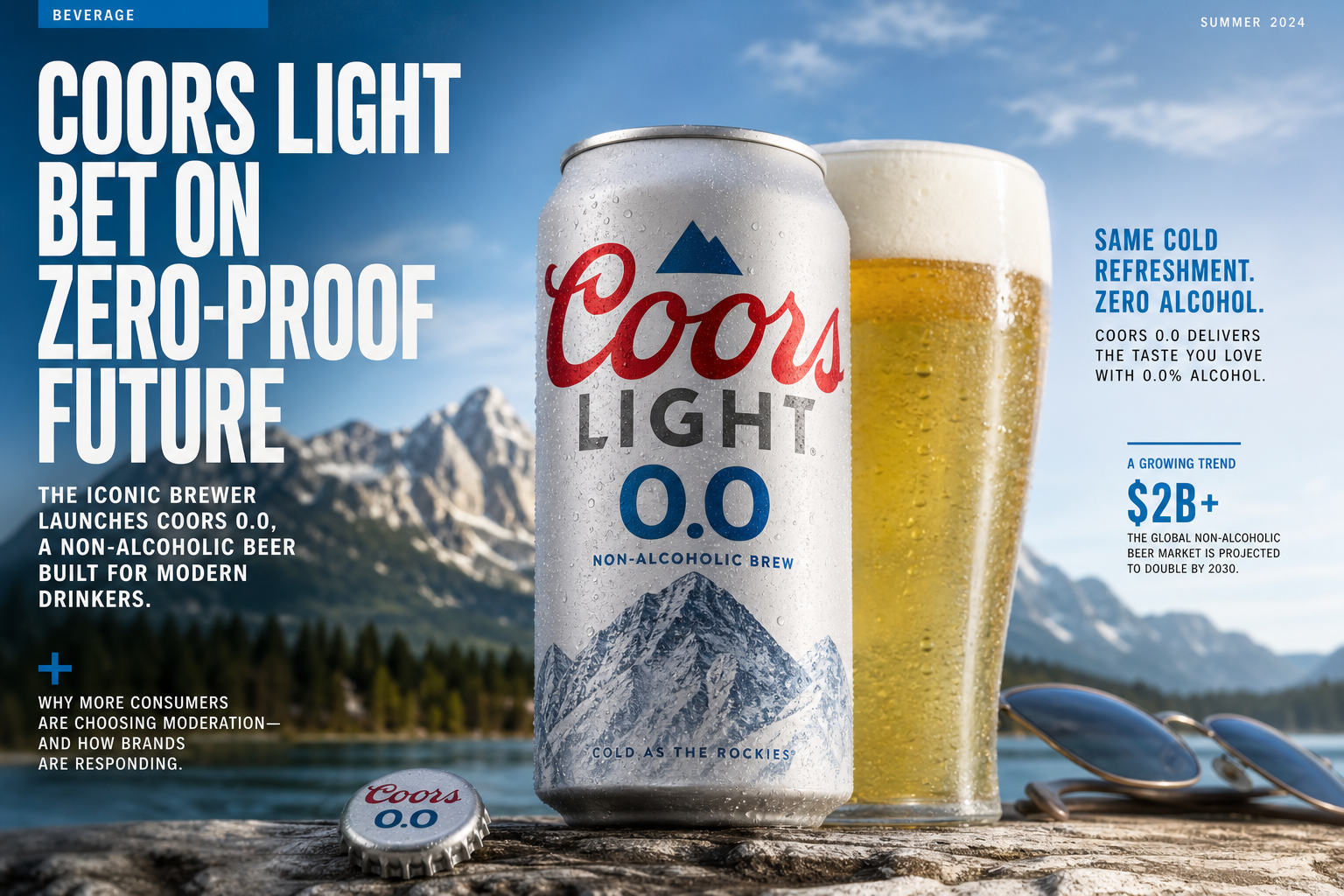
A commentary: Tasting Notes on Coors 0.0%: A Flavor Industry Perspective
By a flavor professional
The beer company will launch its new non-alcoholic beer in the Northeast this May, according to a note released on Facebook, with a nationwide rollout planned for 2027. This concept, while not entirely new, remains noteworthy. The key driver here is changing consumer trends, and there appears to be a genuine and growing market for this unconventional product.
But let's set aside the marketing for a moment. As someone who works in the flavor industry, I look at Coors 0.0% not as a beverage announcement, but as a technical challenge wrapped in a business opportunity. And that is where the real story begins.
The Technical Reality Behind the 0.0% Label
Out of professional curiosity, this product almost certainly derives from a carefully controlled fermentation process. The company likely uses one of two methods — or a combination of both.
First, Molson Coors may employ a specialized yeast strain that produces extremely low levels of alcohol during fermentation. These strains are not new, but they have improved significantly in recent years. Modern low-alcohol yeast can generate the desired beer character — such as esters, phenols, and mouthfeel — while keeping ethanol to trace amounts. Note, however, that when the label claims 0.0% alcohol by volume, it may not mean absolutely zero. In the United States, the TTB allows beverages with less than 0.5% ABV to be labeled as non-alcoholic. Some products labeled 0.0% do contain minute, legally negligible amounts.
Alternatively, an enzymatic process could be used to further remove those trace amounts. This involves adding alcohol-specific enzymes — such as catalase or alcohol oxidase — after standard fermentation to break down residual ethanol. This method is more common in commercial "zero-alcohol" beers because it starts with a fully fermented, flavorful base and then strips the alcohol away. The downside? Some delicate flavor compounds leave with the alcohol.
What This Means for Flavor Creation
Now, here is where my professional perspective sharpens. A flavorist could certainly formulate a compound flavor for this type of beer. You could build a profile that mimics light lager characteristics: grainy, slightly sweet, with a clean finish and perhaps a hint of sulfur or DMS (dimethyl sulfide) for authenticity. You could even add hop oils for bitterness and aroma.
However, such a flavor would be unlikely to be derived from natural sources. Natural beer flavor is extraordinarily complex — hundreds of volatile compounds interacting. To replicate that in a natural, non-GMO, clean-label format is prohibitively expensive and technically challenging. Most non-alcoholic beers on the market today that use added flavoring rely on nature-identical or artificial compounds. This is not necessarily a mark of poor quality. It is simply a practical reality of food science.
A Market That Demands Authenticity
The consumer trend driving Coors 0.0% is not just about drinking less alcohol. It is about drinking with intention. Younger consumers, in particular, want the social ritual of beer — the crack of the can, the cold condensation, the bitter snap — without the impairment. They also demand transparency and authenticity. A beer that tastes like chemicals or artificial sweeteners will fail. A beer that tastes like Coors Light, but without the buzz, might just succeed.
From a competitive standpoint, Molson Coors is late to the party. Heineken 0.0 and Athletic Brewing have already educated the palate of the non-alcoholic drinker. But Coors Light has something they do not: raw, blue-collar ubiquity. If Coors 0.0% can sit on the same convenience store shelf as its alcoholic sibling and deliver a nearly identical sensory experience, the brand could capture a massive segment of casual, price-sensitive consumers.
Final Thoughts for Flavor Professionals
So, could you make a competing product of your own? Absolutely. Start with a clean, neutral malt base. Ferment with a low-alcohol yeast strain. If needed, polish with enzymatic treatment. Then, build your flavor layer carefully: focus on the key lager notes (light toast, cereal, low sulfur) and use hop extracts for bitterness. Keep it simple. Keep it clean. And above all, keep it refreshing.
Coors 0.0% is not a revolution in brewing. But it is a clear signal that the non-alcoholic category has gone mainstream. For those of us in flavor development, that means more clients asking for zero-ABV solutions that actually taste like beer — not beer-flavored seltzer. And that, frankly, is a challenge worth raising a glass to.
News: Coors Light Enters Non-Alcoholic Market with ‘Coors 0.0%’ as Consumer Trends Shift
News Brief:
- According to news released by Food Dive on April 30, 2026, Coors Light has unveiled its first-ever non-alcoholic beer, branded Coors 0.0%, marking a major expansion for parent company Molson Coors into the fast-growing zero-ABV segment.
- The new beverage will launch in select Northeastern U.S. markets in May 2026, with a full national rollout scheduled for 2027.
- The launch follows rising consumer demand for premium non-alcoholic options and builds on Molson Coors’ existing portfolio, including Blue Moon Non-Alcoholic and Coors Edge.
Classic Brand, Zero Alcohol
In a strategic move to adapt to changing drinking habits, Molson Coors announced this week that Coors Light — one of America’s most recognizable light lagers — will now be available in a completely alcohol-free version. Named Coors 0.0%, the beverage aims to offer the same crisp, refreshing taste as the original, but with zero percent alcohol by volume (ABV).
According to company statements, the recipe was developed to maintain the “iconic Rocky Mountain cold refreshment” while removing alcohol. Initial production will begin immediately, with a regional debut in the Northeast this May. A nationwide expansion is planned for early 2027.
Why Now? The Rise of Mindful Drinking
The move comes as alcohol consumption in the U.S. shows signs of softening, particularly among younger adults who are increasingly opting for low- or no-alcohol beverages. Industry data indicates that the non-alcoholic beer market is growing at a double-digit annual rate, with major players like Heineken (Heineken 0.0) and Modelo (Modelo Non-Alcoholic) already capturing share.
“Consumers no longer see non-alcoholic beer as a compromise,” says beverage industry analyst Lisa Tran. “They see it as a choice — for health, productivity, or simply personal preference. Coors bringing its flagship light beer into this space is a direct response to that cultural shift.”
Building a Broader Beverage Portfolio
Coors 0.0% is not Molson Coors’ first venture into non-alcoholic brews. The company already produces Blue Moon Non-Alcoholic, Peroni 0.0, and Coors Edge — a lower-alcohol option. However, analysts note that launching a non-alcoholic version of Coors Light represents a much higher-stakes bet, given the brand’s massive mainstream recognition.
Molson Coors has also diversified beyond beer entirely, recently acquiring Monaco Cocktails to enter the ready-to-drink (RTD) cocktail space and expanding into energy drinks and mixers. CEO Rahul Goyal recently highlighted that the non-alcoholic Blue Moon brand is already growing by 25% year-over-year, signaling strong consumer appetite.
Challenges and Competition
While the opportunity is significant, Coors 0.0% will enter a crowded field. Heineken 0.0 has established a strong foothold in bars and retail, while Anheuser-Busch has aggressively marketed Budweiser Zero and Athletic Brewing Company has built a loyal following among craft non-alcoholic drinkers.
To stand out, Molson Coors will rely on Coors Light’s existing distribution network and marketing muscle. The company has not yet disclosed advertising spend, but industry observers expect a major digital and out-of-home campaign timed to the May launch.
What This Means for Bars and Retailers
For convenience stores, supermarkets, and on-premise venues, the arrival of Coors 0.0% offers a new option to capture the designated driver, health-conscious consumer, and anyone participating in “Dry January” or “Sober October” year-round. The brand’s recognizable silver-and-mountain label is likely to encourage trial among existing Coors Light drinkers looking for an alcohol-free alternative.
Looking Ahead
With a regional launch just weeks away and a national rollout slated for next year, Coors 0.0% represents one of the most significant non-alcoholic beer launches of the decade. If successful, it could accelerate the broader normalization of zero-ABV options at sporting events, barbecues, and happy hours — redefining what it means to “enjoy responsibly.”
###