"Waxy" as a Flavor/Aroma Descriptor: What Flavorists Need to Know
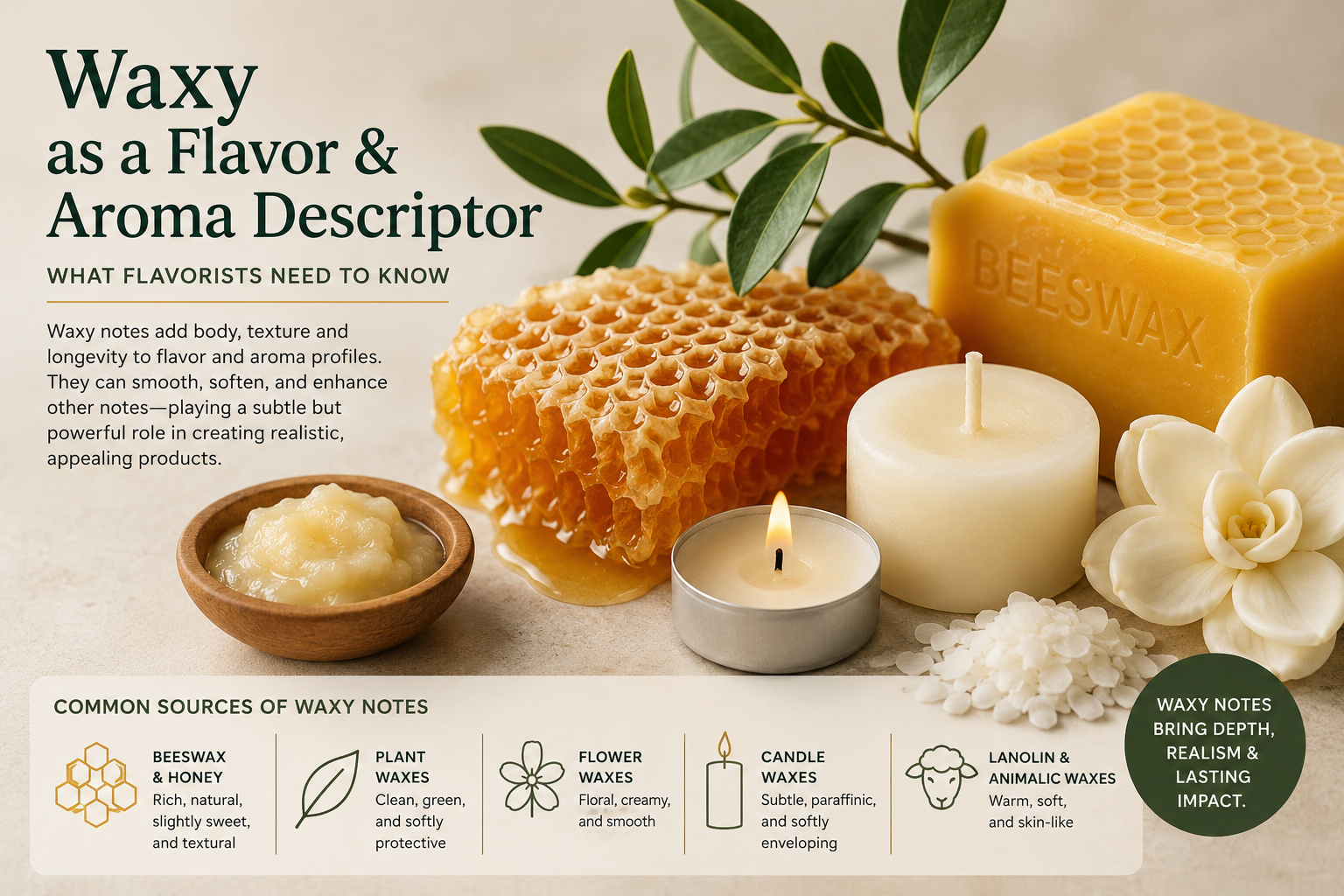
Waxy note is among several dozen flavor attributes that the Society of Flavor Chemists expects certified flavorists to understand and effectively manipulate during flavor formulation. Candidates may also encounter questions related to flavor materials that influence waxy note during the qualification examination or interview.
"waxy" is one of the more nuanced descriptors flavorists use, because it overlaps with fatty, soapy, tallowy, and creamy notes but has its own distinct character (think the smell of a new candle, or the skin of an unwashed apple). Here is a reference document organized by chemical class, since that's how flavorists actually navigate this category in practice.
A quick note: published odor/taste thresholds vary significantly by source (Fenaroli's, Leffingwell & Associates, TGSC, van Gemert's compilation, Devos et al.), by matrix (water vs. oil vs. air), and by panel methodology. Presented here are the typical literature ranges flavorists use as working numbers, but for regulatory or formulation-critical work these should be cross-checked against a primary threshold compilation for the specific matrix you're working in.
The most important working distinction for flavorist trainees: the aldehydes (C9–C14) give the sharpest, most "literal" waxy-soapy character but at razor-thin dosing margins, while the lactones are the practical day-to-day tool since they fold waxy character into fruity/creamy bases without reading as an isolated note. Esters, acids, and fatty alcohols mostly contribute body and aftertaste rather than driving the top note.
This reference document is intended for educational and training purposes only. To foster professional growth, trainees are encouraged to independently develop and expand their own knowledge base throughout their careers.
1. Defining the Descriptor
"Waxy" sits in the fatty/aldehydic region of most flavor and fragrance wheels, adjacent to but distinct from "soapy," "tallowy," "fatty," and "creamy." Sensorially, it describes:
- The smell of paraffin or beeswax candles
- The skin/bloom on unwashed fruit (apples, plums)
- A smooth, slightly oily mouthfeel-adjacent aroma with low volatility "drag"
- Often carries a faint citrus-peel or soapy undertone depending on chain length
Chemically, "waxy" character is overwhelmingly associated with medium-to-long aliphatic carbon chains (C9–C16) — whether as aldehydes, lactones, esters, acids, or alcohols. As chain length increases within a class, the character typically shifts: shorter chains read more "green/fatty," mid-range chains read as classically "waxy," and longer chains drift toward "tallowy" or become nearly odorless (too low volatility to register).
2. Aliphatic Aldehydes (C9–C14) — The Classic "Waxy Aldehydes"
These are the backbone of the waxy-aldehydic family, heavily used in fragrance (where they're sometimes called the "C-series aldehydes") and, at much lower levels, in flavor reconstruction work (especially citrus).
| Compound | Chain | Character | Typical Use | Odor Threshold (approx., water) |
|---|---|---|---|---|
| Nonanal (C9) | C9 | Fatty, waxy, slightly rosy/citrus | Citrus reconstitution, rose bases | ~0.1–1 ppb |
| Decanal (C10) | C10 | Waxy, orange-peel, soapy | Citrus flavors (orange, mandarin), soap/fragrance | ~0.1–0.4 ppb |
| Undecanal (C11) | C11 | Waxy, metallic-citrus, aldehydic | Citrus top notes, fragrance | ~0.005–0.05 ppb |
| Dodecanal / Lauric aldehyde (C12) | C12 | Waxy, soapy, citrus-floral | Fragrance "aldehydic" accords; trace flavor use | ~0.05–0.2 ppb |
| Tridecanal (C13) | C13 | Waxy, fatty, less citrus | Niche fragrance use | Data sparse; low ppb |
| Tetradecanal (C14) | C14 | Waxy, fatty, faint floral | Mostly fragrance; very limited flavor use | Low ppb range |
Flavorist note: These aldehydes have extremely low thresholds, so they're dosed in the low ppb to sub-ppb range in finished flavors. Overdosing rapidly tips "waxy-citrus" into "soapy" or "metallic" — a very narrow window. They're typically introduced as 0.1–1% dilutions in a carrier (TEC, DPG) rather than weighed neat.
3. Lactones — γ- and δ-Lactones (Waxy-Creamy Family)
Lactones are arguably the single most important class for "waxy" character in flavor work specifically (as opposed to fragrance), because they bridge waxy with peach/apricot/coconut/dairy-creamy notes — extremely useful in fruit and dairy flavor construction.
| Compound | Character | Typical Applications | Odor/Taste Threshold (approx., water) |
|---|---|---|---|
| γ-Decalactone | Peach, waxy-creamy | Peach, apricot, fruit flavors broadly | ~10–100 ppb (odor); taste similar order |
| γ-Undecalactone ("Aldehyde C-14, peach") | Peach, waxy, fatty-fruity | Classic peach flavor component | ~1–10 ppb |
| γ-Dodecalactone | Peach/apricot, waxy-creamy, heavier | Dairy, peach, tropical fruit, butter flavors | ~1–7 ppb |
| δ-Decalactone | Creamy, coconut-milky, waxy | Dairy, coconut, butter flavors | ~5–15 ppb |
| δ-Dodecalactone | Peach-creamy, waxy, fuller-bodied | Dairy, peach, "fatty" mouthfeel signaling | ~1–5 ppb |
| Pentadecalactone (macrocyclic) | Musky-waxy, soft, animalic-clean | Mostly fragrance (musk); very limited flavor use | Low ppb |
Flavorist note: γ-lactones generally read sweeter/fruitier; δ-lactones read creamier/milkier with a more pronounced waxy-fatty drag. Both classes are foundational in dairy (butter, cream, cheese) and stone-fruit flavor compounding. They're also used to impart "fattiness" perception in reduced-fat dairy applications without adding actual fat.
4. Long-Chain Fatty Acid Esters (Wax Esters)
Esters of saturated fatty acids (lauric, myristic, palmitic) with short-chain alcohols produce a soft, waxy-fruity note often described as "candle-like" or "rind-like."
| Compound | Character | Applications | Threshold (approx.) |
|---|---|---|---|
| Methyl laurate | Waxy, soapy-fruity, faint coconut | Rum, tropical fruit, coconut accords | Low-to-mid ppm |
| Ethyl laurate | Waxy, fruity-fatty, brandy-like | Rum, brandy, fruit ester top notes | Mid ppm |
| Methyl myristate | Waxy, mild, slightly floral | Dairy/butter background notes | Mid-to-high ppm |
| Methyl palmitate | Waxy, very mild, fatty | Background "body" note in dairy/butter | High ppm (weak odor) |
Flavorist note: These esters are sensorially "quiet" compared to the aldehydes and lactones above — they don't usually carry a flavor on their own but round out the mouthfeel/body perception in dairy, rum, and tropical profiles. They function more as modifiers than top-note drivers.
5. Free Fatty Acids (Saturated, C12–C18)
These contribute waxy-soapy notes and are critical in cheese, dairy, and coconut flavor systems, where they occur naturally.
| Compound | Character | Applications | Taste/Odor Threshold (approx.) |
|---|---|---|---|
| Lauric acid (C12) | Waxy, soapy, coconut-adjacent | Coconut, cheese, dairy flavors | Tens of ppm (taste) |
| Myristic acid (C14) | Waxy, mild, fatty | Cheese, butter | Tens of ppm |
| Palmitic acid (C16) | Waxy, very mild, tallowy | Background dairy "fat" note | High ppm, weak |
| Stearic acid (C18) | Waxy, essentially odorless at use levels | Rarely flavor-active; more a processing aid | Very high threshold |
Flavorist note: Free fatty acids contribute as much to mouthfeel and aftertaste as to retronasal aroma. In cheese flavor work, the lauric/myristic ratio is often tuned alongside butyric and caproic acids to dial in "waxy-rind" vs. "sharp/pungent" character.
6. Long-Chain Fatty Alcohols
| Compound | Character | Applications | Threshold (approx.) |
|---|---|---|---|
| 1-Dodecanol (lauryl alcohol) | Waxy, fatty, faint floral | Mostly fragrance/soap bases; trace flavor use | Low-to-mid ppm |
| 1-Tetradecanol (myristyl alcohol) | Waxy, soft, very mild | Niche fragrance use | High threshold, weak |
These are used far more in fragrance/personal care than in flavor — included here for completeness, since flavorists working in dual flavor/fragrance houses encounter them.
7. Practical Compounding Notes
- Narrow margins: The waxy aldehydes (Section 2) have some of the lowest odor thresholds of any flavor-relevant class — sub-ppb dosing is common, and the difference between "pleasantly waxy-citrus" and "soapy/dishwater" can be a 2–3x concentration shift.
- Lactones as the workhorse: For most practical flavor work, γ- and δ-lactones (Section 3) are the primary waxy-character tool, since they integrate naturally into fruit and dairy bases rather than reading as an isolated "wax" note.
- Esters/acids as body, not top note: Sections 4–5 rarely carry a flavor alone; they're used to build mouthfeel, roundness, and lingering fatty character.
- Matrix dependence: Threshold values shift substantially between water, oil, and air matrices, and again in real food systems (fat content suppresses volatility and raises effective thresholds). Always re-verify thresholds in the actual application matrix during bench trials rather than relying solely on published water-based values.
8. Suggested Primary References for Verified Threshold Data
- Fenaroli's Handbook of Flavor Ingredients (Burdock, ed.)
- Leffingwell & Associates online odor threshold database
- TGSC (The Good Scents Company) database
- van Gemert, L. — Compilations of Odour Threshold Values in Air, Water and Other Media
- Devos, M. et al. — Standardized Human Olfactory Thresholds
(Thresholds in this document are presented as typical working ranges drawn from standard flavor/fragrance literature, intended for training and orientation purposes. For formulation or regulatory submission, confirm exact values against the primary sources above.)
###c